

Canned Alcoholic Beverages Market Analysis & Forecast: 2026 to 2033
Canned Alcoholic Beverages Market is estimated to be valued at USD 9.02 Bn in 2026 and is expected to reach USD 22.56 Bn in 2033, exhibiting a compound annual growth rate (CAGR) of 14.0% from 2026 to 2033.
Key Takeaways
- Based on Product, the Hard Seltzers segment is expected to lead the market with 80% share in 2026, driven by low-calorie appeal, variety, and convenient portability.
- Based on Distribution Channel, the Liquor Stores segment is expected to hold the largest share of the market in 2026, driven by widespread distribution, at-home consumption, and bulk purchase convenience.
- Based on Region, North America is set to lead the canned alcoholic beverages market in 2026, with 53% share. While, Asia Pacific is anticipated to be the fastest growing region.
Market Overview
The global canned alcoholic beverages market is projected to witness strong growth in the near future due to growing preference for convenient travel-friendly canned drinks. Moreover, manufacturers are focusing on creating new attractive flavors in RTD canned alcoholic beverages which is further expected to augment the market growth.
Current Events and Its Impacts on the Canned Alcoholic Beverages Market
Current Event | Description and its Impact |
Regulatory Changes in Key Markets |
|
Sustainability and Environmental Regulations |
|
Distribution & Consumer Behavior
Impulse Purchases
- Statistic: Over 70% of canned alcohol sales in convenience stores are impulse-driven.
- Why it matters: This highlights the critical role of packaging design, shelf placement, and branding. Bright colors, sleek cans, and limited-edition flavors often trigger spontaneous buys.
- Consumer psychology: Shoppers often associate canned alcohol with fun, casual occasions, making it a natural grab-and-go product.
- Implication for brands: Investing in eye-catching packaging and point-of-sale promotions can significantly boost sales.
E-commerce Growth
- Growth rate: Online alcohol sales are expanding at 15–20% annually, and canned formats are particularly well-suited for this channel.
- Logistics advantage: Cans are lighter, more durable, and cheaper to ship compared to glass bottles.
- Consumer trend: Younger demographics (Gen Z and Millennials) are more likely to purchase alcohol online, often seeking subscription boxes, curated cocktail packs, or seasonal canned releases.
- Implication for brands: Optimizing direct-to-consumer (DTC) platforms and partnering with delivery apps can unlock new revenue streams.
- Current Industry Events of 2026
- Market Size Estimation
- Regional Breakdown
- Competitive Landscape
- Customer Intelligence
- Segmental Analysis
- Pricing Analysis
- Key Market Drivers, Challenges & Future Trends
- Customized Insights Section
Segmental Insights
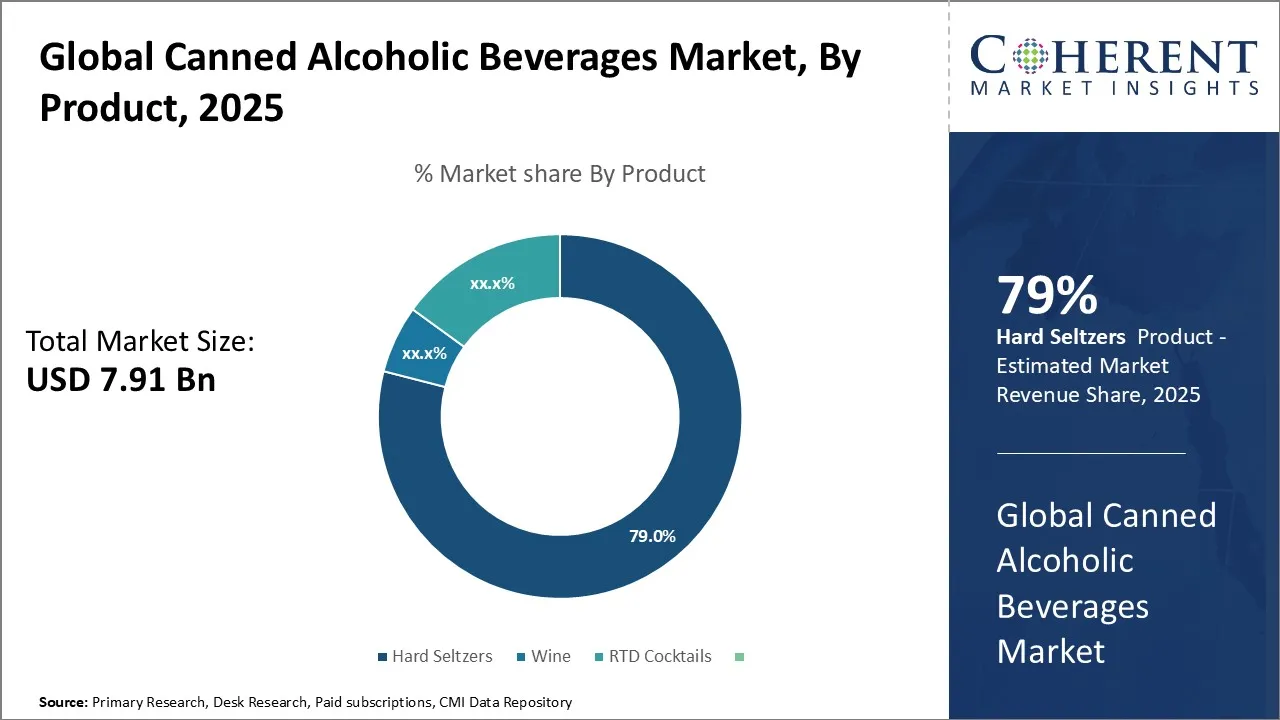
Global Canned Alcoholic Beverages Market Insights, By Product - Hard Seltzers Dominance Is Driven by Low-Calorie Appeal, Variety, And Convenient Portability
In terms of product, the hard seltzers segment is expected to lead the market with 80% share in 2026, fueled by their low in calories and sugar and appeal to health-conscious millennials and Gen Z. There are increasingly more options based on both malt and spirits, and premium spirit-based options are becoming more popular. They are better than canned wines and cocktails considering they are easy to carry, taste good, and are convenient.
For instance, in May 2026, Suntory released its -196 Vodka Seltzer across the U.S., making an enormous impact in the canned hard seltzer market. The lineup has Lemon, Grapefruit, Peach, and new Strawberry flavors, all made using the brand's Freeze Crush Infusion process. With only 3 grams of sugar per can, it is aimed at health-conscious millennials and Gen Z.
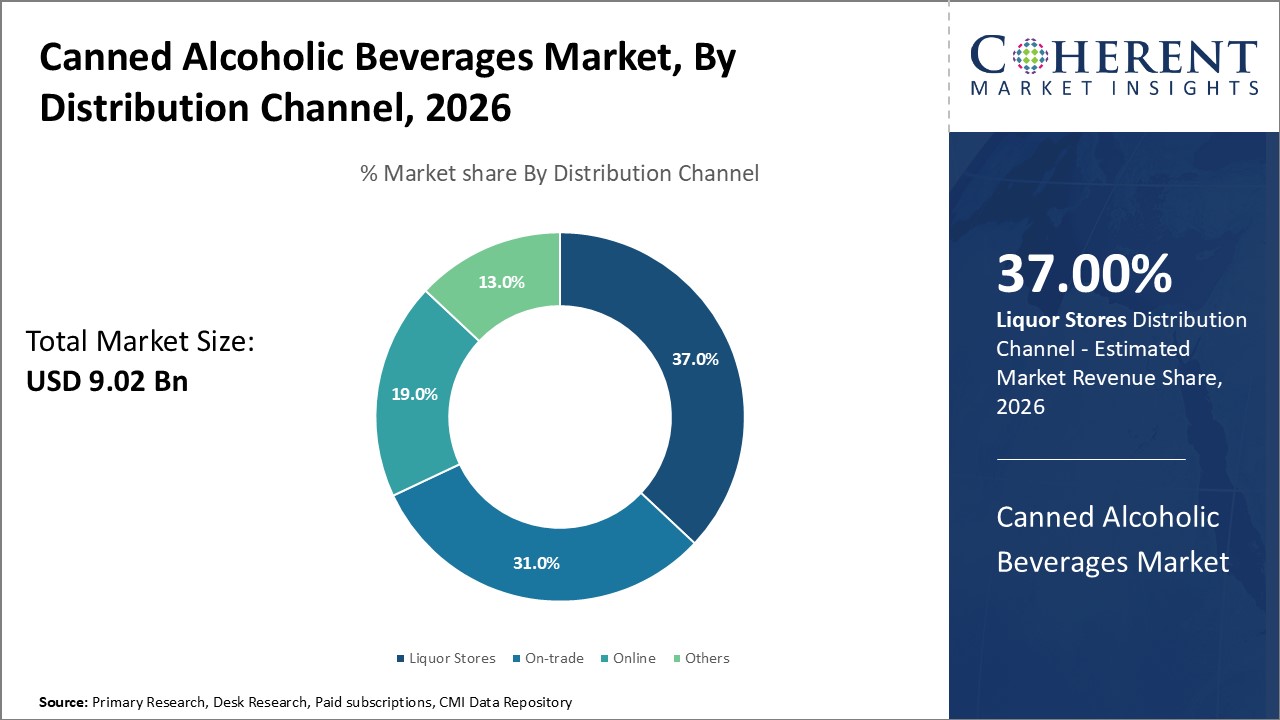
Global Canned Alcoholic Beverages Market Insights, By Distribution Channel - Liquor Stores Lead with Broad Reach and Easy Access to Canned Alcoholic Beverages
Based on distribution channel, the liquor stores segment is expected to dominate the global market over the forecast period and this is attributed to the fact that these stores have widespread and well-established distribution channel for canned alcoholic beverages. Off-trade channels are demanding as consumer prefer at-home consumption and bulk purchases. Liquor stores also provide with an easy access to a wide variety of canned alcoholic beverages.
For instance, in May 2026, Suntory Global Spirits released On The Rocks™ Premium Cocktails Sparkling Cans, which is the brand's first time in canned form. The 10% ABV cocktails come in packs of four and come in flavors like Lime Margarita, Mango & Mint Mojito, and Cucumber & Lemongrass Mule.
Regional Insights
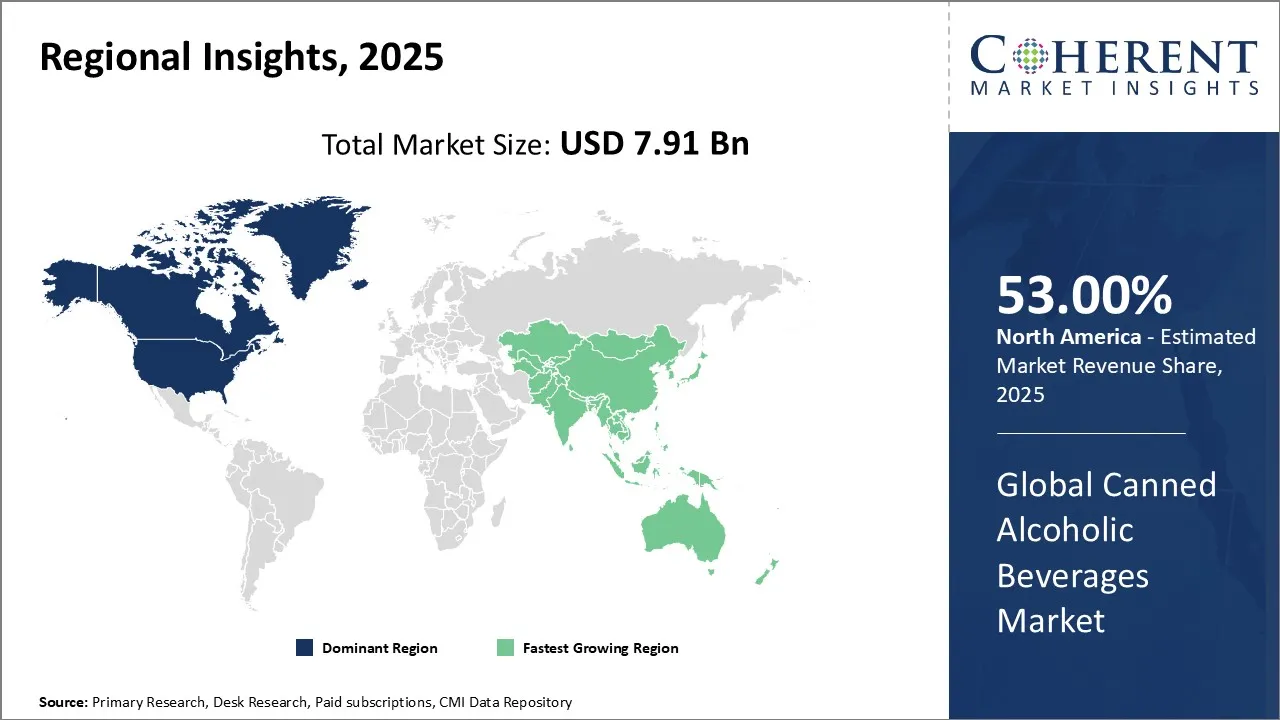
North America Canned Alcoholic Beverages Market Analysis & Trends
North America is expected to dominate the global canned alcoholic beverages market with 53% share in 2026, owing to the rise in expenditure on alcohol and the availability of canned drinks with attractive packaging styles. The market in the region is further fueled by the increased demand for RTDs such as hard seltzers, ready-to-drink cocktails, and long drinks.
For instance, in April 2026, Holla Spirits added a new line of RTD canned cocktails to its product line. This is an effective move for the company in the growing market for canned alcoholic drinks. The launch is meant to be easy to use and carry, and it meets the growing demand for ready-to-drink options. The brand will have a stronger presence in liquor stores and off-trade channels in 2026 due to new flavors and easy-to-open packaging.
Asia Pacific Canned Alcoholic Beverages Market Analysis & Trends
The Asia Pacific canned alcoholic beverages market is expanding at a fast pace, holding 18% share in 2026, owing to the growing population of millennials, improving living standards, and the emergence of several emerging economies. Furthermore, increased awareness about health and fitness among consumers, growing popularity of flavored alcohols and a surge in tourism in the region are further contributing to the growth of this market.
For instance, in November 2026, PepsiCo and its Indian bottling partner Varun Beverages plan to get into the ready-to-drink alcohol market in India. The move is PepsiCo's first step into the country's alcoholic beverage market, which is a new area for the company.
Canned Alcoholic Beverages Market Outlook Country-Wise
The U.S. Canned Alcoholic Beverages Market Trends
The market for canned alcoholic drinks in the U.S. is booming in 2026 as consumers want drinks that are easy to carry, portable, and have new flavors. As people's lives change, RTD cocktails, seltzers, and low-alcohol drinks are becoming more popular. Trends in drinking at home and the rise of premium products are driving growth even more, making canned formats the most popular choice.
For instance, in May 2026, the San Juan Beverage Company and Crown Holdings teamed up to make cans of Super Bowl champion Kam Chancellor's "Bammarita" cocktail. The RTD innovation aims at the U.S. market and combines celebrity branding with easy-to-open packaging. The move makes canned alcoholic drinks more appealing, which is in line with the growing demand for high-quality, portable cocktails in liquor stores and other places that don't sell alcohol.
Japan Canned Alcoholic Beverages Market Trends
Japan's canned alcoholic beverage market is doing well in 2026 since consumers want drinks that are easy to carry, cheap, and convenient. The growing popularity of RTD cocktails, low-alcohol beers, and high-end canned formats fits with how people live today. Events, parties, and get-togethers are what make the business grow, and new flavors and eco-friendly packaging make it more appealing.
For instance, in July 2026, Asahi Brewery released Super Dry Dry Crystal, a low-alcohol beer with an ABV of 3.5%. The product comes in 350ml and 500ml cans and fills the gap between Super Dry and non-alcoholic Dry Zero. It is aimed at the growing demand for lighter, easy-to-carry canned alcoholic drinks.
Market Report Scope
Canned Alcoholic Beverages Market Report Coverage
| Report Coverage | Details | ||
|---|---|---|---|
| Base Year: | 2025 | Market Size in 2026: | USD 9.02 Bn |
| Historical Data for: | 2020 To 2024 | Forecast Period: | 2026 To 2033 |
| Forecast Period 2026 to 2033 CAGR: | 14.0% | 2033 Value Projection: | USD 22.56 Bn |
| Geographies covered: |
| ||
| Segments covered: |
| ||
| Companies covered: | Diageo plc, Brown-Forman, Pernod Ricard, Bacardi Limited, Suntory Holdings Limited, Asahi Group Holdings, Ltd., Anheuser-Busch InBev, E. & J. Gallo Winery, Constellation Brands, Inc., Treasury Wine Estates, Barefoot Cellars, and Kona Brewing Co | ||
| Growth Drivers: |
| ||
| Restraints & Challenges: |
| ||
Global Canned Alcoholic Beverages Market Drivers
Growing demand for ready-to-drink products to foster market growth
The growing consumer preference for RTD alcoholic beverages, which offer convenience and a variety of flavors is driving growth of the market. Additionally, these drinks are convenient to store and carry around, making them suitable for busy lifestyles. Moreover, they are available at affordable prices, which make them accessible to a wider range of consumers. Furthermore, the growing number of bartenders who specialize in preparing a variety of cocktails with RTD alcoholic beverages is further propelling market growth.
Premiumization is another major driver factor
Premiumization of the beverages with improved taste, flavors, and creative packaging is expected to create demand for RTD cocktails, thereby fostering market growth. The key players are emphasizing aggressive advertisement and product launches to capture a high market share.
Global Canned Alcoholic Beverages Market Opportunities
Growing focus of key manufacturers to introduce alcoholic beverages in different flavors is expected to provide significant market growth opportunities over the forecast period.
Growing popularity of canned beverages due to advantages of convenience and affordability is expected to present lucrative market opportunities. The beverage cans are gaining popularity on the account of increasing demand for packaged drinks, especially among millennials. The popularity of canned drinks is also attributable to the fact that they are light-weight, unbreakable, stackable, and durable. Additionally, metal cans protect the beverage from light and excess oxygen and are easier to transport than glass bottles.
Global Canned Alcoholic Beverages Market Trends
Gluten-free alcoholic beverages is a recent trend
Gluten-free alcoholic beverages are reshaping consumer preferences, driving innovation in the canned alcoholic beverages market. Health-conscious buyers increasingly demand gluten-free options, boosting product diversity and premium offerings. This trend significantly influences the canned alcoholic beverages market size, as brands expand portfolios to capture niche segments and meet evolving lifestyle-driven consumption patterns.
Growing number of merger and acquisition
The growing number of mergers and acquisitions is reshaping the canned alcoholic beverages market, fostering consolidation and competitive strength. Leading players leverage strategic deals to expand distribution networks, diversify product portfolios, and enhance innovation. This dynamic directly influences the canned alcoholic beverages market share, driving growth and intensifying rivalry among global brands.
Analyst Opinion (Expert Opinion)
- The market for canned alcoholic beverages keeps growing swiftly as more and more consumers want easy-to-carry, high-quality drinks that are ready to drink. Multiple research companies' market assessments consistently put the category in a range of billions of dollars in revenue, and projections show that it will continue to grow strongly over the next ten years. The differences in reported size are due to the differences in scope, such as whether beer, hard seltzers, canned cocktails, and canned wine are counted together or separately.
- The most growth continues to occur in spirit-based canned cocktails and hard seltzers. Each of these is a large, independent subsegment with an increasing amount of demand each year. North America has the most mature consumer base, while Europe and Asia-Pacific are seeing faster premiumization and new products coming out quickly, especially in cities.
- Demand is still strong because of the shift toward flavored, lower-alcohol formats, single-serve packaging economics, and consumption based on convenience. Aluminum can suppliers have reported an increase in shipments of beverage packaging, which means that supply is tight and they remain investing in more capacity. However, changes in aluminum prices and tariffs that affect input costs are clear margin risks for producers with a lot of canned goods.
- Environmental performance also affects how well a company does in the market. For example, aluminum cans do well in the market since they are recycled more often than other types of cans. However, the fact that recycling rates vary by region shows that companies need to have sustainability strategies that work in each market.
- Overall, the category has strong fundamentals that are shaped by how customers act, the cost of packaging, and how the supply chain works.
Speak to the analyst
Want personalized insights?
Take the findings above to one of our principal consultants, or have the report rebuilt around the segments, geographies and competitors you actually track.
Global Canned Alcoholic Beverages Market: Key Developments
- In December 2025, Cointreau launched its "Canned Cocktail Twists" in the UK, which is the brand's first foray into the ready-to-drink (RTD) market. The slim 125ml cans are made at the company's distillery in Angers, France. They have recyclable packaging and an alcohol content of 12.5%. The launch takes advantage of the growing demand for high-quality, easy-to-make cocktails, which are set to be available at Waitrose supermarkets this holiday season.
- In August 2025, V-Rum rolled out a new line of canned cocktails, which puts them in the fast-growing RTD alcoholic drinks market. The release demonstrates how the brand is moving into convenient, portable formats while still keeping high quality. The canned cocktails help V-Rum's presence in the changing global drinks market by taking advantage of rising consumer demand.
- In June 2025, Maru-Hi has released its Sparkling Cocktail Variety Pack in the U.S., that adds to the market for ready-to-drink canned alcoholic drinks. The pack comes with refreshing cocktail flavors in easy-to-carry 250ml cans that look and feel high-end.
Market Segmentation
- Global Canned Alcoholic Beverages Market, By Product (Revenue, USD Bn, 2021 - 2033)
- Wine
- Still
- Fortified
- Low-alcohol
- Sparkling
- RTD Cocktails
- Malt based
- Spirit based
- Wine based
- Hard Seltzers
- Malt based
- Spirit based
- Wine based
- Sugar based
- Wine
- Global Canned Alcoholic Beverages Market, By Distribution Channel (Revenue, USD Bn, 2021 - 2033)
- On-trade
- Liquor Stores
- Online
- Others
- Global Canned Alcoholic Beverages Market, By Region (Revenue, USD Bn, 2021 - 2033)
- North America
- U.S.
- Canada
- Latin America
- Brazil
- Argentina
- Mexico
- Rest of Latin America
- Europe
- Germany
- U.K.
- Spain
- France
- Italy
- Russia
- Rest of Europe
- Asia Pacific
- China
- India
- Japan
- Australia
- South Korea
- ASEAN
- Rest of Asia Pacific
- Middle East & Africa
- GCC Countries
- Israel
- Rest of Middle East & Africa
- North America
- Global Canned Alcoholic Beverages Market: Key Companies Insights
- Diageo plc
- Brown-Forman
- Pernod Ricard
- Bacardi Limited
- Suntory Holdings Limited
- Asahi Group Holdings, Ltd.
- Anheuser-Busch InBev
- & J. Gallo Winery
- Constellation Brands, Inc.
- Treasury Wine Estates
- Barefoot Cellars
- Kona Brewing Co.
Sources
Primary Research Interviews
- Canned Alcoholic Beverage Manufacturers
- Alcoholic Ready-to-Drink (RTD) Product Developers
- Beverage Packaging & Can Technology Suppliers
- Alcohol Distributors & Importers
- Retail Category Managers (Hypermarkets, Convenience Stores)
- Beverage Formulation Scientists & Flavor Experts
- Others
Databases
- Bloomberg Terminal
- Others
Magazines
- Beverage Industry Magazine
- The Spirits Business
- Beverage Daily
- Food & Beverage Magazine
- Packaging World
- Others
Journals
- Journal of Food Science
- Beverages (MDPI)
- Journal of Agricultural and Food Chemistry
- Food Quality and Preference Journal
- Others
Newspapers
- Financial Times
- The Wall Street Journal
- Reuters
- Bloomberg News
- The Economic Times
- Others
Associations
- Distilled Spirits Council of the United States (DISCUS)
- Brewers Association
- American Beverage Association
- International Alliance for Responsible Drinking (IARD)
- Can Manufacturers Institute
- Others
Public Domain Sources
- U.S. Alcohol and Tobacco Tax and Trade Bureau (TTB)
- U.S. Food and Drug Administration (FDA) – Beverage Regulations
- World Health Organization (WHO) – Alcohol Consumption Data
- Eurostat – Food & Beverage Statistics
- UN Comtrade – Trade Data
- Others
Proprietary Elements
- CMI Data Analytics Tool
- Proprietary CMI Existing Repository of Information for the Last 8 Years
*Definition: Canned alcoholic beverages are used in a variety of settings, including bars, restaurants, hotels, and supermarkets, as well as at social outings and parties. They can be sipped and enjoyed anywhere, even in hot temperatures. Canned drinks are also popular at beaches, beside the pool, while camping, and during sports activities.
Get access to 250+ pages report
Every segment, forecast, competitor profile and data table behind the analysis above — available for instant download.
- ESOMAR Member
- ISO 9001:2015 Certified
- D-U-N-S Registered
- GDPR & CCPA Compliant
Missing comfort of reading report in your local language? Find your preferred language:
Transform your Strategy with Exclusive Trending Reports
Frequently Asked Questions
The Canned Alcoholic Beverages Market is estimated to be valued at USD 9.02 Bn in 2026, and is expected to reach USD 22.56 Bn by 2033.
The CAGR of the Canned Alcoholic Beverages Market is projected to be 14.0% from 2026 to 2033.
Growing demand for ready-to-drink products and premiumization of the beverages are fuelling growth of the market.
The Hard Seltzers segment is the leading component segment in the market.
Increasing demand for non-alcoholic RTD beverages is the major factors restraining growth of the market.
Diageo plc, Brown-Forman, Pernod Ricard, Bacardi Limited, Suntory Holdings Limited, Asahi Group Holdings, Ltd., Anheuser-Busch InBev, E. & J. Gallo Winery, Constellation Brands, Inc., Treasury Wine Estates, Barefoot Cellars, and Kona Brewing Co.