

Fast Food Market Analysis & Forecast: 2026-2033
Fast Food Market is estimated to be valued at USD 855.17 Bn in 2026 and is expected to reach USD 1,187.35 Bn in 2033, exhibiting a compound annual growth rate (CAGR) of 4.8% from 2026 to 2033.
Key Takeaways
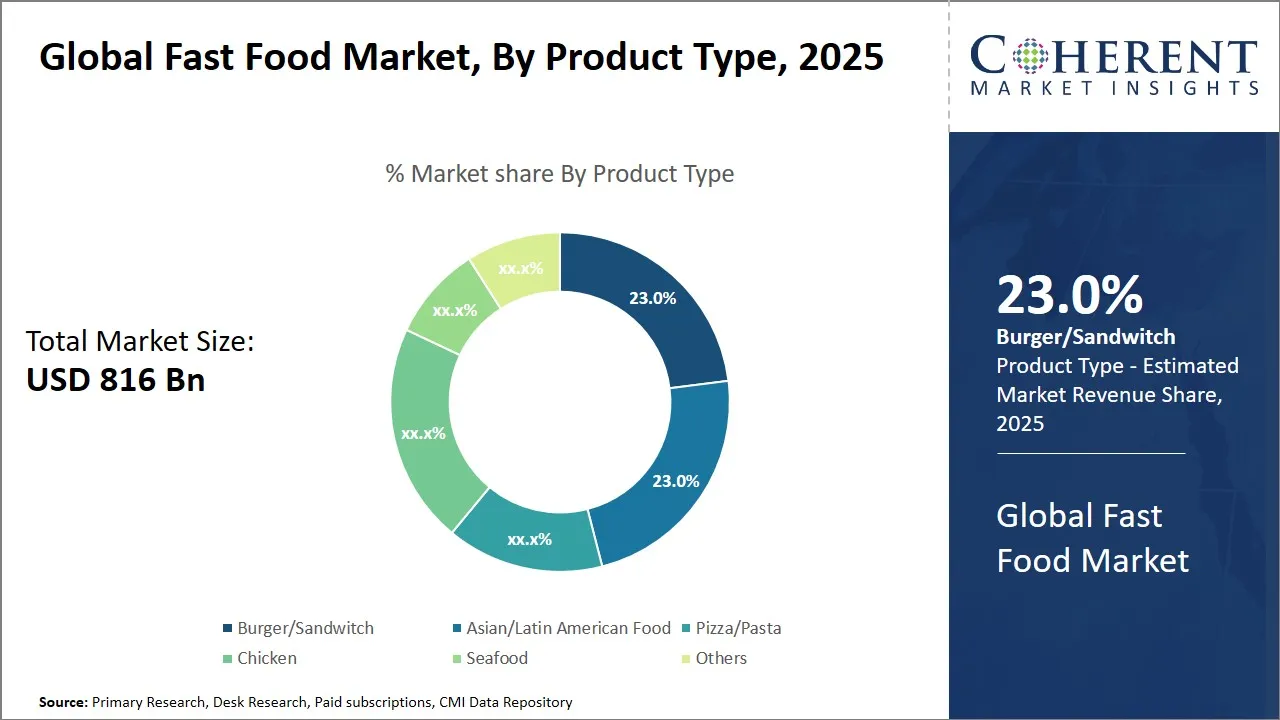
- Based on the Product Type, the Burgers/Sandwiches segment dominates the market due to the growing demand for ethnic and fusion sandwiches and burgers.
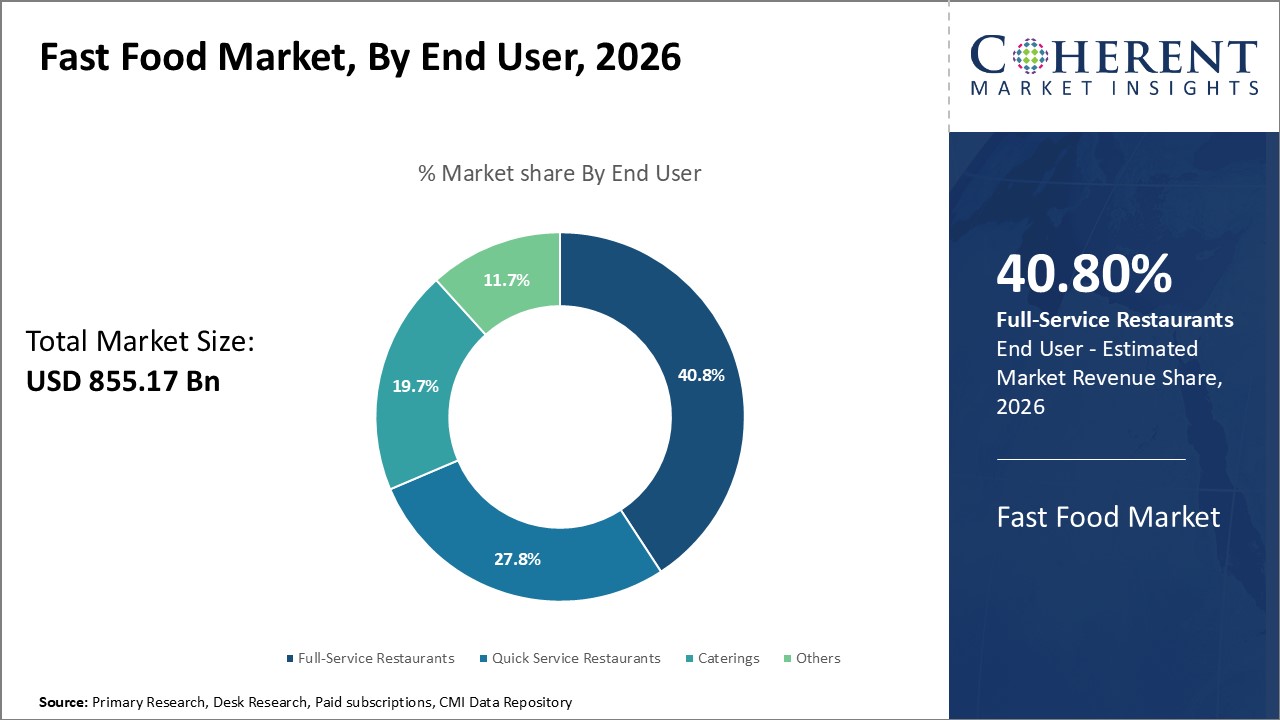
- Based on the End User, the Full-Service Restaurants segment dominates the market due to an increase in Disposable Income.
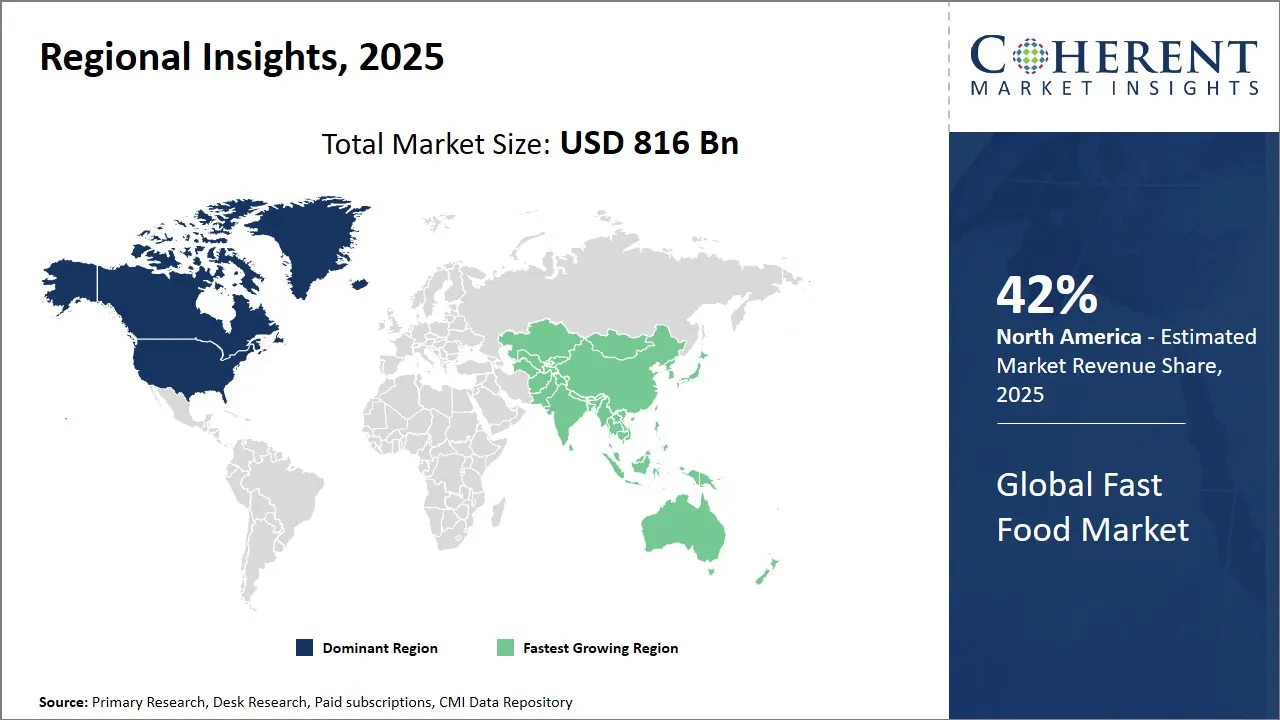
- On the basis of Region, North America acquires the largest share of 42% owing to the growing demand for fast food with healthy ingredients.
Market Overview
The Global fast-food market is experiencing steady growth, driven by evolving consumer preferences, technological advancements, and strategic investments by major players. There are many regional and local chains catering to specific taste and market globally
Current Events and Its Impact
Current Events | Description and its impact |
Technological Advancements and Digital Transformation |
|
Supply Chain Resilience and Post-Pandemic Adjustments |
|
Rising Integration of Automated Kitchens
The fast food market is witnessing a significant rise in the integration of automated kitchens, driven by the need for efficiency, consistency, and cost reduction. Automation technologies, such as robotic cooking systems, AI-powered order processing, and automated food preparation, are transforming traditional kitchen operations. These innovations help streamline workflows, minimize human error, and speed up service, catering to the growing demand for quick, high-quality meals. In April 2025, ABB Robotics and BurgerBots launched a groundbreaking automated kitchen concept for fast-food restaurants in Los Gatos, California. Utilizing ABB’s IRB 360 FlexPicker and YuMi collaborative robot, the system delivers precise and rapid meal assembly. This innovative technology also provides real-time stock monitoring, allowing staff to concentrate on enhancing the customer experience.
- Current Industry Events of 2026
- Market Size Estimation
- Regional Breakdown
- Competitive Landscape
- Customer Intelligence
- Segmental Analysis
- Pricing Analysis
- Key Market Drivers, Challenges & Future Trends
- Customized Insights Section
Role of AI (Artificial Intelligence) in Fast Food
AI is transforming the fast food market by enhancing efficiency, personalization, and customer experience. It enables automated order taking through voice recognition, reduces errors, and speeds up service. AI-driven data analytics help businesses predict demand, optimize inventory, and tailor menus to consumer preferences. In August 2024, Yum! Brands, Inc. announced the launch of voice AI technology at Taco Bell drive-thrus in the US, now live in over 100 locations across 13 states. This innovation aims to enhance order accuracy and streamline back-of-house operations.
Segmental Insights
Fast Food Market Insights, by Product Type
The Burgers/Sandwiches segment dominates the market due to Ethnic and Fusion Sandwiches and Burgers.
Based on product type, the market is segmented into Burgers/Sandwiches, Pizza/Pasta, Asian/Latin American food, Chicken, Seafood, and Others. Out of which, Burgers/Sandwiches is expected to dominate the global market over the forecast period and this is attributed to its increased popularity among consumers. Consumers increasingly seek bold, diverse flavors that blend traditional tastes with global influences, making ethnic sandwiches and fusion burgers especially appealing. These offerings combine familiar comfort food with innovative ingredients and cooking styles, catering to adventurous palates and multicultural demographics. For instance, in June 2025, McDonald’s introduced the “Big Arch Burger”. This premium offering features two beef patties, white cheddar cheese, crispy and fresh onions, shredded lettuce, pickles, and a new Big Arch sauce. This is further propelling the fast food market growth.
Fast Food Market Insights, by End User
Full-Service Restaurants segment dominates the market due to an increase in Disposable Income.
Based on end users, the market is segmented into Full-Service Restaurants, Quick Service Restaurants, Catering, and Others. Out of which, Full-Service Restaurants is expected to dominate the global market over the forecast period and this is attributed to the growing popularity of luxury hotel dining among the high disposable income population. The quick-service restaurants segment is also expected to witness significant growth in the near future. QSR are popular fast food restaurants, that offer limited menus, fast food cuisines, and minimal table service. For instance, establishments like Le Petit Chef combine 3D projected animations with meals, offering guests a story-driven experience that brings dishes to life, thereby creating memorable dining moments. This is further contributing to the fast food market share.
Regional Insights
North America Fast Food Market Trends
North America is expected to dominate the global fast-food market over the forecast period owing to the high consumption of fast food in the U.S. and Canada. Also, the growing demand for fast food with healthy ingredients is again expected to fuel regional market growth. For instance, the U.S. fast-food chain Wendy’s has opened 28 new U.S. restaurants across 18 states and 46 more internationally. The global expansion includes Canada. The brand credits its rapid growth to data-driven insights calling the moment “more exciting than ever”. This is further positively influencing the fast food market forecast
Asia Pacific Fast Food Market Trends
In the near future, the Asia Pacific region is anticipated to be the fastest-growing market for fast food. This is mainly due to the strategic expansion by major players in the region and the rising popularity of fast food among young adults. Additionally, the development of fast food delivery apps in the region is further bolstering market growth. For instance, the Asian fast-food chain Jollibee Group partnered with Singapore’s Food Collective to bring brands like the Tiong Bahru Bakery and The Common Man Coffee Roasters to the Philippines, showcasing cross-border collaborations.
United States Fast Food Market
The United fast-food market is experiencing a dynamic transformation, marked by culinary innovations, technological advancements, and strategic expansion. For instance, in October 2024, Perkins American Food Co. will launch Perkins Griddle & Go, a modern take on American hospitality that blends tradition with innovation. Created with The Aria Group, this compact concept offers a streamlined design and an enhanced café experience tailored for fast-paced customers. Hence, the U.S. fast food market is poised for continued growth, driven by technological innovations, menu diversification, and strategic pricing.
India Fast Food Market
India’s fast food market in 2026 is experiencing significant innovation, driven by evolving consumer preferences, technological advancements, and strategic expansion. These innovations and trends indicate a dynamic shift in India’s fast food market, focusing on speed, personalization, health, sustainability, and technological integration to meet the evolving needs of consumers. For instance, the Papa John’s plans to re-enter the Indian market in 2026, aiming to open their first new outlets and expand to 650 locations over the next decade. This is further positively influencing the fast food market forecast.
Market Report Scope
Fast Food Market Report Coverage
| Report Coverage | Details | ||
|---|---|---|---|
| Base Year: | 2025 | Market Size in 2026: | USD 855.17 Bn |
| Historical Data for: | 2020 To 2024 | Forecast Period: | 2026 To 2033 |
| Forecast Period 2026 to 2033 CAGR: | 4.8% | 2033 Value Projection: | USD 1,187.35 Bn |
| Geographies covered: |
| ||
| Segments covered: |
| ||
| Companies covered: | Auntie Anne's, INC, Cinnabon Franchisor SPV LLC, Domino’s Pizza, INC, Dunkin’ Brands Group, Inc, Hardee's Restaurants LLC, Firehouse Restaurant Group, Inc, Jack in The Box INC., McDonald’s, Restaurant, Brands International Inc, INC, and YUM! BRANDS, INC | ||
| Growth Drivers: |
| ||
| Restraints & Challenges: |
| ||
Global Fast Food Market Drivers
Increasing the number of fast-food restaurants to augment market growth
The rise in the number of fast-food restaurants is a key factor propelling fast-food market growth. As of 2023, there were 542,006 global fast food restaurant businesses, marking a 0.9% increase from 2022. This is further fast food market share.
Key players are introducing new products due to changing consumer taste and preferences
The fast-food market has witnessed substantial growth owing to the change in consumer tastes and preferences. For this key player are introducing new items to increase the variety of fast-food items sold. In May 2025, McDonald’s revamped its menu, introducing two new items and bringing back four fan favorites, including a beloved burger. This is further accelerating the fast food market share.
Global Fast Food Market Opportunities
The global fast-food industry has huge market potential due to the growing consumer demand for convenience food. Many key players in the fast-food market offer a wide range of products and are mostly franchised to minimize the overhead costs and increase flexibility. Some of the larger chains, such as McDonald's and Burger King, provide a consistent menu and quality experience worldwide to provide consumers with a familiar and reliable dining experience. Moreover, many companies are involved in innovation for healthier options, including the use of organic ingredients and natural vegetables.
In order to compete with the growing competition, the global fast-food market players are focusing on implementing innovative strategies and techniques. This is expected to bring bright market opportunities. This includes introducing new products and increasing customer service. Moreover, they are also focusing on minimizing the usage of artificial preservatives in their food products. For instance, some of the largest burger chains have already begun switching to buns made from organic flour and have started reducing their use of antibiotics to raise their livestock. These efforts are expected to offer additional market growth opportunities to the players.
Global Fast Food Market Trends
Emergence of new fast-food outlets
The emergence of new fast-food outlets is a key factor driving the market. These outlets offer a range of dishes such as burgers, pizzas, sandwiches, pasta, and more. They also offer different services, such as food deliveries and drive-through facilities. Additionally, many of these outlets are offering healthy foods that promote better health and aid in weight loss. In September 2024, Konala, a fast-growing healthy fast-food brand known for protein-rich bowls and salads, announced plans to expand to 1,000 locations in 10 years through franchising. Such innovations are accelerating the fast food market share.
Growing number of mergers and acquisitions in the market
Some of the key players are adopting mergers and acquisitions to promote their products in the global fast-food market. In March 2023, Rebel Foods, a Pune-based cloud kitchen operator, acquired master franchise rights to operate Wendy’s restaurants in the country.
Global Fast Food Market: Key Developments
In May 2025, KFC announced a £1.49 billion investment in the UK and Ireland to open 500 new outlets, upgrade 200 existing ones, and create 7,000 jobs, aiming to strengthen its market position.
In June 2025, Popeyes introduced Chicken Wrap priced at $3.99, to compete with Mcdonalds’s Snack Wraps. New blueberry-flavoured beverages were also launched.
In June 2025, Raising Cane’s unveiled its first location in West Michigan, with plans for 20 more in the state over the next decade, following a record expansion of 118 new locations in 2024.
In May 2025, Burger King announced a series of promotional offers scheduled for June, commencing with a complimentary Whopper for Royal Perks loyalty program members upon a minimum purchase of $3 on Sunday.
Analyst Opinion (Expert Opinion)
- With input inflation (beef up 7.4% YoY as of April 2025 per USDA) and labor costs reaching $17/hr in several U.S. metros, value menus are proliferating. McDonald’s CEO openly acknowledged that low-income consumers are “pulling back”, yet the brand still raised prices by over 10% in the last 18 months. Brands like Wendy’s are following suit–not because they want to, but because they must. The fast food model is built on scale + affordability is economically unsustainable without structural price shifts.
- Beyond Meat’s Q1 2025 revenue dropped 18% YoY, and major chains like Dunkin and McDonald’s have quietly retired test products like the Beyond Sausage sandwich or McPlant burger. Consumer trials have peaked, and repeat purchases have failed to justify the operational complexity of inventory costs. Fast food customers crave indulgence and speed, not moral signaling or limiting meats that underperform on taste and value.
- Taco Bell’s “Defy” prototype (4-lane digital drive-thru with vertical food lift) cut service times by nearly 30% – a blueprint for Chick-fil-A and Burger King are rushing to emulate. App-based ordering and proprietary data loops are creating a competitive advantage more durable than menu items. The future isn’t about who owns the fastest, most frictionless fulfillment funnel. If a brand can’t cut time-to-mouth under 3 minutes, it’s already lagging.
Speak to the analyst
Want personalized insights?
Take the findings above to one of our principal consultants, or have the report rebuilt around the segments, geographies and competitors you actually track.
Market Segmentation
- Global Fast Food Market, By Product type (Revenue, USD Bn, 2021 - 2033)
- Burgers/Sandwiches
- Pizza/Pasta
- Asian/Latin America food
- Chicken
- Seafood
- Others
- Global Fast Food Market, By End User (Revenue, USD Bn, 2021 - 2033)
- Full-Service Restaurants
- Quick Service Restaurants
- Caterings
- Others
- Global Fast Food Market, By Region (Revenue, USD Bn, 2021 - 2033)
- North America
- U.S.
- Canada
- Latin America
- Brazil
- Argentina
- Mexico
- Rest of Latin America
- Europe
- Germany
- U.K.
- Spain
- France
- Italy
- Russia
- Rest of Europe
- Asia Pacific
- China
- India
- Japan
- Australia
- South Korea
- ASEAN
- Rest of Asia Pacific
- Middle East
- GCC Countries
- Israel
- Rest of Middle East
- Africa
- South Africa
- North Africa
- Central Africa
- Lamea
- North America
- Company Profiles
- Auntie Anne's, INC
- Cinnabon Franchisor SPV LLC
- Domino’s Pizza, INC
- Dunkin’ Brands Group, Inc
- Hardee's Restaurants LLC
- Firehouse Restaurant Group, Inc
- Jack in The Box INC.
- McDonald’s, Restaurant
- Brands International Inc, INC
- YUM! BRANDS, INC
Sources
Primary Research
Interviews from the following stakeholders
Stakeholders
- Interviews with marketing managers, franchise development heads, operations managers, supply chain directors, procurement specialists, and food safety officers involved in fast food production, logistics, retail, and expansion.
- Specific stakeholders Fast food franchise owners, quick-service restaurant (QSR) operators, third-party delivery partners, food and beverage consultants, commercial kitchen equipment suppliers, packaging solution providers, and academic experts in food science and consumer behavior.
Databases
- Euromonitor International
- IBISWorld
- Mintel GNPD
Magazines
- QSR Magazine
- Nation’s Restaurant News
- Restaurant Business
- Foodservice Equipment & Supplies
- Food & Beverage Magazine
Journals
- Journal of Foodservice Business Research
- International Journal of Hospitality Management
- Journal of Consumer Behaviour
- Food Control
- British Food Journal
Newspapers
- The Wall Street Journal – Food & Beverage Section
- Financial Times – Consumer Goods
- The New York Times – Food Industry Reports
- Reuters – Retail and Consumer News
- The Economic Times – FMCG and Food Services
Associations
- National Restaurant Association (NRA)
- International Foodservice Manufacturers Association (IFMA)
- Food Marketing Institute (FMI)
- International Franchise Association (IFA)
- Institute of Food Technologists (IFT)
Public Domain Sources
- U.S. Department of Agriculture (USDA) – Economic Research Service
- U.S. Food and Drug Administration (FDA) – Food Safety Regulations
- Centers for Disease Control and Prevention (CDC) – Foodborne Illness Reports
- Eurostat – Food and Beverage Statistics
- World Health Organization (WHO) – Nutrition and Food Safety Data
Proprietary Elements
- CMI Data Analytics Tool, and proprietary CMI repository of fast food market intelligence and trend analyses developed over the past 8 years
*Definition: Fast food gives people a taste of new flavors that they may not be able to experience at home. Moreover, it can save a lot of time for busy families.
Get access to 250+ pages report
Every segment, forecast, competitor profile and data table behind the analysis above — available for instant download.
- ESOMAR Member
- ISO 9001:2015 Certified
- D-U-N-S Registered
- GDPR & CCPA Compliant
Missing comfort of reading report in your local language? Find your preferred language:
Transform your Strategy with Exclusive Trending Reports
Frequently Asked Questions
The Fast Food Market is estimated to be valued at USD 855.17 Bn in 2026, and is expected to reach USD 1,187.35 Bn by 2033.
The CAGR of the Fast Food Market is projected to be 4.8% from 2026 to 2033.
An increasing number of fast food restaurants and the growing disposable income of consumers are fuelling the growth of the market.
The Burgers/Sandwiches segment is the leading segment in the market on the basis of product type.
Ill effects of fast food on health are the major factors restraining the growth of the market.
Auntie Anne's, INC, Cinnabon Franchisor SPV LLC, Domino’s Pizza, INC, Dunkin’ Brands Group, Inc, Hardee's Restaurants LLC, Firehouse Restaurant Group, Inc, Jack in The Box INC., McDonald’s, Restaurant, Brands International Inc, INC, and YUM! BRANDS, INC