

Cloud Kitchen Market Analysis & Forecast: 2026-2033
Cloud Kitchen Market is estimated to be valued at USD 62.32 Bn in 2026 and is expected to reach USD 139.49 Bn in 2033, exhibiting a compound annual growth rate (CAGR) of 12.2% from 2026 to 2033.
Key Takeaways
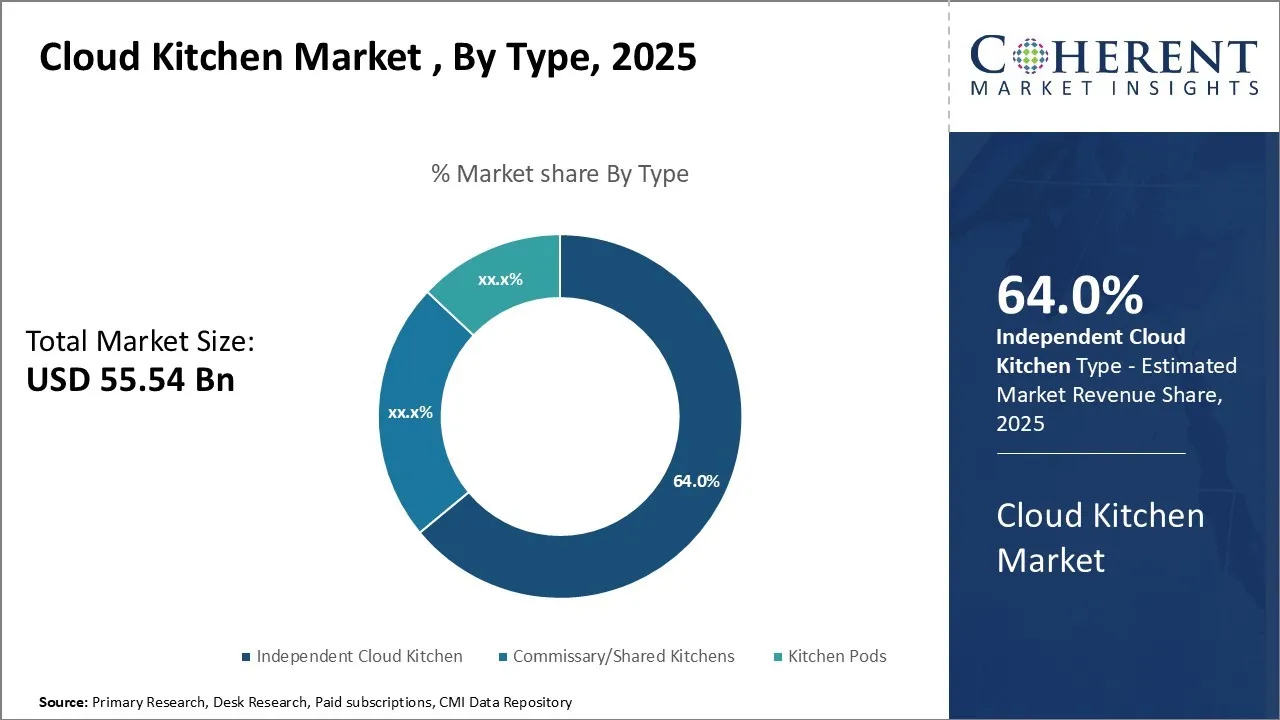
- By Type, The Independent Cloud Kitchen segment is projected to dominate the global cloud kitchen market with a 65% share in 2026.
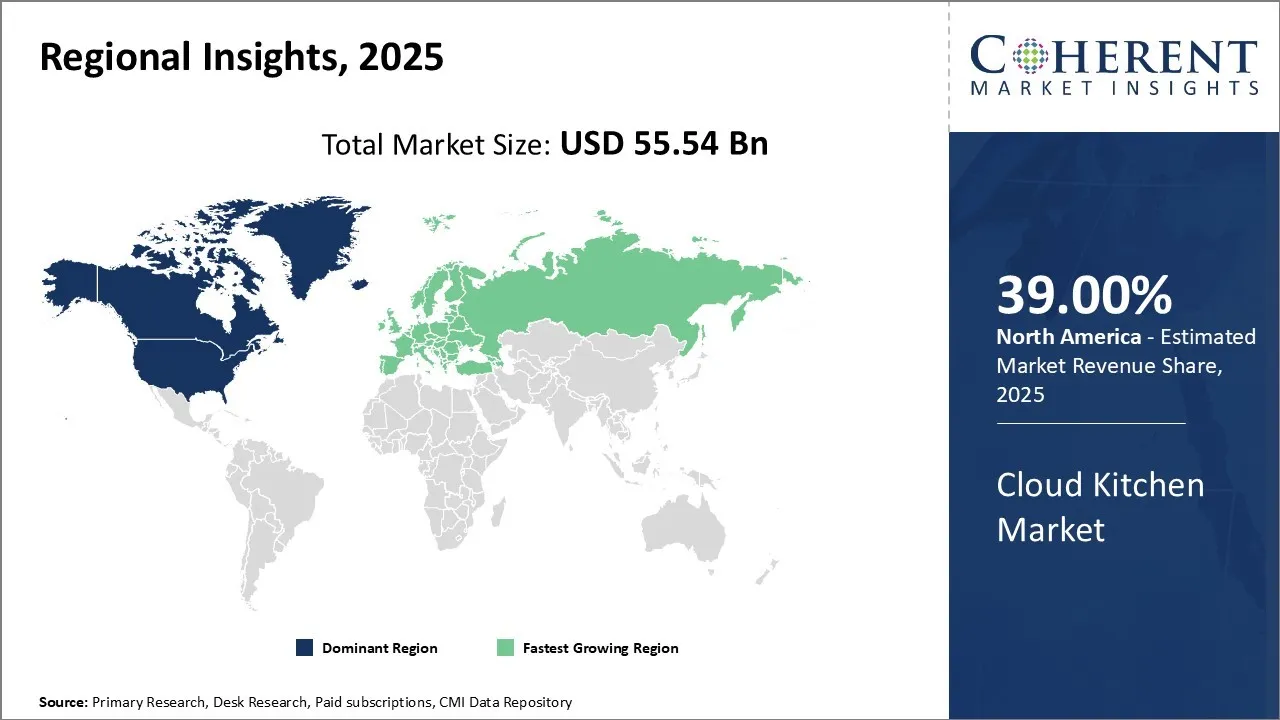
- North America is expected to retain a dominant position in the global cloud kitchen market, holding a 39% share.
- Asia Pacific accounts for 22%, benefiting from its large population, rapid urbanization, and increasing penetration of online food ordering.
- LAMEA (Latin America, Middle East, and Africa) holds a 6% share in the global cloud kitchen market in 2026.
Market Overview
The global Cloud Kitchen Market is witnessing robust growth, driven by rising demand for convenient food delivery and shifting consumer preferences. The market is expanding rapidly due to lower operational costs compared to traditional restaurants, technological advancements in kitchen management, and increased adoption of online food ordering platforms.
Current Events and Its Impact
Current Event | Description and its impact |
Technological Advancements in Kitchen Operations |
|
Shifting Consumer Preferences towards Convenience and Variety |
|
Evolving Regulatory Landscape and Compliance |
|
Pricing Analysis: Cloud Kitchen Market
The pricing dynamics in the global cloud kitchen market are influenced by a diverse set of factors, including operational efficiency, raw material costs, delivery commissions, technology investments, and market competition. In 2025, the market is experiencing a complex interplay of cost pressures and efficiency gains. While the model inherently offers lower overheads compared to traditional restaurants (e.g., no front-of-house staff, reduced rent for prime locations), other costs are significant.
Rising raw material costs and the increasing demand for quality packaging contribute to per-order expenses. A major factor impacting pricing is the high commission rates charged by third-party food aggregators (e.g., Swiggy, Zomato in India), which can range from 20-30% per order, directly impacting profitability. This pressure often forces cloud kitchens to adjust menu prices or absorb the costs, affecting their margins.
However, ongoing investments in automation and data analytics are gradually improving cost efficiency. AI-driven demand forecasting helps minimize food waste and optimize inventory, while kitchen automation can reduce labour costs. The ability to manage multiple virtual brands from a single kitchen also enhances profitability through shared resources. Despite competitive pricing to attract customers, the continuous drive for operational streamlining and direct-to-consumer (D2C) models aims to stabilize long-term pricing trends and improve overall margins.
- Current Industry Events of 2026
- Market Size Estimation
- Regional Breakdown
- Competitive Landscape
- Customer Intelligence
- Segmental Analysis
- Pricing Analysis
- Key Market Drivers, Challenges & Future Trends
- Customized Insights Section
Role of AI in the Cloud Kitchen Market
Artificial Intelligence (AI) is rapidly transforming the cloud kitchen market, driving efficiency and enhancing customer experience, especially in India. AI-powered demand forecasting analyses historical sales data, weather patterns, and local events to predict order volumes and popular dishes. This allows kitchens like Rebel Foods to optimize staffing, manage inventory precisely, and significantly reduce food waste by preventing overstocking or shortages.
Furthermore, AI is crucial for operational streamlining. It optimizes kitchen workflows, assigns orders to the most efficient stations, and minimizes errors. Computer vision models can monitor hygiene and food preparation for quality control, ensuring consistent product quality. AI-driven delivery optimization is also vital, with platforms like Swiggy and Zomato using AI for route planning, rider assignment, and real-time tracking, ensuring faster, fresher deliveries.
AI also enhances the customer journey through personalized recommendations based on past orders and preferences, driving repeat business. AI Chabot’s handle order placement and customer inquiries, improving service efficiency.
Government Regulation on the Cloud Kitchen Market
In India, the cloud kitchen market operates under specific government regulations primarily focused on food safety, hygiene, and business compliance. The Food Safety and Standards Authority of India (FSSAI) is the central regulatory body, mandating licenses for all food businesses, including cloud kitchens. The type of FSSAI license (Basic, State, or Central) depends on the kitchen's annual turnover, ensuring adherence to quality and safety standards.
Beyond FSSAI, cloud kitchens require additional permits like a Trade License from local municipal authorities, GST registration (mandatory if turnover exceeds ₹40 lakhs, or ₹20 lakhs for service providers), and a Shop and Establishment Act License in most states, depending on employee numbers. A Fire Safety Certificate is also crucial. These regulations ensure legal operation, consumer trust, and provide a framework for maintaining hygiene and ethical business practices. While compliance can involve initial administrative hurdles, it ultimately fosters a more credible and organized cloud kitchen ecosystem in India.
Organic and Vegan Options in the Cloud Kitchen Market
The demand for organic and vegan food options is significantly influencing the cloud kitchen market in India, driven by increasing health consciousness and ethical consumerism. Indian consumers, particularly millennial and Gen Z, are showing a growing preference for plant-based diets due to health benefits (reducing risks of heart disease, cancer), environmental concerns, and animal welfare. This is leading to a noticeable shift from traditional vegetarianism to veganism.
Cloud kitchens are uniquely positioned to cater to this rising demand. Their flexible, delivery-only model allows them to easily introduce specialized menus focused on organic and vegan offerings without the overhead of traditional restaurants. This has led to the emergence of dedicated cloud kitchen brands focusing solely on health-conscious consumers, offering diverse vegan, gluten-free, and organic meals.
Furthermore, cloud kitchens are enhancing transparency by providing detailed nutritional information, catering to the growing consumer demand for clean eating and traceable ingredients, making these niche segments a significant growth opportunity within the Indian market.
Cloud Kitchen Market Trends
- Growing demand for international cuisine to augment market growth
Increasing globalization and growing number of working populations are contributing to the demand for international cuisines. Moreover, the cloud kitchen market is also growing rapidly due to the surge in demand for high-quality food delivery services from hungry millennial who are willing to pay premium prices.
Furthermore, the technology is also evolving, with new services being offered to streamline the management of various deliveries through multiple platforms, and to optimize production workflows for faster delivery of food.
In January 2025, Salad Days, a cloud kitchen focused on healthy food, secured ₹30 crore in Series a funding co-led by V3 Ventures and Client Associates Alternate Fund (CAAF). This marks the company's first institutional funding round after operating as a bootstrapped venture for over 10 years, highlighting investor interest in niche, scalable segments.
- Increasing demand for online food delivery to propel market growth
Online food delivery allows customers to order prepared meals or ingredients from restaurants via apps and have them delivered to their homes. Food is usually delivered by third-party delivery services that integrate with restaurants’ own app or website. Online food delivery service market is playing very important role in the overall development of cloud kitchen market.
In April 2025, Indian cloud kitchen startup Rebel Foods (known for brands like Faasos and Behrouz Biryani) secured US$25 million from the Qatar Investment Authority. This funding round, valuing the company at US$1.4 billion, is intended to expand its physical restaurants and food courts, signaling a strategic shift towards an omnichannel approach.
Opportunities in the Cloud Kitchen Market
- Driving Growth through Investment, Technology, and Shifting Consumer Habits
Increasing investment by key players in the cloud kitchen market is expected to present lucrative market opportunities. For instance, In September 2022, A Manila-headquartered start-up - CloudEats, which operates cloud kitchens across the Philippines and Vietnam, has raised a $7 Billion Series A extension led by Nordstar to accelerate the digitization of food service in Southeast Asia.
The start-up plans to penetrate farther into Southeast Asian countries such as Thailand, Malaysia and Indonesia in 2023. Other factors that are expected to offer profitable market opportunities are rising consumer preference for online food ordering and fast-food delivery, growing disposable income of individuals, and changing lifestyles.
Additionally, the rising number of smartphone users is also propelling the growth of this market. Furthermore, the emergence of new technology and innovations in the field of kitchen automation and robotics is helping the cloud kitchen market to flourish.
Segmental Insights
Cloud Kitchen Market Insights, By Type
The independent cloud kitchen segment is projected to dominate the global cloud kitchen market, commanding a substantial 65% share. This strong position is fuelled by significant entrepreneurial activity and the appealing advantage of lower initial setup costs compared to traditional restaurants.
Independent operators benefit from greater flexibility in menu innovation and brand development, allowing for quick adaptation to consumer trends and fostering a dynamic market. This type represents the agility and low-barrier entry that attracts many new ventures.
The Commissary/shared kitchen segment holds a 23% share, reflecting a growing trend where multiple food brands operate from a single, optimized central kitchen. This model maximizes resource utilization and reduces overhead for individual businesses.
Meanwhile, Kitchen pods account for a smaller but significant 13% share, often utilized for specialized or pop-up concepts due to their compact and efficient design. This market distribution clearly indicates a sector driven by both agile independent ventures and collaborative, resource-efficient operational models, all prioritizing delivery efficiency.
Cloud Kitchen Market: Regional Insight
North America Cloud Kitchen Market Trends and Analysis
North America is expected to retain a dominant position in the global cloud kitchen market, holding a substantial 39% share. This regional leadership is driven by significant government initiatives to advance food technology, a strong existing food safety and tech adoption infrastructure, and a high concentration of sophisticated food delivery platforms like Uber Eats and DoorDash. The presence of a large base of tech-savvy consumers further accelerates market growth, making it a mature and highly competitive landscape for cloud kitchen operators.
Europe Cloud Kitchen Market Trends and Analysis
Europe follows with a substantial 33% share in the global cloud kitchen market. This growth is driven by rapidly evolving dining trends, with consumers increasingly embracing digital ordering and delivery. The region benefits from a robust food tech environment, featuring numerous innovative start-ups and established players in online food delivery.
Countries like the UK, Germany, and France are witnessing significant investments in cloud kitchen infrastructure and virtual brands, reflecting a strong shift towards delivery-centric dining experiences.
Cloud Kitchen Market Dominating Countries
United States and Canada
The United States is a dominant force in the North American cloud kitchen market, which accounts for a substantial 39% global share. Its leadership is driven by a highly developed food delivery ecosystem, with major platforms like Uber Eats, DoorDash, and CloudKitchens generating significant revenue. The US benefits from extensive investment in food tech start-ups and a large base of tech-savvy consumers who readily embrace online ordering and delivery.
Canada also plays a significant role in the North American cloud kitchen market. The country is witnessing strong growth driven by increasing demand for online meal delivery and a preference for international cuisines, particularly among its multicultural and younger immigrant population.
Canadian consumers are increasingly ordering food online, with approximately 49.4% doing so at least once a week post-pandemic. Strategic investments in food tech and a robust delivery infrastructure contribute to Canada's expanding cloud kitchen landscape.
Market Report Scope
Cloud Kitchen Market Report Coverage
| Report Coverage | Details | ||
|---|---|---|---|
| Base Year: | 2025 | Market Size in 2026: | USD 62.32 Bn |
| Historical Data for: | 2020 To 2024 | Forecast Period: | 2026 To 2033 |
| Forecast Period 2026 to 2033 CAGR: | 12.2% | 2033 Value Projection: | USD 139.49 Bn |
| Geographies covered: |
| ||
| Segments covered: |
| ||
| Companies covered: | Dahmakan, DoorDash, Ghost Kitchen Orlando, Keatz, Kitchen United, Kitopi Catering Services LLC, Rebel Foods, Starbucks Corporation, Swiggy, and Zuul | ||
| Growth Drivers: |
| ||
| Restraints & Challenges: |
| ||
Analyst Viewpoint – Cloud Kitchen Market
- Analysts generally hold a highly optimistic view of the global cloud kitchen market, especially in India, citing its robust growth trajectory and transformative potential for the food service industry. They emphasize that the market's momentum is driven by fundamental shifts in consumer behaviour towards convenience, online ordering, and diverse culinary experiences. The lower initial setup costs and operational flexibility compared to traditional dine-in restaurants are consistently highlighted as key attractions for entrepreneurs and existing F&B businesses.
- Experts point to technological advancements as a primary catalyst for efficiency and scalability. The increasing adoption of AI for demand forecasting, inventory management, and personalized customer recommendations is crucial for optimizing operations and profitability.
- Regionally, analysts identify Asia Pacific, particularly India and China, as the fastest-growing markets due to vast populations, rapid urbanization, and high smartphone penetration. North America remains dominant, driven by its mature food tech ecosystem and tech-savvy consumers. The future trajectory of the cloud kitchen market, according to analysts, will be defined by continuous innovation, strategic partnerships (including with delivery aggregators and potentially D2C models), and the ability to adapt to evolving regulatory landscapes while maintaining high standards of food safety and quality.
Speak to the analyst
Want personalized insights?
Take the findings above to one of our principal consultants, or have the report rebuilt around the segments, geographies and competitors you actually track.
Cloud Kitchen Market: Key Development
- In April 2025, the Delhi government has been actively engaging with stakeholders to formulate a comprehensive "cloud kitchen policy." Discussions include easing land and licensing regulations, exploring incentives, and potentially establishing cloud kitchen clusters with "plug-and-play" features in industrial areas.
- In December 2024, Rebel Foods, a prominent multi-brand cloud kitchen company in India (owner of brands like Faasos and Behrouz Biryani), secured a strategic investment from global investment firm KKR. This partnership aims to strengthen Rebel Foods' technological backbone, optimize operational efficiency, and support its ambitious expansion plans across India and the Middle East, further solidifying its market leadership.
- In April 2024, Indian food-tech platform Ghost Kitchens acquired The Shy Tiger, an Indian cloud kitchen company. This move is part of Ghost Kitchens' strategic initiative to enhance its market presence, particularly in the Gujarat region, and integrate more innovative food solutions into its growing portfolio, indicating a trend of consolidation and expansion through acquisition in the sector.
- In March 2024, Accel-backed cloud kitchen platform Curefoods (operating brands like EatFit and CakeZone) secured INR 200 crore (approximately $25 million) from Three State Ventures, a fund led by Flipkart co-founder Binny Bansal. This significant investment is intended to fuel Curefoods' aggressive expansion strategy, including further acquisitions and diversification of its brand portfolio across various Indian cities, highlighting continued investor confidence in the cloud kitchen model.
Market Segmentation
- Global Cloud Kitchen Market, By Type (Revenue, USD Bn, 2021 - 2033)
- Independent Cloud Kitchen
- Commissary/Shared Kitchen
- KitchenPods
- Global Cloud Kitchen Market, By Product Type (Revenue, USD Bn, 2021 - 2033)
- Burger/Sandwich
- Pizza/Pasta
- Chicken
- Seafood
- Mexican/Asian Food
- Others
- Global Cloud Kitchen Market, By Nature (Revenue, USD Bn, 2021 - 2033)
- Franchised
- Standalone
- Global Cloud Kitchen Market, By Region (Revenue, USD Bn, 2021 - 2033)
- North America
- U.S.
- Canada
- Latin America
- Brazil
- Argentina
- Mexico
- Rest of Latin America
- Europe
- Germany
- U.K.
- Spain
- France
- Italy
- Russia
- Rest of Europe
- Asia Pacific
- China
- India
- Japan
- Australia
- South Korea
- ASEAN
- Rest of Asia Pacific
- Middle East
- GCC Countries
- Israel
- Rest of Middle East
- Africa
- South Africa
- North Africa
- Central Africa
- North America
- Company profiles
- Dahmakan
- DoorDash
- Ghost Kitchen Orlando
- Keatz
- Kitchen United
- Kitopi Catering Services LLC
- Rebel Foods
- Starbucks Corporation
- Swiggy
- Zuul
Sources
The Stakeholders Consulted
- Cloud kitchen operators
- Food delivery platform executives
- Food technology providers
- Food ingredient suppliers and distributors
- Packaging material manufacturers for food delivery
- Real estate developers and landlords for commercial kitchen spaces
- Investment firms and venture capitalists active in food tech
- Food safety and hygiene consultants
- Restaurant industry associations and forums (e.g., NRAI)
- Consumer insights and behavior specialists
- Government bodies and policymakers related to food and business regulations
- End-users (individual consumers, corporate clients, event planners)
Databases Opened
- National Sample Survey Office (NSSO) – Household Consumer Expenditure Survey (India)
- Ministry of Food Processing Industries (MoFPI) – Food Processing Sector Data (India)
- Invest India – Food Processing & Manufacturing Sector Insights
- World Bank Open Data – Urbanization & Digital Adoption Metrics
- Euromonitor International – Consumer Foodservice Data
- Research and Markets – Cloud Kitchen Industry Reports
- ScienceDirect, SpringerLink – Hospitality and Food Service Journals
Magazines & Trade Publications
- Restaurant India Magazine
- FNB News
- FoodService India
- Outlook Money – Consumer Spending & Lifestyle
- ET Retail – Food & Beverage Section
Scientific and Industry Journals
- International Journal of Contemporary Hospitality Management
- Journal of Foodservice Business Research
- British Food Journal
- Journal of Global Business Insights
- International Journal of Gastronomy and Food Science
Newspapers & Media Outlets
- The Economic Times – Retail & Food Industry
- Business Standard – Food & Beverage Sector
- Livemint – Consumer & Startup Ecosystem
- The Times of India – Business News
- Reuters – India Business News
- Bloomberg – India Markets & Economy
Associations and Regulatory Bodies
- Food Safety and Standards Authority of India (FSSAI)
- National Restaurant Association of India (NRAI)
- Confederation of Indian Industry (CII) – Food Processing
- Ministry of Commerce & Industry (India)
- Local Municipal Corporations (for trade licenses, health permits)
Public Domain Sources
- NITI Aayog – Economic Survey and Industry Reports (India)
- Ministry of Statistics and Programme Implementation (MoSPI) – Consumer Data (India)
- Press Information Bureau (PIB) – Government Announcements (India)
- Reserve Bank of India (RBI) – Consumer Spending Data
- Academic research papers and theses available on university repositories
- Open-source data from global food delivery platforms (e.g., annual reports, investor presentations)
Proprietary Research Elements
- Proprietary Data Analytics Tool (for real-time market tracking and forecasting)
- Proprietary Repository of Market Data (covering the past 8 years of food service and delivery trends in India)
- Expert Interviews and Transcripts (focused on cloud kitchen operational challenges, growth strategies, technological integration, and future outlook)
Get access to 250+ pages report
Every segment, forecast, competitor profile and data table behind the analysis above — available for instant download.
- ESOMAR Member
- ISO 9001:2015 Certified
- D-U-N-S Registered
- GDPR & CCPA Compliant
Missing comfort of reading report in your local language? Find your preferred language:
Transform your Strategy with Exclusive Trending Reports
Frequently Asked Questions
The Cloud Kitchen Market size is estimated to be valued at USD 62.32 Bn in 2026, and is expected to reach USD 139.49 Bn by 2033.
The CAGR of the global Market is projected to be 12.2% from 2026 to 2033.
Growing demand for international cuisine and increasing demand for online food delivery are fuelling the growth of market.
The Independent Cloud Kitchen segment is the leading segment in the market.
Competition from dining and quick service restaurant (QSRs) is the major factors restraining growth of the market.
Dahmakan, DoorDash, Ghost Kitchen Orlando, Keatz, Kitchen United, Kitopi Catering Services LLC, Rebel Foods, Starbucks Corporation, Swiggy, and Zuul