

Global Coffee Pods and Capsules Market Size and Share Analysis – Growth Trends and Forecasts (2026-2033)
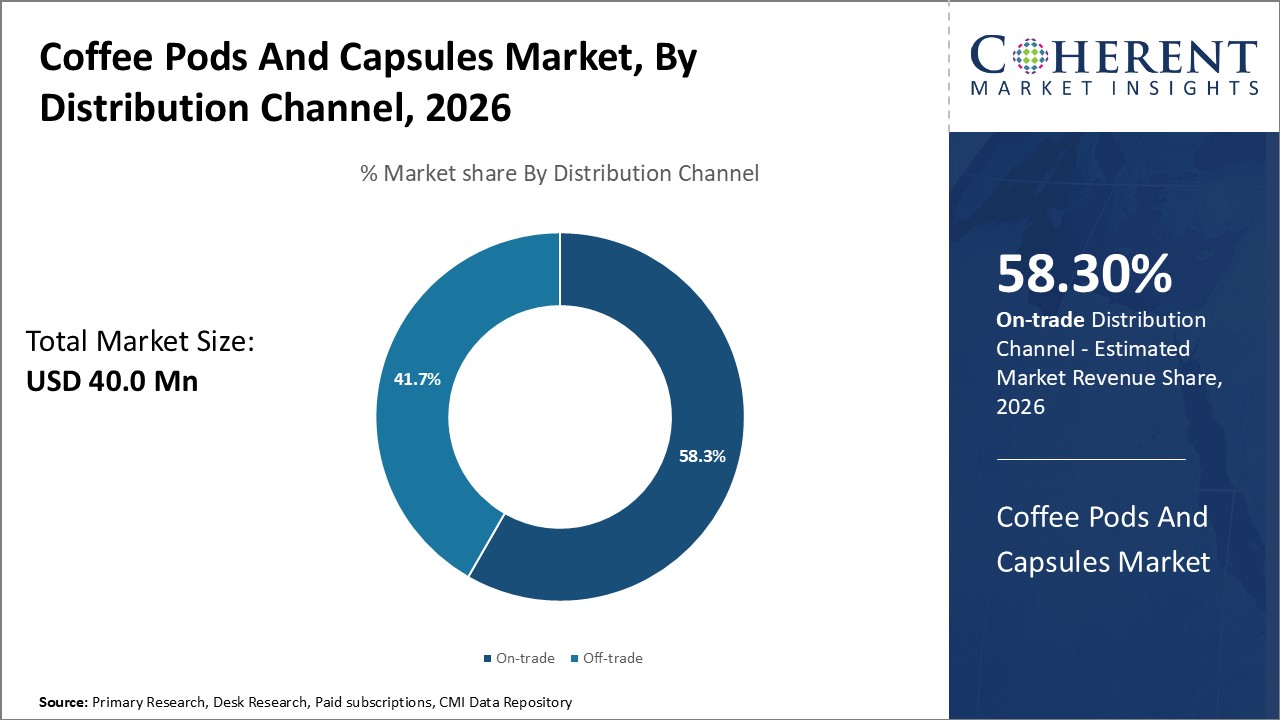
Coffee Pods And Capsules Market is estimated to be valued at USD 40.0 Mn in 2026 and is expected to reach USD 79.0 Mn in 2033, exhibiting a compound annual growth rate (CAGR) of 10.2% from 2026 to 2033.
Key Takeaways
- On the basis of Types, Capsules Segment led with a 60% market share in 2026. This is due to its convenience, precise dosing, and widespread consumer preference for easy-to-use formats.
- Europe is expected to hold around 39% market share during the forecast period. This is due to growing consumer preference for premium, diverse flavors and convenient single-serve options.
Market Overview
Coffee capsule and pod market has grown gradually in recent years because consumers are demanding more convenience, premium coffee at home, and altered lifestyles. One-serve systems have grown in popularity recently because they are easy to use, portion manage, and have limited cleanup. Market growth is also driven by e-commerce expansion, subscription models, and an increased variety of pod flavors and brewing technologies. Green, health-aware consumers are leading product innovation, pushing brands toward recyclable, compostable, and reusable capsule formats.
Current Events and Its Impact on Coffee capsule and pod Market
Current Events | Description and its impact |
Adoption of Sustainable Capsule Materials and Recycling Programs |
|
Smart Capsule Brewing and Flavor Customization Technologies |
|
Pricing Analysis
In 2025 coffee pods and capsules market has tiered pricing that reflects consumer expectations and product positioning. Economy pods, like private-label K-Cups, tend to range from $0.25–$0.60 per pod and are widely available in bulk retail packs at warehouse clubs. Mid-range pods, like Keurig-branded, range from $0.60–$0.70 per pod with consistent flavor and convenience.
The premium end is led by companies like Nespresso, which costs between $1.30–$1.35 per capsule (particularly VertuoLine sizes), and U.S. and Canadian average prices hover around $1.25.
Major price volatility is caused by rising green coffee prices and macroeconomic conditions. Arabica prices were driven up 70% by Brazil's 2024 drought, which reverberated through retail prices of pods and capsules both.
In turn, Nespresso (Nestlé) and Keurig Dr Pepper both signaled price increases early to mid‑2025, with Nespresso increases ranging from $0.03 to $0.18 per capsule, depending on line and format. Regional variation does occur: North America has ~34% value sales, premium pricing being preferred, while Europe prefers higher segments due to the café coffee culture. Rapid growth is occurring in the Asia-Pacific region, although the average price per pod remains lower due to affordability factors.
- Current Industry Events of 2026
- Market Size Estimation
- Regional Breakdown
- Competitive Landscape
- Customer Intelligence
- Segmental Analysis
- Pricing Analysis
- Key Market Drivers, Challenges & Future Trends
- Customized Insights Section
Global Coffee Pods and Capsules Market Drivers
- Increasing prevalence of single-serving coffee in households
The global market for coffee pods and capsules is experiencing a surge due to the increasing prevalence of single-serving coffee in households. Consumers are increasingly willing to invest in coffee machines in order to replicate the experience of a coffee shop at home, thus contributing to the overall growth of the market.
Major players are introducing pods that are compatible with existing machines, including Nespresso, which is once again driving market growth. In 2024, Lavazza released new pods compatible with Nespresso and Keurig machines, targeting convenience-seeking consumers who prefer at-home café-style coffee experiences.
- Increasing demand of organic food and beverages
The global consumption of organic food and beverages, particularly coffee and tea, is increasing at a rapid rate due to alterations in lifestyle habits. This will contribute to the growth of the market. Furthermore, increasing awareness of the benefits of healthy food, alterations in dietary habits, and a desire to sample novel products are further contributing to the growth of specialty and organic coffee pods and capsules.
Global Coffee Pods and Capsules Market Opportunity
- Rise in consumption of coffee pods and capsules in developing countries
The increasing consumption of coffee pods and capsules in developing countries is anticipated to offer lucrative growth prospects in the foreseeable future. For example, in recent years, the consumption of traditional drip coffee has been decreasing, while coffee pods and capsules for espresso automatic have been steadily increasing and have gained market share, particularly in China, a predominantly tea-consuming nation.
- Effective projection of recycling plastic capsules
The advent of recycling plastic capsules is projected to offer significant growth opportunities for market players over the forecast period. For instance, in 2021, Nespresso launched its first coffee capsules made using 80% recycled aluminum. These capsules were made from 95% recycled material earlier this year, in March.
Further, by the end of 2021, Nespresso targets having all machines sold in this new packaging, which, in turn, will boost market growth of pods and capsules. Nestlé Nespresso S.A., trading as Nespresso, is an operating unit of the Nestlé Group, based in Lausanne, Switzerland. Nespresso machines brew espresso and coffee from coffee capsules, a type of pre-apportioned single-use container, or reusable capsules, of ground coffee beans, sometimes with added flavorings, offering a convenient alternative to coffee pods and capsules versus ground coffee, which requires manual measuring and brewing.
Global Coffee Pods and Capsules Market Trends
- New product launches by key players are expected to be a key trend in the market
New product launches by key players are expected to be a key trend in the market. For instance, in April 2022, Bluestone Lane launched a range of Nespresso-compatible coffee pods amid rising customer demand for the at-home coffee format. Bluestone Lane is an Australian-inspired coffee shop, cafés & lifestyle brand committed to providing a genuine daily escape for all our locals a growing number of partnerships and agreements among key players will favor market growth.
For instance, in November 2021, Nestlé and Jacobs Douwe Egberts UK partnered to create first -of -its kind recycling program for coffee pods. Jacobs Douwe Egberts B.V. manufactures and distributes coffee. The Company offers retail products and professional solutions, such as coffee machines, ingredients, and professional services. Jacobs Douwe Egberts serves customers worldwide.
Segmental Insights
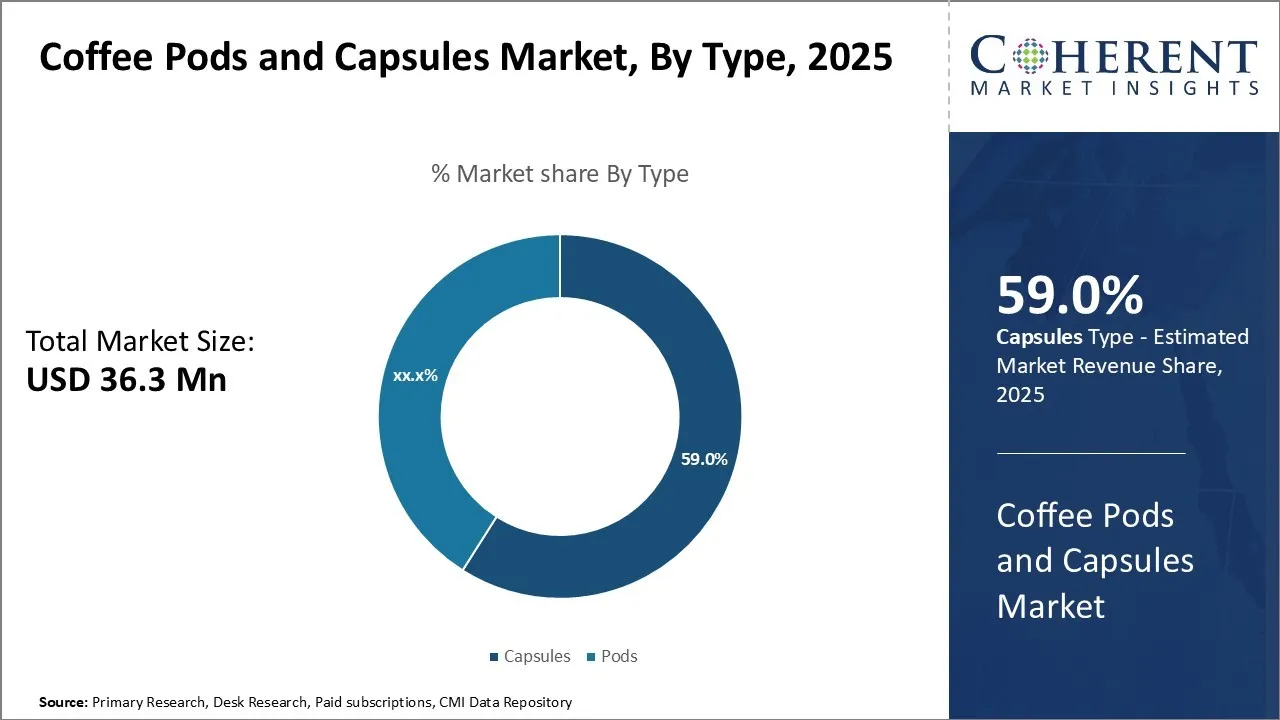
Coffee Pods and Capsules Market Insights, By Type
On the basis of types, in 2026, the capsules segment led with a 60% market share due to its convenience, precise dosing, and widespread consumer preference for easy-to-use formats. Capsules also offer better shelf stability and are ideal for supplements containing fluorspar-derived compounds. Their rapid absorption and minimal taste make them more appealing than pods. As a result, they outperformed pods in both value and adoption.
Regional Insights
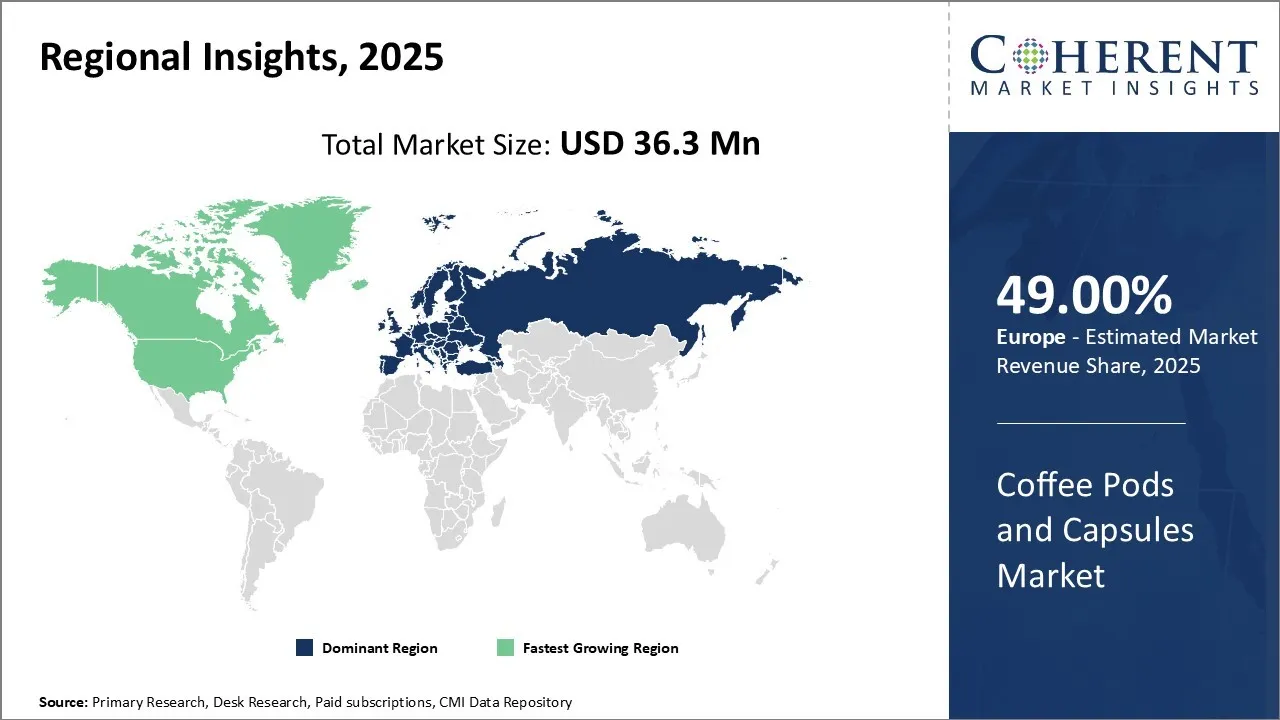
In recent years, the European market has seen a surge in demand for specialized coffee products and single-serving methods. Germany and France have been the most prominent regional players in this market. As the value of coffee pod and capsule products increases, a number of private-label companies are expanding their presence in other European markets.
Coffee Pods and Capsules Market Dominating Countries
United States Coffee Pods and Capsules Market Analysis and Trend
The U.S. is the largest market for coffee pods and capsules, driven by high demand for convenience and single-serve brewing machines. Brands Keurig and Nespresso are extensively penetrated with high acceptance in consumer and business settings. Disposable incomes and time pressures remain to drive demand, especially in the premium and specialty pod categories.
Germany Coffee Pods and Capsules Market Analysis and Trend
Germany is the continent's largest coffee capsule market, with a well-developed coffee culture and home-brewing trend fuelling demand. In this market, the trend is towards sustainability, and demand is on the rise for compostable and recyclable capsules. Pacesetters in serving both traditional and green palates are Nespresso, Tassimo, and domestic players such as Tchibo.
United Kingdom Coffee Pods and Capsules Market Analysis and Trend
The UK is an important user of coffee pods, with growing adoption of pod-based machines in urban domestic homes. Branded and private-label capsules are in rising demand, especially through online and subscription channels. The market also shows a very high level of interest in ethical sourcing and compostable packaging.
France Coffee Pods and Capsules Market Analysis and Trend
France has a developed capsule and pod market with a mix of high-end home use and café culture backing. Nespresso, the Swiss-French player, has significant influence. Single-origin and organic capsule products are trending towards being embraced by consumers in line with broader gourmet food movements.
Market Report Scope
Coffee Pods and Capsules Market Report Coverage
| Report Coverage | Details | ||
|---|---|---|---|
| Base Year: | 2025 | Market Size in 2026: | USD 40.0 Mn |
| Historical Data for: | 2020 To 2024 | Forecast Period: | 2026 To 2033 |
| Forecast Period 2026 to 2033 CAGR: | 10.2% | 2033 Value Projection: | USD 79.0 Mn |
| Geographies covered: |
| ||
| Segments covered: |
| ||
| Companies covered: | Nestlé SA, JAB Holding Company, The Kraft Heinz Company, Inspire Brands Inc. (DUNKIN’ BRANDS), Luigi Lavazza SpA, Starbucks Corporation, Gloria Jean's Coffees, and Strauss Group | ||
| Growth Drivers: |
| ||
| Restraints & Challenges: |
| ||
Global Coffee Pods and Capsules Market: Key Developments
- In 2025, Nespresso opened its first boutique in India at Select Citywalk Mall, New Delhi. This marks a significant milestone in Nespresso's global expansion following its initial entry into India in late 2024. The boutique offers coffee enthusiasts an immersive experience, showcasing Nespresso's range of high-quality coffees and state-of-the-art machines.
- In 2024, Keurig Green Mountain launched new K-Cup compatible pods with major coffee brands like Peet’s Coffee and Dunkin’, boosting sales by catering to growing home single-serve coffee consumption.
Analyst View
- The coffee capsules and pods market continue to show strong momentum, supported by changing consumer habits towards convenience and high-end coffee experiences. The expansion of single-serve coffee makers has radically reshaped home coffee drinking habits, as consumers increasingly appreciate the convenience and diversity provided by pod-based systems. Urbanized lifestyles and the increase in work-at-home culture have fueled adoption, as consumers want barista-made coffee without the hassle of conventional brewing techniques.
- Nonetheless, environmental sustainability issues present a major challenge, considering that the majority of pods have non-biodegradable content that adds to waste. This has seen companies spend heavily on recyclable and compostable options, albeit at increased costs of production. Further, the high-end pricing of pods over ground coffee presents affordability hurdles for budget-conscious consumers.
- Europe leads the market scenario now with a robust coffee culture as well as single-serve machine penetration, followed closely by North America due to established brand presence. The Asia-Pacific market stands out as the most rapidly developing one due to increasing disposable incomes, urbanization, and evolving coffee drinking patterns in China and India.
Market Segmentation
- Global Coffee Pods and Capsules Market, By Type (Revenue, USD Mn, 2021 - 2033)
- Pods
- Capsules
- Global Coffee Pods and Capsules Market, By Distribution Channel (Revenue, USD Mn, 2021 - 2033)
- On-trade
- Off-trade
- Global Coffee Pods and Capsules Market, By Geography (Revenue, USD Mn, 2021 - 2033)
- North America
- U.S.
- Canada
- Latin America
- Brazil
- Argentina
- Mexico
- Rest of Latin America
- Europe
- Germany
- U.K.
- Spain
- France
- Italy
- Russia
- Rest of Europe
- Asia Pacific
- China
- India
- Japan
- Australia
- South Korea
- ASEAN
- Rest of Asia Pacific
- Middle East
- GCC Countries
- Israel
- Rest of Middle East
- Africa
- South Africa
- North Africa
- Central Africa
- Key Players
- Nestle SA
- JAB Holding Company
- The Kraft Heinz Company
- Inspire Brands Inc. (DUNKIN’ BRANDS)
- Luigi Lavazza SpA
- Starbucks Corporation
- Gloria Jean's Coffees
- Strauss Group
Sources
Primary Research Interviews
- Coffee pod and capsule manufacturers
- Coffee retailers and distributors
- Coffee machine manufacturers
- Consumer survey respondents
- Others
Databases
- Euromonitor International
- IBISWorld
- Others
Magazines
- Coffee & Cocoa International
- Tea & Coffee Trade Journal
- Beverage Industry Magazine
- Food Processing Magazine
- Others
Journals
- Journal of Food Science and Technology
- Food Quality and Preference
- International Journal of Food Science
- Others
Newspapers
- Financial Times
- The Wall Street Journal
- Reuters
- Bloomberg
- Others
Associations
- Specialty Coffee Association (SCA)
- National Coffee Association (NCA)
- European Coffee Federation (ECF)
- International Coffee Organization (ICO)
- Others
Public Domain Sources
- U.S. Census Bureau
- European Commission Trade Statistics
- FDA Food Code Database
- World Trade Organization (WTO) Trade Statistics
- Others
Proprietary Elements
- CMI Data Analytics Tool
- Proprietary CMI Existing Repository of information for last 8 years
*Definition: Coffee pods contain seven grams of coffee, as opposed to only one or two grams in coffee capsules. Secondly, they are environmentally friendly. Coffee pods can be easily recycled and can even serve as natural fertilizer for plants. Additionally, coffee pods are cheaper than capsules. Unlike capsules, which contain a powdery material, coffee pods are reusable and work with any pod filter.
Get access to 250+ pages report
Every segment, forecast, competitor profile and data table behind the analysis above — available for instant download.
- ESOMAR Member
- ISO 9001:2015 Certified
- D-U-N-S Registered
- GDPR & CCPA Compliant
Missing comfort of reading report in your local language? Find your preferred language:
Transform your Strategy with Exclusive Trending Reports
Frequently Asked Questions
The Coffee Pods and Capsules Market size is estimated to be valued at USD 40.0 Mn in 2026, and is expected to reach USD 79.0 Mn by 2033.
The global coffee pods and capsules market is estimated to surpass USD 79.0 Mn by 2033, exhibiting a CAGR of 10.2% between 2026 and 2033.
Growing usage of single-serve coffee in households and increased demand for specialty and organic coffee pods and capsules are the main factors driving the global coffee pods and capsules market growth.
Belgium is the leading exporter of coffee capsules globally, owing to its strong coffee pod manufacturing industry.
The Nespresso Original Line format has the highest compatibility with a wide range of third-party coffee capsules.
The best pricing model for subscription pods is a tiered subscription offering discounts on bulk purchases combined with flexible delivery options.
The CAGR of the Coffee Pods and Capsules industry is projected to be 10.2% from 2026 to 2033.