

Tea Market Size and Trends
The global tea market is estimated to be valued at USD 24.26 Bn in 2026 and is expected to reach USD 37.70 Bn by 2033, exhibiting a compound annual growth rate (CAGR) of 6.5% from 2026 to 2033.
Key Takeaways
- Based on Tea Type, the Black Tea segment is set to dominate the tea market in 2026 with a 40.2% share, driven by its potent health benefits and rising global wellness trends.
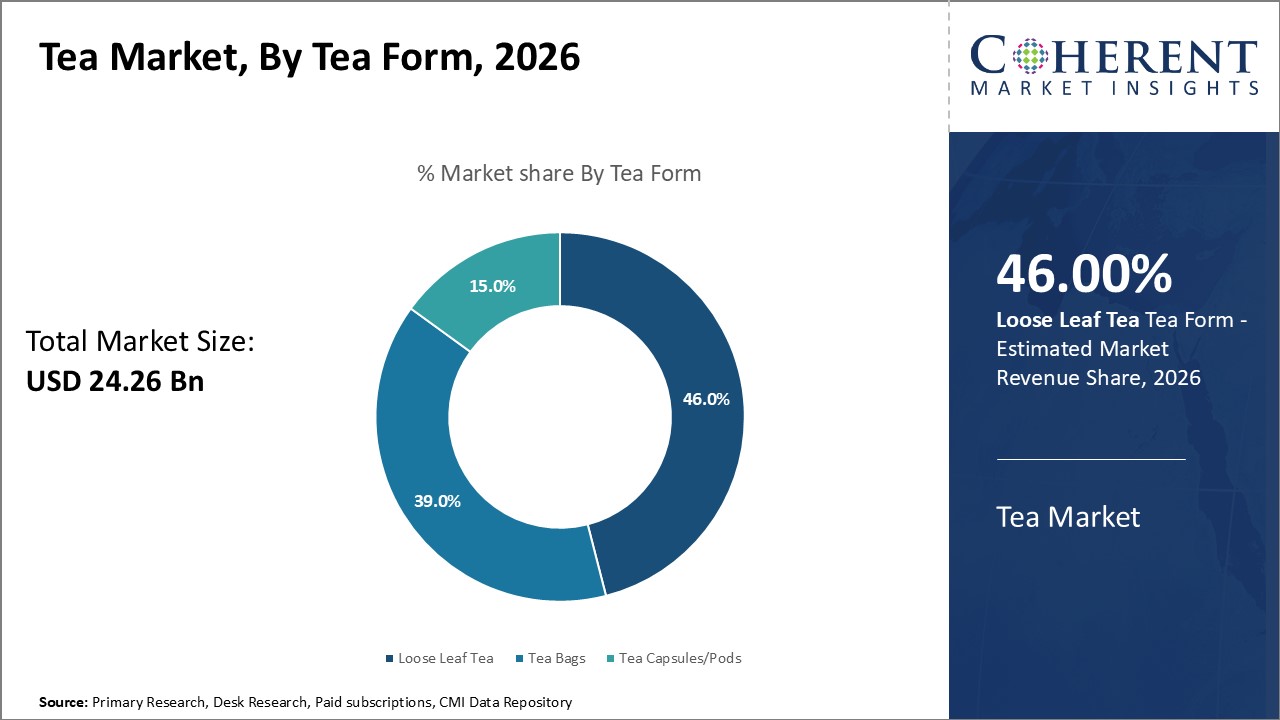
- Based on Tea Form, the Loose Leaf Tea segment is projected to lead the market with a 46% share in 2026, fueled by consumer demand for premium flavor, variety, and a richer brewing experience.
- Based on Distribution Channel, the Supermarkets and hypermarkets segment is set to lead in 2026 with a 50.1% share, driven by their global reach, bulk offerings, and powerful omni-channel strategies.
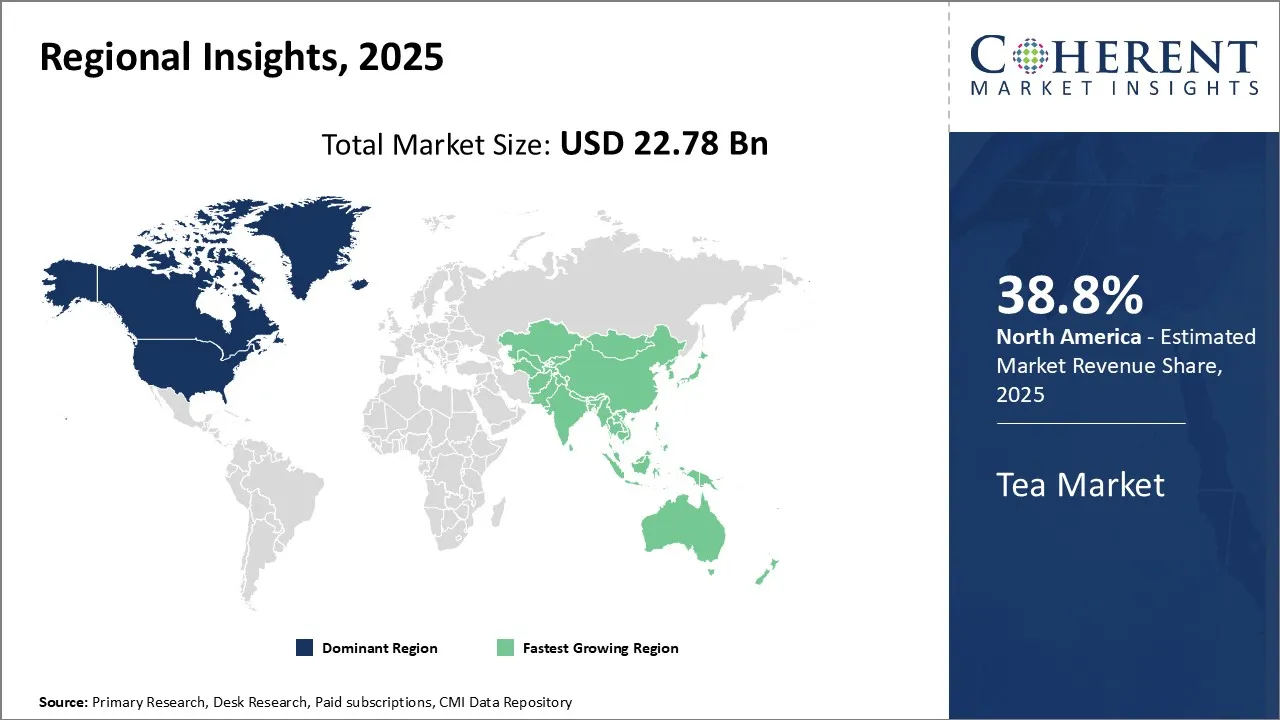
- Based on Region, North America is leading the tea market with 38.8% share in 2026. While, Asia Pacific is anticipated to be the fastest growing region.
Market Overview
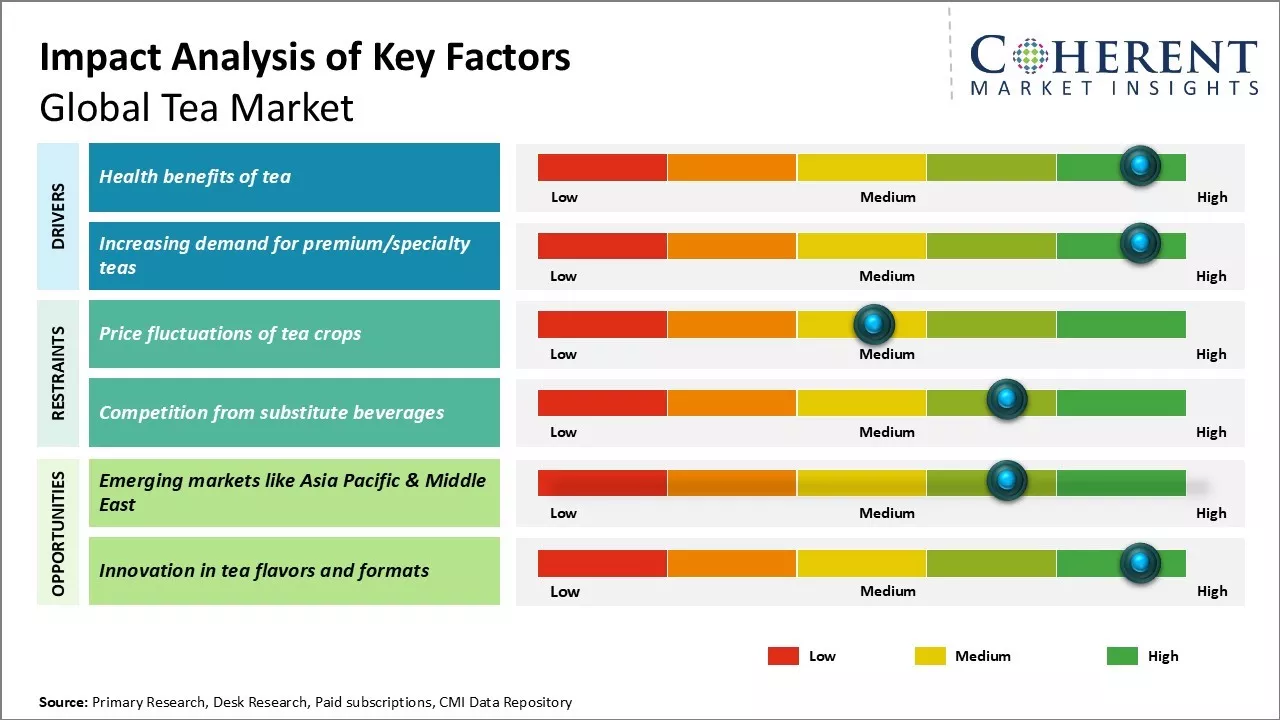
Rising awareness about the health benefits of tea consumption is driving the market growth. Some of the major health benefits of tea include improved heart health, bone strength, mental alertness, and weight management. Increasing disposable incomes in developing regions is also supporting the growing preference for specialty teas.
Current Events and their Impact Tea Market
Current Event | Description and its Impact |
Climate Change and Weather Disruptions |
|
Technological Innovations and Market Evolution |
|
Segmental Insights
- Current Industry Events of 2026
- Market Size Estimation
- Regional Breakdown
- Competitive Landscape
- Customer Intelligence
- Segmental Analysis
- Pricing Analysis
- Key Market Drivers, Challenges & Future Trends
- Customized Insights Section
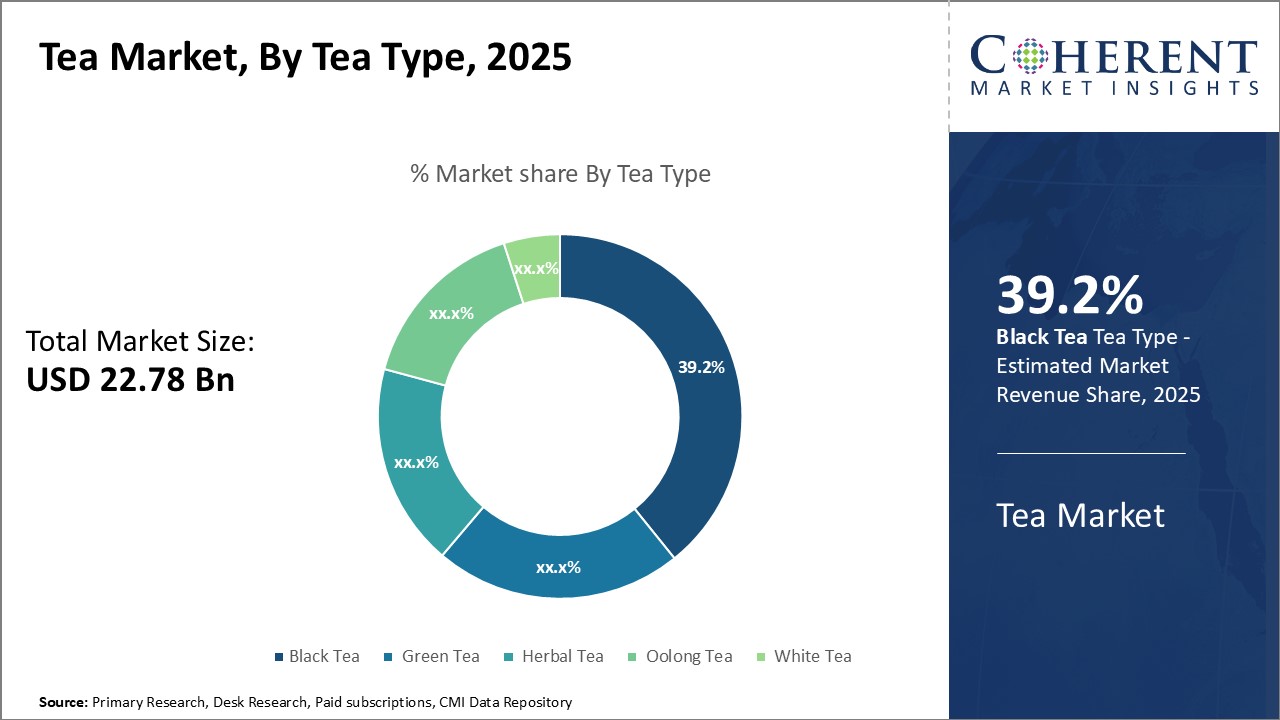
Tea Market Insights, By Tea Type: Black Tea Is Set to Dominate, Driven by Its Potent Health Benefits and Rising Global Wellness Trends
In terms of tea type, black tea is expected to contribute 40.2% share of the market in 2026, owing to its various health benefits attracting consumers globally. Black tea contains antioxidants called polyphenols that protects cells from damage and reduces the risk of chronic diseases. The high levels of flavonoids and other antioxidants in black tea are known to improve cardiovascular health by lowering blood pressure and cholesterol levels, thereby decreasing the risk of heart attacks and strokes. The presence of theaflavins and thearubigins in black tea also provides anti-inflammatory and anti-carcinogenic properties protecting against cancers.
Black tea is a rich source of vitamin C, vitamin K, manganese, and other nutrients. The growing health consciousness and disease preventive lifestyle among populations is increasing the consumption of black tea for its immunity boosting and longevity enhancing properties.
For instance, in October 2025, India's first decaffeinated black tea been launched by CSIR-NEIST, Jorhat, using indigenous technology. Developed from Assam-grown tea leaves, this innovation offers a caffeine-free alternative while preserving the flavor and health benefits of traditional black tea. The breakthrough is expected to boost Assam’s tea industry and cater to health-conscious consumers nationwide.
Tea Market Insights, By Tea Form: Loose Leaf Tea Lead Is Fueled by Consumer Demand for Premium Flavor, Variety, And A Richer Brewing Experience
In terms of tea form, the loose leaf tea segment is expected to contribute 46% share of the market in 2026, owing to consumer's growing preference for variety and superior experience. Loose leaf tea offers a diverse assortment of flavors, grades, regions and cultivars providing connoisseurs with numerous options to choose from according to individual taste and mood. The leaves maintain their essential oils allowing for distinctive aromatic infusion and rich flavor profile compared to other forms. Prizing loose leaves also provides a satisfying ritual and experience for tea drinkers as it allows controlling infusion time, water temperature and leaf quantity for a perfectly balanced cup.
For instance, in July 2025, Assam-based startup Woolah Tea secured a patent for India’s first bagless tea, revolutionizing the tea-drinking experience. The innovation uses compressed whole leaf bundles tied with natural string, eliminating the need for conventional tea bags. This eco-friendly product promotes purity and convenience, with plans to expand exports to the US, UK, UAE, Australia, and New Zealand.
Tea Market Insights, By Distribution Channel: Supermarkets and Hypermarkets Dominance is Driven by Their Global Reach, Bulk Offerings, And Powerful Omni-Channel Strategies
In terms of distribution channel, the supermarkets/hypermarkets segment is expected to contribute 50.1% share of the market in 2026, owing to their wide global reach and dominance as a one-stop shopping destination. Large retailers command an extensive supply chain network allowing comprehensive assortments of popular national and international tea brands under one roof. Their massive store sizes and inventory capacities also ensure optimum economies of scale in procurement. Furthermore, the proliferation of private label and store brand tea products developed by such retailers offers good quality options at competitive prices attracting price-sensitive buyers.
For instance, in June 2025, Indian Coffee House launched its own branded tea in collaboration with Kerala’s Priyadarshini Tea Estate. The new product marks the chain’s entry into the packaged tea market, with plans to retail through supermarkets and its outlets. This initiative aims to expand its brand presence and offer quality tea directly to consumers.
Regional Insights
North America Tea Market Analysis & Trends
North America holds the dominant position in the market, and it is expected to account for 38.8% of the market share in 2026, due to rising health consciousness, demand for functional beverages, and growing interest in herbal and specialty teas. Consumers are shifting from sugary drinks to natural alternatives, boosting sales of green, black, and ready-to-drink teas. Sustainability and premium quality also drive retail and out-of-home tea consumption.
For instance, in November 2026, Lipton expanded its product line to include tea concentrates and herbal blends, targeting the growing demand for functional and customizable beverages in North America. The move reflects shifting consumer preferences toward health-focused, convenient drink options. Lipton aims to appeal to younger, wellness-conscious consumers seeking variety and personalization in their tea choices.
Asia Pacific Tea Market Analysis & Trends
Asia Pacific region is experiencing the fastest growth, due to rising health awareness, urbanization, and disposable incomes. Consumers are increasingly choosing premium, functional teas like green and herbal blends. Convenience products and online retail growth also fuel demand. The region’s deep-rooted tea culture and innovation in packaging further strengthen its global dominance.
For instance, in October 2026, Tata Tea Agni launched “Extra Josh,” India’s first tea with added natural caffeine, targeting consumers seeking a stronger energy boost. The blend combines traditional tea with enhanced caffeine content sourced from natural ingredients. This innovation aims to energize the mass-market segment while reinforcing Tata Tea Agni’s bold and invigorating brand identity.
Tea Market Outlook Country-Wise
The U.S. Tea Market Trends
In 2026, the U.S. tea market is thriving due to rising health consciousness, demand for functional beverages, and interest in natural energy alternatives. Consumers are embracing herbal, green, and ready-to-drink teas for wellness benefits. Innovations in flavor, sustainability, and convenience, along with younger demographics seeking low-caffeine options are fueling steady growth across retail and foodservice channels.
For instance, in October 2026, Caraway Tea Company unveiled a groundbreaking infusion technology that merges tea with dietary supplements, offering enhanced wellness benefits. This innovation delivers functional ingredients like vitamins and adaptogens through everyday tea consumption. The launch marks a significant step in personalized health beverages, catering to consumers seeking convenience, nutrition, and holistic well-being in one cup.
China Tea Market Trends
China’s tea market is booming in 2026 due to rising health awareness, demand for premium products, and strong cultural ties to tea consumption. Government support for traditional industries and innovation in flavors and packaging attract younger consumers. Expanding online retail and domestic tourism further fuel growth, making China a global leader in tea demand.
For instance, in November 2026, iTeaworld launched the world’s first structured Yin Zhi scented tea collections, reviving a millennium-old Chinese tea craft. This innovative line blends traditional techniques with modern presentation, offering a refined sensory experience. The launch marks a milestone in premium tea innovation, celebrating heritage while appealing to global connoisseurs seeking authenticity and elegance.
Market Report Scope
Tea Market Report Coverage
| Report Coverage | Details | ||
|---|---|---|---|
| Base Year: | 2025 | Market Size in 2026: | USD 24.26 Bn |
| Historical Data for: | 2020 To 2024 | Forecast Period: | 2026 To 2033 |
| Forecast Period 2026 to 2033 CAGR: | 6.5% | 2033 Value Projection: | USD 37.70 Bn |
| Geographies covered: |
| ||
| Segments covered: |
| ||
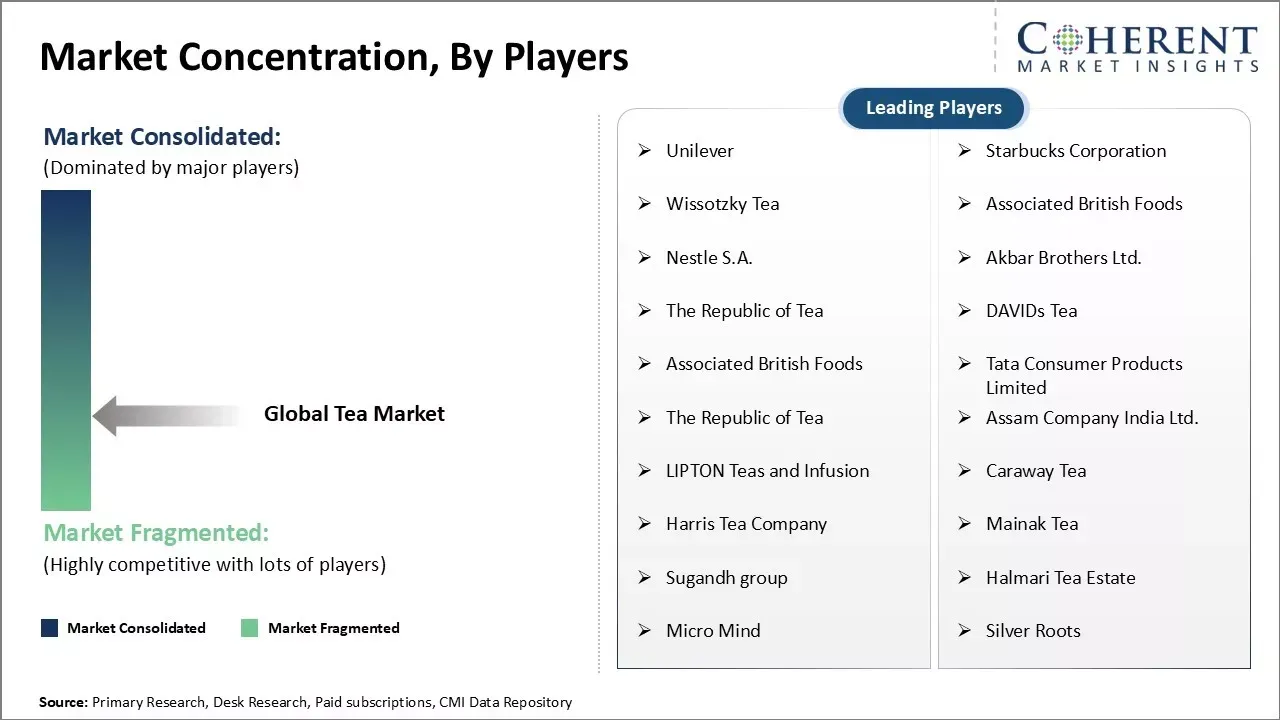
| Companies covered: | Unilever, Starbucks Corporation, Wissotzky Tea, Associated British Foods, Nestle S.A., Akbar Brothers Ltd., The Republic of Tea, DAVIDs Tea, Associated British Foods, Tata Consumer Products Limited, The Republic of Tea, Assam Company India Ltd., LIPTON Teas and Infusion, Caraway Tea, Harris Tea Company, Mainak Tea, Sugandh group, Halmari Tea Estate, Micro Mind, and Silver Roots | ||
| Growth Drivers: |
| ||
| Restraints & Challenges: |
| ||
Tea Market Driver
Health benefits of tea
Tea is widely regarded as one of the healthiest beverages globally, thanks to its rich antioxidant content and diverse health benefits. Green tea, known for boosting metabolism and aiding weight loss, contains EGCG, which protects cells from damage. Oolong tea supports cholesterol reduction, black tea enhances bone health, and white tea offers antiviral properties. Growing health awareness and medical research have elevated tea’s status as a superfood, encouraging daily consumption. The availability of various tea types and promotion of their wellness traits have increased consumer interest. As a result, tea market share continues to expand, driven by lifestyle shifts and wellness trends.
For instance, in February 2025, Harvard Health Publishing explored the health benefits of tea, highlighting its rich antioxidant content and potential to support heart health, brain function, and weight management. The article notes that compounds like flavonoids and catechins in tea may reduce inflammation and protect cells. While more research is needed, tea remains a widely recommended beverage for overall wellness.
Market Concentration and Competitive Landscape
Increasing demand for premium/specialty teas
The steady rise in tea consumption has sparked growing demand for premium varieties, influencing tea market price trends. Consumers are exploring white, oolong, and exotic infusions with fruits, spices, or herbs like turmeric and holy basil. Small producers and importers now focus on high-quality loose-leaf teas, while tea boutiques and cafes offer curated experiences. E-commerce has boosted visibility for artisanal growers, and festivals, tastings, and wellness influencers have elevated niche teas. The luxury appeal of rare or single estate teas attracts affluent buyers. With quality prioritized over quantity, premium teas now command higher prices and represent a larger share of total market revenue.
Tea Market Opportunity
Emerging Markets like Asia Pacific & Middle East
The global tea market is witnessing impressive growth opportunities in the emerging markets of Asia Pacific and Middle East regions. In the Asia Pacific region, countries like China, India, and Vietnam have a deep-rooted tea culture and collectively represent over 50% of global tea consumption. However, per capita consumption in these countries is still lower than developed Western nations. With rising incomes, urbanization and evolving lifestyles, tea demand in Asia Pacific is projected to grow at over 5% annually in the coming years. Similarly, the Middle East market led by Gulf countries is at a nascent stage and offers immense headroom for growth. Factors such as surging expat population, adaptation of western food habits, and health awareness are fueling higher tea intake. Leveraging the demographics and economic growth trends, tea manufacturers have scope to capture additional market share in these emerging territories through customized products, innovative packaging and intensive marketing initiatives. This can substantially boost global tea market revenues in the long run.
Tea Industry News
- In November 2025, Wagh Bakri revamped the food menu at its tea lounges, blending traditional flavors with contemporary appeal. The updated offerings aim to attract younger patrons while preserving classic Indian tastes. This move reflects the brand’s strategy to modernize its tea lounge experience, combining heritage with hip vibes to enhance customer engagement and dining satisfaction.
- In May 2025, Bebida Hospitality introduced Copenhagen Sparkling Tea to India, marking the premium brand’s debut in the country. Known for its blend of Nordic innovation and organic teas, the sparkling tea offers a non-alcoholic luxury beverage experience. This launch caters to India’s growing demand for wellness-oriented, gourmet drinks in upscale hospitality and retail segments.
- In January 2024, Chai Sutta Bar launched a new tea brand called Maatea. This exciting addition to its product lineup aims to cater to tea enthusiasts looking for unique and flavorful tea experiences.
- In June 2024, Lipton unveiled its new Green Tea Portfolio, designed to offer consumers a variety of refreshing and health-focused options. This launch reflects Lipton's commitment to promoting wellness and enhancing the tea-drinking experience.
Analyst Opinion (Expert Opinion)
The global tea market value is undergoing a strategic shift from a commodity-based to a value-driven industry, shaped by health consciousness, sustainability, and regional authenticity. Premiumization and wellness-oriented formulations are redefining consumer expectations. According to the Tea Association of the U.S.A., over 25% of new tea launches in 2023 incorporated functional ingredients such as turmeric and ginger, reflecting the fusion of traditional remedies with modern wellness trends.
Origin-based branding is strengthening, with teas like Darjeeling, Matcha, and Ceylon positioned as symbols of quality and cultural heritage. Data from India’s Tea Board shows specialty tea exports rising by over 9% year-on-year in 2024, signaling growing consumer appreciation for artisanal products. Concurrently, ready-to-drink and cold-brew teas are capturing younger audiences, as seen with Suntory’s Iyemon Tokucha range in Japan achieving double-digit growth through scientifically backed health claims.
Sustainability initiatives, such as Unilever’s 100% Rainforest Alliance sourcing and Tata Consumer Products’ regenerative cultivation pilots are improving brand credibility but raising production costs. Meanwhile, digital-first players like VAHDAM India are driving transparency and storytelling-led engagement, with over 70% of revenue from global e-commerce.
Ultimately, tea’s evolution hinges on authenticity, innovation, and responsible sourcing elements that now define competitive advantage in this maturing global market.
Speak to the analyst
Want personalized insights?
Take the findings above to one of our principal consultants, or have the report rebuilt around the segments, geographies and competitors you actually track.
Market Segmentation
- Tea Type Insights (Revenue, USD Bn, 2026 - 2033)
- Black Tea
- Green Tea
- Herbal Tea
- Oolong Tea
- White Tea
- Tea Form Insights (Revenue, USD Bn, 2026 - 2033)
- Loose Leaf Tea
- Tea Bags
- Tea Capsules/Pods
- Distribution Channel Insights (Revenue, USD Bn, 2026 - 2033)
- Supermarkets/Hypermarkets
- Specialty Tea Shops
- Online/E-commerce
- Foodservice/HoReCa
- Direct-to-Consumer
- Regional Insights (Revenue, USD Bn, 2026 - 2033)
- North America
- U.S.
- Canada
- Latin America
- Brazil
- Argentina
- Mexico
- Rest of Latin America
- Europe
- Germany
- U.K.
- Spain
- France
- Italy
- Russia
- Rest of Europe
- Asia Pacific
- China
- India
- Japan
- Australia
- South Korea
- ASEAN
- Rest of Asia Pacific
- Middle East
- GCC Countries
- Israel
- Rest of Middle East
- Africa
- South Africa
- North Africa
- Central Africa
- Key Players Insights (Revenue, USD Bn, 2021 - 2033)
- Unilever
- Starbucks Corporation
- Wissotzky Tea
- Associated British Foods
- Nestle S.A.
- Akbar Brothers Ltd.
- The Republic of Tea
- DAVIDs Tea
- Associated British Foods
- Tata Consumer Products Limited
- The Republic of Tea
- Assam Company India Ltd.
- LIPTON Teas and Infusion
- Caraway Tea
- Harris Tea Company
- Mainak Tea
- Sugandh group
- Halmari Tea Estate
- Micro Mind
- Silver Roots
Sources
Primary Research Interviews from the following stakeholders
Stakeholders
- Interviews with smallholder tea farmers, plantation managers, estate owners, agronomists, pluckers’ union representatives, and cooperatives.
- Interviews with tea processing factory managers (orthodox & CTC), quality control / lab managers, and blending masters.
- Interviews with bulk tea merchants, commodity traders, and auction house operators.
- Interviews with tea packers, private-label co-packers, and private-brand product managers.
- Interviews with retail category managers (supermarkets, convenience stores) and e-commerce category leads.
- Interviews with foodservice and HoReCa procurement heads, café chain buyers, and QSR menu developers.
- Interviews with cold-brew / RTD beverage manufacturers and ingredient sourcing managers.
- Interviews with logistics & cold-chain providers, export compliance officers, and customs brokers in key ports.
- Interviews with sustainability and certification officers (Rainforest Alliance, Organic certifiers, Fairtrade) and CSR leads at large estates.
- Interviews with consumer insights managers, sensory analysts, and product development teams at beverage brands.
- Interviews with retail merchandisers, in-store marketing leads, and trade promotion managers.
- Interviews with regulators and policy makers in agriculture and trade ministries.
- Interviews with finance / credit officers at rural cooperative banks and microfinance institutions active in tea regions.
Specific stakeholders
- Digital & e-commerce leads at retail chains
- Plantation and operations heads at major estate groups and large smallholder cooperatives
- Export managers and auction officials at principal auction centres
- Product & innovation leads at major beverage brands and RTD tea manufacturers.
- Procurement heads at hotel groups and large café chains
- Quality assurance / lab managers at large packers and blending houses.
- Sustainability / traceability leads at certification bodies and NGOs working in tea
- Commodity traders and brokers active in major tea trading hubs
- Category managers at major online grocers and FMCG marketplaces
- Smallholder cooperative leaders and village extension officers in key producing districts
Databases
- FAO / FAOSTAT (production, yield, crop area).
- UN Comtrade (international trade flows for tea categories).
- World Trade Organization (WTO) Trade Statistics.
- ITC (International Trade Centre) Trade Map.
- National tea boards and customs portals (Tea Board of India; Sri Lanka Export Development Board; Kenya Tea Development Agency; China Customs).
- Eurostat (imports/exports into EU).
- U.S. Department of Agriculture (USDA) / Foreign Agricultural Service reports.
- National statistical offices of producing countries (e.g., Ministry of Commerce & Industry / Directorate General of Commercial Intelligence & Statistics in India).
- Producers’ auction databases (where available) and exchange/auction price bulletins.
Magazines & Trade Media
- Tea & Coffee Trade Journal.
- World Tea News (WorldTeaMedia).
- Tea Magazine (industry features and trade).
- Global Tea Hut / The World of Tea (specialty / culture pieces).
- FoodNavigator / BeverageDaily (tea & beverage sections).
- Retail and FMCG trade publications covering grocery & beverages.
- Cold-Pressed (beverage innovation and RTD coverage).
Academic Journals
- Journal of Agricultural and Food Chemistry.
- Food Chemistry.
- Journal of Food Science and Technology.
- International Journal of Food Science & Technology.
- Journal of Consumer Behaviour (for consumption and preference studies).
- Agricultural Systems / Crop Science journals for agronomy and yield research.
- Public health / nutrition journals for studies on tea health effects.
Newspapers & Business Press
- The Financial Times – Food & Agribusiness / Commodities coverage.
- The Hindu Business Line – Agriculture & Commodities.
- The Economic Times – FMCG & Agriculture.
- Nikkei Asia – Supply chain & China-related tea production/processing.
- South China Morning Post – Chinese market and industry news.
- The Guardian – Food & drink features (consumer trends).
- Local leading newspapers in producing countries for regional developments (e.g., The Daily Star, Dawn).
Associations & Industry Bodies
- International Tea Committee.
- Tea Association of the USA.
- Tea Board of India (and equivalent national tea boards: Sri Lanka, Kenya, Bangladesh, Malawi).
- Speciality Tea Association (or regional speciality tea associations).
- Rainforest Alliance, Fairtrade International, Organic certifiers (as governance/certification stakeholders).
- Chambers of Commerce and exporters’ councils in producing countries.
- Regional grower associations (e.g., Assam Tea Association, Darjeeling Tea Association).
Public Domain Sources & Government Reports
- National tea board annual reports and statistical bulletins (India, Sri Lanka, Kenya, China, Bangladesh).
- Ministry of Agriculture and Ministry of Commerce reports from producing countries.
- FAO country briefs and commodity profiles.
- World Bank and IFPRI reports on cash crops, rural livelihoods and value chains.
- UNCTAD reports on agricultural trade.
- National customs statistics and tariff schedules.
- Government labor and social welfare report relevant to plantation labor.
Proprietary Elements
- CMI Data Analytics Tool
- Proprietary CMI Existing Repository of information for last 8 years
Definition: The global tea market includes all tea products that are manufactured, packaged, and sold across the world. It comprises products like black tea, green tea, oolong tea, and herbal tea. The tea market is growing steadily as demand rises in developing regions and new healthy beverage trends emerge. Key players in the global tea market focus on expanding their international reach, investing in sustainable sourcing and promoting various health benefits of tea to tap into new customer segments globally.
Get access to 250+ pages report
Every segment, forecast, competitor profile and data table behind the analysis above — available for instant download.
- ESOMAR Member
- ISO 9001:2015 Certified
- D-U-N-S Registered
- GDPR & CCPA Compliant
Missing comfort of reading report in your local language? Find your preferred language:
Transform your Strategy with Exclusive Trending Reports
Frequently Asked Questions
The Tea Market is estimated to be valued at USD 24.26 Bn in 2026, and is expected to reach USD 37.70 Bn by 2033.
The CAGR of the Tea Market is projected to be 6.5% from 2026 to 2033.
Health benefits of tea and Increasing demand for premium/specialty teas are the major factors driving the growth of the global tea market.
Price fluctuations of tea crops and competition from substitute beverages are the major factors hampering the growth of the global tea market.
In terms of tea type, black tea is estimated to dominate the market revenue share in 2026.
Unilever, Starbucks Corporation, Wissotzky Tea, Associated British Foods, Nestle S.A., Akbar Brothers Ltd., The Republic of Tea, DAVIDs Tea, Associated British Foods, Tata Consumer Products Limited, The Republic of Tea, Assam Company India Ltd., LIPTON Teas and Infusion, Caraway Tea, Harris Tea Company, Mainak Tea, Sugandh group, Halmari Tea Estate, Micro Mind, and Silver Roots are the major players.
North America is expected to lead the global tea market in 2026.