

Tea Extracts Market Analysis & Forecast: 2026-2033
Tea Extracts Market is estimated to be valued at USD 44.25 Bn in 2026 and is expected to reach USD 546.39 Bn in 2033, exhibiting a compound annual growth rate (CAGR) of 43.2% from 2026 to 2033.
Key Takeaways
- According to Application, Food And Beverages Category is expected to dominate tea extracts market in 2026 with 33.4% market share. As global consumer interest in wellness and natural products grows, the food and beverage segment is anticipated to continue propelling growth and innovation.
- According to region, North America holds the largest market share of 37.60% for Tea Extracts market growth by 2026. Growing consumer desire for natural ingredients in food and beverage, worries about the health effects of synthetic additives, and growing knowledge of the advantages of tea extracts for health which includes their antioxidant qualities.
Market Overview
The Tea Extracts Market Size is anticipated to develop rapidly over the coming years due to innovation, health trends, and growing uses in a variety of industries. The global tea extracts market is experiencing robust growth, fueled by increasing consumer demand for natural, healthy, and functional ingredients across beverages, dietary supplements, and personal care products. This expansion is driven by heightened health consciousness, the antioxidant and bioactive properties of tea extracts, and the popularity of ready-to-drink teas and functional beverages.
For instance, in July 2026, MartinBauer, the vanguard of tea and botanical ingredients for the food, beverage, and dietary supplement industries, has launched a new line of prebiotic solutions. By using prebiotic fibers as carriers, this line transforms conventional extracts into dual-function ingredients that combine the benefits of botanicals with the microbiome-nourishing power of prebiotics.
Current Events and Its Impact on the Tea Extracts Market
Event | Description and Impact |
The shift toward natural ingredients and clean labels |
|
Adoption of AI and Machine Learning in Automation |
|
Tea Export and Import Volumes and Values For 2025
Here’s a table summarizing global tea export and import volumes and values for 2025:
Category | Country/Region | Volume (Metric Tons) | Value (USD Billion) |
Top Exporters | Kenya | 570,000 | 1.45 |
China | 360,000 | 1.20 | |
India | 250,000 | 0.95 | |
Sri Lanka | 230,000 | 0.90 | |
Total Exports | ~2.1 million | ~8.5 | |
Top Importers | Pakistan | 260,000 | 0.85 |
Russia | 150,000 | 0.70 | |
United States | 130,000 | 0.65 | |
EU (combined) | ~400,000 | 1.50 | |
Total Imports | ~1.9 million | ~7.2 |
- Current Industry Events of 2026
- Market Size Estimation
- Regional Breakdown
- Competitive Landscape
- Customer Intelligence
- Segmental Analysis
- Pricing Analysis
- Key Market Drivers, Challenges & Future Trends
- Customized Insights Section
Segmental Insights
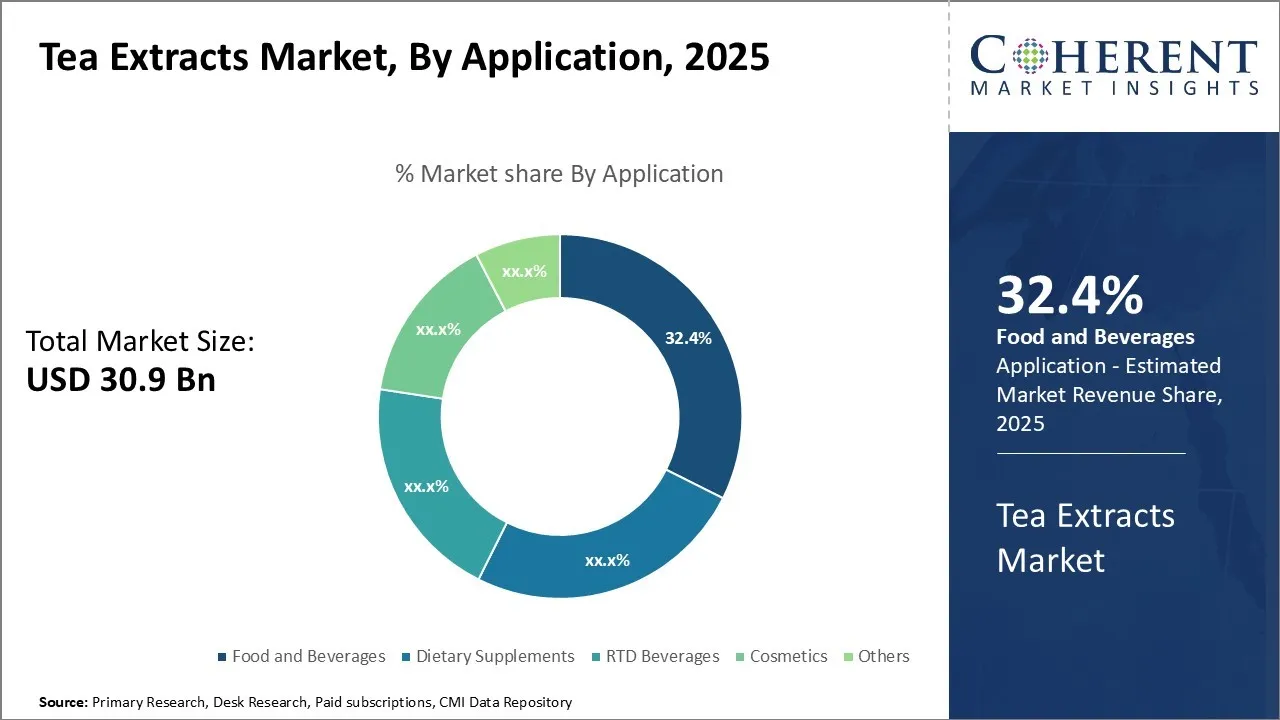
Tea Extracts Market Insights, By Application
In terms of application, the food & beverages segment is expected to contribute largest share of 33.4% for the Tea Extracts market trends in 2026. This is due to growing customer demand for clean-label products and natural, health-promoting ingredients, the food and beverage category is the market leader for tea extracts worldwide.
Because of their high antioxidant content and bioactive components, which appeal to consumers who are health-conscious, tea extracts are frequently used in ready-to-drink teas, functional beverages, dairy substitutes, and even baked goods.
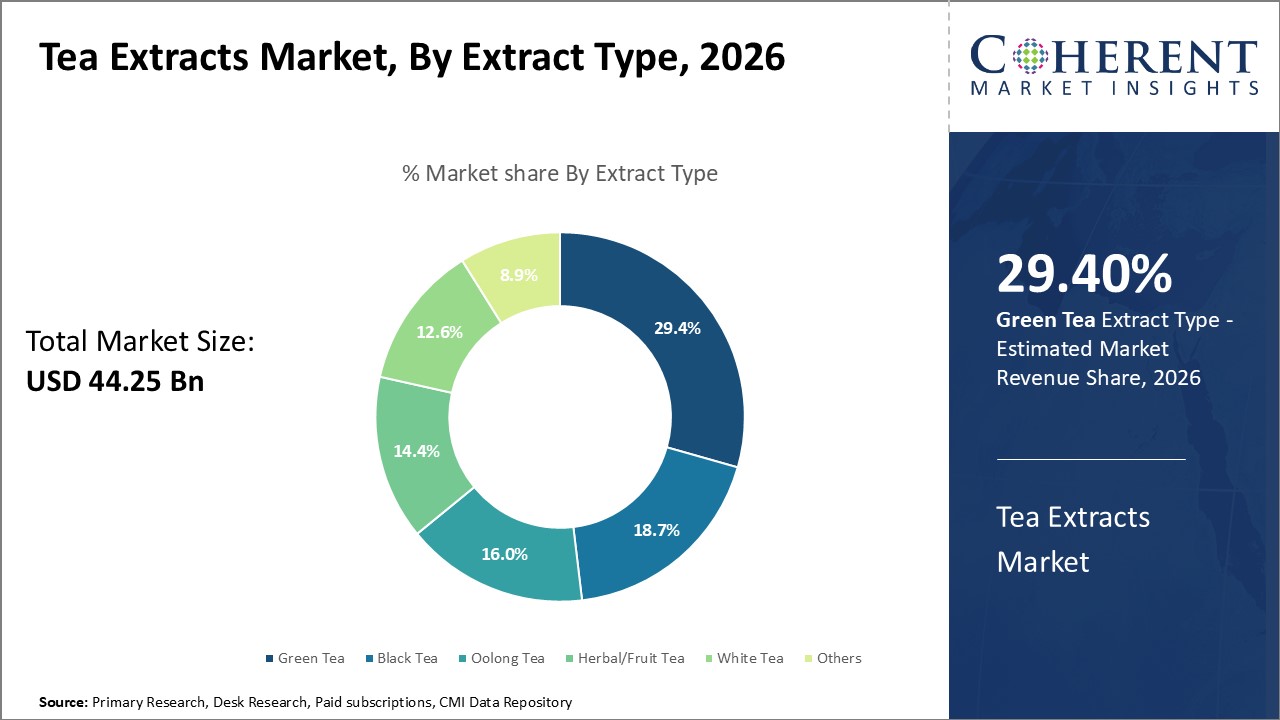
Tea Extracts Market Insights, By Extract Type
In terms of extract type, the green tea segment is expected to contribute largest share of the Tea Extracts market trends in 2026. Green tea extracts are increasingly incorporated into dietary supplements, functional beverages, cosmetics, and pharmaceuticals, reflecting consumer demand for natural, clean-label, and plant-based ingredients.
The segment also benefits from advancements in extraction technologies, which enhance the quality and effectiveness of the extracts, further expanding their applications in food, beverages, and personal care products
For instance, in October 2024, PLT Health Solutions has announced the addition of cellflo6, a patented green tea (Camelia sinensis) extract formulated to provide energy, sport performance, and overall health benefits, to its portfolio. Currently, Cellflo6 is included in several pre-workout, energy, recovery, and men's health formulations.
These include recovery formulae utilized by U.S. military tier 1 operators and 7-Select Fusion Energy, an energy drink marketed under the 7-Eleven brand. The retailer's in-house brands include the new, sugar-free Fusion Energy Drink, which is currently offered in more than 30,000 retail locations across North America, including 7-Eleven, Speedway, and Stripes.
Tea Extracts Market Insights, By Nature
In terms of nature, the conventional segment is expected to contribute largest share of the Tea Extracts market trends in 2026. In the market for tea extracts, the conventional category now commands a higher share than the organic segment. The mass market is served by standard tea extracts, which are widely available and produced using well-established techniques, which contribute significantly to their domination.
Due to rising consumer awareness of tea's health benefits, such as its antioxidant qualities and ability to prevent disease, conventional tea extracts are widely employed in a variety of applications, including food and beverages, nutritional supplements, and personal care items.
Regional Insights
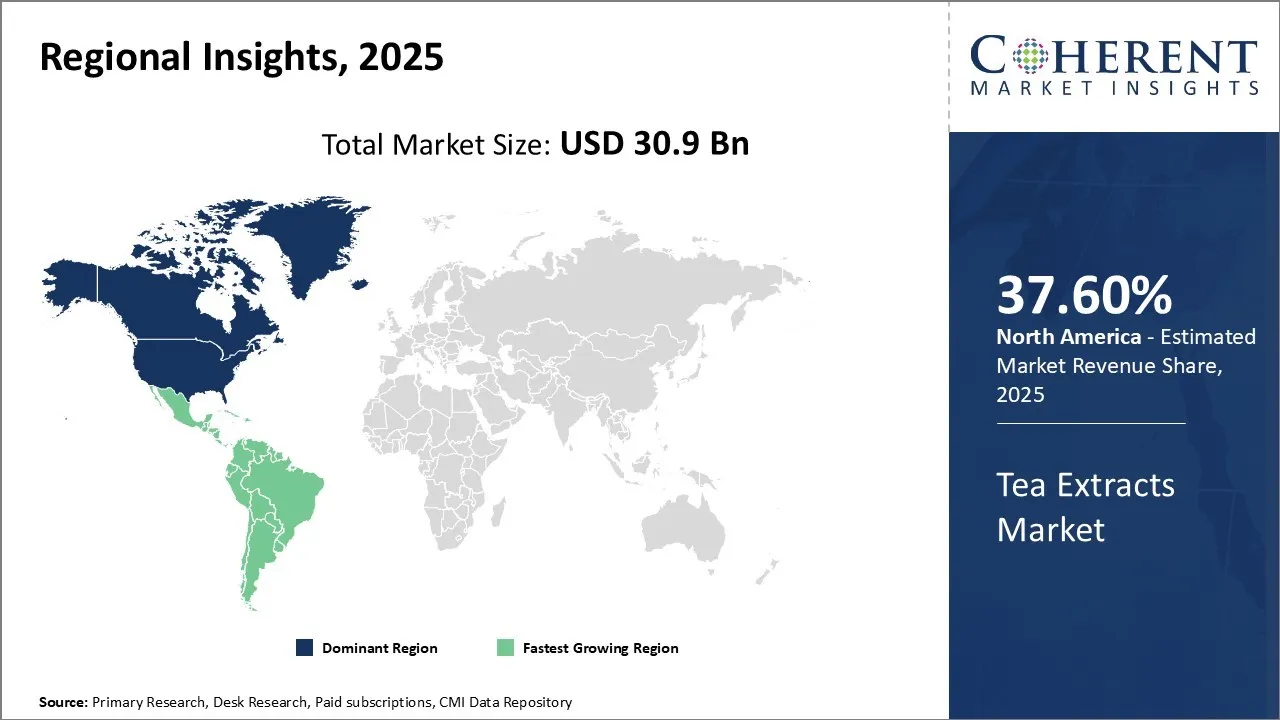
North America Tea Extracts Market
North America held the dominant position in the global tea extracts market in 2026, accounting for a market share of 37.60% in terms of value, followed by Europe and Asia Pacific respectively.
Growing knowledge of the health advantages of tea extracts, including as its anti-oxidant and disease-preventive qualities, as well as a move away from artificial additives as a result of legal constraints and customer demand for clean-label goods, are driving this expansion. Powdered tea extracts are the most widely used form in the region, and the food and beverage category has the biggest market share.
Asia Pacific Tea Extracts Market
The market is further driven by the demand for clean-label and natural ingredients, with tea extracts widely used as flavorings, colorants, and functional additives in food and beverages, as well as for their medicinal properties in nutraceuticals and pharmaceuticals. The popularity of ready-to-drink tea products and functional beverages is rising, supported by innovations in tea blends and e-commerce expansion.
Tea Extracts Market In Europe
The market for tea extracts in Europe is expanding steadily due to rising customer demand for natural, functional, and healthful beverages. Growing demand for herbal and specialty teas, such chamomile and green tea, which are prized for their alleged health advantages and antioxidant qualities, is what defines the industry in the region.
Tea Extracts Market Dominating Countries
U.S Tea Extracts Market
The U.S. also sees significant use of tea extracts in personal care and cosmetic products, reflecting a broader trend toward clean-label and plant-based ingredients. The popularity of ready-to-drink teas and functional beverages continues to rise, supported by a robust retail infrastructure and ongoing product innovation.
India Tea Extracts Market
India is a major player in the market for tea extracts since it is one of the biggest producers and consumers of tea worldwide. Both domestic consumption and export growth are supported by the nation's rich raw material supply and long-standing tea culture. Due to shifting lifestyles and growing health consciousness, tea extracts are being used more and more by Indian consumers in functional meals, nutritional supplements, and nutraceuticals.
Tea Extracts Market In China
As the world's largest producer and a nation with a long history of tea drinking, China dominates the market for tea extracts worldwide. Green tea extracts, which are well known for their health advantages, such as antioxidant and metabolic support, are highly preferred in the Chinese market.
Market Report Scope
Tea Extracts Market Report Coverage
| Report Coverage | Details | ||
|---|---|---|---|
| Base Year: | 2025 | Market Size in 2026: | USD 44.25 Bn |
| Historical Data for: | 2020 To 2024 | Forecast Period: | 2026 To 2033 |
| Forecast Period 2026 to 2033 CAGR: | 43.2% | 2033 Value Projection: | USD 546.39 Bn |
| Geographies covered: |
| ||
| Segments covered: |
| ||
| Companies covered: | AVT Natural, Archer Daniels Midland Company, Blueberry Agro, Cymbio Pharma Pvt Ltd., Harrisons Malayalam Ltd., Indena S.p.A., Martin Bauer Group, Synthite Industries Ltd., Synergy Flavors, Teawolf, Martin Bauer Group., and Taiyo International | ||
| Growth Drivers: |
| ||
| Restraints & Challenges: |
| ||
Tea Extracts Market: Trends
- Surging popularity of innovative and fortified beverages
Various types of tea extracts are widely used across the cosmetics industry. This can be attributed to the anti-inflammatory and antioxidant properties of these extracts. Moreover, the shifting inclination towards natural and organic cosmetic products across the globe is expected to trigger the demand for tea extracts.
Tea Extracts Market: Opportunities
- Demand for organic products is increasing.
The growing global demand for organic goods is likely to create profitable opportunities for market participants in the future. Owing the tremendous demand for tea's functional features, tea makers worldwide are continually launching new and creative products.
In order to widen their product variety and increase total sales, they are also offering ready-to-drink variations. These manufacturers are investing in creative marketing methods and celebrity endorsements, which are projected to drive the market growth in the next few years.
Tea Extracts Market: Growth Drivers
- Increasing awareness about health benefits of tea extracts
Health-related issues among the millennial population have been on the rise for the past few years, owing to consumption of junk food, work-life imbalance, and hectic daily routine, which leaves no time for exercise.
Thus, the need for the consumption of natural or organic tea extracts is being foreseen across the globe. For instance, in September 2025, researchers found that specific compounds in tea extract may help regulate fat metabolism and improve insulin sensitivity. This discovery supports growing interest in tea-based functional ingredients for promoting healthier lifestyles and combating obesity-related conditions.
Lifestyle changes and increased demand
An increasing working population, rising demand for ready-to-use goods, and expanding retail marketplaces are some of the factors predicted to drive the market growth over the forecast period. The rising popularity of tea as a natural element in personal care products is projected to fuel expansion in the worldwide tea extract market.
Growing disposable income, increasing spending on food and beverages, and expanding consumer awareness about the benefits of healthy lifestyles are also projected to fuel the global tea extracts market expansion.
Tea Extracts Market: Key Developments
- May 2025, Finlays, announced the next evolution of its extracts business, Finlays Solutions. Finlays Solutions unveiled a new visual identity, purpose pillars and website representing how it aims to blend tradition with innovation to develop market-changing products.
- January 2025, Java Burn, the revolutionary new supplement, is redefining the wellness market by combining the benefits of natural ingredients with the simplicity of a daily coffee ritual. This innovative formula works synergistically with a morning brew to address common health concerns such as stubborn weight, low energy, and slow metabolism. Java Burn features a science-backed blend of eight carefully chosen ingredients: Chromium, L-Theanine, Vitamin B6, L-Carnitine, Chlorogenic Acid, Green Tea Extract, Vitamin B12, and Camellia Sinensis.
- June 2024, Kay Beauty unveils Velvet Crème multi-use blush. As blush becomes an essential part of every makeup routine, the Kay Beauty Velvet Crème Multi-Use Blush emerges as the ultimate ICON in beauty, capitalizing on the growing trend of multi-functionality products. It’s enriched with Green Tea Extract, so while it delivers a gorgeous flush, it also pampers your skin, staying true to Kay Beauty’s promise of #MakeupThatKares.
Analyst Opinion (Expert Opinion)
- The tea extracts market is experiencing robust growth, driven by rising consumer demand for natural and functional ingredients in beverages, supplements, and cosmetics.
- Health consciousness and the antioxidant value of tea extracts are major market drivers, as consumers increasingly seek clean-label, plant-based products with proven wellness benefits.
- The beverage sector, especially ready-to-drink teas and functional beverages, is the primary growth engine for tea extracts, followed by expanding applications in dietary supplements and skincare.
- Advancements in extraction technology have improved the quality and efficacy of tea extracts, enabling broader use in pharmaceuticals, nutraceuticals, and personal care products.
- The market faces challenges such as fluctuating raw material prices and regulatory hurdles, but these are being addressed through sustainable sourcing and product innovation.
- Asia-Pacific remains the leading region due to its strong tea culture and production, while North America and Europe are seeing rapid adoption of tea extracts in diverse applications.
Speak to the analyst
Want personalized insights?
Take the findings above to one of our principal consultants, or have the report rebuilt around the segments, geographies and competitors you actually track.
Market Segmentation
- Global Tea Extracts Market, By Extract Type
- Green Tea
- Oolong Tea
- Black Tea
- Herbal/Fruit Tea
- White Tea
- Others
- Global Tea Extracts Market, By Nature
- Organic
- Conventional
- Global Tea Extracts Market, By Form
- Liquid
- Powder
- Encapsulated
- Global Tea Extracts Market, By Application
- Food & Beverages
- Dietary Supplements
- RTD Beverages
- Cosmetics
- Others
- Regional Insights (Revenue, USD Bn, 2021 - 2033)
- North America
- U.S.
- Canada
- Latin America
- Brazil
- Argentina
- Mexico
- Rest of Latin America
- Europe
- Germany
- U.K.
- Spain
- France
- Italy
- Russia
- Rest of Europe
- Asia Pacific
- China
- India
- Japan
- Australia
- South Korea
- ASEAN
- Rest of Asia Pacific
- Middle East
- GCC Countries
- Israel
- Rest of Middle East
- Africa
- South Africa
- North Africa
- Central Africa
- North America
- Company Profiles
- AVT Natural, Archer Daniels Midland Company
- Blueberry Agro
- Cymbio Pharma Pvt Ltd.
- Harrisons Malayalam Ltd.
- Indena S.p.A., Martin Bauer Group
- Synthite Industries Ltd.
- Synergy Flavors
- Teawolf
- Taiyo International
- Martin Bauer Group.
Sources
Primary Research Interviews
- Tea extract manufacturers
- Tea estate owners and planters
- R&D heads of beverage and nutraceutical companies
- Procurement managers in F&B companies
- Herbal and functional tea product developers
Databases
- USDA Economic Research Service
- IndiaStat
- UN Comtrade
- Mintel GNPD
- Euromonitor Passport
- Global Trade Atlas
Magazines
- Beverage Industry
- Food & Beverage News
- Tea & Coffee Trade Journal
- Natural Products Insider
- Nutraceuticals World
- Beverage Master Magazine
Journals
- Journal of Food Science
- Journal of Agricultural and Food Chemistry
- International Journal of Food Science and Nutrition
- Journal of Ethnopharmacology
- Food Chemistry
Newspapers
- The Hindu Business Line (Agri & F&B Section)
- Economic Times (Agri Business / FMCG)
- Financial Times (Global Food & Beverage)
- The Japan Times (Tea Culture & Trade)
- China Daily (Agriculture/Exports)
Associations
- Tea Board of India
- European Tea Committee
- World Tea Association
- Specialty Tea Association
- United Planters’ Association of Southern India (UPASI)
- Japan Tea Export Council
- American Botanical Council
Proprietary Elements
- CMI Data Analytics Tool, Proprietary CMI Existing Repository of information for last 8 years
Get access to 250+ pages report
Every segment, forecast, competitor profile and data table behind the analysis above — available for instant download.
- ESOMAR Member
- ISO 9001:2015 Certified
- D-U-N-S Registered
- GDPR & CCPA Compliant
Missing comfort of reading report in your local language? Find your preferred language:
Transform your Strategy with Exclusive Trending Reports
Frequently Asked Questions
The Tea Extracts Market size is estimated to be valued at USD 44.25 Bn in 2026, and is expected to reach USD 546.39 Bn by 2033.
The CAGR of the Tea Extracts Market is projected to be 43.2% from 2026 to 2033.
The major players operating in the market include AVT Natural, Archer Daniels Midland Company, Blueberry Agro, Cymbio Pharma Pvt Ltd., Harrisons Malayalam Ltd., Indena S.p.A., Martin Bauer Group, Synthite Industries Ltd., Synergy Flavors, Teawolf, and Taiyo International.
The rising number of substitutes of conventional tea extracts are expected to act as a restraining factor for the market.
The increasing awareness about the health benefits of tea extracts is expected to drive the market growth during the forecast period.
The encapsulation of tea extracts for producing tablets undertaken across the pharmaceutical sector across the globe is projected to offer lucrative growth opportunities for the key market players in the near future.
Common extraction technologies for tea extracts include solvent extraction, supercritical fluid extraction, and ultrasound-assisted extraction.