

Matcha Market Size and Trends - 2026 to 2033
Matcha market is estimated to be valued at USD 5.40 Bn in 2026 and is expected to reach USD 9.20 Bn by 2033, exhibiting a compound annual growth rate (CAGR) of 7.9% from 2026 to 2033.
Key Takeaways
- Based on Grade, the Classic segment is expected to lead the market with 56% share in 2026, due to widespread usage and balanced quality for daily consumption.
- Based on Application, the Regular Tea segment is expected to hold 48% share of the market in 2026, as consumers increasingly prefer matcha in traditional tea forms.
- Based on Distribution Channel, the Hypermarket segment is projected to account for 45% share of the market in 2026, owing to convenience and large-scale availability.
- Based on Region, Asia Pacific is set to lead the matcha market with 45% share in 2026. While, North America is anticipated to be the fastest growing region.
Market Overview
Rising awareness among consumers about health and wellness is also contributing to the demand for matcha because of the known antioxidant and energizing effects of matcha. There has also been an increasing trend of matcha consumption as an ingredient of everyday food items like teas, lattes, and smoothies, desserts, and baked products, and this has also catalyzed the demand for matcha consumption worldwide.
Current Events and Its Impacts on the Matcha Market
Current Events | Description and its impact |
Japan's Agricultural Policy and Climate Challenges |
|
China's Economic Expansion and Trade Relations |
|
How is product innovation driving the growth in the matcha market?
- Ready-to-Drink Drinks: This will include the launch of ready-to-drink matcha latte, smoothies, and energy drinks.
- Functional Blends: Blending matcha powder with superfoods, vitamins, and adaptogenic elements targeting health-conscious consumers.
- Premium & Ceremonial Products: Offering high-quality matcha for ceremonial and premium gift purposes.
- Matcha-Infused Foods: Creating new product segments in desserts, ice creams, bakery, and snack food categories, thus offering novel consumption occasions.
- Convenient Formats: Sachets, powder sticks, and capsules for easy use at homes and offices.
- Current Industry Events of 2026
- Market Size Estimation
- Regional Breakdown
- Competitive Landscape
- Customer Intelligence
- Segmental Analysis
- Pricing Analysis
- Key Market Drivers, Challenges & Future Trends
- Customized Insights Section
Segmental Insights
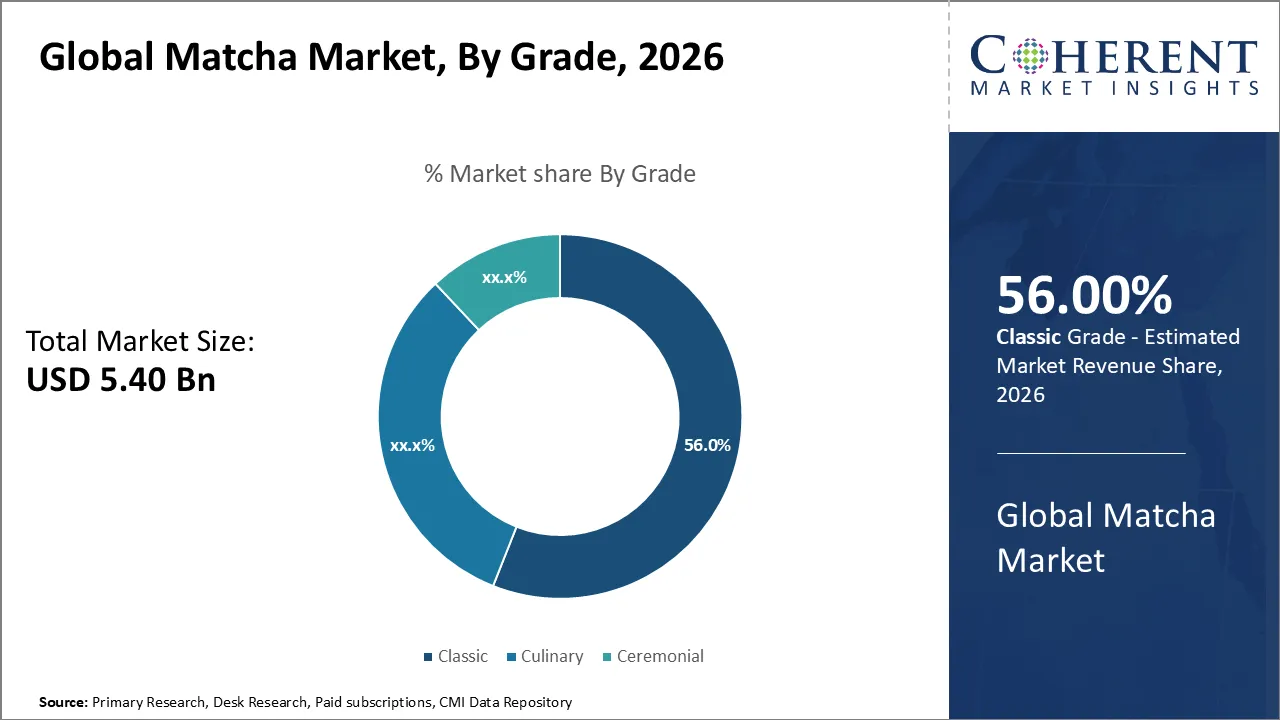
Matcha Market Insights, By Grade – Classic dominates due to widespread usage and balanced quality
By grade, the classic segment is projected to hold the largest market share of 56% by 2026, due to balanced quality suitable for day-to-day consumption. Classic matcha strikes an excellent balance in taste, color, and versatility between beverages and culinary applications. The fact that matcha can easily be found and costs less than ceremony matcha makes it more accessible on the market.
For instance, in April 2025, Lotte’s Coolish brand unveiled a Coolish Matcha Latte ice cream flavor in Japan, expanding the presence of matcha in mainstream consumer products and appealing to younger, convenience‑seeking consumers
Matcha Market Insights, By Application – Regular Tea leads as consumers prefer traditional forms
Based on application, the regular tea segment is estimated to contribute the highest market share of 48% in 2026. Consumers increasingly prefer matcha in traditional forms of tea as it aligns with health-conscious lifestyles and daily routines. The ability to easily prepare, maintain consistent taste, and have consumption patterns make regular tea popular among a wide array of demographics.
For instance, in April 2025, Meiji Co., Ltd. introduced Tsujiri Okoi Matcha Chocolate & Crunch, a green tea ice bar made with Kyoto Uji Sohonke Tsujiri matcha.
Matcha Market Insights, By Distribution Channel – Hypermarkets expand availability and convenience
Based on the distribution channel, the hypermarket segment is forecasted to account for the largest market share of 45% in 2026. This is due to the fact that hypermarkets own large outlets where customers are able to access large numbers of brands of matcha products. Customers are also able to purchase special promotions offered by the hypermarkets.
For instance, in October 2025, McDonald’s Australia launched a nationwide matcha drink range, including matcha‑lattes and iced matcha options after high public demand on social media, illustrating how large‑scale foodservice and retail channels are broadening matcha product access.
Regional Insights
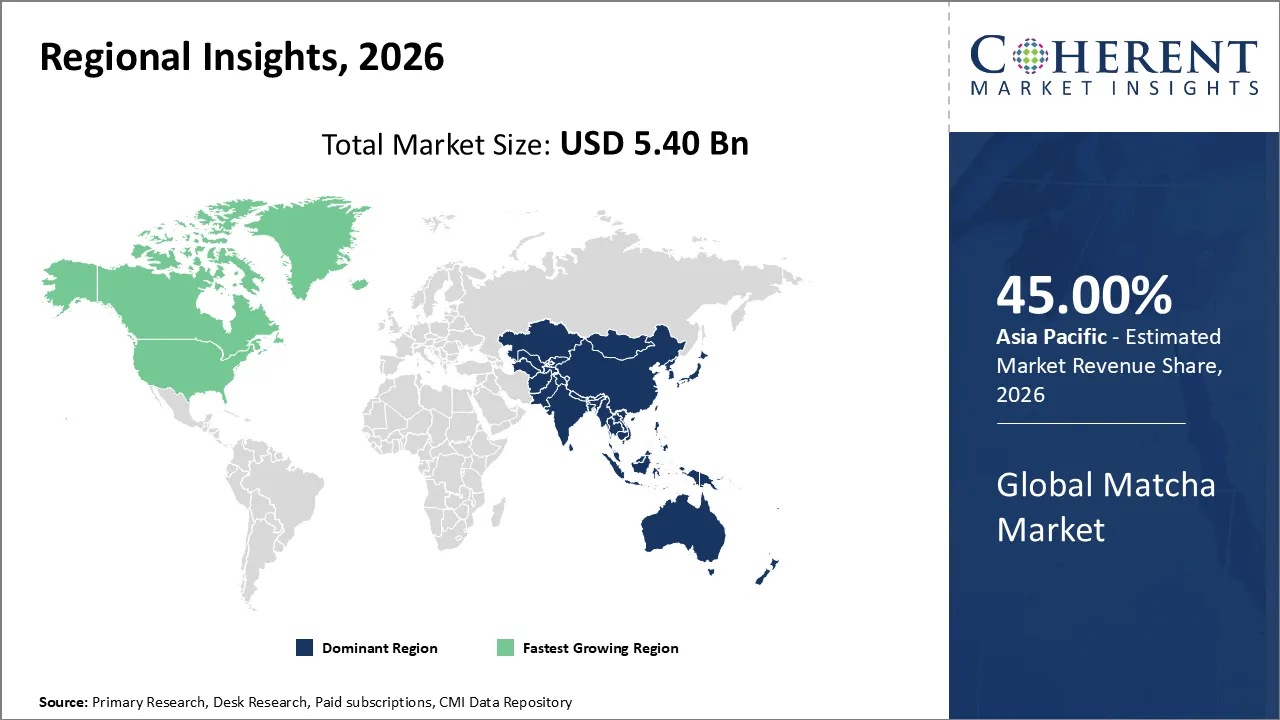
Asia Pacific Matcha Market Analysis & Trends
The Asia Pacific is projected to lead the matcha market in the year 2026, taking approximately 45% of the market. The growth of this market can be attributed to factors that include long-established traditions of consuming matcha, production infrastructures firmly set in regions such as Japan and China, improving awareness regarding wellness, and ever-growing acceptance of matcha in food products like beverages, desserts, and functional foods.
For instance, in March 2025, ChaTraMue Singapore introduced a new matcha beverage series combining traditional flavors with modern drink trends, catering to both classic matcha enthusiasts and new consumers. The launch highlights how brands in Asia Pacific are innovating to meet growing consumer demand for matcha in multiple applications.
North America Matcha Market Analysis & Trends
North America is expected to be the fastest-growing in the matcha market, owing to the rising health-conscious population, the adoption of plant-based diets, and the demand for functional beverages and wellness products. The opening of cafes, e-commerce sites, and specialty stores is also enhancing consumer access and engagement with the product.
For instance, in May 2025, Black Sheep Coffee expanded its matcha beverage lineup with products such as Peaches & Cream Matcha and Matcha Lemonade, boosting iced matcha sales across its U.S. locations. The launch demonstrates North America’s growing appetite for innovative matcha applications in the beverage segment.
Matcha Market Outlook for Key Countries
Is the U.S. matcha market gaining traction from wellness trends and specialty beverages?
The U.S. matcha market is expanding rapidly, driven by rising health consciousness, premium café culture, and growing demand for plant‑based and functional beverages. Specialty cafés have played a major role in introducing consumers to matcha lattes and signature matcha drinks, which in turn boosts retail and at‑home consumption. Over 58% of matcha sales in the U.S. occur through cafés and e‑commerce, reflecting the strong affinity for both out‑of‑home and online matcha experiences.
For instance, in October 2025, OAKBERRY announced the launch of its first‑ever matcha base across select U.S. locations, adding the vibrant green tea product to its superfood menu.
Is China’s traditional tea culture supporting a matcha boom?
China's matcha market is anchored in a long history of tea consumption and has now grown to domestic retail and international export. Places like Jiangkou have become centres for the production of matcha, whose products reach as far as Japan, the U.S., and Europe. Cross-border e-commerce growth is laying the groundwork for wider distribution of Chinese matcha.
For instance, in March 2025, matcha powder from Jiangkou County in Guizhou Province, Southwest China, was shipped in substantial volume (36 metric tons) to North America as the first overseas order of the year, reflecting China’s expanding role in global matcha exports.
Market Report Scope
Matcha Market Report Coverage
| Report Coverage | Details | ||
|---|---|---|---|
| Base Year: | 2025 | Market Size in 2026: | USD 5.40 Bn |
| Historical Data for: | 2020 To 2024 | Forecast Period: | 2026 To 2033 |
| Forecast Period 2026 to 2033 CAGR: | 7.9% | 2033 Value Projection: | USD 9.20 Bn |
| Geographies covered: |
| ||
| Segments covered: |
| ||
| Companies covered: | AOI Tea Company Ltd, DoMatcha, Encha, Midori Spring Ltd., Ippodo Tea Co., AIYA America, and Vivid Vitality Ltd. | ||
| Growth Drivers: |
| ||
| Restraints & Challenges: |
| ||
Matcha Market Driver
Growing health consciousness and functional beverage demand
The growing consumer awareness regarding health and wellness is propelling the global matcha market. Matcha contains high amounts of antioxidants, aids in the regulation of metabolism, and provides alertness with a calming sensation because of the presence of L-theanine. The growing trend of consuming plant-based food and functional drinks is accelerating the consumption rate of matcha, whether it be in the form of tea, smoothies, lattes, or energy drinks. The growing café culture and influence of health trends on social media are increasing the consumption rates in North America, Asia Pacific, and Europe.
Matcha Market Opportunity
Product innovation and expansion into new applications
The market presents opportunities through the launch of innovative matcha products and applications beyond traditional beverages. Companies can explore ready-to-drink matcha beverages, matcha-infused foods like ice cream and baked goods, and even personal care products such as skincare. Developing convenient, flavored, and functional matcha formulations targeted at younger and health-conscious consumers can increase adoption. Expansion of e-commerce and online delivery channels also provides an opportunity to reach wider global audiences efficiently.
Analyst Opinion (Expert Opinion)
The global matcha market is also having a strategic shift because of increasing health awareness and the demand for functional drinks. The demand for matcha surpasses the demand for mere health drinks because it has become more than a health drink, with increasing aspirations in the market. For example, OAKBERRY opened its matcha base in the U.S., which shows that companies are increasingly innovating to target the modern lifestyle of health-driven consumers.
Premiumization shapes expectations among consumers, especially in Japan and China, who really value authenticity and quality. High-grade matcha is increasingly in demand, both for traditional consumption and modern applications like lattes, smoothies, desserts, and even culinary experimentation. Chinese producers scale up their exports to reach global demand, reflecting a growing international trend in the premium matcha arena.
E-commerce platforms as well as retail platforms are rising to significance. This is because matcha is being made more available by specialty cafes, subscription services, as well as online shops. Companies ITO EN, ChaTraMue, and others are using these platforms to reach health-conscious consumers. Even personal care products, including matcha-based products sold under FUKUBISUI, are catching up to show that matcha is not only restricted to beverages.
Overall, the matcha market is evolving from a niche beverage category into a diversified lifestyle sector. The two factors driving market growth include innovation, premiumization of the product, and the expansion of its applications to marry tradition with wellness and modern convenience. Those companies which can balance authenticity with creativity and optimize distribution channels will lead in this dynamic, changing market.
Speak to the analyst
Want personalized insights?
Take the findings above to one of our principal consultants, or have the report rebuilt around the segments, geographies and competitors you actually track.
Matcha Industry News
- In July 2025, Ippodo Tea Co. announced the seasonal release of its New Harvest Matcha 2025—a limited‑edition matcha made from freshly harvested tencha, featuring vibrant fragrance and freshness typical of early harvest teas.
- In July 2025, Encha published official content on its blog about matcha recipes for summer hydration, showcasing how its matcha can be used in refreshing beverage applications during warmer months, reflecting seasonal engagement and product usage trends.
- In April 2025, Meiji Co., Ltd. introduced Tsujiri Okoi Matcha Chocolate & Crunch, a new green tea ice cream bar made with matcha from Kyoto Uji Sohonke Tsujiri.
Market Segmentation
- Grade Insights (Revenue, USD Bn, 2026 - 2033)
- Culinary
- Classic
- Ceremonial
- Application Insights (Revenue, USD Bn, 2026 - 2033)
- Personal Care
- Regular Tea
- Matcha Beverages
- Food
- Matcha Ice-cream
- Matcha Cake
- Cha-Soba Sushi Roll
- Distribution Channel Insights (Revenue, USD Bn, 2026 - 2033)
- Hypermarket
- Supermarket
- Online store
- Others
- Regional Insights (Revenue, USD Bn, 2026 - 2033)
- North America
- U.S.
- Canada
- Latin America
- Brazil
- Argentina
- Mexico
- Rest of Latin America
- Europe
- Germany
- U.K.
- Spain
- France
- Italy
- Russia
- Rest of Europe
- Asia Pacific
- China
- India
- Japan
- Australia
- South Korea
- ASEAN
- Rest of Asia Pacific
- Middle East
- GCC Countries
- Israel
- Rest of Middle East
- Africa
- South Africa
- North Africa
- Central Africa
- North America
- Key Players Insights
- AOI Tea Company Ltd
- DoMatcha
- Encha
- Midori Spring Ltd.
- Ippodo Tea Co.
- AIYA America
- Vivid Vitality Ltd.
Sources
Primary Research Interviews
- Matcha Tea Manufacturers & Brand Managers
- Tea Plantation Owners & Farmers
- Beverage Product Developers & Food Technologists
- Specialty Tea Retailers & Distributors
- E-commerce Platform Merchandising Managers (Beverage & Wellness Segment)
- Nutritionists & Health Experts focusing on Green Tea/Matcha
- Cafe & Restaurant Chain Beverage Managers
- Others
Databases
- Bloomberg Terminal
- Thomson Reuters Eikon
- Others
Magazines
- Tea & Coffee Trade Journal
- World Tea News
- Beverage Daily
- Specialty Food Magazine
- TeaTime Magazine
- Others
Journals
- Journal of Food Science & Technology
- International Journal of Food and Beverage Manufacturing
- Journal of Nutritional Biochemistry
- Food Research International
- Journal of Consumer Behaviour (Food & Beverage Focus)
- Others
Newspapers
- Financial Times
- The Wall Street Journal
- Bloomberg News
- The Guardian – Food & Beverage Section
- Reuters – Food & Beverage Updates
- Others
Associations
- World Tea Association
- Specialty Tea Institute
- Tea Association of the USA
- Japan Tea Association
- International Tea Committee
- Others
Public Domain Sources
- FAO (Food and Agriculture Organization) – Tea Production & Trade Data
- USDA – Tea and Specialty Crop Reports
- World Bank – Food & Beverage Consumer Data
- United Nations Trade Statistics – Agricultural Commodities
- Government Agricultural Ministries (Japan, China, USA) – Tea/Matcha Data
- Others
Proprietary Elements
- CMI Data Analytics Tool
- Proprietary CMI Existing Repository of Information for the Last 8 Years
Get access to 250+ pages report
Every segment, forecast, competitor profile and data table behind the analysis above — available for instant download.
- ESOMAR Member
- ISO 9001:2015 Certified
- D-U-N-S Registered
- GDPR & CCPA Compliant
Missing comfort of reading report in your local language? Find your preferred language:
Transform your Strategy with Exclusive Trending Reports
Frequently Asked Questions
The global Matcha Market is estimated to be valued at USD 5.40 Bn in 2026 and is projected to reach USD 9.20 Bn by 2033.
The CAGR of the Matcha Market is projected to be 7.9% from 2026 to 2033.
Growing health consciousness, rising consumer awareness about the health benefits of matcha, and the increasing popularity of matcha beverages and food applications are the major factors driving market growth.
High prices of premium matcha products, competition from other green teas and herbal beverages, and lack of awareness in certain regions are the major factors hampering market growth.
In terms of grade, the Classic segment is expected to dominate the market in 2026.
AOI Tea Company Ltd., DoMatcha, Encha, Midori Spring Ltd., Ippodo Tea Co., AIYA America, Vivid Vitality Ltd., ChaTraMue, and Meiji Co., Ltd. are the major players.
Asia Pacific is expected to lead the Matcha Market in 2026.