

Airborne Weapon Delivery Systems Market Size and Share Analysis- 2026 To 2033
The Airborne Weapon Delivery Systems Market size is anticipated to grow at a CAGR of 9.7%, with USD 5.06 Bn in 2026, and is expected to reach USD 9.66 Bn by 2033. The primary drivers are largely defined by rising global defense expenditure, increasing procurement of precision-guided and long-range air-launched weapons, modernization of combat aircraft weapon systems, growing demand for stand-off strike capabilities, and the development of hypersonic and network-enabled munitions. According to SIPRI, on April 27, 2026, global military expenditure reached USD 2.887 trillion in 2025, increasing 2.9% in real terms and marking the eleventh consecutive year of growth, supporting sustained investment in advanced weapons and delivery capabilities.
Key Takeaways
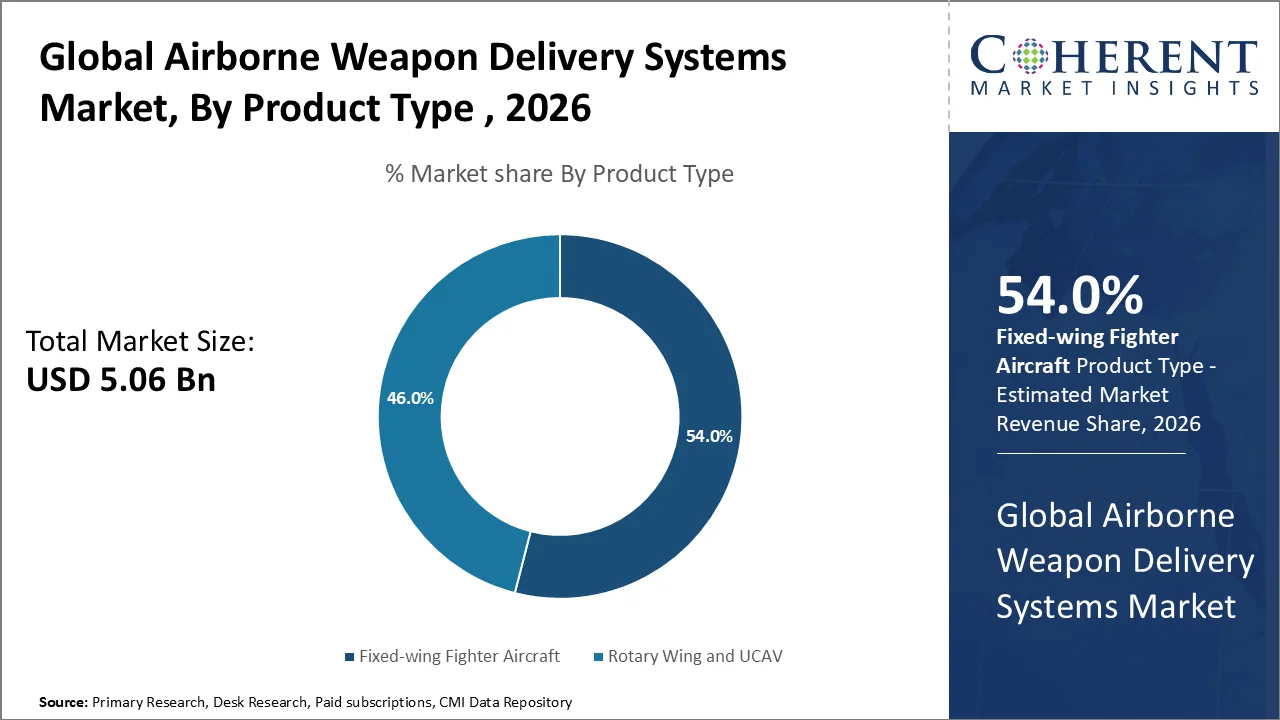
- The fixed-wing fighter aircraft segment is estimated to dominate the market with 54.0% in 2026. The segment’s growth is owing to the large installed base of fighter aircraft, continued modernization of fourth- and fifth-generation combat fleets, integration of precision-guided air-to-air and air-to-surface weapons, and increasing procurement of advanced multirole fighters. In January 2026, Lockheed Martin reported delivering a record 191 F-35 fighter aircraft during 2025, compared with the previous record of 142 aircraft.
- The military agencies segment is estimated to lead the market with 72.0% in 2026. The segment’s growth is owing to rising government defense budgets, expanding procurement of precision-strike missiles, increasing requirements for stand-off attack capabilities, and modernization of national air forces. In July 2025, the U.K. and France announced plans to order additional Storm Shadow/SCALP air-launched cruise missiles while advancing their joint next-generation deep-strike and anti-ship missile program.
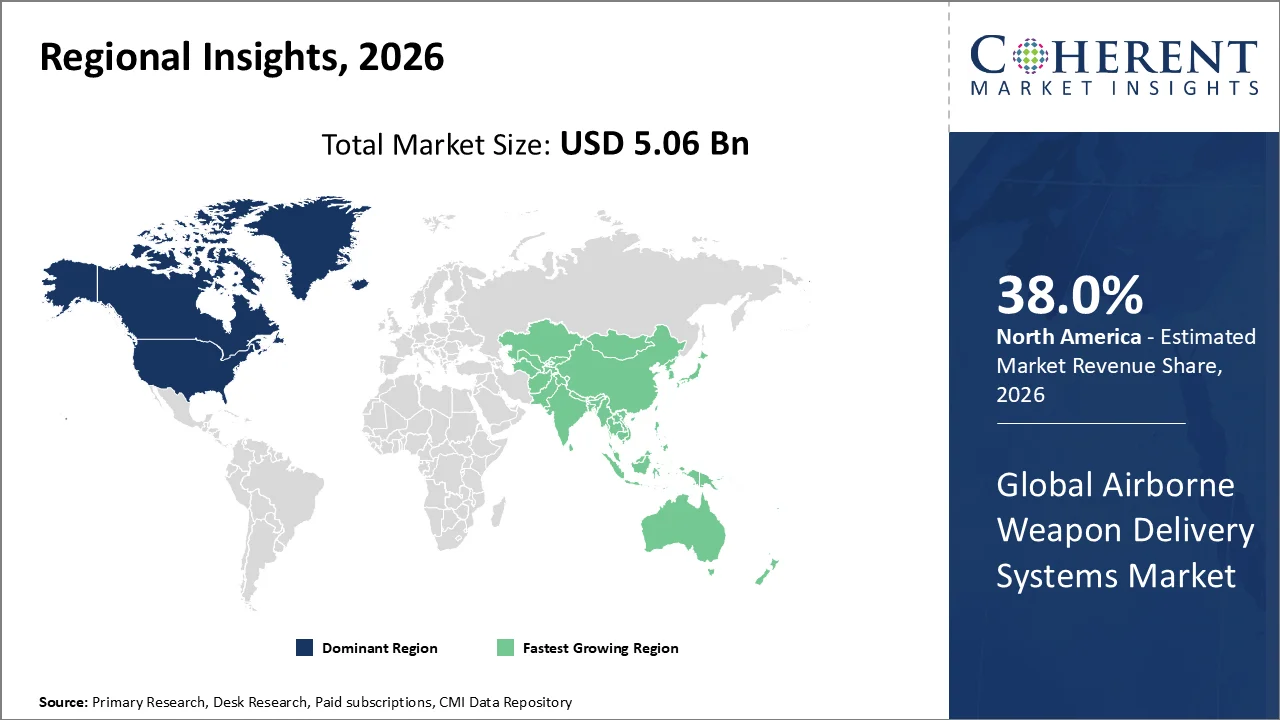
- North America is estimated to dominate the Airborne Weapon Delivery Systems Market with approximately 38.0% share in 2026. The region’s dominance is supported by large-scale fighter aircraft modernization, continued procurement of advanced air-launched weapon systems, strong U.S.–Canada defense integration, and the presence of major airborne weapons manufacturers. In April 2026, the Government of Canada stated that its Future Fighter Capability Project has an acquisition budget of approximately C$27.7 Bn for 88 F-35 fighter aircraft, including associated equipment, training, sustainment, and infrastructure.
Rising Procurement of Long-Range and Precision-Guided Air-Launched Weapons
The Airborne Weapon Delivery Systems Market is gaining momentum owing to increasing military demand for long-range stand-off strike capability, beyond-visual-range engagement, and precision-guided air-to-surface weapons. Modern combat operations increasingly require aircraft to engage high-value targets while remaining outside the effective range of sophisticated enemy air-defense systems, supporting procurement of JASSM-ER, JSM, AMRAAM, LRASM, and similar advanced missiles.
In December 2025, the U.S. State Department approved a potential USD 301 million Foreign Military Sale to Italy for JASSM-ER missiles and associated equipment. The missiles are intended to strengthen Italy's long-range precision-strike capability and can be integrated with advanced combat aircraft.
Modernization of Fighter Aircraft Fleets is Expanding Weapon Integration Requirements
Modernization and expansion of multirole fighter fleets are creating strong demand for advanced weapon launchers, fire-control interfaces, mission computers, targeting systems, and air-to-air and air-to-ground missile integration. Countries are increasingly procuring fighter aircraft together with complete weapon packages rather than acquiring aircraft as standalone platforms, expanding the addressable market for airborne weapon delivery systems.
In September 2025, the U.S. State Department approved a potential USD 3.42 billion F-16 aircraft package for Peru. The package included 12 F-16 aircraft, 12 AIM-120C-8 AMRAAM missiles, 12 AIM-9X Block II Sidewinder missiles, and 52 LAU-129 guided-missile launchers, in addition to radars, mission computers, navigation systems, and associated support equipment.
Current Events and Their Impact on the Airborne Weapon Delivery Systems Market
Current Event | Description and its Impact |
U.S. Introduces America First Arms Transfer Strategy to Accelerate Defense Exports (February 2026) |
|
EU SAFE Regulation Creates €150 Billion Joint Defense Procurement Framework (May 2025–2026) |
|
- Current Industry Events of 2026
- Market Size Estimation
- Regional Breakdown
- Competitive Landscape
- Customer Intelligence
- Segmental Analysis
- Pricing Analysis
- Key Market Drivers, Challenges & Future Trends
- Customized Insights Section
Segmental Insights
Why is Fixed-wing Fighter Aircraft Acquiring the Largest Share?
On the basis of product type, the fixed-wing fighter aircraft segment is estimated to account for the largest Airborne Weapon Delivery Systems Market share of 54.0% in 2026. The segment’s dominance is owing to the large operational fighter-aircraft fleet, higher weapon-carrying capacity, integration of multiple air-to-air and air-to-surface weapons, and continued modernization of multirole combat aircraft across major defense forces.
In April 2025, the U.S. State Department approved a potential USD 5.58 billion sale of 20 F-16 Block 70/72 fighter aircraft to the Philippines. The proposed package included 112 AIM-120C-8 AMRAAMs, 40 AIM-9X Block II Sidewinder missiles, 36 GBU-39/B Small Diameter Bombs, 88 LAU-129 guided-missile launchers, and 60 each of MK-82 and MK-84 bombs.
In June 2026, Lockheed Martin announced the successful completion of the first phase of the U.S. Navy’s F-35C Long-Range Anti-Ship Missile (LRASM) Flight Sciences Test Program.
Military Agencies Hold the Largest Market Share
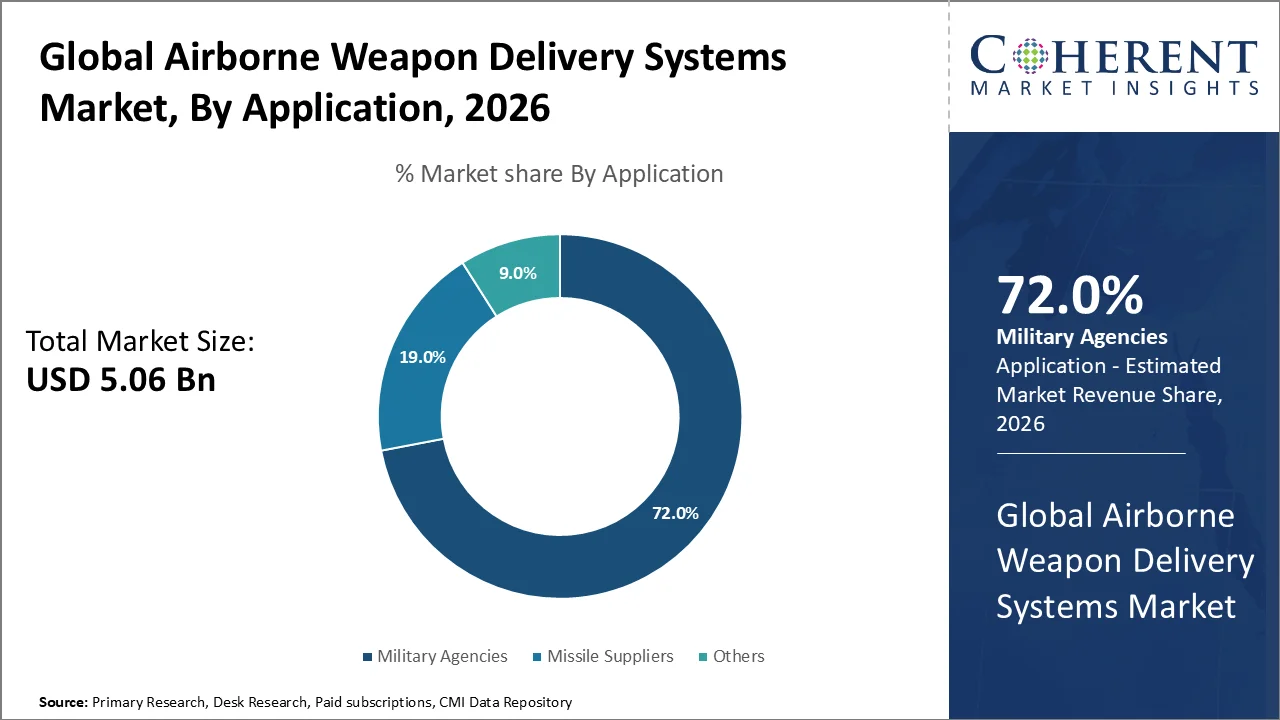
On the basis of application, the military agencies segment is estimated to lead the Airborne Weapon Delivery Systems Market with 72.0% share in 2026. The segment’s dominance is owing to government-led procurement of combat aircraft and precision weapons, expansion of stand-off strike capabilities, replenishment of missile inventories, and increasing requirements to counter sophisticated air and maritime threats.
According to Japan’s Ministry of Defense’s FY2026 defense budget for stand-off defense capabilities is about ¥973 billion. This is about buying a number of long-range weapon systems to hit targets from outside of enemy air-defense threat envelopes.
In January 2026, MBDA announced that it had received an additional order for METEOR beyond-visual-range air-to-air missiles for the German Armed Forces. The contract was awarded through the Meteor Integrated Joint Programme Office on behalf of Germany's BAAINBw procurement authority.
Airborne Weapon Delivery Systems Market Trends
- The rising shift toward long-range stand-off precision weapons is strengthening demand for air-launched systems that allow combat aircraft to engage targets outside sophisticated enemy air-defense envelopes. In July 2026, MBDA stated that its SPEAR miniature air-launched cruise missile entered low-rate initial production during 2026, with the first operational deliveries scheduled for early 2027. The system is designed for beyond-the-horizon precision engagement while allowing the launch aircraft to remain farther from hostile defenses.
- The growing adoption of autonomous and collaborative combat aircraft is expanding airborne weapon delivery beyond conventional piloted fighters. In December 2025, Boeing and the Royal Australian Air Force completed the first autonomous air-to-air weapon engagement by an MQ-28 Ghost Bat, which launched an AIM-120 missile and destroyed a fighter-class target drone while operating with an E-7A Wedgetail and F/A-18F. This highlights the transition toward crewed-uncrewed teaming in future air-combat missions.
- The growing requirement for greater weapon carriage while maintaining survivability is encouraging aircraft manufacturers to adopt larger payload capacity and internal weapons stations. In June 2026, Boeing unveiled upgraded MQ-28 Ghost Bat capabilities featuring a wing more than 25% larger and capacity for an additional 2,000 pounds of fuel, stores, and mission payloads.
Regional Insights
North America Dominates Owing to Advanced Combat-Air Programs and a Strong Defense Industrial Base
The North America region is estimated to account for 38.0% of the Airborne Weapon Delivery Systems Market share in 2026. The region’s dominance is owing to the presence of major defense manufacturers, large-scale development of next-generation combat aircraft, rapid weapon integration programs, and continued investment in precision-strike and autonomous airborne capabilities. Coherent Market Insights identifies the U.S. as the dominant force in the regional landscape, supported by its defense expenditure and established aerospace and defense industry.
In June 2026, General Atomics Aeronautical Systems received a production contract from the U.S. Air Force for the FQ-42A Collaborative Combat Aircraft, marking the transition of the new uncrewed fighter into production. The company stated that the aircraft moved from development contract award to first flight in only 15 months, while its modular architecture supports rapid integration of mission systems and autonomous capabilities.
Asia Pacific Airborne Weapon Delivery Systems Market Trends
Asia Pacific is expected to be the fastest-growing region in the Airborne Weapon Delivery Systems Market over the forecast period. The region’s growth is owing to rapid fighter-fleet modernization, increasing acquisition of long-range air-launched weapons, territorial and maritime-security requirements, and expanding indigenous defense manufacturing across Australia, India, South Korea, Japan, and other countries.
In addition, on August 25, 2025, Saab received an approximately SEK 5.3 billion order for four Gripen E/F fighters for Thailand, consisting of three Gripen E and one Gripen F aircraft with associated equipment, support, and training. Deliveries are scheduled through 2030, illustrating continued expansion of advanced combat-air capabilities across Southeast Asia.
Next-Generation Combat-Air and Long-Range Strike Programs are Strengthening the U.S. Airborne Weapon Delivery Systems Market
The U.S. Airborne Weapon Delivery Systems Market is witnessing strong growth owing to accelerated development of next-generation bombers, collaborative combat aircraft, long-range precision weapons, and modular weapon-integration architectures. The country's emphasis is increasingly shifting toward survivable long-range strike, autonomous teaming, affordable mass, and rapid integration of new weapons for operations in highly contested environments.
The U.S. Department of Defense’s FY2026 budget request included USD 5.5 billion for B-21 Raider low-rate initial production to support the transition to a next-generation, survivable bomber fleet. The budget also included USD 656.3 million for the Family of Affordable Mass Missiles, as the focus on scalable inventories of lower-cost precision weapons increased with high-end strike systems.
Rapid Military Modernization and Carrier-Based Aviation Expansion are Driving China's Market
The China Airborne Weapon Delivery Systems Market is projected to grow at a significant rate over the forecast period owing to continuous military modernization, proliferation of indigenous combat-aircraft programs, development of carrier-based aviation, and increasing investment in advanced weapons and defense technologies. The increasing focus on integrated and intelligentized combat capabilities by China is pushing forward the development of new fighter platforms and associated airborne strike and weapon-delivery systems.
In January 2026, AVIC's Chengdu Aircraft Industry Group disclosed systematic flight-testing activity covering 10 aircraft types across five locations, including newly manufactured J-20A fighters as well as manned and unmanned aircraft.
Who are the Major Companies in Airborne Weapon Delivery Systems Industry
Some of the major key players in Airborne Weapon Delivery Systems Market are Boeing, BAE Systems, General Dynamics, Elbit Systems, CMC Electronics, Lockheed Martin, Raytheon, Northrop Grumman, and Saab.
Key News
- In August, 2026 Boeing announced that the U.S. Air Force cleared the new GBU-75 Joint Direct Attack Munition Long Range (JDAM LR) for initial production through a USD 75 million award.
- In April, 2026, Elbit Systems announced that it received several contracts totaling approximately USD 200 million from the Israel Ministry of Defense for advanced airborne munitions.
Market Report Scope
Airborne Weapon Delivery Systems Market Report Coverage
| Report Coverage | Details | ||
|---|---|---|---|
| Base Year: | 2025 | Market Size in 2026: | USD 5.06 Bn |
| Historical Data for: | 2020 To 2024 | Forecast Period: | 2026 To 2033 |
| Forecast Period 2026 to 2033 CAGR: | 9.7% | 2033 Value Projection: | USD 9.66 Bn |
| Geographies covered: |
| ||
| Segments covered: |
| ||
| Companies covered: | Boeing, BAE Systems, General Dynamics, Elbit Systems, CMC Electronics, Lockheed Martin, Raytheon, Northrop Grumman, and Saab. | ||
| Growth Drivers: |
| ||
| Restraints & Challenges: |
| ||
Analyst Opinion
- The Airborne Weapon Delivery Systems Market is increasingly shifting toward longer-range, low-observable precision weapons that can be launched while aircraft remain outside advanced enemy air-defense envelopes. This is visible in recent international procurement: on June 30, 2026, Kongsberg announced a NOK 4.7 billion Joint Strike Missile order from a sixth customer nation, while Norway, Japan, Australia, the U.S., and Germany had already selected the missile. This widening customer base indicates that fifth-generation air-launched strike weapons are moving from limited adoption toward broader multinational deployment.
- The market is also moving toward weaponized remotely piloted and collaborative combat aircraft, broadening the addressable market beyond conventional fighter jets. On July 20, 2026, General Atomics completed qualification testing for the U.K. Protector RG Mk1, qualifying both the Paveway IV laser-guided bomb and Brimstone 3 air-to-surface missile for launch from the MQ-9B platform. This supports a long-term transition toward multi-role uncrewed aircraft capable of performing precision-strike missions alongside manned combat aircraft.
- Open-architecture and software-defined weapon integration is emerging as an important competitive differentiator in future airborne combat systems. On February 12, 2026, the U.S. Air Force confirmed implementation of its government-owned Autonomy Government Reference Architecture across multiple Collaborative Combat Aircraft platforms, with RTX Collins and Shield AI conducting semi-autonomous flight testing with General Atomics’ YFQ-42 and Anduril’s YFQ-44. This approach reduces dependence on a single supplier and can shorten the integration cycle for new weapons, autonomy software, sensors, and mission capabilities.
Speak to the analyst
Want personalized insights?
Take the findings above to one of our principal consultants, or have the report rebuilt around the segments, geographies and competitors you actually track.
Market Segmentation
- By Product Type (Revenue, USD Bn, 2021-2033)
- Fixed-wing Fighter Aircraft
- Rotary Wing and UCAV
- By Application (Revenue, USD Bn, 2021-2033)
- Military Agencies
- Missile Suppliers
- Others
- By Region (Revenue, USD Bn, 2021-2033)
- North America
- U.S.
- Canada
- Latin America
- Brazil
- Mexico
- Argentina
- Rest of Latin America
- Europe
- Germany
- U.K.
- France
- Italy
- Spain
- Russia
- Rest of Europe
- Asia Pacific
- China
- India
- Japan
- Australia
- South Korea
- ASEAN
- Rest of Asia Pacific
- Middle East
- GCC
- Israel
- Rest of Middle East
- Africa
- South Africa
- Central Africa
- North Africa
- North America
Sources
Primary Research Interviews
- Defense procurement officials and military acquisition specialists
- Air force and naval aviation program managers
- Fighter aircraft and UCAV platform manufacturers
- Air-launched missile and precision-guided munition manufacturers
- Weapon integration and fire-control system engineers
- Avionics, targeting, and mission-system specialists
- Aerospace and defense supply-chain and procurement managers
- Military aviation analysts and defense technology experts
Databases
- Stockholm International Peace Research Institute (SIPRI)
- NATO Defence Expenditure Database
- U.S. Department of Defense Budget Materials
- Defense Security Cooperation Agency (DSCA) Major Arms Sales Database
- U.S. Federal Procurement Data System / SAM.gov
- European Defence Agency (EDA) Defence Data
- World Bank Military Expenditure Database
- UN Register of Conventional Arms (UNROCA)
Magazines
- Aviation Week & Space Technology
- Janes Defence Weekly
- Air & Space Forces Magazine
- Defense News
- FlightGlobal
- Military Aerospace Electronics
Journals
- Journal of Defense Analytics and Logistics
- Aerospace Science and Technology
- Journal of Guidance, Control, and Dynamics
- Defence Technology
- IEEE Aerospace and Electronic Systems Magazine
- International Journal of Aeronautical and Space Sciences
Newspapers
- Financial Times
- The Wall Street Journal
- Reuters
- The New York Times
- The Guardian
- Nikkei Asia
Associations
- Aerospace Industries Association (AIA)
- Air & Space Forces Association (AFA)
- National Defense Industrial Association (NDIA)
- Association of the United States Army (AUSA)
- Aerospace, Security and Defence Industries Association of Europe (ASD)
- Royal Aeronautical Society
- Air Force Association of Canada
Public Domain Sources
- Company Annual Reports and Investor Presentations
- U.S. Department of Defense Contract Announcements
- U.S. Air Force, U.S. Navy, and U.S. Marine Corps Program Publications
- NATO and National Ministry of Defence Publications
- Defense Security Cooperation Agency Arms Sale Notifications
- Government Defence Budget and Procurement Documents
- Company Press Releases on Missile, Fighter Aircraft, and Weapon Integration Programs
- Military Aviation Program and Test & Evaluation Reports
- Patent Databases such as WIPO, USPTO, and Google Patents
- Publicly Available Fighter Aircraft and Missile Program Documents
Proprietary Elements
- CMI Data Analytics Tool
- Proprietary CMI Existing Repository of Information for the Last 10 Years
Get access to 250+ pages report
Every segment, forecast, competitor profile and data table behind the analysis above — available for instant download.
- ESOMAR Member
- ISO 9001:2015 Certified
- D-U-N-S Registered
- GDPR & CCPA Compliant
Missing comfort of reading report in your local language? Find your preferred language:
Transform your Strategy with Exclusive Trending Reports
Frequently Asked Questions
The Airborne Weapon Delivery Systems Market is expected to reach USD 9.66 Bn by 2033, increasing from USD 5.06 Bn in 2026.
Major players operating in the global Airborne Weapon Delivery Systems Market include Boeing, BAE Systems, General Dynamics, Elbit Systems, CMC Electronics, Lockheed Martin, Raytheon, Northrop Grumman, and Saab.
The high development and procurement costs and complex weapon integration requirements are the key factors hampering market growth.
The increasing procurement of advanced fighter aircraft and airborne weapon systems, rising adoption of precision-guided weapons, and growing demand for long-range stand-off strike capabilities are driving market growth.
The Airborne Weapon Delivery Systems Market is anticipated to grow at a CAGR of 9.7% between 2026 and 2033.
Among regions, North America is estimated to dominate the market with approximately 38.0% share in 2026. The region benefits from major defense manufacturers, next-generation combat-air programs, weapon-integration activities, and continued precision-strike investments.
Asia Pacific is expected to be the fastest-growing region over the forecast period. Growth is supported by fighter-fleet modernization, increasing procurement of long-range air-launched weapons, maritime-security requirements, and expanding indigenous defense manufacturing.