

Underwater Drone Market Analysis & Forecast: 2026-2033
Underwater Drone Market is estimated to be valued at USD 5.20 Bn in 2026 and is expected to reach USD 15.03 Bn in 2033, exhibiting a compound annual growth rate (CAGR) of 16.5% from 2026 to 2033.
Key Takeaways
- According to Type, The Remotely-Operated Category is anticipated to account for the largest share of 62.2% for the Underwater Drone market in 2026. Underwater drones controlled by operators from the surface, usually by a tether that supplies power and real time data transmission, are referred to as remotely-operated vehicles (ROVs) in the remotely operated part of the underwater drone market.
- According to Application, The Defense And Security Segment is anticipated to hold 36.5% share of the Underwater Drone market in 2026. Underwater drones are used by defense organizations to test new payload capacities, autonomous navigation systems, and undersea vehicle designs.
- According to Region, North America holds the largest market share of 45.80% for Underwater Drone market growth by 2026. Leading technological companies and manufacturers like Boeing, Lockhead Martin, and General Dynamics as well as creative startups and research institutes are based in this region which guarantees ongoing improvements in underwater drone autonomy, imaging, navigation, and endurance.
- Asia Pacific is considered to be the second largest region with 28.7% of market share by 2026 for Underwater Drone market. Governments are using underwater drones for port security, coastal surveillance, and anti-submarine operations due to the region’s long coastline and territorial conflicts.
Market Overview
The Underwater Drone Market Size is growing rapidly due to its growing use in environmental monitoring, commercial exploration, defense, and maritime research. The underwater drone market is witnessing significant growth driven by increasing areas of applications such as defense, security, and monitoring. Rising security concerns due to geopolitical tensions among countries have led to increased defense spending on maritime security. Underwater drones help in border monitoring, improving maritime domain awareness and countering small vessel threats.
Current Events and Its Impact on the Underwater Drone Market
Event | Description and Impact |
Surge in Underwater Tourism in Europe |
|
Expansion of Offshore Oil & Gas Exploration |
|
Pricing Analysis
The underwater drone market has seen dynamic pricing trends driven by rapid technological advancements, expanding applications, and increasing demand across sectors like defense, oil & gas, and marine research.
The compound annual growth rate (CAGR) is projected between 8.3% and 17.9% through 2033, reflecting robust demand and market expansion. Pricing for underwater drones is influenced by factors such as the level of autonomy (ROV vs. AUV), payload capabilities, sensor sophistication, and integration of advanced features like AI and real-time data transmission.
- Current Industry Events of 2026
- Market Size Estimation
- Regional Breakdown
- Competitive Landscape
- Customer Intelligence
- Segmental Analysis
- Pricing Analysis
- Key Market Drivers, Challenges & Future Trends
- Customized Insights Section
Role of Advanced Technology
- Advanced technology is a primary catalyst in the evolution and expansion of the underwater drone market.
- The operational capabilities, durability, and dependability of underwater drones have been greatly improved by advancements in sensor, imaging, propulsion, and battery technologies.
- The integration of artificial intelligence (AI), Internet of Things (IoT), and machine learning allows for more autonomous navigation, real-time data analysis, and efficient mission execution, even in complex underwater environments.
- The adoption of 5G connectivity and improvements in remote control systems are enabling seamless communication and data transfer, Underwater drones for environmental monitoring to infrastructure inspection and defense surveillance.
Segmental Insights
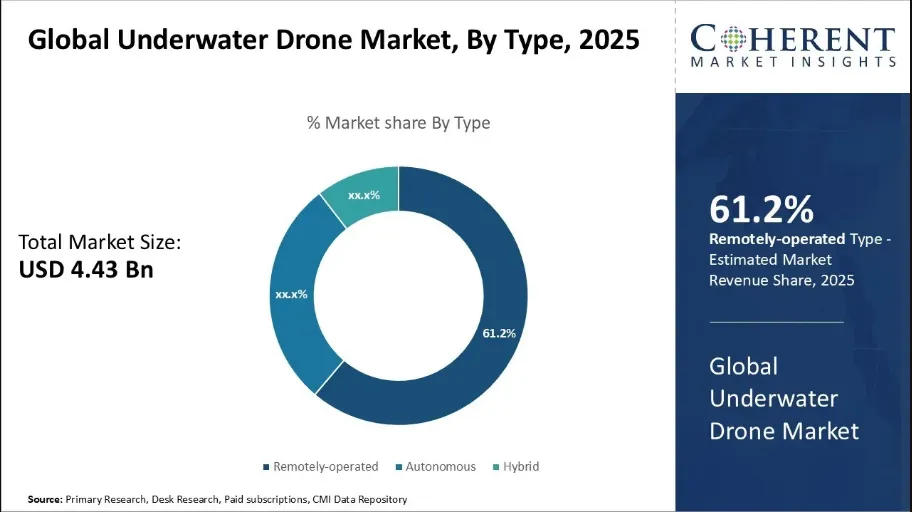
Underwater Drone Market Insights, By Type
The remotely-operated segment is expected to account for the largest share of 62.2% in the market in 2026 due to several key advantages over autonomous and hybrid options. Remote operation allows for greater flexibility that is appealing to defense, scientific, and commercial users.
Operators retain full control over missions and can make adjustments in real-time based on changing underwater conditions or new objectives. This makes remotely-operated drones well-suited for inspection, mapping, and surveillance applications where tasks may need to be altered on short notice.
Underwater drone safety and regulatory concerns, as remote operation removes humans from dangerous underwater environments. Defense and scientific missions often involve uncharted or hazardous areas like shipwrecks, reefs, or near operating vessels and infrastructure.
Remotely piloting drones from the surface allows users to closely monitor environments and retrieve or cancel missions instantly if threats arise. This gives remotely-operated drones a clear advantage for applications in defense, offshore energy, and scientific research of unknown or potentially dangerous underwater locations.
Ease of development and regulatory acceptance have also propelled the remotely-operated segment. Existing remote control technologies could be adapted from other industries like aviation, making initial development more straightforward than creating autonomous capabilities.
Regulatory bodies have been more receptive to remotely-operated vehicles for defense, commercial, and scientific use due to retained human oversight and safety advantages. This early regulatory acceptance opened greater opportunities for remote underwater drones.
Widespread familiarity and experience with remote systems among potential customers in defense, oil/gas, and research has further supported demand. For many organizations, remote operation allows seamless integration of underwater drones into established remote vehicle fleets and operating procedures. Forward compatibility of skills and infrastructure yields long-term cost benefits.
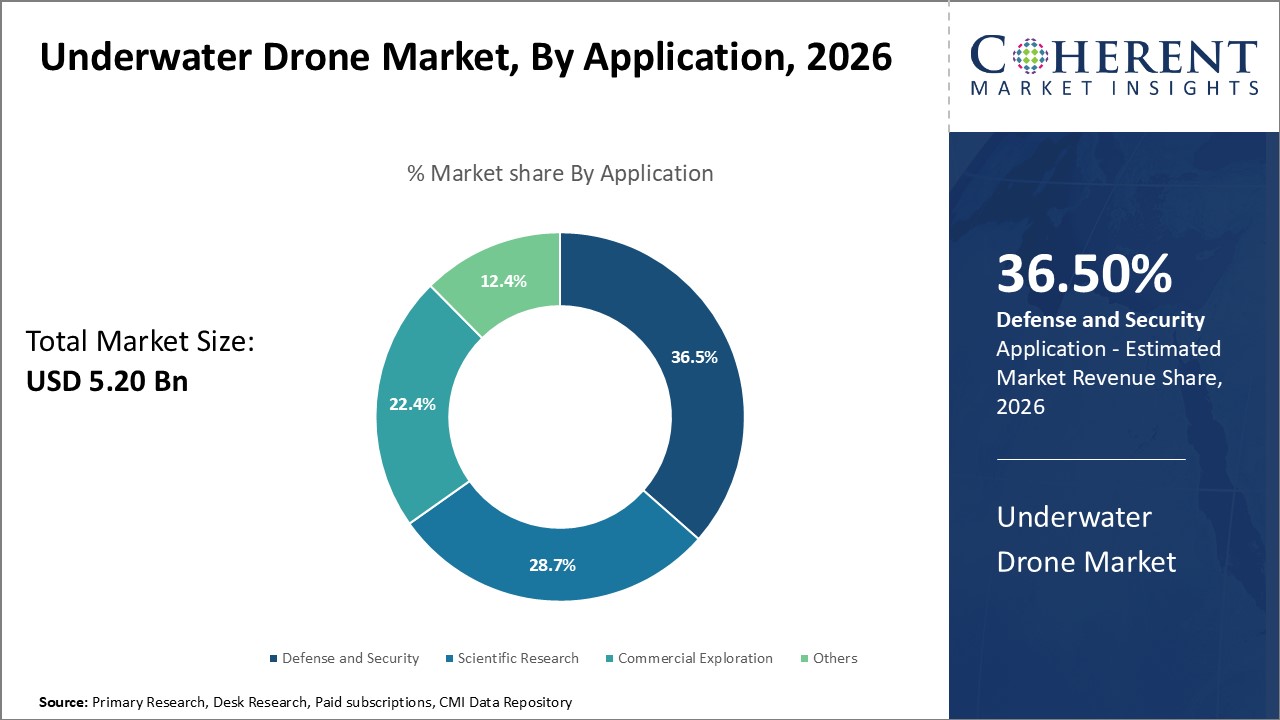
Underwater Drone Market Insights, By Application
The defense and security segment is expected to account for the largest share of 36.5% in the global underwater drone market in 2026 due to diverse and critical military applications. Underwater drones are invaluable tools for naval operations like port and harbor security, infrastructure protection, and mine countermeasures. They can covertly map and monitor foreign waters to detect threats and monitor potential adversaries.
Underwater drones also see extensive use in defense technology demonstration and testing. They are widely employed to evaluate new undersea vehicle designs, verification of platform capabilities, and testing of autonomous navigation, guidance, and payload functions. Given substantial national defense budgets and technological priorities, defense entities invest heavily in continuous demonstration and evaluation projects.
Covert intelligence, surveillance, and reconnaissance comprise another major application domain. Remote-controlled and autonomous underwater drones enable clandestine intelligence gathering of critical ocean-going vessels and seabed infrastructure around the world. They allow observation without risking sensitive assets or tipping off targets to physical presence.
Regional Insights
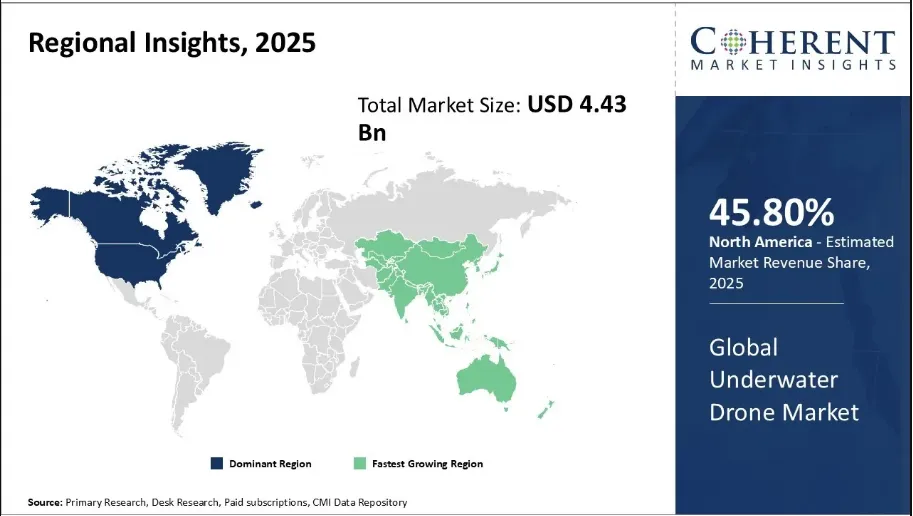
North America Underwater Drone Market
North America is expected to dominate the underwater drone market, holding a share of 45.80% in 2026. The region’s lead can be attributed to the large presence of underwater drone manufacturers as well as the extensive use of underwater drones by governmental agencies for marine research, environmental monitoring, and defense applications. Countries like the U.S. have heavily invested in boosting their naval capabilities, which has driven significant demand for underwater drones.
Asia Pacific Underwater Drone Market
The Asia Pacific region, holding a share of 28.7% in 2026, is expected to exhibit the fastest growth, led by emerging economies like China, Japan, and South Korea. The underwater drone market is gaining traction in the region due to rising maritime concerns and growing emphasis on port security management. Rapid industrialization along coastal lines has also increased the need for underwater inspections.
Underwater Drone Market In Europe
The market for underwater drones in Europe is growing quickly due to rising demand from industries like environmental monitoring, offshore energy, defense, and marine research. Significant investments in cutting-edge technologies, such as better sensors, navigational systems, and communication capabilities, are helping the market by improving the dependability and performance of underwater drones.
Underwater Drone Market Dominating Countries
U.S Underwater Drone Market
The U.S. underwater drone market is the most advanced and dominant globally, driven by significant defense funding, cutting-edge technological innovations, and extensive research and development. Leading companies such as Boeing, Lockheed Martin, and General Dynamics have pioneered underwater drone technology for both military and commercial applications. The U.S. Navy has been a major force behind the adoption of Autonomous Underwater Vehicles (AUVs) and Remotely Operated Vehicles (ROVs), using them for mine countermeasures, intelligence gathering, and deep-sea reconnaissance.
Beyond defense, commercial sectors, including offshore energy and underwater infrastructure inspection, are increasingly deploying these technologies. Startups and research institutions, such as Anduril Industries and the Woods Hole Oceanographic Institution, are also contributing to the evolution of next-generation underwater drones with AI-driven capabilities and enhanced autonomy.
India Underwater Drone Market
The growing applications in industries including defense, oil & gas, marine research, and underwater exploration are driving the underwater drone market in India. Drones are becoming more capable and autonomous because to technological developments like better underwater communication systems, increased mobility, and greater resolution photography.
To satisfy the various demands of Indian industries, major firms are concentrating on developments that offer longer battery life, deeper diving capabilities, and autonomous operations.
Underwater Drone Market In China
The China underwater drone market is expanding rapidly, supported by state-backed marine projects, growing maritime trade, and a strong push for technological self-sufficiency. The Chinese government has placed significant emphasis on developing indigenous Autonomous Underwater Vehicles (AUVs) and hybrid underwater drones to bolster naval surveillance, territorial security, and deep-sea exploration.
Leading domestic players like Chengdu Guangtong and PowerVision are at the forefront of innovation, producing a range of underwater drones for both military and commercial applications. State-owned defense firms and academic institutions, such as the Harbin Engineering University, are heavily investing in research for long-endurance underwater drones with applications in deep-sea mapping and undersea warfare.
Additionally, China is rapidly expanding its commercial underwater drone segment, with growing demand for underwater inspections in offshore oil rigs and subsea telecommunications infrastructure.
Japan Underwater Drone Market Trends
Japan remains a leader in the Asia Pacific underwater drone market, primarily focusing on coastal surveillance, disaster management, and oceanographic research. With its long coastline and reliance on maritime security, the Japanese government has increased investments in Remotely Operated Vehicles (ROVs) and AUVs for monitoring territorial waters and responding to natural disasters such as tsunamis.
Companies like Shibuya Electronics and CHINO are playing a significant role in advancing compact, high-precision underwater drones, used extensively for infrastructure inspections, marine biodiversity studies, and naval reconnaissance.
Additionally, Japan’s shipbuilding giants and robotics firms are collaborating with research institutions to develop next-generation AI-powered underwater drones that can operate in extreme environments, including the deep-sea trenches around Japan. This technological push aligns with Japan’s broader Blue Economy strategy, promoting sustainable marine exploration and offshore resource management.
South Korea Underwater Drone Market Trends
The South Korea underwater drone market is growing rapidly, driven by naval modernization efforts, strong government R&D initiatives, and an expanding defense sector. The country is investing heavily in unmanned underwater systems as part of its broader strategy to enhance maritime security, combat asymmetric threats, and strengthen anti-submarine warfare capabilities.
Key domestic players like Hyundai Heavy Industries, LIGHTTECH, and Daewoo Shipbuilding & Marine Engineering (DSME) are leading the charge in developing autonomous and remotely operated underwater drones tailored for naval defense and commercial applications. In addition to military applications, South Korea is focusing on underwater drones for offshore energy exploration, shipwreck surveys, and environmental monitoring.
The government has also established collaborative research programs with universities and private enterprises to develop next-generation AI-powered underwater robots, further solidifying its position in the regional market.
Germany Underwater Drone Market Trends
Germany has established itself as a key player in the global underwater drone market, leveraging its strong engineering expertise, precision manufacturing, and research collaborations. The country is home to major defense and technology firms like Thales, Atlas Elektronik, and ECA Group, which are actively developing advanced underwater drones for both military and civilian applications.
German companies have focused on producing highly specialized AUVs and ROVs, often used in deep-sea exploration, subsea infrastructure inspections, and mine countermeasure operations. The country’s emphasis on modular, AI-driven underwater drones has made its technology highly sought after for defense and commercial applications across Europe.
Additionally, Germany's extensive research collaborations with marine institutions such as GEOMAR Helmholtz Centre for Ocean Research have facilitated innovations in autonomous navigation, underwater mapping, and environmental monitoring, ensuring its continued leadership in the sector.
Market Report Scope
Underwater Drone Market Report Coverage
| Report Coverage | Details | ||
|---|---|---|---|
| Base Year: | 2025 | Market Size in 2026: | USD 5.20 Bn |
| Historical Data for: | 2020 To 2024 | Forecast Period: | 2026 To 2033 |
| Forecast Period 2026 to 2033 CAGR: | 16.5% | 2033 Value Projection: | USD 15.03 Bn |
| Geographies covered: |
| ||
| Segments covered: |
| ||
| Companies covered: | Lockheed Martin Corporation, Bluefin Robotics, Saab Seaeye Ltd, Teledyne Marine Group, Kongsberg Maritime, Oceaneering International, Inc., TechnipFMC, ECA Group, Deep Ocean Engineering, Inc., The Boeing Company, Anduril Industries, BAE Systems, Northrop Grumman, Huntington Ingalls Industries, and Cellula Robotics | ||
| Growth Drivers: |
| ||
| Restraints & Challenges: |
| ||
Underwater Drone Market: Growth Drivers
Technological advancements enhancing underwater drone capabilities
The underwater drone market is witnessing significant technological advancements that are enhancing the capabilities of these unmanned vehicles. Major players in the market are investing heavily in R&D to develop more sophisticated sensors, navigation systems, and propulsion mechanisms. This is enabling underwater drones to operate autonomously for extended durations in challenging underwater environments. Some of the key capability enhancing technologies include:
Next-generation cameras and vision systems: Manufacturers are developing advanced optical and ultrasonic cameras that provide higher resolution live feed and images from depths of over 1,000 meters underwater. These cameras utilize blue light which transmits farther in water bodies. Some drones are even equipped with multi-spectral cameras and light systems for night operation capabilities.
Improved navigation and obstacle avoidance: Advanced inertial measurement units, Doppler velocity logs, depth sensors, and obstacle avoidance sonars are enabling more precise self-navigation in zero visibility conditions and complex terrains. Some models can now map the seabed in 3D and autonomously plan path according to the surrounding structures without surface control. This is critical for inspection of offshore infrastructure and scientific research.
Longer battery life and endurance: New lithium polymer and lithium-ion battery chemistries coupled with optimized power consumption of avionics and propulsion systems are providing underwater drones with much higher potential and actual operating times. Some designs can now log over 50 hours of active sonar scanning and recording. This prolongs their utility for surveys across large maritime regions.
Efficient propellers and thrusters: Smaller, more efficient and maneuverable propulsion units like ducted fans, co-axial motors and innovative thruster designs help operate drones effortlessly even in swift ocean currents. Some are bio-inspired with underwater flippers providing precision movements for interaction with subsea assets. This makes drones suitable for applications needing close visual examination and manipulation.
Underwater Drone Market: Restraints
- High operational costs associated with underwater drones
One of the key challenges in the global underwater drone market is the high operational costs associated with these advanced maritime robots. Underwater drones require complex navigation, imaging, and communication systems to function and capture data in hazardous underwater environments. These components and technologies come with a significant price tag.
Additional factors like requirement of specially trained pilots to control the drones remotely further increase operational expenditures. Regular maintenance of fleet along with repair and replacement of components damaged by corrosion or during operations drive up recurring maintenance costs. Transportation and deployment of large and heavy drones in offshore locations also lead to high logistical expenses.
Limited battery life of drones poses challenges for longer duration missions requiring multiple battery swaps adding to project timelines and costs. With current technology, bringing down the operational costs to make underwater drones more affordable for widespread commercial and industrial adoption remains a major barrier for broader market growth.
Underwater Drone Market: Trends
The incorporation of cutting-edge technology like machine learning, artificial intelligence (AI), the Internet of Things (IoT), and 5G connectivity into underwater drones is a significant development. These developments are improving autonomous navigation, environmental monitoring, real-time data collecting, and video surveillance, which increases the accuracy and efficiency of underwater activities.
The operational range and endurance of these vehicles are also being increased by advancements in battery life, sensor capabilities, and communication systems. Real-time data processing, anomaly detection, and predictive analytics are made possible by the advent of AI-driven drones, which is especially revolutionary for industries like marine research and defense.
Underwater Drone Market: Opportunities
- Expansion into renewable energy sectors, such as offshore wind farms
One of the major opportunities in the global underwater drone market is the expansion into lucrative renewable energy sectors such as offshore wind farms. As installations of offshore wind turbines continue to grow substantially worldwide to meet increasing clean energy targets, underwater drones can play a vital role in various applications across the project lifecycle.
Drones are increasingly being used for essential inspections of foundations, turbines and undersea cables during construction, operations as well as maintenance activities. They prove effective for assessing corrosion, structural integrity and detecting defects in a non-intrusive manner. With capability to cover larger areas in shorter timeframes compared to traditional methods, drones provide considerable time and cost savings.
As wind farms move into deeper waters, drones equipped with the latest technologies become indispensable for inspection needs. Additionally, drones also enable the collection of high-resolution seabed terrain data for planning new wind farm developments. Hence, sustaining strong growth in offshore wind energy sector is expected to offer substantial opportunities for the adoption of advanced underwater drones in the coming years.
Underwater Drone Market: Key Developments
- June 2025, The US Navy has tidied up after itself by, for the first time, launching and recovering a Yellow Moray Unmanned Underwater Vehicle (UUV) through the standard torpedo tube of a Virginia class nuclear attack submarine. Since the 1990s, robots have been launched from submarines, typically for reconnaissance and mine countermeasure purposes. However, this has typically been a somewhat complex procedure, requiring the UUV to be launched from a torpedo tube on a one-way mission or transported in a specialized module known as a dry shelter on the submarine's deck.
Recent Developments
- In April 2025, Defense tech company named Anduril announced the unmanned undersea vehicle, dubbed Copperhead that is built specifically to be launched from larger underwater dornes.
- In June 2024, DORO decided to introduce its first-of-its-kind underwater launh unmanned aerial vehicles, with the help of Pune-based defence startup
Analyst Opinion
- The underwater drone market is poised for substantial growth in the coming years, driven by increasing defense investments, growing interest in deep-sea exploration, and advancements in artificial intelligence (AI) for autonomous underwater navigation.
- The demand for remotely operated vehicles (ROVs) and autonomous underwater vehicles (AUVs) continues to rise across defense, commercial, and research applications.
- A significant challenge for market expansion is the high cost of development and deployment, alongside the technical difficulties of deep-sea communication and power supply limitations. These factors may slow adoption, particularly in cost-sensitive industries.
- North America is expected to maintain its dominance due to strong military investments and technological innovations. Meanwhile, the Asia-Pacific region is the fastest-growing market, driven by increasing maritime security concerns and expanding deep-sea exploration initiatives.
Speak to the analyst
Want personalized insights?
Take the findings above to one of our principal consultants, or have the report rebuilt around the segments, geographies and competitors you actually track.
Market Segmentation
- Type Insights (Revenue, USD Bn, 2021 - 2033)
- Remotely-operated
- Autonomous
- Hybrid
- Application Insights (Revenue, USD Bn, 2021 - 2033)
- Defense and Security
- Scientific Research
- Commercial Exploration
- Others
- Regional Insights (Revenue, USD Bn, 2021 - 2033)
- North America
- U.S.
- Canada
- Latin America
- Brazil
- Argentina
- Mexico
- Rest of Latin America
- Europe
- Germany
- U.K.
- Spain
- France
- Italy
- Russia
- Rest of Europe
- Asia Pacific
- China
- India
- Japan
- Australia
- South Korea
- ASEAN
- Rest of Asia Pacific
- Middle East
- GCC Countries
- Israel
- Rest of Middle East
- Africa
- South Africa
- North Africa
- Central Africa
- North America
- Key Players Insights
- Lockheed Martin Corporation
- Bluefin Robotics
- Saab Seaeye Ltd
- Teledyne Marine Group
- Kongsberg Maritime
- Oceaneering International, Inc.
- TechnipFMC
- ECA Group
- Deep Ocean Engineering, Inc.
- The Boeing Company
- Anduril Industries
- BAE Systems
- Northrop Grumman
- Huntington Ingalls Industries
- Cellula Robotics
Sources
Primary Research Interviews
- Naval defense procurement officers
- Marine robotics engineers
- Offshore oil & gas operations managers
- Oceanographic research scientists
- Underwater drone manufacturers (Product heads, CTOs)
- Environmental monitoring agencies
Databases
- ProQuest
- SpringerLink
- U.S. Patent and Trademark Office (USPTO)
- European Patent Office (EPO)
- UN Comtrade Database
Magazines
- Sea Technology Magazine
- Offshore Engineer
- Subsea UK News
- Hydro International
Journals
- Journal of Field Robotics
- International Journal of Naval Architecture and Ocean Engineering
- Journal of Marine Science and Engineering
- Ocean Engineering Journal
Newspapers
- The Naval Times
- Business Standard (Tech & Defense sections)
- The Economic Times (Industry/Defense Tech)
- The Hindu (Sci-Tech section)
Associations
- Marine Technology Society (MTS)
- Association for Uncrewed Vehicle Systems International (AUVSI)
- IEEE Oceanic Engineering Society
- Society for Underwater Technology (SUT)
Proprietary Elements
- CMI Data Analytics Tool, Proprietary CMI Existing Repository of information for last 8 years
*Definition: An underwater drone is an unmanned submersible vehicle designed to operate beneath the water's surface for various tasks such as exploration, inspection, research, and maintenance. These vehicles are equipped with cameras, sensors, and sometimes robotic arms, enabling them to capture images, collect data, and perform complex underwater operations without a human occupant.
Get access to 250+ pages report
Every segment, forecast, competitor profile and data table behind the analysis above — available for instant download.
- ESOMAR Member
- ISO 9001:2015 Certified
- D-U-N-S Registered
- GDPR & CCPA Compliant
Missing comfort of reading report in your local language? Find your preferred language:
Transform your Strategy with Exclusive Trending Reports
Frequently Asked Questions
The global underwater drone market size is estimated to be valued at USD 4.43 Bn in 2025 and is expected to reach USD 12.75 Bn by 2032.
The CAGR of the global market is projected to be 16.3% from 2025 to 2032.
Technological advancements enhancing underwater drone capabilities and increasing investments in defense and security applications are the major factors driving the growth of the global underwater drone industry.
High operational costs associated with underwater drones and technical challenges in deep-sea operations are the major factors hampering the growth of the global market.
In terms of type, the remotely-operated segment is estimated to dominate the market revenue share in 2025.
Lockheed Martin Corporation, Bluefin Robotics, Saab Seaeye Ltd, Teledyne Marine Group, Kongsberg Maritime, Oceaneering International, Inc., TechnipFMC, ECA Group, Deep Ocean Engineering, Inc., The Boeing Company, Anduril Industries, BAE Systems, Northrop Grumman, Huntington Ingalls Industries, and Cellula Robotics are the major players.
North America is expected to lead the global market in 2025, holding a share of 45.8%.