

Global Avionics Market Size and Forecast – 2026-2033
The global avionics market is estimated to be valued at USD 58.68 Bn in 2026 and is expected to reach USD 101.22 Bn by 2033, exhibiting a compound annual growth rate (CAGR) of 8.1% from 2026 to 2033.
Key Takeaways of the Global Avionics Market
- The flight control systems segment leads the market holding an estimated share of 21.4% in 2026.
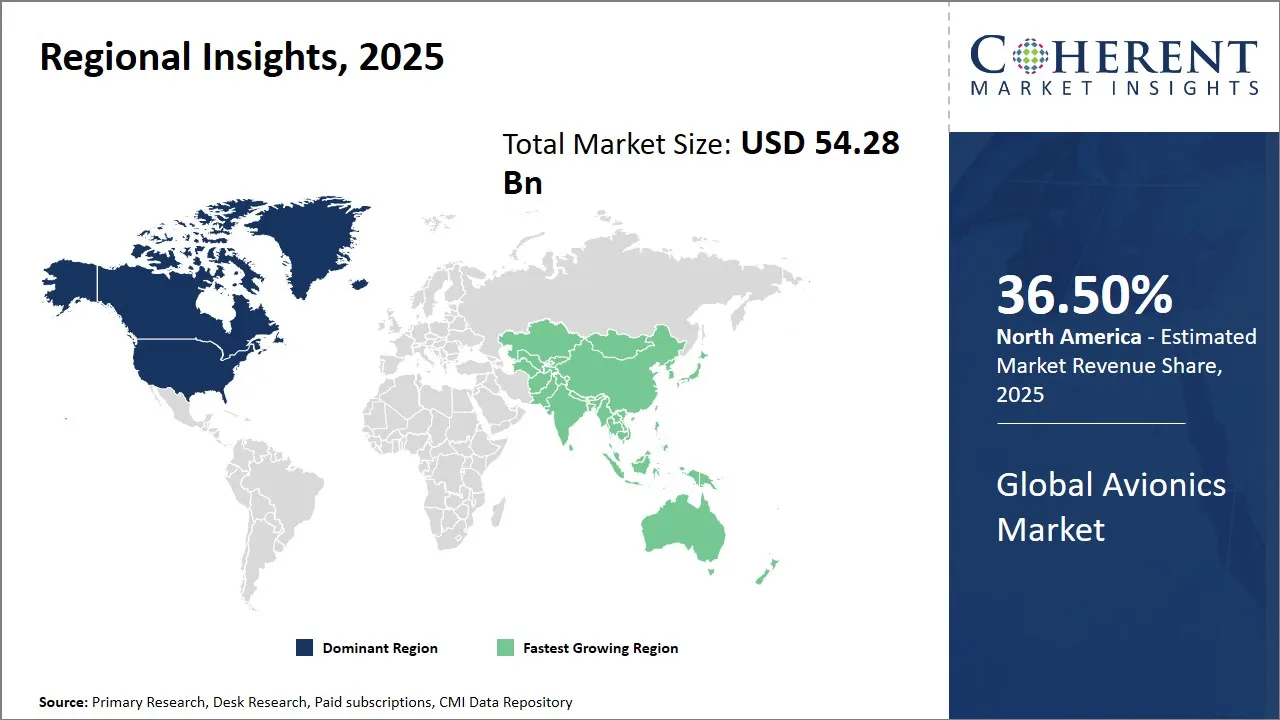
- North America is estimated to lead the market with a share of 36.5 % in 2026.
Asia Pacific, holding a share of 23.3% in 2026, and it is projected to be the fastest growing region.
Market Overview
The market is seeing a big shift towards the use of advanced digital avionics systems that improve flight safety, navigation, and communication. The growing adoption of Unmanned Aerial Vehicles (UAVs) and the development of next-generation aircraft with sustainable and energy-efficient technologies are also affecting the market. Also, increased focus on automation and real-time data analytics is adding to innovation in avionics, adding to the modernization of legacy systems globally.
Current Events and Its Impact
Current Events | Description and its Impact |
Geopolitical and Trade Developments |
|
Economic and Infrastructure Trends |
|
Segmental Insights
- Current Industry Events of 2026
- Market Size Estimation
- Regional Breakdown
- Competitive Landscape
- Customer Intelligence
- Segmental Analysis
- Pricing Analysis
- Key Market Drivers, Challenges & Future Trends
- Customized Insights Section
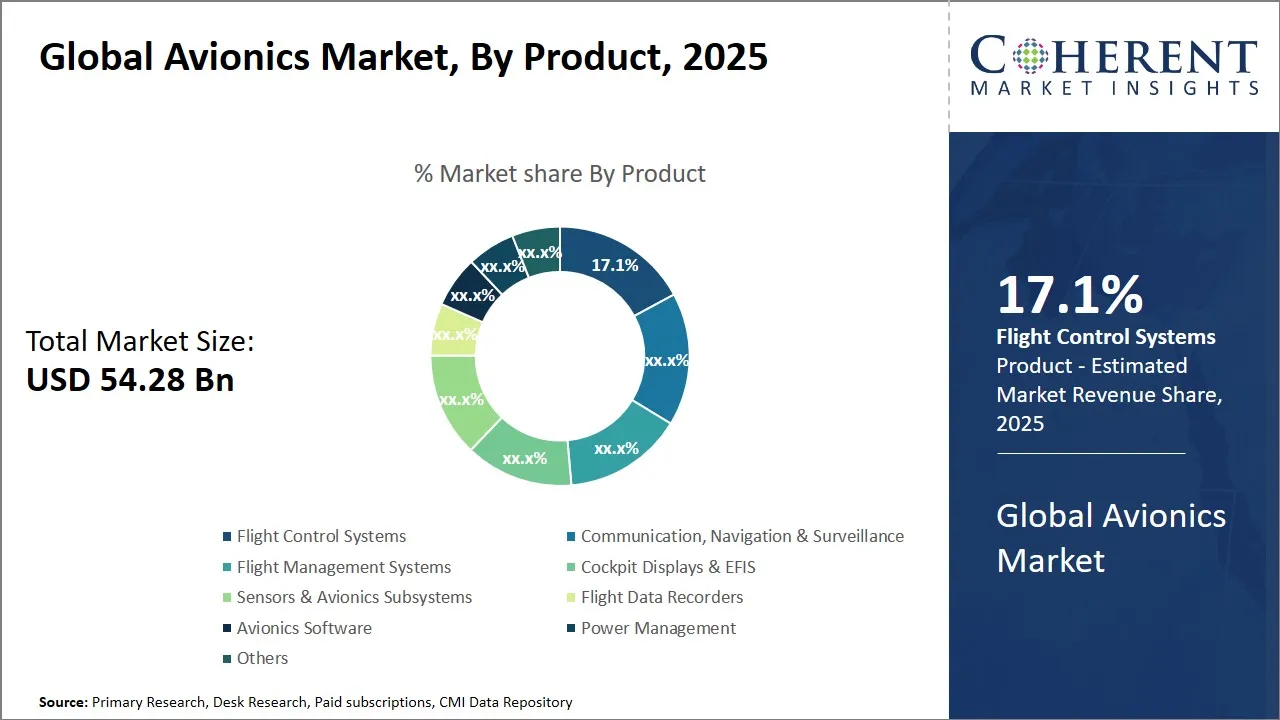
Global Avionics Market Insights, by Product – Advanced Automation and Safety Enhancements Driving Flight Control Systems Segment Growth
The flight control systems segment, holding an estimated share of 21.4% in 2026, holds the highest share of the market because of the increasing demand for improved automation and safety in modern aircraft. Flight control systems are important components that make possible precise management of an aircraft’s stability, maneuverability, and overall flight dynamics through automated or assisted pilot inputs. The rising adoption of fly-by-wire technology has added a lot to the segment growth. This shift improves aircraft responsiveness and reliability and reduces pilot workload, making a lot of demand in commercial, military, and business aviation sectors.
The focus on improving aircraft safety standards globally is also a big factor. Regulatory bodies and aviation authorities are putting in place strict safety norms, pushing manufacturers to use sophisticated flight control technologies that minimize human error and improve fault tolerance. Improved redundancy features and real-time system diagnostics embedded in advanced flight control systems ensure higher operational safety, which remains a high priority in aviation.
Also, rising air traffic coupled with the evolution of complex aircraft designs mandates more advanced flight control solutions. Modern aircraft with increased passenger capacity and range need highly adaptive flight control systems that can manage dynamic aerodynamic forces efficiently. Innovations like adaptive control algorithms and integrated control systems that harmonize with other avionics components also add to segment growth, making possible optimized fuel efficiency and reduced emissions.
Military aviation’s focus on unmanned aerial vehicles (UAVs) and next-generation fighter jets also adds to the demand in the flight control systems segment. These platforms highly depend on sophisticated control systems for precision, agility, and autonomous capabilities, fostering ongoing advancements in flight control technologies.
Impact of AI on the Avionics Market
Artificial Intelligence (AI) is improving operational efficiency, safety, and passenger experience. One major application is in predictive maintenance, where AI algorithms analyze real-time sensor data to identify potential equipment failures before they take place. For instance, GE Aerospace's use of AI-driven predictive maintenance across its jet engine programs has led to a 33% reduction in unscheduled engine removals. Also, AI is being used to optimize flight operations; British Airways' adoption of AI-optimized flight paths resulted in a significant reduction of 100,000 tons of fuel consumption, translating to approximately USD 10 million in cost savings.
Regional Insights
North America Avionics Market Analysis and Trends
North America, holding a projected share of 36.5% in 2026, dominates the global avionics market because of a well-established aerospace ecosystem, advanced technological capabilities, and a lot of government support. The U.S., as the hub of aerospace innovation, has many industry players like Honeywell Aerospace, Collins Aerospace, and Garmin Ltd. These companies invest a lot in R&D to develop cutting-edge avionics solutions including navigation, communication, and flight control systems. Also, strict regulatory frameworks enforced by the Federal Aviation Administration (FAA) ensure high safety standards, indirectly making demand for advanced avionics. The region’s extensive commercial and defense aviation sectors, coupled with high military spending, also add to its leading position. Also, access to a mature supplier network and strong export-import channels make possible smooth trade activities, making North America’s hold stronger in the market.
Asia Pacific Avionics Market Analysis and Trends
The Asia Pacific, holding an estimated share of 23.3% in 2026, shows the fastest growth in the global avionics market because of fast economic expansion, increasing air passenger traffic, and growing defense modernization programs in emerging economies. Countries like China, India, Japan, and South Korea have increased investments in aviation infrastructure and indigenous aerospace manufacturing capabilities. Government initiatives aimed at improving regional connectivity, civil aviation growth policies, and defense upgrades have made demand for advanced avionics solutions. The region sees a burgeoning aerospace supply chain and the entry of global players cooperating with local firms. Key companies adding to this growth include Thales Group, Honeywell, and local players like China’s AVIC and India's Hindustan Aeronautics Limited (HAL). Trade liberalization agreements and expanding aerospace hubs in Singapore and Malaysia also add to the market expansion.
Global Avionics Market Outlook for Key Countries
U.S. Avionics Market Analysis and Trends
The U.S. is a big player in the global avionics industry because of its strong aerospace sector, strong governmental investments in defense and space exploration, and a focus on innovation. Companies like Honeywell Aerospace and Collins Aerospace push this growth with next-generation avionics systems for both commercial and military applications. The FAA’s continuous upgrades in air traffic management systems show the commitment to using advanced avionics solutions. The U.S. defense sector’s modernization programs also make steady demand, with cutting-edge avionics tailored for fighter jets, drones, and transport aircraft.
China Avionics Market Analysis and Trends
China is fast emerging as a big player in the avionics market because of a lot of government support and the fast growth of its commercial aviation sector. The Civil Aviation Administration of China’s policies promote domestic manufacturing under the “Made in China 2026” initiative, pushing firms like the Aviation Industry Corporation of China (AVIC) to develop indigenous avionics systems. Airbus and Boeing, in partnership with local suppliers, also add to the avionics ecosystem. China’s military modernization program makes demand for high-performance avionics, adding to innovations in radar, electronic warfare, and navigation systems.
India Avionics Market Analysis and Trends
India avionics market growth grows because of increasing civil aviation traffic and robust government support for the aerospace sector through initiatives like “Make in India.” Hindustan Aeronautics Limited (HAL) leads indigenous avionics development, joining hands with international companies to improve capabilities. The Indian Air Force’s modernization strategy also makes demand for sophisticated avionics integrated into new aircraft procurements and upgrades. Strategic collaborations with global avionics manufacturers add to knowledge transfer, boosting regional competence and market expansion.
Germany Avionics Market Analysis and Trends
Germany continues to lead the Europe avionics market, supported by a strong aerospace manufacturing base and stringent aviation safety regulations governed by the European Union Aviation Safety Agency (EASA). Companies like Diehl Aerospace and Airbus (headquartered partly in Germany) are crucial contributors, delivering advanced avionics for both civil and defense sectors. Germany’s reputation for precision engineering and innovation sustains demand for reliable, high-performance avionics components, while active collaboration with European aerospace partners helps maintain technological leadership.
Brazil Avionics Market Analysis and Trends
Brazil avionics market is influenced strongly by its aerospace manufacturing giant, Embraer, which plays a pivotal role in developing and integrating avionics for regional jets and military aircraft. The government’s focus on expanding domestic aerospace capabilities through funding and trade incentives fosters technology advances. As regional air travel expands in Latin America, the demand for modern avionics equipped with enhanced navigation and communication systems grows.
Market Players, Key Development, and Competitive Intelligence
Key Developments
- On September 18, 2025, Thales and IndiGo, India’s largest airline, signed a strategic maintenance contract for the airline’s current fleet of 430 Airbus A320 aircraft and future order of over 800 A32X aircraft.
- In July 2025, Safran announced the closing of the acquisition of Collins Aerospace’s flight control and actuation activities which are mission critical systems for commercial and military aircraft, and helicopters. With this transaction, Safran becomes a global leader in flight control and actuation systems and is well-positioned for next-generation platforms.
- In May 2025, India’s major defense technology firm in private domain, Samtel Avionics Ltd. entered into a strategic collaboration and exclusivity agreement with Malaysia-based Aerospace Technology Systems Corp. Sdn. Bhd. The agreement aims to jointly support the Royal Malaysian Air Force’s (RMAF) fleet, particularly the Su-30MKM aircraft, with cutting-edge avionics systems, repair and overhaul services and post-sales support.
- In January 2025, Honeywell and NXP Semiconductors N.V. announced at CES 2025 an expanded partnership that will accelerate aviation product development and chart the path for autonomous flight. This builds on the companies' existing relationship, which is focused on helping optimize how building management systems sense and securely control energy consumption.
Top Strategies Followed by Avionics Market Players
- Established players in this sector invest a lot in research and development (R&D) to make high-performance, cutting-edge products that meet the strict demands of modern aviation.
- Honeywell, partnered with Bombardier to develop next-generation avionics, propulsion, and satellite communication systems. This collaboration includes the development of the Honeywell Anthem integrated flight deck, aiming to improve cockpit automation and connectivity.
- Mid-level players in the avionics market offer a balance between product quality and affordability, appealing to price-sensitive customers like regional airlines, smaller OEMs, and general aviation operators.
- Collins Aerospace's Flight2 integrated avionics system provides a cost-effective and low-risk solution for CNS/ATM upgrades. The system is operational on over 1,100 fixed-wing aircraft, showing its affordability and reliability.
- Small-scale players in the global avionics ecosystem choose agility and innovation, focusing on specialized niches or highly innovative avionics products.
- Garmin's G3X Touch flight display system is designed for experimental aircraft, providing advanced avionics capabilities at a competitive price point.
Market Report Scope
Avionics Market Report Coverage
| Report Coverage | Details | ||
|---|---|---|---|
| Base Year: | 2025 | Market Size in 2026: | USD 58.68 Bn |
| Historical Data for: | 2020 To 2024 | Forecast Period: | 2026 To 2033 |
| Forecast Period 2026 to 2033 CAGR: | 8.1% | 2033 Value Projection: | USD 101.22 Bn |
| Geographies covered: |
| ||
| Segments covered: |
| ||
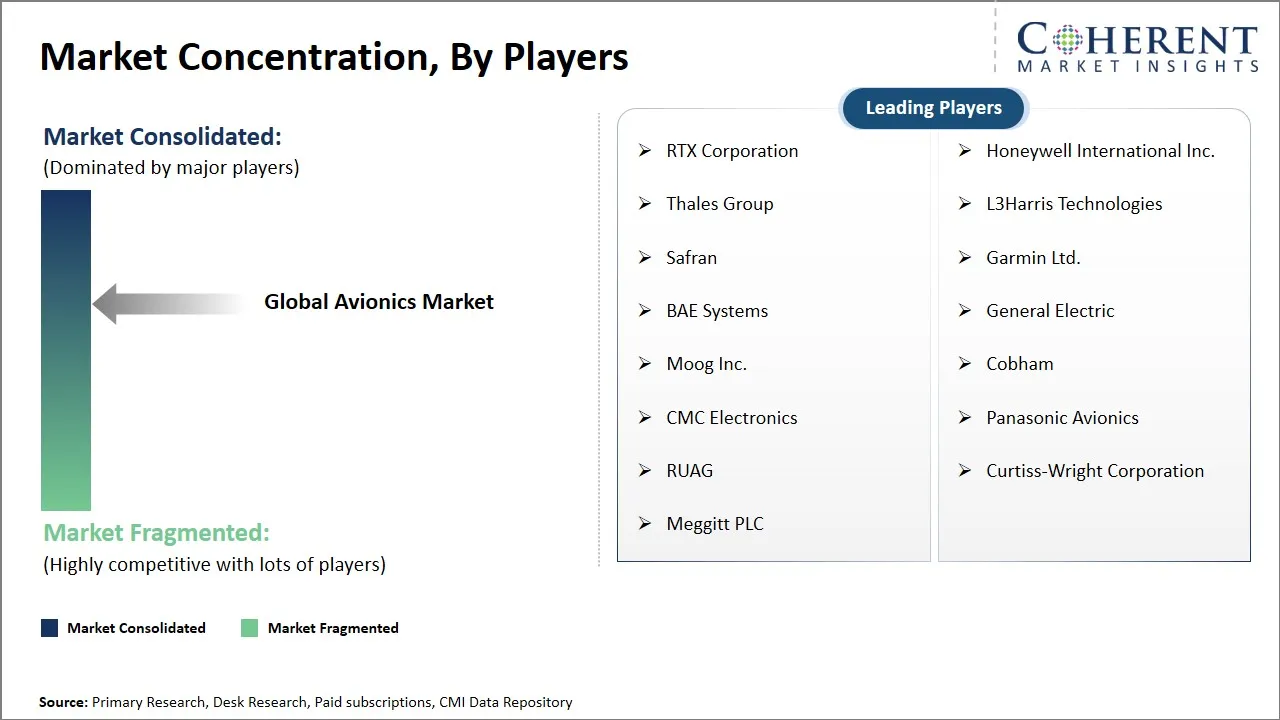
| Companies covered: | RTX Corporation, Honeywell International Inc., Thales Group, L3Harris Technologies, Safran, Garmin Ltd., BAE Systems, General Electric, Moog Inc., Cobham, CMC Electronics, Panasonic Avionics, RUAG, Curtiss-Wright Corporation, and Meggitt PLC | ||
| Growth Drivers: |
| ||
| Restraints & Challenges: |
| ||
Market Dynamics
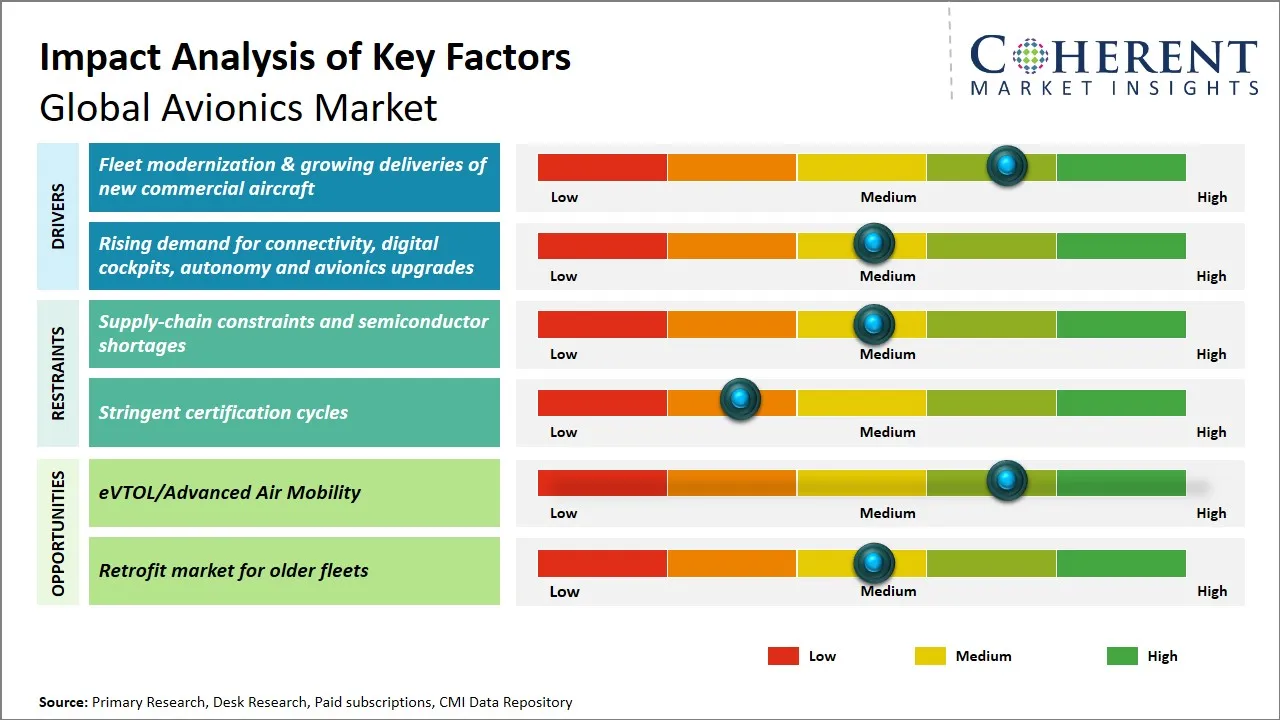
Global Avionics Market Driver – Fleet Modernization & Growing Deliveries of New Commercial Aircraft
The ongoing fleet modernization initiatives seen in airlines worldwide are making a lot of the demand for advanced avionics systems. Airlines are replacing aging aircraft with newer, technologically sophisticated models that need state-of-the-art avionics to improve operational efficiency, safety, and passenger comfort. These modern avionics systems include advanced navigation, communication, and flight management technologies, making possible better fuel efficiency, reduced emissions, and improved real-time data processing capabilities. As carriers look to maintain competitiveness and meet stricter regulatory norms on emissions and safety, investments in advanced avionics become a priority. Consequently, the combined effect of fleet renewal and increased production of next-generation aircraft is a big driver adding to the adoption of sophisticated avionics equipment globally.
Global Avionics Market Opportunity – eVTOL/Advanced Air Mobility
The emergence of electric Vertical Take-Off and Landing (eVTOL) aircraft and Advanced Air Mobility (AAM) solutions give a big opportunity for the global avionics market. This shift creates the need for cutting-edge avionics technologies, including advanced navigation systems, autonomous flight controls, real-time communication modules, and improved safety features suited for urban airspace operations. The unique requirements of eVTOL aircraft like energy-efficient flight management systems and lightweight avionics components add to innovation and demand in the avionics supply chain. Consequently, the use of eVTOL and AAM technologies show a transformative growth vector, adding to the development and adoption of sophisticated avionics systems tailored to next-generation urban air mobility solutions.
Analyst Opinion (Expert Opinion)
- AI is revolutionizing avionics by enabling predictive maintenance, optimizing flight operations, and enhancing safety through autonomous systems. Honeywell's collaboration with NXP Semiconductors exemplifies this trend, integrating AI-driven avionics with advanced computing architectures to support autonomous flying technologies. This partnership aims to adapt automotive autonomy systems for aviation applications, highlighting the industry's shift towards intelligent, self-managing aircraft systems.
- Urban Air Mobility is gaining momentum, driven by the development of electric Vertical Take-Off and Landing (eVTOL) aircraft. These innovations aim to alleviate urban congestion and reduce carbon emissions. Companies like Vertical Aerospace are testing eVTOL prototypes, with Honeywell's Anthem avionics suite being utilized to enhance flight control and safety in these next-generation aircraft.
- The integration of cloud computing into avionics is transforming aircraft operations. Cloud-connected systems enable real-time data sharing, enhancing situational awareness and operational efficiency. Honeywell's Anthem avionics suite exemplifies this trend, offering a cloud-connected cockpit that facilitates seamless communication and data exchange between the aircraft and ground operations.
Speak to the analyst
Want personalized insights?
Take the findings above to one of our principal consultants, or have the report rebuilt around the segments, geographies and competitors you actually track.
Market Segmentation
- Product Insights (Revenue, USD Bn, 2021 - 2033)
- Flight Control Systems
- Communication, Navigation & Surveillance
- Flight Management Systems
- Cockpit Displays & EFIS
- Sensors & Avionics Subsystems
- Flight Data Recorders
- Avionics Software
- Power Management
- Others
- Regional Insights (Revenue, USD Bn, 2021 - 2033)
- North America
- U.S.
- Canada
- Latin America
- Brazil
- Argentina
- Mexico
- Rest of Latin America
- Europe
- Germany
- U.K.
- Spain
- France
- Italy
- Russia
- Rest of Europe
- Asia Pacific
- China
- India
- Japan
- Australia
- South Korea
- ASEAN
- Rest of Asia Pacific
- Middle East
- GCC Countries
- Israel
- Rest of Middle East
- Africa
- South Africa
- North Africa
- Central Africa
- North America
- Key Players Insights
- RTX Corporation
- Honeywell International Inc.
- Thales Group
- L3Harris Technologies
- Safran
- Garmin Ltd.
- BAE Systems
- General Electric
- Moog Inc.
- Cobham
- CMC Electronics
- Panasonic Avionics
- RUAG
- Curtiss-Wright Corporation
- Meggitt PLC
Sources
Primary Research Interviews
Stakeholders
- Avionics OEMs
- Commercial Airlines (Fleet Managers & Technical Operations Heads)
- Defense & Military Aviation Units (Procurement and Flight Safety Officers)
- General Aviation Companies and Business Jet Operators
- eVTOL / Urban Air Mobility Startups (Flight Control and Systems Engineers)
- Avionics Retrofit & Upgrade Service Providers
Databases
- FAA Aircraft Registry Database
- European Aviation Safety Agency (EASA) Fleet & Certification Records
- International Civil Aviation Organization (ICAO) Statistics
- FlightGlobal Fleet Analytics Database
Magazines
- Aviation Today
- Aerospace Manufacturing & Design Magazine
- Air Transport World (ATW)
- Avionics International
Journals
- Journal of Aerospace Engineering
- IEEE Transactions on Aerospace and Electronic Systems
- International Journal of Aviation Management and Technology
- Journal of Air Transport Studies
Newspapers
- Aviation Week & Space Technology
- FlightGlobal News
- The Times (UK) – Aviation Section
- The Economic Times (India) – Aviation & Aerospace
Associations
- Aerospace Industries Association (AIA)
- International Air Transport Association (IATA)
- General Aviation Manufacturers Association (GAMA)
- Society of Automotive Engineers (SAE) – Aerospace Division
- Aircraft Electronics Association (AEA)
Public Domain Sources
- FAA – Federal Aviation Administration Reports
- EUROCONTROL – European Aviation Statistics
- United Nations Office for Outer Space Affairs (UNOOSA) – Air Traffic & Safety Data
- World Bank – Aviation Infrastructure & Investments Reports
- NASA Aeronautics Research Publications
Proprietary Elements
- CMI Data Analytics Tool, Proprietary CMI Existing Repository of information for last 8 years
Get access to 250+ pages report
Every segment, forecast, competitor profile and data table behind the analysis above — available for instant download.
- ESOMAR Member
- ISO 9001:2015 Certified
- D-U-N-S Registered
- GDPR & CCPA Compliant
Missing comfort of reading report in your local language? Find your preferred language:
Transform your Strategy with Exclusive Trending Reports
Frequently Asked Questions
The global avionics market is estimated to be valued at USD 58.68 Bn in 2026 and is expected to reach USD 101.22 Bn by 2033.
The CAGR of the global avionics market is projected to be 8.1% from 2026 to 2033.
Fleet modernization & growing deliveries of new commercial aircraft and rising demand for connectivity, digital cockpits, autonomy and avionics upgrades are the major factors driving the growth of the global avionics market.
Supply-chain constraints and semiconductor shortages and stringent certification cycles are the major factors hampering the growth of the global avionics market.
In terms of product, the flight control systems segment is estimated to dominate the market revenue share in 2026.
Avionics refers to the electronic systems used in aircraft for communication, navigation, flight control, monitoring, and in-flight entertainment.
AI enables predictive maintenance, autonomous flight operations, and enhanced passenger safety and in-flight services (e.g., Honeywell and Collins AI initiatives).