

Airborne Surveillance Market Size and Forecast – 2026 to 2033
The Airborne Surveillance Market is anticipated to grow at a CAGR of 5.3% with USD 6.9 Bn in 2026 and is expected to reach USD 10.3 Bn in 2033. Rising defense modernization initiatives, growing border security requirements, and increasing demand for real-time intelligence, surveillance, and reconnaissance (ISR) capabilities are driving the growth of the Airborne Surveillance Market. India has unveiled a 15-year defence modernization roadmap, representing its most extensive military modernization initiative since independence.
Key Takeaways
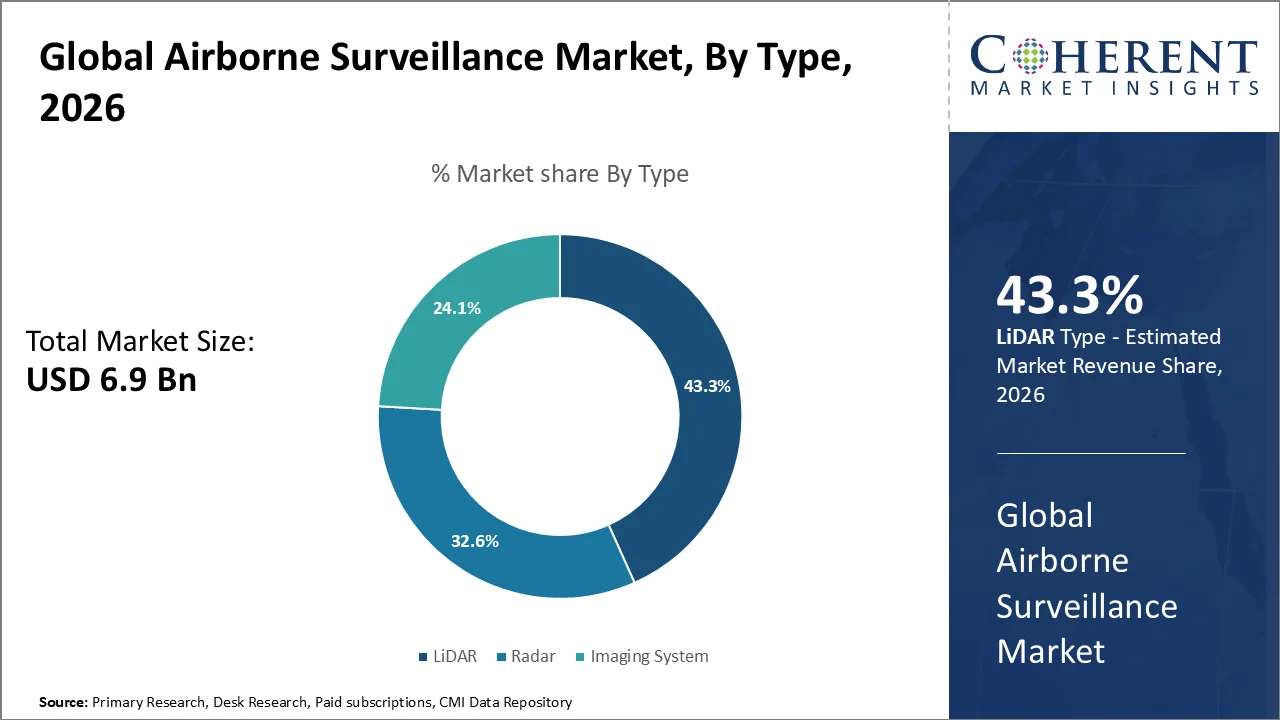
- LiDAR hold the largest market share of 43.3% in 2026 owing to its growing demand for high-resolution geospatial intelligence.
- Manned system expected to hold largest market share of 52.9% in 2026 owing to the rising defense modernization programs.
- Defense acquired the largest market share of 38.8% in 2026 owing to the rising geopolitical tensions. According to the Stockholm International Peace Research Institute (SIPRI), global military expenditure reached a record USD 2.72 trillion in 2024, an increase of 9.4% in real terms compared with 2023.
- North America is expected to acquire the dominant share of 41.7% in 2026 owing to its high defense expenditure. According to SIPRI, the United States spent USD 997 Bn on defense in 2024, accounting for approximately 37% of global military expenditure, reinforcing North America's leadership in defense-related intelligence, surveillance, and geospatial technologies.
Current Events and Their Impact on the Airborne Surveillance Market
Current Event | Description and its Impact |
NATO Members Commit to Higher Defence Spending (2025) |
|
European Union SAFE Defence Financing Instrument (2025) |
|
Segmental Insights
- Current Industry Events of 2026
- Market Size Estimation
- Regional Breakdown
- Competitive Landscape
- Customer Intelligence
- Segmental Analysis
- Pricing Analysis
- Key Market Drivers, Challenges & Future Trends
- Customized Insights Section
Why is LiDAR Acquiring the Largest Market Share?
LiDAR hold the largest market share of 43.3% in 2026. Airborne surveillance operators increasingly adopt LiDAR to achieve highly accurate 3D mapping, terrain analysis, and real-time situational awareness for defense, homeland security, and disaster management missions. Manufacturers continue to improve sensor miniaturization, extend detection ranges, and enhance data processing capabilities, enabling seamless integration with both manned aircraft and unmanned aerial systems. Organizations also combine LiDAR with multi-sensor fusion, artificial intelligence, and geospatial analytics to improve target detection and mission performance. Growing investments in infrastructure monitoring, environmental assessment, and emergency response further drive demand for airborne LiDAR solutions. In August 2026, MicroVision, Inc. launched its MOVIA Air product family for autonomous aerial systems, featuring lightweight lidar sensors that provide real-time 3D environmental awareness for airborne applications. The company will demonstrate the technology at JIFX.
Manned system expected to hold largest market share
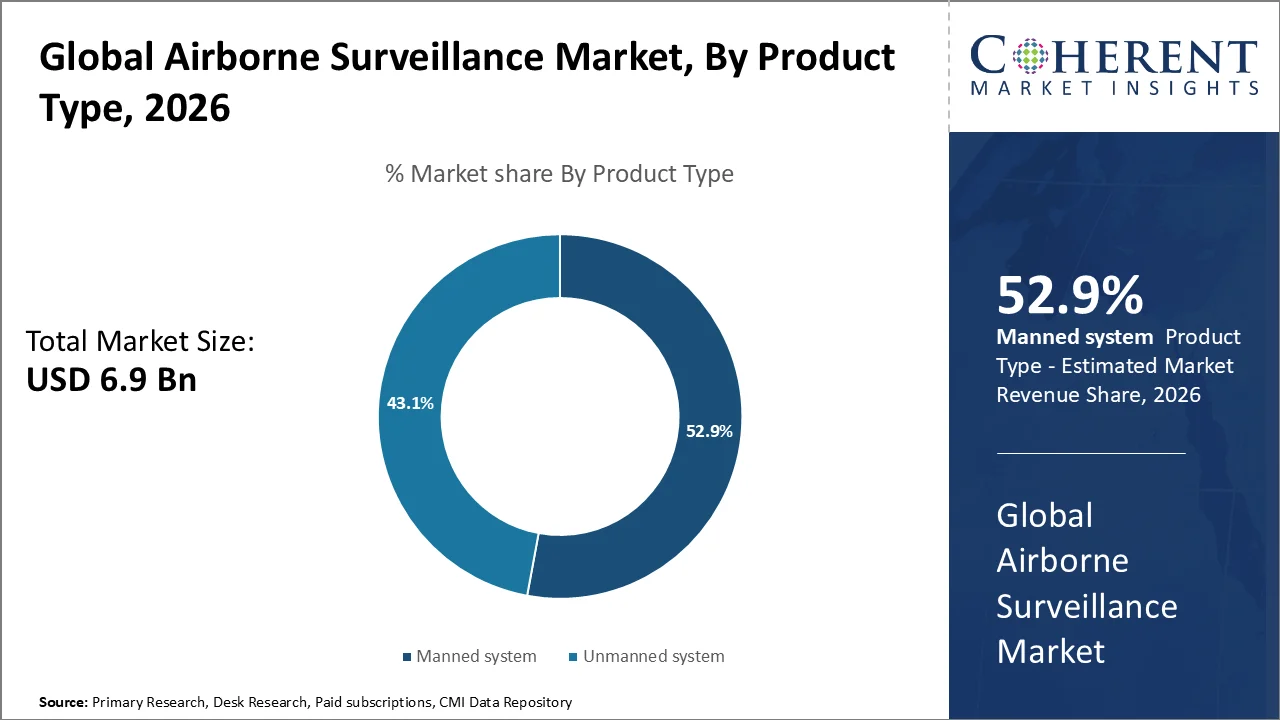
Manned system expected to hold largest market share of 52.9% in 2026 owing to the integration with network-centric warfare systems. Defense agencies increasingly deploy manned systems in the airborne surveillance market to conduct long-endurance intelligence, surveillance, and reconnaissance missions that require advanced onboard decision-making and multi-sensor capabilities. They equip these aircraft with sophisticated payloads, including radar, electro-optical/infrared sensors, LiDAR, and signals intelligence systems, to support complex operations. Governments continue to invest in military modernization, border and maritime security, and fleet upgrades, driving adoption. Operators also rely on manned aircraft to cover vast areas, integrate with command-and-control networks, and respond rapidly to evolving mission requirements. For instance, in September 2024, HENSOLDT launched the ARGOS-15 airborne imaging system at AAD Expo 2024, featuring a 15-inch gimbal designed to deliver advanced surveillance capabilities for medium- and high-altitude manned missions.
Defense acquired the largest market share
Defense acquired the largest market share of 38.8% in 2026 owing to the integration of advanced sensor technologies. Defense organizations drive the airborne surveillance market by addressing rising security threats, advancing military modernization programs, and strengthening real-time intelligence, surveillance, and reconnaissance capabilities. They deploy advanced airborne platforms equipped with radar, electro-optical/infrared sensors, LiDAR, and communication systems to improve situational awareness and enhance mission outcomes. Governments increase investments in border monitoring, maritime security, counterterrorism operations, and battlefield intelligence, creating greater demand for surveillance solutions. The Government of India is strengthening border security through an integrated approach involving border guarding forces, state and district administrations, relevant stakeholders, and local communities to enhance national security and border resilience. Source: PIB
Airborne Surveillance Market Trends
- Increasing deployment of multi-sensor surveillance systems combining radar, electro-optical/infrared (EO/IR), LiDAR, and signals intelligence technologies improve situational awareness, target identification, and operational effectiveness in complex environments. The U.S. Geological Survey (USGS) utilizes LiDAR through its 3D Elevation Program (3DEP) as the national standard for high-resolution elevation mapping, demonstrating the expanding adoption of LiDAR for geospatial intelligence and terrain analysis.
- Expansion of unmanned aerial systems (UAS) adoption supports cost-effective, flexible, and long-duration surveillance missions across defense, law enforcement, disaster response, and infrastructure monitoring applications. Advances in autonomous navigation, sensor miniaturization, and communication technologies continue to improve UAV-based surveillance capabilities. According to the U.S. Federal Aviation Administration (FAA), more than one million drones are registered in the United States, highlighting the growing adoption of unmanned aerial systems across commercial, government, and public safety applications.
- Government investments and defense procurement programs continue to support market growth through fleet modernization, advanced sensor upgrades, and development of network-centric surveillance systems. Countries are prioritizing secure communication networks and real-time data-sharing capabilities to improve operational coordination. At the 2025 NATO Summit, member countries agreed to work toward investing 5% of GDP annually on defence and defence-related expenditure by 2035, supporting modernization of ISR capabilities, airborne surveillance platforms, and secure military communication networks.
Regional Insights
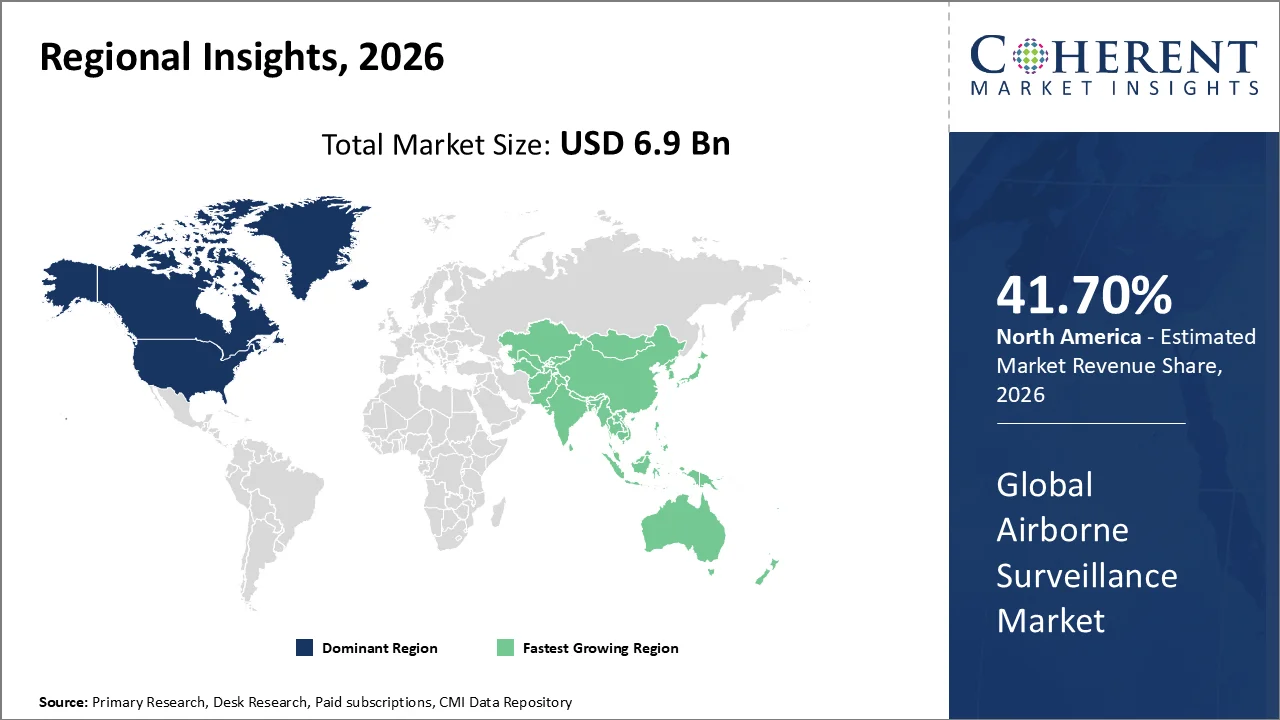
North America dominates owing to presence of a mature aerospace and defense industry
North America is expected to acquire the dominant share of 41.7% in 2026. North America strengthens the airborne surveillance market through substantial defense investments, advanced aerospace capabilities, and rising demand for intelligence, surveillance, and reconnaissance solutions. Governments and defense organizations in the region prioritize military modernization, border protection, maritime monitoring, and homeland security, driving the adoption of manned aircraft, unmanned aerial systems, and advanced sensor technologies. Aerospace and defense companies accelerate innovation in artificial intelligence, radar, LiDAR, and multi-sensor fusion systems. Expanding applications in disaster management, infrastructure inspection, and environmental monitoring further increase the demand for airborne surveillance solutions across the region. The U.S. military conducted “self-defense” airstrikes against Iran on June 9 after Iran allegedly shot down a U.S. Army AH-64 Apache attack helicopter.
Asia Pacific Airborne Surveillance Market Trends
Asia Pacific countries are driving the airborne surveillance market by accelerating defense modernization programs, strengthening border security measures, and expanding maritime monitoring capabilities. Governments are investing in advanced surveillance aircraft, unmanned aerial systems, and intelligence technologies to enhance national security operations. Growing territorial challenges, counterterrorism initiatives, and the demand for real-time situational awareness are increasing the adoption of airborne surveillance solutions. Moreover, advancements in sensors, radar technologies, and communication platforms are enabling military and commercial sectors to improve surveillance efficiency and operational capabilities. Japan has increased its focus on airborne surveillance under its National Security Strategy and Defense Buildup Program, prioritizing the acquisition of intelligence, surveillance, and reconnaissance (ISR) capabilities to strengthen regional security and maritime domain awareness. In July 2026, India has launched a programme to develop indigenous high-altitude airships for long-duration surveillance and intelligence missions, with private companies competing to build platforms capable of supporting months-long ISR operations.
United States Airborne Surveillance Market Trends
The United States airborne surveillance market grows as defense and homeland security organizations increase their demand for advanced intelligence, surveillance, and reconnaissance capabilities. Government agencies and security forces adopt advanced aircraft, unmanned aerial systems, and sensor technologies to address border protection, maritime monitoring, and national security challenges. Defense modernization initiatives, artificial intelligence integration, and the requirement for real-time situational awareness drive market expansion. Increased investments in military infrastructure and advanced surveillance technologies further accelerate the adoption of airborne surveillance solutions. Teledyne FLIR Defense will supply its UltraFORCE 380X-HDc multi-spectral imaging systems to NL EASP AIR, marking the first international sale of its newly launched surveillance gimbal designed for non-U.S. customers.
Japan Airborne Surveillance Market Trends
Japan drives its airborne surveillance market by increasing investments in advanced defense capabilities, maritime security, and border monitoring solutions. The country strengthens situational awareness to address regional security challenges, which encourages the adoption of surveillance aircraft, unmanned aerial systems, and advanced sensor technologies. Japan’s efforts to modernize defense infrastructure, improve disaster management, and enhance intelligence, surveillance, and reconnaissance operations further boost market development. Japan's Ministry of Defense is investing approximately ¥1 trillion (USD 6.3 billion) through fiscal 2027 to procure thousands of unmanned systems across its Ground, Maritime, and Air Self-Defense Forces, strengthening coastal defense and advancing AI-enabled military capabilities.
Who are the Major Companies in Airborne Surveillance Industry
Some of the major key players in Airborne Surveillance are BAE Systems, Boeing, Lockheed Martin Corporation, Raytheon Company, Flir Systems, Israel Aerospace Industries Ltd., L-3 Wescam, Leica Geosystems AG, Leonardo, Northrop Grumman Corporation, and Saab AB.
Key News
- In November 2025, Frontex and Cabo Verde launched aerial surveillance operations to combat cross-border crime and improve maritime safety by enhancing monitoring across the Atlantic migration routes toward the Canary Islands.
Market Report Scope
Airborne Surveillance Market Report Coverage
| Report Coverage | Details | ||
|---|---|---|---|
| Base Year: | 2025 | Market Size in 2026: | USD 6.9 Bn |
| Historical Data for: | 2020 To 2024 | Forecast Period: | 2026 To 2033 |
| Forecast Period 2026 to 2033 CAGR: | 5.3% | 2033 Value Projection: | USD 10.3 Bn |
| Geographies covered: |
| ||
| Segments covered: |
| ||
| Companies covered: | BAE Systems, Boeing, Lockheed Martin Corporation, Raytheon Company, Flir Systems, Israel Aerospace Industries Ltd., L-3 Wescam, Leica Geosystems AG, Leonardo, Northrop Grumman Corporation, and Saab AB. | ||
Analyst Opinion
- Airborne surveillance is shifting from a niche defense capability to a strategic necessity. The demand is no longer driven only by military modernization but by the need for persistent intelligence, faster threat detection, and real-time decision-making. According to the International Civil Aviation Organization (ICAO), thousands of aircraft operate globally at any given time, increasing the importance of advanced airspace monitoring and situational awareness systems. Countries such as Japan, India, and South Korea are prioritizing airborne surveillance platforms to address maritime security concerns, territorial monitoring, and evolving regional threats.
- Unmanned aerial systems are becoming the core growth engine for airborne surveillance adoption. Modern defense forces increasingly prefer drones because they provide longer endurance, lower operational costs, and reduced risks compared with traditional manned platforms. For example, the U.S. military has extensively deployed systems such as the MQ-9 Reaper for intelligence, surveillance, and reconnaissance missions, demonstrating the operational value of unmanned platforms in persistent monitoring and precision intelligence gathering.
- Artificial intelligence and advanced sensor integration will define the next phase of airborne surveillance. Surveillance platforms are moving beyond data collection toward autonomous analysis, where AI-powered systems identify threats, track objects, and support faster military responses. Modern airborne platforms increasingly combine radar, electro-optical/infrared sensors, and machine learning capabilities to process large volumes of data. For instance, the Lockheed Martin F-35 Lightning II integrates advanced sensors and data fusion technologies, highlighting how future surveillance capabilities will depend on intelligent information networks rather than standalone aircraft.
Speak to the analyst
Want personalized insights?
Take the findings above to one of our principal consultants, or have the report rebuilt around the segments, geographies and competitors you actually track.
Market Segmentation
- By Type (Revenue, USD Bn, 2021-2033)
- LiDAR
- Radar
- Imaging System
- By Product Type (Revenue, USD Bn, 2021-2033)
- Manned system
- Unmanned system
- By Application (Revenue, USD Bn, 2021-2033)
- Military
- Defense
- Security and Commercial
- By Region (Revenue, USD Bn, 2021-2033)
- North America
- U.S.
- Canada
- Latin America
- Brazil
- Mexico
- Argentina
- Rest of Latin America
- Europe
- Germany
- U.K.
- France
- Italy
- Spain
- Russia
- Rest of Europe
- Asia Pacific
- China
- India
- Japan
- Australia
- South Korea
- ASEAN
- Rest of Asia Pacific
- Middle East
- GCC
- Israel
- Rest of Middle East
- Africa
- South Africa
- Central Africa
- North Africa
- North America
Sources
Primary Research Interviews
- Discussions with industry stakeholders, including aircraft manufacturers, avionics suppliers, surveillance system developers, defense technology experts, and end users.
- Interviews with professionals involved in airborne intelligence, surveillance, and reconnaissance (ISR) operations.
- Inputs from government agencies, defense organizations, aerospace engineers, and technology specialists.
Databases
- Government defense procurement databases.
- Aviation authority databases.
- Defense expenditure and military equipment databases.
- Aircraft registration and fleet databases.
- Import-export trade databases for aerospace and defense equipment.
- Patent and technology innovation databases.
- Satellite, aerospace, and defense technology databases.
Magazines
- Aerospace industry publications.
- Defense technology magazines.
- Aviation and avionics magazines.
- Military aviation journals and industry newsletters.
- Electronic warfare and surveillance technology publications.
Journals
- Aerospace engineering journals.
- Defense technology research journals.
- Remote sensing and ISR-related academic publications.
- Avionics and radar technology journals.
- Artificial intelligence, sensor technology, and data analytics research journals.
Newspapers
- Global defense and aerospace news publications.
- Aviation industry news sources.
- Government policy and procurement news publications.
- International security and technology news platforms.
Associations
- International Air Transport Association (IATA) resources.
- International Civil Aviation Organization (ICAO) publications.
- Aerospace Industries Association (AIA) resources.
- National Defense Industrial Association (NDIA) publications.
- Aerospace and defense industry associations and technical forums.
Public Domain Sources
- Government defense ministry publications and procurement documents.
- Military aviation program announcements.
- Regulatory authority reports and aviation statistics.
- Congressional/parliamentary defense documents.
- Publicly available aircraft fleet information.
- International security and defense policy documents.
- Patent filings and technology disclosures.
- Academic research papers and conference proceedings.
- Company annual reports and public filings.
- Open-source information on airborne surveillance platforms, sensors, and technologies.
Proprietary Elements
- CMI Data Analytics Tool
- Proprietary CMI Existing Repository of information for last 10 years.
Get access to 250+ pages report
Every segment, forecast, competitor profile and data table behind the analysis above — available for instant download.
- ESOMAR Member
- ISO 9001:2015 Certified
- D-U-N-S Registered
- GDPR & CCPA Compliant
Missing comfort of reading report in your local language? Find your preferred language:
Transform your Strategy with Exclusive Trending Reports
Frequently Asked Questions
The Airborne Surveillance Market is anticipated to grow at a CAGR of 5.3% with USD 6.9 Bn share in 2026 and is expected to reach USD 10.3 Bn in 2033.
The airborne surveillance market is primarily driven by rising demand for persistent intelligence, surveillance, and reconnaissance (ISR) capabilities, and the growing adoption of unmanned aerial systems.
Unmanned aerial systems are transforming airborne surveillance by providing cost-effective, long-duration monitoring capabilities without risking human operators.
Artificial intelligence enhances airborne surveillance by enabling automated data analysis, object recognition, threat identification, and faster decision-making.
Key technologies shaping the market include advanced radar systems, electro-optical and infrared sensors, satellite communication integration, autonomous flight systems, and machine learning-based analytics.
Growing concerns related to illegal fishing, territorial disputes, piracy, and maritime security are encouraging countries to deploy airborne surveillance solutions.