

Zero Emission Aircraft Market Analysis & Forecast - 2026 to 2033
Zero Emission Aircraft Market is estimated to be valued at USD 10.44 Bn in 2026 and is expected to reach USD 30.79 Bn in 2033, exhibiting a compound annual growth rate (CAGR) of 16.7% from 2026 to 2033.
Key Takeaways
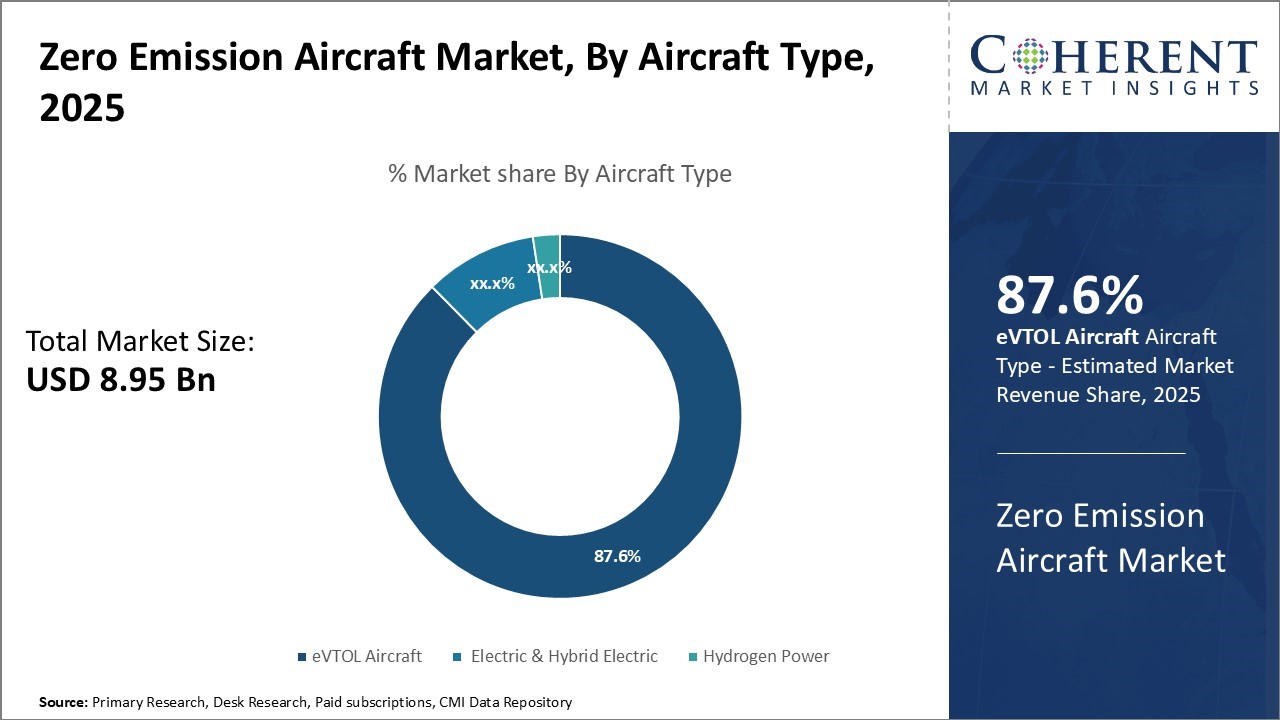
- According to Aircraft Type, the eVTOL category is anticipated to account for the largest share of 88.6% for the zero emission aircraft market in 2026.
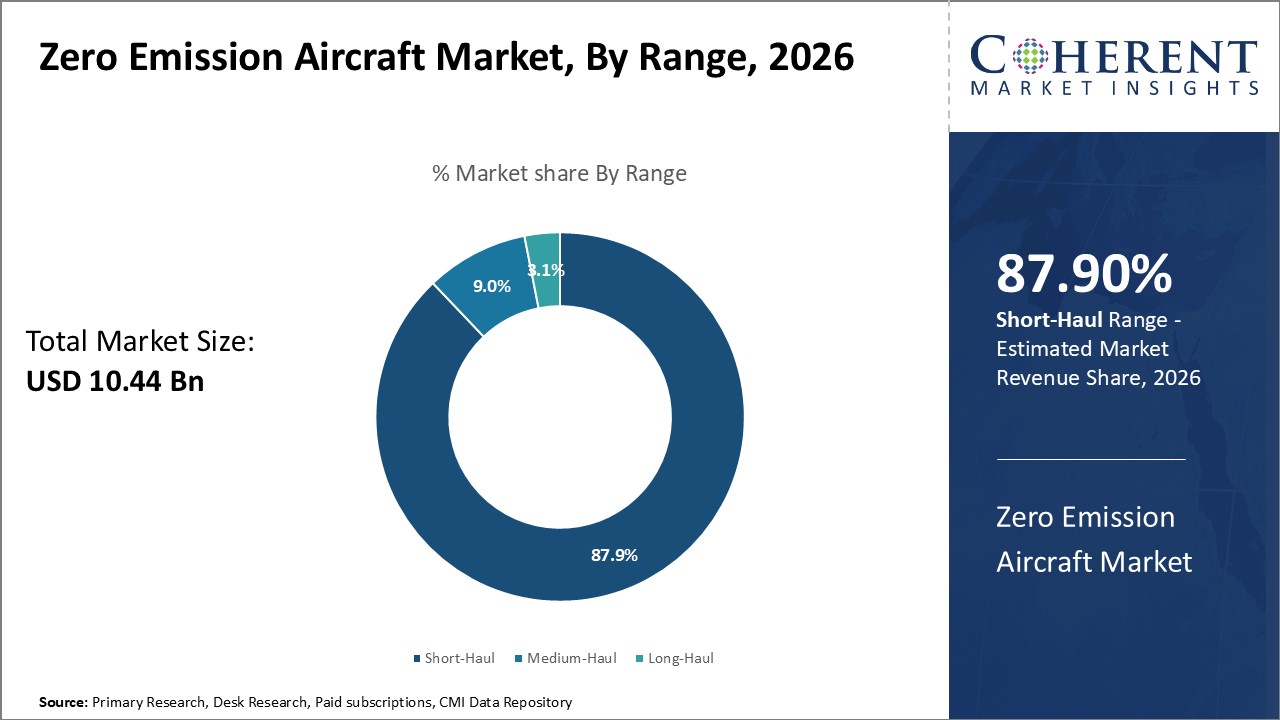
- According to Range, the Short-Haul Segment is anticipated to hold 87.9% share of the zero emission aircraft market in 2026.
- According to Application, Passenger Transportation segment is expected to dominate the zero emission aircraft market with 83.66% shares in 2026.
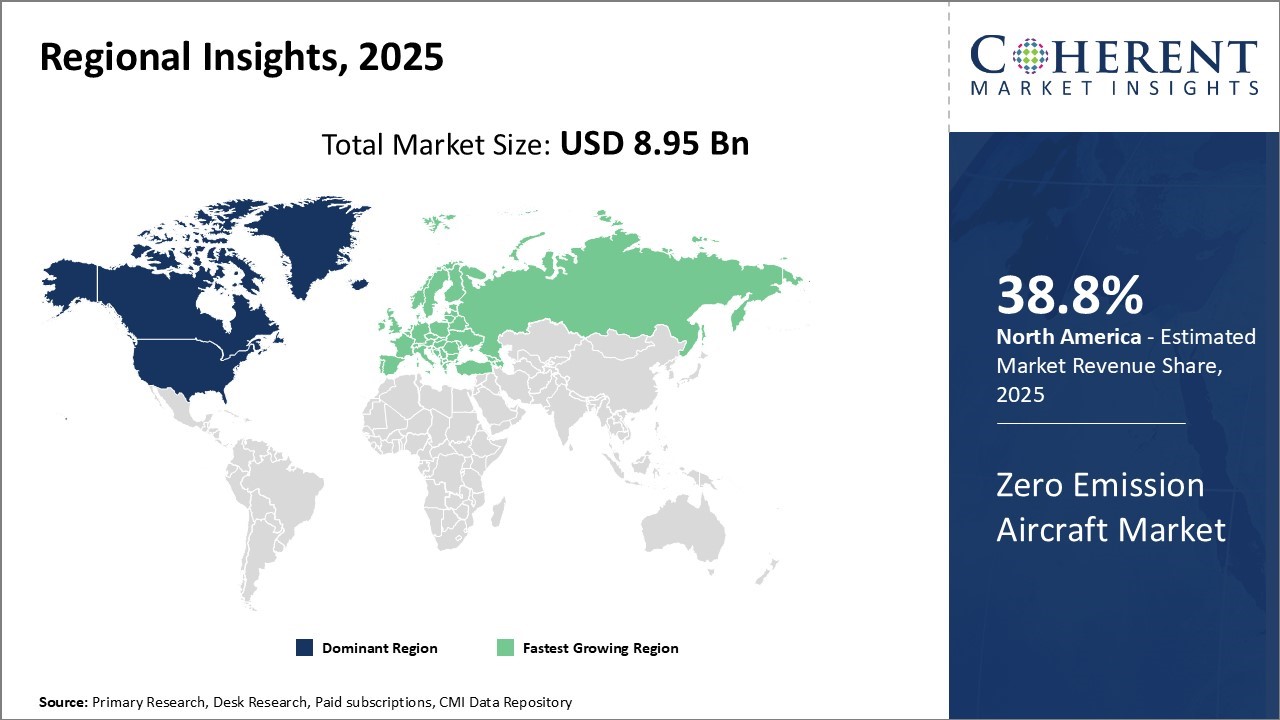
- According to region, North America holds the largest market share of 38.8% in the zero emission aircraft market growth by 2026.
- Europe is considered to be the second dominating region for zero emission aircraft market, exhibiting a CAGR of 21.11% during the forecast period.
Market Overview
The zero emission aircraft market size is bolstered by substantial public and private sector investment, as well as legislative backing and incentives from governments across the globe. The zero-emission aircraft market is expected to witness significant growth over the forecast period. The increasing concerns regarding carbon emissions from air travel along with stringent environmental regulations are expected to drive the demand for zero emission aircraft. Major aircraft manufacturers like Airbus and Boeing are investing heavily in the development of electric and hydrogen-powered aircraft. The development of advanced battery technologies suitable for aviation and increasing range of electric aircraft are further expected to promote adoption of zero emission aircraft.
Current Events and Its Impacts on the Zero Emission Aircraft Market
Event | Description and Impact |
Surge in Government Funding and Incentives |
|
Adoption of AI and Machine Learning in Automation |
|
Segmental Insights
- Current Industry Events of 2026
- Market Size Estimation
- Regional Breakdown
- Competitive Landscape
- Customer Intelligence
- Segmental Analysis
- Pricing Analysis
- Key Market Drivers, Challenges & Future Trends
- Customized Insights Section
Zero Emission Aircraft Market Insights, By Aircraft Type
In terms of aircraft type, eVTOL aircraft is expected to contribute the highest share of 88.6% in 2026, owing to rapid advancements in electric aircraft technologies. eVTOL aircraft or electric vertical take-off and landing aircraft are ideal for short-haul flights and urban air mobility as they can take-off and land vertically like a helicopter but have better cruise efficiency of a fixed-wing aircraft.
Recent technology breakthroughs such as improved battery energy densities, lightweight electric motors and advanced autonomous flight capabilities are making eVTOL aircraft much more viable for commercial applications. Several startups are developing innovative eVTOL designs with multiple rotors and propellers for VTOL operations as well as fixed wings for powered cruise flight.
Successful certification of these new designs by aviation regulators will further spur their adoption over the forecast period. Additionally, investments from automotive and technology giants into urban air mobility startups will help drive the commercial development of eVTOL aircraft for passenger and cargo transportation within cities and metropolitan areas.
Zero Emission Aircraft Market Insights, By Range
In terms of range, short-haul is expected to contribute the highest share of 87.9% in 2026, owing to rising environmental consciousness and congestion on short routes are boosting the demand for zero emission aircraft technology. Air travel accounts for a sizable portion of greenhouse gas emissions globally, with short-haul flights within continents being a major contributor.
Strict emissions regulations for conventional aircraft and the need to reduce carbon footprint is prompting airlines as well as business and private jet operators to adopt hybrid, electric and hydrogen aircraft replacements for short-haul routes.
Zero operating cost benefits and technological improvements will make electric aircraft an economically viable alternative within ranges of up to 500 km over the next decade. This makes short-haul flights an early proliferation area for zero emission aircraft while long-range battery and fuel-cell aircraft technologies continue to advance.
Zero Emission Aircraft Market Insights, By Application
In terms of application, passenger transportation is expected to contribute the highest share of 83.66% in 2026, due to economic growth, rising living standards, and rapid urbanization, thus increasing the demand for air travel, especially locally within major city clusters. While domestic and regional passenger traffic within countries and continents have been rising steadily worldwide, ground transportation infrastructure has not kept pace with increasing congestion levels.
This is opening up opportunities for electric and hybrid-electric aircraft to provide zero-emission options for passenger point-to-point trips between busy metropolitan areas and business hubs that are 200-500 km apart. Major passenger carriers, flying taxis, and eVTOL startups are developing vertiports and establishing routes to capitalize on this lucrative short-haul transportation market driven by increasing travel and the need to reduce emissions as well as traffic from personal vehicles.
Regional Insights
North America Zero Emission Aircraft Market
North America is expected to dominate the zero-emission aircraft market and hold the largest market share of 38.8% in 2026. This can be attributed to strong government support and initiatives in the region for developing and testing electric and hydrogen powered aircraft prototypes.
Many key aircraft manufacturers and startup companies involved in electric propulsion technologies are based in the U.S. and Canada. States like California have ambitious targets for transitioning general aviation to lower emission alternatives. This has accelerated investment in developing scalable technologies required for electric vertical takeoff and landing (eVTOL) aircraft and hybrid electric aircraft designs.
Europe Zero Emission Aircraft Market
Europe is expected to emerge as the fastest growing regional market for zero emission aircraft with CAGR of 21.11% in 2026. Strong policy push for sustainable aviation coupled with focus on emerging technologies under the Clean Aviation partnership is driving the market growth. Countries like Germany and France are at the forefront with testing of various electric aircraft platforms.
For instance, Eviation Aircraft collaborated with Lithuanian companies to flight test its nine-passenger Alice ePlane. EasyJet also partnered with Wright Electric to introduce battery-electric aircraft in its regional fleet by 2030. The growing cross-border collaborations highlight Europe's focus on local manufacturing and building export capabilities in electric aviation systems.
Zero Emission Aircraft Market In Asia Pacific
Industry stakeholders expect the Asia Pacific region especially China to play a dominant role in the future. The country has showed keen interest in the indigenous development of electric aircraft prototypes. State-owned companies, such as China Aviation Industry Corporation (AVIC), are working to accelerate product certification. Localization of supply chains is a key priority to make electric aircraft affordable.
This includes establishing a strong base of cell manufacturers and component engineering talent in the region. Aircraft leasing companies from Singapore have signed agreements with startups working on hybrid aircraft, which is a positive sign for the adoption of sustainable technologies in cargo and commercial transport applications.
Zero Emission Aircraft Market Dominating Countries
U.S Zero Emission Aircraft Market
Strong government backing, a sophisticated aviation infrastructure, the existence of significant aerospace firms, and creative startups all contribute to this leadership. States like California are speeding investment in scalable technologies like electric vertical takeoff and landing (eVTOL) and hybrid electric aircraft by establishing aggressive goals for the transition of general aviation to low-emission alternatives.
India Zero Emission Aircraft Market
India is an emerging market in the zero-emission aircraft sector, with significant potential driven by its rapidly growing aviation industry and increasing focus on sustainability. While India does not yet match the scale of the U.S. or China, the country is witnessing heightened interest in clean aviation technologies due to rising air passenger traffic, government commitments to reduce carbon emissions, and the need to modernize its aviation infrastructure.
Zero Emission Aircraft Market in China
China is rapidly advancing as a major force in the zero-emission aircraft market, propelled by aggressive government policies, substantial investments in green technology, and the world’s largest domestic air travel market. The Chinese government is prioritizing the reduction of aviation emissions as part of its broader climate goals, channeling significant funding into the development of electric and hydrogen propulsion systems.
Market Report Scope
Zero Emission Aircraft Market Report Coverage
| Report Coverage | Details | ||
|---|---|---|---|
| Base Year: | 2025 | Market Size in 2026: | USD 10.44 Bn |
| Historical Data for: | 2020 To 2024 | Forecast Period: | 2026 To 2033 |
| Forecast Period 2026 to 2033 CAGR: | 16.7% | 2033 Value Projection: | USD 30.79 Bn |
| Geographies covered: |
| ||
| Segments covered: |
| ||
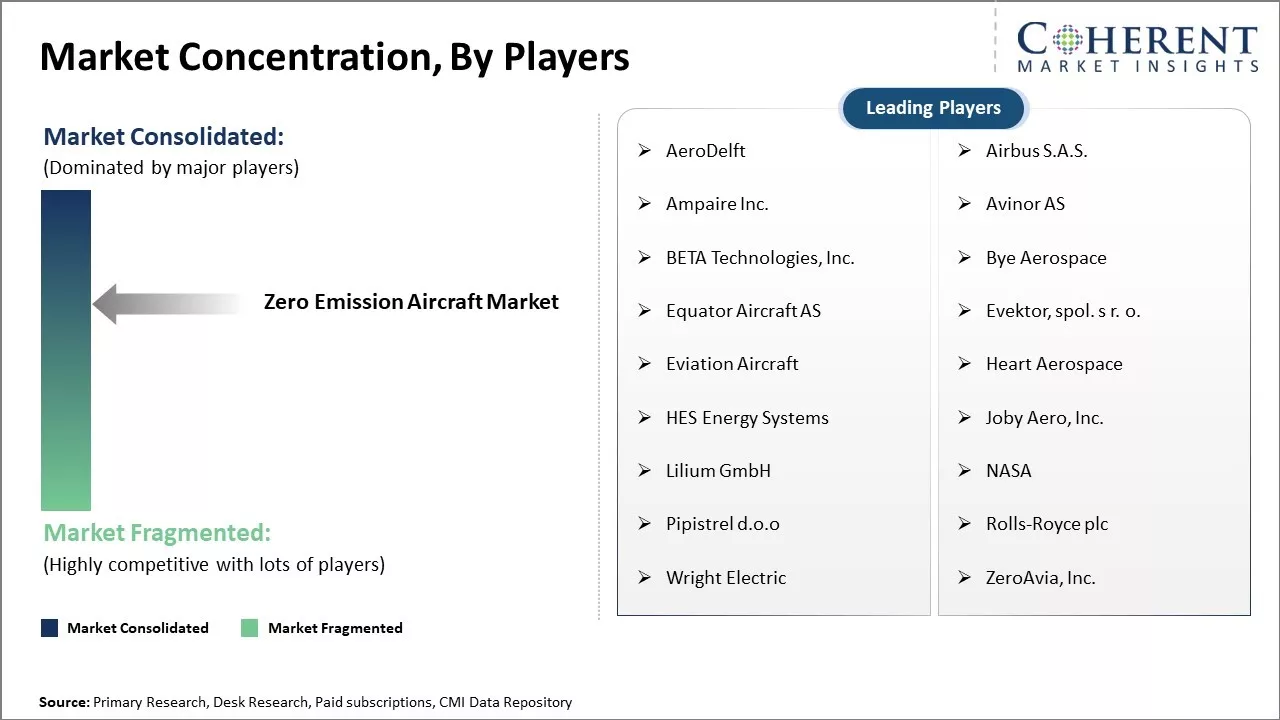
| Companies covered: | AeroDelft, Airbus S.A.S., Ampaire Inc., Avinor AS, BETA Technologies, Inc., Bye Aerospace, Equator Aircraft AS, Evektor, spol. s r. o., Eviation Aircraft, Heart Aerospace, HES Energy Systems, Joby Aero, Inc., Lilium GmbH, NASA, Pipistrel d.o.o, Rolls-Royce plc, Wright Electric, and ZeroAvia, Inc. | ||
| Growth Drivers: |
| ||
| Restraints & Challenges: |
| ||
Market Concentration and Competitive Landscape
Zero Emission Aircraft Market: Growth Drivers
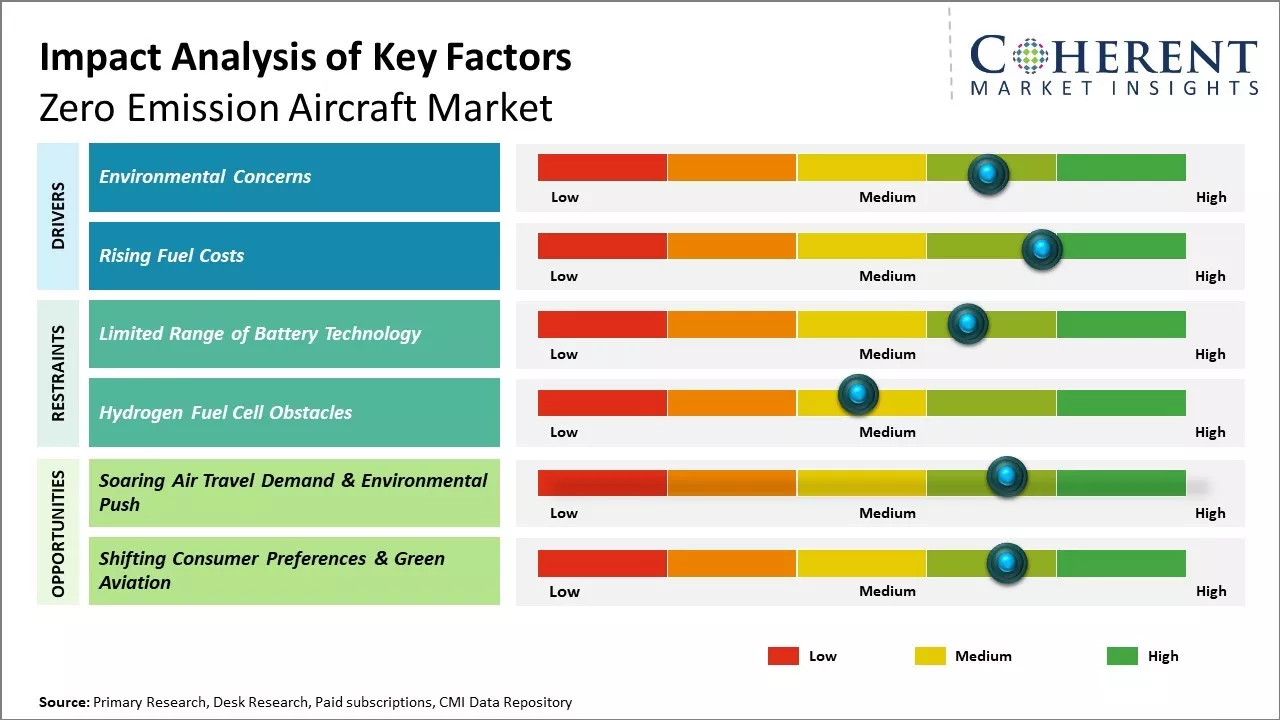
- Environmental Concerns
There is growing concern among governments and the public about the environmental impact of aircraft emissions. The aviation industry is under increasing pressure to reduce its carbon footprint and find ways to cut emissions that contribute to global warming. Commercial aviation accounts for roughly 2-3% of total carbon emissions globally. With air travel continuing to grow in the coming years due to rising incomes and globalization, aviation emissions are expected to increase substantially if no action is taken.
Zero emission aircraft have the potential to address this issue by eliminating local air pollutants and CO2 emissions completely. This would help the aviation industry transition to more sustainable operations and comply with tightening environmental regulations. More countries and municipalities are expected to introduce legislation that incentivizes the deployment of zero emission aircraft, especially for short-haul flights. This is likely to become a major driver of demand over the long run as consumers and corporations become increasingly environmentally conscious.
As the second-largest carbon dioxide emitter globally, after China, the United States faces significant air pollution challenges. In 2021, the country emitted approximately 67 million tons of pollutants, primarily from transportation and electric power sectors.
- Rising Fuel Costs
The aviation industry is heavily dependent on jet fuel to power aircraft and this accounts for a significant portion of operating costs for airlines. Over the past decade, fuel prices have witnessed high volatility driven by geopolitical uncertainty in West Asia and other factors influencing global crude oil markets. In some years, fuel costs alone have wiped out airline profits. The unpredictability of fuel prices poses major challenges for business planning and price competitiveness.
Zero emission aircraft powered by hydrogen fuel cells or electric batteries promise to insulate the industry from these fuel market fluctuations. While hydrogen and electricity will have their own production and distribution costs, they are likely to be more stable over time in comparison to jet fuel whose prices are tied directly to global crude oil markets.
By diversifying their energy sources, airlines can achieve greater budgeting certainty and better manage operating risks. This is attractive from a financial standpoint and could influence investment decisions on new aircraft fleets. As fuel economies continue to improve, total cost of ownership might favor hydrogen and electric options over conventional fueled aircraft.
Higher international refined fuel prices, driven by OPEC cuts and global demand, coupled with a weaker Australian dollar, raised petrol prices in Australia's major cities to 195.6 cpl in the September quarter, up by 12.7 cpl from the previous quarter. ACCC's report highlights the impact of these factors on prices. The increase was primarily due to higher international petrol prices and currency exchange rates. While prices reached record nominal levels, they were lower in real terms compared to previous years. Smaller capital cities saw relatively smaller price hikes, with Hobart at 198.5 cpl, Canberra at 197.4 cpl, and Darwin at 192.6 cpl.
Zero Emission Aircraft Market: Trends
The move to zero-emission alternatives is being supported by economic concerns, such as the need to lessen reliance on conventional fuels and the rising expense of fossil fuels. R&D and the commercialization of these aircraft are being supported Zero Emission Aircraft government incentives including grants and subsidies, as well as investments from the public and private sectors. Governments, technology companies, and manufacturers are working together to accelerate innovation and make it easier to share resources and expertise.
Zero Emission Aircraft Market: Opportunities
- Soaring Air Travel Demand & Environmental Push
The market opportunity for truly zero emission aircraft is massive as air travel demand continues rising globally. Government commitments to sustainability and emission reduction goals in the aviation industry present subsidization possibilities. Early adoption of zero emission flight could yield immense competitive advantages.
Technological improvements may soon overcome current barriers. Growing consumer environmental consciousness may drive preference for green flight options. Airlines seeking to burnish sustainability credentials stand to benefit.
Zero Emission Aircraft Market: Key Developments
- In February 2025, Fabrum, unveiled a hydrogen testing facility in partnership with Christchurch Airport to support the development of green hydrogen-powered technologies, primarily in aviation. The partnership will see a test site established as part of the CIAL’s Kowhai Park, renewable energy precinct.
- In May 2025, ZeroAvia announced that it has signed an agreement with RVL Aviation which will see RVL operate Cessna Grand Caravan aircraft retrofitted with ZeroAvia’s hydrogen-electric, zero-emission ZA600 powertrain. Flights within the British Isles will commence once certification for the engine, airframe integration and planned services are obtained and all retrofit and training work is complete.
- In November 2024, a new, dynamic focus group has been formed to tackle aviation emissions in the United Kingdom. Launched by the country’s Secretary of State for Transport, Louise Haigh, the Jet Zero Taskforce is set to function as the primary driving force in transforming flights in and out of the country, aligning itself with government aims to enforce the UK as an international leader in clean energy.
Analyst Opinion
- The zero emission aircraft market is poised for strong growth over the next decade which is driven by the desire of qerospace companies and governments to reduce carbon emissions from air travel. Major aircraft OEMs like Airbus and Boeing have aggressively ramped up their investments electric and hydrogen powered aircraft development programs in recent years.
- Government policies promoting sustainable aviation along with incentives for using cleaner fules will push airlines and lessors to gradually transition towards zero emission aircraft.
- Technological advancements in battery energy density and hydrogen fuel cells are also helping address concerns around payload capacity and range which were key barriers previously.
- The high costs of creating and scaling new technologies, as well as the requirement for large infrastructure investments, particularly for hydrogen generation, storage, and refueling, are some of the obstacles that analysts point out as potentially slowing the rate of expansion.
- Strong government incentives, rising public and business demand for sustainable aircraft, and the expected cost reductions as technology advance and production scales up have all contributed to the general optimism despite these obstacles.
Speak to the analyst
Want personalized insights?
Take the findings above to one of our principal consultants, or have the report rebuilt around the segments, geographies and competitors you actually track.
Market Segmentation
- By Aircraft Type (Revenue, USD Bn, 2021 - 2033)
- eVTOL Aircraft
- Electric & Hybrid Electric
- Hydrogen Powered
- By Range (Revenue, USD Bn, 2021 - 2033)
- Short-Haul
- Medium-Haul
- Long-Haul
- By Application (Revenue, USD Bn, 2021 - 2033)
- Passenger Transportation
- Cargo and Freight
- Military and Defense
- By Region (Revenue, USD Bn, 2021 - 2033)
- North America
- U.S.
- Canada
- Latin America
- Brazil
- Argentina
- Mexico
- Rest of Latin America
- Europe
- Germany
- U.K.
- Spain
- France
- Italy
- Russia
- Rest of Europe
- Asia Pacific
- China
- India
- Japan
- Australia
- South Korea
- ASEAN
- Rest of Asia Pacific
- Middle East
- GCC Countries
- Israel
- Rest of Middle East
- Africa
- South Africa
- North Africa
- Central Africa
- Key Players Insights
- AeroDelft
- Airbus S.A.S.
- Ampaire Inc.
- Avinor AS
- BETA Technologies, Inc.
- Bye Aerospace
- Equator Aircraft AS
- Evektor, spol. s r. o.
- Eviation Aircraft
- Heart Aerospace
- HES Energy Systems
- Joby Aero, Inc.
- Lilium GmbH
- NASA
- Pipistrel d.o.o
- Rolls-Royce plc.
- Wright Electric
- ZeroAvia, Inc.
Sources
Primary Research Interviews
- Airbus (ZeroE project team)
- Boeing Sustainability & Electrification Division
- Rolls-Royce Electrical
- Wright Electric Inc.
- ZeroAvia Engineering Leads
- Pipistrel (now part of Textron eAviation)
Databases
- IEEE Xplore
- ScienceDirect
- Scopus
- Web of Science
- SpringerLink
Magazines
- Aviation Week & Space Technology
- Aerospace America
- Flying Magazine
- Avionics International
- Aircraft Interiors International
Journals
- Journal of Aerospace Engineering
- International Journal of Hydrogen Energy
- Journal of Aircraft (AIAA)
- Aerospace Science and Technology
- Energy Conversion and Management
- Journal of Power Sources
Newspapers
- The Wall Street Journal (Aviation section)
- The Guardian (Environment and Transport)
- Financial Times (Aerospace sector)
- The New York Times (Climate and Business sections)
- The Times of London (Aviation and Environment)
Associations
- International Civil Aviation Organization (ICAO)
- International Air Transport Association (IATA)
- Clean Aviation Joint Undertaking (EU)
- European Union Aviation Safety Agency (EASA)
- Federal Aviation Administration (FAA)
Proprietary Elements
- CMI Data Analytics Tool
- Proprietary CMI Existing Repository of information for last 8 years
*Definition: The zero emission aircraft market consists of aircraft and component manufacturers focused on developing innovative aircraft technologies that can greatly reduce or completely eliminate aircraft emissions and carbon footprint. It involves research and development of electric and hybrid-electric aircraft powered by batteries, hydrogen fuel cells, or sustainable alternative fuels that produce near-zero or zero emissions. The goal of this emerging market is to commercialize environment-friendly aircraft solutions that can help decarbonize the aviation sector in the coming decades.
Get access to 250+ pages report
Every segment, forecast, competitor profile and data table behind the analysis above — available for instant download.
- ESOMAR Member
- ISO 9001:2015 Certified
- D-U-N-S Registered
- GDPR & CCPA Compliant
Missing comfort of reading report in your local language? Find your preferred language:
Transform your Strategy with Exclusive Trending Reports
Frequently Asked Questions
The Zero Emission Aircraft Market size is estimated to be valued at USD 10.44 Bn in 2026, and is expected to reach USD 30.79 Bn by 2033.
The CAGR of the Zero Emission Aircraft Market is projected to be 16.7% from 2026 to 2033.
Environmental concerns and rising fuel costs are the major factors driving the growth of the global market.
Limited range of battery technology and hydrogen fuel cell obstacles are the major factors hampering the growth of the zero emission aircraft industry.
In terms of aircraft type, eVTOL Aircraft is estimated to dominate the market revenue share in 2026.
AeroDelft, Airbus S.A.S., Ampaire Inc., Avinor AS, BETA Technologies, Inc., Bye Aerospace, Equator Aircraft AS, Evektor, spol. s r. o., Eviation Aircraft, Heart Aerospace, HES Energy Systems, Joby Aero, Inc., Lilium GmbH, NASA, Pipistrel d.o.o, Rolls-Royce plc, Wright Electric, and ZeroAvia, Inc. are the major players.
North America is expected to lead the zero emission aircraft industry in 2026.