

Synthetic Aperture Radar in Space Sector Market Size and Forecast: 2026-2033
The Synthetic Aperture Radar in Space Sector Market is estimated to be valued at USD 1.9 Bn in 2026 and is expected to reach USD 2.34 Bn by 2033, exhibiting a compound annual growth rate (CAGR) of 4.05% from 2026 to 2033.
Key Takeaways
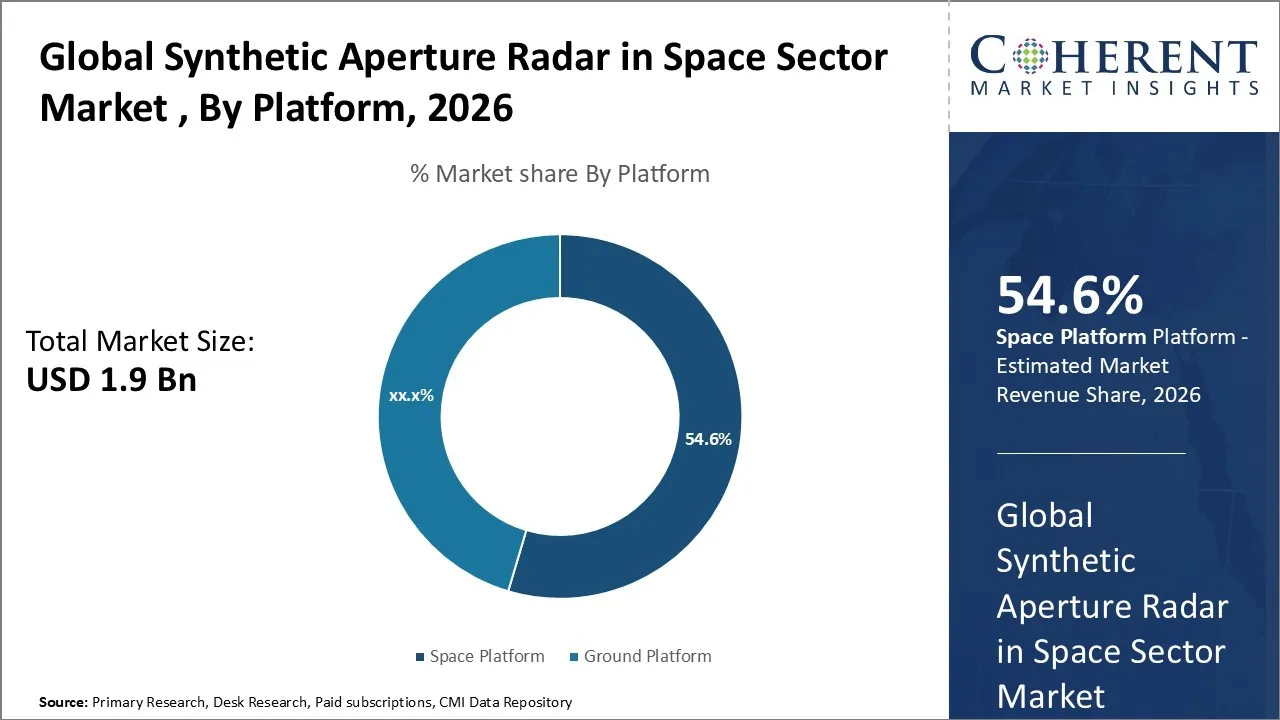
- By Platform, Space Platform hold the largest market share of 54.6% in 2026 owing to the high demand for all-weather, day–night earth observation.
- By Frequency Band, Single-frequency band expected to hold largest market share of 43.4% in 2026 owing to its cost-effectiveness and lower system complexity.
- By Application, Defense acquired the prominent market share of 46.5% in 2026 owing to the strategic surveillance, reconnaissance & intelligence.
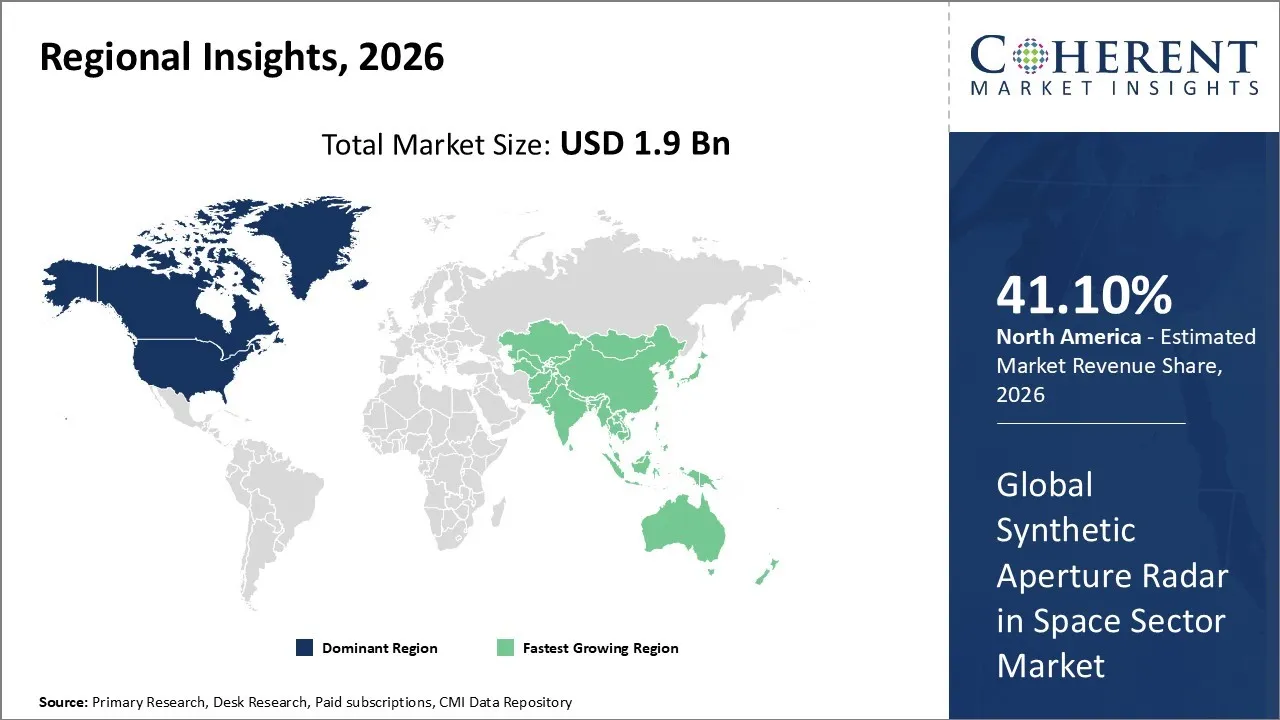
- By Region, North America dominates the overall market with an estimated share of 41.1% in 2026 owing to the strong defense & national security investments.
Market Overview
The Synthetic Aperture Radar in Space Sector Market centers on space-based radar systems that deliver high-resolution Earth observation in all weather and lighting conditions. Strong demand from defense, intelligence, environmental monitoring, disaster response, and commercial geospatial services drives the market. Ongoing advances in satellite miniaturization, launch technologies, and data analytics are speeding up the deployment of SAR satellites and constellations. Continued government backing, along with increasing private sector involvement, is broadening applications in security, infrastructure monitoring, agriculture, and climate observation.
Current Events and Its Impact on the Synthetic Aperture Radar in Space Sector Market
Current Events | Description and its impact |
Geopolitical Tensions and Space Militarization |
|
Economic Shifts and Funding Dynamics |
|
Regulatory and Policy Evolutions |
|
Segmental Insights
- Current Industry Events of 2026
- Market Size Estimation
- Regional Breakdown
- Competitive Landscape
- Customer Intelligence
- Segmental Analysis
- Pricing Analysis
- Key Market Drivers, Challenges & Future Trends
- Customized Insights Section
Synthetic Aperture Radar in Space Sector Market Insights, By Platform - Space Platform contribute the highest share of the market owing to its rising investments & public–private partnerships
Space Platform hold the largest market share of 54.6% in 2026. The space platform segment of the Synthetic Aperture Radar in Space Sector Market grows as users seek continuous and dependable Earth observation from orbit. Space-based platforms deliver broad coverage, frequent revisit rates, and sustained operational performance beyond the reach of ground and airborne systems. Increasing use of satellite constellations for ongoing surveillance, fast disaster response, and maritime tracking strengthens demand. Advances in spacecraft durability, energy efficiency, and onboard data processing continue to drive wider adoption of space platforms for sophisticated SAR missions. For instance, in January 2026, Swiss-based Spacetalk launched a platform to coordinate global space traffic, addressing the lack of a unified international framework and the rapid increase in space actors.
Synthetic Aperture Radar in Space Sector Market Insights, By Frequency Band - Single Frequency band contribute the highest share of the market owing to its strong adoption in defense and security applications
Single-frequency band expected to hold largest market share of 43.4% in 2026. The single frequency band segment in the Synthetic Aperture Radar in Space Sector Market grows as operators focus on ease of use and reliable performance across diverse missions. Single-band SAR systems streamline design, lower development risks, and simplify data processing. Their consistent performance in Earth observation, defense surveillance, and environmental monitoring drives ongoing demand. In addition, seamless integration with current ground infrastructure and established analytical tools motivates organizations to deploy single frequency band solutions for cost-effective and efficient space-based SAR operations. For instance, in January 2026, CLAW introduced three professional plug-and-play UHF wireless microphone systems in India, including the CW-SR50L, CWSR50H, and CWBR100HH, which offer lavalier with head microphone, single handheld, and dual handheld configurations.
Synthetic Aperture Radar in Space Sector Market Insights, By Application - Defense contribute the highest share of the market owing to its growing defense budgets & military modernization
Defense acquired the prominent market share of 46.5% in 2026. The defense segment of the Synthetic Aperture Radar in Space Sector Market grows as militaries and intelligence agencies demand precise, all-weather, and day‑night surveillance. They use space-based SAR to monitor borders, detect threats, track movements, and guide strategic operations. By delivering fast, reliable, and high-resolution imagery, SAR enhances situational awareness and decision-making. Ongoing advancements in satellite constellations, real-time data processing, and integration with intelligence systems continue to expand SAR’s role in modern defense and security missions.
Regional Insights
North America Synthetic Aperture Radar in Space Sector Market Trends
North America dominates the overall market with an estimated share of 41.10% in 2026. The North American Synthetic Aperture Radar in Space Sector Market grows as defense initiatives, government-backed space programs, and technological innovations drive adoption. Organizations deploy advanced satellite platforms, utilize sophisticated data analytics, and integrate miniaturized SAR payloads to improve surveillance, environmental monitoring, and disaster response. Private companies expand their presence through commercial satellite launches and geospatial data services. Federal agencies, research institutions, and industry leaders actively collaborate to accelerate development, positioning North America as a leading center for advanced SAR technology and applications.
Asia Pacific Synthetic Aperture Radar in Space Sector Market Trends
The Asia Pacific Synthetic Aperture Radar in Space Sector Market grows as countries boost investments in space infrastructure and defense capabilities. Governments and private companies deploy SAR satellites to enhance border security, track natural disasters, and manage environmental resources. Advances in smaller satellite platforms and enhanced data analytics improve imaging accuracy and operational efficiency. Research institutions, space agencies, and commercial operators actively collaborate to drive innovation, positioning Asia Pacific as a rising center for space-based SAR applications and strategic Earth observation efforts. For instance, in October 2025, Indian space-tech start-up GalaxEye announced the launch of “Mission Drishti” in early 2026, introducing the world’s first multi-sensor Earth observation satellite that integrates synthetic aperture radar and high-resolution optical payloads, marking a major milestone for India’s private space sector and global space technology.
United States Synthetic Aperture Radar in Space Sector Market Trends
The United States Synthetic Aperture Radar in Space Sector Market grows as federal agencies and defense organizations increase investments in space-based surveillance and intelligence capabilities. U.S. programs deploy SAR satellites to strengthen national security, track environmental changes, and support disaster response efforts. Advances in satellite miniaturization, high-resolution imaging, and real-time data analytics enhance operational efficiency and decision-making. Government agencies, private aerospace companies, and research institutions actively collaborate to drive technology development, establishing the United States as a global leader in space-based SAR solutions and applications.
India Synthetic Aperture Radar in Space Sector Market Trends
The India Synthetic Aperture Radar in Space Sector Market is expanding as the nation strengthens its space capabilities for defense, disaster management, and environmental monitoring. Indian government agencies and private enterprises are launching SAR satellites to improve border security, track natural disasters, and support resource management. Advances in satellite miniaturization, high-resolution imaging, and data analytics are enhancing operational efficiency and accuracy. Collaboration between ISRO, research institutions, and commercial aerospace firms is driving innovation, positioning India as a growing hub for space-based SAR technology and applications. For instance, in December 2025, Indian space and defence technology start-up Sisir Radar has secured USD 7 million in Series A funding, led by 360 ONE Asset with participation from Shastra VC, to support the launch of India’s first privately developed L-band synthetic aperture radar satellite.
End-user Feedback and Unmet Needs in the Synthetic Aperture Radar in Space Sector Market
- Demand for Higher-Resolution Imagery: End-users report the need for more precise and detailed SAR imagery to improve decision-making in defense, environmental monitoring, and infrastructure management. Current resolutions sometimes limit detection of smaller targets or subtle changes, prompting requests for enhanced imaging technology and advanced onboard processing capabilities to deliver actionable intelligence faster.
- Faster Data Delivery and Real-Time Access: Users highlight delays in SAR data transmission and processing as a major challenge. Real-time or near-real-time access is crucial for defense operations, disaster response, and maritime monitoring. End-users seek improvements in satellite networks, ground station infrastructure, and cloud-based analytics to reduce latency and enable immediate actionable insights.
- Integration with Multi-Source Data: Organizations face difficulties combining SAR data with optical, LiDAR, or other remote sensing sources. Users demand platforms and software capable of seamless integration for comprehensive situational awareness. Enhanced interoperability and AI-driven fusion tools are needed to maximize data utility across defense, agriculture, and environmental applications.
Synthetic Aperture Radar in Space Sector Market Trend
Rise of Satellite Constellations
The market is shifting toward deploying SAR satellite constellations to achieve frequent revisit rates and broader coverage. These constellations enable continuous Earth observation, real-time monitoring, and enhanced data reliability. Users in defense, disaster management, and environmental monitoring increasingly prefer coordinated satellite networks over single-satellite missions, driving investments in smaller, cost-effective platforms with improved signal processing and data transmission capabilities.
Integration with AI and Advanced Analytics
SAR data is increasingly paired with artificial intelligence and machine learning tools to extract actionable insights faster. Applications such as automated target recognition, change detection, and predictive environmental monitoring are improving operational efficiency. End-users demand advanced analytics platforms that can process massive datasets in near real-time, enhancing decision-making across defense, agriculture, infrastructure, and climate monitoring sectors.
Synthetic Aperture Radar in Space Sector Market Opportunity
Disaster Management and Humanitarian Support
SAR technology provides reliable data for rapid assessment of natural disasters such as floods, earthquakes, and hurricanes. Governments and NGOs can use SAR imagery to improve emergency response, infrastructure recovery, and early warning systems. Opportunities exist for specialized SAR platforms, real-time data analytics, and subscription-based services that deliver actionable insights, supporting disaster preparedness and humanitarian missions across vulnerable regions.
Market Report Scope
Synthetic Aperture Radar in Space Sector Market Report Coverage
| Report Coverage | Details | ||
|---|---|---|---|
| Base Year: | 2025 | Market Size in 2026: | USD 1.9 Bn |
| Historical Data for: | 2020 To 2024 | Forecast Period: | 2026 To 2033 |
| Forecast Period 2026 to 2033 CAGR: | 4.05% | 2033 Value Projection: | USD 2.34 Bn |
| Geographies covered: |
| ||
| Segments covered: |
| ||
| Companies covered: | Airbus SE, Lockheed Martin Corporation, Israel Aerospace Industries, Thales Group, Northrop Grumman Corporation, MDA Information Systems, Raytheon Company, Harris Corporation, and BAE Systems. | ||
| Growth Drivers: |
| ||
| Restraints & Challenges: |
| ||
Synthetic Aperture Radar in Space Sector Market News
In December 2025, Indian space and defence technology startup Sisir Radar raised $7 million in a Series A round, led by 360 ONE Asset with participation from Shastra VC—marking a key milestone for the company and India’s growing private space sector.
Analyst Opinion (Expert Opinion)
- In expert analysis of the Synthetic Aperture Radar in Space Sector Market, the narrative is increasingly shaped by deployment scale and capability, not abstract growth figures. A defining development has been the rapid build‑out of small satellite SAR constellations, with leading commercial operators launching dozens of satellites to achieve revisit times and imaging fidelity once thought exclusive to government programs; one operator reached a constellation size of 62 SAR spacecraft since 2018, with sub‑30 cm resolution now routinely delivered for defense and disaster response clients globally.
- The integration of dual‑band radar missions, exemplified by the NASA‑ISRO NISAR collaboration—which is the first spaceborne SAR to combine L‑band and S‑band systems for centimeter‑level surface change detection—signals a strategic pivot toward scientific and climate applications in addition to traditional surveillance use.
- On the private side, firms such as ICEYE, now operating nearly fifty satellites providing near‑real‑time imagery to NATO, Japan, and Ukraine, demonstrate that commercial SAR can rival public assets in responsiveness and utility, challenging conventional procurement models and expanding user segments.
- Despite these advances, technical and analytical bottlenecks persist: SAR data remains complex to interpret, demanding intense computational resources and specialized expertise to extract actionable intelligence, and high acquisition and integration costs continue to restrict adoption outside deep‑pocketed defense and government programs.
- Collectively, these trends reflect a market no longer driven solely by capability hype but by operational performance milestones and ecosystem maturity, where satellite count, revisit cadence, and analytical sophistication increasingly determine strategic value.
Speak to the analyst
Want personalized insights?
Take the findings above to one of our principal consultants, or have the report rebuilt around the segments, geographies and competitors you actually track.
Market Segmentation
- By Platform
- Space Platform
- Ground Platform
- By Frequency Band
- Single-frequency Band
- X Band
- C Band
- S Band
- L Band
- UHF/VHF Band
- K/Ku/Ka-Band
- Others
- By Application
- Defense
- Research & Commercial
- Public Safety
- Environmental Monitoring
- Natural Resource Exploration
- Others
- By Regional Insights
- North America
- U.S.
- Canada
- Latin America
- Brazil
- Argentina
- Mexico
- Rest of Latin America
- Europe
- Germany
- U.K.
- Spain
- France
- Italy
- Russia
- Rest of Europe
- Asia Pacific
- China
- India
- Japan
- Australia
- South Korea
- ASEAN
- Rest of Asia Pacific
- Middle East
- GCC Countries
- Israel
- Rest of Middle East
- Africa
- South Africa
- North Africa
- Central Africa
- North America
- Key Players Insights
- Airbus SE
- Lockheed Martin Corporation
- Israel Aerospace Industries
- Thales Group
- Northrop Grumman Corporation
- MDA Information Systems
- Raytheon Company
- Harris Corporation
- BAE Systems
Sources
Primary Research interviews
- Insights from NASA ARSET SAR training webinars
- Expert interviews at IEEE IGARSS 2024 Conference
- Technical discussions from NISAR Early Adopter Workshops
Databases
- NASA Technical Reports Server (NTRS): SAR technology and mission documentation
- NASA Earthdata SAR platform and resources
- ARSET SAR data training and access guides
Magazines
- NASA mission articles on SAR applications and Earth observation
Journals
- Acta Astronautica research on small satellite SAR design
- IEEE IGARSS 2024 proceedings on commercial SAR data usage
Newspapers
- Reuters coverage of the NASA‑ISRO SAR (NISAR) mission launch
- Times of India reporting on Indian SAR satellite initiatives
Associations
- NASA Applied Sciences and SAR training events by ARSET
- International SAR technical discussions and workshops (e.g., conference proceedings)
Public Domain sources
- NASA mission pages for NISAR (dual‑band SAR)
- NASA Earthdata and SAR algorithm tutorials
- NASA historical SAR remote sensing perspectives
Proprietary Elements
- CMI Data Analytics Tool
- Proprietary CMI Existing Repository of information for last 8 years
Get access to 250+ pages report
Every segment, forecast, competitor profile and data table behind the analysis above — available for instant download.
- ESOMAR Member
- ISO 9001:2015 Certified
- D-U-N-S Registered
- GDPR & CCPA Compliant
Missing comfort of reading report in your local language? Find your preferred language:
Transform your Strategy with Exclusive Trending Reports
Frequently Asked Questions
The Synthetic Aperture Radar In Space Sector Market is estimated to be valued at USD 1.9 Bn in 2026 and is expected to reach USD 2.34 Bn by 2033.
The global synthetic aperture radar in space sector market is estimated to surpass USD 2.34 Bn by 2033.
Major players operating in the global synthetic aperture radar in space sector market include Airbus SE, Lockheed Martin Corporation, Israel Aerospace Industries, Thales Group, Northrop Grumman Corporation, MDA Information Systems, Raytheon Company, Harris Corporation, and BAE Systems.
Among applications, defense application segment accounted for largest share in the global SAR in space sector market.
Increasing demand for technology in enhancing situational awareness is one of the major factors that is expected to propel growth of the market over the forecast period.
The global synthetic aperture radar in space sector market is estimated to exhibit a CAGR of 4.05% over the forecast period.
Among regions, North America held the dominant position in the market.