

Weapon Carriage and Release System Market Size and Share Analysis – 2026 To 2033
The global Weapon Carriage and Release System Market size is anticipated to grow at a CAGR of 4.3%, from USD 571 Mn in 2026 to approximately USD 767 Mn by 2033. The key drivers for the growth of the market are the increasing defense modernization programs, increasing procurement of advanced fighter aircraft and unmanned aerial vehicles (UAVs), increasing demand for precision-guided munitions and technological advancements in the aircraft weapon integration and release mechanisms. As per the U.S. The Department of the Air Force employs the GBU-39/B Small Diameter Bomb system, which includes a smart carriage that can carry four precision-guided munitions, thereby increasing aircraft weapon loadout and enhancing operational efficiency.
Key Takeaways
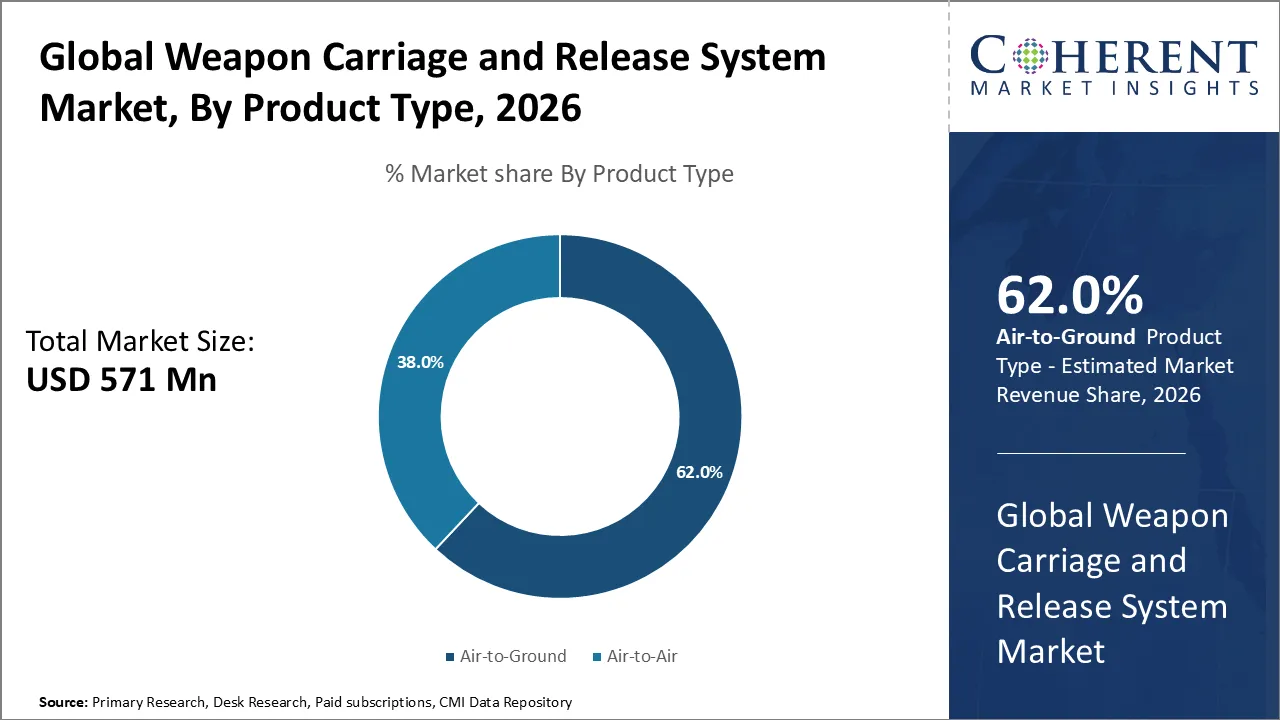
- The air-to-ground segment is expected to dominate the global weapons carriage and release systems market with an estimated share of 62.0% in 2026. The segment’s growth is driven by increasing integration of precision-guided bombs, multi-store ejector racks, and advanced weapon-release mechanisms across modern combat aircraft. According to the U.S. Department of Defense’s FY2026 budget briefing, the department requested USD 3.1 billion for 21 F-15EX aircraft, supporting continued investment in high-payload combat platforms and associated weapon carriage capabilities.
- The air force segment is projected to lead the market with an estimated share of 74.0% in 2026. The segment is expected to dominate due to modernization of fighter aircraft fleet and integration of next-generation weapon systems coupled with increasing demand for reliable airborne weapons deployment. The U.S. Senate Appropriations Committee in February 2026 reported USD 57.3 billion in Air Force procurement funding and USD 50.6 billion for research and development as part of the FY2026 defense appropriations legislation, including additional funding for F-35A fighter aircraft procurement.
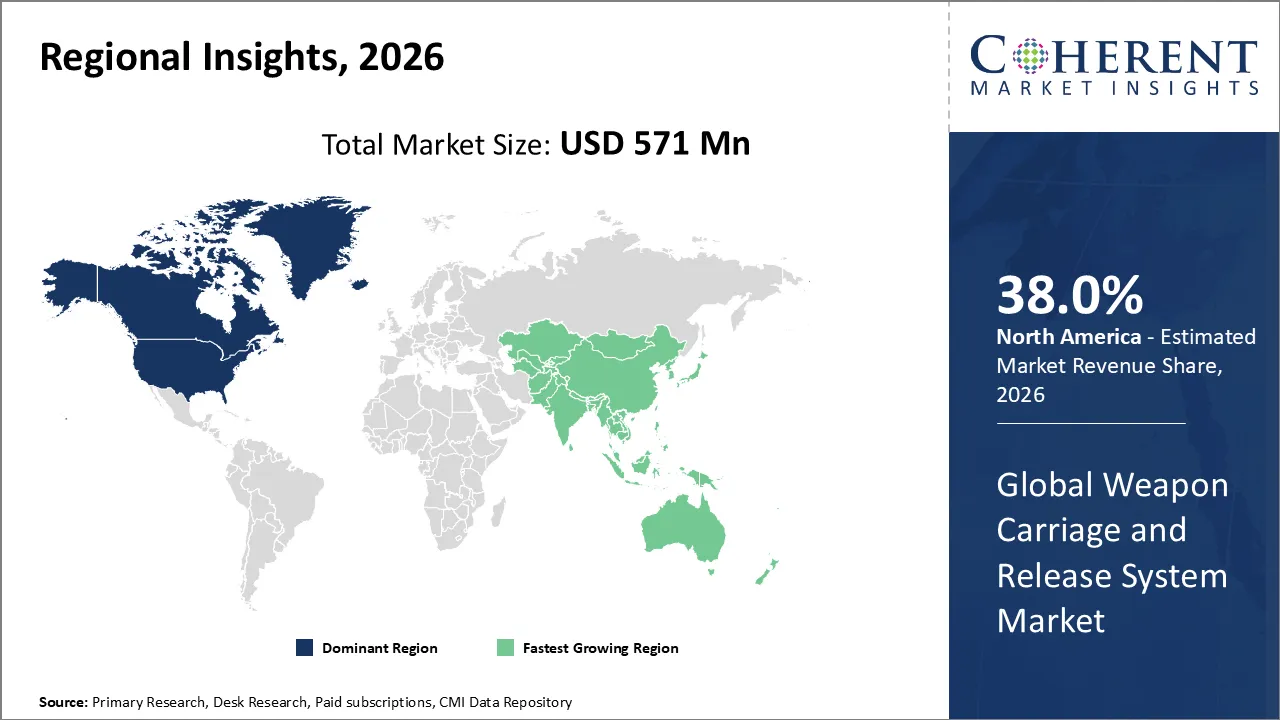
- North America is expected to dominate the market with a share of 38.0% in 2026. The regional aerospace defense manufacturing ecosystem, acquisition programs for advanced combat aircraft and investments in precision weapon integration technologies will drive regional growth. The Stockholm International Peace Research Institute (SIPRI) reports that military expenditure in the U.S. in 2025 amounted to USD 954 billion. This figure is approximately one-third of the world’s military expenditure, proving the U.S. position as the top defense spender in the world.
Market Drivers
Increasing Procurement of Advanced Fighter Aircraft is Accelerating the Weapon Carriage and Release System Market in the U.S.
The U.S. weapon carriage and release system market is anticipated to grow steadily owing to increased investments in next-generation combat aircraft, modernization of existing fighter fleets, and demand for high-capacity weapon deployment systems. With military aircraft having to carry a variety of precision guided weapons, but still retain operational flexibility, the integration of advanced ejector racks, missile launchers and multi-store carriage assemblies is becoming increasingly important.
According to the U.S. Congressional Research Service (CRS), in FY2026, the Department of Defense requested approximately USD 68.3 billion in procurement and research funds for aircraft and related systems, including combat aircraft, military helicopters, and unmanned aerial platforms.
Growing Adoption of Precision-Guided Munitions is Driving Demand for Advanced Weapon Release Systems
Increasing use of precision-guided munitions is emerging as a major factor driving the global weapon carriage and release system market. The air forces of today are concentrating on weapon systems capable of delivering multiple precision-guided bombs and missiles in a single mission. Therefore, the importance of advanced release mechanisms, multi-store ejector racks and electronically controlled weapon carriage systems supporting enhanced targeting flexibility and aircraft payload utilization is on the rise.
In April 2026, the U.S. Air Force awarded Raytheon a contract with a ceiling value of approximately USD 708.9 million for Small Diameter Bomb Increment II (StormBreaker) Production Lot 12, associated test equipment, and spares. The contract also covers foreign military sales involving Belgium, Canada, Finland, Germany, Italy, Norway, South Korea, and Switzerland.
Furthermore, the U.S. Department of Defense’s FY2026 Program Acquisition Costs by Weapon System lists the GBU-53/B StormBreaker as a precision-guided air-to-ground weapon with a standoff range of over 40 nautical miles from medium altitude and 70 nautical miles from higher altitudes. The program emphasizes greater flexibility in targeting and aircraft weapon loadout.
Current Events and Their Impact on the Weapon Carriage and Release System Market
Current Event | Description and its Impact |
U.S. Government Introduces Defense Acquisition Modernization Reforms (2025–2026) |
|
European Union Expands Defense Procurement Funding and Simplifies Cross-Border Regulations (2025–2026) |
|
- Current Industry Events of 2026
- Market Size Estimation
- Regional Breakdown
- Competitive Landscape
- Customer Intelligence
- Segmental Analysis
- Pricing Analysis
- Key Market Drivers, Challenges & Future Trends
- Customized Insights Section
Segmental Insights
Why is the Air-to-Ground Segment Acquiring the Largest Market Share?
On the basis of product type, the air-to-ground segment is projected to account for the largest Weapon Carriage and Release System Market share of approximately 62.0% in 2026. The growth in the segment is due to the rising demand for accurate air-to-ground precision guided munitions, advanced ejector racks, reliable weapon separation mechanisms and multi-store carriage systems on fighter aircraft and bombers.
According to the U.S. Department of Defense’s FY2026 Program Acquisition Costs by Weapon System, the U.S. Air Force and Navy requested a combined USD 187.5 million for 2,298 Joint Direct Attack Munition (JDAM) guidance kits in FY2026. These weapons need compatible aircraft carriage, release and stores-management interfaces, which bodes well for continuing demand for airborne weapon delivery technologies.
In April 2026, the U.S. Navy flight tested the JDAM Long Range (LR) variant twice, with each flight covering approximately 200 nautical miles. Demonstrations showed safe weapon separation, compatibility with existing aircraft interfaces and controlled flight performance, emphasizing the criticality of advanced weapon-release integration to next-generation standoff strike capabilities.
Why Does the Air Force Segment Hold the Largest Market Share?
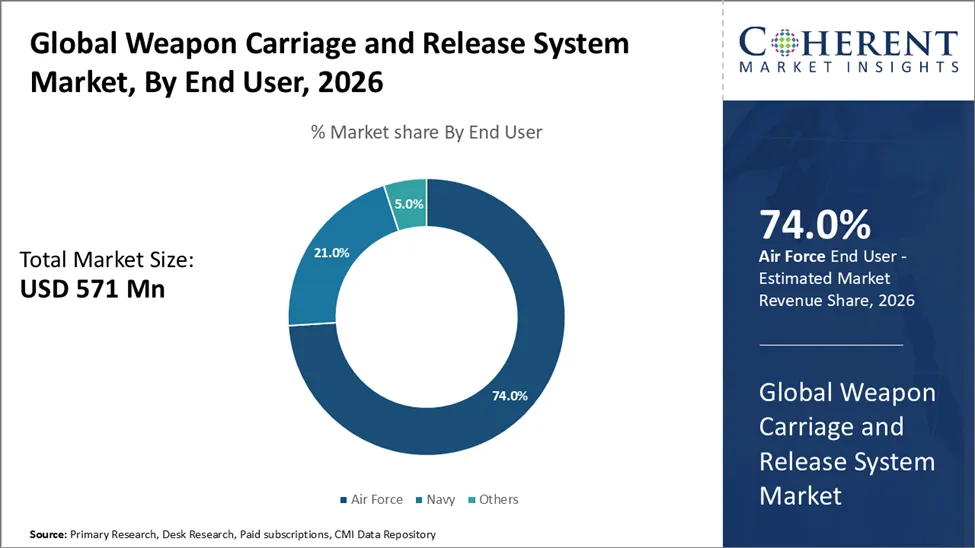
On the basis of end user, the air force segment is anticipated to lead the Weapon Carriage and Release System Market with approximately 74.0% of the total market share in 2026. The growth in the segment is attributed to increasing procurement of multi-role combat aircraft, modernization of existing fighter fleets and growing integration of advanced weapon carriage assemblies and electronically controlled release systems.
In January 2026, Lockheed Martin announced it delivered a record 191 F-35 fighter aircraft in 2025, exceeding its previous annual record of 142 aircraft. That’s coming as the global F-35 fleet approaches 1,300 aircraft, a sign of the increasing number of state-of-the-art military aviation platforms that require integrated weapons management and carriage capability.
The U.S. Air Force announced in July 2026 the successful live-fire testing of its YFQ-44A Collaborative Combat Aircraft (CCA), developed by Anduril Industries, a major step forward in airborne weapon carriage and release technologies.
In July 2026, the U.S. Air Force announced that its Anduril Industries-built YFQ-44A Collaborative Combat Aircraft (CCA) had been successfully tested in live-fire, marking a major breakthrough in airborne weapon carriage and release technologies.
Weapon Carriage and Release System Market Trends
- The increasing use of multi-store weapon carriage systems favors the development of compact missile launchers that can carry multiple precision-guided weapons on a single aircraft. In July 2026, MBDA announced that its SPEAR missile had entered low-rate initial production and confirmed development of a three-missile external launcher, alongside a four-missile internal launcher for the F-35B. The company expects the external launcher to be ready for certification in early 2027.
- The growing integration of long-range standoff missiles on fifth-generation fighter aircraft is increasing demand for advanced pylons, heavy-store carriage assemblies, and reliable weapon-separation mechanisms. Lockheed Martin announced in June 2026 it had finished the first phase of F-35C Long-Range Anti-Ship Missile (LRASM) integration testing after flight trials from September 2024 to April 2026. These tests evaluated aircraft performance with heavy external weapons loads.
- The increasing trend toward pneumatically actuated and electronically controlled release mechanisms is driving the implementation of reusable weapon carriage systems with reduced maintenance requirements. Pneumatic multi-station carriers with integrated compressor, electronic weapon interfaces and 20 ft/sec ejection velocity for 500-pound stores are available from L3Harris. The systems decrease reliance on pyrotechnic cartridges and enable precision weapon deployment across multiple aircraft platforms.
Regional Insights
North America Dominates Owing to Advanced Combat Aircraft Modernization and Strong Defense Manufacturing Capabilities
North America is expected to hold the largest share of the Weapon Carriage and Release System Market with around 38.0% in 2026. Established aerospace and defense manufacturers, rising investment in next-generation unmanned combat aircraft and continued demand for advanced weapon carriage assemblies, ejector racks and electronic release-control systems, support regional growth.
In February 2026 the U.S. Air Force announced that its Collaborative Combat Aircraft (CCA) program had begun weapons integration and captive-carry tests with inert test munitions. The tests include measuring aircraft structural integrity, aerodynamic performance and compatibility between weapons and aircraft systems. This development underscores the growing investment in weapons carriage technologies for both autonomous and next-generation combat platforms.
In December 2025, the U.S. Defense Security Cooperation Agency announced the approval of a possible Foreign Military Sale to Canada of air strike weapons and associated equipment for an estimated USD 2.68 billion. This proposed acquisition reflects Canada’s efforts to enhance its airborne strike capabilities and it is expected to drive demand for compatible weapon integration, carriage and release equipment across North America.
Asia Pacific Weapon Carriage and Release System Market Trends – Fastest Growing Region
Asia Pacific is expected to emerge as the fastest-growing region in the Weapon Carriage and Release System Market during 2026–2033. Regional growth is driven by expanding indigenous combat aircraft manufacturing, increasing procurement of multirole fighter aircraft, and development of advanced airborne weapons integration systems across India, South Korea, Australia, and Japan.
In February 2026, India's Defense Acquisition Council approved capital acquisition proposals worth around INR 3.60 lakh crore (INR 3.6 trillion) including procurement proposals of Rafale multirole fighter aircraft and combat missiles for the Indian Air Force. Most of the proposed fighter aircraft are to be manufactured domestically.
In September 2026, South Korea’s Defense Acquisition Program Administration (DAPA) announced to deliver the first domestically developed KF-21 Boramae fighter aircraft to the Republic of Korea Air Force. The aircraft completed approximately 1,600 flight tests covering more than 13,000 test conditions, including air-to-air weapon firing evaluations.
U.S. Weapon Carriage and Release System Market Trends
The U.S. Weapon Carriage and Release System Market is expected to witness steady growth during 2026–2033, supported by increasing development of affordable air-launched munitions, rapid weapon integration programs, and modernization of existing combat aircraft fleets. The growing emphasis on integrating new weapons with operational fighter aircraft is strengthening demand for advanced carriage assemblies, electronic release-control units, and aircraft-compatible weapon interfaces.
In April 2026, the U.S. Air Force Test Center announced the successful integration of the Family of Affordable Mass Munitions–Lugged (FAMM-L) weapon with the F-16 Fighting Falcon. The March 2026 test at Eglin Air Force Base included weapon fit checks, validation of loading procedures, assessments of flight compatibility and successful carriage and release of the weapon from the aircraft.
China Weapon Carriage and Release System Market Trends
The China Weapon Carriage and Release System Market is projected to grow during the forecast period 2026-2033 due to the increase in domestic production of fifth-generation fighters, upgrading of carrier-based aviation, and the development of advanced airborne missile integration capabilities. The increasing use of stealth fighter aircraft is generating a demand for small internal weapon bays, electronically controlled release mechanisms and aircraft specific missile carriage systems.
According to a January 2026 analysis by the Royal United Services Institute (RUSI) estimated that by mid-2025 the People’s Liberation Army Air Force (PLAAF) had some 300 fifth-generation J-20 fighter aircraft in service, in at least 13 regiments.
Who are the Major Companies in Weapon Carriage and Release System Industry
Some of the major key players in Weapon Carriage and Release System Market are Cobham Plc., Harris Corporation, AVIC (Aviation Industry Corporation), Raytheon, Moog, Inc., Ultra Electronics, Circor Aerospace& Defence, Marotta Controls, AEREA s.p.a., and Systima Technologies.
Key News
- In February 2026, Raytheon, an RTX business, announced that the U.S. Navy had approved its StormBreaker precision-guided weapon for operational use on the F/A-18E/F Super Hornet fighter aircraft. The compact weapon enables aircraft to engage moving and stationary targets in adverse weather conditions while increasing the number of targets that can be engaged during individual missions.
- In September 2026, Marotta Controls announced two contract awards supporting the U.S. Navy's Next Generation Jammer–Low Band (NGJ-LB) engineering and manufacturing development program. The agreements involve CFD Research Corporation and L3Harris Technologies and cover advanced actuation and power-conversion technologies for an airborne electronic warfare platform.
System Market Report Scope
Weapon Carriage and Release System Market Report Coverage
Report Coverage | Details | ||
Base Year: | 2025 | Market Size in 2026: | USD 571 Mn |
Historical Data for: | 2020 to 2024 | Forecast Period: | 2026 to 2033 |
CAGR: | 4.3% | 2033 Value Projection: | USD 767 Mn |
Geographies covered: |
| ||
Segments covered: |
| ||
Companies covered: | Cobham Plc., Harris Corporation, AVIC (Aviation Industry Corporation), Raytheon, Moog, Inc., Ultra Electronics, Circor Aerospace& Defence, Marotta Controls, AEREA s.p.a., and Systima Technologies. | ||
Growth Drivers: |
| ||
Restraints & Challenges: |
| ||
Analyst Opinion
- The Weapon Carriage and Release System Market is increasingly benefiting from the development of high-capacity, multi-weapon launch systems, enabling combat aircraft to carry more precision-guided munitions without significantly increasing aircraft modifications. In July 2026, MBDA announced the development of a three-missile external launcher for its SPEAR weapon, alongside a four-missile internal launcher for the F-35B. The company confirmed that SPEAR entered low-rate initial production in 2026, with initial operational deliveries planned for early 2027.
- The growth of indigenous defense manufacturing programs is providing long-term opportunities for domestic weapon carriage and release technologies, particularly in developing aerospace manufacturing economies. In September 2025, India’s Ministry of Defense declared that it had signed contracts for 97 more LCA Tejas Mk1A aircraft (68 fighters and 29 trainers) with Hindustan Aeronautics Limited. The Tejas platform has nine weapon hardpoints and multiple air-to-air and air-to-ground weapon configurations are supported. These types of programs offer potential opportunities for domestic suppliers of weapon pylons, release mechanisms, missile launchers and stores-management interfaces.
- The increasing integration of precision-guided weapons onto unmanned combat aircraft is expected to reshape weapon carriage and release system requirements during 2026–2033. In July 2026, MBDA and General Atomics Aeronautical Systems announced a collaboration to integrate SPEAR precision-strike missiles onto the MQ-9B remotely piloted aircraft and Gambit 6 collaborative combat aircraft. SPEAR weighs less than 100 kg, supporting compact weapon configurations for unmanned platforms.
Speak to the analyst
Want personalized insights?
Take the findings above to one of our principal consultants, or have the report rebuilt around the segments, geographies and competitors you actually track.
Market Segmentation
- By Product Type (Revenue, USD Mn, 2021-2033)
- Air-to-Ground
- Air-to-Air
- By End User (Revenue, USD Mn, 2021-2033)
- Air Force
- Navy
- Others
- By Region (Revenue, USD Mn, 2021-2033)
- North America
- U.S.
- Canada
- Latin America
- Brazil
- Mexico
- Argentina
- Rest of Latin America
- Europe
- Germany
- U.K.
- France
- Italy
- Spain
- Russia
- Rest of Europe
- Asia Pacific
- China
- India
- Japan
- Australia
- South Korea
- ASEAN
- Rest of Asia Pacific
- Middle East
- GCC
- Israel
- Rest of Middle East
- Africa
- South Africa
- Central Africa
- North Africa
- North America
Sources
Primary Research Interviews
- Weapon carriage and release system manufacturers
- Aerospace and defense equipment design engineers
- Military aircraft weapon integration specialists
- R&D heads from aerospace and defense manufacturing companies
- Aircraft stores management and electronic release system experts
- Defense procurement officials from air forces and naval aviation divisions
- Fighter aircraft and unmanned aerial vehicle (UAV) manufacturers
- Precision-guided munition and missile launcher manufacturers
- Defense industry consultants and key opinion leaders (KOLs) in military aviation
Databases
- U.S. Department of Defense (DoD)
- U.S. Defense Security Cooperation Agency (DSCA)
- Stockholm International Peace Research Institute (SIPRI)
- International Institute for Strategic Studies (IISS) – Military Balance
- NATO Defence Expenditure Database
- U.S. Federal Procurement Data System (FPDS)
- Federal Procurement Data available through USAspending.gov
- European Defence Agency (EDA) – Defence Data
- United Nations Register of Conventional Arms (UNROCA)
- World Bank – Military Expenditure Indicators
Magazines
- Aviation Week & Space Technology
- Air & Space Forces Magazine
- Janes Defence Weekly
- Defense News
- FlightGlobal
- Military Aerospace
- Naval News
Journals
- Journal of Aircraft
- Aerospace Science and Technology
- Defence Technology
- Chinese Journal of Aeronautics
- Journal of Aerospace Engineering
- Journal of Guidance, Control, and Dynamics
- International Journal of Aerospace Engineering
Newspapers
- Reuters
- Financial Times
- The Wall Street Journal
- The Economic Times
- The Guardian
- The New York Times
- The Hindu
Associations
- Aerospace Industries Association (AIA)
- National Defense Industrial Association (NDIA)
- Air & Space Forces Association (AFA)
- Royal Aeronautical Society (RAeS)
- Society of Automotive Engineers (SAE International)
- Association of the United States Army (AUSA)
- Aerospace and Defence Industries Association of Europe (ASD)
- American Institute of Aeronautics and Astronautics (AIAA)
- ASTM International – Aerospace and Defense Standards
Public Domain Sources
- Company Annual Reports and Investor Presentations
- U.S. Department of Defense Budget Justification Documents
- U.S. Air Force and U.S. Navy Aircraft Procurement Reports
- Defense Security Cooperation Agency (DSCA) Foreign Military Sales Announcements
- NATO Defence Expenditure and Military Modernization Reports
- SIPRI Military Expenditure and International Arms Transfer Statistics
- European Defence Agency (EDA) Defence Investment and Procurement Reports
- Aircraft Weapon Integration and Flight-Test Publications
- OEM Product Catalogs, Technical Specifications, and Press Releases
- Government Defense Acquisition Contracts and Tender Publications
- Patent Databases such as WIPO, USPTO, and Google Patents
- Military Aerospace Certification and Safety Standards Publications
Proprietary Elements
- CMI Data Analytics Tool
- Proprietary CMI Existing Repository of Information for the Last 10 Years
Get access to 250+ pages report
Every segment, forecast, competitor profile and data table behind the analysis above — available for instant download.
- ESOMAR Member
- ISO 9001:2015 Certified
- D-U-N-S Registered
- GDPR & CCPA Compliant
Missing comfort of reading report in your local language? Find your preferred language:
Transform your Strategy with Exclusive Trending Reports
Frequently Asked Questions
The global Weapon Carriage and Release System Market is expected to reach approximately USD 767 Mn by 2033, increasing from USD 571 Mn in 2026.
Major players operating in the global Weapon Carriage and Release System Market include Cobham Plc., Harris Corporation, AVIC (Aviation Industry Corporation), Raytheon, Moog, Inc., Ultra Electronics, Circor Aerospace & Defence, Marotta Controls, AEREA S.p.A., and Systima Technologies.
High development and integration costs, stringent defense regulations, complex aircraft compatibility requirements, and lengthy military procurement and certification procedures are the major factors hampering market growth.
Increasing procurement of advanced fighter aircraft, growing adoption of precision-guided munitions, military aircraft modernization programs, and rising demand for electronically controlled weapon-release systems are driving market growth.
The Weapon Carriage and Release System Market is anticipated to grow at an assumed CAGR of 4.3% between 2026 and 2033.
North America is expected to account for the largest market share of approximately 38.0% in 2026, supported by advanced military aviation capabilities, established defense manufacturers, and sustained investments in combat aircraft modernization. The 38.0% figure is an indicative estimate.
A weapon carriage and release system is an aircraft-mounted mechanism designed to securely carry, control, and release military weapons, including bombs, missiles, and other airborne munitions, during combat operations.