

Global Aircraft Manufacturing Market Size and Forecast – 2026-2033
Coherent Market Insights estimates that the global aircraft manufacturing market is expected to reach USD 425 Bn in 2026 and will expand to USD 550 Bn by 2033, registering a CAGR of 4% between 2026 and 2033.
Key Takeaways of the Aircraft Manufacturing Market
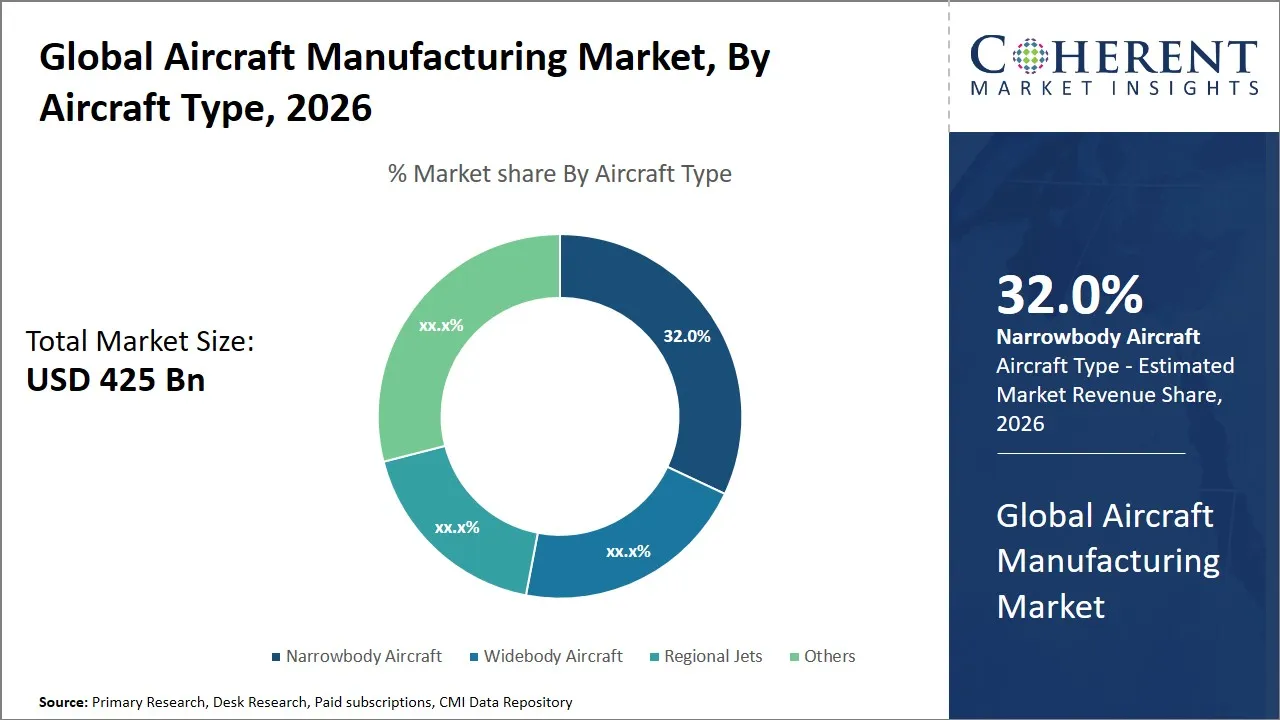
- The narrowbody aircraft segment is expected to account for 32% of the aircraft manufacturing market share in 2026.
- The military and defense segment is projected to capture 37% of the market share in 2026.
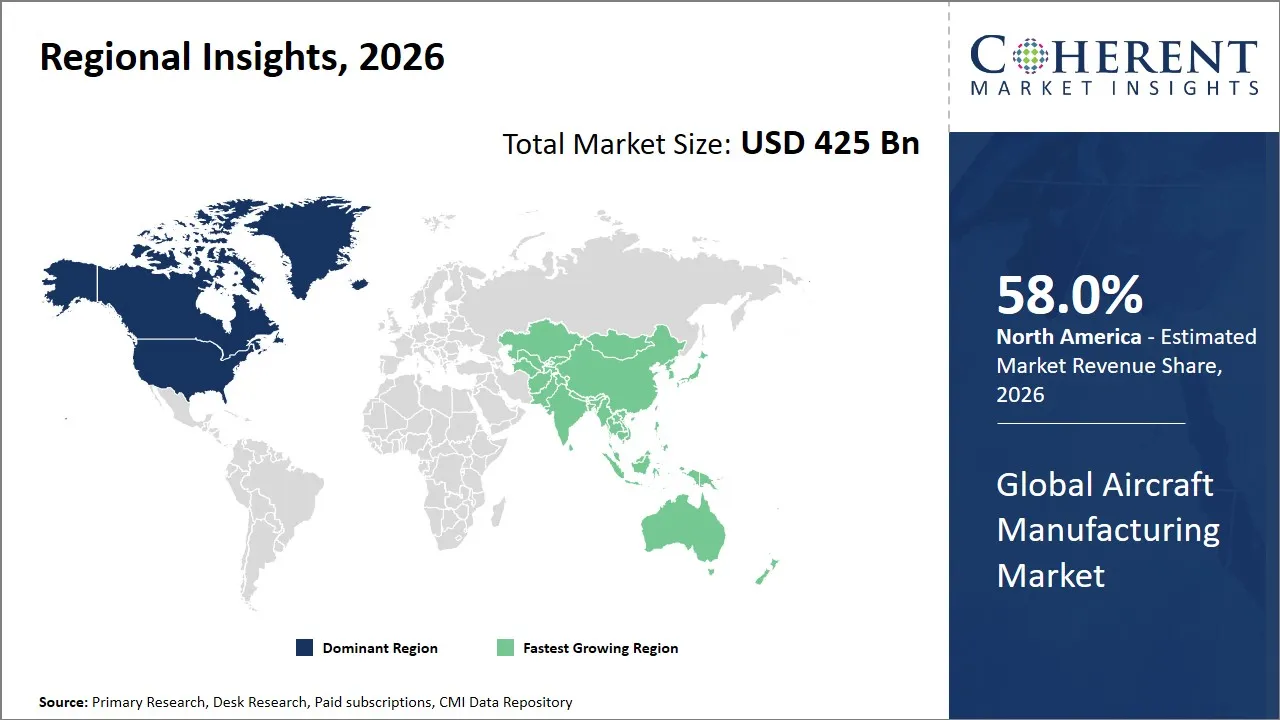
- North America is projected to dominate the aircraft manufacturing market in 2026 with a 58% share.
- Asia Pacific is expected to hold 19% share in 2026 and is expected to record the fastest growth over the forecast period.
Current Events and Its Impact
Current Events | Description and its Impact |
GA-ASI Completes First Flight of Belgium's MQ-9B SkyGuardian |
|
Segmental Insights
- Current Industry Events of 2026
- Market Size Estimation
- Regional Breakdown
- Competitive Landscape
- Customer Intelligence
- Segmental Analysis
- Pricing Analysis
- Key Market Drivers, Challenges & Future Trends
- Customized Insights Section
Why Does the Narrowbody Aircraft Segment Dominates the Global Aircraft Manufacturing Market in 2026?
The narrowbody aircraft segment is expected to hold 32.0% of the global aircraft manufacturing market share in 2026. The growth can largely be attributed to their operational efficiency, cost-effectiveness, and adaptability across a variety of routes. Usually designed with one central passage, these planes fit well on routes covering shorter distances - routes that form a large share of worldwide flight activity. For carriers focused on efficient resource use and steady expense control, such models often stand out. Their structure supports frequent takeoffs and landings without excessive strain on maintenance schedules.
For instance, on November 18, 2025, Etihad Airways announced a significant expansion of its Airbus widebody fleet by placing a firm order for six A330-900s, becoming the latest A330neo customer. In addition, the airline has disclosed an order for seven additional A350-1000s (increasing its total for the type to 27) and three A350F (bringing the airline’s A350F commitment to 10 aircraft).
(Source: etihad.com)
Military and Defense Segment Dominates the Global Aircraft Manufacturing Market
The military and defense segment is expected to hold 37.0% of the global aircraft manufacturing market share in 2026. The growth is due to increasing global geopolitical tensions and the ongoing imperative for nations to modernize their air forces. Defense budgets worldwide have been persistently allocated towards upgrading aircraft fleets to ensure aerial superiority, surveillance capabilities, and rapid response readiness.
Supply Chain Fragility & Tier-2/Tier-3 Dependencies
Metric | Value |
% of aerospace supply chains dependent on single-source suppliers | ~70% |
% of aerospace supply chains experiencing disruptions | ~85% |
% of aircraft manufacturers reporting geopolitical disruption effects | ~60% |
% of aerospace supply chains highly dependent on a few key suppliers | ~60% |
% of Tier-2 suppliers reporting labor shortages | ~65% |
% of Tier-2 suppliers reporting financing gaps | ~58% |
% of Tier-2 suppliers affected by engine subsystem delays | ~52% |
Total Tier-2/Tier-3 suppliers per typical aerospace OEM | >~12,000 |
Number of Tier-1 suppliers per typical aerospace OEM | ~200 |
% of aerospace suppliers ISO 9001 certified | >85% |
Regional Insights
North America Aircraft Manufacturing Market Analysis and Trends
The North America region is projected to lead the market with a 58% share in 2026. Expansion stems from established aerospace systems, consistent support by government bodies, yet concentrated groups of leading manufacturers. Central to this region is the U.S., where companies like Boeing and Lockheed Martin shape global directions through legacy work and new breakthroughs. Progress moves forward, fueled by interconnected manufacturing lines, strong investment in research, also regulations that back both defense and aviation sectors.
Clusters spread across the landscape employ capable specialists while partnerships form naturally between entities such as NASA and independent firms, strengthening regional influence steadily. Trade frameworks focused on overseas markets, combined with enduring agreements involving air carriers and armed forces, maintain leadership in output over time.
For instance, on December 12, 2025, Bombardier announced that the Government of Canada placed orders for six Global 6500 aircraft to perform worldwide utility flights and support missions such as aeromedical evacuations, disaster relief, humanitarian aid, and national security operations.
(Source: bombardier.com)
Asia Pacific Aircraft Manufacturing Market Analysis and Trends
The Asia Pacific region is expected to exhibit the fastest growth in the market contributing 19% share in 2026. Industrial progress, stronger national flight networks, because of focused state policies supporting homegrown aerospace capacity, explain the increase. China and India channel significant funds into developing domestic aircraft industries, reinforcing manufacturing bases, also upgrading infrastructure networks. Initiatives like Made in China 2025 along with Make in India support homegrown production while fostering innovation efforts. Growth seen in budget airlines, along with more people traveling by air, raises need for fresh airplanes - this pushes scale upward.
A surge in local suppliers, combined with state support for new aviation ventures, strengthens expansion across the area. Partnerships with European and North American manufacturers add momentum to progress. Among key players, COMAC - China's aircraft developer - and India’s HAL stand out. Each contributes significantly to production scale and technical advancement. Growth gains depth where industry presence deepens.
Global Aircraft Manufacturing Market Outlook for Key Countries:
Why is the U.S. Emerging as a Major Hub in the Aircraft Manufacturing Market?
Ahead lies steady footing for the U.S., sustained by long-standing aerospace frameworks. Progress unfolds quietly in structural design and materials research. Strength spans both civil aviation and military operations, linked not by flash but consistency. Leading production efforts, Boeing shapes worldwide expectations for transport and freight planes, whereas companies such as Northrop Grumman and Raytheon Technologies deliver high-complexity solutions for national security aviation.
Despite fluctuating priorities, advancement continues through government-backed defense programs combined with collaboration in civilian-led orbital ventures. Tied directly to modernized tooling, digital workflows now shape production techniques while maintenance protocols uphold sustained functionality, capabilities that quietly reinforce global standing.
Is China the Next Growth Engine for the Aircraft Manufacturing Market?
China advances its aircraft production goals steadily with an emphasis on homegrown innovation. Leading this shift, COMAC develops passenger planes without reliance on foreign designs. Support comes through state-driven initiatives that fund aerospace zones across regions. Engine and electronics progress rises due to focused research programs run internally. Demand remains consistent as more people enter the middle-income bracket. Airline expansions mirror rising travel needs within the country. Collaboration with international firms brings knowledge into local teams gradually. Progress unfolds methodically, shaped by long-term planning rather than sudden change.
India Aircraft Manufacturing Market Analysis and Trends
Steady demand marks India's aircraft manufacturing landscape, driven by advancing defense modernization. Growth in civilian flight needs contributes additional impetus to output expansion. Most military planes and components originate at Hindustan Aeronautics Limited, a firm that extends its reach into commercial aviation efforts. Expansion beyond armed forces contracts marks a quiet shift in output focus. Government initiatives such as Make in India emphasize indigenous development and manufacturing of aircraft parts and systems. India is also leveraging foreign direct investments and joint ventures with global aerospace companies to improve its technical capabilities and supply chain integration, positioning itself as an important regional hub.
France Aircraft Manufacturing Market Analysis and Trends
Still central to world aircraft production, France hosts major firms such as Airbus and Dassault Aviation. Operating within the country, Airbus maintains major facilities dedicated to advancing fuel efficiency and next-generation aircraft concepts. Supported by consistent government commitment, clear regulatory frameworks emerge in central areas such as Toulouse. Over years, these environments support sustained strength in technical output. Working jointly through EU networks improves reach into international markets while strengthening component sourcing stability.
Japan Aircraft Manufacturing Market Analysis and Trends
Despite limited domestic demand, Japan maintains a strong presence in aviation production through exacting standards. High accuracy matters more than volume when making components for global aircraft manufacturers. Leading the way, Mitsubishi Heavy Industries builds original designs domestically, yet also delivers framework pieces to factories across the United States. Advanced production techniques form the base of such work, supported by government investment aimed at progress, where inspection occurs continuously throughout each phase. What stands behind success is not speed, but depth in process control. Gradually, military-grade aerial platforms are gaining share within national industry activities.
Market Players, Key Development, and Competitive Intelligence
Key Developments
- On January 7, 2026, Qatar Airways, the operator of the world’s first and largest Starlink equipped widebody fleet, became the first carrier globally to enable Boeing 787-8 with Starlink. The airline has also equipped its entire Airbus A350 fleet with Starlink enabled connectivity.
- On July 23, 2025, Airbus completed manufacturing the first horizontal stabilizer (HTP) for the A350F freighter at its plants in Spain. This milestone demonstrates Spain's key role in the production of commercial aircraft, including the A350F program.
Top Strategies Followed by Global Aircraft Manufacturing Market Players
Player Type | Strategic Focus | Example |
Established Market Leaders | Major Order Confirmation | On July 21, 2025, L3Harris Technologies received a USD 300 million contract from Italy to deliver two Gulfstream G550 aircraft provisioned for a modern electromagnetic warfare system. |
Mid-Level Players | Business Agreement | On January 22, 2024, Saab and the U.A.E. Ministry of Defense announced they have signed a contract and Saab has received an order regarding in-service support for the GlobalEye Airborne Early Warning and Control (AEW&C) solution. |
Small-Scale Players | Textron Product Showcase | On June 16, 2025, Textron Aviation Inc announced the debut of its new multi-mission Beechcraft King Air demonstration aircraft at the 2025 Paris Air Show. |
Market Report Scope
Aircraft Manufacturing Market Report Coverage
| Report Coverage | Details | ||
|---|---|---|---|
| Base Year: | 2025 | Market Size in 2026: | USD 425 Bn |
| Historical Data for: | 2020 To 2024 | Forecast Period: | 2026 To 2033 |
| Forecast Period 2026 to 2033 CAGR: | 4% | 2033 Value Projection: | USD 550 Bn |
| Geographies covered: |
| ||
| Segments covered: |
| ||
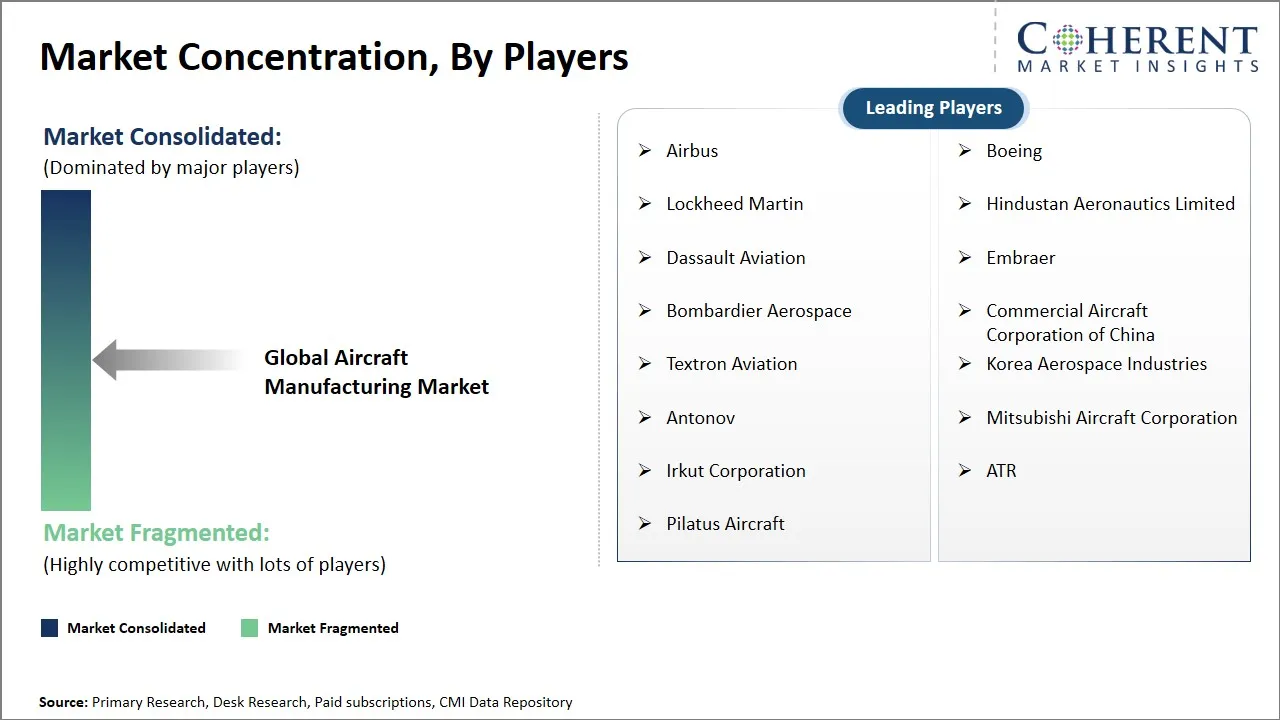
| Companies covered: | Airbus, Boeing, Lockheed Martin, Hindustan Aeronautics Limited, Dassault Aviation, Embraer, Bombardier Aerospace, Commercial Aircraft Corporation of China, Textron Aviation, Korea Aerospace Industries, Antonov, Mitsubishi Aircraft Corporation, Irkut Corporation, ATR, and Pilatus Aircraft | ||
| Growth Drivers: |
| ||
| Restraints & Challenges: |
| ||
Global Aircraft Manufacturing Market Dynamics
Global Aircraft Manufacturing Market Driver - Growing Expansion of Narrowbody Fleets for Fuel Efficiency
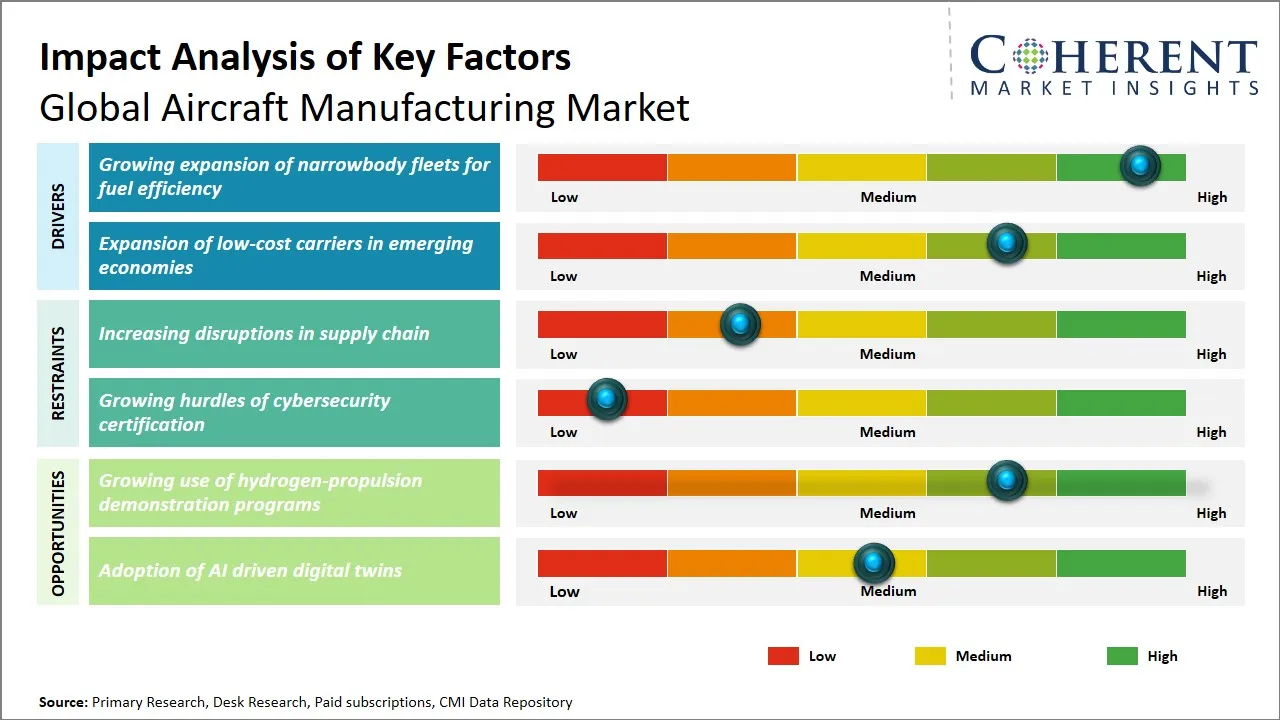
The increasing focus among airlines on optimizing operational costs and reducing carbon emissions is driving a significant expansion of narrowbody commercial aircraft fleets globally. Narrowbody planes, known for their single-aisle design, offer superior fuel efficiency compared to larger widebody counterparts, making them a preferred choice for short- to medium-haul routes that dominate many domestic and regional air travel markets. As fuel prices remain volatile and environmental regulations tighten, carriers are accelerating the replacement of aging widebody and older narrowbody fleets with newer, more fuel-efficient models.
For instance, on October 16, 2025, Abra Group unveiled an incremental order for 50 A320neo aircraft and five A350-900s which were previously announced in 2024 as a Memorandum of Understanding. This order is part of the Group’s fleet growth strategy, aimed at enhancing connectivity to new destinations within the Americas and to Europe.
(Source: airbus.com)
Global Aircraft Manufacturing Market Opportunity - Growing Use of Hydrogen-Propulsion Demonstration Programs
A transformation unfolds within aircraft manufacturing worldwide, driven by trials in hydrogen-based thrust methods, offering notable potential across the sector. Pressure grows from stricter ecological standards alongside airline demands for non-fossil energy sources; here, planes powered by hydrogen present a viable route toward lower carbon output and long-term emission targets. Not only established international and domestic aviation giants but emerging firms channel resources into testing concepts that examine how reliably, securely, and efficiently such technology performs under real conditions.
Analyst Opinion (Expert Opinion)
- Growth in worldwide aircraft manufacturing appears likely, shaped by airline choices favoring less fuel use and longer-term ecological balance. Now leading single-aisle orders are aircraft like the Boeing 737 MAX and Airbus A320neo, favored for reduced fuel consumption. With efficiency gains come fewer emissions, drawing consistent attention from airlines and lease providers alike. Short-haul routes benefit particularly due to decreased operational costs. Improved compliance with environmental rules follows naturally when fuel use declines. Financial pressure on operators eases as energy expenses drop.
- Another factor supporting the market involves continuous updates to global airline fleets, where major companies such as Boeing and Airbus are increasing output due to higher order volumes. Because passenger traffic has risen since pandemic restrictions ended, funding flows toward innovations in aircraft technology - especially electric and hybrid engines. Although challenges remain, focus on expanding plane numbers alongside improvements in aerodynamic efficiency points to sustained industry momentum ahead. Following these shifts closely reveals how deeply engineering progress influences future production trends.
Speak to the analyst
Want personalized insights?
Take the findings above to one of our principal consultants, or have the report rebuilt around the segments, geographies and competitors you actually track.
Market Segmentation
- Aircraft Type Insights (Revenue, USD Billion, 2021 - 2033)
- Narrowbody Aircraft
- Widebody Aircraft
- Regional Jets
- Others
- Application Insights (Revenue, USD Billion, 2021 - 2033)
- Military and defense
- Civil
- Commercial
- Others
- Regional Insights (Revenue, USD Billion, 2021 - 2033)
- North America
- U.S.
- Canada
- Latin America
- Brazil
- Argentina
- Mexico
- Rest of Latin America
- Europe
- Germany
- U.K.
- Spain
- France
- Italy
- Russia
- Rest of Europe
- Asia Pacific
- China
- India
- Japan
- Australia
- South Korea
- ASEAN
- Rest of Asia Pacific
- Middle East
- GCC Countries
- Israel
- Rest of Middle East
- Africa
- South Africa
- North Africa
- Central Africa
- North America
- Key Players Insights
- Airbus
- Boeing
- Lockheed Martin
- Hindustan Aeronautics Limited
- Dassault Aviation
- Embraer
- Bombardier Aerospace
- Commercial Aircraft Corporation of China
- Textron Aviation
- Korea Aerospace Industries
- Antonov
- Mitsubishi Aircraft Corporation
- Irkut Corporation
- ATR
- Pilatus Aircraft
Sources
Primary Research Interviews
- Aircraft Manufacturers and OEMs
- Aerospace Component Suppliers
- Aviation Industry Executives
- Defense Contractors and Military Aircraft Specialists
Databases
- Aerospace & Defense Intelligence Database
- Aviation Week Intelligence Network (AWIN)
- Jane's All the World's Aircraft Database
- Flight Global Database
Magazines
- Aviation Week & Space Technology
- Aerospace Manufacturing Magazine
- Flight International
- Defense News
- Aircraft Commerce
Journals
- Journal of Aircraft Engineering and Aerospace Technology
- International Journal of Aerospace Engineering
- Aerospace Science and Technology Journal
Newspapers
- The Wall Street Journal (Aerospace Section)
- Financial Times (Aviation Industry Coverage)
- Reuters (Aerospace & Defense News)
- Bloomberg (Aviation Industry Reports)
- Aviation Daily
Associations
- Aerospace Industries Association (AIA)
- International Air Transport Association (IATA)
- Aircraft Manufacturers Association
- National Aerospace and Defense Contractors Accreditation Program (NADCAP)
- International Coordinating Council of Aerospace Industries Associations (ICCAIA)
Public Domain Sources
- Federal Aviation Administration (FAA) Publications
- European Aviation Safety Agency (EASA) Reports
- International Civil Aviation Organization (ICAO) Documents
- NASA Aeronautics Research Mission Directorate Reports
- Boeing and Airbus Annual Reports and Press Releases
Proprietary Elements
- CMI Data Analytics Tool
- Proprietary CMI Existing Repository of information for last 8 years
Get access to 250+ pages report
Every segment, forecast, competitor profile and data table behind the analysis above — available for instant download.
- ESOMAR Member
- ISO 9001:2015 Certified
- D-U-N-S Registered
- GDPR & CCPA Compliant
Missing comfort of reading report in your local language? Find your preferred language:
Transform your Strategy with Exclusive Trending Reports
Frequently Asked Questions
The global aircraft manufacturing market is estimated to stand at USD 425 Bn in 2026 and is projected to reach USD 550 Bn by 2033.
The CAGR of global aircraft manufacturing market is projected to be 4% from 2026 to 2033.
Growing expansion of narrowbody fleets for fuel efficiency and expansion of low-cost carriers in emerging economies are the major factors driving the growth of the global aircraft manufacturing market.
Increasing disruptions in supply chain and growing hurdles of cybersecurity certification are the major factors hampering the growth of the global aircraft manufacturing market.
In terms of aircraft type, narrowbody aircraft is estimated to dominate the market revenue share in 2026.
Defense spending supports demand for fighter jets, transport aircraft, surveillance planes, and helicopters.
Manufacturers are focusing on lightweight materials, sustainable aviation fuels, and lower-emission aircraft designs.