

Unmanned Combat Aerial Vehicle (UCAV) Market Size and Share Analysis- 2026 To 2033
The Unmanned Combat Aerial Vehicle (UCAV) Market size is anticipated to grow at a CAGR of 12.5% with USD 16.3 Bn in 2026 and is expected to reach USD 37.2 Bn in 2033. The primary drivers are defined by rising defense expenditure, intensifying geopolitical tensions, expanding demand for persistent intelligence, surveillance, and reconnaissance, and growing adoption of autonomous precision-strike capabilities. According to SIPRI, global military expenditure reached USD 2.89 trillion in 2025, increasing 2.9% in real terms from 2024. This is strengthening demand for medium- and high-altitude UCAVs, stealth platforms, autonomous mission systems, precision-guided weapons, advanced sensors, secure communications, and AI-enabled targeting across air forces and defense modernization programs worldwide in major developed and emerging defense markets.
Key Takeaways
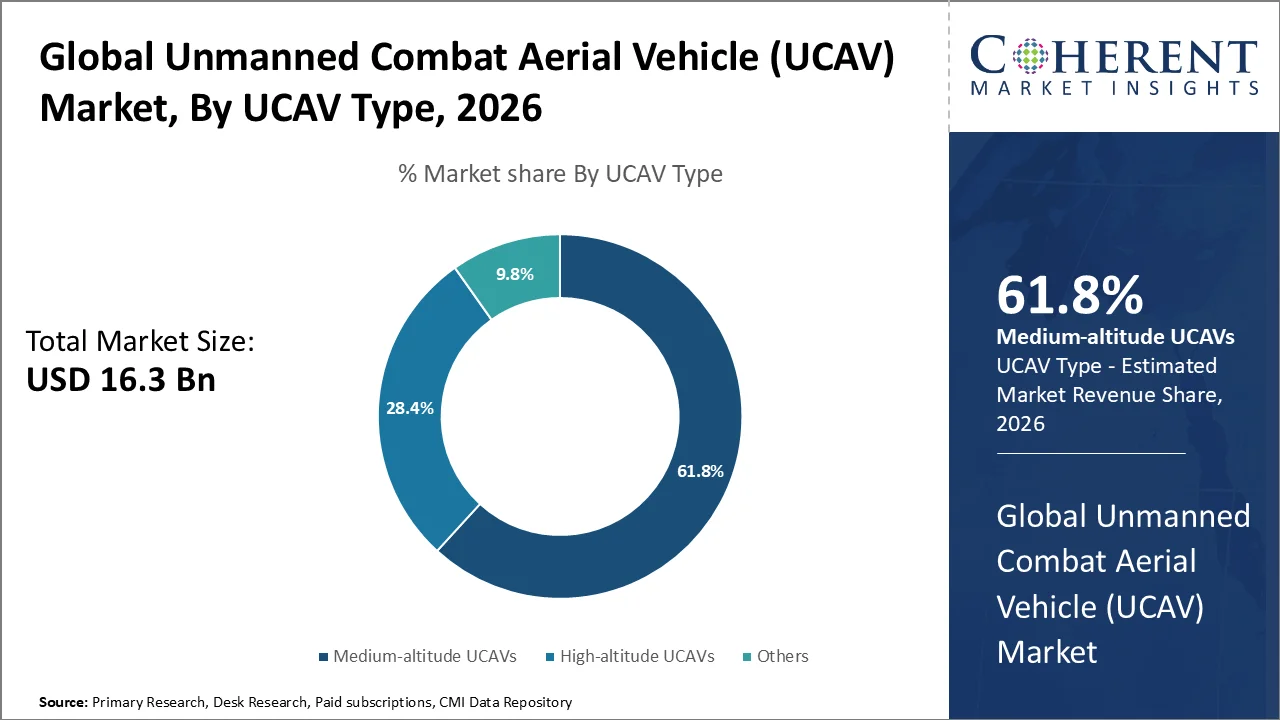
- The medium-altitude UCAVs segment is likely to dominate the market with 61.8% in 2026. The segment’s growth is owing to the extended endurance, operational flexibility, and growing deployment for intelligence, surveillance, reconnaissance, and precision-strike missions across modern defense forces.
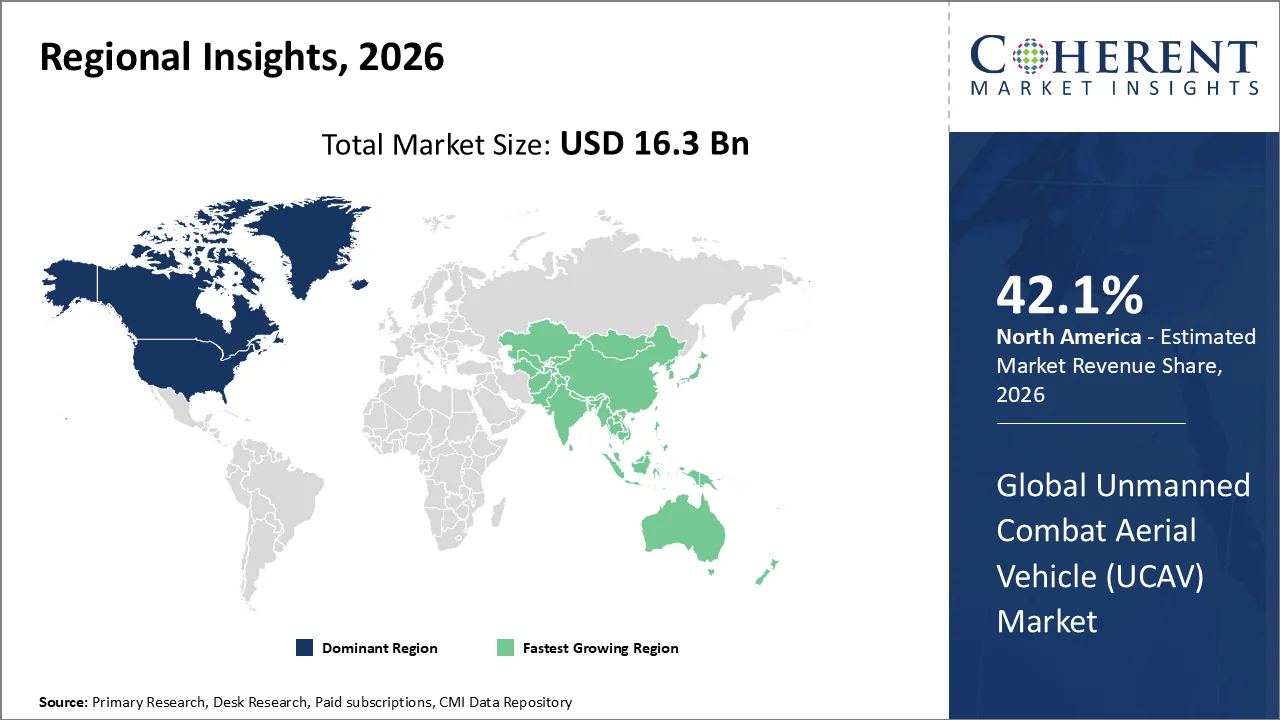
- North America is expected to acquire the prominent share of 42.1% in 2026. The region’s growth is owing to the high defense expenditure, strong investments in autonomous warfare technologies, and increasing procurement of advanced UCAV platforms for surveillance, tactical operations, and long-range combat missions.
Segmental Insights
Why is Medium-altitude UCAVs Segment Acquiring the Largest Share?
On the basis of UCAV type, the medium-altitude UCAVs segment is projected to account for the largest Unmanned Combat Aerial Vehicle (UCAV) Market share of 61.8% in 2026. The segment’s growth is owing to the balance between long endurance, wide-area surveillance, precision-strike capability, payload flexibility, satellite communications, and comparatively efficient operating economics. These characteristics make medium-altitude platforms suitable for intelligence, surveillance and reconnaissance, persistent overwatch, target acquisition, border protection, counter-insurgency, maritime monitoring, and precision strike.
The U.S. Air Force identifies the MQ-9 Reaper as an armed, multi-mission, medium-altitude, long-endurance remotely piloted aircraft, highlighting its relevance for sustained combat operations. The MQ-9 carries a payload of 3,750 pounds and can employ up to eight AGM-114 Hellfire laser-guided missiles, demonstrating the weapon-carrying flexibility that supports deployment across strike and surveillance missions.
- Current Industry Events of 2026
- Market Size Estimation
- Regional Breakdown
- Competitive Landscape
- Customer Intelligence
- Segmental Analysis
- Pricing Analysis
- Key Market Drivers, Challenges & Future Trends
- Customized Insights Section
Market Drivers
Rising Innovations in Collaborative Combat Aircraft are Transforming the UCAV Market in the U.S.
The U.S. is shifting UCAV development toward Collaborative Combat Aircraft (CCA) that can operate as distributed, semi-autonomous partners to crewed fighters. Unlike traditional remotely piloted platforms, next-generation aircraft are being designed around autonomous mission execution, modular payloads, open architectures, electronic warfare, distributed sensing, weapons employment under human authorization, and rapid software upgrades. This model is expected to increase the number of aircraft that can be deployed without proportionately increasing pilot requirements or exposing aircrew to highly contested environments.
In June 2026, the U.S. Air Force awarded engineering, manufacturing development, and production contracts for General Atomics' FQ-42 and Anduril's FQ-44 CCA platforms. The service stated that these aircraft were ready for full-scale manufacturing and outlined an objective to procure more than 150 combat-capable CCA by the end of the decade. Mission-autonomy contracts were simultaneously awarded across a six-vendor pool comprising Anduril, General Atomics, Lockheed Martin, Northrop Grumman, RTX Collins Aerospace, and Shield AI. This transition from prototype development toward production provides one of the strongest current indicators of commercialization within next-generation UCAV technology.
Mission Autonomy and Human-Machine Teaming: A Major Breakthrough in the UCAV Market
Mission autonomy represents one of the most significant technological shifts occurring within UCAV development. Traditional armed UAVs typically depend heavily on remote operators for navigation, surveillance, mission management, and weapons employment. Emerging UCAVs instead combine onboard computing, artificial intelligence, sensor fusion, autonomous navigation, digital mission planning, collaborative algorithms, and secure datalinks to perform larger portions of a combat mission independently while retaining human oversight for critical decisions.
This approach can significantly improve operational scale. Autonomous aircraft can accompany fighters, extend sensor coverage, carry additional weapons, perform reconnaissance, conduct electronic warfare, act as decoys, and operate forward of crewed aircraft. Boeing's MQ-28 Ghost Bat, for example, is designed for trusted autonomy and crewed-uncrewed teaming. Boeing reports a range exceeding 2,000 nautical miles, speeds up to Mach 0.9, and an operating ceiling above 40,000 feet. The company states that the platform was designed with an affordability intention equivalent to roughly one-tenth of a crewed platform.
Open software architecture is equally important. In February 2026, the U.S. Air Force confirmed semi-autonomous flight testing involving government-owned A-GRA architecture across General Atomics and Anduril aircraft with autonomy software from multiple suppliers. The architecture is designed to prevent vendor lock-in and enable algorithms from different developers to operate on compatible aircraft.
Current Events and Their Impact on the Unmanned Combat Aerial Vehicle (UCAV) Market
Current Event | Description and its Impact |
2025 U.S. “Drone Dominance” Policy and Accelerated Military Drone Procurement
|
|
FY2026 U.S. Defense Budget Expansion for Autonomous and Unmanned Systems |
|
Unmanned Combat Aerial Vehicle (UCAV) Market Trends
- Rising deployment of AI-enabled autonomous UCAVs improves target recognition, navigation, mission planning, and survivability while reducing dependence on continuous human control in contested environments.
- Growing integration of UCAVs with crewed fighter aircraft supports collaborative combat operations, expanding reconnaissance, electronic warfare, strike, and attritable combat capabilities across advanced air forces.
- Advancements in stealth, sensor fusion, secure datalinks, precision weapons, and electronic warfare systems are strengthening UCAV effectiveness against increasingly sophisticated air-defense networks.
- Ongoing conflicts are accelerating military demand for unmanned strike platforms, particularly systems capable of operating in electronically contested environments. NATO states that AI, drones, and autonomous systems are reshaping warfare and redefining capabilities required for deterrence and defense.
- Growing national investment in autonomous combat-aircraft programs is expanding the future UCAV development pipeline. In July 2026, the U.K. government committed £300 million to launch a new autonomous combat-aircraft program, targeting a flying demonstrator by at least 2030 as part of its future combat-air strategy.
Regional Insights
North America Dominates Owing to the Rising Procurement of Advanced Unmanned Combat Aircraft
The North America region accounts for 42.1% of the market share in 2026. The region’s growth is owing to the sustained U.S. and Canadian procurement of armed and autonomous unmanned aircraft, supported by large defense budgets and rapid capability development. In April 2026, the U.S. Air Force stated that its budget proposal allocated USD 2.7 billion to the Collaborative Combat Aircraft program, representing a USD 1.7 billion increase for semi-autonomous combat aircraft development. Separately, the U.S. Department of Defense awarded General Atomics a not-to-exceed USD 107.98 million contract in December 2024 for MQ-9B remotely piloted aircraft hardware supporting Canada’s program.
In August 2025, the U.S. Air Force and General Atomics launched flight testing of the YFQ-42A Collaborative Combat Aircraft (CCA) in California. The uncrewed fighter prototype is designed to operate alongside fifth- and sixth-generation crewed aircraft, supporting autonomous combat operations and scalable airpower deployment.
Asia Pacific Unmanned Combat Aerial Vehicle (UCAV) Market Trends
Asia Pacific is expected to witness strong growth in market over the forecast period. The region’s growth is owing to the expanding defence investment, indigenous autonomous-aircraft programs, and growing emphasis on crewed-uncrewed teaming.
Australia is emerging as a key contributor. In December 2025, the Australian Government announced approximately A$1.4 billion to advance the MQ-28A Ghost Bat toward operational service, including Block 2 and Block 3 aircraft. Earlier official Defence reporting stated that, by July 25, 2025, the Ghost Bat program had completed 119 live sorties and 146 flight hours, demonstrating accelerating flight-test maturity. The platform is designed to operate alongside crewed combat aircraft and extend combat mass without placing aircrew at risk.
In December 2025, the Ghost Bat successfully engaged and destroyed an airborne target using an AIM-120 air-to-air missile while operating alongside an RAAF E-7A Wedgetail. The test demonstrated Australia’s advanced collaborative combat aircraft capability and autonomous strike readiness.
Rising Procurement of Armed RPAS and Expansion of Domestic Drone Manufacturing is Accelerating the UCAV Market in Canada
In Canada, the Unmanned Combat Aerial Vehicle (UCAV) Market is influenced by the procurement of armed remotely piloted aircraft for surveillance, strike, and allied operations. The Department of National Defence confirms the RPAS project will deliver 11 remotely piloted aircraft capable of carrying and employing precision-guided munitions, alongside ground-control infrastructure and initial weapons.
In May 2026, Canada and Ukraine signed an arrangement supporting the production of Ukrainian uncrewed aerial systems in Canada. The agreement established the Airlogix–Sentinel partnership, bringing together Ukrainian defence technology company Airlogix and Canadian UAS manufacturer Sentinel R&D to manufacture drone systems in Canada for the Armed Forces of Ukraine.
China Unmanned Combat Aerial Vehicle (UCAV) Market Trends
China’s UCAV market is expanding as national defense modernization prioritizes intelligent, unmanned and networked combat capabilities. In March 2026, China’s Ministry of National Defense reported national defense expenditure of RMB 1.94 trillion for 2026, supporting modernization of weapons, equipment and emerging combat capabilities.
In May 2026, the Ministry highlighted a formation flight involving the GJ-11 stealth unmanned combat aircraft with J-20 stealth fighters and J-16 multirole fighters, demonstrating progress in manned-unmanned collaborative operations. This integration strengthens demand for stealth airframes, autonomous mission systems, secure datalinks and precision-strike technologies.
Who are the Major Companies in Unmanned Combat Aerial Vehicle (UCAV) Industry
Some of the major key players in Unmanned Combat Aerial Vehicle (UCAV) Market are BAE Systems, General Atomics Aeronautical Systems, Boeing, Northrop Grumman, Israel Aerospace Industries, Denel Dynamics, Dassault Aviation, Lockheed Martin, and Elbit Systems.
Key News
- In June 2026, BAE Systems unveiled Brontanax, the UK’s first British-designed autonomous Collaborative Combat Aircraft. The aircraft is designed for precision strike and electronic warfare missions and uses an open, modular architecture for crewed-uncrewed teaming.
- In June 2026, Airbus showcased the new U760 Ravenstorm combat drone, designed for air-to-air combat, precision air-to-surface strikes, and electronic warfare. The aircraft incorporates Airbus' AI-supported MARS mission system for autonomous operations and crewed-uncrewed teaming.
Market Report Scope
Unmanned Combat Aerial Vehicle (UCAV) Market Report Coverage
| Report Coverage | Details | ||
|---|---|---|---|
| Base Year: | 2025 | Market Size in 2026: | USD 16.3 Bn |
| Historical Data for: | 2020 To 2024 | Forecast Period: | 2026 To 2033 |
| Forecast Period 2026 to 2033 CAGR: | 12.5% | 2033 Value Projection: | USD 37.2 Bn |
| Geographies covered: |
| ||
| Segments covered: |
| ||
| Companies covered: | BAE Systems, General Atomics Aeronautical Systems, Boeing, Northrop Grumman, Israel Aerospace Industries, Denel Dynamics, Dassault Aviation, Lockheed Martin, and Elbit Systems | ||
| Growth Drivers: |
| ||
| Restraints & Challenges: |
| ||
Analyst Opinion
- Unmanned combat aerial vehicles are driven by the need for persistent surveillance, precision strike, and reduced risk to military personnel. The U.S. FY2026 defense budget allocates USD 13.4 billion to autonomy and autonomous systems, including USD 9.4 billion for unmanned and remotely operated aerial vehicles, highlighting institutional demand for next-generation unmanned combat capabilities.
- Medium-altitude, long-endurance UCAVs remain central to deployment because they combine long loiter time with multi-mission payloads. The MQ-9 Reaper, for example, provides a 1,150-mile range and 3,750-pound payload capacity, enabling intelligence, surveillance, reconnaissance, and precision-strike missions from a single platform.
- AI-enabled autonomy, sensor fusion, secure communications, and precision weapons are becoming technology differentiators. As armed forces move toward networked autonomous operations, demand is expected to shift toward UCAVs capable of faster target identification, longer endurance, multi-domain coordination, and lower operator exposure.
Speak to the analyst
Want personalized insights?
Take the findings above to one of our principal consultants, or have the report rebuilt around the segments, geographies and competitors you actually track.
Market Segmentation
- By UCAV Type (Revenue, USD Bn, 2021-2033)
- Medium-altitude UCAVs
- High-altitude UCAVs
- Others
- By Region (Revenue, USD Bn, 2021-2033)
- North America
- U.S.
- Canada
- Latin America
- Brazil
- Mexico
- Argentina
- Rest of Latin America
- Europe
- Germany
- U.K.
- France
- Italy
- Spain
- Russia
- Rest of Europe
- Asia Pacific
- China
- India
- Japan
- Australia
- South Korea
- ASEAN
- Rest of Asia Pacific
- Middle East
- GCC
- Israel
- Rest of Middle East
- Africa
- South Africa
- Central Africa
- North Africa
- North America
Sources
Primary Research Interviews
- Defense procurement officials
- Military UAV and UCAV program managers
- Air force and armed forces personnel
- UAV pilots and mission operators
- Aerospace and defense engineers
- UCAV manufacturers and system integrators
- Avionics, sensor, and payload suppliers
- Defense technology consultants and industry experts
- Key opinion leaders (KOLs) in unmanned aerial systems and defense technologies
Databases
- Stockholm International Peace Research Institute (SIPRI)
- International Institute for Strategic Studies (IISS)
- U.S. Department of Defense (DoD)
- Defense Security Cooperation Agency (DSCA)
- NATO
- United Nations Register of Conventional Arms (UNROCA)
- Janes Defence Intelligence
Magazines
- Defense News
- Aviation Week & Space Technology
- Air & Space Forces Magazine
- Military Aerospace Electronics
- Janes Defence Weekly
Journals
- Defence Technology
- Aerospace Science and Technology
- Journal of Aerospace Engineering
- IEEE Aerospace and Electronic Systems Magazine
- International Journal of Aeronautical and Space Sciences
Newspapers
- The New York Times
- The Guardian
- The Wall Street Journal
- Financial Times
- The Washington Post
Associations
- Association for Uncrewed Vehicle Systems International (AUVSI)
- Aerospace Industries Association (AIA)
- Aerospace, Security and Defence Industries Association of Europe (ASD)
- ADS Group
- National Defense Industrial Association (NDIA)
Public Domain Sources
- Company Annual Reports and Investor Presentations
- Government Defense Ministry and Armed Forces Publications
- Defense Procurement and Military Modernization Documents
- U.S. Department of Defense Budget and Procurement Publications
- NATO Defense and Security Publications
- SIPRI Arms Transfers and Military Expenditure Publications
- Government Tender and Contract Award Databases
- Patent and Technology Publications Related to UAV/UCAV Systems
Proprietary Elements
- CMI Data Analytics Tool
- Proprietary CMI Existing Repository of Information for Last 10 Years
Get access to 250+ pages report
Every segment, forecast, competitor profile and data table behind the analysis above — available for instant download.
- ESOMAR Member
- ISO 9001:2015 Certified
- D-U-N-S Registered
- GDPR & CCPA Compliant
Missing comfort of reading report in your local language? Find your preferred language:
Transform your Strategy with Exclusive Trending Reports
Frequently Asked Questions
The Unmanned Combat Aerial Vehicle (UCAV) Market is expected to reach USD 37.2 Bn in 2033.
Major players operating in the global Unmanned Combat Aerial Vehicle (UCAV) Market include BAE Systems, General Atomics Aeronautical Systems, Boeing, Northrop Grumman, Israel Aerospace Industries, Denel Dynamics, Dassault Aviation, Lockheed Martin, and Elbit Systems.
The high costs, strict export controls, cyber vulnerabilities, and complex legal and ethical concerns are the key factors hampering growth of the market.
The rising geopolitical tensions, surging military budgets, and advanced artificial intelligence integration is boosting the demand for Unmanned Combat Aerial Vehicle (UCAV).
The Unmanned Combat Aerial Vehicle (UCAV) Market is anticipated to grow at a CAGR of 12.5% between 2026 and 2033.
Among regions, North America is expected to account for a largest market share in the global Unmanned Combat Aerial Vehicle (UCAV) Market over the forecast period.
The market outlook remains positive due to rising defense budgets, active integration of artificial intelligence (AI), and evolving autonomous swarm concepts in modern military doctrines.