

Global Military Drone Market Size and Forecast – 2026-2033
The Global Military Drone Market is estimated to be valued at USD 27.20 Bn in 2026 and is expected to reach USD 58.22 Bn by 2033, exhibiting a compound annual growth rate (CAGR) of 11.5% from 2026 to 2033.
Key Takeaways of the Global Military Drone Market:
- The strategic drones segment leads the market holding an estimated share of 49.4% in 2026.
- The fixed-wing segment is projected to dominate with a share of 51.1% in 2026.
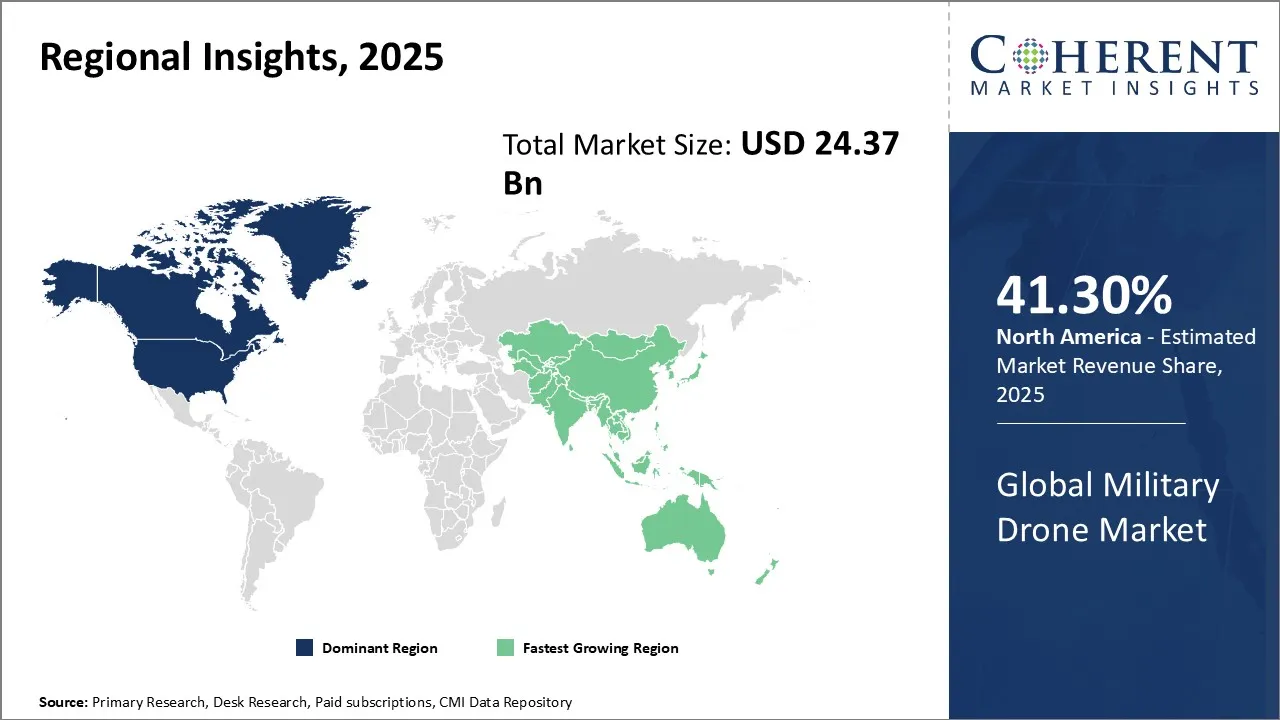
- North America is estimated to lead the market with a share of 41.3% in 2026. Asia Pacific, holding a share of 24.6% in 2026, is projected to be the fastest growing region.
Market Overview:
The military drone market is experiencing significant growth due to increasing demand for unmanned aerial vehicles (UAVs) in various military applications such as intelligence, surveillance, and reconnaissance (ISR), combat operations, and border patrolling. Drones are being increasingly adopted for these purposes because they can provide real-time data and reduce human casualties. Looking at the future, advancements in drone technology, such as improved endurance and autonomous capabilities will add to the drones' popularity.
Current Events and Their Impact:
Current Events | Description and its impact |
Russia-Ukraine War and Escalating Military Drone Usage |
|
Middle Eastern Military Modernization Initiatives |
|
Segmental Analysis
- Current Industry Events of 2026
- Market Size Estimation
- Regional Breakdown
- Competitive Landscape
- Customer Intelligence
- Segmental Analysis
- Pricing Analysis
- Key Market Drivers, Challenges & Future Trends
- Customized Insights Section
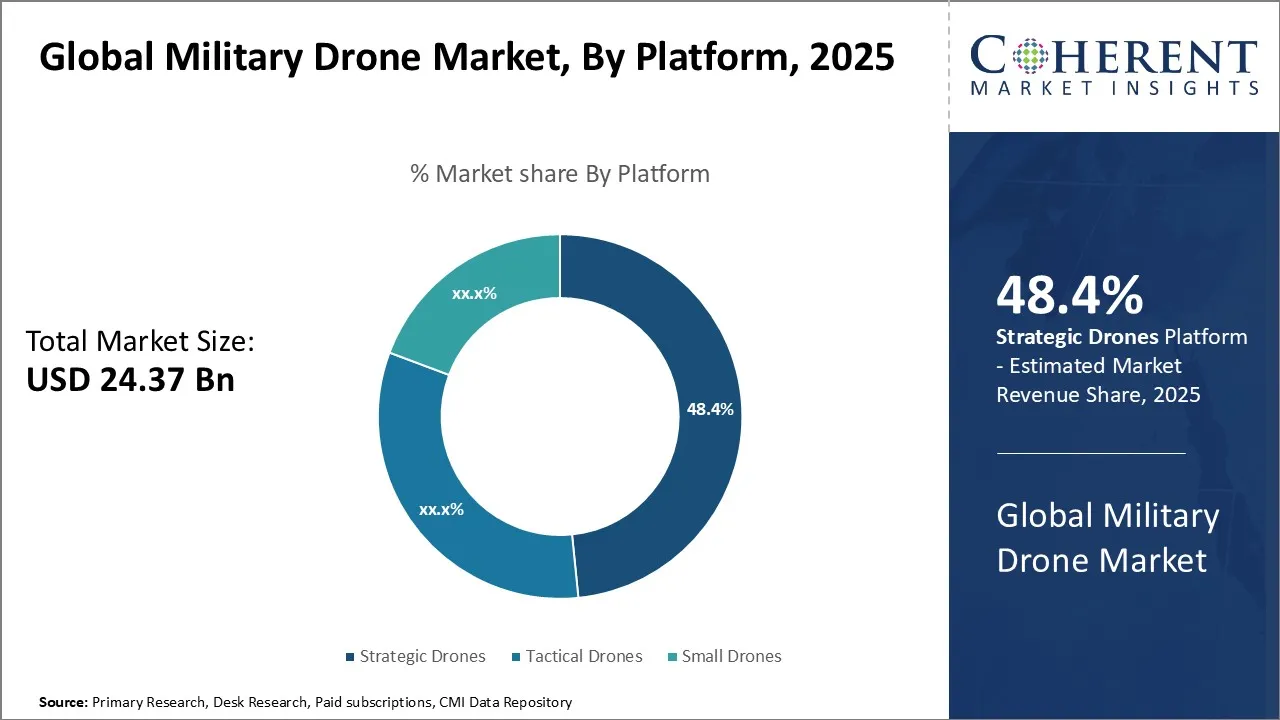
Global Military Drone Market Insights, by Platform - Strategic Drones Lead Due to their Crucial Role in Modern Warfare and Advanced Capabilities
Strategic drones, also known as High-Altitude Long Endurance (HALE) drones, are the largest segment, holding a share of 49.4% in 2026. Strategic drones provide military forces with real-time intelligence, surveillance, and reconnaissance (ISR) data, enabling them to monitor large areas, track targets, and gather critical information about enemy activities. These drones can also be used for border patrol, maritime surveillance, and communication relay, further expanding their utility in various military applications.
Moreover, artificial intelligence (AI) and machine learning (ML) technologies will improve the drones' autonomous capabilities, such as decision-making and target identification.
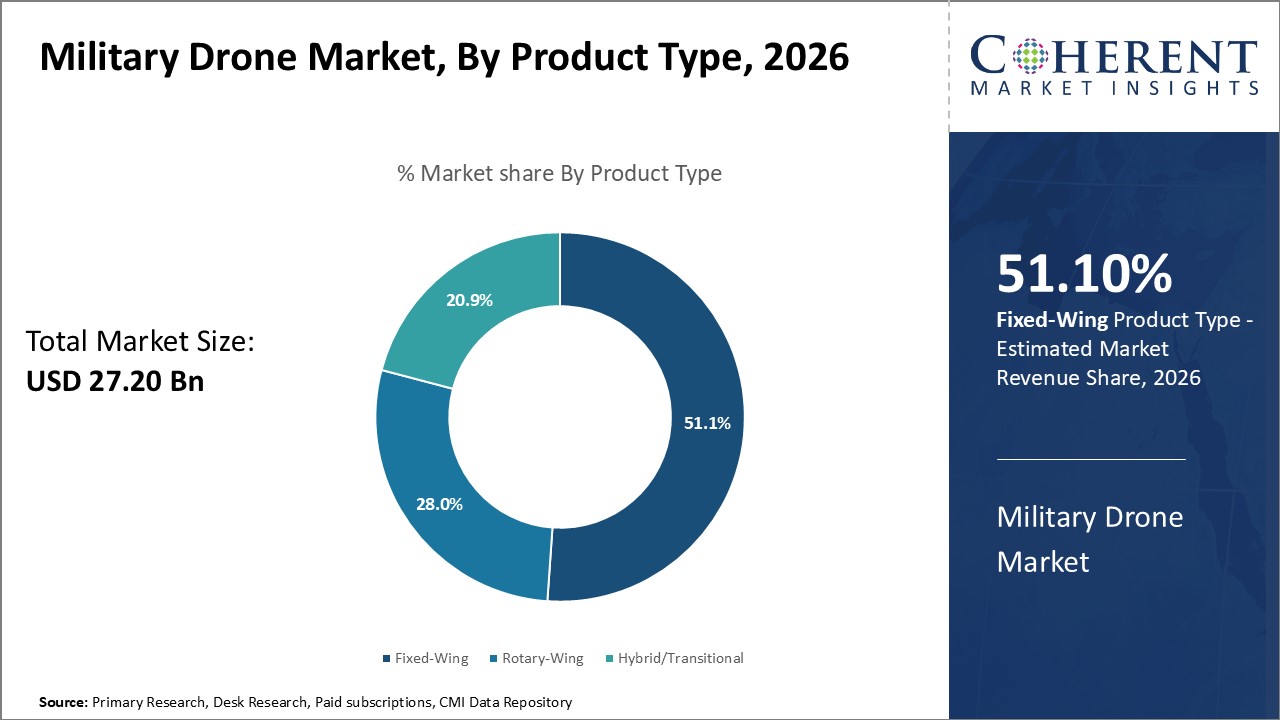
Global Military Drone Market Insights, by Product Type - Fixed-Wing Drones Dominate due to their Superior Performance
Fixed-wing segment have emerged as the largest segment, holding a share of 51.1% in 2026. These drones are characterized by their airplane-like design, with rigid wings that provide lift and enable long-range, high-altitude flights. Fixed-wing drones offer several advantages that make them ideal for military applications. They have longer flight endurance, allowing them to cover vast areas and remain airborne for extended periods. Additionally, fixed-wing drones typically have higher payload capacities compared to other drone types. This allows them to carry a wide range of sensors, cameras, and communication equipment, enhancing their intelligence-gathering capabilities. Fixed-wing drones can also be equipped with weapons systems, enabling them to conduct precision strikes against enemy targets.
Role of Artificial Intelligence (AI) in the Market:
Artificial intelligence has become the keystone of modern military drone capabilities, transforming unmanned systems from remote-piloted cameras into semi-autonomous warriors. By embedding machine-learning algorithms on board, next-generation drones can process sensor data in real time—identifying targets, mapping terrain, and adapting flight paths without human intervention. This shift reduces operator workload, shrinks reaction times, and enables complex “swarm” tactics, where dozens of drones coordinate autonomously to overwhelm defenses or conduct persistent surveillance across vast areas. AI also underpins predictive maintenance and logistical planning, using analytics to forecast component failures before they happen and optimize mission readiness.
Shield AI’s “Hivemind” system, deployed by U.S. special operations in contested environments, uses computer-vision models to recognize obstacles and threats, allowing quadrotor drones to navigate urban ruins or dense foliage at high speed.
Regional Insights
North America Military Drone Market Analysis and Trends
North America, holding a share of 41.30% in 2026, is expected to dominate the global military drone market. The region has a well-established defense industry, with the presence of major drone manufacturers such as General Atomics, Northrop Grumman, and Lockheed Martin. The U.S., in particular, has been at the forefront of military drone technology development and adoption, driven by its significant defense budget and ongoing military operations worldwide. The U.S. government's policies and initiatives have fostered innovation and growth in the military drone sector. Moreover, the region benefits from advanced infrastructure, research and development capabilities, and a skilled workforce, further strengthening its position in the market.
Asia Pacific Military Drone Market Analysis and Trends
The Asia Pacific region, holding a share of 24.6% in 2026, is expected to exhibit the fastest growth in the global military drone market. This growth can be ascribed to several factors, including increasing defense spending by countries such as China, India, Japan, and South Korea. These nations are investing in modernizing their military capabilities, with a focus on unmanned aerial systems. The region's growing geopolitical tensions and territorial disputes have also fueled the demand for military drones for surveillance, reconnaissance, and combat operations. Additionally, the Asia Pacific region has witnessed the emergence of local drone manufacturers, such as DJI and Yuneec in China, which have contributed to the market's growth. Favorable government policies and initiatives to promote the domestic defense industry have further supported the expansion of the military drone market in the region.
Global Military Drone Market Outlook for Key Countries:
U.S. Military Drone Market Analysis and Trends
The U.S. military drone market is characterized by its technological advancements, extensive research and development efforts, and the presence of major defense contractors. The U.S. military has been employing drones for various missions, including intelligence gathering, targeted strikes, and surveillance. Companies, such as General Atomics, with its renowned Predator and Reaper drones, have been instrumental in shaping the market landscape. The U.S. government's continued investment in drone technology and its global military presence are expected to drive the market's growth in the country.
China Military Drone Market Analysis and Trends
China military drone market has experienced significant growth in recent years, driven by the country's increasing defense budget and its focus on developing indigenous drone capabilities. Chinese companies, such as AVIC and CASC, have been actively involved in the development and production of military drones, catering to both domestic and international markets. The Chinese government's emphasis on military modernization and its assertive stance in regional conflicts have further propelled the demand for military drones. As China continues to invest in research and development, it is expected to emerge as a key player in the global military drone market.
Israel Military Drone Market Analysis and Trends
Israel continues to be a leader in the development and export of military drones, leveraging its technological expertise and operational experience. Israeli companies, such as Israel Aerospace Industries (IAI) and Elbit Systems, have established themselves as prominent players in the market, offering a range of advanced drone systems for intelligence, surveillance, and reconnaissance missions. Israel's close collaboration with the U.S. and its focus on countering regional security threats have driven the country's military drone industry. The Israel military drone market is expected to maintain its strong position, with ongoing research and development efforts and international partnerships.
India Military Drone Market Analysis and Trends
India military drone market is experiencing rapid growth, driven by the country's efforts to modernize its armed forces and enhance its surveillance and combat capabilities. The Indian government has been investing in the procurement of military drones and encouraging domestic production through initiatives like "Make in India." International collaborations and technology transfers have also played a crucial role in the development of India's military drone industry. With the increasing demand for drones in border surveillance, counterterrorism operations, and maritime security, India's market presents significant growth opportunities for both domestic and foreign players.
Market Players, Key Development, and Competitive Intelligence
Key Developments:
- In April 2025, Optiemus Unmanned Systems Private Limited (OUS), a wholly owned subsidiary of Optiemus Infracom Limited, unveiled four advanced unmanned aerial vehicles (UAVs) at the Milipol India 2025 exhibition held at Yashobhoomi Convention Centre, New Delhi (India).
- In February 2025, The India-based Garuda Aerospace launched 8 drones meant for defense, safety, and military operations at Aero India 2025 held between February 10 to 14 at Yelahanka Air Force Station, Bengaluru (India).
- In October 2024, India finalized a USD 3.5 billion deal with the U.S. to acquire 31 MQ-9B Predator drones.
- In August 2024, the Australian Department of Defence’s Advanced Strategic Capabilities Accelerator (ASCA) awarded USD 6.6 million in contracts to three Australian companies – including Grabba Technologies – as part of the Sovereign Uncrewed Aerial Systems (UAS) Challenge. This initiative aims to establish a sovereign drone manufacturing capability, mitigating security and supply chain risks associated with commercial drones, and enabling defense and other government agencies to benefit from economies of scale.
Top Strategies Followed by Global Military Drone Market Players
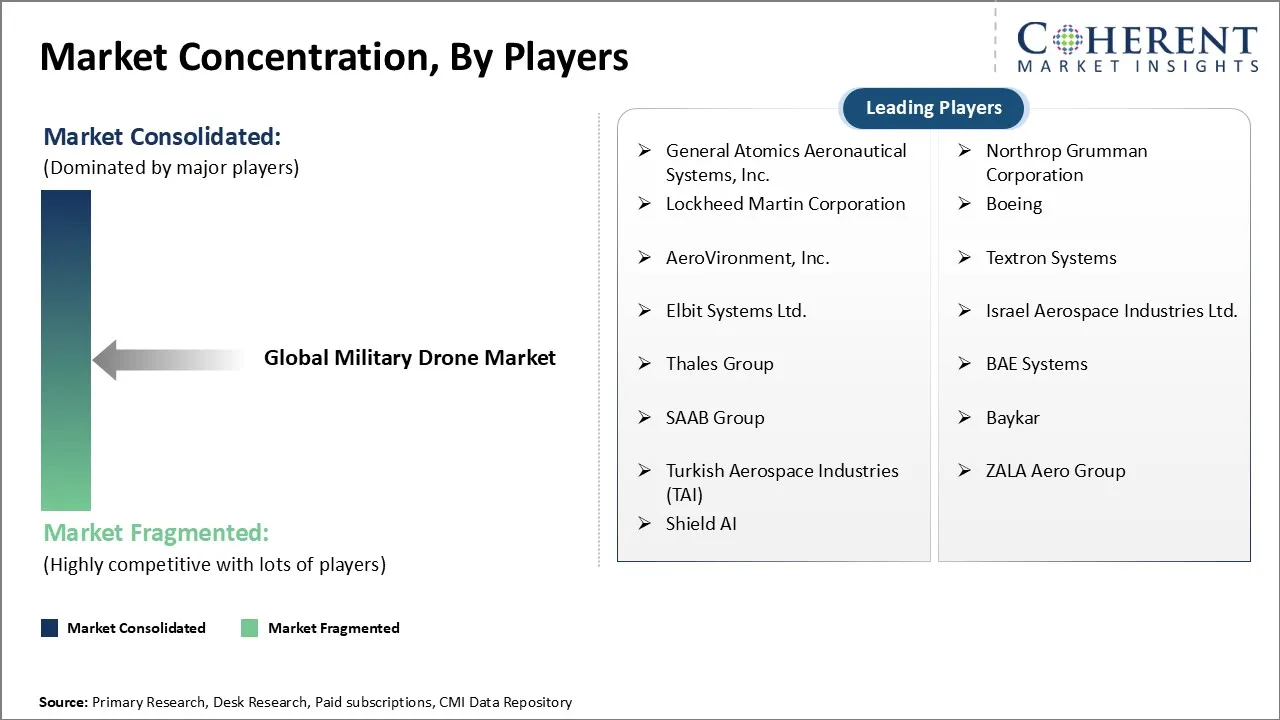
- Established players like Lockheed Martin, Northrop Grumman, and Boeing are investing heavily in R&D to develop cutting-edge drone technologies, such as advanced sensors, stealth capabilities, and improved autonomy.
- Lockheed Martin has developed Stalker VXE, a long-endurance drone capable of vertical takeoff and landing (VTOL)
- Mid-level players are focusing on delivering cost-effective solutions to target price-sensitive consumers.
- Turkish Aerospace Industries (TAI) offers ANKA-S, a medium-altitude long-endurance (MALE) drone with satellite communications and day-night surveillance capabilities.
- Small-scale players are targeting niche markets with specialized drones that offer unique features or innovative capabilities.
- Anduril’s Ghost drone is a lightweight, tactical quadcopter designed for rapid deployment and autonomous reconnaissance missions. What sets it apart is its AI-driven operating system, Lattice, which enables real-time threat detection and autonomous decision-making.
Market Report Scope
Military Drone Market Report Coverage
| Report Coverage | Details | ||
|---|---|---|---|
| Base Year: | 2025 | Market Size in 2026: | USD 27.20 Bn |
| Historical Data for: | 2020 To 2024 | Forecast Period: | 2026 To 2033 |
| Forecast Period 2026 to 2033 CAGR: | 11.5% | 2033 Value Projection: | USD 58.22 Bn |
| Geographies covered: |
| ||
| Segments covered: |
| ||
| Companies covered: | General Atomics Aeronautical Systems, Inc., Northrop Grumman Corporation, Lockheed Martin Corporation, Boeing, AeroVironment, Inc., Textron Systems, Elbit Systems Ltd., Israel Aerospace Industries Ltd., Thales Group, BAE Systems, SAAB Group, Baykar, Turkish Aerospace Industries (TAI), ZALA Aero Group, and Shield AI | ||
| Growth Drivers: |
| ||
| Restraints & Challenges: |
| ||
Market Dynamics
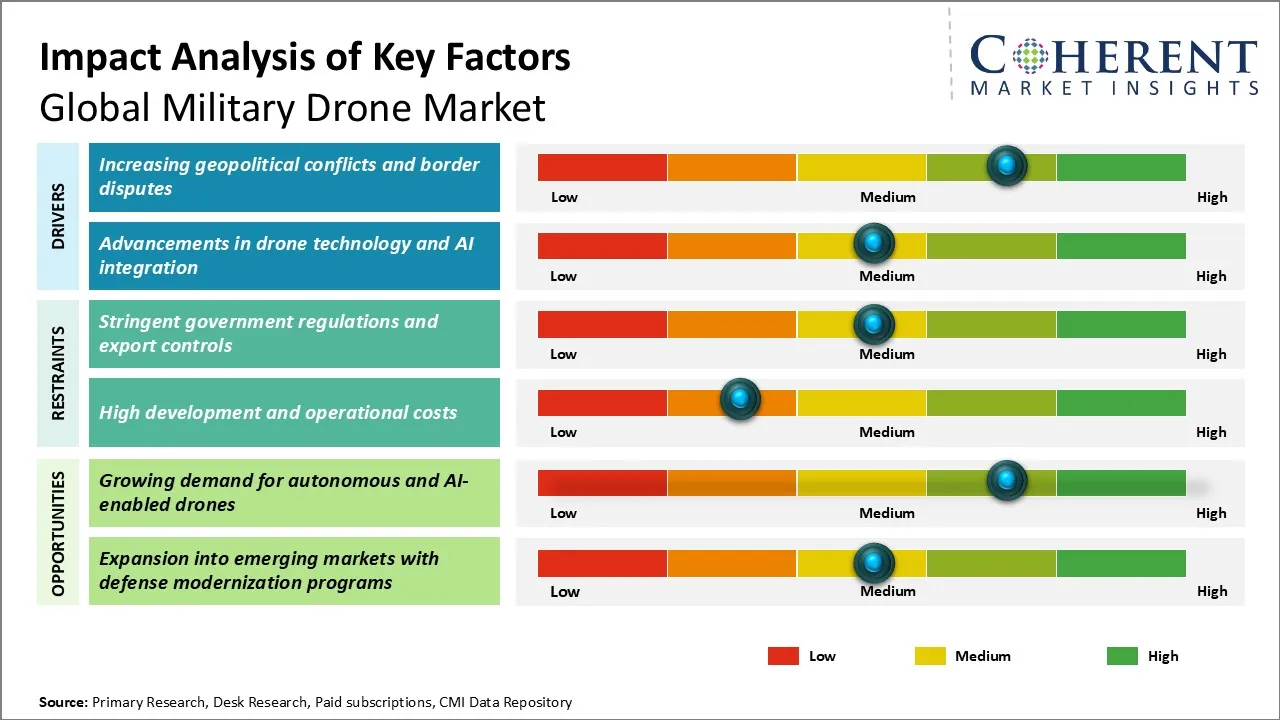
Global Military Drone Market Driver - Increasing geopolitical conflicts and border disputes
As nations grapple with the increasingly complex security landscape, the deployment of military drones has emerged as a strategic imperative. These unmanned aerial vehicles offer a range of advantages, including enhanced surveillance capabilities, improved situational awareness, and the ability to conduct targeted strikes with minimal risk to human personnel. The rising frequency of cross-border conflicts, territorial disputes, and asymmetric warfare has compelled countries to invest heavily in advanced drone technologies. For example, Ukraine used Bayraktar TB2 drones in its defense against the Russian invasion.
Global Military Drone Market Opportunity - Growing demand for autonomous and AI-enabled drones
As military operations become increasingly complex and the need for real-time intelligence and decision-making capabilities rises, the integration of artificial intelligence and autonomous features into drones is becoming a key priority. Autonomous drones offer the advantage of being able to operate without constant human intervention, reducing the risk to human operators and enabling longer mission durations. AI-enabled drones can process vast amounts of data in real-time, providing valuable insights and enhancing situational awareness for military personnel. The incorporation of machine learning algorithms allows drones to adapt to changing environments and make intelligent decisions based on the data they collect.
For instance, U.S. Air Force’s Skyborg program aims to develop a family of AI-powered unmanned combat aerial vehicles (UCAVs) that can fly autonomously alongside piloted jets.
Analyst Opinion (Expert Opinion)
- Regional confrontations—such as in Ukraine, Gaza, and Kashmir—are fueling rapid drone adoption as militaries seek low-cost, high-impact solutions. These conflicts showcase drones as force multipliers, accelerating the demand for tactical and Intelligence, Surveillance, and Reconnaissance (ISR) platforms even among mid-tier defense powers.
- Geopolitical tensions have prompted countries like India, Turkey, and Australia to invest in indigenous drone production, reducing dependency on the U.S. or Chinese suppliers. This is creating regional hubs and reshaping global supply chains, thereby decentralizing market dominance.
- Prolonged and technologically intense conflicts, notably in Ukraine, have normalized the battlefield use of autonomous and AI-powered drones. This is pushing R&D investment away from traditional piloted systems toward swarming capabilities, adaptive targeting, and autonomous decision-making—setting a new standard for future military procurement.
Speak to the analyst
Want personalized insights?
Take the findings above to one of our principal consultants, or have the report rebuilt around the segments, geographies and competitors you actually track.
Market Segmentation
- Platform Insights (Revenue, USD Bn, 2021 - 2033)
- Strategic Drones
- Tactical Drones
- Small Drones
- Product Type Insights (Revenue, USD Bn, 2021 - 2033)
- Fixed-Wing
- Rotary-Wing
- Hybrid/Transitional
- Regional Insights (Revenue, USD Bn, 2021 - 2033)
- North America
- U.S.
- Canada
- Latin America
- Brazil
- Argentina
- Mexico
- Rest of Latin America
- Europe
- Germany
- U.K.
- Spain
- France
- Italy
- Russia
- Rest of Europe
- Asia Pacific
- China
- India
- Japan
- Australia
- South Korea
- ASEAN
- Rest of Asia Pacific
- Middle East
- GCC Countries
- Israel
- Rest of Middle East
- Africa
- South Africa
- North Africa
- Central Africa
- North America
- Key Players Insights
- General Atomics Aeronautical Systems, Inc.
- Northrop Grumman Corporation
- Lockheed Martin Corporation
- Boeing
- AeroVironment, Inc.
- Textron Systems
- Elbit Systems Ltd.
- Israel Aerospace Industries Ltd.
- Thales Group
- BAE Systems
- SAAB Group
- Baykar
- Turkish Aerospace Industries (TAI)
- ZALA Aero Group
- Shield AI
Sources
Primary Research Interviews:
Stakeholders:
- Defense Procurement Officers (e.g., from Ministries of Defense in NATO countries)
- UAV Program Managers at Aerospace & Defense Firms (e.g., Lockheed Martin, Baykar, Elbit Systems)
- Aerospace Systems Integrators and Payload Developers
- Tactical Operations Officers from Army, Navy, and Air Force Drone Units
- Defense Technology Consultants and Analysts
- Military Logistics and Surveillance Experts
Databases:
- U.S. Department of Defense Procurement Data Repository
- European Defence Agency (EDA) Capability Development Plan Reports
- Asia-Pacific Defense Outlook Archives
- Center for Strategic and International Studies (CSIS) Military Balance Datasets
Magazines:
- Defense Innovation Weekly
- Unmanned Systems International
- Military Technology Today
- Drone & Warfare Digest
Journals:
- Journal of Unmanned Aerial Vehicle Systems & Operations
- Defense Technology and Policy Journal
- Global Security and Surveillance Research Quarterly
- Journal of Advanced Military Platforms & Strategy
Newspapers:
- The Global Defense Times
- Defense Horizon Daily
- The Security Post
- Asia-Pacific Military Review
Associations:
- International Association of Defense Drone Manufacturers (IADDM)
- Global UAV Defense Alliance (GUDA)
- American Institute for Advanced Military Aerospace (AIAMA)
- European Federation for Unmanned Systems (EUFUS)
- Indo-Pacific Drone & Tactical Systems Forum (IPDTSF)
Public Domain Sources:
- U.S. Defense Security Cooperation Agency (DSCA) Reports
- NATO Communications and Information Agency (NCIA)
- Stockholm International Peace Research Institute (SIPRI)
- World Bank Military Expenditure Database
- ResearchGate Defense Systems Repository
Proprietary Elements:
- CMI Data Analytics Tool, Proprietary CMI Existing Repository of information for last 8 years
Get access to 250+ pages report
Every segment, forecast, competitor profile and data table behind the analysis above — available for instant download.
- ESOMAR Member
- ISO 9001:2015 Certified
- D-U-N-S Registered
- GDPR & CCPA Compliant
Missing comfort of reading report in your local language? Find your preferred language:
Transform your Strategy with Exclusive Trending Reports
Frequently Asked Questions
The global military drone market is estimated to be valued at USD 24.37 billion in 2025 and is expected to reach USD 51.56 billion by 2032.
The CAGR of the global military drone market is projected to be 11.3% from 2025 to 2032.
Increasing geopolitical conflicts and border disputes and advancements in drone technology and AI integration are the major factors driving the growth of the global military drone market.
Stringent government regulations and export controls and high development and operational costs are the major factors hampering the growth of the global military drone market.
In terms of platform, the strategic drones segment is estimated to dominate the market revenue share in 2025.
General Atomics Aeronautical Systems, Inc., Northrop Grumman Corporation, Lockheed Martin Corporation, Boeing, AeroVironment, Inc., Textron Systems, Elbit Systems Ltd., Israel Aerospace Industries Ltd., Thales Group, BAE Systems, SAAB Group, Baykar, Turkish Aerospace Industries (TAI), ZALA Aero Group, and Shield AI are the major players.
North America is expected to lead the global military drone market in 2025.