

Active Phased Array Radar (APAR) Market Size and Forecast — 2026 - 2033
The Global Active Phased Array Radar Market size is estimated to be valued at USD 4.8 billion in 2026 and is expected to reach USD 9.6 billion by 2033, exhibiting a compound annual growth rate (CAGR) of 10.5% from 2026 to 2033.
Overview
The Active Phased Array Radar (APAR) market is driven by rising defense modernization programs, increasing geopolitical tensions, and growing demand for advanced surveillance and threat detection systems. Governments worldwide are investing in next-generation radar technologies to enhance air, naval, missile, and border defense capabilities. APAR systems offer superior target tracking, faster beam steering, greater reliability, and improved resistance to electronic warfare compared to conventional radars, driving their adoption. The expansion of unmanned aerial vehicles (UAVs), missile defense networks, and integrated battlefield management systems further supports market growth. Additionally, technological advancements in semiconductor components and radar signal processing are accelerating APAR deployment globally.
Key Takeaways
The Surveillance and Reconnaissance segment dominates the Active Phased Array Radar (APAR) market, generating the highest revenue due to its essential role in naval and airborne defense platforms for real-time situational awareness.
The Navy-led naval subsegment holds approximately 44% market share, driven by increasing ship modernization and retrofit programs incorporating advanced APAR systems.
The X-Band frequency segment leads the market owing to its high resolution, precision tracking, and strong multi-target engagement capabilities required for modern defense operations.
Regionally, North America holds the largest market share due to strong defense spending and advanced technology adoption, while Asia Pacific records the fastest growth, supported by naval expansion and rising geopolitical tensions.
Active Phased Array Radar (APAR) Market Segmentation Analysis
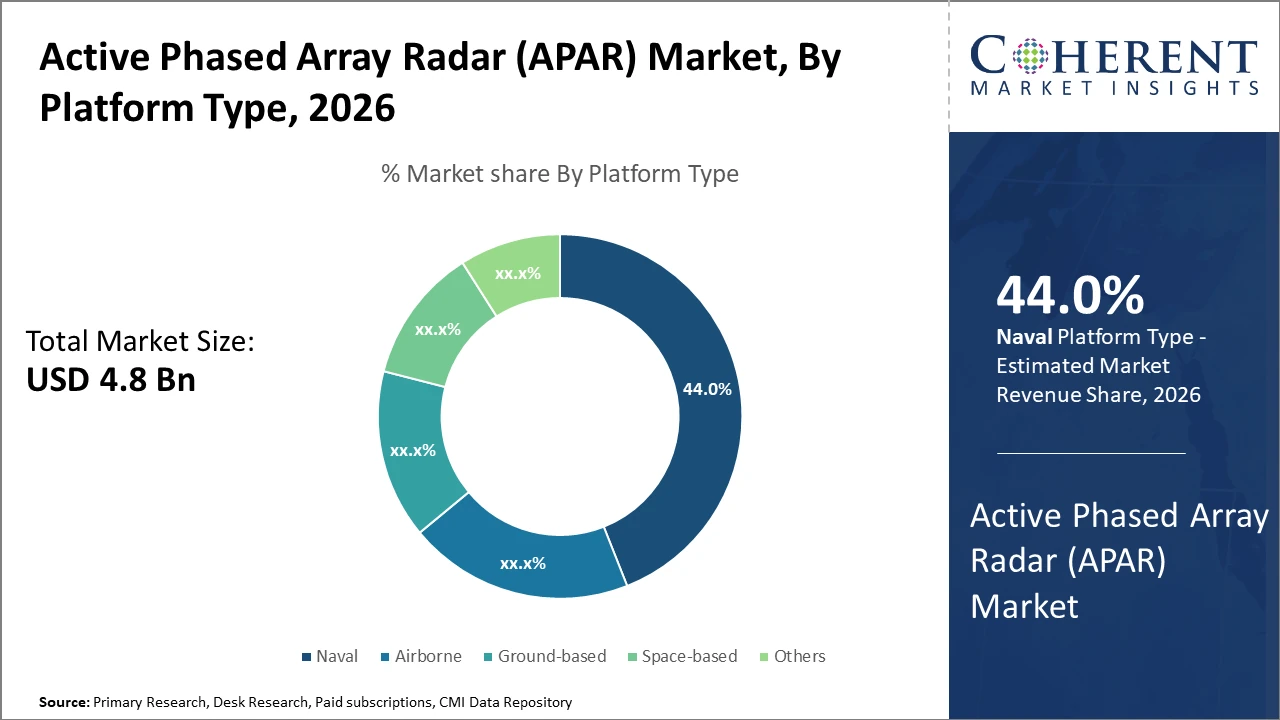
Active Phased Array Radar (APAR) Market Insights, By Platform Type
The Naval segment dominates the Active Phased Array Radar (APAR) market, holding approximately 44% share, driven by rising demand for advanced multi-function radar systems on destroyers, frigates, and other warships. These systems enhance threat detection, tracking, and engagement capabilities in complex maritime environments. The Space-Based segment is the fastest growing, supported by expanding satellite surveillance missions and increasing demand for real-time intelligence using advanced spaceborne radar technologies. Airborne APAR systems remain important for fighter jets, AWACS, and UAVs, offering wide-area coverage and mobility. Ground-based systems support missile defense and battlefield awareness, while other applications include mobile command and emerging integrated defense platforms globally.
Active Phased Array Radar (APAR) Market Insights, By Application
The Surveillance and Reconnaissance subsegment dominates the Active Phased Array Radar (APAR) market due to its critical role in threat detection, early warning, and continuous battlefield monitoring, contributing the highest revenue share. The Weapon Targeting subsegment is the fastest growing, driven by increasing adoption of precision-guided munitions and the need for real-time targeting accuracy in modern warfare scenarios. Target Tracking remains essential for maintaining continuous lock-on of fast-moving aerial, naval, and ground threats. The Electronic Warfare segment is steadily expanding as systems evolve to counter jamming and electronic attacks, while others include niche applications such as simulation training and radar testing environments globally.
Active Phased Array Radar (APAR) Market Insights, By Frequency Band
The X-Band segment dominates the Active Phased Array Radar (APAR) market due to its high-resolution imaging, superior accuracy, and strong multi-target tracking capabilities, making it essential for precision defense operations. The S-Band is the fastest growing, supported by its long-range performance and all-weather reliability, increasingly used in naval and airborne radar systems. The L-Band offers extended coverage and strong penetration capabilities, making it suitable for early warning and missile detection systems. The C-Band supports medium-range surveillance and is often integrated into multi-band radar architectures. The ‘Others’ category includes emerging frequency bands designed for specialized and evolving defense applications globally.
Active Phased Array Radar (APAR) Market Trends
The Active Phased Array Radar market is increasingly adopting software-defined radar systems, enabling capability upgrades through software enhancements without hardware replacement, thereby reducing lifecycle costs and improving operational flexibility, as demonstrated in programs like the U.S. Navy’s AN/SPY-6 upgrades in 2025.
Artificial intelligence and machine learning integration are significantly enhancing target detection, classification, and response speed, improving radar performance in complex and high-threat environments.
Ongoing miniaturization of radar systems for unmanned platforms is creating new market opportunities, supporting the shift toward multi-domain surveillance and expanding APAR deployment across UAVs and compact defense systems.
Active Phased Array Radar (APAR) Market Insights, By Geography
Asia Pacific Active Phased Array Radar (APAR) Market Analysis and Trends
Asia Pacific is the fastest-growing region in the Active Phased Array Radar (APAR) market, registering a CAGR exceeding 12%, driven by extensive naval modernization programs across China, India, Japan, and Australia. Rising geopolitical tensions and maritime security concerns are accelerating procurement of APAR-equipped warships, fighter aircraft, and airborne early warning systems. Governments in the region are increasingly emphasizing indigenous manufacturing capabilities, strengthening domestic supply chains and reducing reliance on imports. Additionally, defense companies are forming strategic partnerships and technology transfer agreements to enhance regional presence, improve radar innovation capabilities, and support large-scale deployment of advanced surveillance and multi-domain defense systems.
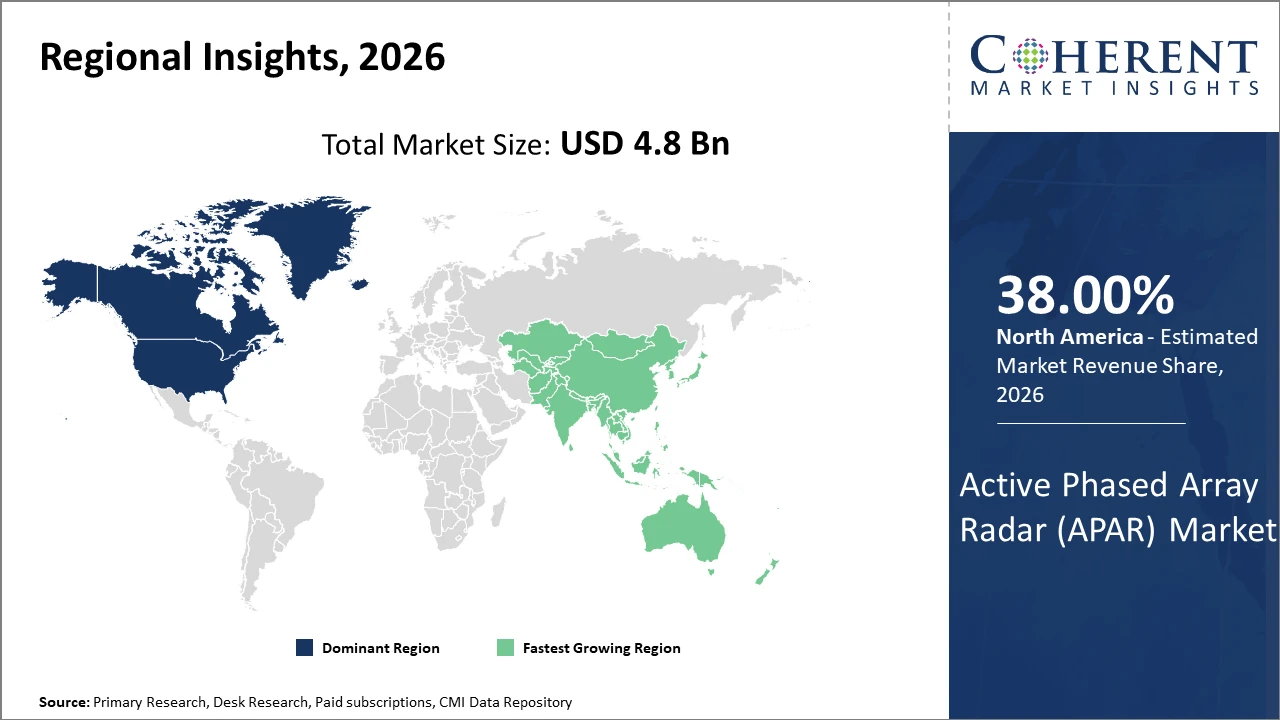
North America Active Phased Array Radar (APAR) Market Analysis and Trends
North America dominates the Active Phased Array Radar (APAR) market, supported by high defense spending from the United States and Canada, with a strong focus on naval and airborne radar modernization programs. The U.S. leads regional demand through major procurement initiatives, including advanced systems such as the AN/SPY-6 deployed on Arleigh Burke-class destroyers, contributing to approximately 38% of the regional market share. Continuous government investment in defense R&D strengthens technological leadership and accelerates innovation in radar capabilities. Additionally, close collaboration between defense agencies and key industry players ensures sustained advancements in APAR systems, reinforcing North America’s leadership in global radar technology development.
Active Phased Array Radar (APAR) Market Outlook for Key Countries
USA Active Phased Array Radar (APAR) Market Analysis and Trends
The USA plays a pivotal role in the Active Phased Array Radar (APAR) market, driven by high defense expenditure and continuous advancements in radar technologies. Major initiatives such as the Aegis Combat System modernization reflect significant investments exceeding USD 800 million annually, directly contributing to APAR market growth and innovation. Leading defense contractors like Lockheed Martin and Raytheon Technologies are actively involved in developing next-generation radar platforms and system upgrades. Integration with missile defense architectures and expanding airborne early warning programs further strengthen the country’s dominance, supported by government policies promoting domestic manufacturing and advanced defense technology ecosystems.
Germany Active Phased Array Radar (APAR) Market Analysis and Trends
Germany’s Active Phased Array Radar (APAR) market is driven by rising defense modernization, NATO commitments, and increasing maritime security needs in the Baltic and North Seas. Germany is investing in advanced naval radar systems, including AESA-based solutions for frigates such as the F124 and future F126 programs, alongside upgrades to air defense networks. Key players include Hensoldt, Thales Group, Rheinmetall, and Airbus Defence and Space, focusing on digital beamforming, electronic warfare integration, and long-range detection capabilities. Trends include AI-enabled radar processing, network-centric warfare systems, and increasing collaboration with EU defense programs to enhance situational awareness and interoperability across platforms globally.
Analyst Opinion
Expanding APAR production capacity is driving market growth, with offshore radar manufacturing output rising by 22% in 2025 to meet increased military demand from Asia-Pacific and Europe, improving delivery timelines for advanced systems.
Demand-side growth is supported by rising defense budgets and procurement programs, including over USD 480 million allocated by the U.S. Department of Defense in 2024 for upgrading naval APAR systems, along with stronger import demand from Indo-Pacific naval exercises.
Pricing strategies are influencing market expansion, with competitive pricing models introduced in 2026 resulting in a 15% increase in system procurement by emerging defense nations, supported by cost efficiencies and standardization.
Diverse applications across aerospace surveillance, missile defense, and maritime domain awareness are broadening the market, with multinational naval deployments contributing to a 30% rise in APAR orders from 2024 to 2026.
- Current Industry Events of 2026
- Market Size Estimation
- Regional Breakdown
- Competitive Landscape
- Customer Intelligence
- Segmental Analysis
- Pricing Analysis
- Key Market Drivers, Challenges & Future Trends
- Customized Insights Section
Market Scope
| Report Coverage | Details | ||
|---|---|---|---|
| Base Year: | 2025 | Market Size in 2026: | USD 4.8 billion |
| Historical Data for: | 2020 To 2024 | Forecast Period: | 2026 To 2033 |
| Forecast Period 2026 to 2033 CAGR: | 10.5% | 2033 Value Projection: | USD 9.6 billion |
| Geographies covered: |
| ||
| Segments covered: |
| ||
| Companies covered: | Leonardo S.p.A., Thales Group, Denel SOC Ltd., Hensoldt AG, Saab AB, Lockheed Martin Corporation, Bharat Electronics Limited, CEA Technologies, Aselsan AS | ||
| Growth Drivers: |
| ||
Active Phased Array Radar (APAR) Market Growth Factors
The global Active Phased Array Radar (APAR) market is primarily driven by rising defense budgets focused on naval modernization and airborne tactical upgrades. Enhanced multi-mission capabilities and advancements in digital signal processing have expanded APAR applications across electronic warfare, surveillance, and missile defense systems. The adoption of gallium nitride (GaN) semiconductor technology has significantly improved radar range, power efficiency, and overall system performance, accelerating deployment across various defense platforms. Additionally, growing demand for maritime domain awareness amid rising geopolitical tensions, particularly in the Asia-Pacific region, has boosted procurement activity, with multiple navies commissioning advanced APAR-equipped frigates during the 2024–2026 period globally.
Active Phased Array Radar (APAR) Market Development
In July 2025, the Philippine Navy strengthened its maritime defense capabilities with the commissioning of the Miguel Malvar frigate in May 2025, while the second vessel, Diego Silang, was launched in March and scheduled for delivery later in the year.
Key Players
Leading Companies of the Market
Leonardo S.p.A
Thales Group
Saab AB
Bharat Electronics Limited
CEA Technologies
Denel SOC Ltd.
Hendsoldt AG
Lockheed Martin Corporation
Aselsan AS
Several market players are investing heavily in R&D to advance APAR capabilities. For instance, Raytheon Technologies partnered with the U.S. Navy to develop next-generation radar arrays, improving operational bandwidth and enhancing target tracking accuracy. Thales Group strengthened production capacity through semiconductor investments, reducing lead times and improving cost efficiency. Meanwhile, Leonardo introduced modular APAR systems, enabling flexible integration across naval platforms and increasing contract wins in key European maritime regions.
Active Phased Array Radar (APAR) Market Future Outlook
The Active Phased Array Radar (APAR) market is expected to witness steady growth driven by rising demand for multi-function surveillance, missile defense, and electronic warfare capabilities. Future systems will increasingly adopt software-defined radar architectures, AI-enabled signal processing, and enhanced digital beamforming for superior target detection and tracking accuracy. Naval and airborne platforms will remain key adoption areas, especially within NATO modernization programs and Asia-Pacific defense expansion. Companies such as Raytheon Technologies, Thales Group, and Hensoldt are expected to focus on compact, energy-efficient, and highly integrated radar systems, enabling improved situational awareness, network-centric warfare, and interoperability across multi-domain operations globally.
Active Phased Array Radar (APAR) Market Historical Analysis
The Active Phased Array Radar (APAR) market has evolved from early mechanically scanned radar systems to advanced AESA-based digital architectures over the past two decades. Initially driven by naval modernization programs in the US and Europe, adoption expanded with the need for multi-target tracking and electronic warfare resistance. Companies such as Raytheon Technologies, Thales Group, Lockheed Martin, and Hensoldt played key roles in developing solid-state transmit/receive modules and phased array integration. During the 2010s, growth accelerated due to missile defense programs and fighter aircraft upgrades. Increasing computing power enabled real-time beamforming, shaping today’s highly networked, software-defined radar ecosystems globally today.
Sources
Primary Research Interviews:
Defense electronics manufacturers, radar system integrators, aerospace OEMs, naval shipbuilders, air defense system developers, and military procurement agencies involved in Active Phased Array Radar (APAR) design, deployment, and modernization programs.
Radar engineers, electronic warfare specialists, signal processing experts, defense R&D directors, military technology consultants, and avionics system architects specializing in AESA/APA radar systems, beamforming technologies, and multi-domain surveillance platforms.
Magazines:
Defense News – Coverage of global defense procurement, radar system upgrades, and military modernization programs.
Jane’s Defence Weekly – Insights into radar technologies, APAR deployments, and defense electronics advancements.
Aviation Week & Space Technology – Updates on aerospace radar innovations, avionics integration, and surveillance system developments.
Journals:
IEEE Transactions on Aerospace and Electronic Systems – Research on phased array radar design, signal processing, and adaptive beamforming.
IET Radar, Sonar & Navigation – Studies on radar system architecture, target detection, and electronic warfare applications.
Journal of Electromagnetic Waves and Applications – Research on antenna arrays, propagation modeling, and radar performance optimization.
Newspapers:
Financial Times – Coverage of defense budgets, aerospace investments, and geopolitical drivers influencing radar demand.
Reuters – Reporting on defense contracts, military technology acquisitions, and international security developments.
Bloomberg – Insights into defense company performance, radar system procurement trends, and global aerospace markets.
Associations:
IEEE Aerospace and Electronic Systems Society (AESS) – Research standards, conferences, and publications on radar and aerospace systems.
NATO Science and Technology Organization (STO) – Collaborative research on defense technologies, radar interoperability, and electronic warfare systems.
Association of Old Crows (AOC) – Focus on electronic warfare, radar countermeasures, and spectrum dominance technologies.
Get access to 250+ pages report
Every segment, forecast, competitor profile and data table behind the analysis above — available for instant download.
- ESOMAR Member
- ISO 9001:2015 Certified
- D-U-N-S Registered
- GDPR & CCPA Compliant
Missing comfort of reading report in your local language? Find your preferred language:
Transform your Strategy with Exclusive Trending Reports
Frequently Asked Questions
Leading companies include Leonardo S.p.A., Thales Group, Lockheed Martin, and CEA Technologies, driven by strong technological capabilities and large defense contracts.
The Active Phased Array Radar market is expected to grow from USD 4.8 billion in 2026 to around USD 9.6 billion by 2033, reflecting a CAGR of 10.5% supported by global defense modernization programs.
The naval segment offers the highest growth potential due to increasing investments in multi-functional radar systems for advanced maritime defense and fleet modernization.
Future growth will be shaped by AI integration, software-defined radar systems, and GaN-based technologies, along with rising adoption in electronic warfare and unmanned platforms.
The market is highly competitive, with strong R&D focus and strategic partnerships, while challenges include high costs, system integration complexity, and strict regulatory requirements.
Companies focus on partnerships, modular radar solutions, pricing strategies, and expansion into emerging defense markets to strengthen global presence.