

UAV Propellers Market Size and Share Analysis: 2026 - 2033
The global UAV propellers market size is estimated to reach approximately USD 800 Mn in 2026 and is expected to grow at a CAGR of 13.8% during the forecast period (2026-2033), totaling USD 2,100 Mn by 2033.
Key Takeaways from the UAV Propellers Market Report
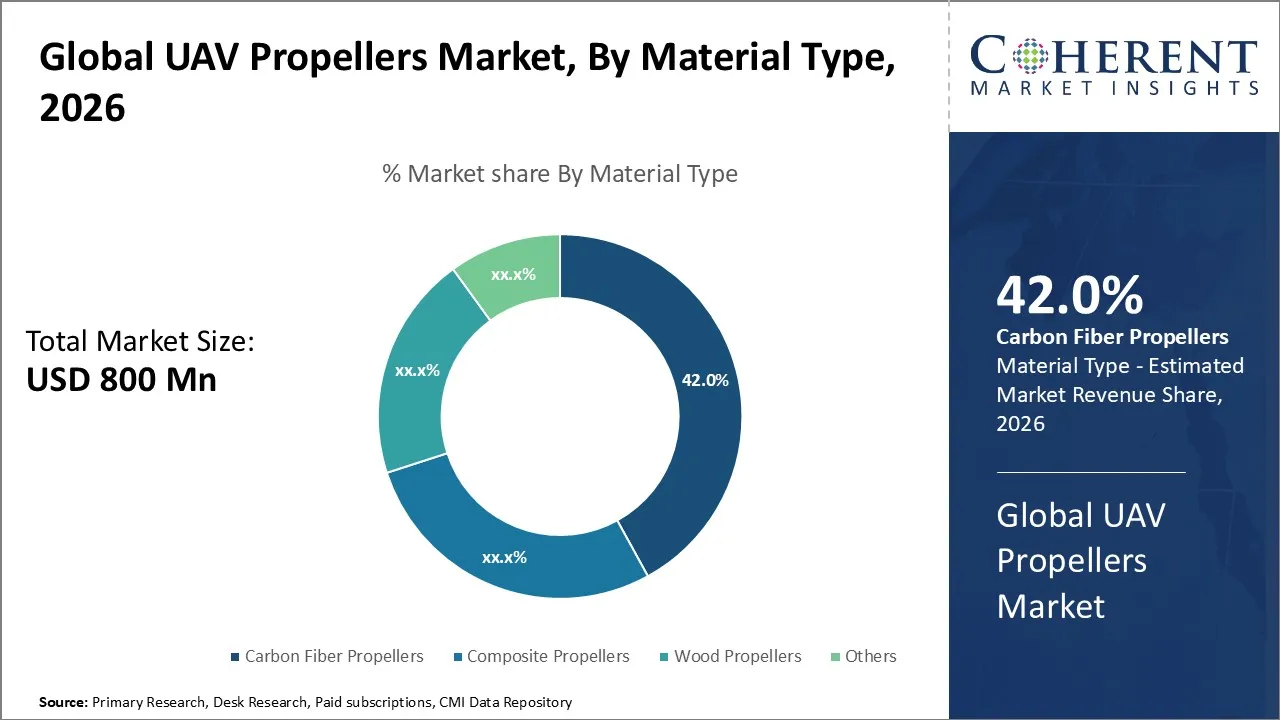
- Carbon fiber is expected to remain the most widely used material for manufacturing UAV propellers, accounting for about 42% of the market in 2026 thanks to its superior strength-to-weight ratio and durability.
- By industry, government and defense segment is set to hold about 42.2 % of the global UAV propellers market share in 2026, followed by the e-commerce segment with a 20% share.
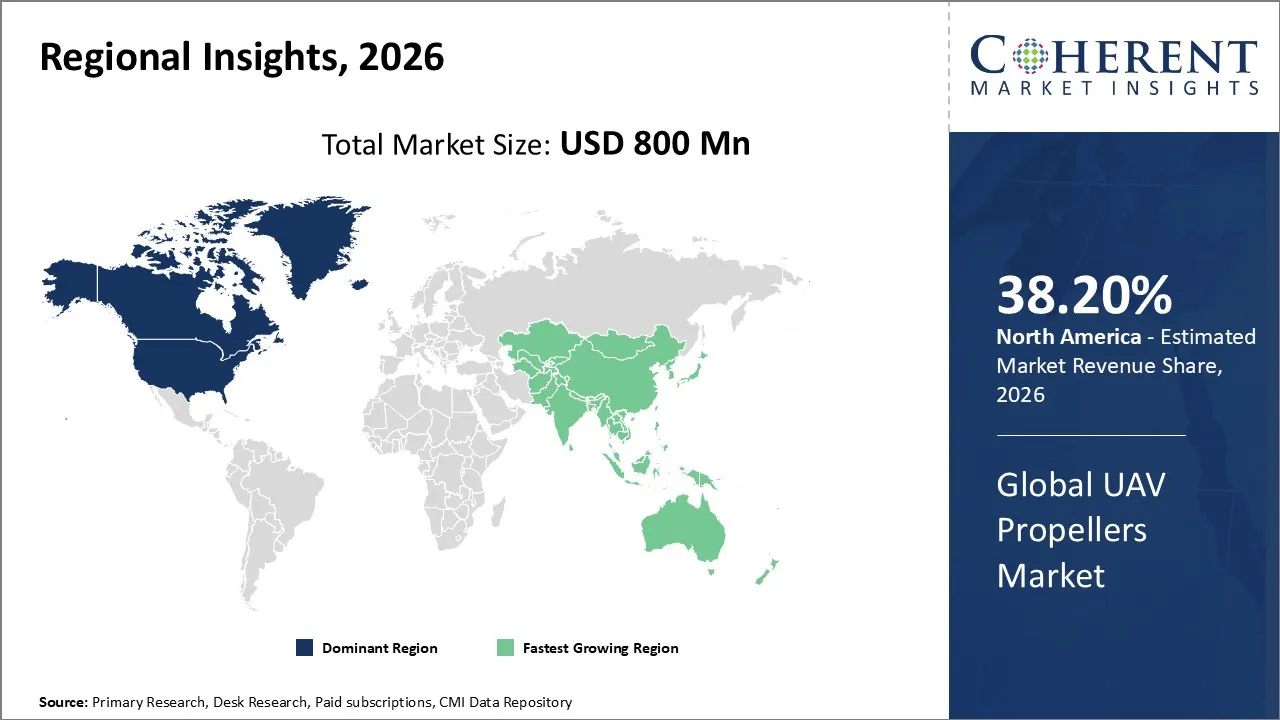
- North America is expected to lead the global UAV propellers industry, capturing a share of about 38.20 % in 2026, owing to strong defense demand and technology innovation.
- Asia Pacific, with an estimated share of about 29% in 2026, is anticipated to emerge as the most lucrative pocket for UAV propeller manufacturers during the forecast period. This is mostly due to expanding UAV production and commercial adoption.
UAV Propellers Market Overview
The global UAV propellers market is expected to register robust growth during the forecast period. This is mostly due to rising adoption of drones across industries like agriculture, logistics, and defense. Moreover, technological advancements in propeller materials and design that enhance flight efficiency and performance are supporting market expansion.
Unmanned Aerial Vehicles (UAVs) are drones that can be controlled remotely or fly on their own. They are used in many areas, including healthcare, e-commerce, food, retail, and defense industries. Propellers are an important part of UAVs, as they turn rotational energy into thrust, allowing the drone to take off and fly efficiently.
Increasing adoption of UAVs in oil and gas industry is boosting demand for UAV propellers. Automated drones are used for surveillance and inspection of infrastructure and pipelines. For example, recently Chevron got a special waiver from the U.S. Federal Aviation Administration (FAA) to fly an AiRanger drone for automatic pipeline inspection in the San Joaquin Valley.
Drones are also widely used in the mining industry for generating point clouds, digital surface models, and digital terrain models of mining sites. Therefore, growing demand for UAVs in these sectors is expected to drive growth of the UAV propellers market during the forecast period. Growing popularity of drone-as-a-service (DaaS) is also positively influencing UAV propeller sales.
Current Events and Their Impact on the UAV Propellers Market
Current Event | Description and its Impact |
Technological Breakthroughs and Innovation |
|
Geopolitical Tensions and Commercial Market Expansion |
|
Segmental Insights
- Current Industry Events of 2026
- Market Size Estimation
- Regional Breakdown
- Competitive Landscape
- Customer Intelligence
- Segmental Analysis
- Pricing Analysis
- Key Market Drivers, Challenges & Future Trends
- Customized Insights Section
UAV Propellers Market Insights, By Material Type - Carbon Fiber Propeller Dominates Unmanned Aerial Vehicle Propellers Market
By material type, carbon fiber segment is expected to dominate the global unmanned aerial vehicle propellers industry, with a revenue share of over 42% in 2026. This is mostly due to rising popularity of carbon fiber-based propellers because of their lightweight design, superior strength-to-weight ratio, enhanced durability, and ability to provide improved flight efficiency and stability for UAVs.
Growing demand for UAVs across commercial, defense, and recreational applications is creating a strong need for high-performance propellers like those made from carbon fiber. Manufacturers increasingly prefer carbon fiber over traditional materials like plastic or aluminium. This is because it allows drones to achieve longer flight times, higher payload capacities, and greater maneuverability. These advantages make carbon fiber the material of choice for advanced UAV designs.
According to a study published in the International Journal of Innovative Research and Scientific Studies, carbon fiber composites can reduce UAV structural weight by up to 30%-40% compared with metals like aluminum, resulting in longer flight times and improved stability. This is the reason why they are being adopted in high-performance UAV designs.
UAV Propellers Market Insights, By Industry - Government and Defense Remain Revenue Engines for UAV Propeller Companies
Based on industry, government and defense segment is expected to account for 42.2% of the global unmanned aerial vehicle propellers market share in 2026. This is mainly due to rising adoption of UAV’s in government and defense applications.
Unmanned aerial vehicles (UAVs) are increasingly used by military and government agencies for surveillance, reconnaissance, border control, and tactical missions. These applications require high‑performance, durable propellers, leading manufacturers to invest in advanced materials, precision designs, and innovation to meet defense needs. This is making government and defense a key revenue contributor in the market.
Regional Insights
Increasing Military Applications Propelling Demand in North America
North America is expected to dominate the global UAV propellers market during the forecast period, accounting for a share of 38.20% in 2026. This is mostly due to increasing demand for UAVs in the military & defense sector, strong presence of leading UAV manufacturers, and rapid technological advancements in unmanned aerial systems.
Defense agencies in North America continue to expand and modernize their unmanned aerial systems for a wider range of operations. The substantial portion of UAV propeller demand in the region is tied to defense requirements. For instance, high-altitude long‑endurance platforms like the Northrop Grumman MQ‑4C Triton, used by the U.S. Navy for maritime surveillance, rely on reliable propellers.
Tactical ISR and combat drones, such as the Shield AI MQ‑35 V‑BAT, have also secured major contracts with the U.S. Army and Coast Guard for maritime ISR missions. These examples highlight the evolving military demand for high-performance UAV propellers.
Asia Pacific Becoming a Hotbed for UAV Propeller Manufacturers
Asia Pacific UAV propellers market is expected to record highest growth during the forecast period, capturing a share of about 29% in 2026. This is attributable to increasing expenditure on UAVs by the China and Indian governments. For instance, India and the United States recently finalised a major defence UAV purchase deal worth roughly US $3.5 billion for 31 MQ‑9B Predator / SkyGuardian / SeaGuardian long‑endurance UAVs.
Another factor boosting sales of UAV propellers in the region is the rapid expansion of civil and commercial UAV applications, especially in agriculture, logistics, and infrastructure surveillance. Governments across the region are actively liberalising regulations and offering incentives to promote drone usage beyond defence. This is boosting demand for lightweight, high‑performance components such as propellers.
UAV Propellers Market Outlook – Country-wise
China UAV Propellers Market Trends
The unmanned aerial vehicle propellers industry in China is slated to grow rapidly during the forecast period. This is mostly due to rapid expansion of the commercial drone sector, particularly in logistics, agriculture, and infrastructure inspection. Rising adoption of drones for precision agriculture and aerial surveying is driving demand for lightweight, high-strength carbon fiber and composite propellers that improve flight efficiency and payload capacity.
United States UAV Propellers Market Forecast
Demand for UAV propellers in the U.S. is expected to grow steadily because drones are being used more in defense, surveillance, and commercial delivery services. New technologies, like 3D-printed propellers and better aerodynamic designs, are improving performance and lowering operating costs, which is encouraging more industries to adopt them.
Environmental and regulatory factors are also shaping market growth in the U.S. There is a rising focus on noise reduction and energy-efficient propellers to comply with urban airspace regulations. In addition, surge in commercial drone startups is creating demand for customizable and high-performance propeller solutions.
UAV Propellers Industry News
- In December 2025, HOBBYWING launched the X9 G2L integrated propulsion system for agricultural and Class IV industrial drones. The system delivers a more efficient and reliable power solution for agricultural and industrial UAV applications.
- In April 2025, ePropelled launched the Sparrow Series, a new line of high-performance propulsion motors for uncrewed aerial vehicles (UAVs). These motors are engineered to meet the demands of diverse UAV applications.
- In February 2025, Hartzell Propeller launched the Kestrel, a lightweight carbon‑fiber constant‑speed propeller for the Rotax 916‑powered CubCrafters Carbon Cub UL. The Kestrel propeller has already received ASTM approval.
- In March 2025, Sensenich introduced a new FAA-approved propeller for the Cessna 172. The new propeller uses a ground‑adjustable composite design that offers better performance and lower weight than the standard prop.
Market Report Scope
UAV Propellers Market Report Coverage
| Report Coverage | Details | ||
|---|---|---|---|
| Base Year: | 2025 | Market Size in 2026: | USD 800 Mn |
| Historical Data for: | 2020 To 2024 | Forecast Period: | 2026 To 2033 |
| Forecast Period 2026 to 2033 CAGR: | 13.8% | 2033 Value Projection: | USD 2,100 Mn |
| Geographies covered: |
| ||
| Segments covered: |
| ||
| Companies covered: | Cato Manufacturing Ltd, Culver Props, Inc., Delta Electronics, Inc., Dowty Circuits Limited, Hartzell Propeller, Inc., McCauley Propeller Systems, Inc., Sensenich Propeller Service, Inc., and others | ||
| Growth Drivers: |
| ||
| Restraints & Challenges: |
| ||
UAV Propellers Market Drivers
Rising Demand for UAVs for Commercial and Military Applications
Drones are being increasingly used in aerial photography, infrastructure inspection, mapping, agriculture, logistics, and surveying. In precision farming, for instance, they enable farmers to monitor crop health as well as optimize irrigation and apply fertilizers or pesticides with high accuracy. These expanding applications are increasing demand for UAV propellers. As demand for drones grows, so will sales of UAV propellers.
In addition, military adoption for surveillance, reconnaissance, and tactical missions continues to underpin substantial investment in propeller technology designed for endurance, stealth, and reliability. The defense sector is investing heavily in UAVs for reconnaissance, intelligence, and tactical operations. This is fueling demand for specialized, reliable, and high-thrust propellers capable of supporting complex missions.
Escalating Geopolitical Tensions Boosting UAV Propellers Market Value
Increasing geopolitical tensions are creating a conducive environment for the expansion of UAV propellers market. Drones are becoming an essential component of modern military operations. Nations like Iran, Israel, Russia, Ukraine, and the United States have already showcased their strategic capabilities using UAV technology.
For instance, Ukraine recently conducted its largest drone operation, named “Operation Spiderweb,” targeting Russian military infrastructure with approximately 117 low-cost strike drones. Likewise, the United Kingdom has pledged to supply up to 100,000 drones to Ukraine by April 2026. These developments are expected to open revenue-generation streams for manufacturers of UAV propellers during the assessment period.
Expansion of E-Commerce and Delivery Services
There is a rising interest in using unmanned aerial vehicles in logistics, especially in last-mile delivery. Companies are increasingly exploring drone-based delivery solutions to reduce costs as well as improve speed. For example, companies like Zipline and Amazon are exploring drone delivery services. This, in turn, is driving demand for UAV propellers that can handle longer flight durations and heavier payloads.
Growing Adoption of Composite Materials in UAV Propellers
The industry is slowly moving towards using composite materials for UAV propeller manufacturing. Composite propellers are lighter, more efficient, and produce less noise and vibration. Composite drones create less vibration, which helps in surveillance and reconnaissance missions. Advanced UAV programs, including experimental military drones, are also looking at hybrid or electric propulsion systems with composite propellers to reduce noise and improve stealth.
UAV Propellers Market Opportunities
Technological Advancements in UAV Propellers
Advanced materials, especially carbon fiber composites, are seeing strong uptake due to their high strength to weight ratio, durability, and performance advantages. These materials enhance efficiency as well as flight time. Likewise, improved aerodynamic designs and noise-reduced propellers help optimize thrust, reduce vibration, and enable quieter operations.
Many companies use AI and machine learning for optimized propeller design, real time monitoring, and predictive maintenance, improving performance and reliability. Integration of smart sensors and real time diagnostics in propeller hubs is enhancing operational insights as well as reducing downtime. These innovations are expected to support market expansion in the coming years.
Shift Towards Customized and Specialized Designs
Growth of multi-rotors and VTOL UAVs is creating need for specialized propulsion solutions. Coaxial, foldable, pitched, and noise-optimized propellers are being developed to suit the requirements. These customized UAV propellers are becoming increasingly popular, which is likely to contribute to the growth rate during the forecast period.
Analyst Opinion (Expert Opinion)
- The UAV propellers' sector is seeing significant changes due to material advancements, where carbon fiber is the leader in the professional or defense-grade UAV propellers' sector. These offer the best strength-to-weight ratio, along with reduced vibration by up to 30%, compared to the commonly used plastic materials. This means high-end commercial-grade drones, such as the DJI Matrice series, are mostly utilizing these carbon fiber propellers to extend flight times while carrying out complex missions such as mapping or inspection missions.
- Another factor affecting the propellers' sector is the need for quieter propellers, where low-noise propellers are designed to ensure the drone flies at levels lower than 65 dB. This is especially significant for drones carrying out missions in the European Union, where noise levels must be taken into consideration to ensure the smooth execution of these missions, especially in the case of drones carrying out delivery missions in the region.
- Another significant advancement in the propellers' sector is the engineering aspect, where variable-pitch or foldable propellers are increasingly being used in mid- to heavy-lift drones, which can be utilized to optimize power on the fly. According to experts, these variable-pitch propellers can improve the energy efficiency of the drone by up to 15%, especially when carrying out multiple missions, which means the drone can fly longer or lift more without the need to upgrade the powertrain.
- The UAV propellers' sector is also seeing significant changes in the defense or industrial sector, where specifications are becoming the new norm. Around 40% of the new defense contracts are now requiring custom-designed propellers, especially the carbon fiber or hybrid materials, along with the torsional stiffness, to reduce aeroelastic fatigue while enhancing stealth capabilities. Companies such as AeroVironment or Parrot are designing mission-specific propellers, especially for the surveillance or tactical UAV sector, which means these propellers are no longer considered mere accessories but rather the key to the success of the mission.
Speak to the analyst
Want personalized insights?
Take the findings above to one of our principal consultants, or have the report rebuilt around the segments, geographies and competitors you actually track.
Market Segmentation
- By Material Type Insights ( Revenue, USD Mn, 2020 - 2033)
- Wood Propellers
- Carbon Fiber Propellers
- Composite Propellers
- Others
- By Industry Insights ( Revenue, USD Mn, 2020 - 2033)
- Government and Defense
- Oil and Gas Industry
- Mining
- E-commerce
- Others
- By Region Insights ( Revenue, USD Mn, 2020 - 2033)
- North America
- U.S.
- Canada
- Latin America
- Brazil
- Argentina
- Mexico
- Rest of Latin America
- Europe
- Germany
- U.K.
- Spain
- France
- Italy
- Russia
- Rest of Europe
- Asia Pacific
- China
- India
- Japan
- Australia
- South Korea
- ASEAN
- Rest of Asia Pacific
- Middle East & Africa
- GCC Countries
- Israel
- Rest of Middle East & Africa
- North America
- Key Players
- Cato Manufacturing Ltd
- Culver Props, Inc.
- Delta Electronics, Inc.
- Dowty Circuits Limited
- Hartzell Propeller, Inc.
- McCauley Propeller Systems, Inc.
- Sensenich Propeller Service, Inc.
- Others
Sources
Primary Research interviews
- Interviews with OEMs (Original Equipment Manufacturers) of UAVs and propellers
- Discussions with procurement, engineering, and R&D heads of UAV manufacturers
- Conversations with supply chain and component sourcing specialists in aerospace
- Interviews with UAV operators in defense, agriculture, and commercial sectors
Databases
- International Trade Centre (ITC) Trade Map
- United Nations Comtrade Database
- Eurostat
- World Bank Open Data
- National aviation and aerospace equipment databases (e.g., FAA, EASA equipment registry)
Magazines
- Rotor & Wing International
- Aviation Week & Space Technology
- Unmanned Systems Technology
- Avionics International
Journals
- Journal of Intelligent & Robotic Systems
- Aerospace Science and Technology
- Journal of Aircraft
- IEEE Aerospace and Electronic Systems Magazine
Newspapers
- The Wall Street Journal (Aerospace & Defense section)
- The New York Times (Technology section)
- The Guardian (Technology & Defense coverage)
- The Times of India (Technology & Aviation)
Associations
- Association for Unmanned Vehicle Systems International (AUVSI)
- ASTM International – UAV Standards Committees
- The Vertical Flight Society
- Aerospace Industries Association (AIA)
Public Domain Sources
- Government regulatory filings (FAA, EASA directives)
- Defense procurement portals (e.g., US DoD acquisition updates)
- Patent databases (USPTO, WIPO)
- ISO standards and documentation related to UAV components
- National aerospace and defense research reports
Proprietary Elements
- CMI Data Analytics Tool
- Proprietary CMI Existing Repository of information for last 8 years
Get access to 250+ pages report
Every segment, forecast, competitor profile and data table behind the analysis above — available for instant download.
- ESOMAR Member
- ISO 9001:2015 Certified
- D-U-N-S Registered
- GDPR & CCPA Compliant
Missing comfort of reading report in your local language? Find your preferred language:
Transform your Strategy with Exclusive Trending Reports
Frequently Asked Questions
The global market is estimated to be valued at USD 800 Mn in 2026.
The global UAV Propellers Market value is expected to surpass USD 2,100 Mn by 2033.
The global market is poised to exhibit a CAGR of 13.8% from 2026 to 2033.
Major growth factors include increasing demand for UAVs for commercial and military applications and rising adoption of composite materials in UAV propellers.
Lack of skilled & trained personnel for operations.
Cato Manufacturing Ltd, Culver Props, Inc., Delta Electronics, Inc., Dowty Circuits Limited, Hartzell Propeller, Inc., McCauley Propeller Systems, Inc., and Sensenich Propeller Service, Inc. are the major players.
North America, with 38.2% share in 2026, is expected to lead the global market during the forecast period.