

Global Artillery Ammunition Market Size and Forecast – 2026-2033
The Global Artillery Ammunition Market is estimated to be valued at USD 5.77 Bn in 2026 and is expected to reach USD 8.44 Bn by 2033, exhibiting a compound annual growth rate (CAGR) of 5.6% from 2026 to 2033.
Key Takeaways of the Artillery Ammunition Market
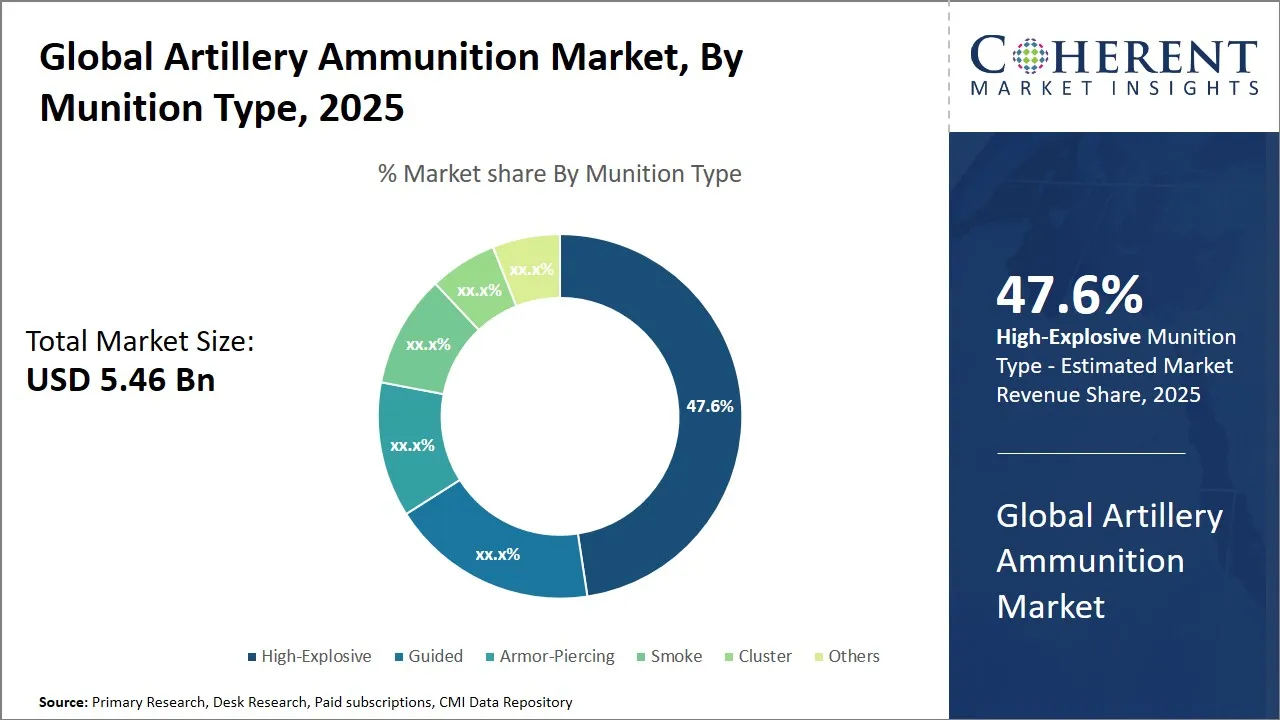
- The high-explosive segment leads the market holding an estimated share of 48.6 % in 2026.
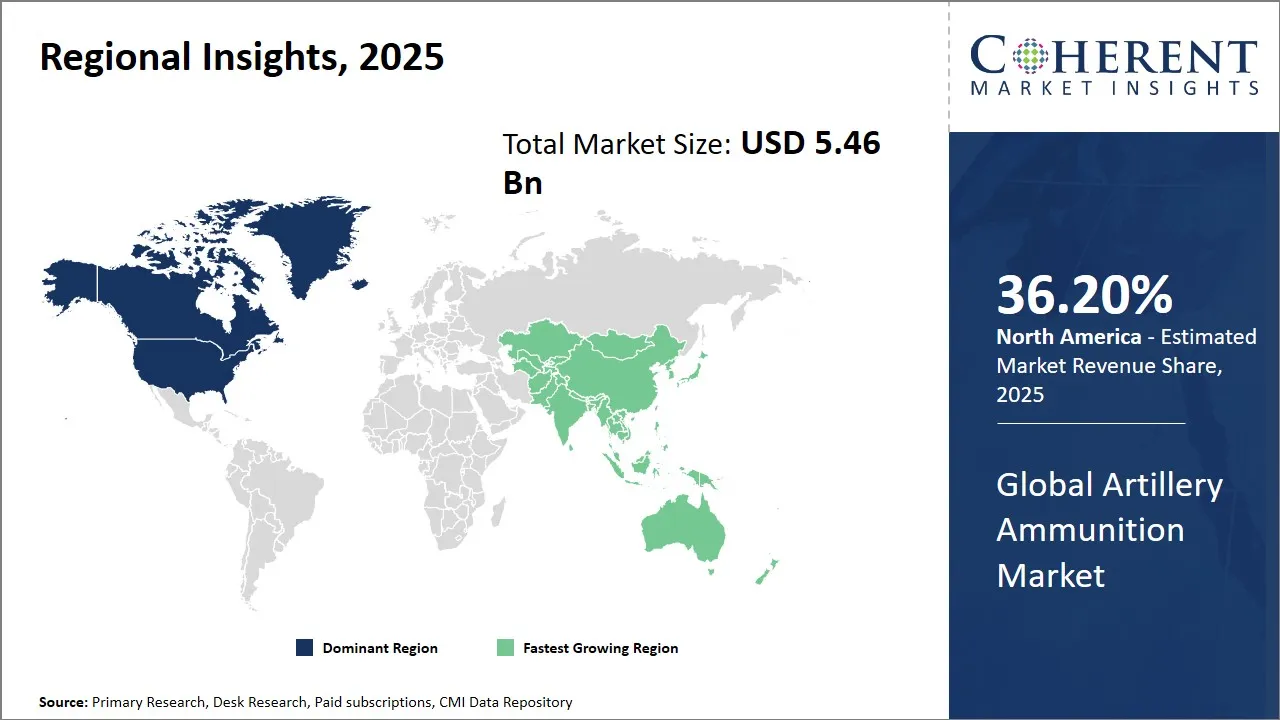
- North America is estimated to lead the market with a share of 36.2 % in 2026.
- Asia Pacific, holding a share of 22.6 % in 2026, is projected to be the fastest growing region.
Market Overview
The market is witnessing a growing adoption of smart and precision-guided artillery shells, which improves targeting accuracy and operational efficiency. Also, rising investments in research and development for sustainable and environment-friendly ammunition are to be expected in the future. Increasing collaborative programs between defense manufacturers and governments are adding to innovation, which is will create demand for advanced artillery systems and their ammunition in the coming years.
Current Events and Its Impact
Current Events | Description and its impact |
Sweden artillery ammunition contracts (Rheinmetall & Nammo) |
|
Rheinmetall wins multi-year 155 mm ammunition order |
|
Partnership & plant for Rheinmetall Defense Lietuva (Lithuania) |
|
Segmental Insights
- Current Industry Events of 2026
- Market Size Estimation
- Regional Breakdown
- Competitive Landscape
- Customer Intelligence
- Segmental Analysis
- Pricing Analysis
- Key Market Drivers, Challenges & Future Trends
- Customized Insights Section
Global Artillery Ammunition Market Insights, by Munition Type - High-Explosive Munition is Driving Dominance in the Global Artillery Ammunition Market
High-explosive is expected to contribute the highest share of 48.6% in the market in 2026. High-explosive artillery shells give maximum blast impact and fragmentation over a wide area, making them highly effective in neutralizing enemy personnel, fortifications, and light vehicles. High-explosive ammunition provides reliable firepower, improving the tactical effectiveness of artillery units.
Technological advancements have also added to the desirability of High-Explosive rounds. Innovations, such as improved fuse mechanisms and improved explosive materials, have increased payload efficiency, safety during handling, and precision.
To add, many countries are upgrading their artillery capabilities to meet evolving defense requirements, and this often includes procuring advanced high-explosive ammunition compatible with newer delivery platforms. Also, geopolitical tensions and increasing defense budgets in different regions add to the popularity of high-explosive munitions. As nations focus on strengthening their ground forces and artillery capabilities to deter or engage in conflict scenarios, High-Explosive rounds remain integral to their arsenals.
Impact of AI on the Artillery Ammunition Market
AI-powered systems can process huge amounts of sensor, geospatial, and targeting data in real time, helping artillery crews optimize fire missions, adjust trajectories mid-flight, and improve hit probability while reducing collateral damage. In manufacturing, AI is used for predictive maintenance of production machinery, defect detection in shell casings, and supply chain optimization, which shortens lead times and lowers costs. For example, AI-driven ballistic computation systems integrated into advanced fire-control solutions can account for weather conditions, barrel wear, and target movement instantly, improving the effectiveness of each shot.
BAE Systems has integrated AI-enabled targeting algorithms into its BONUS 155 mm sensor-fuzed munitions. These munitions use onboard sensors and AI-driven image recognition to autonomously detect and classify armored targets in the target area, selecting the highest-value threats and avoiding civilian infrastructure.
Regional Insights
North America Artillery Ammunition Market Analysis and Trends
North America, holding a share of 36.2% in 2026, is expected to dominate the global artillery ammunition market because of a highly developed defense ecosystem, high government defense spending, and a strong presence of major defense contractors. The U.S., as a key player, sees a robust procurement framework supported by sophisticated R&D infrastructure and advanced manufacturing capabilities.
Government policies focused on modernization of artillery systems and strategic military readiness create sustained demand for artillery ammunition. The presence of industry giants such as Lockheed Martin, Northrop Grumman, and General Dynamics adds to innovation and supply reliability. Also, North America’s extensive network of alliances and export controls add to stable market dynamics, fostering both domestic production and selective international trade.
Asia Pacific Artillery Ammunition Market Analysis and Trends
The Asia Pacific region, holding a share of 22.6% in 2026, is expected to exhibit the fastest growth in the artillery ammunition market because of the increasing geopolitical tensions, expanding defense budgets, and modernization initiatives in emerging economies. Countries like India, China, and South Korea are investing a lot in indigenous artillery production and upgrading existing arsenals to improve firepower capabilities.
Supportive government policies encouraging defense self-reliance and partnerships with global defense technology providers further stimulate market expansion. The presence of indigenous manufacturers such as Bharat Dynamics Limited in India, Norinco in China, and Hanwha Defense in South Korea, coupled with significant import activities, positions Asia Pacific as a rapidly evolving market.
Global Artillery Ammunition Market Outlook for Key Countries
U.S. Artillery Ammunition Market Analysis and Trends
The U.S. drives North America’s market presence with a sophisticated defense industrial base led by major companies like General Dynamics and Lockheed Martin. Investments in artillery modernization programs and procurement of precision-guided artillery shells illustrate a focused demand structure. The U.S. military’s focus on all-weather, networked artillery systems add to the need for advanced ammunition solutions. Government contracts and international sales channels also sustain market leadership and technological advancement, positioning the country as an important hub for innovation and supply in artillery ammunition.
India Artillery Ammunition Market Analysis and Trends
India shows a strategic focus on modernizing artillery assets domestically while ensuring supply chain security. Notable players like Bharat Dynamics Limited and Indian Ordnance Factories are focusing on indigenous ammunition production, supported by government initiatives such as “Make in India” and defense procurement reforms. Increased border tensions and regional security imperatives add to the demand for diverse artillery ammunition types, ranging from conventional rounds to precision-guided munitions.
China Artillery Ammunition Market Analysis and Trends
China leads Asia Pacific because of its large state-owned defense industry and significant R&D investment in munitions technology. Key manufacturers such as Norinco and China North Industries Group Corporation produce different artillery ammunition supporting the People’s Liberation Army’s extensive modernization. Government policies focus on self-reliance and export promotion, enabling China to expand both domestic and international market reach.
South Korea Artillery Ammunition Market Analysis and Trends
South Korea displays advanced defense capabilities and strategic partnerships with global defense companies like Hanwha Defense and LIG Nex1. The government’s defense modernization programs continuously upgrade artillery systems to improve firepower and precision, adding to artillery ammunition demand. Geopolitical considerations, including the security situation on the Korean Peninsula, foster sustained investments in artillery ammunition production and technology.
Germany Artillery Ammunition Market Analysis and Trends
Germany artillery ammunition market sees a strong industrial base and the presence of leading manufacturers such as Rheinmetall and Diehl Defence. As a major European defense hub, Germany supplies advanced artillery munitions to NATO and allied countries, supported by high standards of quality and innovation. Government policies focused on European defense cooperation and modernization projects create demand within the region. Germany’s role in defense exports and participation in multinational development programs add to its continued influence in the Europe artillery ammunition market.
Market Players, Key Development, and Competitive Intelligence
Key Developments
- On August 4, 2025, Gust launched FourthWave 2025, a 16 week program for women-led tech startup. It is a non-dilutive, grant-funded accelerator that focuses on funding readiness, leadership development, and business strategy.
- In May 2025, WTFund, India’s platform for entrepreneurs under 25, has opened applications for its third cohort, C1/25. The program invites young founders to apply for a non-dilutive grant and mentorship.
- In December 2024, AngelList partnered with Bitwave to streamline digital asset management for venture funds. AngelList fund clients now have access to Bitwave’s solutions, enabling them to manage digital assets with the same precision as traditional assets.
- In December 2021, Circle raised a USD 25 million Series A funding round. The company aimed to use the funding to hire engineers and designers to become the best-in-class community platform.
Top Strategies Followed by Artillery Ammunition Market Players
- Established players, which often include multinational defense contractors and leading OEMs, leverage their substantial resources to maintain dominance.
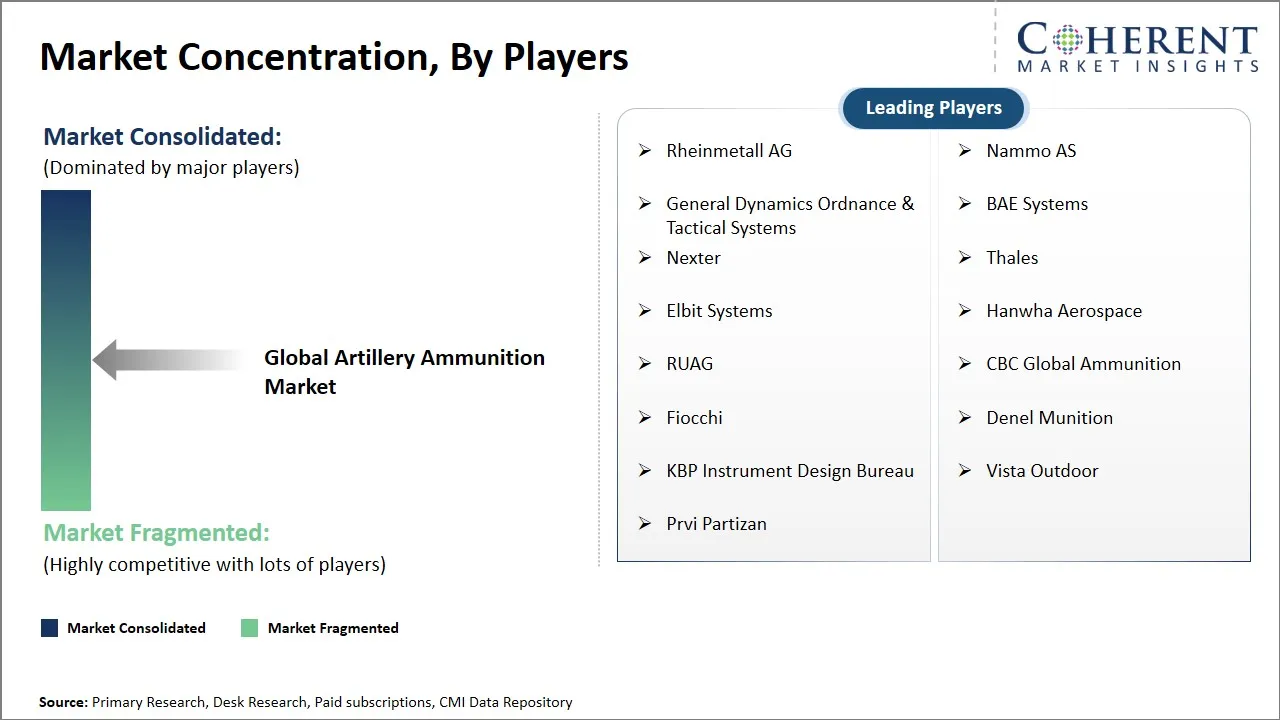
- Established manufacturers like Rheinmetall AG are investing heavily in R&D to advance precision-guided artillery and extended-range munitions.
- Mid-level players adopt a distinctly pragmatic approach to compete effectively in the artillery ammunition sector. Their primary focus is delivering cost-effective solutions that strike a balance between quality and affordability, addressing the significant segment of price-sensitive consumers—often smaller national defense forces or countries with budget constraints.
- Companies like Nammo AS are focusing on cost-optimized, high-volume production for standard HE rounds to meet replenishment demands of European defense forces.
- Small-scale players in the artillery ammunition market often face significant constraints in resources and scale, prompting them to adopt specialized strategies for survival and growth.
- Small-scale producers such as Denel PMP (Pretoria Metal Pressings) in South Africa target specialized segments like smoke, illumination, and training rounds for both domestic and export markets.
Market Report Scope
Artillery Ammunition Market Report Coverage
| Report Coverage | Details | ||
|---|---|---|---|
| Base Year: | 2025 | Market Size in 2026: | USD 5.77 Bn |
| Historical Data for: | 2020 To 2024 | Forecast Period: | 2026 To 2033 |
| Forecast Period 2026 to 2033 CAGR: | 5.6% | 2033 Value Projection: | USD 8.44 Bn |
| Geographies covered: |
| ||
| Segments covered: |
| ||
| Companies covered: | Rheinmetall AG, Nammo AS, General Dynamics Ordnance & Tactical Systems, BAE Systems, Nexter, Thales, Elbit Systems, Hanwha Aerospace, RUAG, CBC Global Ammunition, Fiocchi, Denel Munition, KBP Instrument Design Bureau, Vista Outdoor, and Prvi Partizan | ||
| Growth Drivers: |
| ||
| Restraints & Challenges: |
| ||
Market Dynamics
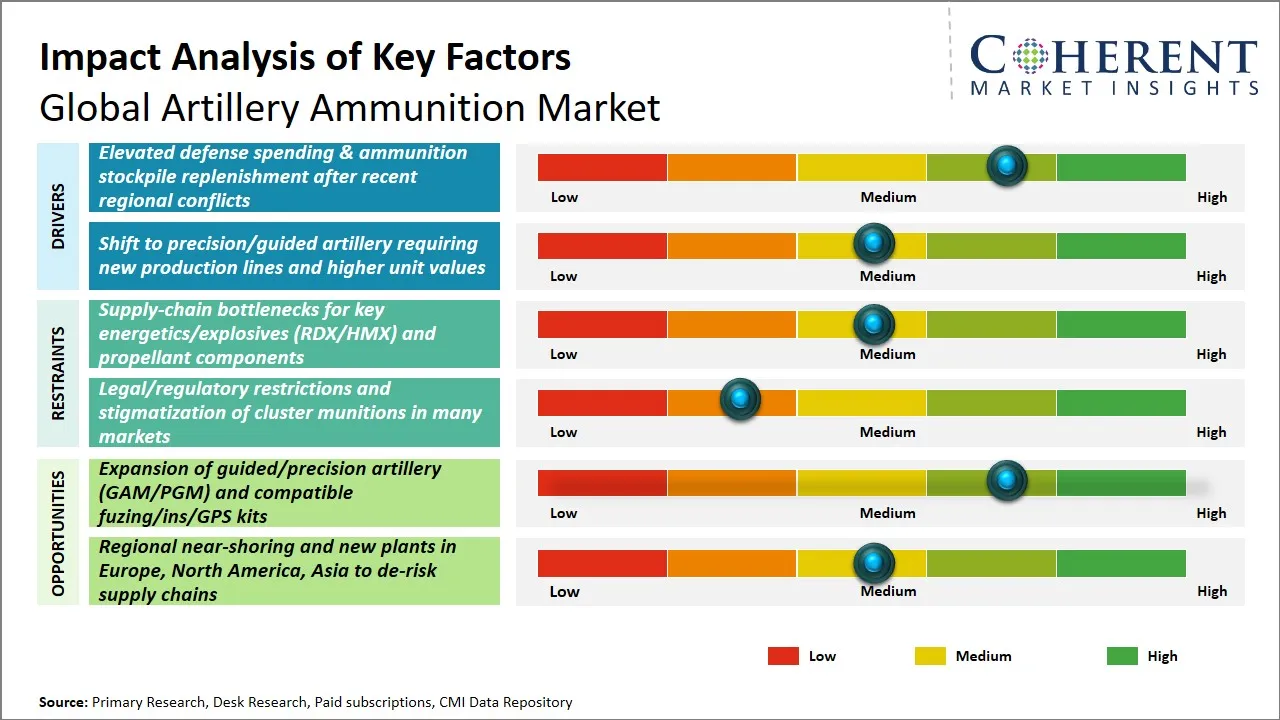
Global Artillery Ammunition Market Driver – Elevated Defense Spending & Ammunition Stockpile Replenishment After Recent Regional Conflicts
Recent regional conflicts have underscored the critical need for sustained military readiness, prompting numerous nations to significantly ramp up their defense budgets. This increased allocation aims to modernize armed forces and address gaps exposed during recent engagements, with a particular focus on replenishing depleted artillery ammunition stockpiles. The intensity and duration of these conflicts have led to fast consumption of existing ammunition reserves, creating a lot of demand for replenishment to maintain operational capabilities and deterrence postures. After the Russia–Ukraine conflict escalated in 2022, the U.S. Department of Defense and several NATO allies greatly increased budgets for artillery ammunition replenishment.
Seeing geopolitical uncertainties and the evolving nature of warfare, defense establishments are focusing on the procurement of advanced artillery ammunition that offers improved range, accuracy, and lethality.
Global Artillery Ammunition Market Opportunity – Expansion of Guided/Precision Artillery Ammunition and Compatible Fuzing/INS/GPS Kits
The market sees a big opportunity because of the fast expansion of guided and precision artillery munitions (GAM/PGM) and the increasing integration of advanced fuzing systems, Inertial Navigation Systems (INS), and Global Positioning System (GPS) kits. Modern warfare needs higher accuracy and lethality, pushing militaries worldwide to upgrade from conventional unguided shells to precision-guided artillery rounds that reduce collateral damage and improve mission success. In 2024, BAE Systems secured contracts to supply BONUS 155 mm sensor-fuzed munitions to Sweden’s armed forces. These rounds use GPS/INS navigation and onboard target-recognition sensors to autonomously locate and attack high-value armored targets.
Also, fuzing mechanisms and navigation kits ensure optimal detonation timing and precise trajectory control, even in challenging terrains and adverse weather conditions. Manufacturers are investing a lot in R&D to improve the miniaturization, reliability, and interoperability of these kits with existing artillery platforms, thereby expanding their applicability across different global defense arsenals.
Analyst Opinion (Expert Opinion)
- The incorporation of AI into precision-guided artillery is enabling real-time trajectory adjustments, improved target recognition, and selective engagement of high-value threats. This not only enhances mission success rates but also aligns with stricter rules of engagement demanding minimal collateral damage.
- Advances in base-bleed, rocket-assisted propulsion, and modular charge systems are extending effective ranges beyond 40–60 km. Coupled with multi-mode fuzes (impact, delay, proximity, and airburst), these features allow a single ammunition type to adapt to diverse mission profiles, reducing logistical burdens.
- Emerging network-enabled munitions are integrating two-way data links, allowing in-flight updates or mission aborts. This capability, combined with programmable fuzes, is shifting artillery from purely “fire-and-forget” to a more flexible, networked fires approach in joint-force operations.
Speak to the analyst
Want personalized insights?
Take the findings above to one of our principal consultants, or have the report rebuilt around the segments, geographies and competitors you actually track.
Market Segmentation
- Munition Type Insights (Revenue, USD Bn, 2021 - 2033)
- High-Explosive
- Guided
- Armor-Piercing
- Smoke
- Cluster
- Others
- Regional Insights (Revenue, USD Bn, 2021 - 2033)
- North America
- U.S.
- Canada
- Latin America
- Brazil
- Argentina
- Mexico
- Rest of Latin America
- Europe
- Germany
- U.K.
- Spain
- France
- Italy
- Russia
- Rest of Europe
- Asia Pacific
- China
- India
- Japan
- Australia
- South Korea
- ASEAN
- Rest of Asia Pacific
- Middle East
- GCC Countries
- Israel
- Rest of Middle East
- Africa
- South Africa
- North Africa
- Central Africa
- North America
- Key Players Insights
- Rheinmetall AG
- Nammo AS
- General Dynamics Ordnance & Tactical Systems
- BAE Systems
- Nexter
- Thales
- Elbit Systems
- Hanwha Aerospace
- RUAG
- CBC Global Ammunition
- Fiocchi
- Denel Munition
- KBP Instrument Design Bureau
- Vista Outdoor
- Prvi Partizan
Sources
Primary Research Interviews
Stakeholders
- Defense Ministries and Procurement Agencies (e.g., acquisition officers, materiel commands)
- Artillery Units and Fire Support Officers (operational end-users)
- Ordnance Factories and State-owned Ammunition Plants (production managers, plant engineers)
- Major Defense Contractors and Ammunition Manufacturers (e.g., production, R&D & sales leads)
- Propellant, Explosives and Energetics Suppliers (chemical suppliers, quality assurance leads)
- Fuze, Guidance and Electronics Suppliers (INS/GPS/fuze manufacturers and integrators)
- Ammunition Logistics & Storage Operators (supply-chain managers, ammunition depot staff)
- Military Test Ranges and Ballistic Research Facilities (test engineers, metallurgists)
- Export Control & Compliance Officers (licensing, regulatory specialists)
- Defense Policy Analysts and Think-tank Experts (IISS, RAND analysts)
Databases
- SIPRI Arms Transfers Database (Stockholm International Peace Research Institute)
- IISS – The Military Balance/IISS databases
- Jane’s Defence & Security databases (open-source intelligence & procurement tracking)
- UN Register of Conventional Arms (UNROCA)
- U.S. Department of Defense (DoD) procurement and budget reports (USG public datasets)
- NATO Support & Procurement Agency (NSPA) / NATO defense expenditure datasets
- National defense budget and procurement portals (e.g., UK DSCA/Congressional Research Service for the U.S.)
Magazines
- Jane’s Defence Weekly/Jane’s Defence & Security Review
- Defense News
- Army Technology/Naval Technology
- Janes Missiles & Rockets (where applicable)
- Military & Aerospace Electronics
Journals
- Journal of Defense Modeling and Simulation
- Defence Studies
- Military Operations Research/Journal of Strategic Studies
- Defence and Peace Economics
- International Journal of Explosives Engineering (or related energetic-materials journals)
Newspapers
- Reuters – Defence & Security coverage
- The New York Times – Defence reporting
- The Guardian – Defense & geopolitics reporting
- The Economic Times (India) – Defense-industrial developments and orders
- Financial Times – Major defense industry M&A and contracts
Associations
- National Defense Industrial Association (NDIA)
- Association of the United States Army (AUSA)
- European Defence Agency (EDA)
- Institute for Strategic Studies (IISS) — think-tank resources
- International Ammunition Technical Guidelines (IATG) contributors / national ordnance societies
Public Domain Sources
- SIPRI (public reports & datasets)
- NATO public reports & defense expenditure data
- U.S. DoD public releases, budget justifications and contract announcements
- UN Register of Conventional Arms (UNROCA)
- National ministries of defense/official procurement portals (e.g., FMV Sweden, MoD India public notices)
- ResearchGate/public academic repositories (for technical papers)
Proprietary Elements
- CMI Data Analytics Tool, Proprietary CMI Existing Repository of information for last 8 years
Get access to 250+ pages report
Every segment, forecast, competitor profile and data table behind the analysis above — available for instant download.
- ESOMAR Member
- ISO 9001:2015 Certified
- D-U-N-S Registered
- GDPR & CCPA Compliant
Missing comfort of reading report in your local language? Find your preferred language:
Transform your Strategy with Exclusive Trending Reports
Frequently Asked Questions
The global artillery ammunition market is estimated to be valued at USD 5.77 billion in 2026 and is expected to reach USD 8.44 billion by 2033.
The CAGR of global artillery ammunition market is projected to be 5.6% from 2026 to 2033.
Elevated defense spending & ammunition stockpile replenishment after recent regional conflicts and shift to precision/guided artillery requiring new production lines and higher unit values are the major factors driving the growth of global artillery ammunition market.
Supply-chain bottlenecks for key energetics/explosives (RDX/HMX) and propellant components and legal/regulatory restrictions and stigmatization of cluster munitions in many markets are the major factors hampering the growth of global artillery ammunition market.
In terms of munition type, high-explosive is estimated to dominate the market revenue share in 2026.
Artillery ammunition is produced by major defense companies such as Rheinmetall AG, Nammo AS, General Dynamics Ordnance & Tactical Systems, BAE Systems, Nexter/KNDS, Hanwha Aerospace, as well as numerous national ordnance factories and specialized regional manufacturers.
Artillery ammunition is commonly referred to as “rounds” or “shells”, and can include high-explosive (HE) shells, armor-piercing projectiles, smoke/illumination rounds, and precision-guided munitions, typically classified by caliber (e.g., 155 mm HE).