

Global Aerospace and Defense Market Size and Forecast – 2026 to 2033
The global aerospace and defense market is estimated to be valued at USD 918.08 Bn in 2026 and is expected to reach USD 1,614.68 Bn by 2033, exhibiting a compound annual growth rate (CAGR) of 8.4% from 2026 to 2033.
Key Takeaways of the Aerospace and Defense Market
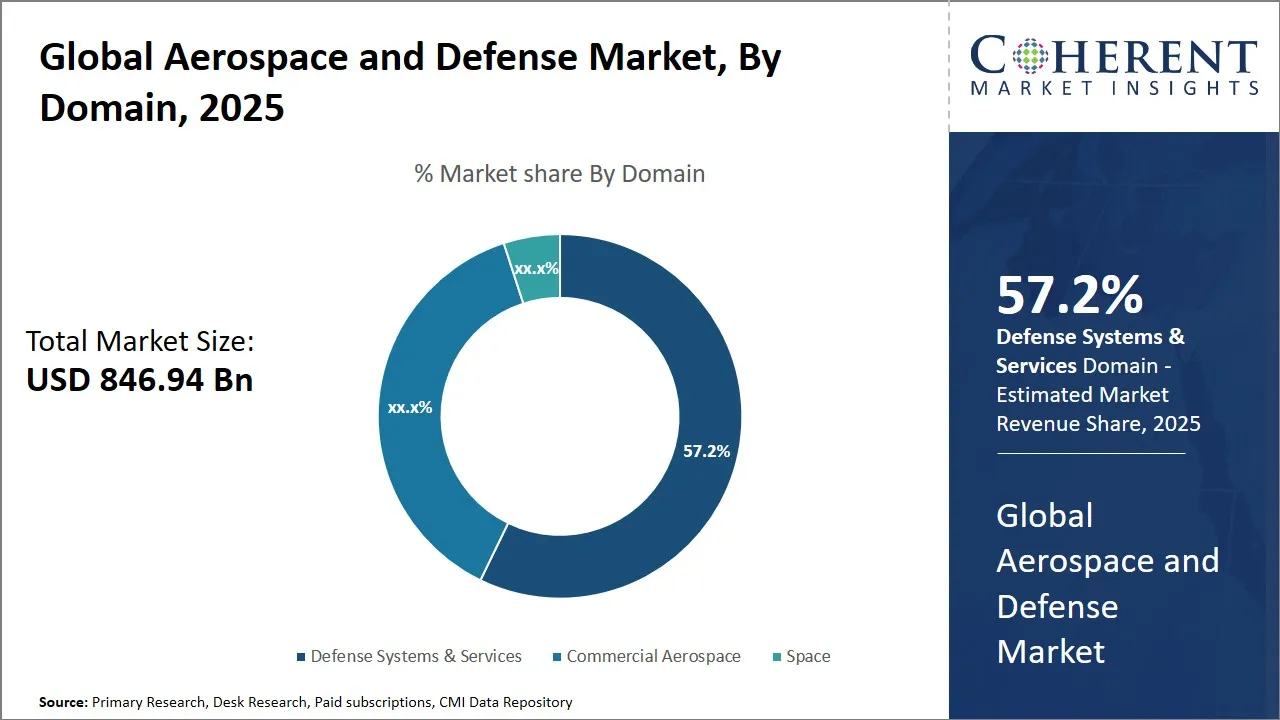
- The defense systems & services segment leads the market holding an estimated share of 58.2 % in 2026.
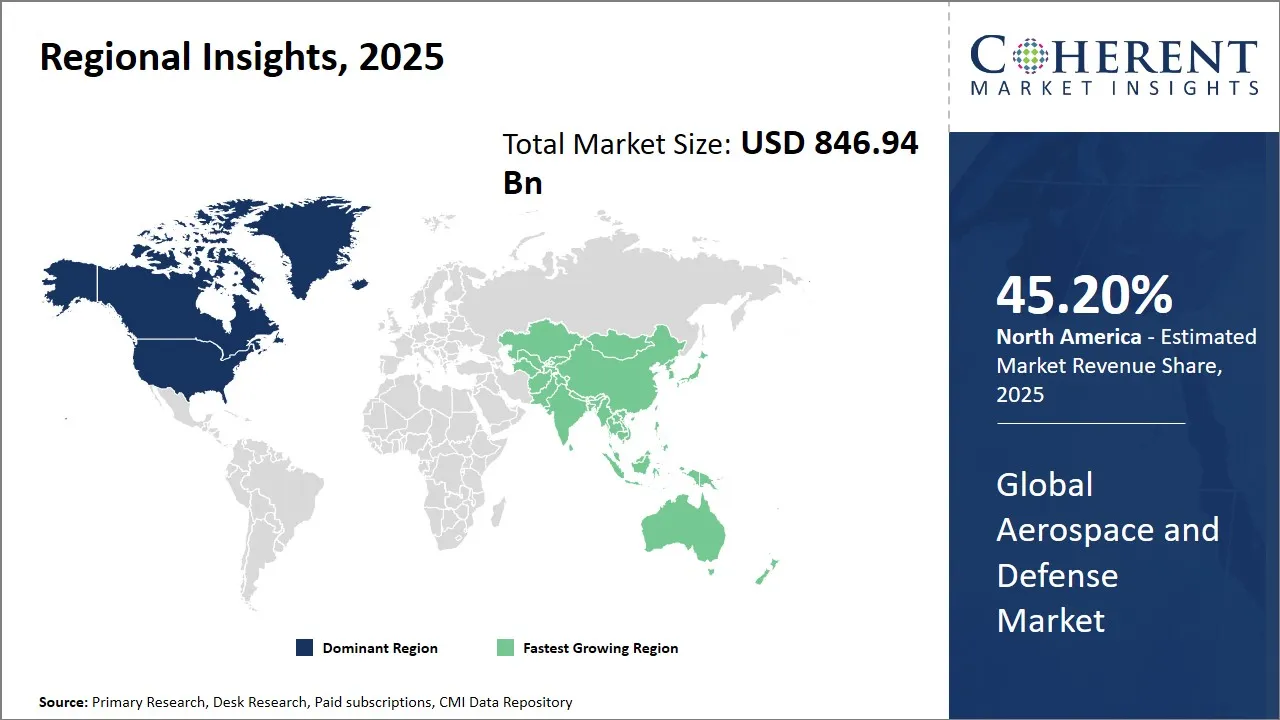
- North America is estimated to lead the market with a share of 45.2 % in 2026.
- Asia Pacific is expected to hold a share of 21.8 % in 2026, and it is projected to be the fastest growing region.
Market Overview
The market is seeing the use of advanced technologies such as artificial intelligence, big data analytics, and unmanned systems, improving operational efficiency and combat capabilities. Also, there is a growing focus on sustainability with investments in fuel-efficient aircraft and green technologies. Shift towards cybersecurity and space exploration can also be seen, leading to increased innovation and diversified market opportunities.
Current Events and Its Impact
Current Events | Description and its impact |
Geopolitical and Defense Developments |
|
Commercial Aerospace Trends |
|
Segmental Insights
- Current Industry Events of 2026
- Market Size Estimation
- Regional Breakdown
- Competitive Landscape
- Customer Intelligence
- Segmental Analysis
- Pricing Analysis
- Key Market Drivers, Challenges & Future Trends
- Customized Insights Section
Global Aerospace and Defense Market Insights, by Domain – Rising Global Security Concerns Propel Defense Systems & Services Segment
The defense systems & services segment leads the market holding an estimated share of 58.2% in 2026. The governments in different regions are focusing on the modernization of military capabilities to address evolving security threats. In 2022, Germany announced a USD 1.16 billion (€100 billion) special defense fund in response to the Russia–Ukraine conflict, which has since accelerated procurement of F-35 fighter jets, air defense systems, and ISR platforms.
Technological advancements have added to the adoption of cutting-edge defense innovations such as Unmanned Aerial Vehicles (UAVs), missile defense systems, and integrated command and control networks. Furthermore, the global shift towards network-centric warfare and digitization underscores the demand for advanced defense systems that can provide real-time intelligence and superior battlefield management.
Another critical factor contributing to the dominance of defense systems & services is the extensive presence of government initiatives aimed at strengthening indigenous defense manufacturing capabilities. Additionally, emerging threats such as cyber warfare, terrorism, and asymmetric conflicts have necessitated the development of specialized defense services including Intelligence, Surveillance, Reconnaissance (ISR), and threat assessment. The growing emphasis on defense services rather than just hardware acquisition expands the market scope, driving increased demand for comprehensive defense solutions and strategic support services.
Impact of AI on the Aerospace and Defense Market
Artificial Intelligence (AI) is rapidly reshaping the aerospace and defense market by enhancing efficiency, decision-making, and predictive capabilities. In defense, AI supports applications such as autonomous drones, threat detection, and battlefield simulations, enabling militaries to respond faster and more accurately in dynamic environments. In aerospace, AI-driven predictive maintenance helps airlines and MRO providers anticipate equipment failures, reduce downtime, and extend asset lifespans, translating into cost savings and improved safety. As defense systems become increasingly data-intensive, AI algorithms allow armed forces to process and analyze massive amounts of intelligence data in real time, providing a strategic advantage.
An example of AI adoption is Lockheed Martin’s partnership with the U.S. Department of Defense on Project Maven, which applies AI to analyze drone surveillance footage. This initiative has significantly improved the speed and accuracy of identifying potential threats compared to manual methods.
Regional Insights
North America Aerospace and Defense Market Analysis and Trends
North America is estimated to lead the market with a share of 45.2% in 2026, driven by a mature and sophisticated ecosystem characterized by significant government investment, a strong industrial base, and advanced technological capabilities. The U.S. Department of Defense (DoD) plays a pivotal role through substantial funding, R&D incentives, and procurement programs, encouraging innovation and development in defense technologies.
The region benefits from the presence of well-established aerospace giants such as Lockheed Martin, Boeing, Raytheon Technologies, and Northrop Grumman, which maintain extensive global supplier networks and continuous technological innovation in areas like stealth technology, avionics, and missile defense systems. Mitsubishi Heavy Industries (Japan) has been advancing the Mitsubishi SpaceJet program and investing in hydrogen-based propulsion technologies for future aircraft.
Asia Pacific Aerospace and Defense Market Analysis and Trends
The Asia Pacific, holding an estimated share of 21.8% in 2026, exhibits the fastest growth fueled by increasing defense budgets, strategic modernization programs, and a rising focus on domestic aerospace manufacturing capabilities. Countries such as China, India, Japan, South Korea, and Australia are actively expanding their aerospace and defense sectors with major government initiatives aimed at self-reliance and technological innovation.
Policy reforms encouraging Foreign Direct Investment (FDI) and technology transfers have catalyzed the entry of multinational companies like Boeing, Airbus, and BAE Systems into joint ventures with domestic firms. Further, India’s "Make in India" initiative and China’s rapid advancements in aerospace manufacturing have created a conducive environment for local startups and established companies alike. The dynamic geopolitical landscape in the region also necessitates upgraded defense systems and aerospace infrastructure, accelerating the market expansion.
Global Aerospace and Defense Market Outlook for Key Countries
U.S. Aerospace and Defense Market Analysis and Trends
The U.S. is characterized by technological leadership and comprehensive defense spending directed at next-generation aerospace systems, cyber defense, and unmanned platforms. Major players such as Lockheed Martin, Boeing, Raytheon Technologies, and General Dynamics contribute significantly to R&D and manufacturing innovation. The U.S. maintains extensive global defense alliances, further boosting exports and collaborative projects. Government policies emphasizing modern warfare capabilities and space exploration projects continue to shape the market landscape.
China Aerospace and Defense Market Analysis and Trends
China aerospace and defense market is growing fast because of strong government backing to develop indigenous technologies such as fighter jets, missiles, aerospace manufacturing, and space systems. State-owned enterprises like Aviation Industry Corporation of China (AVIC), China Aerospace Science and Technology Corporation (CASC), and China North Industries Group (Norinco) are big players adding to this evolution.
India Aerospace and Defense Market Analysis and Trends
India aerospace and defense market is seeing growth because of its focus on indigenization through initiatives like "Make in India" and Defense Procurement Procedure reforms. Government policies are pushing domestic manufacturing and reducing dependence on imports. Key players include Hindustan Aeronautics Limited (HAL), Bharat Electronics Limited (BEL), Bharat Dynamics Limited (BDL), and a growing number of private aerospace firms like Tata Advanced Systems and Larsen & Toubro.
U.K. Aerospace and Defense Market Analysis and Trends
The U.K. continues to lead in advanced aerospace design and defense electronics because of government defense contracts. Companies like BAE Systems, Rolls-Royce, and Leonardo UK are big players renowned for fighter aircraft development, propulsion systems, and defense electronics. U.K.’s participation in collaborative multinational programs like the Eurofighter Typhoon and international defense partnerships makes its market position stronger.
Market Players, Key Development, and Competitive Intelligence
Key Developments
- On August 13, 2025, Lockheed Martin expanded its industrial collaboration package for the Philippines as part of its F-16 Block 70 solution for the country's Multi Role Fighter program. The enhanced offer includes a strategic partnership with Southern Methodist University (SMU) to drive digital innovation, intellectual property creation, and workforce development with Philippine universities and industry.
- In May 2025, Northrop Grumman Corporation successfully completed two test flights of its Advanced Hypersonic Technology Inertial Measurement Unit at hypersonic speed, leveraging Stratolaunch’s reusable hypersonic airplane, Talon-A.
- In April 2025, Airbus SE entered into a definitive agreement with Spirit AeroSystems for the acquisition of industrial assets dedicated to its commercial aircraft programs.
- In April 2025, Gulfstream Aerospace Corp., a wholly owned subsidiary of General Dynamics (NYSE:GD), announced today that the all-new Gulfstream G800, the world's longest-range business aircraft, has earned type certification from the Federal Aviation Administration (FAA) along with certification from the European Union Aviation Safety Agency (EASA)
Top Strategies Followed by Aerospace and Defense Market Players
- Established industry giants invest heavily in research and development (R&D) to innovate high-performance, cutting-edge products that meet stringent safety and efficiency standards.
- Lockheed Martin invests over USD 1.3 billion annually in R&D, focusing on next-gen technologies like hypersonics, AI-driven battle management, and directed energy weapons.
- Mid-level players in the aerospace and defense sector adopt a more cost-sensitive strategy, concentrating on delivering solutions that balance quality with affordability.
- Embraer focuses on regional jets like the E2 family, offering fuel-efficient and cost-effective aircraft compared to larger Airbus/Boeing alternatives.
- Small-scale players operate in a distinct niche within the aerospace and defense market by focusing on specialized features or innovative, often highly customized products.
- Kongsberg Defense & Aerospace specializes in precision missile systems like the Naval Strike Missile (NSM), carving a niche in advanced missile technology.
Market Report Scope
Aerospace and Defense Market Report Coverage
| Report Coverage | Details | ||
|---|---|---|---|
| Base Year: | 2025 | Market Size in 2026: | USD 918.08 Bn |
| Historical Data for: | 2020 To 2024 | Forecast Period: | 2026 To 2033 |
| Forecast Period 2026 to 2033 CAGR: | 8.4% | 2033 Value Projection: | USD 1,614.68 Bn |
| Geographies covered: |
| ||
| Segments covered: |
| ||
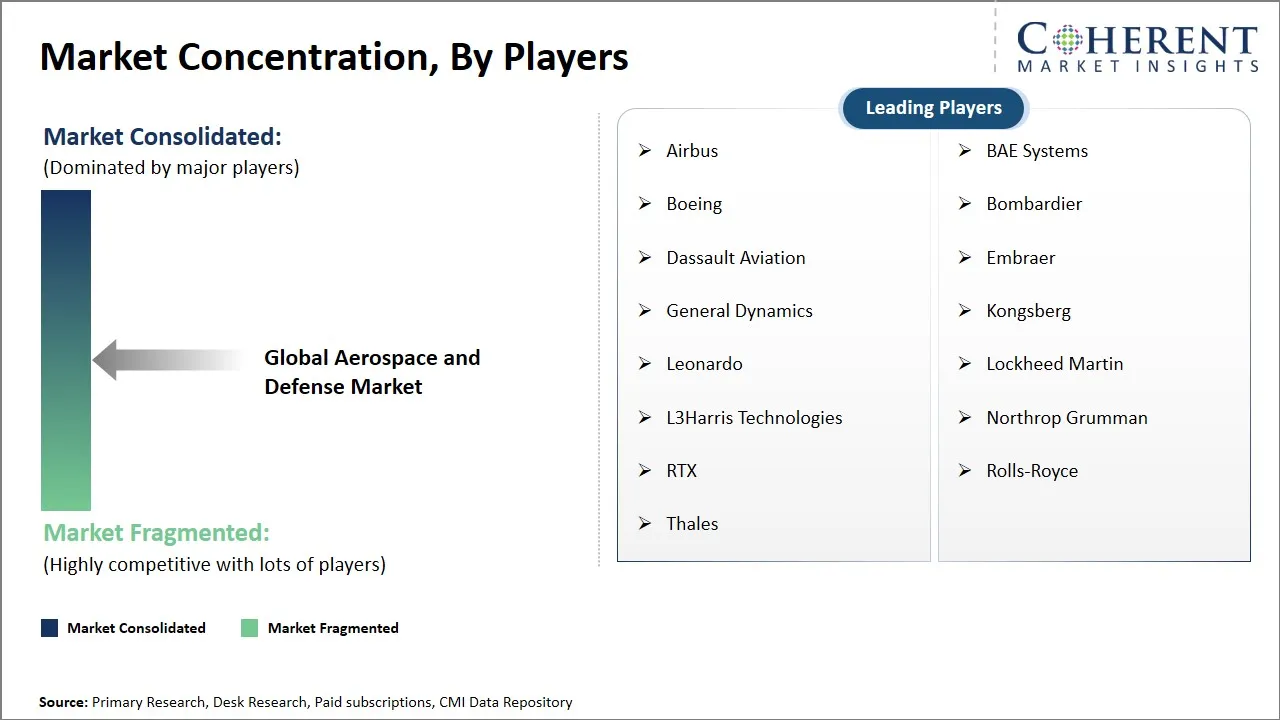
| Companies covered: | Airbus, BAE Systems, Boeing, Bombardier, Dassault Aviation, Embraer, General Dynamics, Kongsberg, Leonardo, Lockheed Martin, L3Harris Technologies, Northrop Grumman, RTX, Rolls-Royce, and Thales | ||
| Growth Drivers: |
| ||
| Restraints & Challenges: |
| ||
Market Dynamics
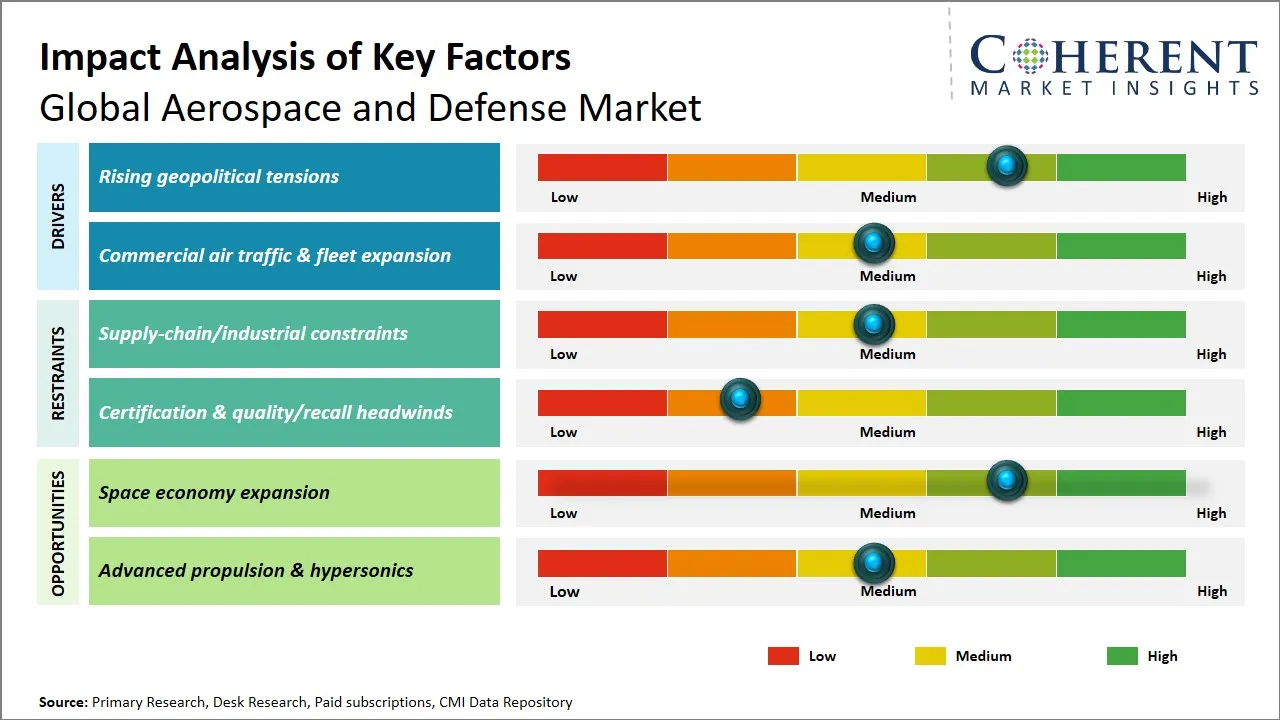
Global Aerospace and Defense Market Driver – Rising Geopolitical Tensions
Nations are increasingly prioritizing the modernization and expansion of their military capabilities to safeguard sovereignty and maintain strategic advantages amid uncertain international relations. Heightened conflicts, territorial disputes, and power rivalries compel governments to allocate substantial resources toward upgrading defense infrastructure, procuring cutting-edge aircraft, missile defense systems, and surveillance technologies. For instance, the Russia–Ukraine war has prompted NATO members and other European countries to significantly boost defense spending. For example, Germany announced a USD 1.16 billion (€100 billion) defense fund in 2022, leading to accelerated procurement of fighter jets, missile defense systems, and other advanced platforms.
This urgency is further intensified by the rapid development of asymmetric warfare tactics and cyber threats, necessitating sophisticated aerospace solutions capable of addressing multifaceted security challenges. Additionally, defense alliances and partnerships are pushing member countries to enhance interoperability through advanced communication and reconnaissance platforms.
Global Aerospace and Defense Market Opportunity – Space Economy Expansion
The emergence of commercial spaceflight, satellite deployment, and space exploration initiatives has catalyzed demand for advanced aerospace technologies, innovative propulsion systems, and next-generation defense capabilities. Governments worldwide are enhancing their space programs to secure strategic advantages, leading to increased procurement budgets and partnerships with defense contractors specializing in space technologies. A real instance is India’s successful Chandrayaan-3 lunar mission in 2023 and the subsequent surge in government and private investment in space technologies.
Additionally, the rapid growth of satellite-based services in telecommunications, Earth observation, and global navigation is propelling demand for more reliable, cost-effective, and high-performance aerospace components. Private sector players, ranging from startups to established corporations, are aggressively entering the market, fostering innovation through reusable launch vehicles, small satellite technology, and space tourism ventures. This ecosystem expansion drives significant opportunities for suppliers of materials, electronics, and software systems tailored to meet the rigorous demands of space applications.
Analyst Opinion (Expert Opinion)
- The adoption of artificial intelligence for predictive maintenance, mission planning, and autonomous systems (e.g., drones, loyal wingmen) is set to transform both defense operations and commercial aviation efficiency. Players investing early in AI integration will gain a significant competitive edge.
- With programs in the U.S., China, and Russia advancing rapidly, hypersonic weapons and propulsion technologies are becoming central to defense modernization. These technologies will drive long-term R&D spending and reshape military deterrence strategies.
- The rapid growth of the space economy—spanning satellite constellations, reusable launch systems, and space-based communications—offers dual-use opportunities for defense and commercial sectors. This convergence will expand partnerships between governments, primes, and private space firms.
Speak to the analyst
Want personalized insights?
Take the findings above to one of our principal consultants, or have the report rebuilt around the segments, geographies and competitors you actually track.
Market Segmentation
- Domain Insights (Revenue, USD Bn, 2021 - 2033)
- Defense Systems & Services
- Commercial Aerospace
- Space
- Regional Insights (Revenue, USD Bn, 2021 - 2033)
- North America
- U.S.
- Canada
- Latin America
- Brazil
- Argentina
- Mexico
- Rest of Latin America
- Europe
- Germany
- U.K.
- Spain
- France
- Italy
- Russia
- Rest of Europe
- Asia Pacific
- China
- India
- Japan
- Australia
- South Korea
- ASEAN
- Rest of Asia Pacific
- Middle East
- GCC Countries
- Israel
- Rest of Middle East
- Africa
- South Africa
- North Africa
- Central Africa
- North America
- Key Players Insights
- Airbus
- BAE Systems
- Boeing
- Bombardier
- Dassault Aviation
- Embraer
- General Dynamics
- Kongsberg
- Leonardo
- Lockheed Martin
- L3Harris Technologies
- Northrop Grumman
- RTX
- Rolls-Royce
- Thales
Sources
Primary Research Interviews
Stakeholders
- Defense Contractors & System Integrators
- Commercial Aircraft Manufacturers
- Space Agencies & Launch Providers
- Avionics & Propulsion System Suppliers
- Airlines & MRO Service Providers
- Military Procurement Officials & Policy Advisors
- Aerospace Startups focusing on AI, UAVs, and Hypersonics
Databases
- U.S. Department of Defense Budget Data
- European Defence Agency (EDA) Statistics
- SIPRI Military Expenditure Database
- International Civil Aviation Organization (ICAO) Data Hub
- OECD Aerospace & Defense Reports
Magazines
- Aviation Week & Space Technology
- Defense News
- Aerospace Manufacturing Magazine
- Military & Aerospace Electronics
- SpaceWatch Global
Journals
- Journal of Aerospace Engineering
- Defence and Security Analysis Journal
- Acta Astronautica
- Journal of Air Transport Management
- International Journal of Defense Studies
Newspapers
- FlightGlobal
- The Aviation Herald
- Jane’s Defence Weekly
- The Economic Times (India – Aerospace & Defence section)
- The Guardian (UK – Defence & Security section)
Associations
- Aerospace Industries Association (AIA – U.S.)
- European Aerospace and Defence Association (ASD)
- International Air Transport Association (IATA)
- Society of Indian Defence Manufacturers (SIDM)
- Space Foundation
Public Domain Sources
- U.S. Census Bureau (transport & manufacturing statistics)
- EUROSTAT (aerospace industry data)
- United Nations Office for Outer Space Affairs (UNOOSA)
- World Bank – Aerospace & Defense Trade Indicators
- ResearchGate (open access aerospace research papers)
Proprietary Elements
- CMI Data Analytics Tool, Proprietary CMI Existing Repository of Aerospace & Defense Industry Information (last 8 years)
Get access to 250+ pages report
Every segment, forecast, competitor profile and data table behind the analysis above — available for instant download.
- ESOMAR Member
- ISO 9001:2015 Certified
- D-U-N-S Registered
- GDPR & CCPA Compliant
Missing comfort of reading report in your local language? Find your preferred language:
Transform your Strategy with Exclusive Trending Reports
Frequently Asked Questions
The global aerospace and defense market is estimated to be valued at USD 918.08 billion in 2026 and is expected to reach USD 1,614.68 billion by 2033.
The CAGR of the global aerospace and defense market is projected to be 8.4% from 2026 to 2033.
Rising geopolitical tensions and commercial air traffic & fleet expansion are the major factors driving the growth of the global aerospace and defense market.
Supply-chain/industrial constraints and certification & quality/recall headwinds are the major factors hampering the growth of the global aerospace and defense market.
In terms of domain, the defense systems & services segment is estimated to dominate the market revenue share in 2026.
Hypersonic weapons and counter-hypersonic systems are the most disruptive in defense.
AI supports predictive maintenance, autonomous operations, and faster threat analysis in aerospace.