

Spacesuit Market Size and Forecast — 2026 - 2033
The Global Spacesuit Market size is estimated to be valued at USD 3.5 billion in 2026 and is expected to reach USD 7.8 billion by 2033, exhibiting a compound annual growth rate (CAGR) of 11.5% from 2026 to 2033.
Overview
The Spacesuit Market includes a variety of products designed to ensure astronaut safety, mobility, and life support in extreme space environments. Key types include Extravehicular Mobility Units (EMUs) for spacewalks, Intravehicular Activity (IVA) suits for operations inside spacecraft, and specialized launch and entry suits for takeoff and re-entry protection. Advanced suits incorporate life support systems, thermal regulation, radiation shielding, and communication modules. Innovations in lightweight materials, flexible joints, and modular designs enhance comfort and mobility. These products are used by government space agencies, commercial space ventures, and research institutions, supporting missions in low Earth orbit, deep space, and planetary exploration.
Key Takeaways
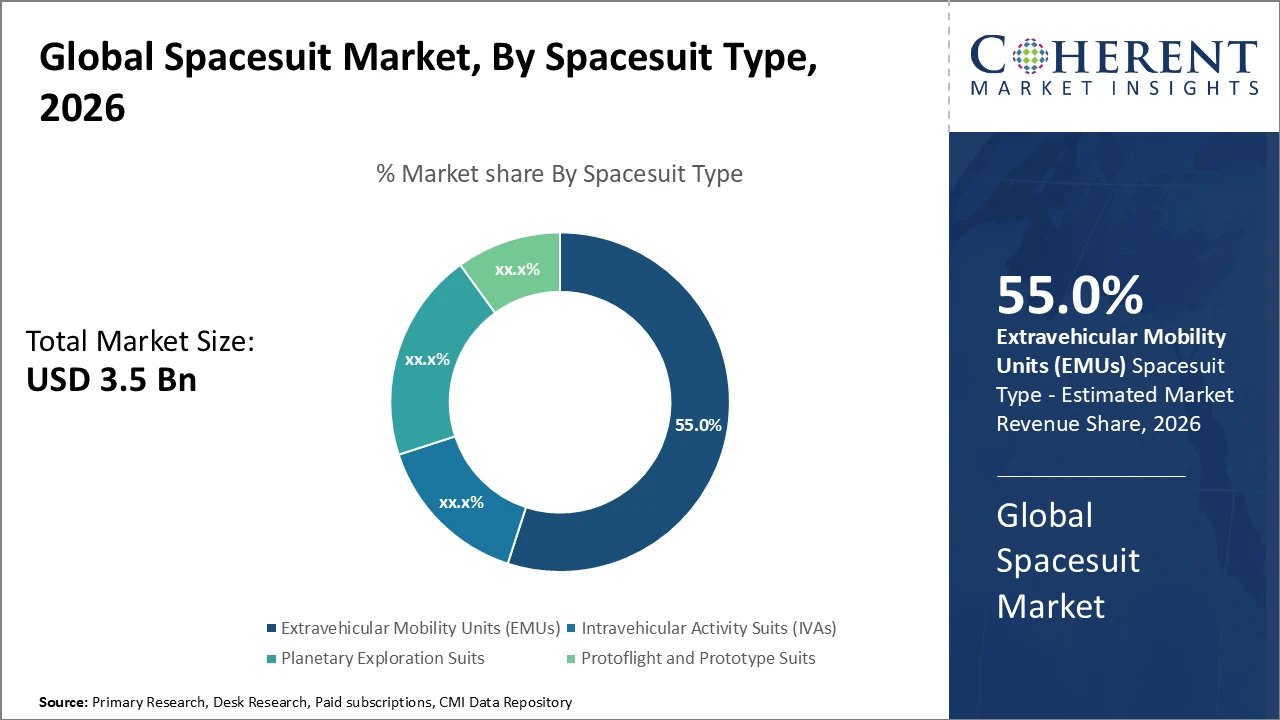
The Extravehicular Mobility Unit segment dominates the spacesuit market with a share of 55%, driven by increased lunar and Mars mission requirements.
Government space agencies remain the largest end-users, emphasizing the criticality of tailored suits for crewed exploration.
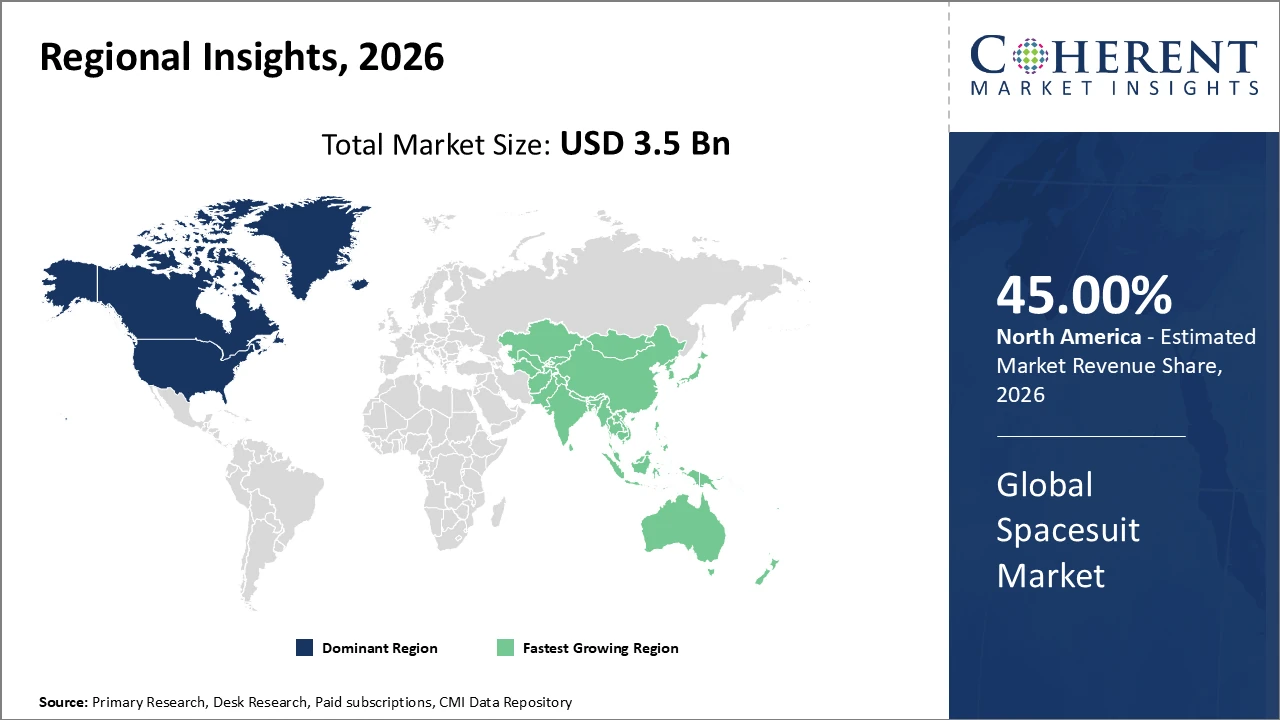
North America controls over 45% of the spacesuit market size, supported by robust aerospace infrastructure and sustained government funding.
Asia Pacific exhibits the fastest growth trajectory with a CAGR exceeding 14%, fueled by expanding space programs in China and India.
Spacesuit Market Segmentation Analysis
Spacesuit Market Insights, By Spacesuit Type
Extravehicular Mobility Units (EMUs) dominate the spacesuit market with a 55% share, owing to their critical role in spacewalks and surface missions. EMUs are designed to provide maximum mobility, life support, and durability during extended extravehicular activities, meeting the growing demands of lunar and Mars exploration. Planetary Exploration Suits are the fastest-growing subsegment, developed to withstand harsh extraterrestrial environments and varying gravity conditions. Intravehicular Activity Suits, intended for spacecraft interiors, offer lightweight construction and pressure stabilization but account for a smaller market share. Protoflight and Prototype Suits serve as experimental platforms, while other specialized suits address safety and rescue operations.
Spacesuit Market Insights, By Component
The Primary Life Support System dominates the spacesuit market in revenue, providing essential functions such as oxygen supply, carbon dioxide removal, and thermal regulation, critical for astronaut safety and mission success. Communication Systems are the fastest-growing subsegment, driven by innovations in embedded telemetry, real-time data transmission, and mission-critical connectivity, achieving over 20% annual growth. Pressure Garment Assemblies maintain structural integrity and a stable internal environment, ensuring mobility and protection in extreme conditions. Mobility Enhancements, including flexible materials and soft joint designs, further improve astronaut comfort and maneuverability during extravehicular activities, contributing to overall performance and operational efficiency in space missions.
Spacesuit Market Insights, By End User
Government space agencies dominate the spacesuit market, accounting for over 60% of the total share, driven by sustained investments in crewed exploration programs. Organizations such as NASA and CNSA require advanced suits for diverse mission profiles, ensuring market stability and continuous demand. Private space tourism operators represent the fastest-growing subsegment, propelled by commercial spaceflight expansion and demand for customized suit designs, comprising nearly 25% of new suit procurements over the past two years. Research institutions focus on prototype and experimental suit development, while defense sectors adapt spacesuit technologies for high-altitude and microgravity military applications, collectively supporting innovation and market diversification.
Spacesuit Market Trends
The spacesuit market is experiencing rising demand for multifunctional suits suitable for both extravehicular and intravehicular activities within a single mission profile.
Hybrid suit adoption increased by 20% in 2025, largely driven by NASA’s Artemis lunar missions, which require versatile and flexible suit systems.
Integration of digital health analytics in spacewear is expanding, with biometric monitoring capabilities embedded in suits to enhance astronaut safety, witnessing a 35% increase in deployments in recent years.
Sustainable design initiatives using recyclable materials are gaining traction, with companies like ILC Dover leading efforts to minimize mission waste and environmental impact.
Spacesuit Market Insights, By Geography
North America Spacesuit Market Analysis and Trends
In North America, the spacesuit market is predominantly driven by the United States, which accounts for roughly 45% of the global market share. Continuous government funding for space programs, including NASA’s Artemis missions, combined with well-established aerospace infrastructure and long-term industry partnerships, underpins this market dominance. Leading companies such as Lockheed Martin and Collins Aerospace play a pivotal role in research, development, and production of advanced spacesuits, contributing to technological innovation and reliability. Strong collaboration between government agencies and private aerospace firms ensures sustained market growth, making North America the most influential region in the global spacesuit industry.
Asia Pacific Spacesuit Market Analysis and Trends
Asia Pacific is the fastest-growing spacesuit market, registering a CAGR exceeding 14%, driven primarily by China’s expanded lunar exploration initiatives and India’s advancements in space missions. Both countries are enhancing spacesuit manufacturing capabilities and investing in research to support crewed and robotic space programs. Favorable government policies promoting indigenous space technologies, combined with emerging public-private partnerships, are accelerating innovation and production in the region. Increasing participation in international space collaborations and growing investments in commercial space ventures further contribute to market expansion. These factors collectively position Asia Pacific as a key growth hub in the global spacesuit industry.
Spacesuit Market Outlook for Key Countries
USA Spacesuit Market Analysis and Trends
The U.S. spacesuit market is bolstered by significant budget allocations for Moon and Mars exploration missions, driving demand for advanced, durable suits. Collaborative efforts such as Lockheed Martin’s work with NASA on xEMU suits and Honeywell Aerospace’s development of integrated life support systems highlight the country’s technological leadership. These initiatives have enhanced astronaut safety, improved mobility, and enabled longer extravehicular activity durations, directly contributing to higher mission efficiency. Continuous innovation, government funding, and strategic partnerships ensure sustained growth in the market. As a result, the U.S. remains the dominant contributor to global spacesuit revenue and technological advancement.
Germany Spacesuit Market Analysis and Trends
The Germany spacesuit market demonstrates steady growth, driven by the country’s strong aerospace engineering expertise and active participation in European space programs. Government initiatives and collaborations with the European Space Agency (ESA) support the development of advanced Extravehicular Mobility Units (EMUs) and Intravehicular Activity (IVA) suits. German manufacturers focus on innovation in lightweight materials, mobility enhancements, and integrated life support systems, catering to both research missions and commercial space ventures. The market also benefits from rising interest in space tourism and experimental space missions. Sustainable design practices and modular suit technologies further strengthen Germany’s position as a key player in the European spacesuit industry.
Analyst Opinion
Increased demand from lunar and Mars missions: Renewed lunar exploration, including NASA's Artemis program, and planned Mars projects have driven strong demand for next-generation spacesuits. NASA’s planned EVA suit upgrades contributed to a 15% increase in production capacity by the end of 2025, boosting the market share of planetary surface suits.
Enhanced production efficiency and material innovation: Use of high-strength, lightweight materials like Vectran and advanced soft joint technology reduced spacesuit weight by 12%, improving mobility and mission duration. Production throughput for these materials increased by 18% in 2024, supporting faster market revenue growth.
Expansion of commercial space tourism: Private crewed spaceflights are diversifying demand, with customized and modular suits emerging as key growth drivers. By 2026, over 30% of market revenue is expected to come from commercial clients.
Supply chain optimization and localization trends: Regional manufacturing hubs in North America and Europe improved responsiveness, reducing lead times by around 20% from 2024 to 2026, enhancing delivery efficiency and cost management.
- Current Industry Events of 2026
- Market Size Estimation
- Regional Breakdown
- Competitive Landscape
- Customer Intelligence
- Segmental Analysis
- Pricing Analysis
- Key Market Drivers, Challenges & Future Trends
- Customized Insights Section
Market Scope
| Report Coverage | Details | ||
|---|---|---|---|
| Base Year: | 2025 | Market Size in 2026: | USD 3.5 billion |
| Historical Data for: | 2020 To 2024 | Forecast Period: | 2026 To 2033 |
| Forecast Period 2026 to 2033 CAGR: | 11.5% | 2033 Value Projection: | USD 7.8 billion |
| Geographies covered: |
| ||
| Segments covered: |
| ||
| Companies covered: | Collins Aerospace, Axiom Space, Lockheed Martin, SpaceX, ILC Dover, Honeywell Aerospace, Orbital Technologies, Boeing, David Clark Company, Oceaneering International | ||
| Growth Drivers: |
| ||
Spacesuit Market Growth Factors
Significant government investment in space exploration ensures a steady demand for spacesuits designed for extreme extraterrestrial environments. The growing privatization of space missions is driving the need for adaptable, reusable suits capable of supporting multiple mission types. Technological advancements, including intelligent suit systems with embedded health monitoring, adaptive thermal regulation, and real-time telemetry, are enhancing astronaut safety and mission efficiency, accelerating market growth. Additionally, rising geopolitical interest in space dominance and defense-related space initiatives is fueling the development of specialized spacesuits for strategic applications. Collectively, these factors sustain innovation and expand opportunities in the global spacesuit market.
Spacesuit Market Development
In March 2026, NASA prepares for its first lunar fly-around mission in over 50 years, with engineer Dustin Gohmert leading spacesuit development at the Johnson Space Center’s Orion Crew Survival Systems Lab. Years in development, these suits are built to safeguard astronauts during launch, landing, and emergencies.
Key Players
Leading Companies of the Market
Collins Aerospace
Axiom Space
Lockheed Martin
Boeing
SpaceX
David Clark Company
ILC Dover
Honeywell Aerospace
Orbital Technologies
Oceaneering International
Leading market players are pursuing competitive strategies through strategic partnerships and technological collaborations to enhance spacesuit modularity, performance, and life support capabilities. For instance, Lockheed Martin’s collaboration with NASA on the next-generation Exploration Extravehicular Mobility Unit (xEMU) has increased operational life cycles for suited astronauts by 25%, improving mission efficiency and safety. Similarly, Axiom Space has focused on developing customized suits for commercial space tourism, expanding its market presence by 18% in 2025. These initiatives leverage customer-driven design innovations and advanced technologies, enabling companies to strengthen their competitive positioning and address both governmental and emerging commercial space demands.
Spacesuit Market Future Outlook
The spacesuit market is expected to experience robust growth driven by ongoing lunar and Mars exploration initiatives, expanding commercial space tourism, and rising investments in defense-related space programs. Future developments will focus on lightweight, multifunctional suits integrating advanced life support systems, adaptive thermal regulation, and real-time biometric monitoring to enhance astronaut safety and mission efficiency. Modular and reusable designs will gain prominence, supporting multiple mission profiles and reducing operational costs. Technological innovations, sustainable materials, and public-private collaborations will further accelerate market expansion. Overall, increasing space activities, coupled with technological advancement and commercialization, will shape a dynamic and high-growth future for the spacesuit industry.
Spacesuit Market Historical Analysis
The spacesuit market has evolved significantly over the past decades, driven by advancements in space exploration and astronaut safety requirements. Early development focused on basic pressure suits for orbital missions, gradually progressing to Extravehicular Mobility Units (EMUs) enabling extended spacewalks. Government space agencies, particularly NASA and ESA, dominated the market, funding research in life support systems, mobility enhancements, and thermal regulation technologies. The introduction of commercial space ventures in recent years diversified demand, prompting innovation in modular and lightweight suit designs. Historical trends highlight continuous improvements in materials, safety, and functionality, laying the foundation for modern multifunctional spacesuits used in lunar, Martian, and orbital missions.
Sources
Primary Research Interviews:
Product managers, R&D heads, and design engineers at leading aerospace and spacesuit manufacturing companies
Operations directors, technical leads, and innovation managers at commercial spaceflight and private space tourism companies
Aerospace consultants, mission planners, and space safety experts advising on extravehicular activity, life support systems, and astronaut mobility
Magazines:
Space.com – Space Missions, Astronaut Equipment, and Suit Innovations
Aviation Week & Space Technology – Aerospace Technologies, Spacesuit Developments, and Life Support Systems
SpaceNews – Commercial Spaceflight, Spacesuit Technology, and Market Trends
Popular Mechanics – Space Exploration, EVA Technology, and Innovation Updates
Journals:
Journal of Aerospace Engineering – Advances in Spacesuit Design and Extravehicular Systems
SAE International Journal of Aerospace – Life Support, Mobility Enhancements, and Thermal Regulation Technologies
Acta Astronautica – Planetary Exploration Suits, Safety Systems, and Material Innovations
Journal of Space Safety Engineering – Astronaut Health Monitoring, Pressure Garments, and EVA Systems
Newspapers:
The Wall Street Journal – Space Industry Developments, Technology, and Market Movements
Financial Times – Aerospace Investments, Space Tourism, and Government Programs
TechCrunch – Startups, Innovations, and Commercial Space Ventures
Space Daily – Market Updates, Product Launches, and Global Space Programs
Associations:
International Astronautical Federation (IAF) – Research, Standards, and Space Technology Insights
American Institute of Aeronautics and Astronautics (AIAA) – Aerospace Engineering, Suit Development, and Mission Safety
European Space Agency (ESA) – Space Program Guidelines, EVA Standards, and Collaboration Initiatives
Space Safety and Certification Association (SSCA) – Safety Protocols, Testing Standards, and Spacesuit Compliance
Get access to 250+ pages report
Every segment, forecast, competitor profile and data table behind the analysis above — available for instant download.
- ESOMAR Member
- ISO 9001:2015 Certified
- D-U-N-S Registered
- GDPR & CCPA Compliant
Missing comfort of reading report in your local language? Find your preferred language:
Transform your Strategy with Exclusive Trending Reports
Frequently Asked Questions
The spacesuit market is led by industry leaders such as Collins Aerospace, Lockheed Martin, Axiom Space, and David Clark Company, each excelling through innovation in life support systems and suit mobility.
The spacesuit market size is projected to reach USD 7.8 billion by 2033 with a CAGR of 11.5% from 2026 to 2033, reflecting strong demand across governmental and commercial sectors.
Government space agencies remain the dominant end-users, although commercial space tourism is emerging as the fastest growing sector with significant revenue contribution.
Integrations of smart suit technologies, sustainable materials, and modular designs will define market trends, enabling higher mission efficiency and broader application scopes.
The market features high technological barriers, significant R&D investments, and competitive partnerships focused on innovation. Challenges include cost containment and regulatory compliance for new suit types.
Strategic collaborations, technology licensing, and customer-centric design adaptations are common strategies to address diverse use cases ranging from exploration to tourism.