

Global Radar Market Size and Forecast – 2026-2033
The global radar market is estimated to be valued at USD 44.44 Bn in 2026 and is expected to reach USD 69.06 Bn by 2033, exhibiting a compound annual growth rate (CAGR) of 6.5% from 2026 to 2033.
Key Takeaways of the Global Radar Market
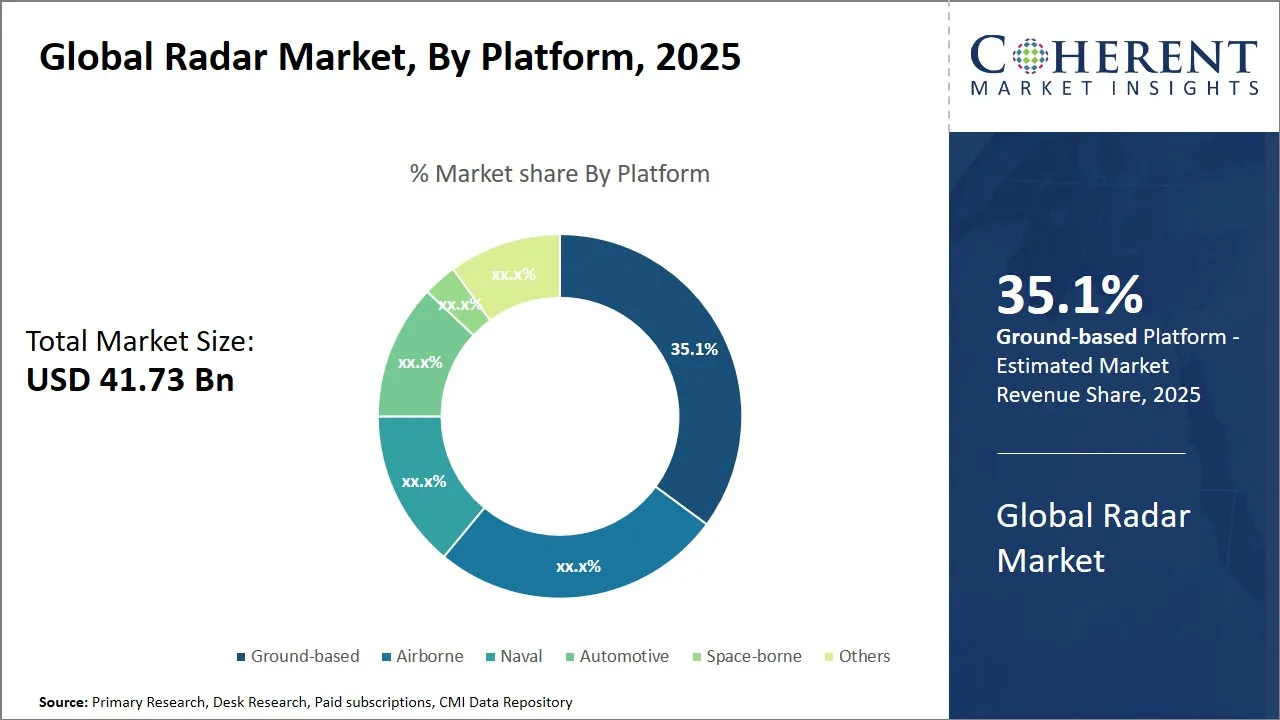
- The ground-based segment is expected to lead the market, holding a share of 36.1% in 2026.
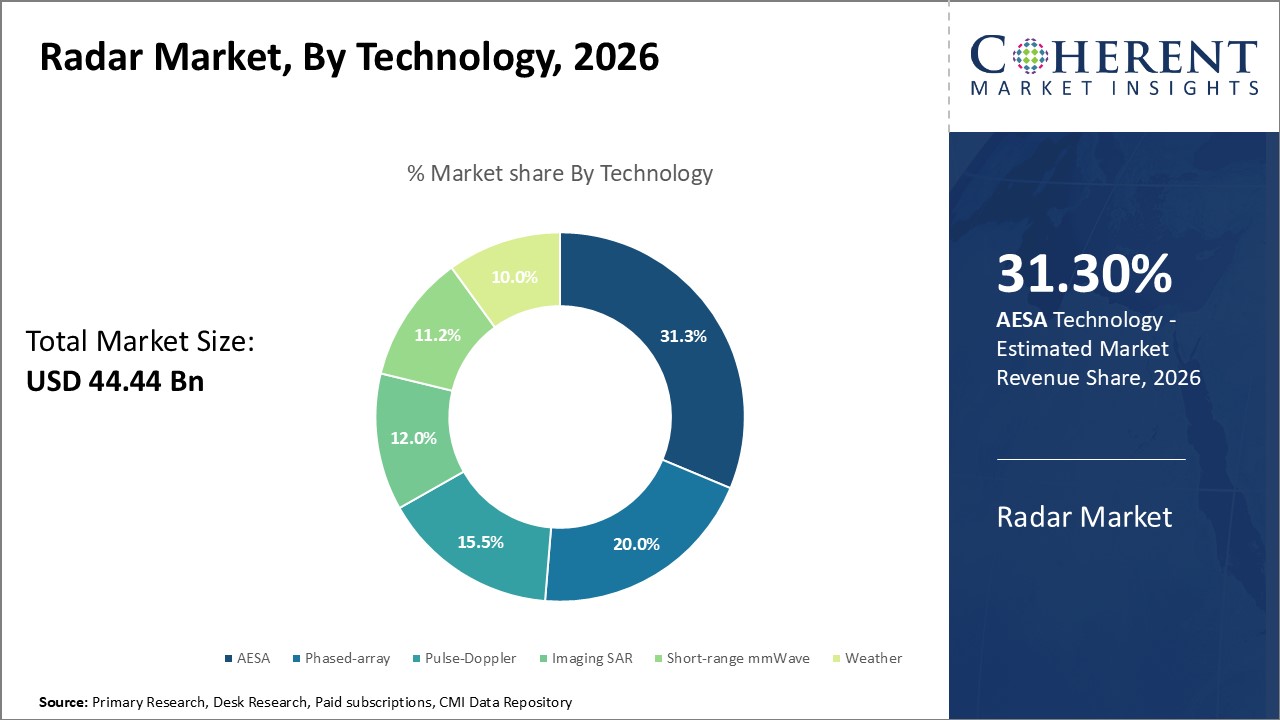
- The AESA segment is projected to dominate with a share of 31.3% in 2026.
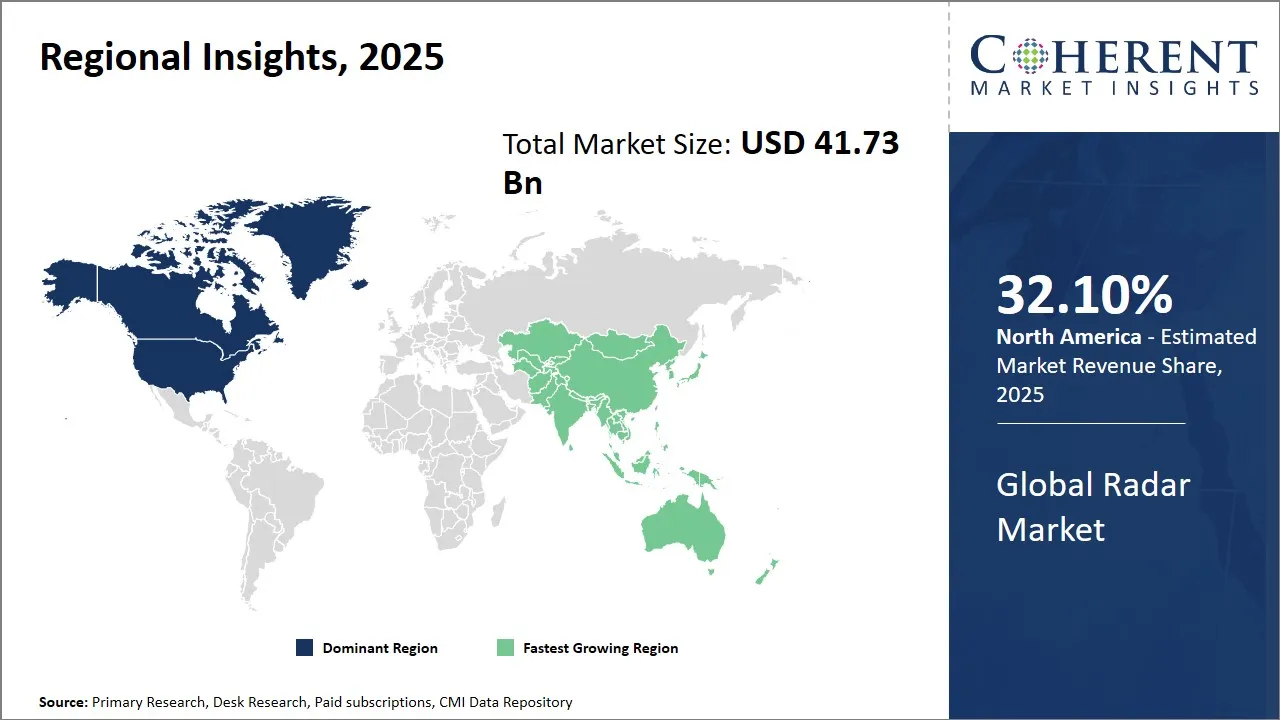
- North America, expected to hold a share of 32. 1% in 2026, is projected to dominate the market.
- Asia Pacific, projected to hold a share of 29. 7% in 2026, shows the fastest growth in the market.
Market Overview
The market is seeing a big shift towards the integration of artificial intelligence and machine learning in radar systems, enabling smarter and more adaptive sensing solutions. Also, the growing demand for autonomous vehicles and enhanced surveillance systems is propelling innovation and investments in radar technology, adding to growth in both commercial and military domains.
Current Events and Its Impact
Current Events | Description and its Impact |
Geopolitical & Defense Developments |
|
Technology & Innovation Trends |
|
Segmental Insights
- Current Industry Events of 2026
- Market Size Estimation
- Regional Breakdown
- Competitive Landscape
- Customer Intelligence
- Segmental Analysis
- Pricing Analysis
- Key Market Drivers, Challenges & Future Trends
- Customized Insights Section
Global Radar Market Insights, By Platform – Ground-based Segment Leads Owing to its Critical Role in Defense, Surveillance, and Infrastructure Monitoring
The ground-based segment, holding an estimated 36.1% of the market share in 2026, leads the market due to its essential role in airspace surveillance, missile defense, homeland security, and infrastructure monitoring. Governments rely heavily on these systems for early-warning, border protection, and critical infrastructure surveillance. Continuous improvements in detection range, resolution, AI-enabled tracking, and operational reliability have made demand.
Ground-based radars are also widely used in air traffic management, weather monitoring, and intelligent transportation systems, including traffic flow control and speed enforcement. Their ability to work in all weather and terrain conditions further elevates adoption.
The U.S. Army’s LTAMDS (Lower Tier Air and Missile Defense Sensor), a next-generation ground-based radar made by Raytheon, entered production and deployment phases, making U.S. missile defense capabilities stronger and showcasing global demand for advanced ground-based systems.
Global Radar Market Insights, By Technology – AESA Technology Leads Because of its Superior Performance and Versatility Across Defense and Commercial Applications
The AESA segment, projected to account for 31.3% of the market share in 2026, dominates due to its superior beam-steering speed, multi-target tracking, high reliability, and multi-function capability. AESA systems offer strong advantages in fighter jets, naval platforms, missile defense, and airborne surveillance, because of innovations such as GaN-based modules that enhance power efficiency and range.
AESA’s software-defined design enables fast upgrades, while strong resistance to electronic countermeasures (ECM) makes it suited for today’s contested electronic warfare environment. Beyond defense, AESA technology is increasingly used in commercial aviation, UAVs, spaceborne systems, and emerging automotive ADAS applications.
The AN/APG-81 AESA radar on the F-35 fighter jet, made by Northrop Grumman, is now used globally and shows AESA’s dominance through its advanced multi-mode surveillance, targeting precision, and ECM resilience.
Pricing Analysis of the Radar Market
Platform/Type | Approximate Price (USD) per Unit |
Ground-based Air-Defense/Early-Warning (AN/TPY-2) | ~ USD 181 million |
Very Long Range Ground-Based (GBX-type) | ~ USD 320 million |
Naval AESA Radar (AN/SPY-6) | ~ USD 300 million |
Transportable 3D Ground Radar (Thales GM403) | ~ USD 30 million |
Ground-Based Missile Defense Radar (EL/M-2080 Green Pine) | ~ USD 83 million |
Counter-Battery/Weapon-Locating Radar (AN/TPQ-37 Firefinder) | ~ USD 16.7 million |
Low-cost Civil/Traffic Doppler Radar | USD 200–320 |
Surveillance/Civil Radar (Mid-range) | USD 250,000 |
Lightweight Radar Panel (Drone/Low-altitude Monitoring) | ~ USD 78,500 |
Ground Penetrating Radar (GPR) – Entry/Professional | USD 14,000–60,000 |
Why ADAS Drives Radar Demand?
- Regulatory & safety pressure: OEMs add radars for AEB, ACC and lane-keeping.
- Higher automation: Levels 2-4 require robust long-/mid-/short-range radar coverage for perception in poor light/weather.
- Mass-market penetration: Volume scales and unit demand soars.
- Technology improvements: Better range/resolution and smaller modules, enabling wider OEM fitment.
Key Regulations & Test Regimes
- NCAP/Regional NCAPs (Euro NCAP, NHTSA NCAP updates) — new ADAS assessment protocols push manufacturers to improve highway assist, AEB, and lane-keeping performance; radar sensors are commonly required inputs for these tests.
- UNECE regulations
- UN-R131/AEBS: Advanced Emergency Braking rules require forward-collision detection & automatic braking capability for many vehicle classes — a core function fulfilled by radar + camera sensor fusion.
- UN-R157/ALKS: This enables certified Level-3 operation under defined conditions — systems approved under R157 rely on redundant sensing (radar + camera ± LiDAR) and thus drive high-spec radar adoption.
- SAE J3016 (Automation Levels) — This provides the Level 0–5 taxonomy used by OEMs and regulators; moving from Level-2 (driver assistance) to Level-3 (conditional automation) materially increases radar sensor requirements for perception and redundancy.
Vehicle Automation Levels
- Level 0–1: Radar used for simple collision warnings, parking sensors.
- Level 2: Radar required for adaptive cruise control (ACC) + lane centering; two- or three-sensor redundancy starts appearing.
- Level 3: Radar must support environment monitoring while driver may be disengaged; higher-accuracy mid/long-range radar + redundancy is required (often fused with camera and LiDAR).
- Levels 4–5: Dense multi-radar arrays and fusion with other sensors lead to huge per-vehicle radar content growth.
OEM Examples
- Mercedes-Benz — DRIVE PILOT (Level 3)
- Mercedes secured UN-R157 system approval and markets Level-3 DRIVE PILOT (S-Class/EQS lines). DRIVE PILOT uses a surround-sensor suite (radar + cameras + LiDAR in certified configs) to meet redundancy and safety requirements — a clear example where regulatory approval directly increases high-spec radar fitment.
- BMW — New 7 Series (Highly automated driving option/Personal Pilot)
- BMW’s flagship integrates the “latest-generation” radar sensors (together with cameras, ultrasonic and optional LiDAR) to deliver Level-3 features (Personal Pilot); demonstrates OEM strategy of adding multiple radar units for sensing coverage.
- Volvo — Pilot Assist/ACC
- Volvo’s Pilot Assist and adaptive cruise systems explicitly use camera & radar fusion for distance control, collision mitigation and lane assist — an example of radar as a standard safety sensor across model lines.
- Other broad OEM practice
- Most mainstream OEM ADAS stacks (Ford, Audi, Hyundai/Kia, etc.) use one or more mid-/long-range mmWave radars for ACC, AEB and blind-spot functions; OEMs are increasing radar channel counts and moving to higher-resolution (77 GHz/4D) radars as automation ambitions rise.
Practical Impacts on Radar Market Metrics
- Per-vehicle radar content: Average radar sensor count per vehicle has risen (from 1–2 units to 3–6 units on higher trim/models) as ACC, blind-spot, rear cross-traffic and surround monitoring proliferate.
- Unit volumes: Mainstreaming of ADAS (NCAP pressure + consumer demand) pushes large OEMs to specify radar even on non-premium trims.
- Tech shift: Migration to 77 GHz, 4D imaging radar & GaN-enabled modules for better angular resolution and clutter suppression enables radar to take on tasks previously reserved for LiDAR/camera fusion.
Regional Insights
North America Radar Market Analysis and Trends
North America, expected to hold a share of 32.1% in 2026, dominates the global radar market, because of a well-established aerospace and defense ecosystem, significant government investments, and strong industrial capabilities. The U.S. Department of Defense and various federal agencies allocate substantial budgets toward upgrading radar systems for military surveillance, missile defense, and homeland security, fostering innovation and adoption of advanced radar technologies. The presence of leading radar technology companies such as Raytheon Technologies, Lockheed Martin, and Northrop Grumman adds to North America’s leading position.
These companies use cutting-edge R&D and strategic partnerships to make multifunctional radar systems catering to defense, aviation, automotive, and maritime sectors. Also, the region sees a mature supply chain and advanced manufacturing infrastructure. Trade dynamics also favor North America because of established export agreements and collaboration with allied countries, enhancing its influence in the global radar equipment supply.
Asia Pacific Radar Market Analysis and Trends
The Asia Pacific region, expected to hold a share of 29.7% in 2026, exhibits the fastest growth in the global radar market fueled by increasing defense modernization efforts, expanding civil aviation activities, and growing investments in border security and maritime surveillance. Governments across countries such as China, India, Japan, and South Korea are prioritizing radar upgrades to meet growing security challenges and foster technological self-reliance.
The growing automotive sector, especially the adoption of advanced driver-assistance systems (ADAS), also adds to radar market expansion in the region. Regional policies encouraging indigenous production, foreign direct investments, and public-private partnerships support rapid ecosystem development. Big players with strong footholds in Asia Pacific include China Electronics Technology Group Corporation (CETC), Bharat Electronics Limited (BEL), and Mitsubishi Electric.
Global Radar Market Outlook for Key Countries
U.S. Radar Market Analysis and Trends
The U.S. radar market shows global leadership in innovation and deployment, because of vast defense budgets and advanced aviation infrastructure. Key industry players such as Raytheon Technologies and Lockheed Martin dominate, providing highly sophisticated radar systems for military applications, including Aegis combat systems and airborne early warning.
Also, the country’s push toward using radar technologies in autonomous vehicles and smart infrastructure is adding to further diversification in civilian applications. Government-led initiatives for sustaining technological superiority through continuous upgrades and innovation influence market dynamics.
China Radar Market Analysis and Trends
China radar market sees aggressive expansion because of government support for defense modernization and civil infrastructure development. State-owned enterprises like China Electronics Technology Group Corporation (CETC) play a big role, focusing on indigenous radar designs tailored to domestic and export demands. Strategic investments in research and development have enabled China to enhance capabilities in phased array and multifunctional radar systems.
Also, China’s focus on maritime and border security, alongside growing commercial aviation, adds to broad-based radar deployment. Collaborative efforts between Chinese firms and international companies further add to technology transfer and market growth prospects.
India Radar Market Analysis and Trends
India radar market continues to grow fast, because of the government’s focus on modernizing defense capabilities and expanding surveillance infrastructure. Bharat Electronics Limited (BEL), a big domestic player, contributes a lot by developing radar systems for air defense, coastal monitoring, and battlefield awareness. Initiatives such as Make in India encourage local manufacturing and technology development, reducing reliance on imports.
Investment in upgrading air traffic management systems and enhancing naval radar technology also makes demand. Partnerships with global defense firms help India access advanced technology while adding to indigenous innovation.
Japan Radar Market Analysis and Trends
Japan radar market emphasizes advanced technological development, because of the country’s strong manufacturing base and stringent government policies focused on security and technological excellence. Leading companies like Mitsubishi Electric and NEC Corporation make cutting-edge radar systems for defense and civil aviation sectors. Japan’s geopolitical environment and commitment to maritime security add to extensive radar system upgrades.
The country also focuses on radar applications in automotive safety and disaster management, bridging innovation with societal needs. Collaborative R&D programs with government agencies make Japan’s position stronger in the radar market ecosystem.
South Korea Radar Market Analysis and Trends
South Korea radar market sees fast advancements fueled by government initiatives aimed at strengthening military and industrial capabilities. Firms, such as LIG Nex1 and Hanwha Systems, are instrumental in making sophisticated radar solutions for air defense, missile detection, and civilian applications. South Korea’s strategic investments in smart city projects and autonomous vehicles further diversify the application spectrum of radar technologies.
The country sees a lot of export potential and cooperative defense agreements, facilitating technology enhancement and market expansion. Government policies favoring high-tech innovation and industry-academia collaboration continue to propel the radar market forward.
Market Players, Key Development, and Competitive Intelligence
Key Developments
- In September 2025, Raytheon, an RTX business, was awarded a U.S. Army contract valued at USD 1.7 billion to deliver the Lower Tier Air and Missile Defense Sensor, or LTAMDS. The contract includes a total quantity of nine radars for the U.S. Army and Poland, which is the first international LTAMDS customer, as well as engineering services, spares, support, development and testing.
- In June 2025, Thales launched the best-in-class simultaneous civil and military secondary surveillance air traffic radar, the RSM NG/IFF.
- In June 2025, Raytheon was awarded a USD 536 million contract from the U.S. Navy for the SPY-6 family of radars. The contract is a follow-on to the previously awarded Integration and Production Support contract and includes upgrading Flight IIA destroyers with the SPY-6(V)4 variant.
- In September 2024, the Norway-based Defense Materiel Agency (NDMA) exercised a contract option to procure three additional TPY-4 radars from Lockheed Martin (LM), bringing the new total to 11 of the ground-based multi-mission radars.
Top Strategies Followed by Radar Market Players
- Established companies, often large multinational corporations, invest a lot in research and development (R&D) to continually innovate and launch high-performance radar systems that meet the evolving demands of defense, automotive, aerospace, and industrial applications.
- Raytheon invested billions for making GaN-based SPY-6 naval radar and LTAMDS missile defense radar, positioning itself as the global leader in next-gen AESA technology.
- Mid-level radar manufacturers adopt a somewhat different approach, balancing the dual imperatives of product quality and cost efficiency to appeal to price-sensitive market segments.
- Saab’s Giraffe series is competitively priced and widely exported to mid-budget customers.
- Small-scale radar companies, often startups or regional manufacturers, distinguish themselves by focusing on niche segments and specialized product features that larger players may overlook.
- Echodyne produces compact, high-performance radars like EchoGuard, used by U.S. DHS, DoD, and commercial drone-security firms.
Market Report Scope
Radar Market Report Coverage
| Report Coverage | Details | ||
|---|---|---|---|
| Base Year: | 2025 | Market Size in 2026: | USD 44.44 Bn |
| Historical Data for: | 2020 To 2024 | Forecast Period: | 2026 To 2033 |
| Forecast Period 2026 to 2033 CAGR: | 6.5% | 2033 Value Projection: | USD 69.06 Bn |
| Geographies covered: |
| ||
| Segments covered: |
| ||
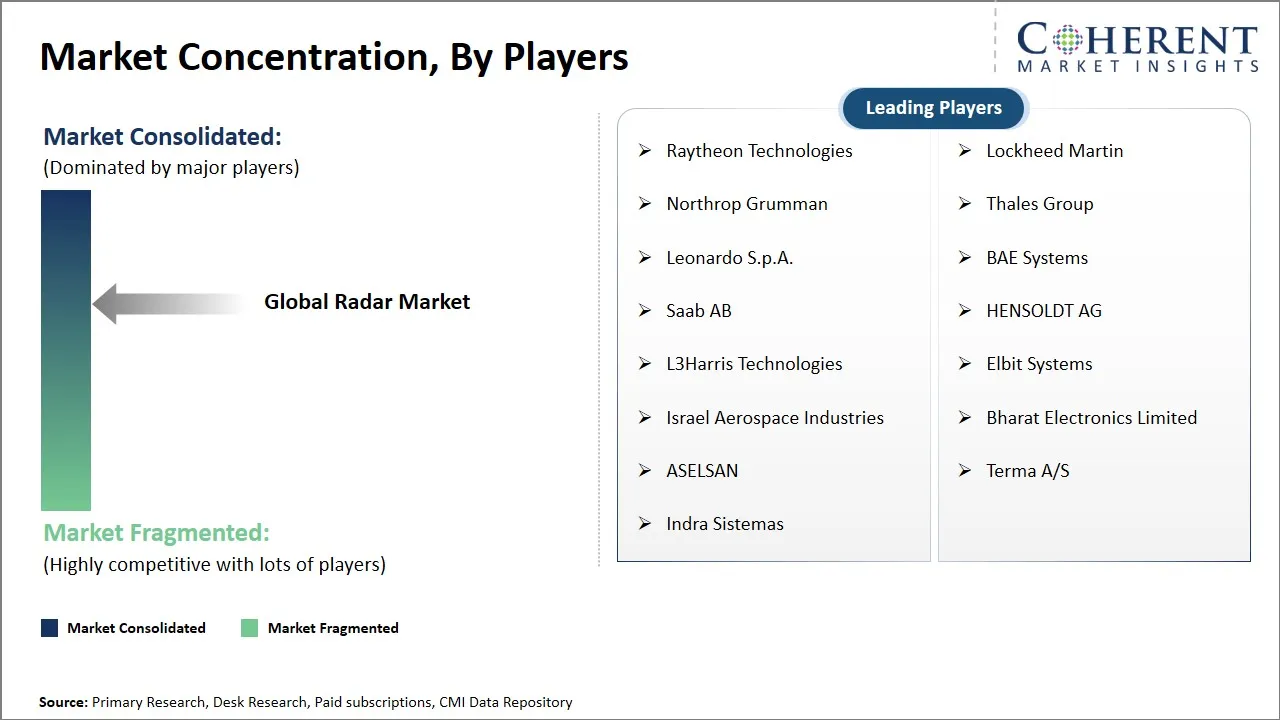
| Companies covered: | Raytheon Technologies, Lockheed Martin, Northrop Grumman, Thales Group, Leonardo S.p.A., BAE Systems, Saab AB, HENSOLDT AG, L3Harris Technologies, Elbit Systems, Israel Aerospace Industries, Bharat Electronics Limited, ASELSAN, Terma A/S, and Indra Sistemas | ||
| Growth Drivers: |
| ||
| Restraints & Challenges: |
| ||
Market Dynamics
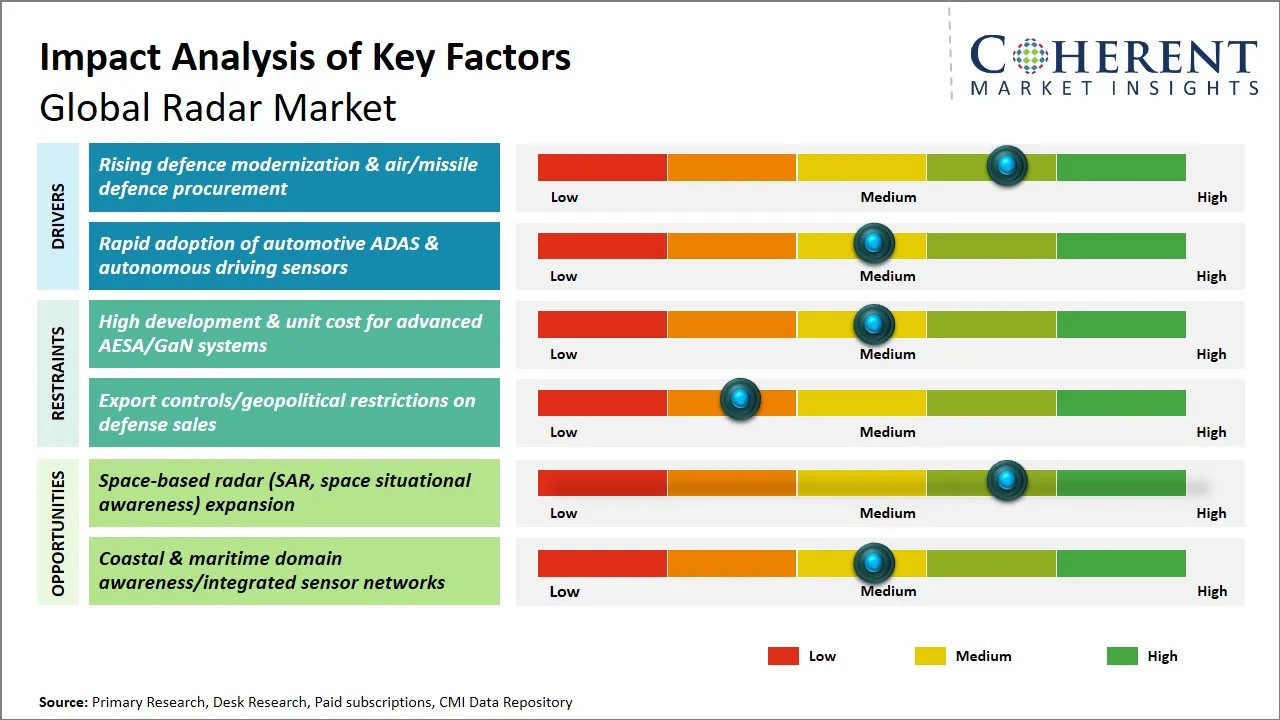
Global Radar Market Driver – Rising Defense Modernization & Air/Missile Defense Procurement
Global defense forces are rapidly upgrading legacy radar systems to enhance surveillance, tracking accuracy, and air/missile defense capabilities amid rising geopolitical tensions. Modern military programs increasingly require AESA, multi-mission, and long-range early-warning radars that can detect and track advanced threats such as ballistic, cruise, and hypersonic missiles. Large-scale procurement programs in air and missile defense, supported by national modernization initiatives, are accelerating radar demand across naval, airborne, and ground platforms.
Poland’s recent acquisition of the U.S. LTAMDS radar under the Wisła air and missile defense program highlights global momentum toward next-generation missile-defense radar procurement.
Global Radar Market Opportunity – Space-Based Radar (SAR, Space Situational Awareness) Expansion
Space-based radar represents a major growth opportunity as demand rises for all-weather imaging, environmental monitoring, and space situational awareness (SSA). SAR satellites provide high-resolution, continuous Earth observation, while SSA radars support debris tracking and satellite safety amid increasing orbital congestion. Advances in miniaturized radar payloads and AI-based data processing are enabling low-cost satellite constellations that deliver faster revisit times and broader coverage for defense and commercial applications.
Capella Space’s SAR satellite constellation—offering sub-50 cm resolution imagery—demonstrates rapid commercial adoption of high-performance space-based radar systems.
Analyst Opinion (Expert Opinion)
- Despite strong demand, the high price of next-generation radar systems—especially AESA, multi-mission, and GaN-based platforms—is creating procurement bottlenecks. Many defense budgets simply cannot keep pace with the rapid rise in radar sophistication, forcing governments to delay upgrades longer than they should. The market often presents modernization as inevitable, but the reality is cost inflation is forcing harsh prioritization across defense portfolios.
- Radar manufacturers rarely admit how difficult integration has become across multimodal platforms, network-centric architectures, and joint command systems. Legacy infrastructure cannot easily accommodate modern digital radars, causing extended installation timelines and interoperability headaches. The industry’s push toward “plug-and-play” radar ecosystems remains far from mature, making system compatibility one of the most underappreciated market barriers.
- While radar technology is evolving, adversaries’ jamming, spoofing, and stealth tactics are evolving faster. The market tends to overstate radar resilience, but the truth is that even state-of-the-art systems face increasing vulnerability in contested environments. The widening gap between radar capabilities and next-gen EW tools is creating a strategic disadvantage that vendors are not addressing urgently enough.
Speak to the analyst
Want personalized insights?
Take the findings above to one of our principal consultants, or have the report rebuilt around the segments, geographies and competitors you actually track.
Market Segmentation
- Platform Insights (Revenue, USD Bn, 2021 - 2033)
- Ground-based
- Airborne
- Naval
- Automotive
- Space-borne
- Others
- Technology Insights (Revenue, USD Bn, 2021 - 2033)
- AESA
- Phased-array
- Pulse-Doppler
- Imaging SAR
- Short-range mmWave
- Weather
- Regional Insights (Revenue, USD Bn, 2021 - 2033)
- North America
- U.S.
- Canada
- Latin America
- Brazil
- Argentina
- Mexico
- Rest of Latin America
- Europe
- Germany
- U.K.
- Spain
- France
- Italy
- Russia
- Rest of Europe
- Asia Pacific
- China
- India
- Japan
- Australia
- South Korea
- ASEAN
- Rest of Asia Pacific
- Middle East
- GCC Countries
- Israel
- Rest of Middle East
- Africa
- South Africa
- North Africa
- Central Africa
- North America
- Key Players Insights
- Raytheon Technologies
- Lockheed Martin
- Northrop Grumman
- Thales Group
- Leonardo S.p.A.
- BAE Systems
- Saab AB
- HENSOLDT AG
- L3Harris Technologies
- Elbit Systems
- Israel Aerospace Industries
- Bharat Electronics Limited
- ASELSAN
- Terma A/S
- Indra Sistemas
Sources
Primary Research Interviews
Stakeholders
- Defense Procurement Officers
- Radar Manufacturers & Suppliers
- Aerospace & Avionics Engineers involved in radar system integration
- Automotive OEM ADAS Integration Teams
- Weather Monitoring Agencies and Meteorologists using ground-based Doppler radars
- Satellite Operators specializing in SAR and SSA applications
- Electronic Warfare (EW) Specialists and Signal Intelligence Analysts
- Airport Authorities & Air Traffic Control Radar Supervisors
- Border Surveillance Agencies (Ground Monitoring & Early-Warning Teams)
- AI/ML Radar Software Developers and Algorithm Architects
Databases
- Eurostat
- U.S. Census
- Aviation Systems Performance Archive (ASPA)
- Defense Hardware Utilization Database (DHU-Index)
- Radar Technology Intelligence Repository (RTIR)
- OECD
- Global Aerospace Installation Registry (GAIR)
Magazines
- Defense Radar Weekly
- Aerospace Electronics Review
- Surveillance Systems Digest
- Military Technology Insights
- Automotive Radar & ADAS Monthly
- Aviation Radar Today
Journals
- Journal of Defense Radar & Electronic Systems
- IEEE Radar Systems Journal
- Journal of Aerospace Surveillance Technology
- IEEE Transactions on Aerospace and Electronic Systems
- Synthetic Aperture Radar Review Journal
Newspapers
- The Defense Herald
- Aerospace Times Daily
- The Guardian (UK)
- The Economic Times (India)
- The Military Observer (Global Edition)
- The Surveillance & Frontier Security Newsline
Associations
- Global Radar & Surveillance Association (GRSA)
- International Radar and EW Society (IREWS)
- Aerospace & Defense Systems Association (ADSA)
- American Institute of Aeronautics and Astronautics (AIAA)
- International Society of Photogrammetry & Remote Sensing (ISPRS)
- Space Situational Awareness Alliance (SSAA)
Public Domain Sources
- U.S. Census Bureau
- EUROSTAT
- United Nations Economic Commission for Europe (UNECE)
- World Bank
- ResearchGate
- NASA Technical Reports Server (NTRS)
- European Space Agency (ESA) Open Data Portal
Proprietary Elements
- CMI Data Analytics Tool, Proprietary CMI Existing Repository of information for last 8 years
Get access to 250+ pages report
Every segment, forecast, competitor profile and data table behind the analysis above — available for instant download.
- ESOMAR Member
- ISO 9001:2015 Certified
- D-U-N-S Registered
- GDPR & CCPA Compliant
Missing comfort of reading report in your local language? Find your preferred language:
Transform your Strategy with Exclusive Trending Reports
Frequently Asked Questions
The global radar market is estimated to be valued at USD 44.44 billion in 2026 and is expected to reach USD 69.06 billion by 2033.
The CAGR of the global radar market is projected to be 6.5% from 2026 to 2033.
Rising defense modernization & air/missile defense procurement and rapid adoption of automotive ADAS & autonomous driving sensors are the major factors driving the growth of the global radar market.
High development & unit cost for advanced AESA/GaN systems and export controls/geopolitical restrictions on defense sales are the major factors hampering the growth of the global radar market.
In terms of platform, the ground-based segment is estimated to dominate the market revenue share in 2026.
Radar provides early warning, tracking, and guidance support for intercept systems.
Yes, SAR and SSA radars are increasing due to demand for Earth observation and space safety.