

Australia Titanium Dioxide Market Analysis & Forecast: 2026-2033
The Australia Titanium Dioxide Market is anticipated to grow at a CAGR of 4.4% with USD 11.6 Bn share in 2026 and is expected to reach USD 16.8 Bn in 2033. Strong Demand from Paints & Coatings Industry, Rising Use in Plastics, Packaging, and Industrial Applications and Increasing Adoption in Renewable Energy (Solar). According to the Coherent Market Insights, the paints and coatings market is estimated to be valued at USD 209.89 Bn in 2026 and is expected to reach USD 268.85 Bn by 2033, growing at a compound annual growth rate (CAGR) of 3.6% from 2026 to 2033.
Key Takeaways
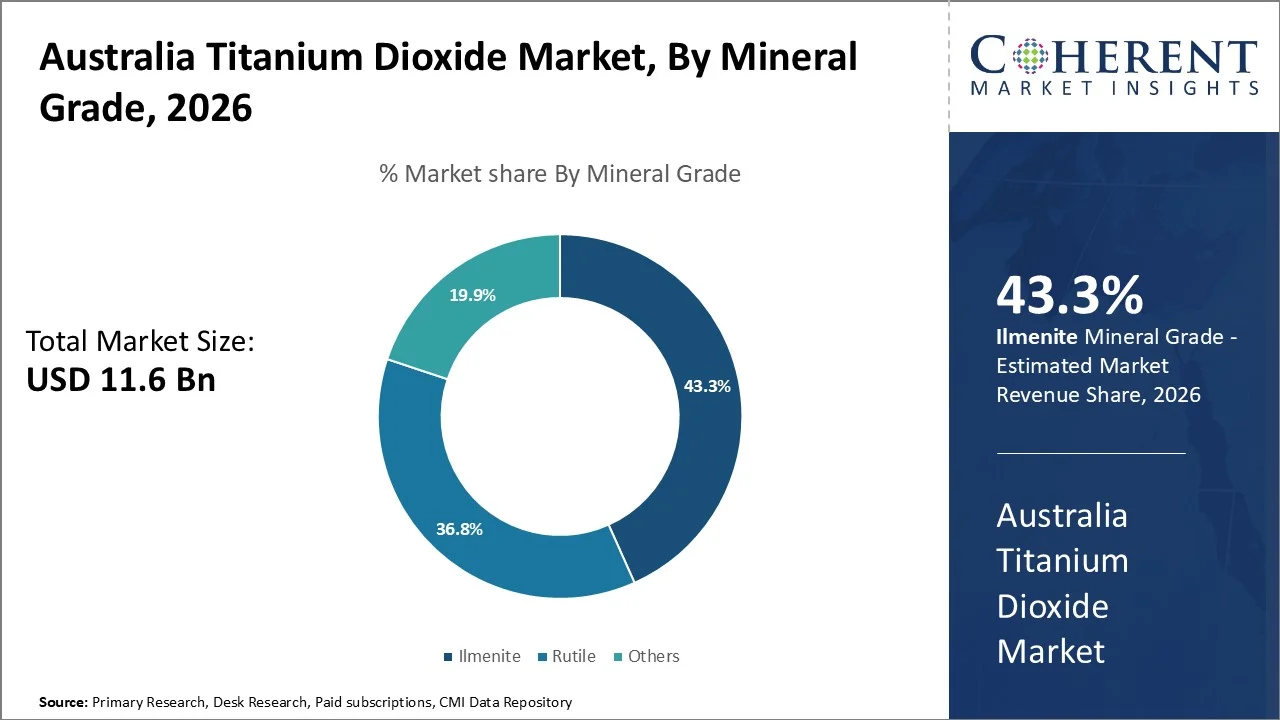
- By Mineral Grade, Ilmenite hold the largest market share of 43.3% in 2026 owing to the strong demand for titanium dioxide pigments. Ilmenite production reached 391 thousand tonnes in 2021–22, up 11% from the previous year. Odisha led with 60% of output, followed by Kerala (28%) and Tamil Nadu (12%).
- By Products Type, pigments expected to hold largest market share of 52.2% in 2026 owing to the strong demand from paints & coatings industry.
- By Application, Pure Titanium Metals & Welding Rods acquired the prominent market share of 34.4% in 2026 owing to its aerospace & defense industry demand.
Current Events and Their Impact on the Australia Titanium Dioxide Market
Current Event | Description and its Impact |
Global Supply Chain Disruptions |
|
Technological Advancements in Nano Titanium Dioxide Applications |
|
Segmental Insights
- Current Industry Events of 2026
- Market Size Estimation
- Regional Breakdown
- Competitive Landscape
- Customer Intelligence
- Segmental Analysis
- Pricing Analysis
- Key Market Drivers, Challenges & Future Trends
- Customized Insights Section
Why Ilmenite holds the largest market share?
Ilmenite hold the largest market share of 43.3% in 2026 owing to the automotive and industrial coatings demand. Strong consumption of TiO₂ pigments in paints, coatings, plastics, and paper drives ilmenite demand in Australia’s titanium dioxide market. Growing construction, infrastructure, and renovation activities increase the need for durable, high-quality coatings. Australia’s construction sector is set to enter a new phase of cost escalation from 2027, as Brisbane’s Olympic-driven projects coincide with a rebound in activity across Sydney and Melbourne.
Expanding plastics and packaging industries further boost demand. Australia leverages its abundant mineral sands resources and export-oriented supply chain, particularly to Asian markets, to strengthen production. Ongoing technological improvements in mineral processing and a rising preference for sustainable, long-lasting materials also support steady ilmenite demand.
Pigments expected to hold largest market share
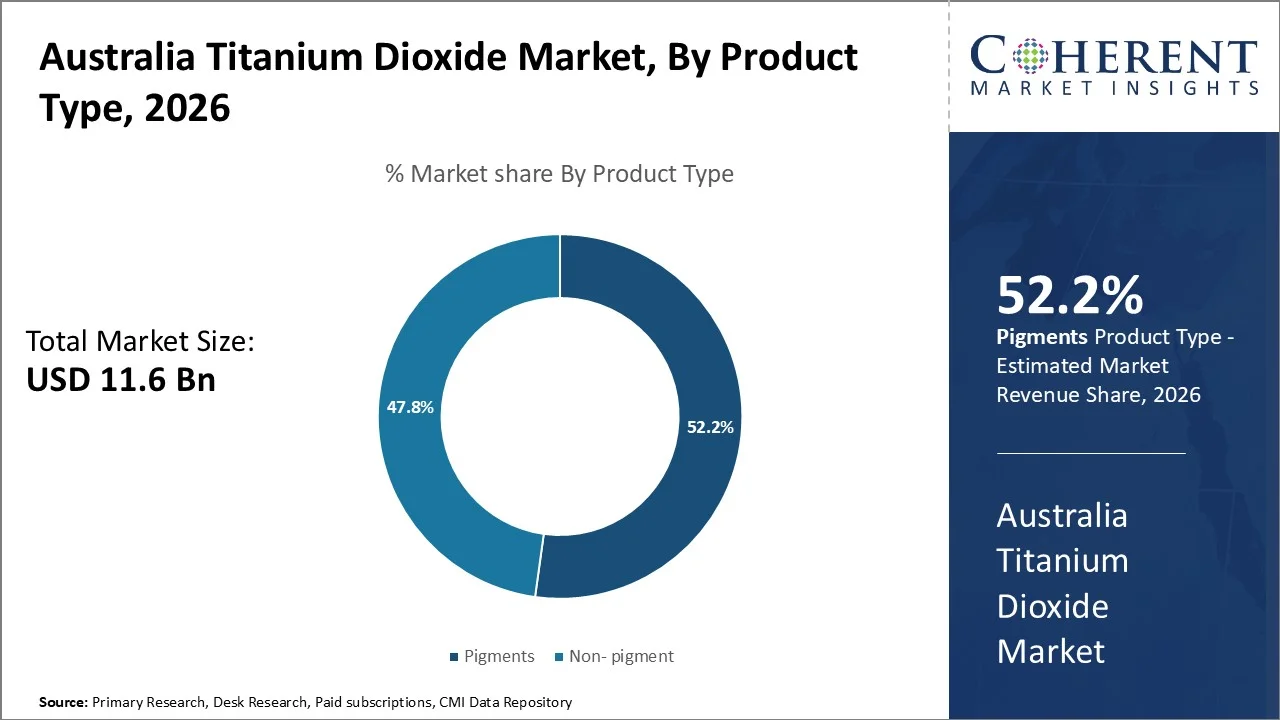
Pigments expected to hold largest market share of 52.2% in 2026 owing to the rising demand from plastics & packaging. Strong use of paints and coatings in construction, infrastructure, and renovation activities drives pigment demand in Australia’s titanium dioxide market. The Australian paints and coatings industry produces surface-coating products worth about USD 2.7 billion. Expanding plastics and packaging industries increase the need for consistent color and durability. Automotive and industrial sectors raise demand for high-performance coatings.
A growing preference for long-lasting, weather-resistant, and sustainable materials further boosts usage. Steady repainting cycles in residential and commercial spaces also maintain continuous demand for titanium dioxide pigments across the country.
Pure Titanium Metals & Welding Rods acquired the prominent market share
Pure Titanium Metals & Welding Rods acquired the prominent market share of 34.4% in 2026 owing to its Medical and healthcare applications. Aerospace, defense, and medical industries drive demand for pure titanium metals and welding rods in Australia’s titanium dioxide market by requiring strong, lightweight, and corrosion-resistant materials. Industrial sectors such as chemical processing and marine applications further support usage. In FY23, the marine industry generated USD 203 billion in total value added, accounting for 9.1% of Australia’s GDP. This is further creating demand for titanium oxide in Australia.
Expanding infrastructure and fabrication activities increase demand for welding rods and electrodes. Manufacturers increasingly adopt lightweight and high-performance materials, which also boosts consumption. Australia’s strong mineral resource base and export connections further sustain the supply and demand for titanium-based products.
Australia Titanium Dioxide Market Trends
- Rising demand for titanium dioxide pigments in paints and coatings supports strong usage across construction, infrastructure, and renovation activities, improving opacity, brightness, and durability of finished products. According to an article published by Magic New Family Homes, nearly one in three homeowners across Australia renovated their places in 2025. Also, in December 2025, Samsung C&T’s E&C Group accelerated its expansion in Australia’s energy infrastructure sector by securing a major HVDC transmission project.
- Growing consumption of titanium dioxide in plastics and packaging industries enhances product quality, UV resistance, and color stability in food packaging, consumer goods, and industrial applications. In Australia in 2023–24, 6.84 million tonnes of packaging were placed on the market.
- Expanding automotive and industrial sectors increase adoption of titanium dioxide-based coatings for improved surface protection, weather resistance, and aesthetic finish in vehicles and machinery.
Who are the Major Companies in Australia Titanium Dioxide Industry
Tronox Limited, Iluka Resource Limited, and Cristal Australia Pty Ltd
Key News
- In November 2025, Empire Metals Limited has started a diamond drilling program at the Thomas prospect in its Pitfield Project in Western Australia, advancing its exploration strategy. The campaign will cover about 1,000 metres across 10 holes.
Market Report Scope
Australia Titanium Dioxide Market Report Coverage
| Report Coverage | Details | ||
|---|---|---|---|
| Base Year: | 2025 | Market Size in 2026: | USD 11.6 Bn |
| Historical Data for: | 2020 To 2024 | Forecast Period: | 2026 To 2033 |
| Forecast Period 2026 to 2033 CAGR: | 4.4% | 2033 Value Projection: | USD 16.8 Bn |
| Segments covered: |
| ||
| Companies covered: | Tronox Limited, Iluka Resource Limited, and Cristal Australia Pty Ltd | ||
Analyst Opinion
- Australia’s titanium dioxide market is fundamentally resource-led, not demand-led, with Western Australia acting as the critical supply backbone. Geological surveys confirm Australia holds some of the world’s highest-quality ilmenite and rutile deposits, with Western Australia contributing a major share of national mineral sands output.
- Ilmenite is no longer just a raw material input; it is a geopolitical industrial asset tied to pigment security in Asia. Industry supply chain analyses show that a large portion of Australian titanium feedstocks is exported to China for TiO₂ pigment manufacturing, where demand is anchored in massive coatings and plastics production. For example, China’s dominance in global pigment processing means any disruption or price tightening in its pigment sector immediately transmits back to Australian ilmenite producers, making export dependence a defining market risk rather than a growth opportunity alone.
- The paints and coatings industry is the real demand engine, but it is increasingly efficiency-driven rather than volume-driven. Construction and infrastructure maintenance in developed economies like Australia prioritize high-durability coatings, which require higher TiO₂ loading per application.
- The market is becoming more technologically segmented, with synthetic rutile and upgraded ilmenite redefining competitiveness. Processing advancements in Western Australia have enabled producers to upgrade lower-grade ilmenite into higher-value feedstocks suitable for chloride-route TiO₂ production.
Speak to the analyst
Want personalized insights?
Take the findings above to one of our principal consultants, or have the report rebuilt around the segments, geographies and competitors you actually track.
Australia Titanium Dioxide Market Segmentation
- By Mineral Grade
- Ilmenite
- Rutile
- Others (Anatase, Brookite, etc.)
- By Product Type
- Pigments
- Non- pigment (Titanium Metals & Welding Rods)
- By Application
- Dyes & Paints
- Plastics & rubber
- Paper
- Pure Titanium Metals & Welding Rods
- Others (Semiconductors, Gems & Jewelry, etc.)
Sources
Primary Research interviews
- Interviews with industry participants in coatings, plastics, and paper manufacturing sectors in Australia
- Discussions with procurement managers and raw material suppliers in chemical processing industries
- Inputs from distributors and traders of titanium dioxide pigment in the Australian market
- Feedback from end-use industries such as construction, automotive, and packaging
Databases
- Australian Bureau of Statistics (ABS) trade and production data
- UN Comtrade database for titanium dioxide import/export statistics
- World Bank Open Data for macroeconomic indicators influencing demand
- Industry trade databases covering chemicals and pigments supply chains
- Australian Customs import/export shipment databases
Magazines
- Chemical industry trade magazines covering pigments and coatings developments
- Materials and manufacturing industry magazines in Australia and Asia-Pacific region
- Construction and infrastructure magazines focusing on raw material usage trends
- Packaging industry magazines highlighting demand for whitening and coating agents
Journals
- Peer-reviewed chemical engineering journals focusing on pigments and inorganic materials
- Materials science journals covering titanium dioxide properties and applications
- Industrial chemistry journals discussing production processes and innovations
- Environmental science journals covering pigment sustainability and compliance
Newspapers
- Australian national and regional newspapers covering manufacturing and industrial developments
- Business newspapers reporting on import costs, trade policies, and raw material pricing trends
- Financial newspapers covering chemical industry supply-demand dynamics
- Trade-focused news sections reporting on construction and industrial output
Associations
- Chemical and materials industry associations in Australia
- Construction industry associations and building materials councils
- Plastics and polymer industry associations
- Paints and coatings industry trade associations
- Import-export and trade facilitation bodies in Australia
Public Domain sources
- Government of Australia trade and industry ministry publications
- Environmental protection authority reports on chemical usage and compliance
- International trade organization reports and commodity dashboards
- University research publications on materials science and pigment applications
- Publicly available corporate annual reports and investor presentations
Proprietary Elements
- CMI Data Analytics Tool
- Proprietary CMI Existing Repository of information for last 8 years
Get access to 250+ pages report
Every segment, forecast, competitor profile and data table behind the analysis above — available for instant download.
- ESOMAR Member
- ISO 9001:2015 Certified
- D-U-N-S Registered
- GDPR & CCPA Compliant
Missing comfort of reading report in your local language? Find your preferred language:
Transform your Strategy with Exclusive Trending Reports
Frequently Asked Questions
The Australia titanium dioxide market is estimated to reach USD 16.8 Bn by the end of 2033.
Major players operating in the Australia titanium dioxide market include Tronox Limited, Iluka Resource Limited, and Cristal Australia Pty Ltd.
The slowdown of the economy in the country and rising usage of substitute of titanium dioxide such as silica are some of the major factors that are expected to hamper growth of the market over the forecast period.
Rising application of titanium dioxide across paints, paper, dyes, and plastic in the region is one of the major factors that is expected to propel growth of the market over the forecast period.
The Australia Titanium Dioxide Market is anticipated to grow at a CAGR of 4.4% with USD 11.6 Bn share in 2026 and is expected to reach USD 16.8 Bn in 2033.