

Ethylene Carbonate Market Size and Forecast – 2026 to 2033
The Ethylene Carbonate Market is estimated to be valued at USD 985.5 Mn in 2026 and is expected to reach USD 2,007.6 Mn by 2033, exhibiting a compound annual growth rate (CAGR) of 10.7% from 2026 to 2033.
Key Takeaways
- By Application, Intermediates and Agents acquired the prominent share of 58.9% in 2026 as growing demand from chemical & pharmaceutical industries.
- By End-User Industry, Automotive hold the largest market share in 2026 owing to its government policies, incentives & regulatory pressure.
- By Region, Asia Pacific dominates the overall market with an estimated share of 69.85% in 2026 owing to the rapid growth of EVs and battery manufacturing.
Market Overview
Rising demand from lithium-ion battery production, especially for electric vehicles and consumer electronics, drives the strong ethylene carbonate market growth. Industries rely on ethylene carbonate as a high-performance solvent and key electrolyte component for energy storage technologies. Manufacturers also expand its use in lubricants, coatings, and pharmaceuticals. The Asia-Pacific region leads the market with its strong manufacturing base and expanding energy storage sector. Technological advancements and stricter environmental regulations further accelerate the adoption of ethylene carbonate across various applications.
Current Events and Its Impact
Current Events | Description and its impact |
Geopolitical Tensions in Major Chemical Producing Regions |
|
Environmental Regulations and Sustainability Trends |
|
Fluctuations in Crude Oil and Natural Gas Prices |
|
End-user Feedback and Unmet Needs in the Ethylene Carbonate Market
- Demand for Battery-Grade Purity: End-users in the battery industry emphasize the need for ultra-high-purity ethylene carbonate to ensure optimal performance and safety. Impurities can hinder battery efficiency, prompting requests for stricter quality control and improved consistency in supply for advanced lithium-ion battery applications.
- Concerns Over Supply Chain Stability: Automotive and electronics manufacturers report disruptions due to inconsistent ethylene carbonate availability. Supply chain bottlenecks and limited domestic production capacity, especially in emerging markets, lead to delays, forcing users to seek more reliable sourcing and localized manufacturing options.
- Need for Cost-Effective Alternatives: Pharmaceutical and chemical processing industries seek more affordable ethylene carbonate options without compromising performance. They express concerns over price volatility driven by raw material costs and regulatory compliance, creating a demand for stable pricing models and cost-efficient production methods.
- Current Industry Events of 2026
- Market Size Estimation
- Regional Breakdown
- Competitive Landscape
- Customer Intelligence
- Segmental Analysis
- Pricing Analysis
- Key Market Drivers, Challenges & Future Trends
- Customized Insights Section
Segmental Insights
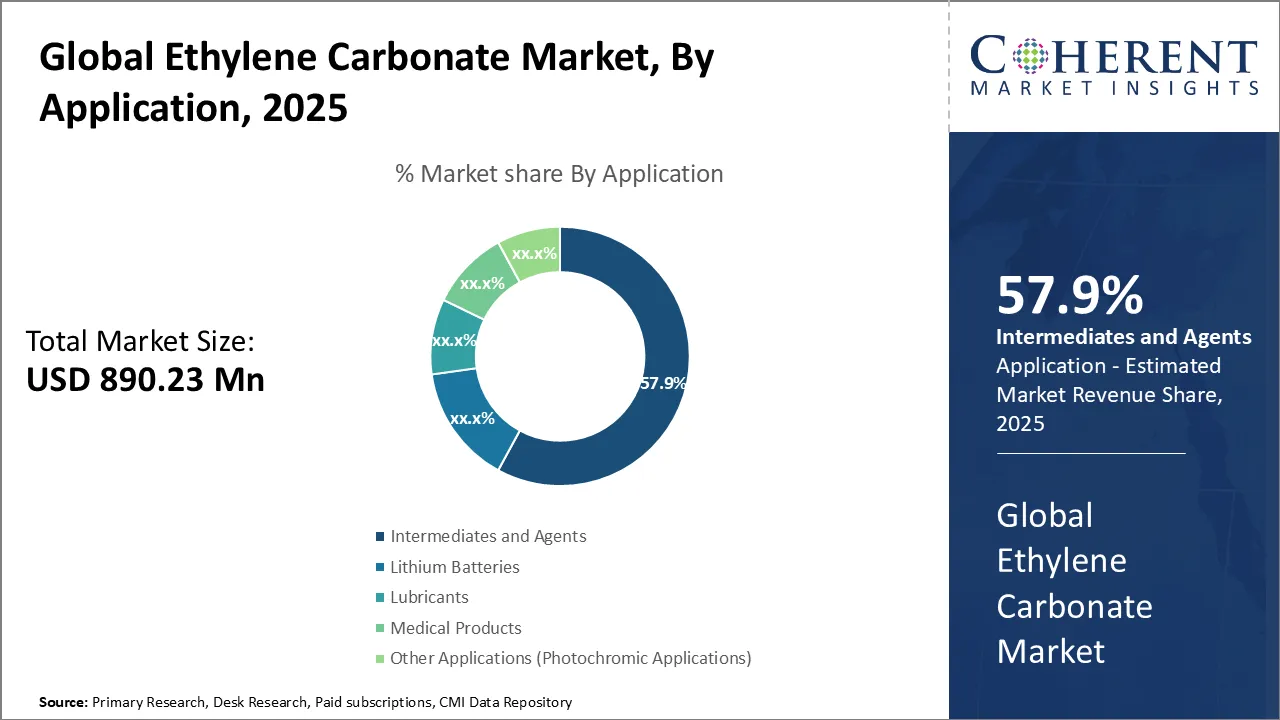
Ethylene Carbonate Market Insights, by Application - Intermediate and Agents contribute the highest share of the market owing to its technological advances in EC production.
Intermediates and Agents acquired the prominent share of 58.9% in 2026. Pharmaceutical, coatings, and specialty chemical industries drive demand for ethylene carbonate as a chemical intermediate and solvent due to its high polarity and low toxicity. Manufacturers prefer it for various synthesis processes that require high-performance and environmentally friendly chemicals. Shifting regulations encourage the use of safer solvents, further supporting its adoption. Expanding industrial activities, especially in emerging markets, also contribute to the growth of this segment, as industries increasingly rely on ethylene carbonate for efficient and sustainable chemical applications.
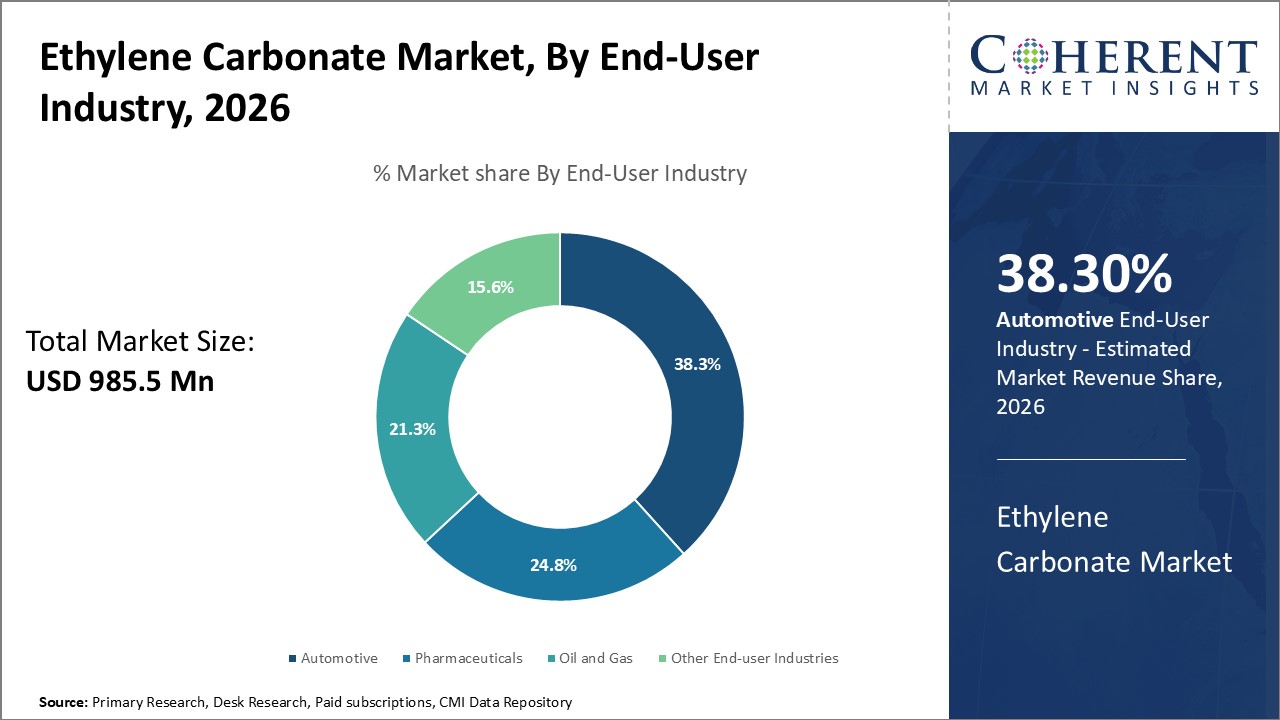
Ethylene Carbonate Market Insights, by End-User Industry - Automotive contribute the highest share of the market owing to its improved battery performance requirements.
Automotive manufacturers drive demand for ethylene carbonate by increasing their use of lithium-ion batteries, particularly in electric vehicles. They rely on ethylene carbonate as a key electrolyte component to improve battery efficiency and safety. The push for high-performance energy storage boosts the need for battery-grade chemicals. Advancements in lubricants and coatings also expand its applications within the sector. Supportive government policies for clean mobility and growing vehicle production in major regions further accelerate the use of ethylene carbonate in automotive applications. For instance, in December 2024, Jiangsu Sailboat Petrochemical began operating a new carbonates plant in Lianyungang, China, using Asahi Kasei's technology to produce high-purity ethylene carbonate and dimethyl carbonate from CO₂ for EV battery electrolytes.
Regional Insights
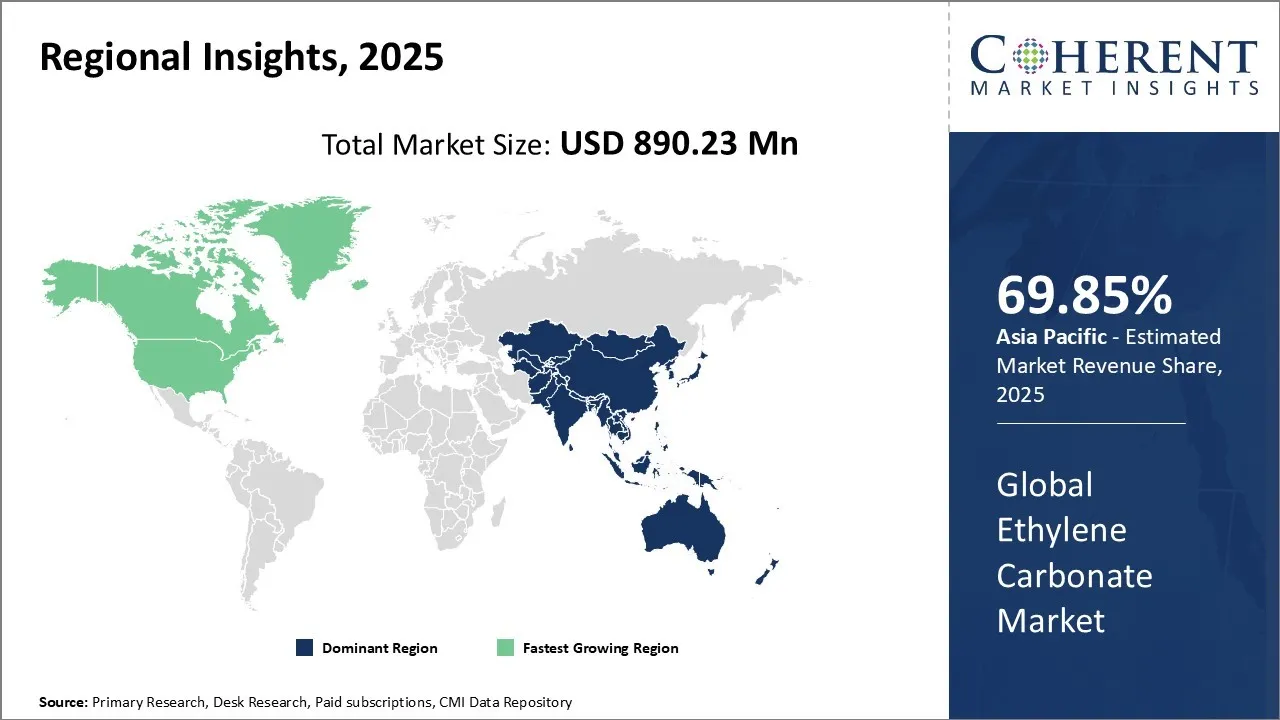
Asia Pacific Ethylene Carbonate Market Trends
Asia Pacific dominates the overall market with an estimated share of 69.85% in 2026. Expanding electric vehicle production, rising demand for energy storage systems, and growth in industrial manufacturing are driving momentum in the Asia-Pacific ethylene carbonate market. Companies in the region are investing heavily in battery technologies and infrastructure, strengthening the ethylene carbonate supply chain. Local producers are increasing capacity to satisfy both domestic and export needs. Governments’ focus on clean energy initiatives, along with the presence of key electronics and automotive hubs, actively shapes long-term demand, positioning Asia-Pacific as a crucial growth hub for ethylene carbonate.
For instance, in February 2026, UBE C1 Chemical America, a UBE subsidiary, begun building a DMC and EMC plant in Louisiana using UBE’s energy-efficient gas-phase nitrite process, which offers higher quality and fewer impurities than ethylene-based methods.
North America Ethylene Carbonate Market Trends
Increasing adoption of electric vehicles and advancements in battery technology are rapidly evolving the North American ethylene carbonate market. For instance, zero-emission vehicles made up 9.2% of new vehicle registrations in Canada in Q2 2026, down from 9.7% in the previous quarter. Researchers and developers in the region actively work to improve electrolyte performance and sustainability. Industries in pharmaceuticals, coatings, and lubricants continue to expand their use of ethylene carbonate, diversifying demand. Governments promote clean energy and emission reduction initiatives, encouraging the use of eco-friendly chemicals like ethylene carbonate. This blend of innovation, regulatory backing, and growing end-use sectors drives the dynamic market landscape in North America.
United States Ethylene Carbonate Market Trends
Expanding electric vehicle production and battery manufacturing are driving strong momentum in the United States ethylene carbonate market. Researchers and manufacturers are actively improving electrolyte efficiency and safety to meet the needs of advanced energy storage systems. Industries continue to adopt ethylene carbonate in pharmaceuticals, coatings, and lubricants, supporting consistent market growth. Government incentives and strict environmental regulations promote the use of sustainable chemicals, reinforcing the U.S. position as a leading contributor to the global ethylene carbonate industry’s development.
In February 2026, UBE Corporation held a groundbreaking ceremony for its new dimethyl carbonate (DMC) and ethyl methyl carbonate (EMC) plant in Louisiana, USA.
China Ethylene Carbonate Market Trends
China's ethylene carbonate market is growing rapidly as rising demand for lithium-ion batteries in electric vehicles and energy storage systems drives production. Manufacturers are ramping up output and innovating battery materials in response to the country’s push for carbon neutrality and clean energy. Government investments and support for the EV industry are further accelerating market development. Companies are also improving production technologies and securing raw materials like carbon dioxide, strengthening China’s manufacturing base and reinforcing its role in the global ethylene carbonate market. For instance, in December 2024, Jiangsu Sailboat Petrochemical launched commercial operations at a new plant in Lianyungang, Jiangsu Province, China, producing high-purity ethylene carbonate (EC) and dimethyl carbonate (DMC) from carbon dioxide (CO₂) for lithium-ion battery electrolytes.
Market Report Scope
Ethylene Carbonate Market Report Coverage
| Report Coverage | Details | ||
|---|---|---|---|
| Base Year: | 2025 | Market Size in 2026: | USD 985.5 Mn |
| Historical Data for: | 2020 To 2024 | Forecast Period: | 2026 To 2033 |
| Forecast Period 2026 to 2033 CAGR: | 10.7% | 2033 Value Projection: | USD 2,007.6 Mn |
| Geographies covered: |
| ||
| Segments covered: |
| ||
| Companies covered: | BASF SE, Huntsman International LLC, Lixing Chemical, Merck KGaA, Mitsubishi Chemical Corporation, OUCC, Shandong Senjie Cleantech Co. Ltd, Shandong Shida Shenghua Chemical Group Co. Ltd, Toagosei Co. Ltd, Tokyo Chemical Industry Co. Ltd, Zibo Donghai Industries Co. Ltd., Liaoning Ganglong Chemical Co., Ltd., and Taixing Taida Fine Chemical Co., Ltd | ||
| Growth Drivers: |
| ||
| Restraints & Challenges: |
| ||
Market Dynamics
Ethylene Carbonate Market Trend
Rising Integration in EV Battery Supply Chains
As electric vehicle production surges, manufacturers are integrating ethylene carbonate more deeply into battery supply chains. The compound’s role as a high-performance electrolyte solvent makes it indispensable for lithium-ion cells. Automakers and battery producers are securing long-term supply agreements and encouraging localized production to ensure availability. This trend reflects a strategic shift from spot buying to structured sourcing models, aimed at minimizing risk and ensuring consistent quality amid growing demand for electric mobility and energy storage systems.
Ethylene Carbonate Market Opportunity
Expansion into Solid-State Battery Electrolytes
With increasing R&D in solid-state batteries, ethylene carbonate presents an opportunity as a transitional or hybrid electrolyte component. Its strong dielectric properties and SEI-forming capability make it suitable for next-gen lithium technologies. Manufacturers that tailor EC formulations for partial or full compatibility with solid-state systems can tap into early-stage adoption by EV and energy storage companies. This opens new application avenues beyond conventional lithium-ion batteries and positions EC producers at the forefront of battery innovation.
Ethylene Carbonate Market News
- In February 2025, UBE C1 Chemical America, a subsidiary of Japan’s UBE, began construction of a plant in Louisiana to produce 100,000 tons of dimethyl carbonate (DMC) and 40,000 tons of ethyl methyl carbonate (EMC) annually.
- In December 2024, Jiangsu Sailboat Petrochemical began commercial operations of a new carbonates plant in Lianyungang, China. Using Asahi Kasei-licensed technology, the plant produces high-purity ethylene carbonate (EC) and dimethyl carbonate (DMC) from CO2, serving as electrolyte solvents for lithium-ion batteries in electric vehicles.
Analyst Opinion (Expert Opinion)
- The most striking shift is how battery‑grade EC is leaving all other uses in the dust—not just in demand but in margin compression. Technical or industrial EC, used in plastics, lubricants or coatings, is increasingly commoditized. But high‑purity grades (≥99.9%) required by EV battery electrolytes are becoming gatekeepers. For example, there are fewer than ~20 global facilities that meet automotive‑grade cyclic carbonate specifications, creating real supply bottlenecks.
- Ethylene oxide, the precursor, sees volatile pricing, and disruptions (weather, regulation, energy cost) translate almost immediately into EC cost instability. In 2023, smaller non‑integrated producers reported supply chain bottlenecks and cost increases of up to 14 % tied directly to disruptions in the ethylene oxide market. Producers with captive upstream feedstock or deep vertical integration are gaining a material competitive advantage. Those who don’t are being squeezed.
- Purity does more than just enable performance—it determines who wins contracts. Several battery manufacturers are rejecting EC lots with moisture or trace impurity levels that industrial‑grade suppliers might tolerate. The difference between 99.5 % and 99.9 + % purity is becoming a deciding factor. Liquid battery‑grade EC (with tightly controlled moisture, often <20 ppm water) is growing faster, specifically because it reduces in‑plant handling risk and QC failures.
- Substitution risk is rising in non‑battery uses. In industrial, coating, adhesive or lubricant applications, blends or partial replacements with propylene carbonate, dimethyl carbonate or other cyclic carbonates are appearing more frequently—with up to ~20‑30 % substitution trials documented. But in batteries, EC remains stubbornly hard to replace because of its SEI‑forming ability, its dielectric constant, and stability under high voltage.
Speak to the analyst
Want personalized insights?
Take the findings above to one of our principal consultants, or have the report rebuilt around the segments, geographies and competitors you actually track.
Market Segmentation
- Global Ethylene Carbonate Market By, Application (Revenue, USD Mn, 2021 - 2033)
- Lithium Batteries
- Lubricants
- Medical Products
- Intermediates and Agents
- Other Applications (Photochromic Applications)
- Global Ethylene Carbonate Market By, End-Users Industry (Revenue, USD Mn, 2021 - 2033)
- Automotive
- Pharmaceuticals
- Oil and Gas
- Other End-user Industries (Electrical and Electronics, Personal Care, Agriculture, Construction, and Consumer Goods)
- Global Ethylene Carbonate Market By, Geography (Revenue, USD Mn, 2021 - 2033)
- North America
- U.S.
- Canada
- Latin America
- Brazil
- Argentina
- Mexico
- Rest of Latin America
- Europe
- Germany
- U.K.
- Spain
- France
- Italy
- Russia
- Rest of Europe
- Asia Pacific
- China
- India
- Japan
- Australia
- South Korea
- ASEAN
- Rest of Asia Pacific
- Middle East
- GCC Countries
- Israel
- Rest of Middle East
- Africa
- South Africa
- North Africa
- Central Africa
- North America
- Key Players Insights
- BASF SE
- Huntsman International LLC
- Lixing Chemical
- Merck KGaA
- Mitsubishi Chemical Corporation
- OUCC
- Shandong Senjie Cleantech Co. Ltd
- Shandong Shida Shenghua Chemical Group Co. Ltd
- Toagosei Co. Ltd
- Tokyo Chemical Industry Co. Ltd
- Zibo Donghai Industries Co. Ltd.
- Liaoning Ganglong Chemical Co., Ltd.
- Taixing Taida Fine Chemical Co., Ltd
Sources
Primary Research Interviews
- Key procurement managers from lithium-ion battery manufacturers in China and South Korea
- Production heads from specialty chemical manufacturers in Germany and Japan
- R&D chemists involved in carbonate solvent formulation in the U.S. and India
- Senior executives at OEMs and electrolyte producers using EC in cathode chemistries
- Regulatory compliance officers in EU-based chemical export firms
Databases
- UN Comtrade (Commodity Trade Statistics Database)
- World Bank Open Data – Chemical manufacturing value-added statistics
- Eurostat – External trade and chemicals production index
- Indian Ministry of Commerce – Import/export data for ethylene oxide and derivatives
- U.S. International Trade Commission (USITC) DataWeb – Harmonized Tariff Schedules for EC
Magazines
- Chemical & Engineering News (C&EN)
- ICIS Chemical Business
- Battery Technology Magazine
- The Chemical Engineer
- Paint & Coatings Industry Magazine
Journals
- Journal of Power Sources – Studies on electrolyte solvents and EC performance in LIBs
- Electrochimica Acta – Research on cyclic carbonate-based electrolytes
- Industrial & Engineering Chemistry Research – Process efficiency and synthesis of EC
- Journal of Cleaner Production – Environmental footprint of EC synthesis routes
- ACS Sustainable Chemistry & Engineering – Greener alternatives to EC and its feedstocks
Newspapers
- The Economic Times (India) – Chemicals & manufacturing sector developments
- Nikkei Asia – Asian battery material trade trends
- Handelsblatt (Germany) – European chemical manufacturing shifts
- The Hindu BusinessLine – Energy storage and chemicals export policy updates
- South China Morning Post – China’s battery supply chain and policy decisions
Associations
- The European Chemical Industry Council (Cefic)
- Indian Chemical Council (ICC)
- Japan Chemical Industry Association (JCIA)
- Battery Association of Japan (BAJ)
- American Chemistry Council (ACC)
Public Domain Sources
- REACH Chemicals Database (ECHA) – Classification and environmental data on EC
- U.S. EPA – Risk assessments and toxicity profiles for ethylene carbonate
- DOE (Department of Energy) Battery Materials Initiative Reports
- BIS (Bureau of Indian Standards) – Chemical product specifications
- Patent filings via WIPO and Espacenet – Innovations in EC synthesis and purification
Proprietary Elements
- CMI Data Analytics Tool, and Proprietary CMI Existing Repository of Information for Last 8 Years
Get access to 250+ pages report
Every segment, forecast, competitor profile and data table behind the analysis above — available for instant download.
- ESOMAR Member
- ISO 9001:2015 Certified
- D-U-N-S Registered
- GDPR & CCPA Compliant
Missing comfort of reading report in your local language? Find your preferred language:
Transform your Strategy with Exclusive Trending Reports
Frequently Asked Questions
The Ethylene Carbonate Market is estimated to be valued at USD 985.5 Mn in 2026 and is expected to reach USD 2,007.6 Mn by 2033.
Increasing penetration of electric vehicle and growing demand as chemical intermediates in chemical sector are fuelling the market.
The Intermediates and Agents segment is the leading component segment in the market.
High cost of ethylene carbonate and Covid-19 impact are the major factors restraining the market.
BASF SE, Huntsman International LLC, Lixing Chemical, Merck KGaA, Mitsubishi Chemical Corporation, OUCC, Shandong Senjie Cleantech Co. Ltd, Shandong Shida Shenghua Chemical Group Co. Ltd, Toagosei Co. Ltd, Tokyo Chemical Industry Co. Ltd, Zibo Donghai Industries Co. Ltd., Liaoning Ganglong Chemical Co., Ltd., and Taixing Taida Fine Chemical Co., Ltd