

Rutile Market Size and Forecast — 2026-2033
The Global Rutile Market size is estimated to be valued at USD 1.93 billion in 2026 and is expected to reach USD 2.9 billion by 2033, exhibiting a compound annual growth rate (CAGR) of 7.3% from 2026 to 2033.
Overview
Rutile is a naturally occurring mineral composed primarily of titanium dioxide (TiO₂), known for its high refractive index, opacity, and corrosion resistance. It is widely used as a pigment in paints, plastics, paper, and cosmetics, providing whiteness, brightness, and UV protection. Industrially, rutile serves as a raw material for titanium metal production, welding electrodes, and ceramic applications. The product’s chemical inertness, thermal stability, and photostability make it indispensable in both pigment and metallurgical industries. Its extraction involves mineral sands or synthetic TiO₂ production processes to achieve high-grade applications.
Key Takeaways
The pigment segment dominates rutile market size with over 68% share, underscoring the critical role of coatings and plastics industries in market revenue expansion.
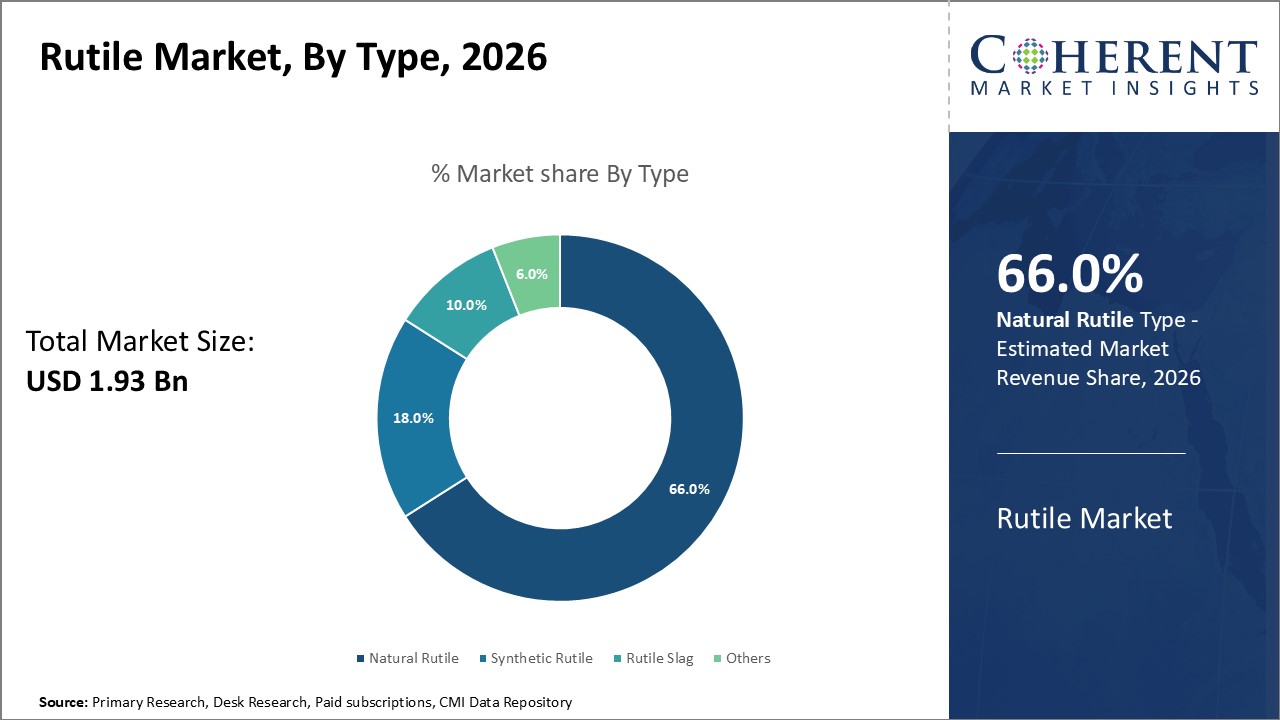
Natural rutile remains the predominant type, with a 66% market share driven by large-scale mining operations primarily in Australia and South Africa.
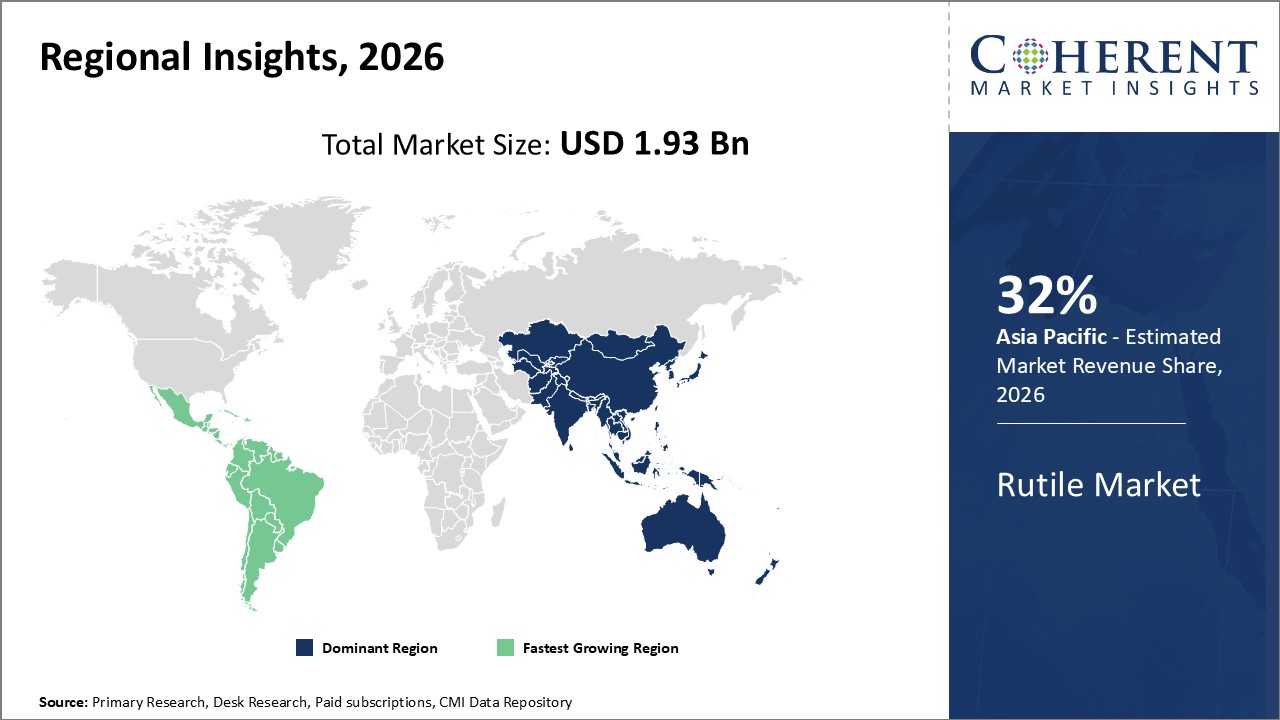
Asia Pacific leads regional market share at approximately 32%, reflecting rapid industrial growth and high pigment demand.
North America exhibits steady market growth supported by advanced technology adoption and stable industrial ecosystems, contributing significantly to industry share.
Rutile Market Segmentation Analysis
Rutile Market Insights, By Type
Natural Rutile dominates the market share with 66%. Natural Rutile's predominance is attributed to its superior titanium dioxide content and inherent quality characteristics that cater efficiently to pigment and refractory sectors. The consistent mining and supply from Australia and South Africa ensure steady availability, thereby anchoring its market leadership. Synthetic Rutile witnesses the fastest-growing segment due to technological innovations, making it an economically viable alternative amid natural rutile supply constraints. With a growth spurt noted over 30% in 2025, synthetic rutile addresses increasing demands for customised purity levels in electronics and speciality ceramics.
Rutile Market Insights, By Application
Pigments dominate, holding 68% of the market share due primarily to their extensive use in paints, coatings, and plastics that require brightness and durability. The surge in automotive coatings and packaging industries, especially in Asia Pacific, supports this dominance, with pigment-related rutile consumption growing by nearly 9% in 2025. Welding Electrodes represent a rapidly expanding application segment driven by growth in infrastructure and manufacturing sectors. These electrodes, benefiting from rutile's fluxing properties, have seen demand increase by around 7% year-over-year. Ceramics utilise rutile for enhancing strength and thermal resistance, with moderate growth noted due to innovations in electronics and advanced materials.
Rutile Market Insights, By End-Use Industry
Coatings dominate the market share at approximately 55%. The expansion of construction, automotive, and consumer goods industries globally fuels this segment's growth. Demand for corrosion-resistant and UV-protective coatings in emerging economies surged by 8% in 2025, positioning coatings as the primary market revenue contributor. Plastics emerge as the fastest-growing end-use segment, leveraging rutile for enhanced UV resistance and opacity. Growth in plastic packaging and automotive parts applications has accelerated demand by over 7% in recent years. Paper applications utilize rutile primarily for brightness improvement but remain a smaller segment.
Rutile Market Trends
The rutile market trend reflects a forward momentum driven by sustainable practices and supply chain optimization.
Major market players have accelerated the use of eco-friendly extraction methods that reduce environmental impact and improve cost efficiency.
Recent years have highlighted an increased reliance on synthetic rutile as an alternative to natural sources, particularly in the Asia Pacific.
For example, Chinese and Indian companies have scaled synthetic rutile production by 31% in 2025, aligning with both environmental mandates and rising demand for high-purity materials.
Geographically, Asia Pacific dominates the rutile market share with approximately 32%, fueled by rapid industrialization and a booming coatings market.
Stringent environmental policies in Europe have driven investments in cleaner manufacturing processes, while North America remains a hub for advanced technology-driven applications and stable demand.
The shift towards sustainability, coupled with expanding downstream uses in electronics and automotive sectors, forms the underpinning of emerging market trends.
Rutile Market Insights, By Geography
Asia Pacific Rutile Market Analysis and Trends
In Asia Pacific, the dominance in the rutile market stems from robust pigment and coating industries, supported by strong industrial output in China and India. Government incentives for infrastructure development and increasing urban population drive high rutile consumption. Furthermore, local production of synthetic rutile has improved supply reliability, contributing to nearly half of the total Asia Pacific market value.
Latin America Rutile Market Analysis and Trends
Meanwhile, Latin America exhibits the fastest growth with a CAGR exceeding 8% between 2026 and 2033, driven by expanding construction activities and rising exports from Brazil and Argentina. Improving trade relations and mining infrastructure development have enabled Latin American countries to establish themselves as emerging production hubs.
Rutile Market Outlook for Key Countries
USA Rutile Market Analysis and Trends
The USA's rutile market benefits from a well-established coatings and plastics industry that demands high-quality rutile for various applications. The country’s focus on sustainable manufacturing and advanced material research underpins steady growth, with pigment-based rutile applications expanding by 5% annually in recent years. Domestic production remains limited; therefore, imports primarily from Canada and Australia fill supply requirements. Key players engage in forward integration and joint ventures to strengthen market presence while adhering to stringent environmental regulations.
Australia Rutile Market Analysis and Trends
Australia is the largest rutile producer globally, contributing over 30% of natural rutile supply in 2025. Its vast deposits and operational efficiency make it a critical exporter, particularly to Asia Pacific markets. Iluka Resources and Base Resources dominate local mining, continuously investing in environmental compliance and process optimization, which have enhanced output capacity by 10% in 2025. Australia’s market activities directly influence global rutile market dynamics and pricing due to their strategic export volumes and quality standards.
Analyst Opinion
Increasing production capacity of rutile is a decisive supply-side indicator influencing market size. The ramp-up of mining operations in Australia, the largest rutile-producing country, surged by 12% in 2025, boosting raw material availability and stabilizing pricing. This expansion has facilitated increased exports, especially to high-demand regions in Asia Pacific, directly impacting market revenue.
Demand-side indicators reveal diversified end-use applications driving market growth. The pigment industry alone consumed over 65% of rutile produced in 2025, attributed to rising demand in automotive coatings and packaging materials. Notably, Asia Pacific accounted for nearly 45% of global imports, indicating shifting procurement patterns that favor emerging economies.
Pricing robustness remains a micro-indicator with rutile prices maintaining an upward trend by approximately 6% year-over-year between 2023 and 2025, influenced by raw material scarcity and processing cost inflations. This sustained pricing power underpins strong market revenues despite global economic fluctuations.
Technological advancements in synthetic rutile production also impact the market dynamics, supplementing natural rutile supply especially in China and India. In 2025, synthetic production contributed close to 26% of the total market demand, underscoring a competitive strategy to balance supply and fulfill increasing industrial requirements without compromising quality.
- Current Industry Events of 2026
- Market Size Estimation
- Regional Breakdown
- Competitive Landscape
- Customer Intelligence
- Segmental Analysis
- Pricing Analysis
- Key Market Drivers, Challenges & Future Trends
- Customized Insights Section
Market Scope
| Report Coverage | Details | ||
|---|---|---|---|
| Base Year: | 2025 | Market Size in 2026: | USD 1.93 billion |
| Historical Data for: | 2020 To 2024 | Forecast Period: | 2026 To 2033 |
| Forecast Period 2026 to 2033 CAGR: | 7.3% | 2033 Value Projection: | USD 2.9 billion |
| Geographies covered: |
| ||
| Segments covered: |
| ||
| Companies covered: | Meridian Mining SA, Kenmare Minerals, Exxaro Resources Limited, DuPont Titanium Technologies, Kronos Worldwide, Venus Minerals Ltd, Tronox Pigments (South Africa), Sibelco Group, Toho Titanium Co. Ltd, Sumitomo Metal Mining Co. Ltd | ||
| Growth Drivers: |
| ||
Rutile Market Growth Factors
Market growth is largely driven by escalating demand from the coatings industry, where durability and colourfastness are critical. The booming automotive and construction sectors in the Asia Pacific have propelled coatings demand by more than 9% year-over-year in recent years. Simultaneously, increasing environmental regulations have steered the pigment industry to prioritize rutile for its superior brightness and resistance properties.
Industrialization and urbanization in emerging markets contribute significantly to the rise in plastic applications utilizing rutile, leveraging its UV protection characteristics, which demand has grown by approximately 7% from 2023 to 2025. Furthermore, enhancements in mining technologies have reduced extraction costs and environmental impact, fueling market expansion. Rising investments in titanium-based welding electrodes, used widely in infrastructure projects, also catalyze market revenue.
Rutile Market Development
In March 2026, Sovereign Metals initiated a US$40 million equity raising to accelerate the development of its Kasiya rutile-graphite project in Malawi, widely recognized as the world’s largest known rutile deposit. The capital raise is aimed at advancing feasibility studies, infrastructure planning, and early-stage project execution, reinforcing the company’s position in the global titanium feedstock market. The funding is also expected to support strategic engagements with potential offtake partners and expand resource delineation across the broader Kasiya project area.
In 2026, DY6 Metals secured its third rutile asset in Cameroon as part of its ongoing regional expansion strategy, highlighting heightened exploration activity aimed at uncovering new high-grade rutile sources. The near-term acquisition reflects the company’s deliberate push to build a diversified portfolio of titanium mineral sands prospects, strengthening its presence in a region increasingly recognised for untapped rutile potential. This progression also aligns with the industry’s growing demand for alternative supply channels amid tightening global rutile availability.
Key Players
Leading Companies of the Market
Meridian Mining SA
Exxaro Resources Limited
DuPont Titanium Technologies
Kronos Worldwide
Venus Minerals Ltd
Tronox Pigments (South Africa)
Sibelco Group
Toho Titanium Co. Ltd
Sumitomo Metal Mining Co. Ltd
Leading market players have employed focused operational expansion and vertical integration strategies, with Iluka Resources expanding its Australian mining portfolio to consolidate market share, leading to a 16% increase in production capacity in 2025. Additionally, Tronox Holdings PLC has invested substantially in downstream processing capabilities, enhancing product quality and achieving a cost reduction of 9%, which improved its competitive positioning in pigment supply chains.
Rutile Market Future Outlook
Rutile demand is projected to increase with global construction, automotive, and coating sector growth. The rise of high-performance and UV-protective coatings, as well as lightweight titanium metal for aerospace and automotive applications, will drive consumption. Innovations in pigment processing, synthetic TiO₂ production, and nanomaterial applications may broaden usage. Emerging regions, especially Asia-Pacific, are expected to contribute significantly to global demand.
Rutile Market Historical Analysis
Rutile, the natural source of titanium dioxide, has long been used as a pigment in paints, plastics, paper, and cosmetics due to its high refractive index and opacity. Industrial uses include titanium metal production, welding electrodes, and ceramics. Its stability, chemical inertness, and thermal resistance made it highly suitable across multiple industries. Historically, growth was supported by expanding construction, automotive, and consumer goods sectors, particularly in developed markets.
Sources
Primary Research Interviews:
Mineralogists
Pigment Manufacturers
Ceramic Product Engineers
Databases:
USGS Mineral Commodity Summaries
Magazines:
Industrial Minerals
Titanium Today
Ceramic Industry Magazine
Journals:
Journal of Materials Science
International Journal of Mineral Processing
Materials Chemistry and Physics
Newspapers:
Financial Times (Resources)
The Wall Street Journal (Mining & Minerals)
The Guardian (Industry)
Associations:
International Titanium Association (ITA)
American Ceramic Society (ACerS)
ASTM International
Get access to 250+ pages report
Every segment, forecast, competitor profile and data table behind the analysis above — available for instant download.
- ESOMAR Member
- ISO 9001:2015 Certified
- D-U-N-S Registered
- GDPR & CCPA Compliant
Missing comfort of reading report in your local language? Find your preferred language:
Transform your Strategy with Exclusive Trending Reports
Frequently Asked Questions
The dominant players include Iluka Resources, Tronox Holdings PLC, Rio Tinto Group, and Kenmare Resources PLC, who lead due to their extensive mining operations and vertical integration in pigment manufacturing.
The Rutile Market size is projected to grow from USD 1.93 billion in 2026 to USD 2.9 billion by 2033, supported by rising demand in coatings, plastics, and refractory industries.
The coatings industry holds the largest growth opportunity driven by urbanization and industrial expansions, particularly in the Asia Pacific region.
Market trends will be shaped by sustainable mining technologies, increased synthetic rutile production, and growing demand for high-purity rutile in advanced applications like electronics and ceramics.
The competitive landscape is characterized by strategic expansion, capacity enhancement, and technological innovation. Challenges include resource depletion, environmental regulations, and price volatility.
Key strategies involve vertical integration, capacity expansion, technological advancements in processing, and geographical diversification to tap into emerging markets.