

Flat Glass Market Size and Trends - 2026 to 2033
The flat glass market is estimated to be valued at USD 339.47 Bn in 2026 and is expected to reach USD 468.19 Bn by 2033, exhibiting a compound annual growth rate (CAGR) of 4.7% from 2026 to 2033.
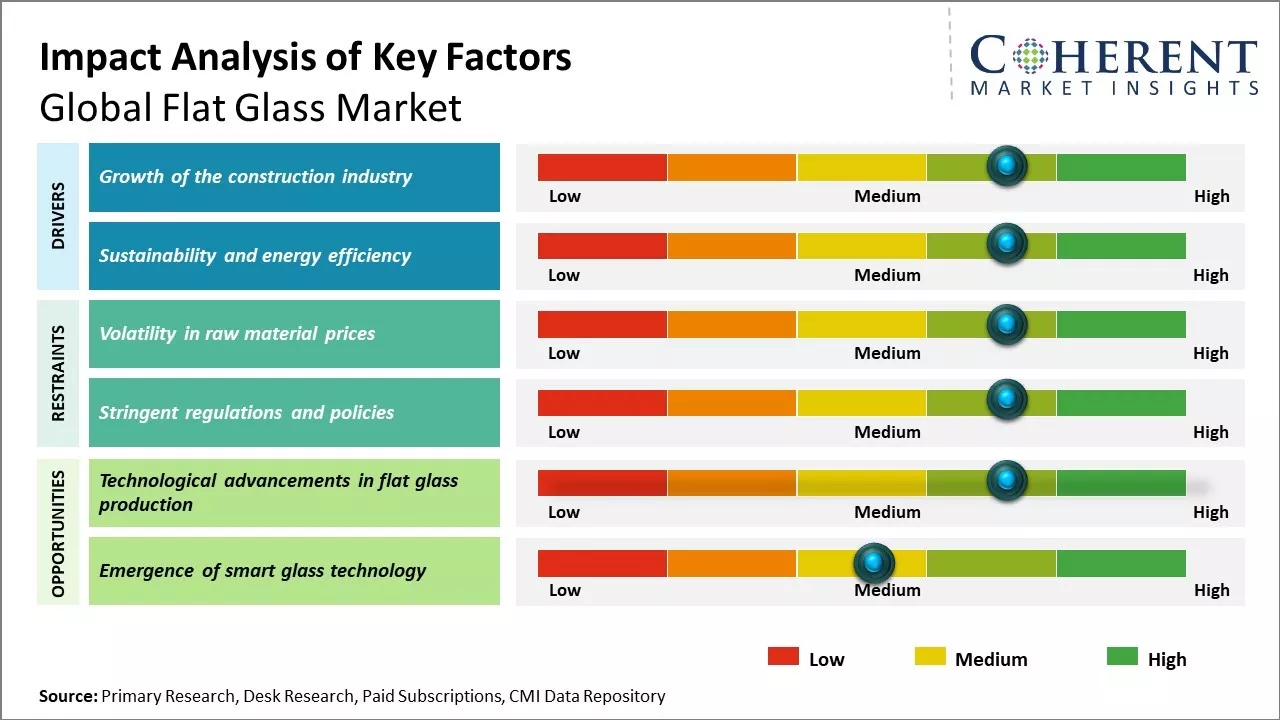
Key Takeaways
- Based on Product, the Tempered segment is expected to lead the market with 37.6% share in 2026, owing to its superior strength and safety.
- Based on Application, the Architecture segment is expected to hold 38.2% share of the market in 2026, driven by global construction and energy-efficient building trends.
- Based on Region, North America is set to lead the global flat glass market with 50% share in 2026. While, Asia Pacific is anticipated to be the fastest growing region.
Market Overview
The growing construction and automotive industries are expected to propel the demand for flat glass in the coming years. The flat glass market is expected to witness positive growth over the forecast period. Increasing commercial and residential construction activities across developed as well as developing countries is driving the growth of the market. Additionally, rapid urbanization and growing population is also fueling the demand for flat glass in architectural and infrastructure applications.
Current Events and their Impacts on the Flat Glass Market
Current Event | Description and its Impact |
Renewable energy and climate regulation acceleration |
|
Technological disruption and innovation requirements |
|
End User Feedback and Unmet Needs in Flat Glass Market
End User Feedback
- Energy Efficiency: Builders and architects prioritize low-emissivity (Low-E) and insulated glass units to meet green building standards. However, they often cite high costs and limited availability of advanced glass types as barriers.
- Customization & Aesthetics: Consumers want glass that blends functionality with design, like tinted, frosted, or patterned options. Feedback suggests that custom glass solutions are often expensive and have long lead times.
- Durability & Safety: Automotive and construction sectors value tempered and laminated glass for safety. Yet, concerns persist about impact resistance and long-term performance in extreme climates.
- Smart Glass Adoption: While smart glass (e.g., switchable or electrochromic) is gaining interest, users report limited integration with existing systems and high installation costs as major hurdles.
Unmet Needs
- Affordability of Advanced Glass: High-performance glass types like solar control or fire-resistant variants remain cost-prohibitive for mid-tier projects, especially in emerging markets.
- Supply Chain Reliability: Construction firms in India and Southeast Asia report frequent delays and inconsistent quality due to fragmented supply chains.
- Sustainability & Recycling: There’s growing demand for eco-friendly and recyclable glass, but manufacturers lag in offering certified sustainable options at scale.
- Thermal & Acoustic Insulation: Residential users seek better noise reduction and thermal comfort, but current offerings often require multi-layered setups that increase cost and complexity.
- Digital Integration: Smart buildings need glass that integrates with IoT systems. Users note a lack of standardized protocols and compatibility across vendors.
- Current Industry Events of 2026
- Market Size Estimation
- Regional Breakdown
- Competitive Landscape
- Customer Intelligence
- Segmental Analysis
- Pricing Analysis
- Key Market Drivers, Challenges & Future Trends
- Customized Insights Section
Segmental Insights
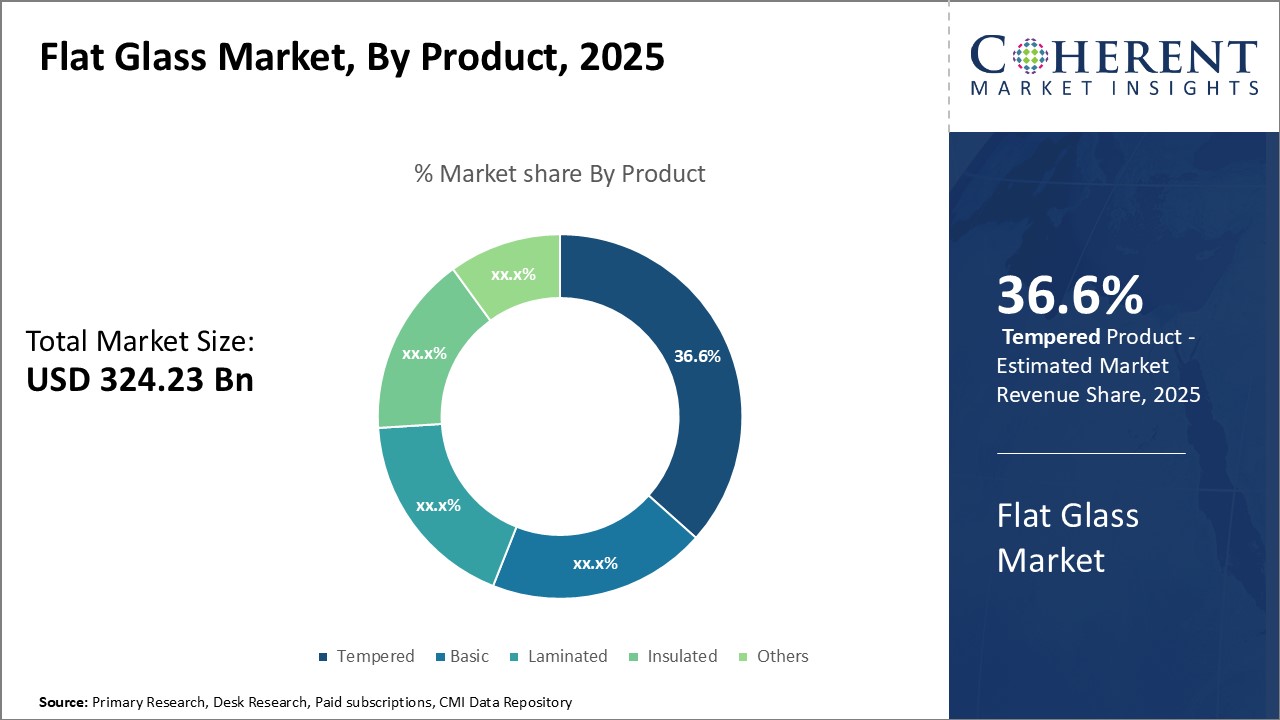
Flat Glass Market Insights, By Product: Tempered Glass Leads with Its Superior Strength and Safety
In terms of product, tempered is expected to contribute 37.6% share of the flat glass market in 2026, it is valued for its strength and safety. It’s nearly four times stronger than regular glass and shatters into small, harmless chunks. The tempering process creates internal stresses that boost durability. Widely used in automotive windows, glass doors, railings, and commercial buildings, it’s mandatory in many countries for vehicle safety. Its resilience in harsh weather and high-traffic areas makes it ideal for perimeter windows, skylights, and bath enclosures. These properties drive its dominance in architectural and automotive applications where safety is paramount.
For instance, in August 2025, Union Minister Ashwini Vaishnaw inaugurated India’s first tempered glass manufacturing facility in Noida, marking a major milestone in domestic glass production. The plant aims to reduce import dependency and boost local manufacturing under the Make in India initiative, with advanced technology to support sectors like electronics, construction, and automotive.
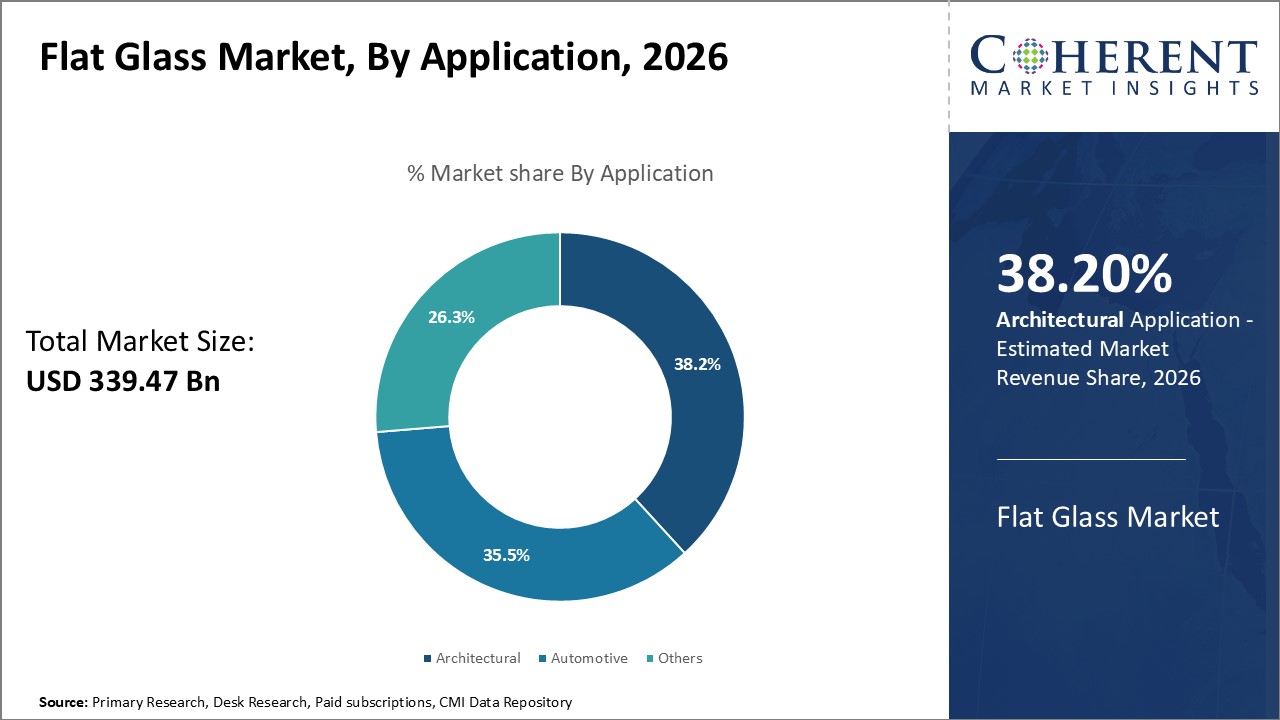
Flat Glass Market Insights, By Application: Architectural Applications Lead Is Driven by Global Construction and Energy-Efficient Building Trends
In terms of application, architectural is expected to contribute 38.2% share of the flat glass market in 2026, driven by global construction and renovation growth. Flat glass is widely used in windows, doors, walls, skylights, and curtain walls across residential and commercial buildings. Developed nations favor glass facades for energy efficiency and daylighting, while rapid urbanization in emerging economies fuels demand. Renovation efforts also boost the market, replacing outdated panels with energy-efficient glass. Interior applications like partitions, bath enclosures, and furniture add further momentum, combining aesthetics with functionality to meet modern design and sustainability goals.
For instance, in September 2025, Saint-Gobain Glass and LuxWall partnered to introduce INSIO®, a next-generation vacuum glazing solution, to the European market. Combining LuxWall’s transparent insulation technology with Saint-Gobain’s global expertise, INSIO® aims to revolutionize energy-efficient building design by significantly reducing heat loss through glass façades and windows.
Regional Insights
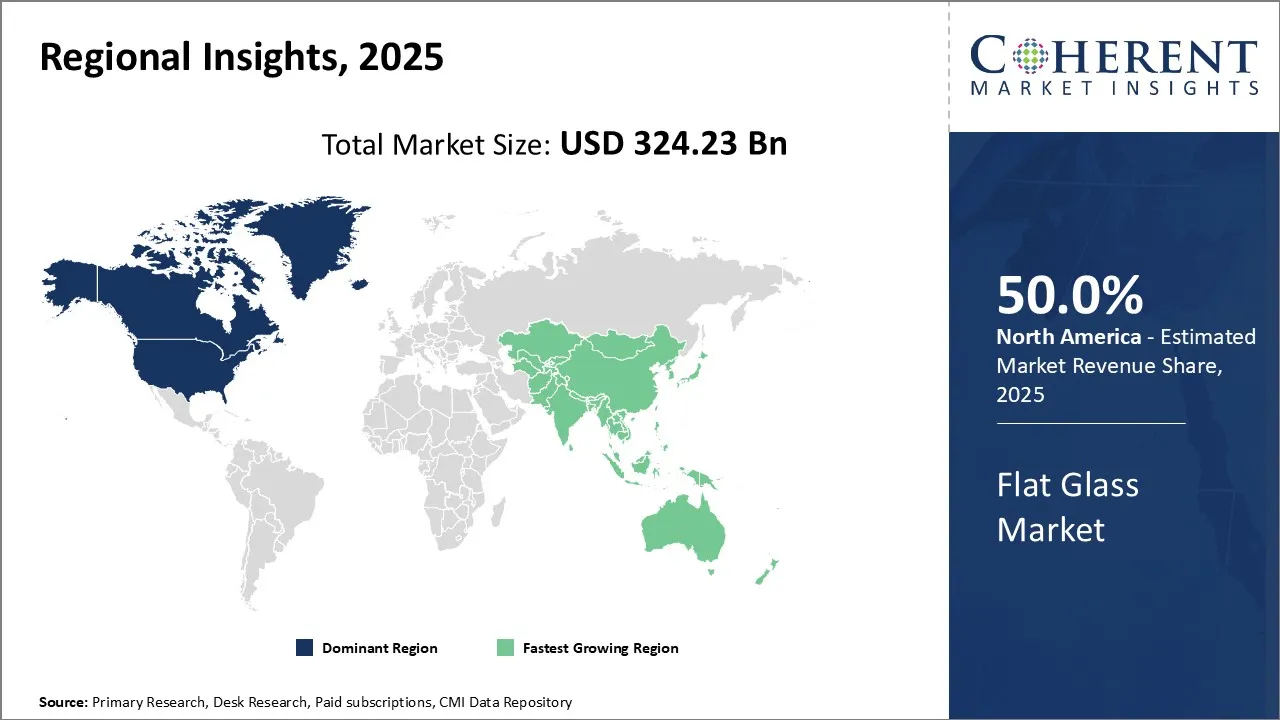
North America Flat Glass Market Analysis & Trends
North America has established itself as the dominant region in the global flat glass market. The region is expected to account for 50.0% of the market share in 2026. With the presence of major manufacturers and an extensive glass processing industry, the U.S. and Canada collectively account for the largest market share. The automotive industry has been a major growth driver in the region, positively impacting demand from both the original equipment and replacement channels. Stringent building codes focusing on energy efficiency have also boosted the sales of high-performance glass products for applications in the construction sector. Furthermore, regional trade policies and strong domestic demand have allowed manufacturers to operate at large economies of scale. As a result, North America enjoys competitive advantage in terms of price and design flexibility.
For instance, in June 2026, NSG Group launched a new solar array at its flat glass manufacturing site in Rossford, Ohio, enhancing its commitment to sustainability. The installation will supply renewable energy directly to the facility, reducing carbon emissions and supporting eco-friendly production of architectural and automotive flat glass products.
Asia Pacific Flat Glass Market Analysis & Trends
The Asia Pacific region has emerged as the fastest growing market for flat glass globally. Rapid urbanization and industrialization have fueled massive infrastructure development programs across countries like China, India, and Southeast Asian nations. This has translated into immense opportunities for flat glass suppliers catering to both commercial and residential construction. China, in particular, now leads the world in glass production volumes owing to its immense manufacturing prowess and favorable business environment. Moreover, these developing economies are also attracting significant investments by multinational auto manufacturers to establish local production facilities. This is positively impacting regional aftermarket sales. Additionally, ASEAN countries have liberalized trade regimes supporting an influx of global material suppliers into the region.
For instance, in July 2026, Glasspex India 2026, took place in Mumbai, showcased cutting-edge developments in the glass industry, with a strong focus on flat glass technologies. The event also highlighted advancements in architectural, automotive, and solar glass applications, positioning India as a growing hub for glass manufacturing and innovation.
Flat Glass Market Outlook Country-Wise
Czech Republic Flat Glass Market Trends
In 2026, the Czech Republic sees growing demand for flat glass driven by expansion in construction, automotive, and solar energy sectors. Increased infrastructure projects and energy-efficient building initiatives fuel architectural glass needs, while automotive manufacturing and renewable energy goals boost consumption of toughened and coated flat glass varieties.
For instance, in February 2026, AGC Glass Europe inaugurated its revolutionary VOLTA flat glass production line in Moustier, Belgium. The facility integrates advanced digitalization and sustainability features, aiming to reduce carbon emissions and enhance energy efficiency. This milestone strengthens AGC’s position in high-performance flat glass manufacturing for architectural and automotive applications across Europe.
Australia Flat Glass Market Trends
Australia’s flat glass market sees strong growth in 2026 due to rising infrastructure investments, energy-efficient building regulations, and advancements in glass tempering and lamination technologies. Demand is driven by construction of smart cities, public buildings, and transportation terminals, alongside increased use in solar panels and automotive applications.
For instance, in October 2026, GlassKote FGI unveiled two major low-iron flat glass manufacturing projects in Queensland, Australia, and the UAE. These advanced facilities will support architectural, solar, and specialty applications, integrating smart glazing, AI-driven performance, and building-integrated photovoltaics. The expansion marks a significant step in global flat glass innovation and sustainable production.
Market Report Scope
Flat Glass Market Report Coverage
| Report Coverage | Details | ||
|---|---|---|---|
| Base Year: | 2025 | Market Size in 2026: | USD 339.47 Bn |
| Historical Data for: | 2020 To 2024 | Forecast Period: | 2026 To 2033 |
| Forecast Period 2026 to 2033 CAGR: | 4.7% | 2033 Value Projection: | USD 468.19 Bn |
| Geographies covered: |
| ||
| Segments covered: |
| ||
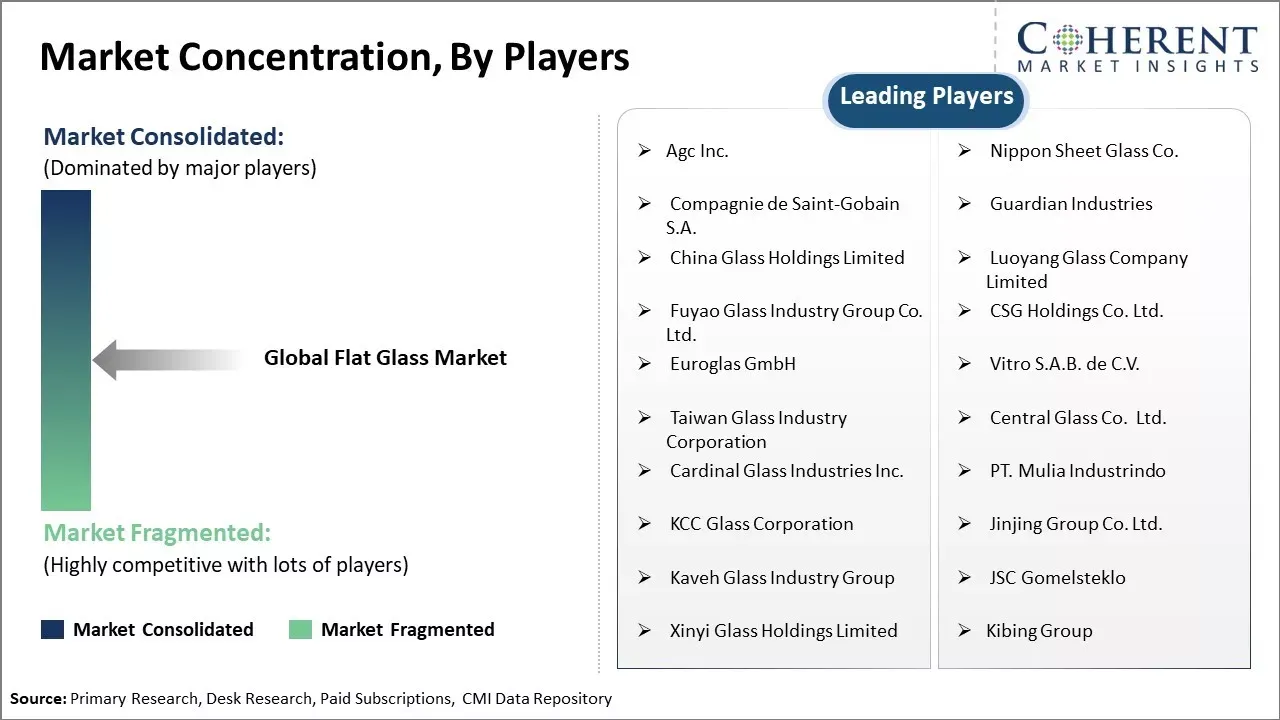
| Companies covered: | Agc Inc., Nippon Sheet Glass Co., Compagnie de Saint-Gobain S.A., Guardian Industries, China Glass Holdings Limited, Luoyang Glass Company Limited, Fuyao Glass Industry Group Co. Ltd., CSG Holdings Co. Ltd., Euroglas GmbH, Vitro S.A.B. de C.V., Taiwan Glass Industry Corporation, Central Glass Co. Ltd., Cardinal Glass Industries Inc., PT. Mulia Industrindo, KCC Glass Corporation, Jinjing Group Co. Ltd., Kaveh Glass Industry Group, JSC Gomelsteklo, Xinyi Glass Holdings Limited, and Kibing Group | ||
| Growth Drivers: |
| ||
| Restraints & Challenges: |
| ||
Flat Glass Market Driver
Growth of the construction industry
In the last decade, most of the developing economies like China, India, Brazil, etc. have witnessed massive infrastructure development projects related to buildings, roads, bridges, etc. This has generated high demand for materials used in construction including flat glass which finds wide applications in windows, facades, doors, etc. of residential as well as commercial buildings. Emerging economies are rapidly urbanizing and their populations are moving from rural to urban areas resulting in new construction activities.
Moreover, the increasing disposable incomes have boosted consumer spending on housing and real estates in developing nations. The growing middle-class section can now afford better quality homes compared to the past which is employing more use of glass panels, windows and doors in buildings. Governments across regions have also promulgated various housing policies and schemes to fulfill the objective of providing housing for all.
Market Concentration and Competitive Landscape
Sustainability and Energy Efficiency
With growing environmental concerns, regulations around the world have been tightened to curb carbon emissions and reduce energy consumption of buildings. In response, construction companies and builders are emphasizing on the use of energy efficient components and eco-friendly materials in their projects. Flat glass has emerged as a sustainable construction material owing to its various properties. Glass facade and windows allow maximum natural light inside buildings minimizes the usage of artificial lighting, thereby lowering electricity costs. The insulation properties of glass also help maintain ambient indoor temperature and thus reducing energy needs for heating and cooling.
Advanced glazing technologies have further strengthened the energy saving potential of flat glass. The introduction of innovations like low-e glass, smart glass, and vacuum glass have made windows more insulating. These specialized glasses can reflect sunlight, retain indoor heat, and some can even change properties according to temperature control needs.
Flat Glass Market Opportunity
Technological advancements in flat glass production
Technological advancements have provided a great opportunity for growth in the global flat glass market. Production of flat glass has significantly benefitted from incorporating Industry 4.0 technologies like automation, artificial intelligence, and internet of things. These innovations are driving increased productivity, better quality control, and reduced manufacturing costs for producers. For example, autoclaving and bending processes that have traditionally required labor-intensive work are now being automated through robotics. Machines can handle glass more precisely and safely as compared to human workers, reducing breakage and defects. Integration of sensors and advanced process controls also allows for real-time monitoring of manufacturing variables to optimize energy usage, maximize yields, and ensure consistency in product specifications. Some plants have even implemented predictive maintenance techniques using AI and big data analysis to anticipate equipment issues before downtime occurs.
Analyst Opinion (Expert Opinion)
The flat glass industry is undergoing a structural transformation driven by advanced manufacturing, sustainable design, and performance-oriented applications. Demand is increasingly defined by energy-efficient and functional glass, rather than volume growth. Low-emissivity (Low-E) coatings, for example, now account for over 20% of architectural glass use in Europe due to strict energy efficiency mandates, while North America and Asia Pacific are rapidly adopting similar technologies.
In the automotive sector, laminated and lightweight glass is gaining prominence, particularly in electric vehicles where energy efficiency and cabin acoustics are key. Tesla’s adoption of double-laminated acoustic glass illustrates this shift toward multifunctional materials. Meanwhile, the solar energy sector has emerged as the most dynamic segment, with ultra-clear and anti-reflective glass improving photovoltaic efficiency by up to 3%. China’s dominance, producing over 70% of solar glass, underscores both its manufacturing scale and supply chain influence.
Technological advances such as automated defect mapping and precision coatings have enhanced quality and reduced waste, while recycling initiatives are cutting furnace energy consumption by 25%. Overall, the market is transitioning from volume-driven expansion to value-driven innovation, where sustainability, coating performance, and circular production practices define long-term competitiveness.
Speak to the analyst
Want personalized insights?
Take the findings above to one of our principal consultants, or have the report rebuilt around the segments, geographies and competitors you actually track.
Flat Glass Industry News
- In October 2025, Saint-Gobain Glass's launch of COOL-LITE® XTREME 51/23 (II) introduces a high-performance solar control coated flat glass designed for architectural applications. Available in annealed and to-be-tempered versions, this triple silver-coated glass offers exceptional light transmission and low solar factor, making it ideal for energy-efficient building facades, windows, and curtain walls.
- In October 2025, Delemar Industrial Group announced a $105 million expansion to develop advanced industrial complexes in Egypt. The initiative includes facilities for producing flat glass, aligning with the country’s push for industrial self-sufficiency and export growth. This move is expected to boost local manufacturing and support sectors like construction, automotive, and solar energy.
Market Segmentation
- Product Insights (Revenue, USD Bn, 2026 - 2033)
- Basic
- Tempered
- Laminated
- Insulated
- Others
- Application Insights (Revenue, USD Bn, 2026 - 2033)
- Architectural
- Automotive
- Others
- Regional Insights (Revenue, USD Bn, 2026 - 2033)
- North America
- U.S.
- Canada
- Latin America
- Brazil
- Argentina
- Mexico
- Rest of Latin America
- Europe
- Germany
- U.K.
- Spain
- France
- Italy
- Russia
- Rest of Europe
- Asia Pacific
- China
- India
- Japan
- Australia
- South Korea
- ASEAN
- Rest of Asia Pacific
- Middle East & Africa
- GCC Countries
- Israel
- Rest of Middle East & Africa
- Key Players Insights (Revenue, USD Bn, 2021 - 2033)
- Agc Inc.
- Nippon Sheet Glass Co.
- Compagnie de Saint-Gobain S.A.
- Guardian Industries
- China Glass Holdings Limited
- Luoyang Glass Company Limited
- Fuyao Glass Industry Group Co. Ltd.
- CSG Holdings Co. Ltd.
- Euroglas GmbH
- Vitro S.A.B. de C.V.
- Taiwan Glass Industry Corporation
- Central Glass Co. Ltd.
- Cardinal Glass Industries Inc.
- PT. Mulia Industrindo
- KCC Glass Corporation
- Jinjing Group Co. Ltd.
- Kaveh Glass Industry Group
- JSC Gomelsteklo
- Xinyi Glass Holdings Limited
- Kibing Group
Sources
Primary research — Interviews from the following stakeholders
Stakeholders
- Interviews with float glass and processed glass manufacturers, glass processors and fabricators, architectural glazing contractors, curtain-wall installers, commercial/residential façade consultants, building developers, automotive glazing buyers, solar-glass buyers, and procurement heads across leading global markets.
- Site visits and on-floor interviews at manufacturing plants, tempering lines, and lamination units.
Specific stakeholders
- Manufacturing leads / plant managers at major float glass plants and tempering lines (e.g., production / operations heads at leading regional float glass makers).
- Product and procurement heads at automotive OEMs and tier-1 auto glazing suppliers (e.g., Toyota, Volkswagen, Denso-level procurement teams).
- Architects and façade consultants at global architecture practices and façade design firms (e.g., Foster + Partners, SOM, Gensler façade teams).
- Project and procurement managers at large real-estate developers and contractors (e.g., major commercial & residential developers in India, Middle East, Europe).
- Facility and operations managers at large infrastructure hubs and airports (e.g., Heathrow, Chhatrapati Shivaji Maharaj Intl., JFK).
- Sustainability / green-building leads at hotel and retail chains (e.g., major global hotel groups, large retail chains).
- Product managers at display/window/toughened glass component suppliers (coatings, low-e, IGU systems), and at chemical suppliers for glass (soda, silica, flux).
- Technical leads at solar module manufacturers (for solar glass demand and specs).
- R&D teams at glass coatings and thin-film suppliers (low-E, anti-reflective, sputtered coatings).
- Distributors, wholesalers and glazing contractors in regional markets (India, China, EU, USA, Middle East).
- Testing labs and certification bodies (temperature, impact, optical, insulating performance).
Databases & Trade Statistics
- World Trade Organization (WTO) trade statistics.
- UN Comtrade database (HS codes for flat glass, processed glass, mirrors, laminated/tempered glass).
- National customs / trade portals (China Customs, Japan Customs, Korea Customs Service).
- Eurostat international trade statistics.
- U.S. Census / USA trade statistics / Bureau of Economic Analysis imports/exports.
- Directorate General of Commercial Intelligence & Statistics (DGCIS), India.
- National statistical offices (ONS, INSEE, NBS China, etc.).
- International Energy Agency (IEA) — for solar glass use and trends.
- OECD statistics and World Bank trade indicators.
Industry Magazines & Trade Publications
- Glass Magazine (industry news, processing, coating tech).
- USGlass / Glass: The Journal of the Glass Industry.
- Glass International.
- Glass & Glazing Manufacturer trade newsletters.
- Architectural Record — façade and glazing features.
- Window & Door / Fenestration publications.
- Solar industry trade press (for solar/photovoltaic glass demand).
- Construction and building trade magazines covering façade and cladding.
Academic Journals & Technical Literature
- Glass Technology: European Journal of Glass Science and Technology.
- Journal of Non-Crystalline Solids (glass science).
- Construction and Building Materials (façade performance, thermal/optical studies).
- Solar Energy Materials & Solar Cells (for solar/photovoltaic glass).
- Surface & Coatings Technology (coatings for glass).
- Journal of Cleaner Production (LCA, sustainability of glass).
- Journal of Materials Science (glass compositions and treatments).
Newspapers & Business Press
- The Wall Street Journal — industry, supply-chain & manufacturing.
- Financial Times — manufacturing, materials and supply chain.
- The Economic Times / Business Standard (India) — glass sector, construction demand.
- Nikkei Asia — electronics, materials and supply chains (notably East Asia).
- South China Morning Post — China manufacturing & trade coverage.
- Local business dailies for regional project & plant announcements.
Associations, Standards Bodies & Industry Groups
- Glass for Europe (association of European flat glass manufacturers).
- Glass Association of North America (GANA).
- International Commission on Glass (ICG).
- China Building Glass & Glass Industry Association (CBGIA) / relevant national glass associations.
- Indian Glass Manufacturers’ Federation (IGMF) / equivalent national bodies.
- American Architectural Manufacturers Association (AAMA) — fenestration and glazing standards.
- ASTM International (glass testing standards), ISO (glass & glazing standards), CEN (European standards).
- American National Standards Institute (ANSI) / relevant national standards bodies.
- International Energy Agency / national energy efficiency programmes (for insulated glass regulations).
Public-Domain & Government Sources
- Ministry of Commerce / Customs portals (national trade flows).
- Ministry of Housing / Urban Affairs (policy & construction demand).
- Ministry of Electronics and Information Technology (for display-glass intersections where relevant).
- Bureau of Indian Standards / BIS (glazing and safety standards).
- U.S. International Trade Commission (USITC) reports and tariff schedules.
- National Institute of Standards and Technology (NIST) — materials testing protocols.
- METI (Japan) / Ministry of Industry portals for manufacturing data.
- Reserve Bank / central bank economic reports (construction sector indicators).
- National building code / energy efficiency programme reports (impact on insulated & low-E glass uptake).
Get access to 250+ pages report
Every segment, forecast, competitor profile and data table behind the analysis above — available for instant download.
- ESOMAR Member
- ISO 9001:2015 Certified
- D-U-N-S Registered
- GDPR & CCPA Compliant
Missing comfort of reading report in your local language? Find your preferred language:
Transform your Strategy with Exclusive Trending Reports
Frequently Asked Questions
The Flat Glass Market is estimated to be valued at USD 339.47 Bn in 2026, and is expected to reach USD 468.19 Bn by 2033.
The CAGR of the Flat Glass Market is projected to be 4.7% from 2026 to 2033.
Growth of the construction industry and sustainability and energy efficiency are the major factors driving the growth of the global flat glass market.
Volatility in raw material prices and stringent regulations and policies are the major factors hampering the growth of the global flat glass market.
In terms of product, tempered is estimated to dominate the market revenue share in 2026.
Agc Inc., Nippon Sheet Glass Co., Compagnie de Saint-Gobain S.A., Guardian Industries, China Glass Holdings Limited, Luoyang Glass Company Limited, Fuyao Glass Industry Group Co. Ltd., CSG Holdings Co. Ltd., Euroglas GmbH, Vitro S.A.B. de C.V., Taiwan Glass Industry Corporation, Central Glass Co. Ltd., Cardinal Glass Industries Inc., PT. Mulia Industrindo, KCC Glass Corporation, Jinjing Group Co. Ltd., Kaveh Glass Industry Group, JSC Gomelsteklo, Xinyi Glass Holdings Limited, and Kibing Group are the major players.
North America is expected to lead the global flat glass market.