

High Performance Insulation Materials Market Size and Forecast — 2026 - 2033
Global High Performance Insulation Materials Market Size and Forecast – 2026 – 2033
The Global High Performance Insulation Materials Market size is estimated to be valued at USD 7.6 billion in 2026 and is expected to reach USD 13.9 billion by 2033, exhibiting a compound annual growth rate (CAGR) of 9.1% from 2026 to 2033.
Overview
The Global High Performance Insulation Materials Market includes advanced materials designed to provide superior thermal, acoustic, and fire resistance across industrial, commercial, and residential applications. Key products include aerogels, vacuum insulation panels (VIPs), and high-performance fiberglass, which offer exceptional energy efficiency and space-saving benefits. Ceramic fibers and mineral wool are widely used in high-temperature industrial applications such as furnaces and power plants. Polyurethane and polystyrene foams provide lightweight insulation for construction and refrigeration systems. These materials are engineered to reduce energy loss, improve sustainability, and enhance safety standards, driving their increasing adoption across building, oil and gas, and transportation sectors globally.
Key Takeaways
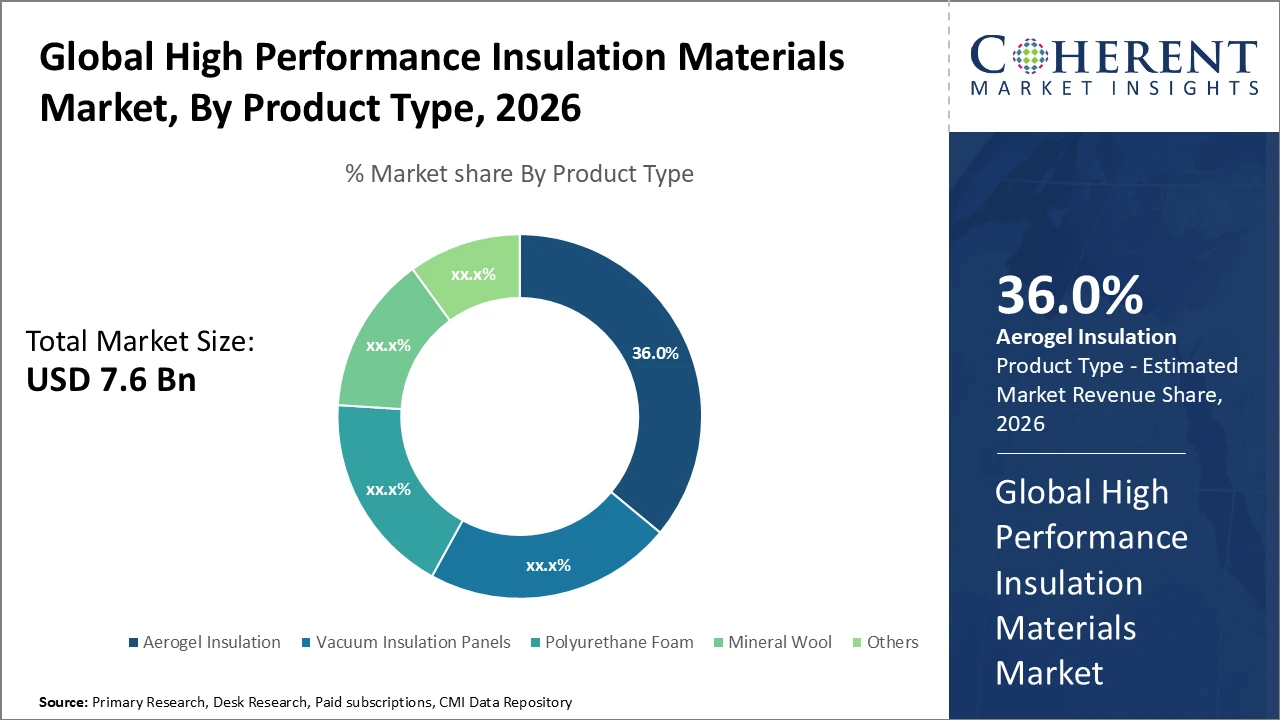
The Aerogel Insulation segment holds a dominant 36% market share, driven by its superior thermal performance and increasing use in aerospace and automotive applications.
Vacuum Insulation Panels (VIPs) are witnessing rapid growth due to their rising adoption in energy-efficient building envelopes and green construction projects.
The Building & Construction application segment generates the highest revenue, supported by ongoing infrastructure development in emerging economies and retrofit projects in developed regions.
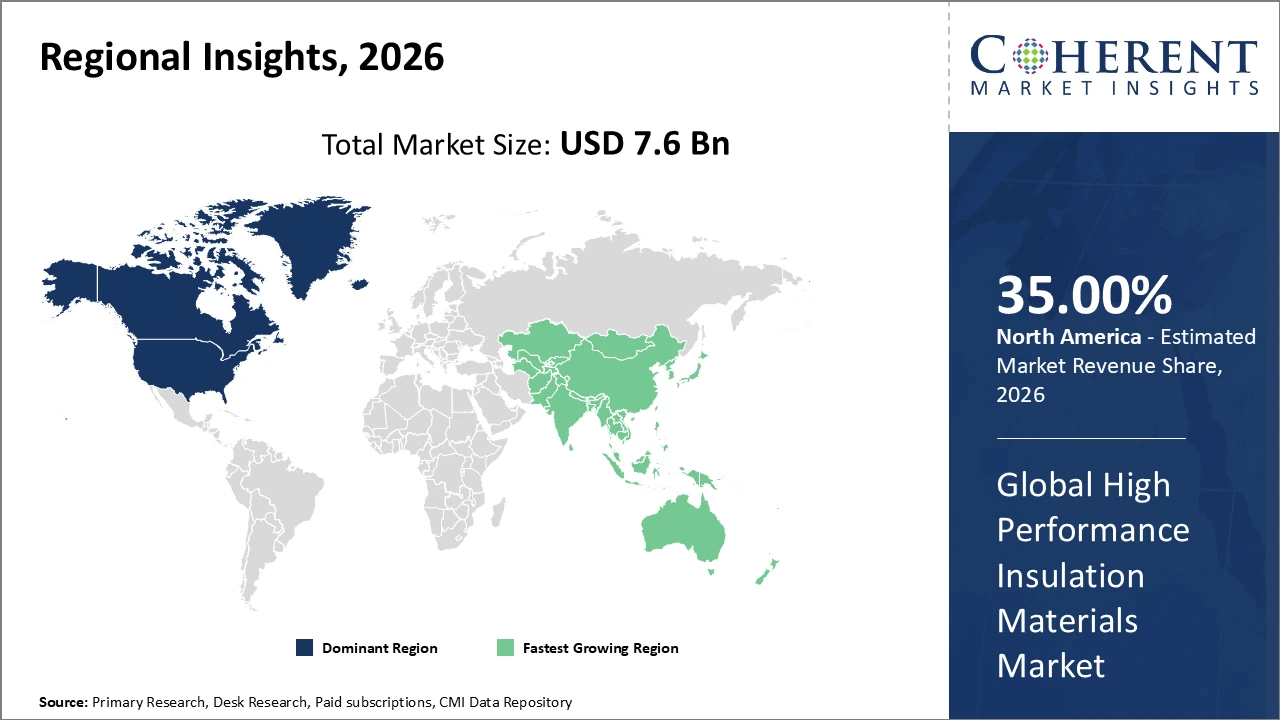
North America maintains a strong market share of 35% due to strict energy efficiency regulations and high adoption of advanced insulation technologies.
Asia Pacific is the fastest-growing region, fueled by government initiatives in China and India promoting urbanization, sustainability, and energy-efficient construction, resulting in a higher CAGR than other regions.
Global High Performance Insulation Materials Market Segmentation Analysis
Global High Performance Insulation Materials Market Insights, By Product Type
Aerogel Insulation dominates the market share due to its exceptional thermal resistance, ultra-lightweight structure, and superior performance, making it highly suitable for aerospace, industrial, and high-end engineering applications requiring maximum insulation efficiency. Vacuum Insulation Panels (VIPs) represent the fastest-growing subsegment, driven by rising demand for energy-efficient buildings and refrigeration systems where space-saving and high thermal performance are critical. Polyurethane Foam remains widely adopted because of its versatility, cost-effectiveness, and suitability for residential and industrial insulation needs. Mineral Wool is preferred for its excellent fire resistance and acoustic properties in commercial construction. The Others segment includes emerging composite insulation materials.
Global High Performance Insulation Materials Market Insights, By Application
The Building & Construction segment dominates the market share due to extensive adoption of energy-efficient insulation materials in both new construction and building retrofits worldwide. This growth is strongly supported by government regulations promoting sustainability, energy conservation, and carbon neutrality in infrastructure. The Automotive & Transportation segment is the fastest growing, driven by vehicle electrification and increasing demand for advanced thermal management in EV batteries and passenger cabins. Industrial applications, especially in petrochemical and manufacturing facilities, show steady demand for insulation to improve safety and operational efficiency. Aerospace & Defense remains a niche but high-value segment requiring ultralight, high-performance insulation materials.
Global High Performance Insulation Materials Market Insights, By End User
The Residential subsegment holds the dominant market share due to strong demand for energy-efficient housing, increasing environmental awareness, and rising retrofit activities across developed and emerging economies. The implementation of stringent building codes, particularly in North America and Europe, further supports this growth. The Commercial subsegment is the fastest growing, driven by rapid urbanization and large-scale infrastructure development, including offices, retail spaces, and hospitality buildings focused on reducing energy costs and achieving green building certifications. The Industrial segment emphasizes energy conservation in manufacturing operations, while the Institutional segment includes schools, hospitals, and public infrastructure aligned with sustainability objectives. The Others segment covers niche applications.
Global High Performance Insulation Materials Market Trends
The market is witnessing accelerated adoption of bio-based and smart insulation materials, driven by sustainability goals and technological advancements.
Europe recorded a 14% increase in bio-composite insulation usage in 2025, supported by strong policy incentives for green buildings and reduced carbon emissions.
North America is advancing pilot projects involving sensor-embedded insulation materials, enabling real-time energy monitoring and improved building efficiency.
The industry is increasingly influenced by circular economy principles, focusing on recyclability and sustainable material lifecycle management.
Growing emphasis on lifecycle assessment is shaping product development and procurement decisions in the high-performance insulation materials market.
Global High Performance Insulation Materials Market Insights, By Geography
North America Global High Performance Insulation Materials Market Analysis and Trends
In North America, the dominance in the High Performance Insulation Materials market is driven by a mature construction industry, stringent energy efficiency regulations, and strong enforcement of building energy codes. The region benefits from the presence of leading manufacturers such as Owens Corning and Johns Manville, which contribute significantly to innovation and supply capabilities. A key growth driver is the increasing focus on retrofitting existing infrastructure to improve energy efficiency and reduce carbon emissions. Government incentives and corporate sustainability initiatives further strengthen demand. As a result, North America accounts for over 35% of the global market share in high-performance insulation materials.
Asia Pacific Global High Performance Insulation Materials Market Analysis and Trends
Meanwhile, Asia Pacific exhibits the fastest growth in the High Performance Insulation Materials market, with a CAGR exceeding 11%, driven by rapid urbanization, industrialization, and expanding automotive production. Countries such as China and India are making significant investments in sustainable infrastructure, energy-efficient buildings, and electric vehicle development, which is accelerating demand for advanced insulation solutions. Government initiatives supporting green construction and clean energy adoption further strengthen market expansion. Additionally, collaborations between local manufacturers and multinational companies are enhancing production capabilities and technology transfer. Cost advantages, supportive policies, and rising environmental awareness collectively position Asia Pacific as the fastest-growing regional market.
Global High Performance Insulation Materials Market Outlook for Key Countries
USA Global High Performance Insulation Materials Market Analysis and Trends
The USA’s High Performance Insulation Materials market is characterized by stringent energy efficiency regulations, including the International Energy Conservation Code (IECC), which strongly promotes the adoption of advanced insulation solutions. Leading companies such as Owens Corning and Johns Manville are heavily investing in research and development to create sustainable, high-performance product lines. These innovations have contributed to approximately 10% market revenue growth in 2025. Additionally, large-scale building retrofit projects aimed at improving energy efficiency are driving demand. The expansion of electric vehicle manufacturing hubs further supports application diversification, reinforcing the USA’s significant role in shaping global market growth and technological advancement.
Germany Global High Performance Insulation Materials Market Analysis and Trends
Germany’s High Performance Insulation Materials market is highly developed and innovation-driven, supported by strict EU energy efficiency regulations such as the Gebäudeenergiegesetz (GEG) and the EPBD framework. The country leads Europe due to its strong renovation ecosystem, large stock of older buildings, and government incentives for energy-efficient retrofitting. Demand is further strengthened by industrial insulation needs in manufacturing and automotive sectors, where energy optimization is critical. Key players like BASF, Knauf Insulation, and Rockwool drive technological advancements in aerogels, VIPs, and mineral wool solutions. Sustainability trends, circular economy adoption, and rising preference for low-carbon materials are shaping market growth and long-term opportunities.
Analyst Opinion
A key demand-side driver in the High Performance Insulation Materials market is the rise in retrofitting activities in developed regions. North America recorded a 15% increase in building renovation projects using high-performance insulation in 2025, contributing to a 12% rise in market revenue, supported by programs like Energy Star.
On the supply side, manufacturers expanded production capacity by around 8% in 2024 to meet rising demand, leading to 7.5% pricing stabilization despite raw material volatility. This expansion was largely supported by new facilities in Asia Pacific.
The automotive sector is a major application area, with insulation materials widely used in electric vehicle battery thermal management. In 2026, exports of EV-related insulation components grew by 18%, reflecting strong global integration.
In niche applications, aerospace insulation is emerging as a high-value segment. Aerogel-based insulation adoption increased by 10% in 2025, driven by demand for lightweight, high-performance thermal protection systems.
- Current Industry Events of 2026
- Market Size Estimation
- Regional Breakdown
- Competitive Landscape
- Customer Intelligence
- Segmental Analysis
- Pricing Analysis
- Key Market Drivers, Challenges & Future Trends
- Customized Insights Section
Market Scope
| Report Coverage | Details | ||
|---|---|---|---|
| Base Year: | 2025 | Market Size in 2026: | USD 7.6 billion |
| Historical Data for: | 2020 To 2024 | Forecast Period: | 2026 To 2033 |
| Forecast Period 2026 to 2033 CAGR: | 9.1% | 2033 Value Projection: | USD 13.9 billion |
| Geographies covered: |
| ||
| Segments covered: |
| ||
| Companies covered: | Owens Corning, Dow Inc., BASF SE, Rockwool International, Knauf Insulation, Kingspan Group, 3M Company, Paroc Group, Covestro AG, Astec Industries | ||
| Growth Drivers: |
| ||
Global High Performance Insulation Materials Market Growth Factors
The increasing global emphasis on energy efficiency and carbon footprint reduction is significantly driving market revenue growth. Strict insulation regulations, such as the European Union’s “Nearly Zero Energy Buildings” directive, are boosting demand for advanced insulation materials across residential and commercial construction. The rapid expansion of electric vehicles is further diversifying applications, as insulation is widely used in battery thermal management systems, particularly in Asia Pacific and North America. Advances in material science, including next-generation aerogels with superior thermal performance and lower density, are improving adoption rates. Additionally, government subsidies for retrofit programs in countries like Canada and Germany are accelerating market penetration.
Global High Performance Insulation Materials Market Development
In August 2025, Foli Aerogel, a leader in advanced aerogel insulation, announced a strategic distribution partnership with Aerogel Technologies, LLC, a global aerogel commercialization and distribution company.
Key Players
Leading Companies of the Market
Owens Corning
BASF SE
Kingspan Group
Rockwool International
Dow Inc.
Paroc Group
Covestro AG
Astec Industries
Knauf Insulation
3M Company
Leading companies are aggressively pursuing technological innovation and geographic expansion to strengthen their market positions. For instance, Kingspan Group’s strategic acquisition of smaller regional insulation manufacturers across Asia Pacific in 2025 enabled it to expand its distribution network and achieve a 20% increase in revenue by accessing high-growth emerging markets. Similarly, Owens Corning increased its investment in sustainable and energy-efficient insulation product lines, which resulted in a 25% rise in product adoption across North America in 2024. These developments reflect a competitive landscape increasingly focused on sustainability, advanced materials, and integrated insulation solutions to meet evolving global energy efficiency demands.
Global High Performance Insulation Materials Market Future Outlook
The Global High Performance Insulation Materials Market is expected to witness strong growth driven by rising energy efficiency regulations, rapid urbanization, and increasing demand for sustainable construction solutions. Expansion of electric vehicles and industrial modernization will further boost adoption of advanced insulation materials for thermal management applications. Technological advancements in aerogels, vacuum insulation panels, and bio-based materials will enhance product performance and affordability. Government incentives supporting green buildings and retrofit projects will accelerate market penetration in both developed and emerging economies. Additionally, growing emphasis on carbon neutrality and lifecycle efficiency will shape future innovation, ensuring steady long-term market expansion across diverse end-use industries.
Global High Performance Insulation Materials Market Historical Analysis
The Global High Performance Insulation Materials Market has shown steady historical growth driven by rising awareness of energy conservation and tightening building energy regulations over the past decade. Initially, traditional insulation materials like fiberglass and mineral wool dominated the market due to cost efficiency and widespread availability. Over time, increasing demand for higher thermal efficiency led to the adoption of advanced materials such as aerogels, vacuum insulation panels, and polyurethane foams. Industrialization, urbanization, and infrastructure expansion further accelerated market growth. Government policies promoting green buildings and energy-efficient retrofitting played a crucial role in shaping market evolution, particularly in North America and Europe.
Sources
Primary Research Interviews:
Construction material manufacturers, insulation product engineers, and building energy efficiency consultants focusing on thermal performance, fire resistance, and advanced insulation systems
Energy policy experts, sustainability consultants, and green building certification specialists involved in energy efficiency regulations, carbon reduction targets, and building code compliance (e.g., NZEB, LEED)
Executives from insulation material companies, R&D heads, and process engineers working on aerogels, vacuum insulation panels, polyurethane foams, and next-generation eco-friendly insulation solutions
Magazines:
Insulation Outlook – Industry news on insulation technologies, building efficiency, and material innovations
Construction Specifier – Updates on building materials, codes, and high-performance insulation solutions
Building Design + Construction – Trends in sustainable construction and energy-efficient building systems
Energy Manager Today – Energy efficiency policies, retrofit trends, and insulation advancements
Journals:
Energy and Buildings – Research on building insulation performance and thermal efficiency
Journal of Building Engineering – Studies on advanced insulation materials and construction applications
Construction and Building Materials – Material science developments in insulation technologies
Renewable and Sustainable Energy Reviews – Sustainability and lifecycle analysis of insulation systems
Newspapers:
The Wall Street Journal – Construction industry investments and energy efficiency trends
Financial Times – Global infrastructure development and green building transitions
Reuters Energy/Construction – Policy updates and insulation market developments
Bloomberg – Building materials sector analysis and sustainability-driven market trends
Associations:
U.S. Green Building Council (USGBC) – LEED certification standards and green building practices
International Energy Agency (IEA) – Global energy efficiency and building insulation guidelines
European Insulation Manufacturers Association (EURIMA) – Industry standards and insulation policy advocacy
National Insulation Association (NIA) – North American insulation industry standards and market data
Get access to 250+ pages report
Every segment, forecast, competitor profile and data table behind the analysis above — available for instant download.
- ESOMAR Member
- ISO 9001:2015 Certified
- D-U-N-S Registered
- GDPR & CCPA Compliant
Missing comfort of reading report in your local language? Find your preferred language:
Transform your Strategy with Exclusive Trending Reports
Frequently Asked Questions
Leading market players include Owens Corning, Covestro AG, BASF SE, Kingspan Group, and Rockwool International, which collectively hold substantial market share through extensive product portfolios and strong geographic expansion strategies.
The market size is projected to reach USD 13.9 billion by 2033, growing at a CAGR of 9.1% from 2026 to 2033, driven by strong demand from construction, automotive, and industrial sectors globally.
The Building & Construction sector offers the largest growth opportunity, supported by strict energy efficiency regulations, green building initiatives, and widespread retrofitting activities across developed and emerging economies.
Market trends are expected to shift toward eco-friendly insulation materials, smart insulation systems with embedded technologies, and circular economy models focusing on recyclability and lifecycle efficiency.
The competitive landscape is characterized by strong innovation, consolidation, and global expansion, while key challenges include raw material price volatility and increasingly strict environmental and regulatory compliance requirements.
Common strategies include geographic expansion into high-growth regions, continuous product innovation focused on sustainability, strategic mergers and acquisitions, and partnerships to strengthen distribution networks and market reach.