

Aerogels Market Size and Share Analysis- Growth Trends and Forecasts (2026-2033)
The Aerogels Market is projected to grow at a CAGR of 9.9% from USD 1.66 Bn in 2026 to reach USD 3.21 Bn by 2033. The major factors are primarily driven by the rising demand for high-performance thermal insulation, increasing adoption of aerogels in oil & gas and construction industries, growing use in electric vehicle batteries and energy-efficient applications, and increasing utilization of lightweight insulation materials in aerospace and industrial applications. Aspen Aerogels in its 2025 Form 10-K reported USD 168.9 Million in revenue in 2025 from PyroThin aerogel-based thermal barriers, supplying production parts to GM, Toyota, and ACC, indicating commercial-scale adoption of aerogel materials in EV battery thermal management.
Key Takeaways
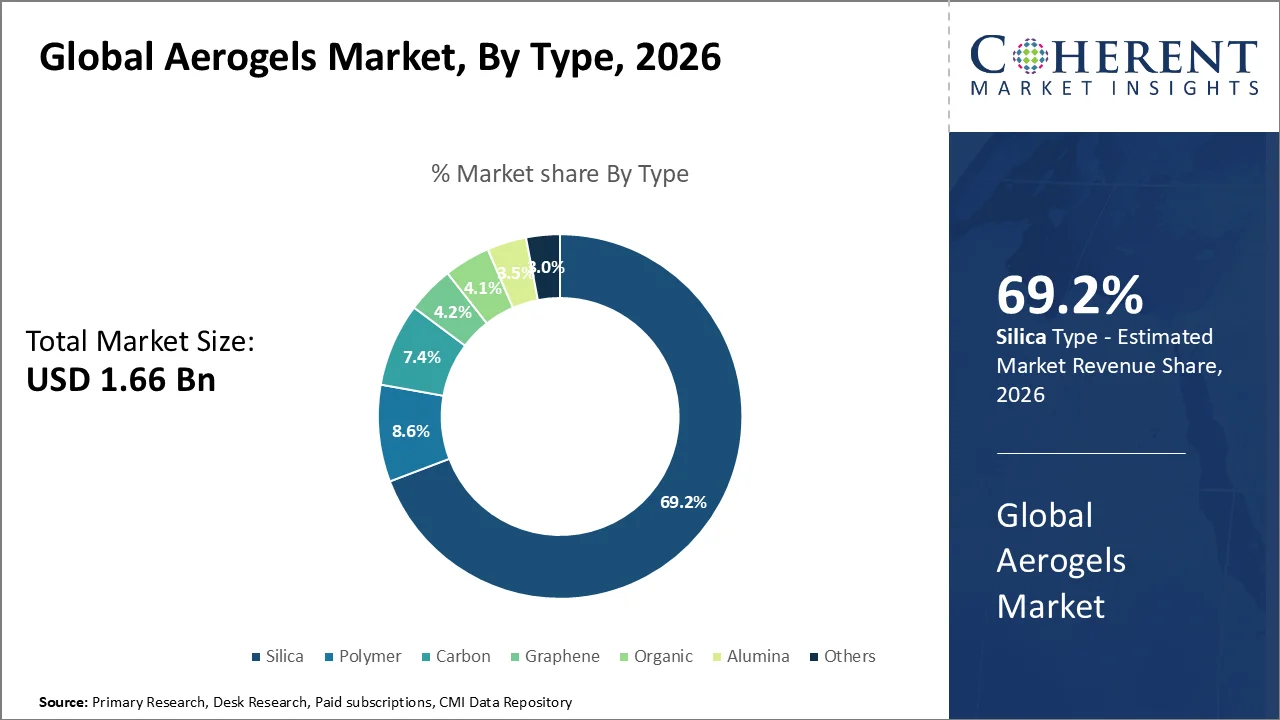
- The silica aerogel segment is likely to dominate the market with 69.2% in 2026. The segment’s growth is owing to its extremely low thermal conductivity, high porosity, lightweight structure, thermal stability, and widespread suitability for industrial and transportation insulation. A study published in October 2025 reported a flexible silica aerogel with thermal conductivity as low as 0.0286 W/(m·K) and reversible deformation up to 90%, demonstrating the combination of thermal and mechanical performance achievable with silica-based aerogels.
- The blanket segment is set to lead the market with 64.5% in 2026. The segment’s growth is owing to the flexibility, ease of installation, low thickness, resistance to compression, and ability of aerogel blankets to conform around pipelines, vessels, subsea systems, and industrial equipment. According to Aspen Aerogels' Form 10-K filed in March 2026, the company had sold more than USD 1.6 Bn of aerogel insulation products globally, representing an installed base exceeding 525 million square feet. The company also shipped 20.6 million square feet of aerogel products in 2025.
- The virgin aerogel segment is expected to dominate the processing category with 56.0% in 2026. The segment’s growth is supported by the requirement for directly manufactured aerogel material as the base input for subsequent cutting, lamination, composite formation, and customized fabrication. Aspen Aerogels reported in March 2026 that its aerogel technology platform was supported by 400 issued patents and another 438 pending patents as of December 31, 2025, covering product design, chemistry, process technology, and applications.
- The thermal insulator segment is likely to lead the application category with 61.0% in 2026. The segment growth is credited to the aerogel’s extremely low heat transfer, space-saving insulation performance, fire-resistance, and increasing integration in buildings, batteries, industrial equipment, and cryogenic systems. A research published in August 2025 demonstrated that adding SiO2 aerogel into EPS-based super-insulation panels improved the thermal insulation performance by 23.1% compared to the conventional TEPS panels, supporting the increasing use of aerogel in energy-efficient building envelope applications.
- Oil & gas segment is forecasted to dominate the end-user category with 59.0% in 2026. The segment’s growth is attributed to the widespread use of aerogel insulation in refinery piping, LNG facilities, storage tanks, subsea infrastructure, petrochemical plants, and high-temperature processing systems. Aspen Aerogels’ aerogel products are installed in more than 30% of the world’s estimated 640 refineries and its aerogel blankets are used by 24 of the world’s 25 largest refining companies and all of the world’s 20 largest petrochemical companies, based on its Form 10-K filed March 13, 2026.
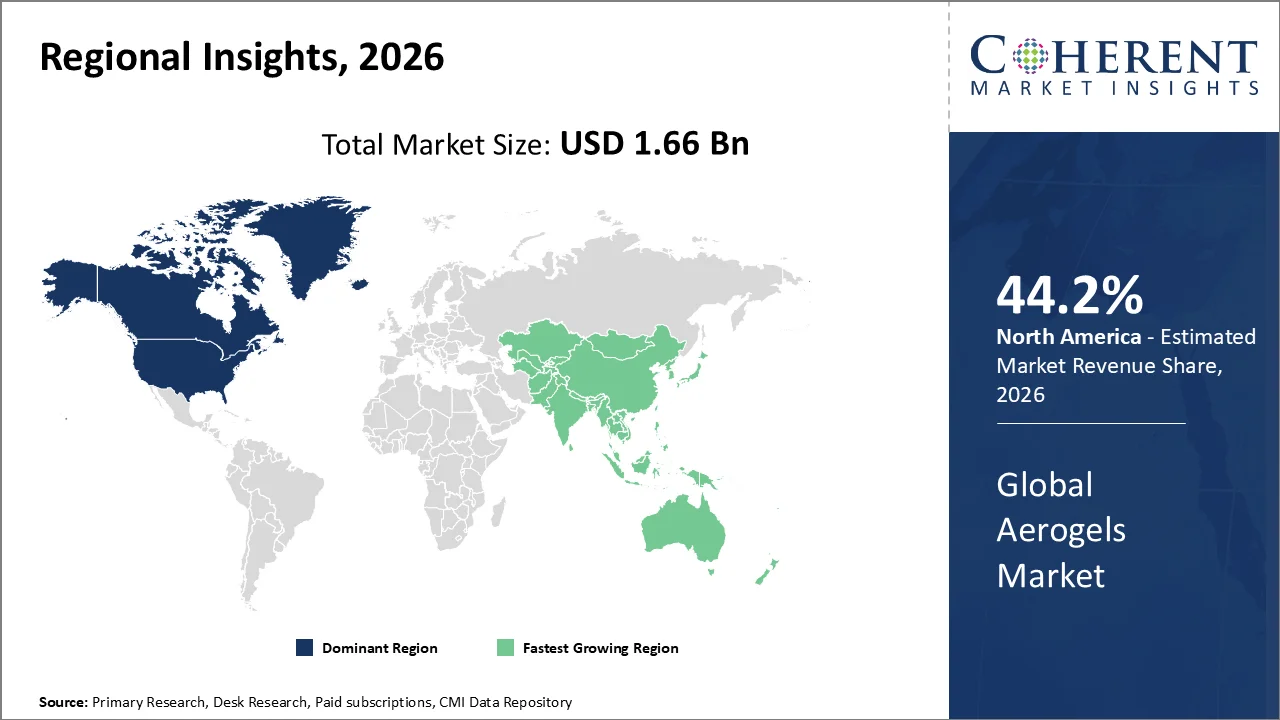
- North America is expected to dominate the global aerogels market with around 44.2% share in 2026. The region is also expected to dominate the market due to the presence of a large number of aerogel manufacturers, widespread utilization of advanced insulation in oil & gas infrastructure, increasing use of thermal barriers in electric vehicles, and continued adoption of high-performance insulation in construction and aerospace applications. As of January 1, 2026, the U.S. had 130 operable refineries with approximately 18.2 million barrels per calendar day of operable atmospheric distillation capacity, U.S. Energy Information Administration, June 29, 2026.
Market Drivers
Expansion of LNG and Cryogenic Infrastructure is Supporting Industrial Aerogel Demand
Increasing investment in LNG terminals, cryogenic pipelines, storage facilities and gas-processing infrastructure is driving the demand for aerogel insulation. LNG infrastructure works at very low temperatures and requires insulation systems that limit heat ingress, reduce condensation, ensure process efficiency and take up limited physical space. For these purposes, silica aerogel composites are of special interest due to their low thermal conductivity and capability to work in the extreme temperature environment.
In April 2026, the U.S. Energy Information Administration forecast U.S. LNG exports to increase by 1.9 billion cubic feet per day in 2026 to an average of 17.0 Bcf/d. The EIA also expects five LNG export projects to start operations or ramp up production by the end of 2027.
Rising Demand for Energy-Efficient Buildings is Accelerating Aerogel Adoption
The global aerogels market is gaining pace due to rising demand for high-performance thermal insulation in residential, commercial and industrial buildings. Aerogels exhibit very low thermal conductivity and much less insulation thickness, than many conventional materials. They are attractive for space-constrained building envelopes, facades, roofs and renovation projects.
According to the UN Environment Program (UNEP) reported on May 19, 2026, that buildings and construction are responsible for about 37% of global CO₂ emissions and investment in building energy efficiency needs to more than double to around USD 5.9 trillion by 2030 to stay on track with climate goals. This is creating demand for more sophisticated insulation technologies to reduce the need for heating and cooling energy.
Current Events and Their Impact on the Aerogels Market
Current Event | Description and its Impact |
U.S. Department of Energy Advances Aerogel-Based Super-Insulating Window Program (2026) |
|
China Implements Stricter Mandatory EV Battery Safety Standard GB 38031-2025 (2026) |
|
- Current Industry Events of 2026
- Market Size Estimation
- Regional Breakdown
- Competitive Landscape
- Customer Intelligence
- Segmental Analysis
- Pricing Analysis
- Key Market Drivers, Challenges & Future Trends
- Customized Insights Section
Segmental Insights
Why is Silica Aerogel Acquiring the Largest Share?
On the basis of type, the silica aerogel segment is projected to account for the largest Aerogels Market share of 69.2% in 2026. The segment’s growth is owing to its extremely low thermal conductivity, high porosity, low density, strong temperature resistance, and versatility across industrial insulation, EV batteries, construction, aerospace, and energy applications. Silica-based aerogels also have a comparatively mature manufacturing ecosystem, which supports their large-scale commercialization over emerging carbon, graphene, and alumina aerogels.
A silica aerogel composite that was thermally stable to 1,200°C and had a low thermal conductivity of 0.021–0.045 W/(m·K) from 600°C to 1,200°C was reported in Composites Part A: Applied Science and Manufacturing in March 2025.
In June 2026, Svenska Aerogel announced that Matrix Brands had launched Ozen in the UK, marking the first commercial application of Svenska Aerogel’s aerogel technology in oral care.
Why is the Blanket Form Acquiring the Largest Share?
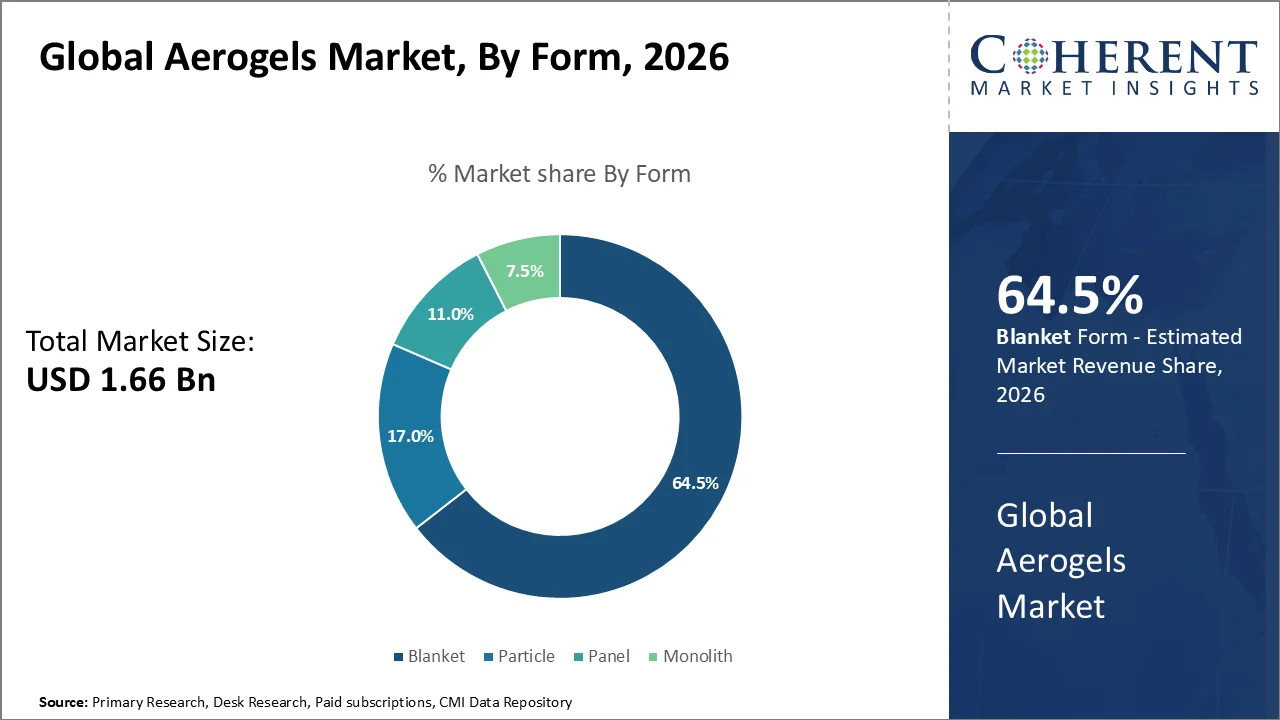
On the basis of form, the blanket segment is set to lead the Aerogels Market with 64.5% share in 2026. The segment’s growth is owing to its flexibility, ease of cutting and installation, ability to conform around complex equipment geometries, low thickness, and combination of thermal insulation with mechanical reinforcement. These characteristics make aerogel blankets particularly suitable for pipelines, vessels, batteries, industrial equipment, building envelopes, and cryogenic infrastructure.
Research published in the Journal of Energy Storage on April 1, 2026 evaluated silica aerogel blankets for controlling thermal runaway in lithium-ion batteries. The study found that while a 1 mm aerogel mat was insufficient to stop thermal-runaway propagation, all tested 3 mm aerogel blanket configurations effectively stopped propagation.
Why is Virgin Aerogel Acquiring the Largest Share?
On the basis of processing, the virgin aerogel segment is expected to dominate with 56.0% share in 2026. The segment’s growth is owing to the demand for directly manufactured aerogel materials that serve as the primary input for subsequent fabrication into blankets, panels, particles, coatings, and customized components. Advances in ambient-pressure drying are particularly important because they can simplify aerogel manufacturing and reduce dependence on more complex supercritical drying processes.
In July 2026, researchers demonstrated a new ambient-pressure drying route for directly produced silica aerogel. The resulting virgin aerogel achieved a density of just 0.134 g/cm³, thermal conductivity of 0.018 W/m·K, and specific surface area of 602.68 m²/g. An Al₂O₃-templated formulation further lowered density to 0.129 g/cm³ and thermal conductivity to 0.015 W/m·K.
Why is Thermal Insulation Acquiring the Largest Share?
On the basis of application, the thermal insulator segment is likely to account for the largest Aerogels Market share of 61.0% in 2026. The segment’s dominance is attributed to the ability of aerogels to impede conductive, convective and radiative heat transfer, while maintaining extremely low density and insulation thickness. Their wide operating temperature range allows applications in buildings, industrial equipment, batteries, cryogenic systems, aerospace platforms and high temperature processing facilities.
In June 2026, a Journal of Building Engineering paper presented an aerogel mortar with ultra-low thermal conductivity, achieving 0.0192 W/(m·K). The results indicated that the increase in aerogel content optimized the pore structure of the material and enhanced the thermal insulation performance significantly.
Why does Oil & Gas Hold the Largest Market Share?
On the basis of end user, the oil & gas segment is set to dominate the Aerogels Market with 59.0% share in 2026. The segment’s growth is owing to extensive insulation requirements across LNG liquefaction facilities, pipelines, refineries, petrochemical complexes, subsea systems, storage tanks, and high-temperature processing equipment. Aerogels are particularly suitable for these environments because they provide high thermal resistance with reduced insulation thickness while also supporting cryogenic and high-temperature applications.
In January 2026, a study published in the Journal of Non-Crystalline Solids evaluated CaO–SiO₂ aerogel insulation specifically for oil steam pipelines. The aerogel achieved thermal conductivity of only 0.02785 W/(m·K) and delivered 74.13% thermal-insulation efficiency at 400°C.
Aerogels Market Trends
- The growing development of carbon aerogels for energy-storage applications is broadening aerogel demand beyond thermal insulation into supercapacitors and advanced electrodes. In June 2026, researchers obtained a biomass-derived N/O-doped carbon aerogel with a specific capacitance of 249 F/g at 1 A/g and an energy density of 14.5 Wh/kg at 500 W/kg. The device kept 75.58% of initial capacitance after 5,000 cycles.
- Increasing use of aerogels as high-capacity adsorbents is strengthening their role in water treatment, oil-water separation, and environmental remediation. A study was published on 3 March 2026 which developed reduced-graphene-oxide/bacterial-cellulose aerogels that adsorb up to 116 g organic liquid per gram of aerogel. The material could also be reused for up to five adsorption cycles while maintaining a high proportion of its initial adsorption capacity.
- The emergence of multifunctional and wearable aerogel structures is shifting aerogels from passive insulation toward active thermal-management, sensing, and smart-material applications. Research published online in May 2026 developed an alginate/silk-fibroin aerogel-nanofiber wearable system in which one surface achieved 88% solar absorption for heating, while the opposite surface provided 82% solar reflectivity for cooling.
Regional Insights
North America Dominates Owing to Advanced Aerogel R&D and Commercialization Infrastructure
North America is likely to account for approximately 44.2% of the global Aerogels Market in 2026. The region’s dominance is supported by a mature aerogel manufacturing ecosystem, robust aerospace and energy R&D programs, commercialization of advanced thermal barriers, and increasing aerogel deployment in refrigeration, aerospace, batteries, and industrial insulation.
In 2026, the U.S. Oak Ridge National Laboratory (ORNL) said it has scaled up its ultra-clear silica aerogel manufacturing process to produce panels with surface areas about 20 times larger than its previous laboratory-scale technology. The project also developed full-scale refrigerator-door prototypes using silica aerogel and conducted real-world thermal-performance and energy-saving evaluations.
In March 2026, NASA presented its next-generation polymer aerogel research for cryogenic fuel systems. NASA highlighted aerogels for liquid-hydrogen and other cryogenic applications because they combine very low thermal conductivity with improved structural integrity and toughness, strengthening their potential across aerospace and advanced-energy infrastructure.
Asia Pacific Aerogels Market Trends
Asia Pacific is expected to witness the fastest growth in the Aerogels Market over the forecast period. The region’s growth is owing to rapid EV production, expansion of battery-safety requirements, increasing regional aerogel manufacturing capabilities, and growing adoption of aerogel thermal barriers by automotive manufacturers across China, South Korea, Japan, and India.
In July 2026, China's government reported that the country produced 7.438 million new-energy vehicles and sold 7.446 million units during the first half of 2026. Pure electric vehicles represented 67% of total NEV sales, creating a large addressable base for lightweight aerogel thermal barriers used to control cell-to-cell heat propagation in battery packs.
Commercialization of Advanced Aerogel Insulation and Energy-Storage Growth is Supporting the U.S. Aerogels Market
The U.S. Aerogels Market is witnessing strong development owing to the commercialization of transparent silica aerogels, expanding battery-energy-storage infrastructure, and increasing demand for lightweight, high-performance thermal-management materials across buildings, energy systems, and transportation.
According to the U.S. Energy Information Administration on August 7, 2026, U.S. utility-scale battery-storage capacity reached nearly 52 GW by June 2026, after 8.3 GW was added during the first six months of the year. Operators expect another 14 GW to be added during the second half of 2026.
In May 2026, Massachusetts-based AeroShield Materials announced that its transparent aerogel glazing became the first aerogel-coated glazing product listed in the International Glazing Database (IGDB).
China Aerogels Market Trends
China is expected to witness strong growth in the Aerogels Market owing to rapid expansion of domestic manufacturing capacity, declining production costs, increasing commercialization of aerogel insulation, and growing deployment across buildings, batteries, aerospace, petrochemicals, and industrial infrastructure.
In May 2026, China issued GB/T 47613-2026, Test Method of Thermal Protective Performance of Thermal Insulation Sheets, a new national standard specifically covering thermal-insulation sheets used between cells in power and energy-storage battery packs.
Who are the Major Companies in Aerogels Industry
Some of the major key players in Aerogels Market are Aspen Aerogels Inc. (U.S.), Cabot Corporation (U.S.), Aerogel Technologies LLC (U.S.), Nano High-Tech Co. Ltd. (China), Guangdong Alison Hi-Tech Co. Ltd. (China), Active Aerogels (Portugal), Enersens SAS (France), JIOS Aerogel Corporation (South Korea), and BASF SE (Germany).
Key News
- In August 2026, Aspen Aerogels announced that its PyroThin aerogel-based thermal barrier had been selected for two next-generation Jaguar Land Rover vehicle architectures, covering multiple JLR brands. Production under the programs is expected to commence in 2027.
- In June 2026, Enersens announced the presentation of its SKOGAR aerogel thermal-barrier portfolio at Battery Show Europe 2026. The company highlighted a new UHT grade capable of withstanding flame exposure of up to 1,700°C, compared with up to 1,300°C for SKOGAR HT.
Market Report Scope
Aerogels Market Report Coverage
| Report Coverage | Details | ||
|---|---|---|---|
| Base Year: | 2025 | Market Size in 2026: | USD 1.66 Bn |
| Historical Data for: | 2020 To 2024 | Forecast Period: | 2026 To 2033 |
| Forecast Period 2026 to 2033 CAGR: | 9.9% | 2033 Value Projection: | USD 3.21 Bn |
| Geographies covered: |
| ||
| Segments covered: |
| ||
| Companies covered: | Aspen Aerogels Inc., Cabot Corporation, Aerogel Technologies LLC., Nano High-Tech Co. Ltd., Guangdong Alison Hi-Tech Co. Ltd., Active Aerogels, Enersens SAS, JIOS Aerogel Corporation, and BASF SE. | ||
| Growth Drivers: |
| ||
| Restraints & Challenges: |
| ||
Analyst Opinion
- The Aerogels Market is transitioning from specialty insulation toward scalable advanced-material manufacturing, with production cost reduction becoming critical for wider commercialization. The EU-funded EN.MOTION project, renewed in 2025, was an overall investment of around €3.47 million (€2.43 million EU funding) to industrialize continuous manufacturing of ultra-thin silica aerogel blankets.
- Aerogels are developing an important high-value commercialization pathway through government-backed aerospace research. The EU-funded ISBA project, which ended on 30 April 2026, was granted approximately €3.0 million to develop aerogel and xerogel insulation technologies for space applications. The program is aimed at thermal environments ranging from cryogenic temperatures near -196C to temperatures above 800C while exploring aerogels for a variety of satellite and launch vehicle applications.
- The long-term outlook is also strengthening as next-generation polymer and hybrid aerogels move into specialized aerospace and safety applications. On September 25, 2025, NASA awarded USD 149,880 under its SBIR program to Material Answers LLC to develop polybenzoxazine aerogels for insulation in environments containing up to 38% oxygen. The project targets ultra-low flammability, low density, and high thermal-insulation performance for exploration habitats, spacecraft cabins, and vehicles.
Speak to the analyst
Want personalized insights?
Take the findings above to one of our principal consultants, or have the report rebuilt around the segments, geographies and competitors you actually track.
Market Segmentation
- By Type (Revenue, USD Bn, 2021-2033)
- Silica
- Polymer
- Carbon
- Graphene
- Organic
- Alumina
- Others
- By Form (Revenue, USD Bn, 2021-2033)
- Blanket
- Particle
- Panel
- Monolith
- By Processing (Revenue, USD Bn, 2021-2033)
- Virgin Aerogel
- Fabricated Aerogel
- By Application (Revenue, USD Bn, 2021-2033)
- Adsorption agent
- Catalyst
- Thickening agent
- Thermal Insulator
- To trap space dust
- Water purification
- Others
- By End User (Revenue, USD Bn, 2021-2033)
- Oil & Gas
- Construction
- Automotive
- Marine
- Sports
- Aerospace
- Others
- By Region (Revenue, USD Bn, 2021-2033)
- North America
- U.S.
- Canada
- Latin America
- Brazil
- Mexico
- Argentina
- Rest of Latin America
- Europe
- Germany
- U.K.
- France
- Italy
- Spain
- Russia
- Rest of Europe
- Asia Pacific
- China
- India
- Japan
- Australia
- South Korea
- ASEAN
- Rest of Asia Pacific
- Middle East
- GCC
- Israel
- Rest of Middle East
- Africa
- South Africa
- Central Africa
- North Africa
- North America
Sources
Primary Research Interviews
- Aerogel manufacturers and material technology developers
- Silica, polymer, carbon, and composite aerogel specialists
- Thermal insulation engineers and material scientists
- R&D heads from advanced materials and specialty chemical companies
- Oil & gas insulation and pipeline engineering professionals
- EV battery thermal management and automotive material experts
- Construction insulation and building-envelope specialists
- Aerospace and cryogenic insulation engineers
- Procurement managers from oil & gas, automotive, construction, and aerospace companies
- Key opinion leaders (KOLs) in aerogels, nanomaterials, and thermal management
Databases
- U.S. Department of Energy (DOE)
- U.S. Energy Information Administration (EIA)
- European Commission – CORDIS
- International Energy Agency (IEA)
- National Aeronautics and Space Administration (NASA)
- National Institute of Standards and Technology (NIST)
- World Bank
- Organisation for Economic Co-operation and Development (OECD)
Magazines
- Materials Today
- Chemical & Engineering News
- Composites World
- Chemical Engineering
- Hydrocarbon Processing
- LNG Industry
- Automotive World
Journals
- Journal of Non-Crystalline Solids
- Journal of Building Engineering
- Construction and Building Materials
- Journal of Energy Storage
- Advanced Materials
- ACS Applied Materials & Interfaces
- Composites Part A: Applied Science and Manufacturing
- Energy and Buildings
- Materials & Design
Newspapers
- Reuters
- Financial Times
- The Wall Street Journal
- The Economic Times
- Nikkei Asia
- South China Morning Post
Associations & Standards Organizations
- ASTM International
- American Society of Mechanical Engineers (ASME)
- American Institute of Chemical Engineers (AIChE
- American Chemistry Council (ACC)
- Society of Automotive Engineers (SAE International)
- International Institute of Refrigeration (IIR)
- European Industrial Insulation Foundation (EiiF)
- International Association of Oil & Gas Producers (IOGP)
Public Domain Sources
- Company annual reports, investor presentations, and SEC filings
- Company product launches, press releases, and technical datasheets
- Government energy-efficiency and advanced-material research publications
- University and national laboratory aerogel research publications
- Patent databases such as WIPO, USPTO, and Google Patents
- Building energy-efficiency regulations and insulation standards
- EV battery safety regulations and thermal-runaway testing standards
- Publicly available LNG, refinery, construction, and battery-industry statistics
- Regulatory and standards publications related to thermal insulation, fire safety, and advanced materials
Proprietary Elements
- CMI Data Analytics Tool
- Proprietary CMI Existing Repository of Information for the Last 10 Years
Get access to 250+ pages report
Every segment, forecast, competitor profile and data table behind the analysis above — available for instant download.
- ESOMAR Member
- ISO 9001:2015 Certified
- D-U-N-S Registered
- GDPR & CCPA Compliant
Missing comfort of reading report in your local language? Find your preferred language:
Transform your Strategy with Exclusive Trending Reports
Frequently Asked Questions
The Aerogels Market is expected to reach approximately USD 3.21 Bn by 2033, increasing from USD 1.66 Bn in 2026.
Major players operating in the global Aerogels Market include Aspen Aerogels Inc., Cabot Corporation, Aerogel Technologies LLC., Nano High-Tech Co. Ltd., Guangdong Alison Hi-Tech Co. Ltd., Active Aerogels, Enersens SAS, JIOS Aerogel Corporation, and BASF SE.
The high production and processing cost, along with the fragility and low mechanical strength of certain aerogel materials, are among the key factors hampering market growth.
The increasing adoption of aerogels in oil & gas insulation applications and the rising use of aerogels in EV battery thermal management are major factors driving market growth. Demand is also supported by energy-efficient buildings, LNG infrastructure, and advanced thermal-insulation applications.
The Aerogels Market is anticipated to grow at a CAGR of approximately 9.9% between 2026 and 2033.
Among regions, North America is expected to dominate the global Aerogels Market with approximately 44.2% share in 2026. The region benefits from an established aerogel manufacturing ecosystem, strong aerospace and energy research, and increasing adoption across batteries and industrial insulation.
Aerogels are highly porous, lightweight materials primarily used where very low heat transfer, low density, and reduced insulation thickness are required. Their properties make them suitable for thermal insulation, adsorption, catalysis, water purification, and other specialized applications.