

3d Concrete Printing Market Size and Forecast – 2026 to 2033
The 3d Concrete Printing Market is anticipated to grow at a CAGR of 46.2% with USD 1,032.8 Bn in 2026 and is expected to reach USD 15,962.6 Bn in 2033. Builders are adopting 3D concrete printing to reduce construction costs, and lower labor requirements while meeting growing demand for affordable and sustainable construction. The construction industry faces a labor shortage of approximately 499,000 workers, with 88%–94% of firms reporting difficulties in hiring qualified craft professionals.
Key Takeaways
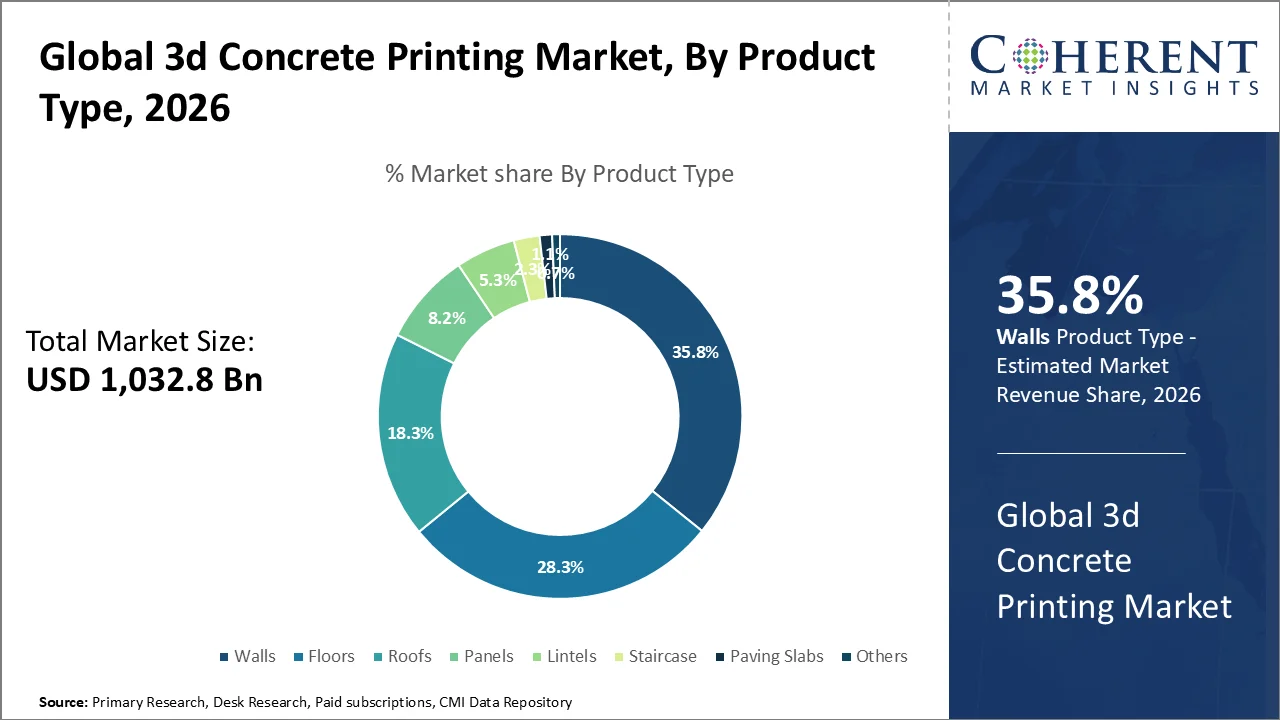
- Walls hold the largest market share of 35.8% in 2026 owing to its lower construction labor requirements.
- Ready-Mix Concrete expected to hold largest market share of 37.9% in 2026 owing to its growing adoption of 3d-printed construction. Using standard ready-mix concrete (RMC) in 3D concrete printing can reduce material costs compared with specialized 3D-printing concrete mixes.
- Design Software acquired the prominent market share of 43.8% in 2026 owing to the growing adoption of digital construction.
- Residential captures the largest market share of 39.9% in 2026 owing to its growing demand for affordable housing. Residential construction spending was estimated at a seasonally adjusted annual rate of USD 877.1 Bn in June.
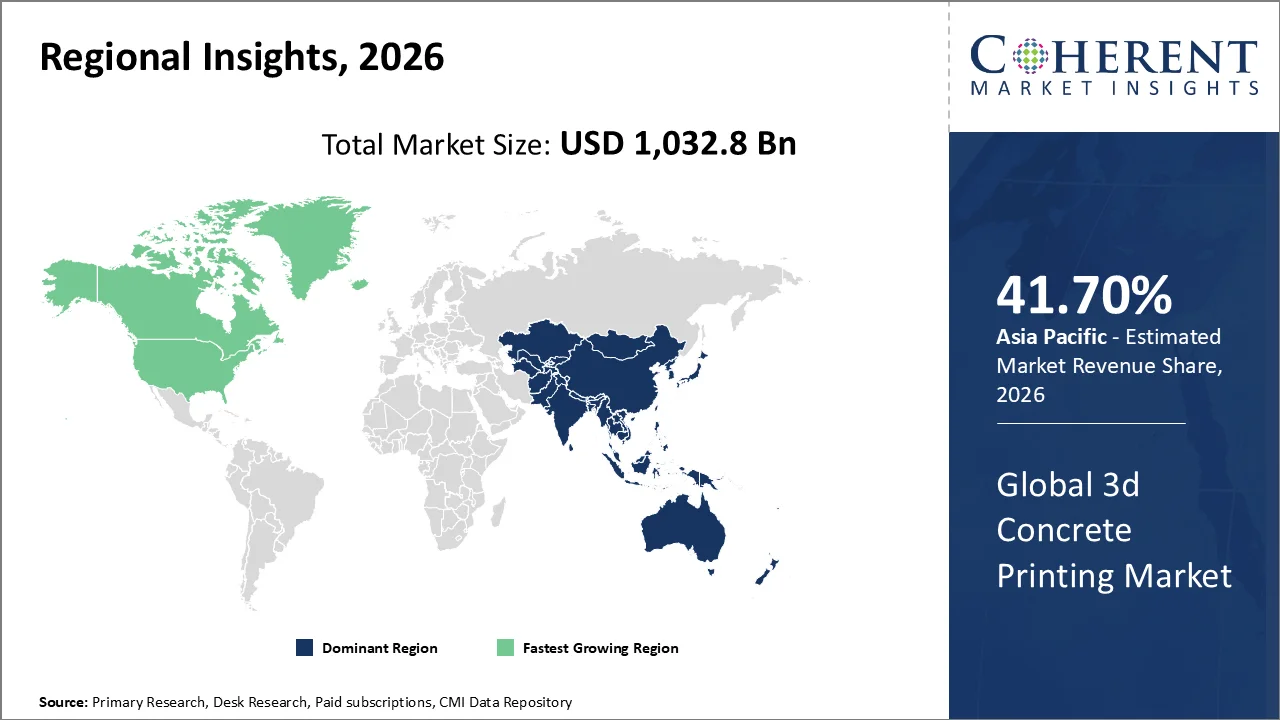
- Asia Pacific is expected to acquire the dominant share of 41.7% in 2026 owing to the rapid urbanization and infrastructure development. India’s urban population is projected to reach 600 million, or 40% of the total population, by 2036, up from 31% in 2011, with urban areas expected to contribute nearly 70% of GDP. (Source: World Bank)
Current Events and Their Impact on the 3d Concrete Printing Market
Current Event | Description and its Impact |
Dubai regulates 3D printing in construction and targets 25% of new buildings by 2030 |
|
Saudi Arabia updates its building-code framework for concrete construction |
|
Segmental Insights
- Current Industry Events of 2026
- Market Size Estimation
- Regional Breakdown
- Competitive Landscape
- Customer Intelligence
- Segmental Analysis
- Pricing Analysis
- Key Market Drivers, Challenges & Future Trends
- Customized Insights Section
Why is Walls Acquiring the Largest Market Share?
Walls hold the largest market share of 35.8% in 2026. The walls segment in the 3D Concrete Printing Market is gaining momentum as builders seek faster, cost-effective, and automated construction solutions. 3D printing allows construction companies to build walls with fewer workers, less material waste, and limited use of conventional formwork. Rising housing demand, labor shortages, and increasing construction costs are encouraging residential and commercial developers to adopt the technology. Residential construction costs increased 0.4% in the fourth quarter of 2026, following a 0.6% rise in the previous quarter. Furthermore, advances in printable concrete, robotic printing systems, and digital design tools are improving construction precision, customization, and productivity, supporting continued segment growth. For instance, in August 2026, Matthäi Schlüsselfertigbau, a subsidiary of Germany’s major construction firm Matthäi, has launched its own construction 3D printing division. Using COBOD’s BOD2 printer, the company completed the printing in 105 hours starting May 21, 2025. PERI 3D Construction used Holcim’s TectorPrint material for the walls, while workers built the foundation, floors, and roof using conventional methods.
Ready-Mix Concrete expected to hold largest market share
Ready-Mix Concrete expected to hold largest market share of 37.9% in 2026 owing to its improved quality and consistency. The ready-mix concrete segment in the 3D Concrete Printing Market is gaining traction as construction companies adopt automated methods and demand consistent, high-quality printable concrete. Ready-mix concrete accelerates construction by minimizing on-site mixing and enabling precise control over material properties. Growing residential and infrastructure development, labor shortages, and sustainability goals are further driving its adoption. In addition, manufacturers are developing specialized concrete formulations with enhanced pumpability, extrudability, buildability, and strength, supporting wider use of ready-mix concrete in 3D printing applications. For instance, Titan America launched xForm3D, a U.S.-patented 3D-printable concrete technology for automated construction. Its three products—xForm3D Standard, Marine, and RMX—target general construction, marine applications, and ready-mix delivery.
Design Software acquired the prominent market share
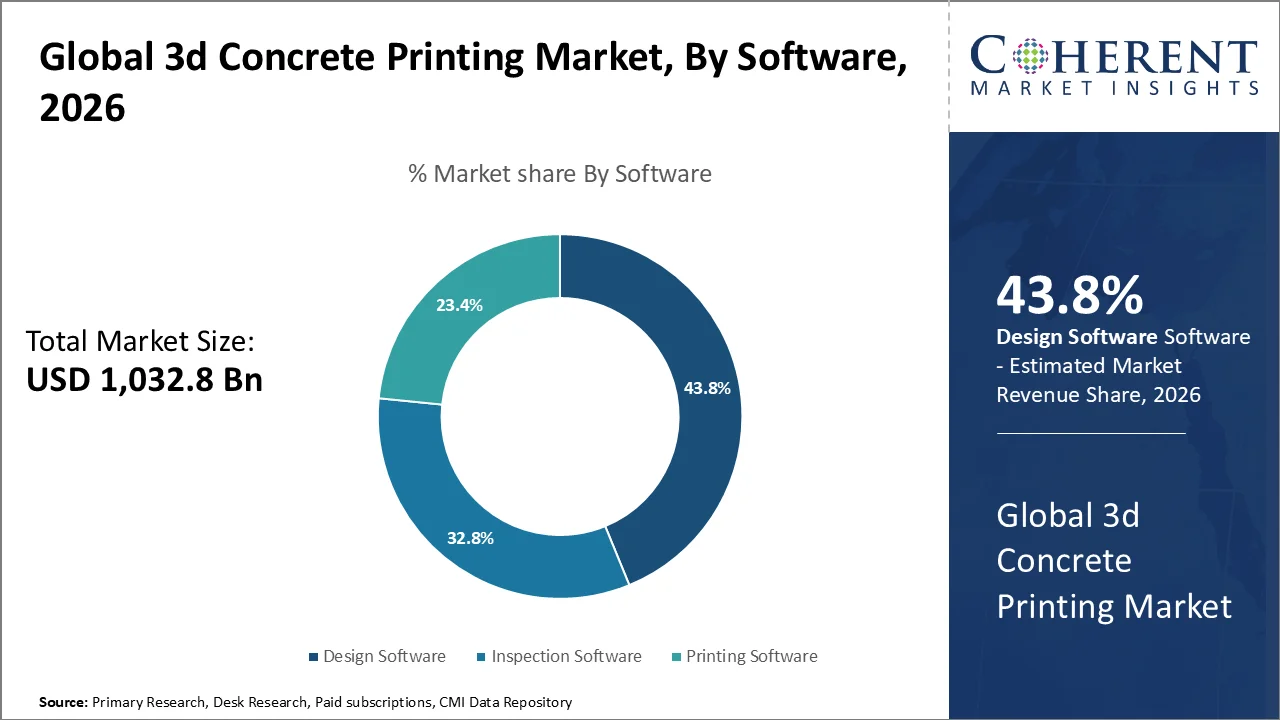
Design Software acquired the prominent market share of 43.8% in 2026 owing to the increasing demand for automated construction. The design software segment in the 3D Concrete Printing Market is gaining momentum as construction companies adopt digital construction, BIM, CAD, and automated printing technologies. Architects and engineers use specialized software to develop complex geometries, optimize material consumption, generate accurate printing paths, and enhance construction precision. Growing demand for customized structures, material efficiency, and faster project completion further drives adoption. Software integration with robotic printing systems and real-time monitoring tools enables greater design flexibility, streamlines workflows, and improves overall construction productivity. For instance, ABB Robotics and Simpliforge Creations are partnering to advance 3D printing technology for India’s construction sector, helping companies build structures faster, safer, and more sustainably.
Which End User segment dominates the market?
Residential captures the largest market share of 39.9% in 2026. The residential segment in the 3D Concrete Printing Market is gaining traction as developers seek affordable, faster, and more efficient construction solutions. Developers deploy 3D concrete printing to reduce labor needs, limit material waste, and accelerate homebuilding. Rapid urbanization, housing shortages, and rising construction costs further drive adoption. Advances in printable concrete, robotics, and digital design improve construction efficiency and enable greater customization. Increasing investment in 3D-printed housing and growing demand for sustainable construction continue to expand residential applications.
3d Concrete Printing Market Trends
- Growing adoption of automated construction technologies is accelerating interest in 3D concrete printing as a response to construction labor constraints. In the U.S., Associated Builders and Contractors estimated that the construction industry would need to attract approximately 349,000 net new workers in 2026 to meet projected demand, followed by 456,000 workers in 2027. This labor requirement is encouraging interest in technologies that can automate repetitive construction activities, although 3D printing does not eliminate the need for skilled workers across the entire construction process.
- Government-backed affordable-housing initiatives are creating real-world applications for 3D concrete printing. In October 2025, India’s Ministry of Rural Development inaugurated the country’s first 3D concrete-printed rural house under PMAY-G at CSIR-CBRI in Roorkee. The government also called for the piloting of 100 cost-effective 3D-printed houses under PMAY-G. This provides a direct example of 3D concrete printing being evaluated for affordable and rural housing applications.
- Advancements in printable concrete materials and structural performance are becoming a major area of development. In July 2026, CSIR-SERC and Merlin Automation Solutions launched a collaborative project to develop specialized concrete mixes for 3D printing and conduct seismic evaluations of G+1 3D-printed concrete buildings. The project is intended to strengthen the technical basis for wider commercialization of 3D concrete printing in India.
Regional Insights
Asia Pacific dominates owing to growing investment and demonstration projects
Asia Pacific is expected to acquire the dominant share of 41.7% in 2026. The Asia Pacific 3D Concrete Printing Market is gaining momentum as rapid urbanization, rising housing demand, and infrastructure development increase the need for efficient construction solutions. Construction companies across the region are adopting automated technologies to address labor shortages, control rising costs, and accelerate project completion. Governments are promoting advanced construction methods, while investments in sustainable building, robotics, and printable concrete strengthen adoption. Digitalization, local manufacturing capabilities, and growing 3D-printed housing projects further expand opportunities across residential, commercial, and infrastructure applications. In December 2025, CEPT University partnered with Chennai-based Tvasta Manufacturing Solutions to establish an advanced additive manufacturing workshop on its Ahmedabad campus, strengthening research in automated concrete construction.
North America 3d Concrete Printing Market Trends
North American construction companies are driving the 3D concrete printing market by adopting automated, cost-efficient construction methods to address labor shortages and sustainability goals. Advanced 3D printing technologies enable builders to reduce material waste, shorten construction timelines, lower labor requirements, and achieve greater design flexibility. Infrastructure modernization, residential development, and commercial construction projects further fuel adoption. Moreover, companies and research institutions are expanding research and development efforts, while government initiatives and growing demand for low-carbon construction encourage contractors and developers to integrate 3D concrete printing solutions. For instance, in March 2026, ICON launched its Titan robotic construction platform enabling builders to directly acquire its integrated 3D printing system.
United States 3d Concrete Printing Market Trends
The United States 3D concrete printing market is expanding as construction companies seek automated, cost-efficient methods and address labor shortages. Builders are increasingly adopting sustainable practices and advanced technologies, such as robotic printing systems, to accelerate project completion and minimize material waste. Government agencies and private investors are also funding infrastructure development and affordable housing projects, creating new opportunities for 3D concrete printing. Meanwhile, companies are strengthening research and development, advancing printing technologies, and introducing innovative solutions that encourage broader adoption across the U.S. construction industry.
Japan 3d Concrete Printing Market Trends
Japan’s 3D concrete printing market benefits from labor shortages, rising construction costs, and growing demand for faster building methods. Construction companies increasingly adopt automation and robotic technologies to address the country’s aging workforce and reduce reliance on manual labor. Developers also use 3D printing to support disaster-resilient and sustainable infrastructure by optimizing material use and creating customized structures. Government initiatives promoting construction innovation, investments in smart infrastructure, and collaboration among technology firms, contractors, and research institutions further accelerate market development. In November 2025, the Tokyo Metropolitan Government selected four groups to manage public-private funds totaling approximately ¥20 billion ($130 million) to support affordable rental housing below prevailing market rates.
Who are the Major Companies in 3d Concrete Printing Industry
Some of the major key players in 3d Concrete Printing are WinSun Global, Universe Architecture, Sika, Carilliom Plc., Fosters + Partners, Skanska, DUS Architecture, and LafargeHolcim.
Key News
- In June 2026, Australian construction technology company Luyten launched ASCEND, a tower crane-mounted 3D concrete printing system designed to build structures up to 328 feet tall, expanding additive construction into high-rise projects.
Market Report Scope
3d Concrete Printing Market Report Coverage
| Report Coverage | Details | ||
|---|---|---|---|
| Base Year: | 2025 | Market Size in 2026: | USD 1,032.8 Bn |
| Historical Data for: | 2020 To 2024 | Forecast Period: | 2026 To 2033 |
| Forecast Period 2026 to 2033 CAGR: | 46.2% | 2033 Value Projection: | USD 15,962.6 Bn |
| Geographies covered: |
| ||
| Segments covered: |
| ||
| Companies covered: | WinSun Global, Universe Architecture, Sika, Carilliom Plc., Fosters + Partners, Skanska, DUS Architecture, and LafargeHolcim. | ||
Analyst Opinion
- 3D concrete printing is moving from a construction experiment to a practical response to Japan’s structural labor shortage. Japan’s construction industry faces a workforce that is aging rapidly, while the number of construction workers has fallen substantially over the long term. In our view, this makes automation-led construction technologies increasingly difficult for contractors to ignore. 3D concrete printing can automate labor-intensive processes such as formwork and material placement, allowing companies to address productivity constraints without relying solely on additional workers.
- Construction productivity is the strongest commercial argument for 3D concrete printing. Conventional construction often requires extensive formwork, multiple trades, and repeated manual operations, whereas robotic concrete printing can produce complex structural components directly from digital designs. Projects such as Japan’s 3D-printed houses demonstrate that companies can fabricate building components with significantly fewer workers and substantially shorter construction cycles. We believe this productivity advantage will become increasingly important as Japan accelerates housing, infrastructure, and disaster-recovery construction.
- Sustainability will strengthen adoption, but we view material efficiency—not environmental messaging—as the more compelling business case. 3D concrete printing places material only where the digital design requires it, potentially reducing unnecessary concrete consumption associated with conventional formwork. Japanese construction companies are also experimenting with low-carbon and recycled concrete mixtures for additive manufacturing. This combination of automated production, optimized material placement, and alternative cementitious materials positions 3D printing as a credible tool for reducing construction waste while meeting Japan’s increasingly demanding environmental requirements.
- Our view is that Japan will not adopt 3D concrete printing simply because it is technologically innovative; adoption will depend on whether contractors can prove lower labor requirements, faster completion, reliable structural performance, and regulatory compliance. The strongest opportunities therefore lie with companies that integrate robotic printing, digital design, specialized concrete formulations, and automated construction workflows rather than selling printers alone. In our assessment, Japan’s labor constraints make this integrated automation model significantly more commercially compelling than 3D printing as a standalone construction technology.
Speak to the analyst
Want personalized insights?
Take the findings above to one of our principal consultants, or have the report rebuilt around the segments, geographies and competitors you actually track.
Market Segmentation
- By Product Type (Revenue, USD Bn, 2021-2033)
- Walls
- Floors
- Roofs
- Panels
- Lintels
- Staircase
- Paving Slabs
- Others
- By Concrete Type (Revenue, USD Bn, 2021-2033)
- Ready-Mix Concrete
- Shotcrete
- High-Density Concrete
- Precast Concrete
- Lightweight Concrete
- Limecrete
- Stamped Concrete
- Others
- By Software (Revenue, USD Bn, 2021-2033)
- Design Software
- Inspection Software
- Printing Software
- By End-Use Industry (Revenue, USD Bn, 2021-2033)
- Residential
- Commercial
- Architectural
- Industrial Construction
- Sports
- Education
- Healthcare
- Others
- By Region (Revenue, USD Bn, 2021-2033)
- North America
- U.S.
- Canada
- Latin America
- Brazil
- Mexico
- Argentina
- Rest of Latin America
- Europe
- Germany
- U.K.
- France
- Italy
- Spain
- Russia
- Rest of Europe
- Asia Pacific
- China
- India
- Japan
- Australia
- South Korea
- ASEAN
- Rest of Asia Pacific
- Middle East
- GCC
- Israel
- Rest of Middle East
- Africa
- South Africa
- Central Africa
- North Africa
- North America
Sources
Primary Research interviews
- 3D concrete printing technology developers and equipment manufacturers
- Ready-mix concrete and construction material manufacturers
- Concrete admixture and specialty chemical manufacturers
- Construction companies and general contractors
- 3D printing service providers and construction technology firms
- Architects, structural engineers, and construction consultants
- Infrastructure developers and real estate developers
- Government authorities and public infrastructure agencies
- Academic researchers and university experts specializing in construction automation, additive manufacturing, and concrete technology
- Project managers and technical experts involved in 3D-printed construction projects
- Raw material suppliers, including cement, aggregates, admixtures, and specialty concrete suppliers
- Distributors and technology integrators serving the construction 3D printing industry
Databases
- United Nations Comtrade Database
- World Bank Open Data
- OECD Data
- Eurostat Database
- U.S. Census Bureau
- U.S. Bureau of Labor Statistics
- U.S. Bureau of Economic Analysis
- U.S. International Trade Commission DataWeb
- International Trade Centre Trade Map
- Federal Reserve Economic Data (FRED)
- National statistical databases of major construction and manufacturing markets
- Government construction expenditure and infrastructure databases
- Patent and intellectual-property databases
- Public building permit and construction activity databases
Magazines
- Construction Dive
- Engineering News-Record (ENR)
- Concrete Products
- Concrete Construction
- World Cement
- Global Cement
- International Cement Review
- Additive Manufacturing Media
- 3D Printing Industry
- 3DPrint.com
- Construction Technology Review
- Civil Engineering Magazine
Journals
- Automation in Construction
- Cement and Concrete Research
- Cement and Concrete Composites
- Construction and Building Materials
- Additive Manufacturing
- Materials & Design
- Journal of Building Engineering
- Journal of Materials in Civil Engineering
- Advances in Civil Engineering Materials
- International Journal of Concrete Structures and Materials
- Case Studies in Construction Materials
- Buildings
- Materials
- Journal of Cleaner Production
- Structural Concrete
Newspapers
- The New York Times
- The Guardian
- Financial Times
- The Wall Street Journal
- Reuters
- Bloomberg
- The Economic Times
- The Times of India
- The Hindu
- Business Standard
- The Indian Express
- Nikkei Asia
Associations
- American Concrete Institute (ACI)
- American Society of Civil Engineers (ASCE)
- ASTM International
- International Organization for Standardization (ISO)
- International Federation for Structural Concrete (fib)
- National Ready Mixed Concrete Association (NRMCA)
- Portland Cement Association (PCA)
- Global Cement and Concrete Association (GCCA)
- European Ready Mixed Concrete Organization (ERMCO)
- American Society of Mechanical Engineers (ASME)
- Association for Computing Machinery (ACM)
- International Society for Additive Manufacturing and 3D Printing
- International Code Council (ICC)
- Institution of Civil Engineers (ICE)
- Indian Concrete Institute (ICI)
- Bureau of Indian Standards (BIS)
Public Domain sources
- U.S. Census Bureau construction and manufacturing statistics
- U.S. Department of Energy publications and building technology data
- U.S. Department of Transportation infrastructure statistics
- U.S. Department of Housing and Urban Development datasets
- European Commission construction and manufacturing statistics
- Eurostat construction activity and industrial production data
- United Nations industrial and trade statistics
- World Bank infrastructure and economic indicators
- OECD construction and industrial statistics
- International Labour Organization employment and construction statistics
- National government infrastructure investment reports
- Public procurement and tender databases
- Building permit and housing construction datasets
- Government publications on additive manufacturing and construction technology
- Patent databases, including USPTO, EPO, and WIPO
- Academic publications and institutional repositories
- University research centers and publicly available technical reports
- Open-access conference proceedings and standards-related publications
Proprietary Elements
- CMI Data Analytics Tool
- Proprietary CMI Existing Repository of information for last 10 years
Get access to 250+ pages report
Every segment, forecast, competitor profile and data table behind the analysis above — available for instant download.
- ESOMAR Member
- ISO 9001:2015 Certified
- D-U-N-S Registered
- GDPR & CCPA Compliant
Missing comfort of reading report in your local language? Find your preferred language:
Transform your Strategy with Exclusive Trending Reports
Frequently Asked Questions
The 3d Concrete Printing Market is anticipated to grow at a CAGR of 46.2% with USD 1,032.8 Bn in 2026 and is expected to reach USD 15,962.6 Bn in 2033.
3D concrete printing is an automated construction method that deposits concrete or specialized cementitious materials layer by layer according to a digital design, reducing the need for conventional formwork and manual construction processes.
Key drivers include construction labor shortages, demand for faster project completion, automation, material optimization, and increasing interest in sustainable construction methods.
3D concrete printing can automate several labor-intensive construction activities, particularly material placement and formwork-related processes.
Major applications include residential buildings, commercial structures, infrastructure components, walls, bridges, disaster-relief housing, architectural elements, and customized construction components.
The technology can reduce material waste by depositing concrete only where required and can enable lightweight or optimized structural designs.