

Transparent Ceramics Market Size and Forecast — 2026 - 2033
The Global Transparent Ceramics Market size is estimated to be valued at USD 1.8 billion in 2026 and is expected to reach USD 3.5 billion by 2033, exhibiting a compound annual growth rate (CAGR) of 9.5% from 2026 to 2033.
Overview
The Transparent Ceramics market encompasses a range of advanced materials used for optical, structural, and protective applications. Key product types include alumina-based ceramics, which dominate due to their high mechanical strength and optical clarity, and yttrium aluminum garnet (YAG) ceramics, valued for laser and photonics applications. Spinel and magnesium aluminate ceramics are increasingly adopted for armor, infrared windows, and sensor protection because of their exceptional thermal and chemical stability. Other emerging materials, such as sapphire and zirconia ceramics, offer high hardness and scratch resistance, enabling use in electronics, defense, and aerospace sectors. Overall, product innovation and material diversification drive market growth.
Key Takeaways
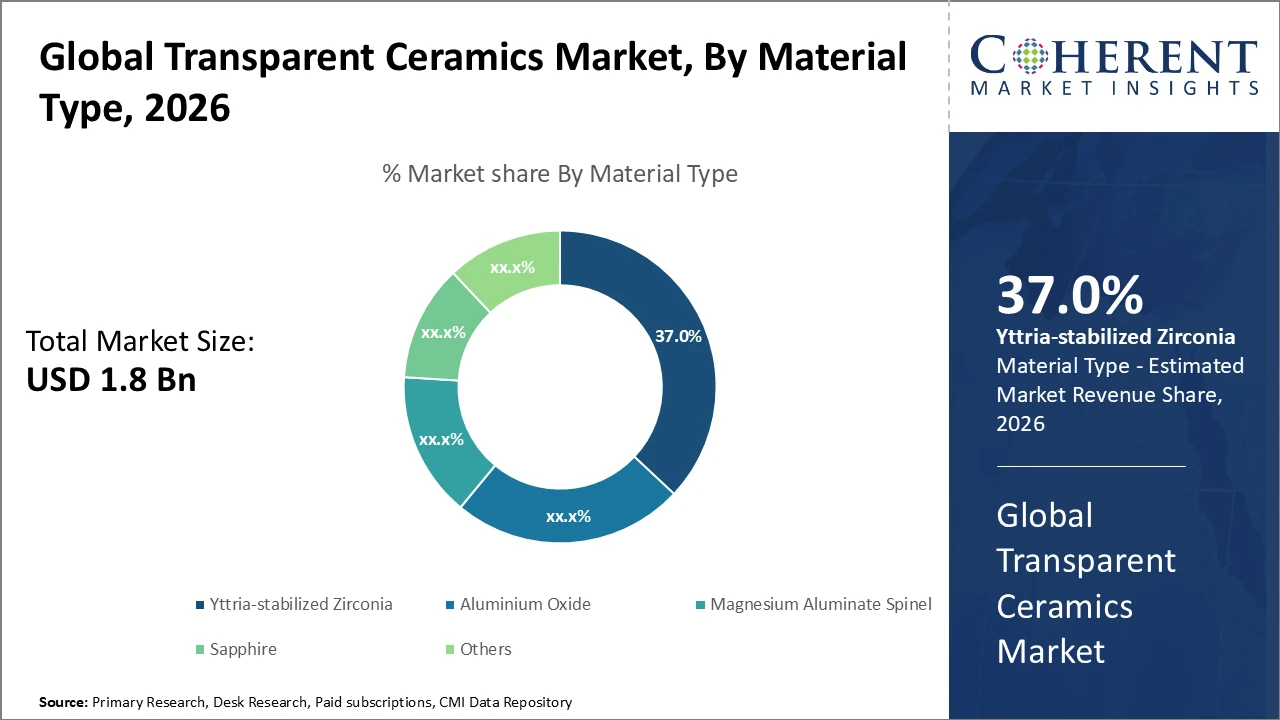
• Yttria-Stabilized Zirconia leads the market with a 37% share due to its combination of optical transparency and mechanical strength. Magnesium aluminate spinel is the fastest-growing subsegment, driven by applications in automotive and electronics.
• Defense & Security dominates market revenue, supported by consistent government expenditure, while the Electronics & Optics subsegment grows rapidly because of rising consumer electronics demand.
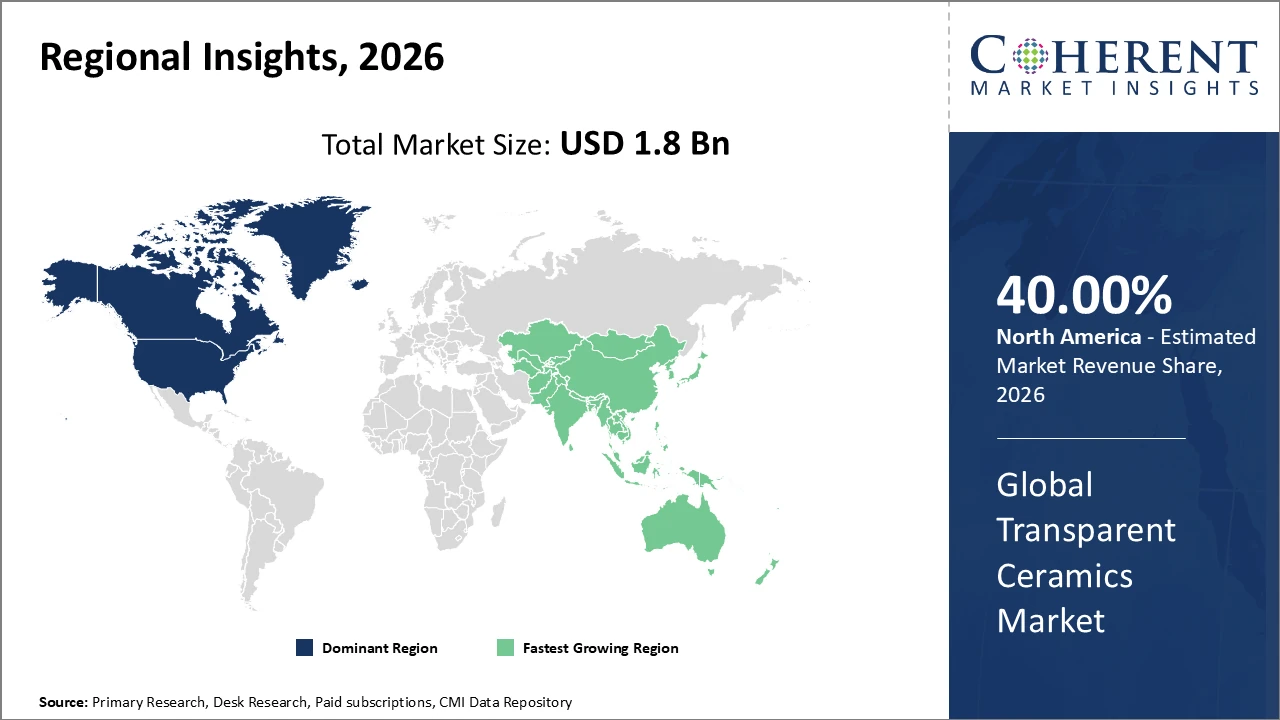
• North America holds the largest market share at over 40%, bolstered by a strong defense sector and technological innovation. Asia Pacific shows the fastest growth with a CAGR above 11%, fueled by expanding electronics manufacturing and supportive government initiatives.
Transparent Ceramics Market Segmentation Analysis
Transparent Ceramics Market Insights, By Material Type
Yttria-Stabilized Zirconia (YSZ) dominates the transparent ceramics market with a 37% share, owing to its unique combination of thermal stability, optical clarity, and mechanical strength, which makes it ideal for applications ranging from defense armor to electronic lenses. Magnesium aluminate spinel is the fastest-growing subsegment, gaining traction in automotive and electronics sectors due to its scratch resistance and chemical inertness. Aluminum oxide remains widely used for protective windows, while sapphire is primarily adopted for high-durability smartphone displays. The “Others” category includes experimental and composite ceramics, which, although niche, are steadily expanding into specialized applications across defense, aerospace, and optics.
Transparent Ceramics Market Insights, By Application
Defense & Security dominates the transparent ceramics market, supported by steady government contracts and the demand for lightweight, bulletproof materials in military applications. Electronics & Optics is the fastest-growing segment, driven by the rise of flexible and foldable displays and advanced camera systems requiring durable transparent ceramics. The automotive sector is expanding its use, integrating transparent ceramics into heads-up displays and protective windows for electric and autonomous vehicles. Healthcare applications, including bio-ceramic implants and optical medical devices, are emerging markets with significant growth potential. The “Others” category covers specialized uses such as laser technologies and aerospace components.
Transparent Ceramics Market Insights, By Manufacturing Process
Pressureless sintering commands the largest market share in transparent ceramics due to its cost-effectiveness and scalability, making it ideal for mass-producing electronic components and protective panels. Hot pressing is also widely used, particularly for applications requiring higher density and optical clarity, such as specialized defense optics. Hot isostatic pressing, though currently smaller in share, is the fastest-growing subsegment because it enables precise control over ceramic microstructure, delivering superior durability and uniformity essential for aerospace and medical applications. The “Others” category comprises emerging hybrid sintering techniques that combine multiple processes to customize material properties for specific applications.
Transparent Ceramics Market Trends
Innovation in material composition and expanded applications is shaping the transparent ceramics market.
Magnesium aluminate spinel saw rising use in automotive and electronics in 2025, driven by demand for enhanced scratch resistance and durability.
Adoption in AR and VR hardware has diversified applications and stimulated local manufacturing ecosystems, particularly in Asia Pacific.
Advances in sintering and coating technologies enable manufacturers to scale production efficiently and reduce costs, supporting market growth.
Government incentives in countries like the U.S. and Japan promote advanced materials research, further accelerating market development.
Transparent Ceramics Market Insights, By Geography
North America Transparent Ceramics Market Analysis and Trends
In North America, the Transparent Ceramics market is led by the region’s advanced defense sector and strong research infrastructure. The United States, contributing nearly 25% of global defense spending in 2025, drives substantial demand for transparent ceramics in armor, optical devices, and surveillance systems. Leading companies such as Kyocera and CoorsTek leverage government contracts and ongoing R&D initiatives to strengthen product portfolios and maintain high-quality standards. Combined with established supply chains and technical expertise, these factors enable North America to command over 40% of the global market share, reinforcing its position as a dominant and technologically advanced market for transparent ceramics.
Asia Pacific Transparent Ceramics Market Analysis and Trends
Asia Pacific demonstrates the fastest growth in the transparent ceramics market, with a projected CAGR exceeding 11%. This growth is fueled by the rapid expansion of consumer electronics manufacturing hubs in China, Taiwan, and South Korea, which drive demand for durable, high-performance materials. Favorable government policies supporting material innovation, research, and export-oriented growth further accelerate market adoption. Strategic collaborations between regional manufacturers and global suppliers or OEMs enhance technology transfer and supply chain efficiency, enabling broader deployment of transparent ceramics across automotive, electronics, defense, and optics applications. These factors collectively strengthen the region’s market revenue trajectory through 2033.
Transparent Ceramics Market Outlook for Key Countries
USA Transparent Ceramics Market Analysis and Trends
The U.S. Transparent Ceramics market is driven by significant defense spending, exceeding USD 800 million in 2025, which fuels demand for materials in ballistic protection and advanced optical systems. Key players are leveraging government-backed R&D initiatives to create next-generation ceramics with superior thermal stability and mechanical strength. Beyond defense, the expanding healthcare and electronics sectors increasingly incorporate transparent ceramics in medical devices and high-end displays, boosting market growth. Coupled with a strong innovation ecosystem and strategic military partnerships, these factors ensure the U.S. maintains a leading share in the global transparent ceramics industry, supporting long-term market expansion.
Germany Transparent Ceramics Market Analysis and Trends
Germany’s transparent ceramics market is characterized by strong industrial and defense applications, underpinned by advanced manufacturing capabilities and precision engineering expertise. The country’s focus on high-quality optical components, protective windows, and armor systems has driven adoption of yttria-stabilized zirconia and magnesium aluminate spinel. In 2025, production of spinel-based ceramics for electronics and automotive displays increased by 18%, reflecting innovation-led growth. Research institutions and collaborations with companies like CeramTec and SCHOTT support material optimization and advanced sintering techniques. Additionally, government initiatives promoting high-performance materials and export-oriented strategies strengthen Germany’s position as a leading player in the European transparent ceramics market.
Analyst Opinion
Asia Pacific experienced over 8% growth, driven by increased adoption of transparent ceramics for armor systems and optical components, emphasizing the need for expanded production capacity to meet rising demand.
On the demand side, consumer electronics applications, particularly smartphone screens and camera lenses, led to an estimated 12% year-over-year increase in imports to Asia Pacific in 2024, illustrating diversification in end-use applications and boosting market revenue streams.
Micro-indicators show a 7% reduction in manufacturing costs for yttria-stabilized zirconia by 2026, supported by advanced sintering and coating technologies, enabling broader market adoption.
Nano-indicators indicate emerging applications in laser systems and biomedical implants grew about 15% globally in 2025, fueled by increased R&D, highlighting the high-growth potential of novel transparent ceramic variants.
- Current Industry Events of 2026
- Market Size Estimation
- Regional Breakdown
- Competitive Landscape
- Customer Intelligence
- Segmental Analysis
- Pricing Analysis
- Key Market Drivers, Challenges & Future Trends
- Customized Insights Section
Market Scope
| Report Coverage | Details | ||
|---|---|---|---|
| Base Year: | 2025 | Market Size in 2026: | USD 1.8 billion |
| Historical Data for: | 2020 To 2024 | Forecast Period: | 2026 To 2033 |
| Forecast Period 2026 to 2033 CAGR: | 9.5% | 2033 Value Projection: | USD 3.5 billion |
| Geographies covered: |
| ||
| Segments covered: |
| ||
| Companies covered: | Kyocera Corporation, CoorsTek, Toshiba Corporation, Saint Gobain, Ceramtec GmbH | ||
| Growth Drivers: |
| ||
Transparent Ceramics Market Growth Factors
The Transparent Ceramics market is primarily driven by rising demand from defense and security sectors, where the superior ballistic resistance of these materials contributed to nearly 30% of North American market revenue in 2025. Concurrently, the electronics industry accelerated growth through adoption in smartphone displays and camera lenses, fueled by strong sales of premium devices in Asia Pacific. Automotive applications, particularly heads-up displays and protective windows in electric vehicles, further expand market scope. Additionally, technological innovations that lower production costs and improve material performance are enabling new opportunities in healthcare, laser systems, and other advanced applications.
Transparent Ceramics Market Development
In February 2026, GROHE introduced Matte Black Ceramics in India to meet rising consumer demand for more sophisticated and sleek alternatives to traditional white ceramics.
Key Players
Leading Companies of the Market
Kyocera Corporation
CoorsTek
Toshiba Corporation
Saint-Gobain
Cermatec GmbH
The Transparent Ceramics market has experienced robust growth driven by rising demand from defense and security applications, owing to the superior ballistic resistance of these materials. In North America, defense contracts alone accounted for nearly 30% of total market revenue in 2025, highlighting their strategic importance. Concurrently, the electronics sector’s uptake of transparent ceramics for smartphone displays and camera lens covers surged, fueled by rising sales of premium devices in the Asia Pacific region. Additionally, the automotive segment expanded, particularly in electric vehicles incorporating heads-up displays and protective windows. Technological advancements improving material properties and lowering production costs have further catalyzed growth, creating new opportunities in healthcare and laser technology applications.
Transparent Ceramics Market Future Outlook
The Transparent Ceramics market is poised for substantial growth driven by expanding applications across defense, electronics, automotive, and healthcare sectors. Innovations in material composition, such as magnesium aluminate spinel and yttria-stabilized zirconia, are enhancing optical clarity, durability, and thermal stability, making products more versatile. Increasing adoption in AR/VR devices, electric vehicles, and advanced medical implants is expected to diversify revenue streams. Asia Pacific will remain the fastest-growing region, supported by electronics manufacturing hubs and favorable government policies. Continuous R&D, coupled with cost-efficient production technologies like hot isostatic pressing, will strengthen market penetration and create opportunities for novel transparent ceramic variants globally.
Transparent Ceramics Market Historical Analysis
The Transparent Ceramics market has witnessed steady growth over the past decade, driven by rising demand in defense, electronics, and industrial applications. Early adoption focused primarily on yttria-stabilized zirconia for armor and optical components due to its balance of transparency and mechanical strength. Over the years, innovations in sintering and coating techniques improved production efficiency and material performance, enabling wider application in electronics, automotive, and healthcare. North America led the market historically due to substantial defense spending, while Asia Pacific emerged as a growing hub for electronics-driven demand. Market expansion was further supported by government R&D initiatives and strategic industry partnerships globally.
Sources
Primary Research Interviews:
Materials scientists, R&D managers, and production engineers from companies manufacturing transparent ceramics for defense, electronics, and automotive applications.
Project managers and technical specialists from firms producing yttria-stabilized zirconia, magnesium aluminate spinel, sapphire, and other transparent ceramic materials.
Industry experts from equipment providers specializing in sintering, hot pressing, and coating technologies for high-performance transparent ceramics.
Magazines:
Ceramic Industry – Trends in advanced ceramics, transparent ceramic innovations, and production techniques.
Advanced Ceramics Manufacturing – Market developments, applications in defense and electronics, and technological advances.
Materials Today – Updates on ceramic materials research, manufacturing methods, and market insights.
Journals:
Journal of the European Ceramic Society – Studies on transparent ceramic properties, applications, and processing methods.
Ceramics International – Research on mechanical, optical, and thermal performance of ceramics.
Materials Science and Engineering A – Insights on manufacturing, sintering, and functional applications of advanced ceramics.
Newspapers:
The Wall Street Journal – Corporate activities, mergers, and investments in transparent ceramics.
Financial Times – Market trends, policy updates, and industrial developments affecting the ceramics sector.
Reuters – Industry news on production, technology adoption, and global market performance.
Bloomberg – Company strategies, market growth, and revenue trends in advanced ceramics.
Associations:
American Ceramic Society (ACerS) – Standards, research, and data on advanced ceramic materials.
European Ceramic Society – Updates on European markets, policies, and technological developments.
International Ceramic Federation (ICF) – Insights on global ceramic industry trends, events, and innovation reports.
Get access to 250+ pages report
Every segment, forecast, competitor profile and data table behind the analysis above — available for instant download.
- ESOMAR Member
- ISO 9001:2015 Certified
- D-U-N-S Registered
- GDPR & CCPA Compliant
Missing comfort of reading report in your local language? Find your preferred language:
Transform your Strategy with Exclusive Trending Reports
Frequently Asked Questions
The dominant players include Kyocera Corporation, CoorsTek, Toshiba Corporation, Saint-Gobain, and Ceramtec GmbH, recognized for their extensive product portfolios and continuous investment in technological innovation.
The market size is estimated at USD 1.8 billion in 2026 and is projected to reach USD 3.5 billion by 2033, reflecting a CAGR of 9.5%.
The Defense & Security sector represents the largest growth opportunity due to increasing demand for premium electronic devices using transparent ceramics in displays, lenses, and camera modules.
Trends include the adoption of advanced composite ceramics, expansion into AR/VR and automotive applications, and improved durability and multifunctionality driving new market opportunities.
The market is highly competitive with a focus on R&D, strategic partnerships, and innovation. Challenges include high manufacturing costs, limited raw material availability, and supply chain constraints affecting scalability.
Companies employ product innovation, collaborations with end-use industries, and geographic expansion to increase market penetration, enhance brand recognition, and capture revenue growth.