

Cross Linked Polyethylene Market
Cross Linked Polyethylene Market is estimated to be valued at USD 7,114.1 Mn in 2026 and is expected to reach USD 11,933.9 Mn in 2033, exhibiting a compound annual growth rate (CAGR) of 7.6% from 2026 to 2033.
Key Takeaways
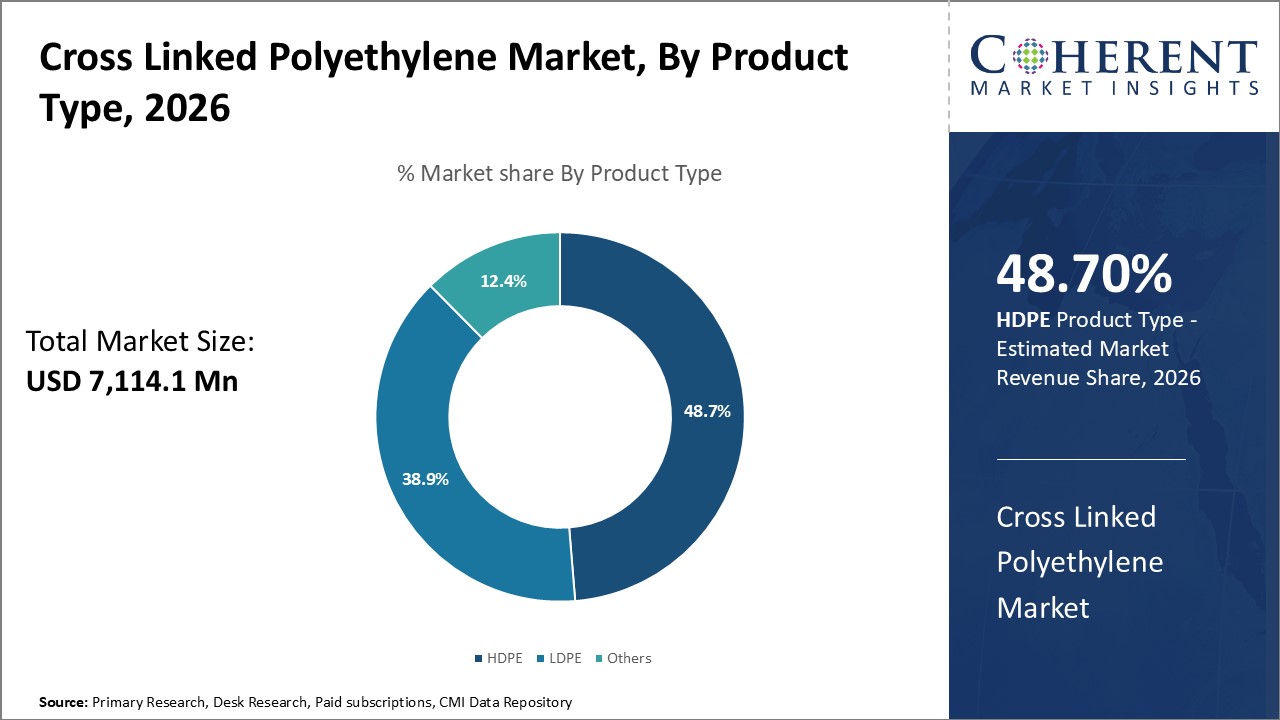
- Based on product type, the HDPE segment is expected to hold the largest market share of the market in 2026, due to its exceptional chemical structure, mechanical strength, and compatibility with crosslinking processes.
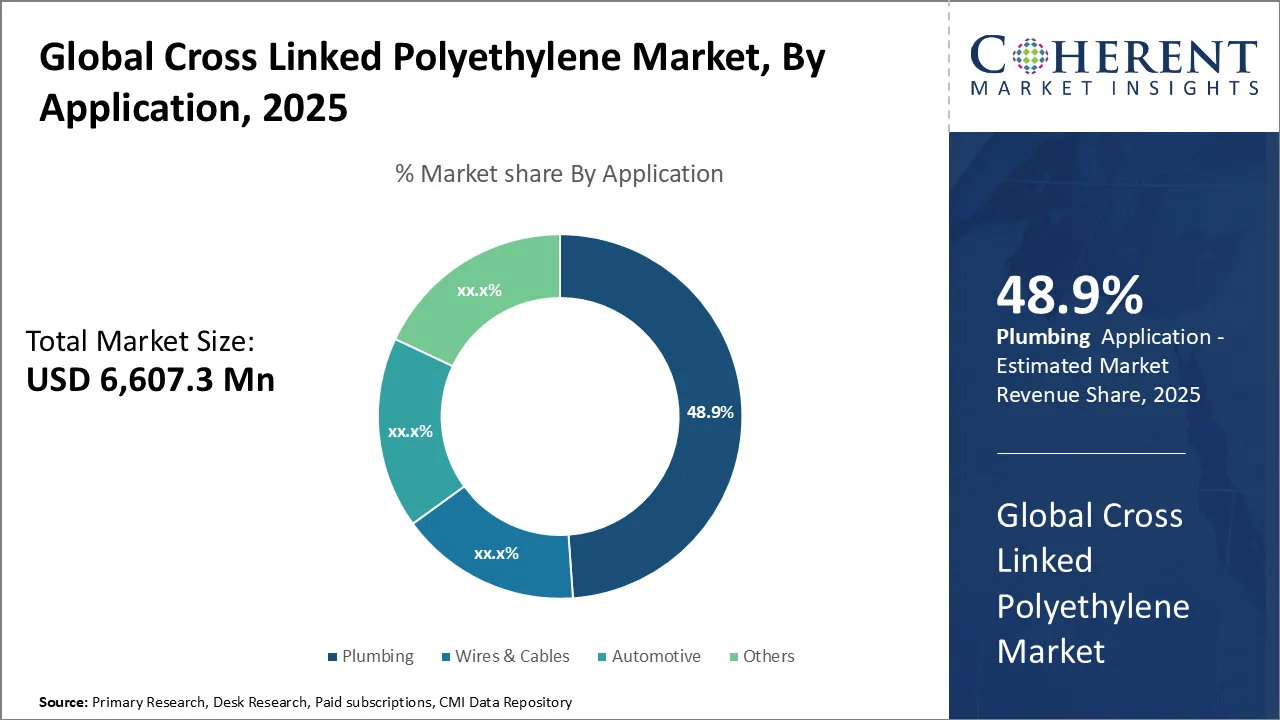
- Based on application, the plumbing segment is expected to lead the market with a 49.9% share in 2026, due to its unique combination of performance, cost-efficiency, and ease of installation.
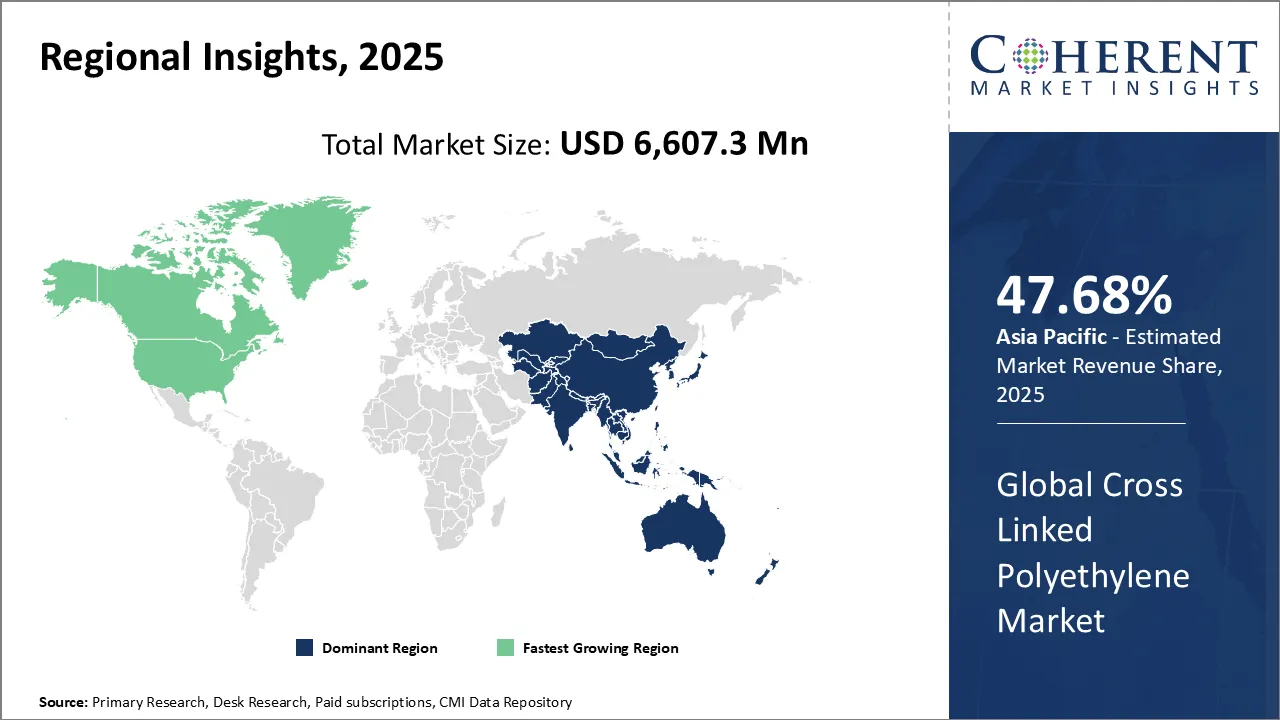
- Based on region, Asia Pacific is expected to lead the market, holding a share of 47. 68% in 2026. While, North America is anticipated to be the fastest growing region during the forecast period.
Market Overview
The cross-linked polyethylene market is growing steadily due to its durability, flexibility, and resistance to heat and chemicals. Widely used in plumbing, electrical insulation, automotive, and industrial applications, PEX offers a cost-effective alternative to copper and PVC, especially in hot and cold-water systems. The cross-linked polyethylene market demand is high in North America and Europe due to advanced infrastructure, while Asia-Pacific sees rapid growth from construction and modernization. Innovation in production methods and rising infrastructure investment continue to drive the market, though sustainability concerns around recyclability present future challenges.
End-User Feedback and Unmet Needs in the Cross-Linked Polyethylene (XLPE) Market
Installation Complexity and Skilled Labor Requirements
Installation of XLPE cables and systems often necessitates specialized tools and trained personnel. End-users report that improper handling during installation—especially in complex terrains or urban infrastructures—can result in insulation damage and increased failure risks.
Unmet Needs
- Simplified installation solutions, including pre-configured kits or modular assemblies.
- Broader access to certified training programs for installers to reduce labor-related risks and costs.
Environmental Impact and End-of-Life Management
Environmental sustainability remains a growing concern. XLPE is known to have limited recyclability, and a significant portion of end-of-life material is disposed of in landfills. With increasing regulatory and societal pressure to adopt sustainable materials, this poses a barrier to adoption in environmentally conscious sectors.
Unmet Needs
- Development of recyclable or biodegradable XLPE variants.
- Implementation of circular economy initiatives such as take-back schemes or closed-loop recycling programs.
Awareness and Education Deficits
Despite its superior electrical and mechanical properties, XLPE adoption remains limited in some regions and applications due to a lack of awareness or misconceptions about its performance and cost-effectiveness. This is particularly evident in low-voltage applications and emerging markets.
Unmet Needs
- Market-wide educational initiatives, including seminars, case studies, and technical white papers to inform stakeholders about the advantages of XLPE.
- Comparative performance analyses to aid decision-making for engineers and procurement teams.
Current Events and their Impact on the Cross Linked Polyethylene Market
Current Event | Description and its Impact |
Regulatory Shifts in Key Regions |
|
Sustainability and Climate Initiatives |
|
- Current Industry Events of 2026
- Market Size Estimation
- Regional Breakdown
- Competitive Landscape
- Customer Intelligence
- Segmental Analysis
- Pricing Analysis
- Key Market Drivers, Challenges & Future Trends
- Customized Insights Section
Segmental Insights
Cross Linked Polyethylene Market Insights, By Application
Plumbing Segment Holds the Largest Market Share
In terms of application, the plumbing segment is expected to lead the market with 49.9% share in 2026, due to its unique combination of performance, cost-efficiency, and ease of installation. PEX is highly flexible, allowing it to be bent around corners without the need for elbow fittings which reduces installation time and material costs. This makes it ideal for residential and commercial plumbing, especially in retrofit projects. Unlike metal pipes, PEX does not corrode or accumulate scale over time, ensuring a longer lifespan and cleaner water supply. This is especially important in areas with hard or acidic water. Cross-linking gives PEX excellent thermal resistance, making it suitable for both hot and cold-water lines. It can withstand high pressures and fluctuating temperatures, which is crucial for modern plumbing systems.
In September 2024, Jones Stephens expanded its plumbing portfolio with the introduction of PEX‑B pipe, adding cross‑linked polyethylene tubing engineered for potable-water use. The pipe offers enhanced durability, corrosion resistance, and flexibility to streamline installations. Available in red, white, and blue, the product comes in both coils and straight lengths up to 1″, accompanied by a full range of F1807 brass and F2159 poly crimp fittings.
Cross Linked Polyethylene Market Insights, By Product Type
HDPE Dominates the Overall Market on Account of its Exceptional Chemical Structure
In terms of product type, the HDPE segment is expected to hold the largest shares of the market in 2026 due to its exceptional chemical structure, mechanical strength, and compatibility with crosslinking processes. HDPE has a high molecular weight and linear polymer chains with minimal branching, making it well-suited for crosslinking through methods like peroxide (PEX-a), silane (PEX-b), or electron beam (PEX-c). This results in a three-dimensional polymer network that enhances thermal and chemical resistance. Cross-linked HDPE offers improved tensile strength, crack resistance, and flexibility, which are essential for plumbing, radiant heating, and industrial piping. These properties help PEX tubing maintain structural integrity under high pressure and temperature. HDPE is readily available, recyclable, and cost-effective compared to other polymers. Its widespread use in packaging and piping ensures a robust supply chain, which benefits manufacturers of cross-linked polyethylene products.
In July 2025, Dow launched INNATE™ TF 220 Precision Packaging Resin, a recyclable, high-density polyethylene designed for biaxially oriented flexible packaging. The resin enhances process efficiency, reduces waste, and delivers improved stiffness, heat resistance, optical clarity, and durability, making mono-material packaging easier to recycle.
Regional Insights
Asia Pacific Cross Linked Polyethylene Market Analysis & Trends
Asia Pacific is expected to lead the cross-linked polyethylene market, with an estimated 47.68% share in 2026 due to rapid industrialization, infrastructure development, and energy modernization. In China, the government’s massive investments such as the State Grid's plans for ±800 kV ultra‑high‑voltage transmission projects are increasingly relying on cross linked polyethylene-insulated cables for their superior thermal stability and electrical performance. India is also experiencing electrification growth, with programs like the Saubhagya initiative bringing power to millions of rural homes and deploying weather-resistant cross linked polyethylene cables.
Additionally, in South Korea, Taihan Cable & Solution partnered with Hanwha Solutions to develop and certify advanced cross linked polyethylene insulation materials for high-voltage and submarine cable applications, underscoring regional momentum toward cutting‑edge, durable cable systems. These factors are driving the cross linked polyethylene market demand in Asia Pacific, as the region works to expand and modernize its power and industrial infrastructure.
North America Cross Linked Polyethylene Market Analysis & Trends
North America is considered to be the fastest growing region during the forecast period. The growing is experienced due to robust infrastructure and energy-efficiency initiatives. In the U.S., the Bipartisan Infrastructure Law has allocated USD 65 billion toward modernizing power systems, fueling a 28% year-over-year increase in XLPE cable procurement for undergrounded electrical grids, particularly in regions like California aiming to mitigate wildfire risks.
Likewise, North America's rapid adoption of solar thermal systems with a 43% rise in installations since 2020 is accelerating demand for high-temperature-resistant PEX piping in solar collectors and hydronic heating systems. These trends demonstrate how government-backed infrastructure spending and green-building mandates are propelling XLPE demand region-wide, as utilities, construction firms, and clean-energy installers increasingly prefer durable, efficient piping and cable solutions.
Cross Linked Polyethylene Market Outlook Country-Wise
The U.S. Cross Linked Polyethylene Market Trends
The U.S. cross-linked polyethylene is experiencing surging demand, especially in infrastructure upgrades targeting underground systems for wildfire resilience. For example, California utilities like Pacific Gas & Electric have committed to undergrounding thousands of miles of power lines, using XLPE-insulated cables to replace traditional overhead lines and comply with state directives aimed at reducing wildfire ignition risk, a move supported by Governor Gavin Newsom's executive order speeding rebuilds after recent fires.
Similarly, utilities such as Southern California Edison are expanding the use of covered conductor and underground XLPE cables to strengthen grid safety and reliability. Beyond electrical systems, cross-linked polyethylene is also being specified more frequently for high-efficiency plumbing and heating applications, including emerging solar thermal installations that require durable, temperature-resistant piping. These trends reflect North America’s growing investment in safe, long-lasting, and energy-efficient infrastructure solutions.
China Cross Linked Polyethylene Market Trends
China’s market is influenced by massive investments in urban infrastructure, power-grid expansion, and real estate development are significantly boosting the demand for cross-linked polyethylene cables. The State Grid Corporation is executing an ambitious plan to install thousands of kilometers of ultra‑high-voltage lines by 2026, particularly in coastal industrial hubs like Guangdong and Zhejiang provinces.
A prime example is the Guangdong offshore wind export project, where Orient Cable secured a contract to supply a 500 kV extra‑high-voltage subsea cable spanning over 90 km, utilizing cross-linked polyethylene insulation for its superior mechanical and thermal endurance in marine environments. Similarly, inland clean-energy projects like the Ningxia renewable heating and power initiative have adopted medium-voltage XLPE-insulated cables (26/35 kV) to ensure grid stability and longevity under harsh conditions. These real-world deployments underscore how China's push for electrification, renewable integration, and resilient infrastructure continues to drive strong demand for cross-linked polyethylene cables across the market.
India Cross Linked Polyethylene Market Trends
India has emerged as a notable player in the Asia Pacific cross linked polyethylene market through rising sharply within major water infrastructure and green-energy initiatives. As part of the Jal Jeevan Mission, the government has accelerated the replacement of traditional materials with durable, long-lasting piping, including cross-linked polyethylene to ensure reliable, leak-resistant rural tap water connections. In Uttar Pradesh, companies like BirlaNu have supplied advanced, TruFit® leakproof pipes to 15 districts, prioritizing sustainable and maintenance-free networks for millions of households. Complementing water projects, solar thermal installations are increasingly specifying cross-linked piping due to its high thermal stability and resistance to scaling qualities confirmed by a recent analysis of large solar pipeline systems. These developments illustrate how India’s national programs including Smart Cities, Jal Jeevan Mission, and clean-energy drives are fueling the adoption of cross-linked polyethylene across municipal and renewable infrastructure, reinforcing its quality, durability, and cost-efficiency in real-world applications.
Market Report Scope
Cross Linked Polyethylene Market Report Coverage
| Report Coverage | Details | ||
|---|---|---|---|
| Base Year: | 2025 | Market Size in 2026: | USD 7,114.1 Mn |
| Historical Data for: | 2020 To 2024 | Forecast Period: | 2026 To 2033 |
| Forecast Period 2026 to 2033 CAGR: | 7.7% | 2033 Value Projection: | USD 11,933.9 Mn |
| Geographies covered: |
| ||
| Segments covered: |
| ||
| Companies covered: | ExxonMobil Chemical Company, LyondellBasell Industries, 3H Vinacom Co., Hanwha Chemicals, Arkema Group, AkzoNobel N.V., Falcone Specialities AG, Borealis AG, and PolyOne Corporation. | ||
| Growth Drivers: |
| ||
| Restraints & Challenges: |
| ||
Cross Linked Polyethylene Market Drivers
Cross-linked HDPE finds wide applications
Cross-linked high-density polyethylene has become a versatile engineering material, finding applications well beyond traditional plumbing. In residential and commercial construction, its enhanced strength, flexibility, and corrosion resistance make it ideal for durable piping and underfloor heating systems. In electrical infrastructure, this polymer serves as insulation in power and telecom cables, offering excellent dielectric properties and thermal stability featuring critical amid global expansion of renewables and smart grid networks.
The automotive industry also leans on cross-linked high-density polyethylene for fuel lines, coolant systems, and wiring harnesses, where its chemical resistance and toughness enable lightweight, efficient designs. Moreover, in the medical sector, its biocompatibility and sterilization resilience support applications in surgical implants, tubing, and equipment housings. Industrially, it is used to manufacture chemical storage tanks and acid-resistant piping systems, favored for durability and maintenance efficiency. These diverse applications underscore the material’s adaptability, driving its prominence in the global cross-linked polyethylene market.
Low cost and can be reused
Cross-linked polyethylene (PEX) stands out in the piping market for its low material cost and high reusability, which contribute to its growing popularity. Unlike copper or rigid plastics, PEX is significantly cheaper and easier to install as homeowners often find a 100 ft coil of ½‑inch PEX tubing for less than $50, making it ideal for both new construction and DIY renovations.
Additionally, manufacturers are investing in chemical recycling technologies that enable PEX to be reused at scale. In early 2023, Uponor partnered with Wastewise, Neste, and Borealis to successfully produce the world’s first circular PEX pipe made entirely from chemically recycled PEX production waste is maintaining full performance quality while supporting sustainable reuse. This breakthrough not only lowers long-term costs but also reinforces PEX as a cost-effective and reusable solution in plumbing and heating systems.
Recent Developments
- In May 2025, Chroma Color Corporation introduced ChromaXLPEUltra, its next-generation line of high-performance color concentrates tailored for cross-linked polyethylene (XLPE) used in demanding environments such as aerospace, mining, automotive, and power infrastructure. The offering delivers vibrant coloration at low loadings (1–2%) while ensuring flame resistance (VW‑1 rating), mechanical integrity, and compliance with UL 746C, ASTM, RoHS, REACH, and HMF standards.
- In May 2025, Borealis and its joint‑venture partner Borouge introduced a major expansion across Europe and the Middle East, doubling capacity for cross‑linked polyethylene (XLPE) and semiconductive (semicon) compounds by 2027 to support the global shift to renewable energy.
- In April 2025, STEER World, based in Bengaluru, introduced its Omega Twin‑Screw Extrusion Technology, enabling the first-ever recycling of crosslinked polyethylene (XLPE), traditionally regarded as non‑recyclable into reusable De‑XLPE pellets. Using patented Fractional Geometry Technology, the twin-screw extruder applies precise shear and heat to break crosslinks while preserving the polymer’s core structure.
- In February 2025, Uzbekistan introduced its inaugural cross-linked polyethylene (PE‑X) production plant, the Uzeltekhsanoat Industry Association. The $8 million joint venture, NASAF XCP TECHNO, brings together China’s Yunnan Xinchengpeng Polymer Technology, Techno Cable Group, the Shurtan Gas Chemical Complex, and Uzbekneftegaz. The facility aims to produce 35,000 tons annually, surpassing domestic demand of 25,000–30,000 tons, reducing import dependency by $30 million per year, and creating 65 new jobs.
Analyst Opinion (Expert Opinion)
The cross-linked polyethylene market value is undergoing a structural transformation that goes far beyond incremental material innovation. While PEX has long been recognized for its superior mechanical and thermal resistance, its adoption is no longer merely a function of product merit—it is now a reflection of broader system-level shifts in infrastructure planning, regulatory tightening, and digitalization of utilities.
The momentum in the residential and commercial plumbing segment is not just persistent, it is intensifying. This is by the accelerated replacement of legacy copper and PVC systems. In the U.S. alone, estimates from the EPA suggest that over 10 million homes still have led or galvanized pipes, a regulatory and health risk that municipalities are aggressively addressing through public-private partnerships. Cross-linked polyethylene has emerged as the material of choice in these conversions due to its ease of retrofitting and reduced installation labor (by approximately 30–40%, according to estimates from contractor networks in Michigan and Arizona).
Equally compelling is PEX’s growing relevance in district heating and underground infrastructure. Scandinavian countries, particularly Sweden and Denmark, have standardized on PEX-A systems in low-temperature thermal grids due to their durability under cyclic loading and reduced maintenance costs over a 20+ year lifecycle. These nations have begun exporting this design ethos, influencing new builds across northern Germany, Poland, and parts of the U.K. is creating a diffusion of best practices that favors PEX suppliers with scalable extrusion capabilities and consistent cross-linking quality.
A critical yet underappreciated development is the emergence of smart grid-compatible PEX systems, particularly in water metering and leak detection. Companies like Uponor and Rehau are embedding sensor-integrated manifolds into PEX distribution networks, aligning with the broader trend of digital twin modeling in infrastructure. These integrations are driving procurement decisions in Tier-1 cities where long-term cost optimization and predictive maintenance now outweigh upfront material costs.
Moreover, resistance to chlorine degradation, a known weakness of non-cross-linked polyethylene in high-temperature recirculating systems has made PEX-B the preferred variant in hot water loop designs in healthcare facilities. The lower incidence of biofilm formation and corrosion, compared to metallic systems, is also a decisive factor in life sciences and food processing industries, where sterilization cycles are frequent and material stability under stress is non-negotiable.
The peroxide method (PEX-A) offers better elasticity but requires higher process control and cost input, whereas silane cross-linking (PEX-B) allows for faster throughput and consistency. The market is bifurcating between premium and utility segments, with high-growth emerging markets in Latin America and Southeast Asia opting for PEX-B due to its superior economics, while North American and European OEMs continue to favor PEX-A for high-specification applications.
In conclusion, the trajectory of the cross-linked polyethylene market is increasingly being shaped not by traditional cost-performance tradeoffs but by its alignment with regulatory compliance, smart infrastructure integration, and lifecycle management. Market participants that fail to invest in functional customization, smart compatibility, and post-installation diagnostics risk obsolescence in a segment that is fast outgrowing its commodity roots.
Speak to the analyst
Want personalized insights?
Take the findings above to one of our principal consultants, or have the report rebuilt around the segments, geographies and competitors you actually track.
Market Segmentation
- Global Cross linked polyethylene Market, By Product Type (Revenue, USD Mn, 2021 - 2033)
- HDPE
- LDPE
- Others
- Global Cross Linked Polyethylene Market, By Application (Revenue, USD Mn, 2021 - 2033)
- Plumbing
- Wires & Cables
- Automotive
- Others
- Global Cross Linked Polyethylene Market, By Region (Revenue, USD Mn, 2021 - 2033)
- North America
- U.S.
- Canada
- Latin America
- Brazil
- Argentina
- Mexico
- Rest of Latin America
- Europe
- Germany
- U.K.
- Spain
- France
- Italy
- Russia
- Rest of Europe
- Asia Pacific
- China
- India
- Japan
- Australia
- South Korea
- ASEAN
- Rest of Asia Pacific
- Middle East & Africa
- GCC Countries
- Israel
- Rest of Middle East & Africa
- North America
- Key players
- ExxonMobil Chemical Company
- LyondellBasell Industries
- 3H Vinacom Co.
- Hanwha Chemicals
- Arkema Group
- AkzoNobel N.V.
- Falcone Specialities AG
- Borealis AG
- PolyOne Corporation.
Sources
Primary Research Interviews from the following stakeholders
Stakeholders
- Interviews with polymer manufacturers, chemical engineers, product development heads, infrastructure planners, procurement leads, and R&D specialists across utilities, automotive, construction, and healthcare industries.
Databases
- World Trade Organization (WTO) Trade Statistics
- UN Comtrade Database
- Chemical and Petrochemical Statistics at Ministry of Chemicals & Fertilizers (India)
- Eurostat – Plastics and Elastomers Trade Data
- China Customs Statistics
- Japan Ministry of Economy, Trade and Industry (METI) – Polymers and Advanced Materials
- U.S. Bureau of Economic Analysis – Plastics Sector
- Directorate General of Commercial Intelligence and Statistics (DGCIS), India
- Korea International Trade Association (KITA) – XLPE Export/Import Trends
Magazines
- Plastics Technology
- Modern Plastics India
- Compounding World
- Cable & Wire International
- Pipe & Profile Extrusion Magazine
- Automotive Manufacturing Solutions
- Construction Week
- Packaging World
Journals
- Journal of Applied Polymer Science
- Polymer Engineering & Science
- Materials Today Proceedings
- IEEE Transactions on Dielectrics and Electrical Insulation
- Construction and Building Materials (Elsevier)
- Journal of Thermoplastic Composite Materials
- Automotive Innovation Journal
Newspapers
- The Economic Times – Chemicals & Petrochemicals
- Business Standard – Manufacturing & Materials
- Financial Express – Infrastructure & Energy
- The Hindu Business Line – Polymer and Cable Industry Reports
- South China Morning Post – Plastics and Packaging
- Reuters – Global Petrochemical Insights
Associations
- Plastindia Foundation
- Indian Plastics Institute (IPI)
- Society of Plastics Engineers (SPE)
- International Association of Plastics Distributors (IAPD)
- Central Institute of Plastics Engineering & Technology (CIPET)
- World Plastics Council
- Cables and Conductors Manufacturers Association of India (CCMAI)
- Confederation of Indian Industry (CII) – Chemicals and Materials Panel
Public Domain Sources
- Department of Chemicals & Petrochemicals (India)
- Ministry of Power (India) – Cable Standards and Grid Modernization
- U.S. Department of Energy – Smart Grid and Insulation Materials Reports
- European Chemicals Agency (ECHA) – XLPE and Polymer Classifications
- National Institute of Standards and Technology (NIST) – Cable and Polymer Standards
- National Investment Promotion & Facilitation Agency (India) – Chemicals & Materials Investment Tracker
- Japan External Trade Organization (JETRO) – Plastics and Compound Materials Export Guides
- Reserve Bank of India (RBI) – Industrial Outlook Surveys
Proprietary Elements
- CMI Data Analytics Tool, and Proprietary CMI Existing Repository of information for last 8 years
Get access to 250+ pages report
Every segment, forecast, competitor profile and data table behind the analysis above — available for instant download.
- ESOMAR Member
- ISO 9001:2015 Certified
- D-U-N-S Registered
- GDPR & CCPA Compliant
Missing comfort of reading report in your local language? Find your preferred language:
Transform your Strategy with Exclusive Trending Reports
Frequently Asked Questions
The Cross Linked Polyethylene Market is estimated to be valued at USD 7,114.1 Mn in 2026, and is expected to reach USD 11,933.9 Mn by 2033.
Major players in the market include ExxonMobil Chemical Company, LyondellBasell Industries, 3H Vinacom Co., Hanwha Chemicals, Arkema Group, AkzoNobel N.V., Falcone Specialities AG, Borealis AG, and PolyOne Corporation.
HDPE segment is expected to witness the fastest growth.
Rapid growth in the automotive industry is the key factor driving the growth of market.
The CAGR of the Cross Linked Polyethylene Market is projected to be 7.7% from 2026 to 2033.
Asia Pacific dominating the market growth due to the growing population, increased urbanization, and growth commercial sector, is expected to drive the growth of the market over the forecast period.
Cross-linked polyethylene (PEX) is used for fuel systems, wire insulation, and tubing due to its durability and heat resistance.