

High Performance Polyamides Market Size and Forecast — 2026 - 2033
The Global High Performance Polyamides Market size is estimated to be valued at USD 5.6 billion in 2026 and is expected to reach USD 9.8 billion by 2033, exhibiting a compound annual growth rate (CAGR) of 8.2% from 2026 to 2033.
Overview
High Performance Polyamides (HPPAs) are advanced engineering thermoplastics designed to deliver superior mechanical strength, thermal stability, and chemical resistance compared to standard nylons. They typically include materials such as PA6T, PA9T, PA46, and semi-aromatic polyamides, which offer excellent stiffness, wear resistance, and dimensional stability under high temperatures. These polymers perform well in demanding environments, maintaining properties even above 150°C. HPPAs are widely used in automotive, electrical and electronics, industrial, and aerospace applications where lightweight, durable materials are required. Their high strength-to-weight ratio, resistance to fuels and oils, and good processability make them suitable for metal replacement in structural and precision components.
Key Takeaways
PA 6.6 dominates the High Performance Polyamides market with a 48% share, driven by its superior thermal resistance and mechanical strength, making it highly preferred in automotive and aerospace applications.
The Automotive & Transportation segment is the fastest-growing, experiencing double-digit expansion due to lightweighting mandates and the proliferation of electric vehicles.
Asia Pacific holds the largest market share for High Performance Polyamides, supported by a strong manufacturing base and capacity expansions in countries such as China and India.
Europe offers significant growth opportunities, driven by stringent regulatory frameworks and a focus on sustainable material usage in automotive and electronics sectors.
High Performance Polyamides Market Segmentation Analysis
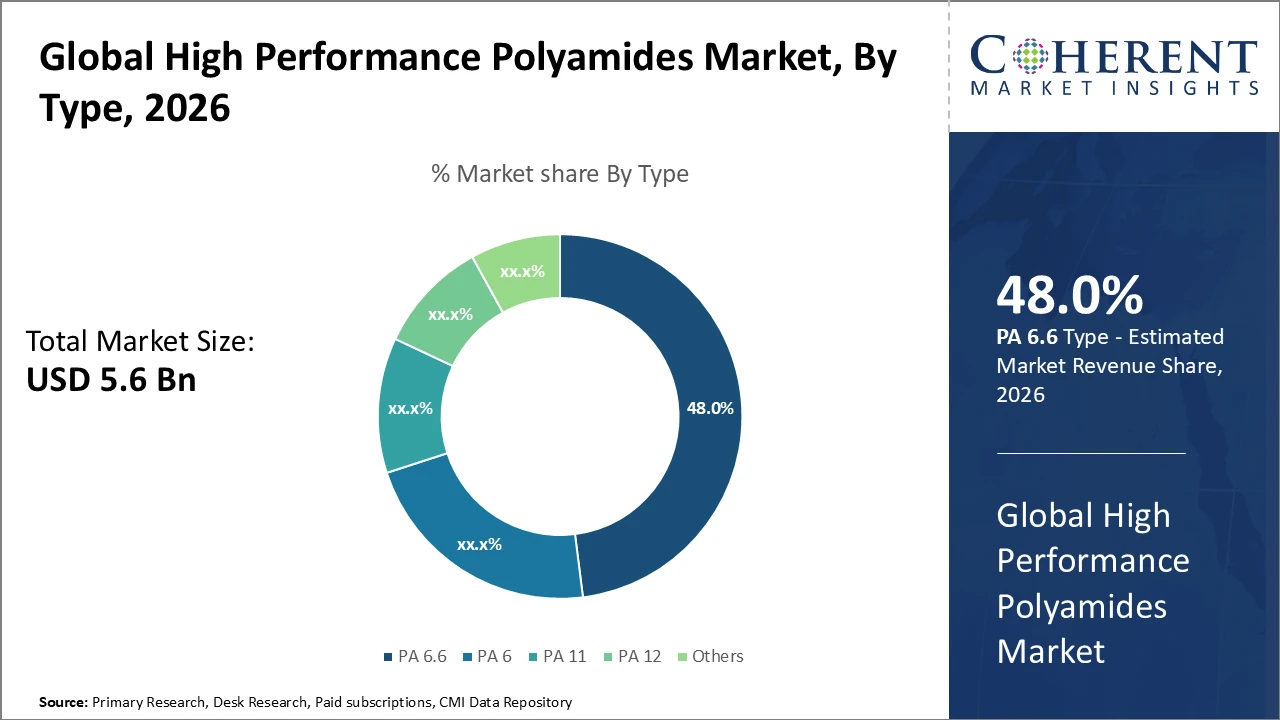
High Performance Polyamides Market Insights, By Type
PA 6.6 dominates the High Performance Polyamides market, with its superior tensile strength and high melting point making it essential for automotive engine components and aerospace parts. It is particularly favored for applications exposed to high heat and mechanical stress. PA 6 is widely used for general-purpose applications due to its cost efficiency, making it common in consumer goods and industrial machinery. PA 11 and PA 12, valued for their flexibility and chemical resistance, are increasingly applied in medical devices and cable jacketing. Specialty polyamides serve niche applications, with technological advancements driving PA 6.6 and flexible uses boosting PA 11 and PA 12 demand.
High Performance Polyamides Market Insights, By Application
The Automotive & Transportation segment dominates the High Performance Polyamides market, driven by increasing lightweighting mandates and the growth of electric vehicle production, where HPPA’s mechanical strength and thermal performance are essential. The Electrical & Electronics sector is the fastest-growing application, fueled by rising demand for miniaturized, heat-resistant components. Industrial Machinery relies on HPPA for high-wear gears and seals, while Consumer Goods, including sports equipment and lifestyle products, benefit from polyamides’ durability and aesthetic appeal. Other applications, such as packaging, are exploring biodegradable polyamides. Overall, automotive expansion and rising electronics demand are the primary drivers of market growth.
High Performance Polyamides Market Insights, By End-Use Industry
The Aerospace segment dominates the High Performance Polyamides market, leveraging HPPA’s weight-saving capabilities and compliance with stringent safety standards, with growing demand for fuel-efficient aircraft driving expansion. Medical Devices are among the fastest-growing subsegments, supported by biocompatible HPPA variants used in surgical tools and implants. Sports & Leisure products incorporate HPPA for high-performance gear that offers enhanced durability and flexibility. Packaging applications are emerging through biodegradable HPPA grades designed for sustainable solutions. Other niche markets adopt customized polyamides to meet specific performance requirements. Overall, growth in Aerospace and Medical Devices is primarily driven by technological innovation and regulatory compliance.
High Performance Polyamides Market Trends
Sustainability practices are increasingly shaping the High Performance Polyamides market, with bio-based polymer grades gaining significant adoption.
In 2025, the use of bio-HPPA materials in automotive applications increased by over 14%, reflecting a shift toward eco-friendly solutions.
Digitalization and Industry 4.0 practices are being implemented to optimize polymer production, improve quality control, and enhance product consistency.
Nanocomposite-enhanced HPPA materials are emerging, offering improved thermal and mechanical performance for demanding applications.
These technological advancements support wider adoption of HPPA in electric vehicles, aerospace, and other high-performance sectors.
High Performance Polyamides Market Insights, By Geography
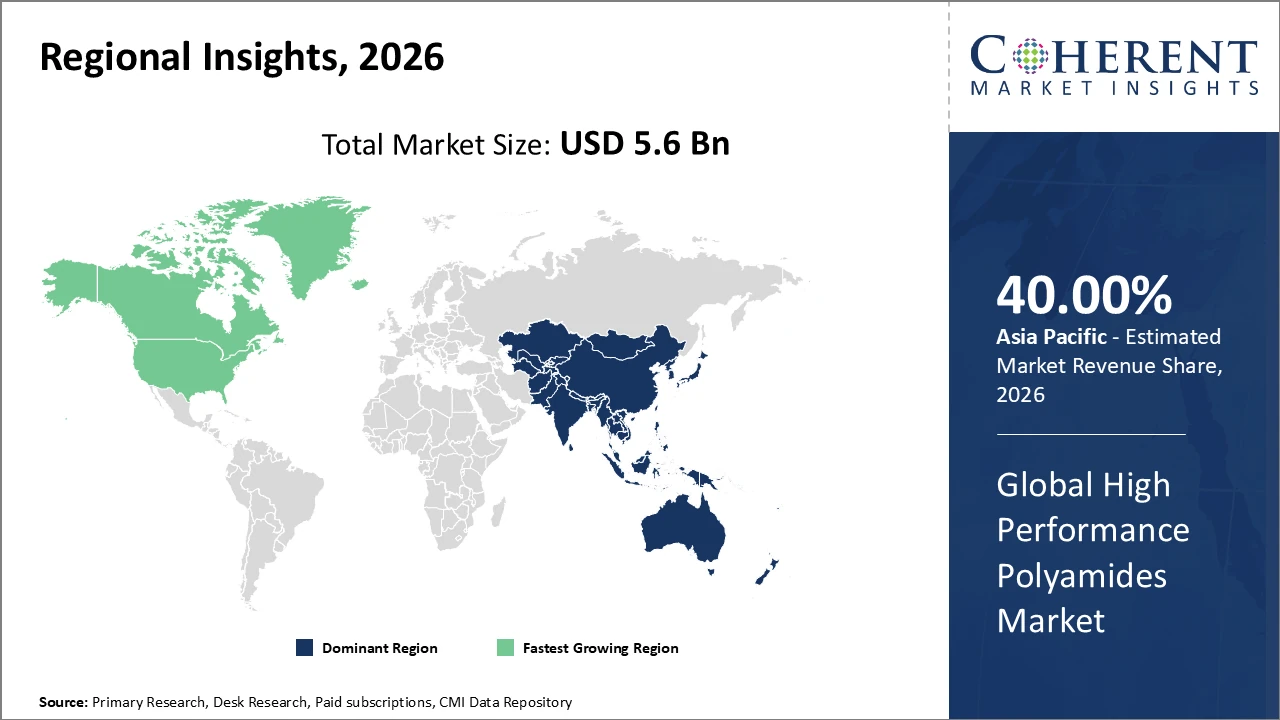
North America High Performance Polyamides Market Analysis and Trends
North America exhibits the fastest growth in the High Performance Polyamides market, with a CAGR exceeding 9%, driven by increasing lightweighting mandates, the rise of electric vehicle startups, and growing adoption of HPPA materials in aerospace and defense applications. Supportive U.S. government policies promoting advanced materials development further strengthen market growth. Leading regional companies are investing heavily in R&D and forming strategic collaborations with automotive OEMs to develop innovative HPPA solutions tailored for high-performance and sustainable applications. These initiatives enhance product performance, reduce vehicle weight, and improve energy efficiency, positioning North America as a key driver of global HPPA market expansion.
Asia Pacific High Performance Polyamides Market Analysis and Trends
In Asia Pacific, the High Performance Polyamides market is dominated by rapid industrialization, supportive government incentives for polymer production, and the expansion of automotive and electronics manufacturing hubs. China leads the region with a market share exceeding 40%, driven by large-scale polymer plants commissioned in 2026 and strong downstream adoption across key industries. Regional companies, alongside multinational firms, have invested heavily in local R&D to develop customized HPPA products tailored to the region’s specific climatic and industrial requirements. These efforts have enhanced material performance, supported sustainable applications, and reinforced Asia Pacific’s position as a major growth engine in the global HPPA market.
High Performance Polyamides Market Outlook for Key Countries
USA High Performance Polyamides Market Analysis and Trends
The USA’s High Performance Polyamides market plays a crucial role in global revenue generation. In 2025, U.S. automotive manufacturers increased HPPA usage by nearly 20%, driven by stringent federal fuel efficiency and lightweighting standards. Major suppliers expanded production capacities and invested in advanced HPPA grades offering superior heat resistance, mechanical strength, and reduced weight, supporting sustained market growth. Strategic partnerships between polymer producers and electric vehicle manufacturers have further accelerated adoption of HPPA materials across engine components, structural parts, and high-performance applications. These initiatives reinforce the U.S. market’s leadership and provide a strong foundation for future expansion in automotive, aerospace, and electronics sectors.
Germany High Performance Polyamides Market Analysis and Trends
Germany’s High Performance Polyamides market is driven by a mature automotive and industrial base, with strong demand for lightweight, high-strength polymers in engines, gears, and electrical components. PA 6.6 and specialty polyamides dominate due to their thermal stability and mechanical performance, while biobased and flame-retardant grades are increasingly adopted for sustainability and regulatory compliance. The country benefits from advanced manufacturing infrastructure and R&D capabilities, enabling tailored HPPA solutions for automotive, aerospace, and electronics applications. Emphasis on energy efficiency, electric vehicle production, and adherence to EU environmental standards continues to shape market trends, offering steady growth opportunities in both conventional and high-performance sectors.
Analyst Opinion
The surge in automotive lightweighting initiatives is a key demand-side driver for High Performance Polyamides. In 2025, OEMs increased HPPA usage by over 15% compared to 2024 due to stringent CAFE regulations in the U.S., directly boosting market revenue. This trend is expected to grow with global expansion of electric vehicle manufacturing.
Supply-side growth is supported by production capacity expansions in Asia Pacific, particularly in China and India. Large-scale polymer plants commissioned in 2026 increased regional output by over 20% year-over-year, strengthening market share.
Pricing dynamics have remained stable despite raw material volatility, aided by long-term contracts between polyamide producers and electronics manufacturers. In 2024, strategic procurement reduced price fluctuations by 3%, stabilizing revenue.
The industrial machinery sector shows growing reliance on polyamides for gears, bearings, and seals. Usage rose by 12% in 2026, driven by demand for durable, lightweight components, supporting positive market forecasts.
- Current Industry Events of 2026
- Market Size Estimation
- Regional Breakdown
- Competitive Landscape
- Customer Intelligence
- Segmental Analysis
- Pricing Analysis
- Key Market Drivers, Challenges & Future Trends
- Customized Insights Section
Market Scope
| Report Coverage | Details | ||
|---|---|---|---|
| Base Year: | 2025 | Market Size in 2026: | USD 5.6 billion |
| Historical Data for: | 2020 To 2024 | Forecast Period: | 2026 To 2033 |
| Forecast Period 2026 to 2033 CAGR: | 8.2% | 2033 Value Projection: | USD 9.8 billion |
| Geographies covered: |
| ||
| Segments covered: |
| ||
| Companies covered: | BASF SE, DSM N.V., Evonik Industries AG, Solvay SA, Lanxess AG, RadiciGroup, Arkema S.A., UBE Industries Ltd., Mitsui Chemicals, Inc., Toray Industries, Inc. | ||
| Growth Drivers: |
| ||
High Performance Polyamides Market Growth Factors
Increasing environmental regulations worldwide are driving automakers to adopt lightweight, high-durability materials such as high performance polyamides. For example, Europe’s Euro 7 standards, effective from 2025, prompted a 12% rise in HPPA usage in vehicle components. Advances in polymer synthesis and formulation, including the integration of nanocomposites, are enhancing thermal and mechanical properties, supporting growth in electronics and aerospace applications; in 2026, the addition of carbon nanotubes to HPPA composites increased thermal conductivity by 10%. The rise of electric vehicles, requiring improved thermal management and weight reduction, boosted global HPPA consumption by 18% in 2025, while emerging economies like India and Southeast Asia saw significant revenue growth from expanding manufacturing and end-user adoption since 2024.
High Performance Polyamides Market Development
In September 2025, BASF introduced the first thermoplastic polyamide with high water permeability. Combining strength with moisture transmission, Ultramid H is designed for artificial sausage casings that allow smoking and subsequent drying in a single material solution.
Key Players
Leading Companies of the Market
BASF SE
DSM N.V.
Solvay SA
Toray Industries, Inc.
Evonik Industries AG
Lanxess AG
Arkema S.A.
UBE Industries, Ltd.
RadiciGroup
Mitsui Chemicals, Inc.
Several leading market companies have recently invested heavily in R&D to expand high-performance, bio-based polyamide solutions. For example, BASF launched a pilot plant in 2025 focused on renewable feedstocks, achieving a 7% reduction in carbon footprint compared to traditional HPPA variants. Similarly, DSM’s strategic collaboration with automotive manufacturers led to the development of tailored polymer grades that enhance the thermal stability of electric motor components, significantly boosting its market share. These initiatives highlight the industry’s focus on sustainability, innovation, and customized solutions to meet the evolving demands of automotive, aerospace, and high-performance industrial applications.
High Performance Polyamides Market Future Outlook
The High Performance Polyamides market is expected to experience robust growth driven by increasing demand for lightweight, durable, and high-temperature-resistant materials across automotive, aerospace, and electronics sectors. Rising adoption of electric vehicles and stringent environmental regulations are accelerating the use of bio-based and sustainable HPPA variants. Technological advancements, including nanocomposite integration and tailored polymer formulations, are enhancing thermal, mechanical, and flame-retardant properties, expanding applicability in high-performance components. Emerging economies in Asia Pacific are projected to witness significant growth due to industrial expansion and automotive manufacturing. Overall, innovation, sustainability, and regional market development will underpin long-term HPPA market expansion.
High Performance Polyamides Market Historical Analysis
The High Performance Polyamides market has demonstrated steady growth over the past decade, driven by rising demand in automotive, aerospace, and industrial applications. Historically, PA 6.6 and PA 6 dominated due to their superior mechanical strength, thermal stability, and versatility in engine components, gears, and electrical parts. Early adoption in Europe and North America was fueled by stringent fuel efficiency and safety regulations, while Asia Pacific gradually emerged as a key production hub. Technological advancements, including flame-retardant and nanocomposite-enhanced polyamides, along with increasing focus on sustainability and lightweighting, have shaped the market’s historical trajectory and laid the foundation for current and future expansion.
Sources
Primary Research Interviews:
Automotive, aerospace, and electronics component manufacturers
High performance polyamide manufacturers and chemical producers
Industrial machinery and consumer goods companies using HPPA materials
Magazines:
Polymer Engineering & Science
Plastics Today
Chemical Week
Materials Performance
Journals:
Journal of Applied Polymer Science
Polymer Testing
Journal of Materials Science
Macromolecular Materials and Engineering
European Polymer Journal
Newspapers:
The New York Times – Materials & Chemicals
The Guardian – Manufacturing & Sustainability
Reuters – Polymers & Plastics
Financial Times – Polymers & Industrial Materials
Associations:
Society of Plastics Engineers (SPE)
European Plastics Converters (EuPC)
American Chemistry Council (ACC) – Plastics Division
Plastics Industry Association (PLASTICS)
International Association of Plastics Manufacturers (IAPM)
Get access to 250+ pages report
Every segment, forecast, competitor profile and data table behind the analysis above — available for instant download.
- ESOMAR Member
- ISO 9001:2015 Certified
- D-U-N-S Registered
- GDPR & CCPA Compliant
Missing comfort of reading report in your local language? Find your preferred language:
Transform your Strategy with Exclusive Trending Reports
Frequently Asked Questions
The market is primarily led by BASF SE, DSM N.V., Evonik Industries AG, Solvay S.A., who collectively account for a substantial market share due to innovation and strategic partnerships.
The High Performance Polyamides Market size is projected to reach USD 9.8 billion by 2033, growing at a CAGR of 8.2% from 2026 to 2033.
Aerospace sector offers the largest growth opportunity, driven by regulatory mandates on vehicle emissions and lightweight construction.
Market development trends are expected to focus on bio-based polyamides and composites integration to improve sustainability and performance metrics, backed by investments in R&D and supply chain expansions.
The competitive landscape is highly innovative, emphasizing sustainable product development and strategic collaborations. Challenges include raw material price volatility and the complexities associated with bio-based polymer scale-up.
Leading market companies adopt strategies such as joint ventures with OEMs, expansion of manufacturing capacities in emerging regions, and focus on technological innovation through dedicated R&D centers.