

Sustainable Materials Market Analysis & Forecast: 2026-2033
Sustainable Materials Market is estimated to be valued at USD 401.50 Bn in 2026 and is expected to reach USD 909.95 Bn in 2033, exhibiting a compound annual growth rate (CAGR) of 12.4% from 2026 to 2033.
Key Takeaways
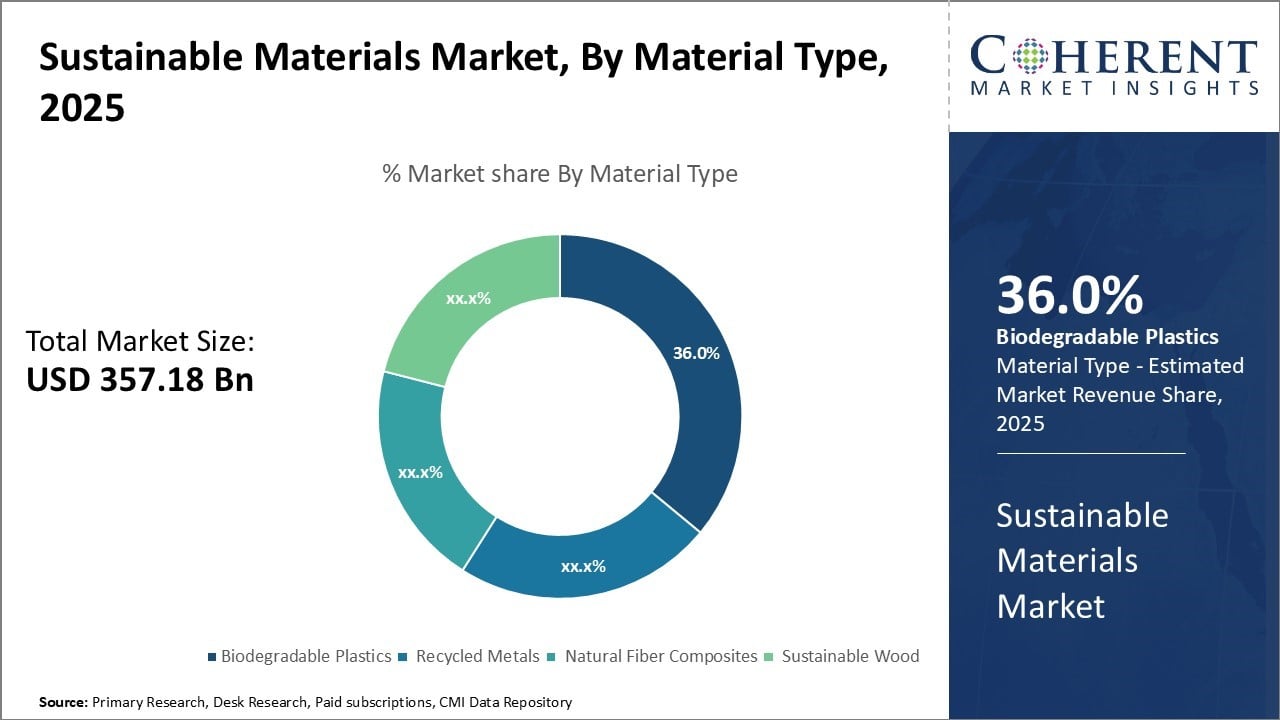
- According to Material Type, the Biodegradable Plastics Category is anticipated to account for the largest share of 37% for the Sustainable Materials market in 2026.
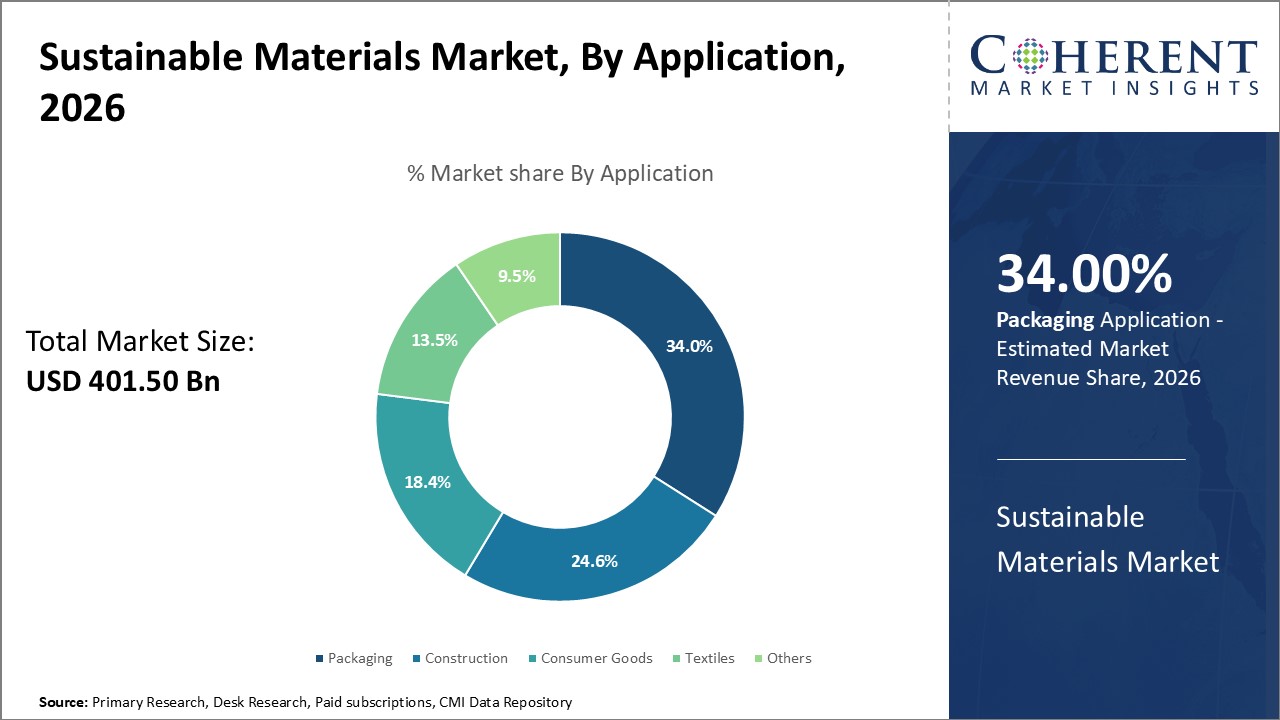
- According to Application, The Packaging Segment is anticipated to hold 34% share of the Sustainable Materials market in 2026.
- Europe is considered to be the most dominating region for Sustainable Materials market by 2026 with 37.0% market share.
Market Overview
Growing environmental consciousness, regulatory pressures, and the adoption of eco-friendly techniques in sectors like manufacturing, packaging, construction, and the automotive industry are all contributing to the strong growth of the global market for sustainable materials.
For instance, in May 2026, JK Tyre & Industries Ltd. has started producing its new passenger car tyre, the 'UX Royale Green', using ISCC Plus certified sustainable materials at its Chennai facility. This development marks the introduction of India’s first passenger car tyre manufactured with globally certified renewable and recycled raw materials.
Current Events and Its Impact
Event | Description and Impact |
India’s Sustainable Construction and Textile Innovation |
|
Adoption of AI and Machine Learning in Automation |
|
Segmental Insights
- Current Industry Events of 2026
- Market Size Estimation
- Regional Breakdown
- Competitive Landscape
- Customer Intelligence
- Segmental Analysis
- Pricing Analysis
- Key Market Drivers, Challenges & Future Trends
- Customized Insights Section
Sustainable Materials Market Insights, by Material Type
In terms of Material Type, Biodegradable Plastics segment is estimated to hold 37% share of the market in 2026, owing to increasing environmental awareness. Biodegradable plastics have emerged as the most prominent sustainable material due to rising consumer demand for eco-friendly products. These plastics are derived from renewable plant-based resources like corn starch, sugarcane, and cellulose, allowing them to decompose without leaving behind toxic residues.
For instance, in December 2024, A natural and biodegradable resin has been introduced by United Kingdom-based packaging technology company Symphony Environmental Ltd. According to the business, the new product, dubbed NbR, is manufactured using natural minerals to lessen the quantity of polyethylene (PE) or polypropylene (PP) derived from fossil fuels. It is also designed to biodegrade naturally in the event that it is not recycled and ends up as trash in the open environment.
Sustainable Materials Market Insights, by Application
In terms of Application, Packaging segment is estimated to hold 34% share of the market in 2026, due to its extensive utilization across multiple industries for both food and non-food products. Packaging manufactured using bio-based materials like paper, bioplastics, and recycled metals provide an eco-friendly yet highly functional solution for brands wishing to reduce their carbon footprint and cater to eco-conscious consumers.
For instance, in June 2026, Coinciding with World Environment Day, ATP Lighting introduces its new sustainable packaging: a box made from untinted natural cardboard and printed with a single white ink. This strategic move responds to a clear objective: to minimize the environmental footprint of every product manufactured and shipped.
Regional Insights

Europe Sustainable Materials Market
Europe is projected to hold the largest share of the precious metals market in 2026, accounting for 37.0% of global sales. The region also leads the global sustainable materials market, driven by robust government backing through regulatory measures that encourage sustainability and the circular economy.
Countries like Germany and France have implemented ambitious climate action initiatives that support the adoption of renewable and recycled materials across various industries. Additionally, the strong presence of major automotive and construction companies in the region further boosts the demand for sustainable alternatives.
Asia Pacific Sustainable Materials Market
The Asia Pacific market exhibits the fastest growth, led by China, India and other developing nations. With rapid industrialization and urbanization, these countries are focusing on developing sustainable infrastructure and lowering carbon footprint of manufacturing. Governments such as China have framed policies around investments in green technologies and alternatives to conserve resources for the future.
Sustainable Materials Market In North America
The sustainable materials market in North America is experiencing significant growth, driven by heightened environmental awareness, stringent regulations, and strong consumer demand for eco-friendly products. This expansion is supported by strict building codes, environmental laws, and government incentives such as tax credits and grants that promote the use of sustainable materials in construction. Programs like LEED and ENERGY STAR further accelerate adoption by certifying and rewarding green buildings.
Sustainable Materials Market Dominating Countries
U.S Sustainable Materials Market
The U.S. market, in particular, leads the region, with a focus on reducing greenhouse gas emissions, improving indoor air quality, and integrating recycled and energy-efficient materials into both residential and commercial projects. Major industry players, including BASF, Dow, and DuPont, are actively investing in sustainable innovation, while consumer preferences continue to shift toward environmentally responsible choices.
India Sustainable Materials Market
India is emerging as a key player in the sustainable materials market due to its growing demand for environmentally friendly alternatives across industries. The government has also set ambitious targets for renewable energy and sustainability. India’s construction sector is witnessing a rise in demand for sustainable building materials, such as fly ash bricks and recycled concrete.
Companies like Larsen & Toubro are focusing on sustainable construction practices. In the textile industry, India is seeing increased adoption of sustainable fabrics such as organic cotton and recycled polyester. Brands like Fabindia are promoting sustainable sourcing practices.
Sustainable Materials Market In China
China is one of the largest players in the global sustainable materials market, and its government has been making significant strides in promoting sustainability. The country’s Green Development Initiative and focus on circular economy practices are central to this transition. In the automotive sector, companies like BYD and NIO are pushing for electric vehicles (EVs) made from recycled or sustainable materials.
Germany's Leadership in Sustainable Materials: Innovations in Automotive and Construction Sectors
Germany is one of the most prominent countries in Europe when it comes to sustainable materials, owing to its strong commitment to green technologies, recycling, and circular economy principles. In automotive manufacturing, companies like BMW and Volkswagen are increasingly incorporating sustainable materials into their vehicles, such as recycled plastics and biodegradable composites.
The construction sector in Germany is seeing a shift towards green buildings, with an emphasis on energy-efficient materials, including insulating materials and low-carbon concrete. Germany's focus on passive house standards promotes the use of energy-efficient and sustainable building materials.
France's Commitment to Sustainability: Circular Economy and Innovation in Consumer Goods Packaging
France has established itself as a leader in the transition to a circular economy and sustainable materials, with government policies that support recycling, reusing, and reducing waste across industries. France’s Anti-Waste and Circular Economy Law, which mandates greater recycling, eco-design, and the use of renewable materials.
The country is also working towards carbon neutrality by 2050. France is promoting the use of biodegradable and recyclable materials in consumer goods. For example, Danone has made strides in using recycled plastics in packaging, while L'Oréal is advancing sustainable packaging initiatives.
Advancing Bioplastics and Eco-Friendly Building Practices in Japan
Japan has been at the forefront of technological innovation for sustainability, with a focus on resource efficiency, recycling, and advanced materials that contribute to lower environmental impact. Japan has pioneered the use of bioplastics in consumer products and packaging.
Companies like Toyota and Honda are increasingly using sustainable materials in vehicle manufacturing, such as bioplastics and recycled metals. In construction, Japan's push for eco-friendly building materials like wooden structures and green roofs is part of its larger environmental strategy.
Market Report Scope
Sustainable Materials Market Report Coverage
| Report Coverage | Details | ||
|---|---|---|---|
| Base Year: | 2025 | Market Size in 2026: | USD 401.50 Bn |
| Historical Data for: | 2020 To 2024 | Forecast Period: | 2026 To 2033 |
| Forecast Period 2026 to 2033 CAGR: | 12.4% | 2033 Value Projection: | USD 909.95 Bn |
| Geographies covered: |
| ||
| Segments covered: |
| ||
| Companies covered: | BASF SE, Dow Inc., NatureWorks LLC, Novamont S.p.A., Trex Company, Inc., Stora Enso Oyj, UPM-Kymmene Corporation, Braskem S.A., Eastman Chemical Company, Covestro AG, Coca-Cola Company (PlantBottle), Unilever, IKEA (Sustainable Wood Products), Henkel AG & Co. KGaA, and Procter & Gamble Co. | ||
| Growth Drivers: |
| ||
| Restraints & Challenges: |
| ||
Sustainable Materials Market: Growth Drivers
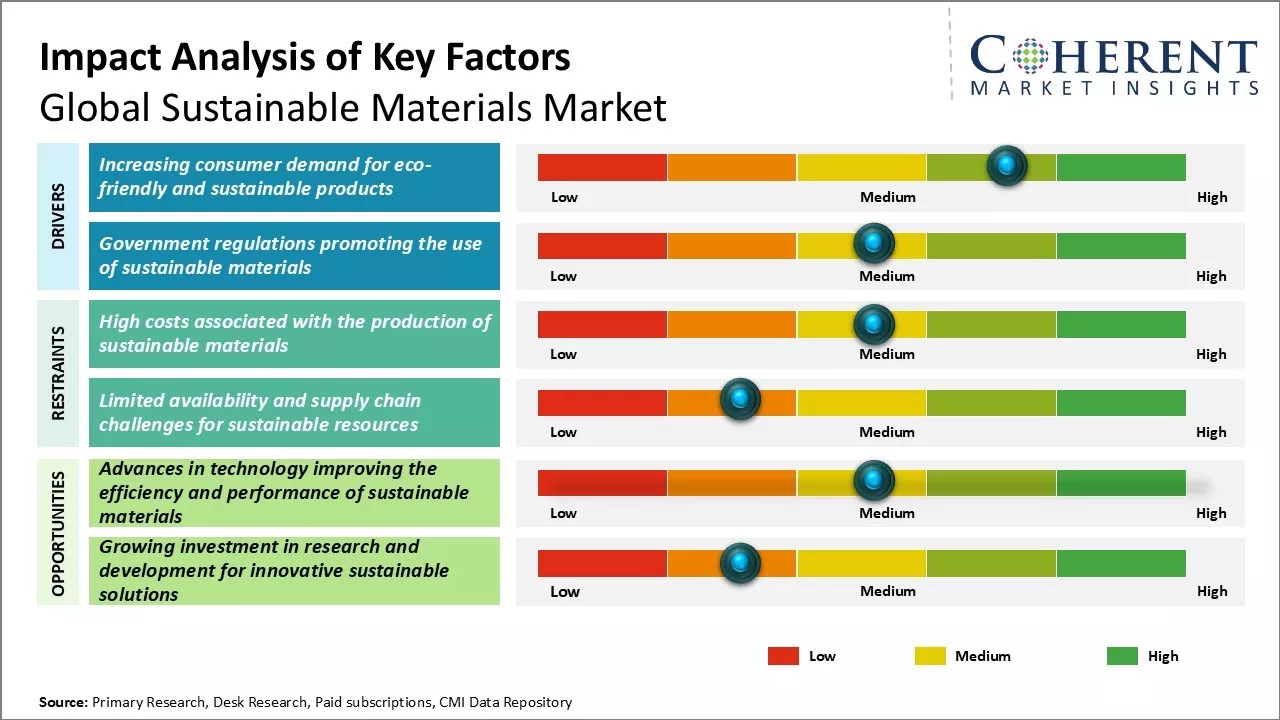
- Increasing consumer demand for eco-friendly and sustainable products
Consumer awareness of environmental issues and the desire to reduce carbon footprints have grown significantly, driving demand for products made with eco-friendly materials and processes. Consumers are willing to pay a premium for items with eco-labels and green certifications.
This shift in preferences is fueling the growth of the sustainable materials industry. Companies across sectors are embracing recycled, bio-based, and lower-carbon materials, with many clothing brands launching collections made from organic cotton, bamboo, or recycled polyester.
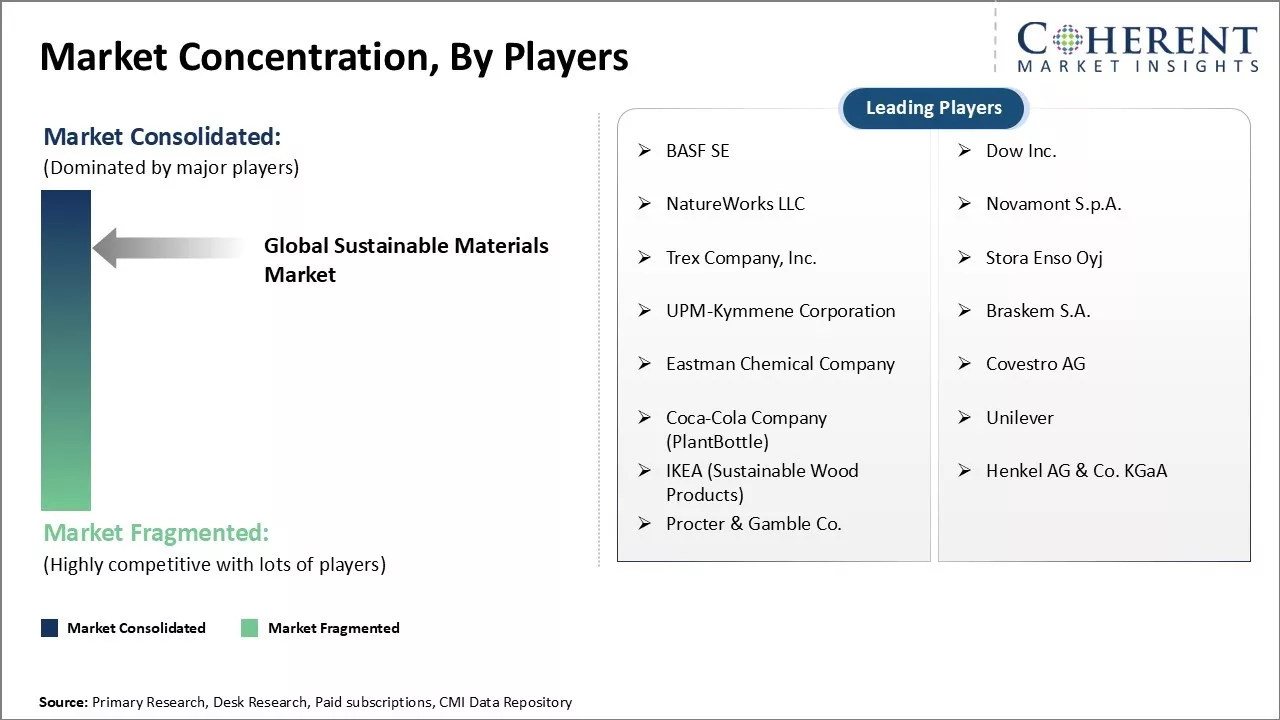
Market Concentration and Competitive Landscape
Sustainable Materials Market: Restraints
- High costs associated with the production of sustainable materials
One of the major challenges in the market is the high costs associated with the production of these materials. Producing sustainable materials requires extensive research and development to make the materials as environmentally friendly as possible while also maintaining performance standards. This level of R&D drives up initial production costs significantly.
Additionally, sustainable materials often require more intricate and sophisticated production processes than traditional materials. Setting up facilities with the necessary equipment and technology to manufacture sustainable materials at scale also increases capital expenditures.
Sustainable Materials Market: Trends
- Increasing growth of food packaging industry in Asia Pacific is trending in the market
Asia Pacific has presence of large population pool, and the region is witnessing expansion of disposable income among customers, due to which food packaging industry is one of the major markets in the region. Moreover, technological developments across countries in the region are enabling premium food manufacturers to deliver unique food choices in long-lastingly and sustainable manner.
- Increasing digital transformation of enterprises around the world is a growing trend
Due to digital transformation of enterprises, the emergence of automation powered by digital technologies such as AI and robotics is increasing around the world. This is likely to help companies reduce cost of manufacturing. The use of robotic filling equipment allows packagers to create more than they can with manual product filling.
This technology can enable dependable, repeatable, and consistent fill with every cycle, whether the fill is based on a volume, level, weight, or another measurement. Thus, growing digital transformation of enterprises to fuel growth of the global Sustainable Materials market during the forecast period.
Sustainable Materials Market: Opportunities
- Advances in technology improving the efficiency and performance of sustainable materials for market
One major opportunity for the market growth lies in continued advances in technologies that can improve the efficiency and performance of these materials. As research into sustainability accelerates, innovative new production techniques and material formulations are enhancing performance while reducing costs.
For example, new bio-based plastics attain properties similar to traditional oil-based plastics. Improved material properties expand the viable applications for sustainable options. With further technology innovations, sustainable materials could eventually meet or exceed the efficiency, functionality, and price points of conventional alternatives.
Sustainable Materials Market: Key Developments
- February 2025, DaklaPack US, the market leader in kitting solutions, innovative green packaging, medical packaging and shipping materials, has announced the launch of its new website. The new website has been expertly designed to showcase its diverse range of sustainable packaging solutions. With increased accessibility and the introduction of easy-to-navigate service categories, the new website delivers a more immersive and user-friendly experience.
- February 2025, Mondi and Proquimia have collaborated to create paper-based, stand-up pouches for dishwashing tabs in Spain and Portugal. The sustainable packaging and paper provider, Mondi, has conducted internal product impact assessments that demonstrate that the new solution has significantly lower CO2 emissions from cradle to gate, compared to plastic solution alternatives.
- May 2025, Materials science company UBQ Materials has launched UBQ Masterbatch – its new product portfolio that the company says is “set to transform manufacturing and supply chains” because the technology turns household waste into plastic. As US landfills are projected to run out of capacity by 2036, UBQ Materials provides a solution to the looming waste crisis.
- October 2024, CRH Ventures, the venture capital unit of CRH, the leading building materials solutions business, announced the launch of its latest accelerator, Sustainable Building Materials. CRH is leading the transition to smarter, more sustainable construction and the Sustainable Building Materials accelerator will target promising Seed-, Series A- and Series B-stage companies in the construction technology and climate tech space with market-ready products. The program aims to identify innovative materials and applications to lower emissions, reduce waste and improve energy use - leveraging CRH’s extensive network and expertise to drive forward innovative and sustainable solutions for the built environment.
Analyst Opinion
- Governments across major nations are implementing stringent regulations to curb carbon emissions and promote usage of eco-friendly substances. This will drive increased demand for sustainable alternatives to conventional materials. Major pain points like waste generation and fossil fuel dependency are also motivating industries to adopt green solutions.
- Recycled plastics and paper will see higher utilization supported by expanding collection and sorting infrastructure. Development of bio-based feedstocks is meanwhile opening up opportunities for substituting petroleum-derived chemicals and composites. Cost competitiveness remains a challenge but ongoing R&D and technology advancements are steadily addressing this. Standards and certifications frameworks need to be harmonized globally to boost transparency and consumer confidence.
- Europe currently dominates owing to proactive policy push while China is the largest producer of many sustainable chemicals. However, other emerging markets like India and Brazil are expected to grow at an accelerated pace supported by rising environmental awareness and an ambitious renewable commitment from their governments. North America will also emerge as an important regional market driven by venture capital investments and startup culture.
Speak to the analyst
Want personalized insights?
Take the findings above to one of our principal consultants, or have the report rebuilt around the segments, geographies and competitors you actually track.
Market Segmentation
- By Material Type Insights (Revenue, USD Bn, 2021 - 2033)
- Biodegradable Plastics
- Recycled Metals
- Natural Fiber Composites
- Sustainable Wood
- By Application Insights (Revenue, USD Bn, 2021 - 2033)
- Packaging
- Construction
- Consumer Goods
- Textiles
- Others
- Regional Insights (Revenue, USD Bn, 2021 - 2033)
- North America
- U.S.
- Canada
- Latin America
- Brazil
- Argentina
- Mexico
- Rest of Latin America
- Europe
- Germany
- U.K.
- Spain
- France
- Italy
- Russia
- Rest of Europe
- Asia Pacific
- China
- India
- Japan
- Australia
- South Korea
- ASEAN
- Rest of Asia Pacific
- Middle East
- GCC Countries
- Israel
- Rest of Middle East
- Africa
- South Africa
- North Africa
- Central Africa
- Key Players Insights
- BASF SE
- Dow Inc.
- NatureWorks LLC
- Novamont S.p.A.
- Trex Company, Inc.
- Stora Enso Oyj
- UPM-Kymmene Corporation
- Braskem S.A.
- Eastman Chemical Company
- Covestro AG
- Coca-Cola Company (PlantBottle)
- Unilever
- IKEA (Sustainable Wood Products)
- Henkel AG & Co. KGaA
- Procter & Gamble Co.
Sources
Primary Research interviews
- Industry Experts (R&D heads, sustainability officers)
- Raw Material Suppliers
- Sustainability Consultants
- Circular Economy Experts
- Government Regulators (Environment Ministries, Green Boards)
- Procurement Heads (FMCG, Automotive, Construction)
- Startups in Sustainable Materials
Databases
- Bloomberg Terminal
- S&P Capital IQ
Magazines
- GreenBiz
- Materials Today
- Sustainable Brands Magazine
- Chemical & Engineering News
- Eco-Business
- Plastics News
- Recycling Today
- Packaging World
Journals
- Journal of Cleaner Production
- Sustainability (MDPI)
- Green Chemistry
- Resources, Conservation and Recycling
- Materials Science for Energy Technologies
- ACS Sustainable Chemistry & Engineering
- Journal of Sustainable Materials and Technologies
- Environmental Science & Technology
Newspapers
- The Guardian (Environment section)
- The New York Times (Climate & Environment)
- Financial Times (Sustainable Business)
- The Economic Times (Energy & Environment)
- Business Standard
- Livemint (Sustainability)
- The Hindu (Science & Tech)
Associations
- Ellen MacArthur Foundation
- World Business Council for Sustainable Development (WBCSD)
- Global Green Growth Institute (GGGI)
- Sustainable Packaging Coalition
- ASTM International
- International Council on Materials Education
- Green Chemistry & Commerce Council (GC3)
Proprietary Elements
- CMI Data Analytics Tool, Proprietary CMI Existing Repository of information for last 8 years
*Definition: Sustainable Materials are devices that allow for the consistent, accurate, and efficient filling of containers with a liquid product. The machines are commonly used in the food, beverage, and pharmaceutical industries. They also serve as a key component of production lines, and are capable of filling bottles, jars, containers, cans, sachets, and pouches.
Get access to 250+ pages report
Every segment, forecast, competitor profile and data table behind the analysis above — available for instant download.
- ESOMAR Member
- ISO 9001:2015 Certified
- D-U-N-S Registered
- GDPR & CCPA Compliant
Missing comfort of reading report in your local language? Find your preferred language:
Transform your Strategy with Exclusive Trending Reports
Frequently Asked Questions
The Sustainable Materials Market size is estimated to be valued at USD 401.50 Bn in 2026, and is expected to reach USD 909.95 Bn by 2033.
The CAGR of the global Market is projected to be 12.4% from 2026 to 2033.
Increasing consumer demand for eco-friendly and sustainable products and government regulations promoting the use of sustainable materials are the major factor driving the growth of the global market.
High costs associated with the production of sustainable materials and limited availability and supply chain challenges for sustainable resources are the major factor hampering the growth of the global market.
In terms of Material Type, Biodegradable Plastics segment is estimated to dominate the market revenue share in 2026.
BASF SE, Dow Inc., NatureWorks LLC, Novamont S.p.A., Trex Company, Inc., Stora Enso Oyj, UPM-Kymmene Corporation, Braskem S.A., Eastman Chemical Company, Covestro AG, Coca-Cola Company (PlantBottle), Unilever, IKEA (Sustainable Wood Products), Henkel AG & Co. KGaA, and Procter & Gamble Co. are the major players.
Europe is expected to lead the global sustainable materials industry in 2026.