

Specialty Valves Market Size and Forecast – 2026 to 2033
The Specialty Valves Market is estimated to be valued at USD 14.56 Bn in 2026 and is expected to reach USD 22.6 Bn by 2033, exhibiting a compound annual growth rate (CAGR) of 7.1% from 2026 to 2033.
Key Takeaways
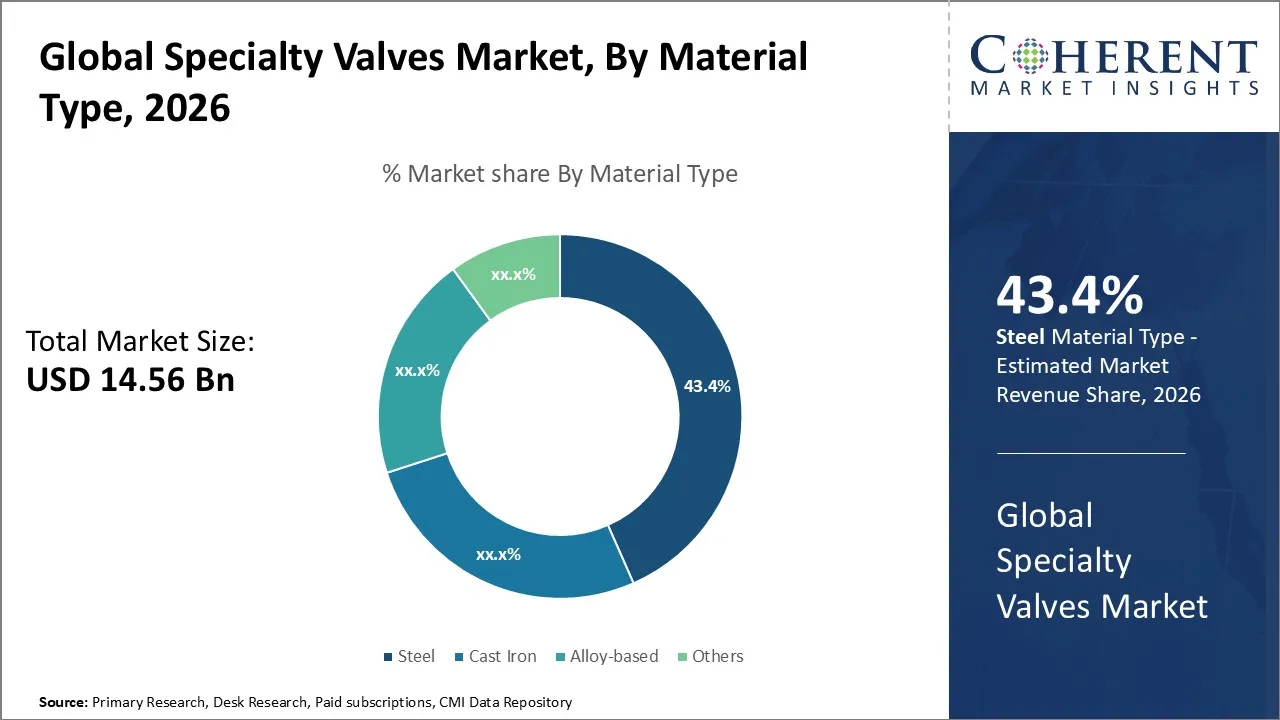
- By Material Type, Steel holds the largest market share of 43.4% in 2026 owing to the core industrial demand for high-performance materials.
- By Valve Type, Ball Valve expected to hold largest market share of 32.6% in 2026 owing to its rapid industrialization & infrastructure development.
- By Application, Oil & Gas acquired the prominent market share of 36.6% in 2026 owing to the rising global energy demand.
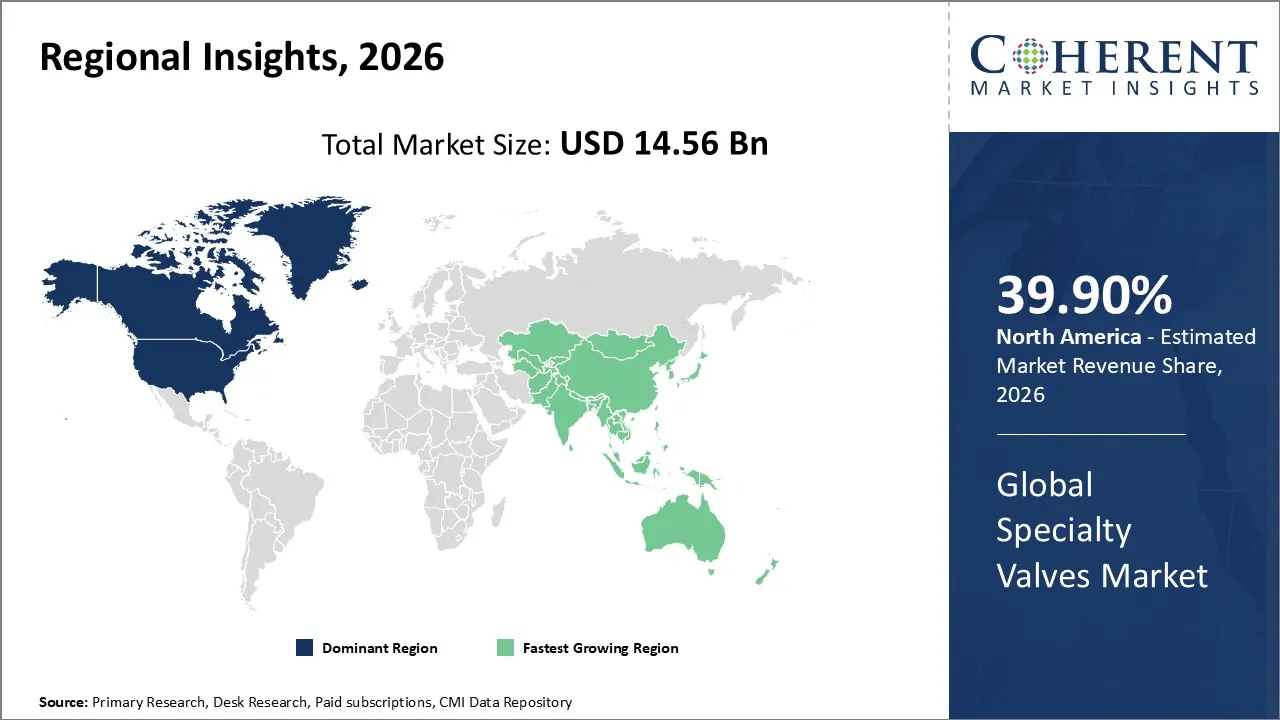
- By Region, North America dominates the overall market with an estimated share of 39.9% in 2026 owing to the strong oil & gas and energy infrastructure.
Market Overview
Rising demand from the oil & gas, power generation, chemical processing, water and wastewater, and industrial manufacturing sectors drives the specialty valves market. These valves play a critical role in controlling flow under high pressure, high temperature, and corrosive operating conditions. Growing infrastructure development, expanding industrial automation, and stricter safety and environmental regulations are accelerating the adoption of advanced and reliable valve solutions. In addition, technological innovation, smart valve integration, and the replacement of aging industrial systems continue to support steady market expansion across both developed and emerging regions.
Current Events and Its Impact on the Specialty Valves Market
Current Events | Description and its impact |
Geopolitical Tensions in Eastern Europe |
|
Growing Environmental Regulations and Sustainability Initiatives |
|
Economic Fluctuations and Market Volatility |
|
Segmental Insights
- Current Industry Events of 2026
- Market Size Estimation
- Regional Breakdown
- Competitive Landscape
- Customer Intelligence
- Segmental Analysis
- Pricing Analysis
- Key Market Drivers, Challenges & Future Trends
- Customized Insights Section
Specialty Valves Market Insights, By Material Type - Steel contributes the highest share of the market owing to its industrial automation & smart manufacturing
Steel holds the largest market share of 43.4% in 2026. Steel strongly drives the specialty valves market by offering high strength, durability, and reliable performance in demanding operating conditions. Industries such as oil & gas, power generation, and chemical processing actively choose steel valves to manage high pressure, extreme temperatures, and corrosive media. Operators seek longer service life, lower maintenance requirements, and improved safety in critical applications, which further increases steel adoption. Moreover, ongoing infrastructure expansion and modernization initiatives continue to boost global demand for steel-based specialty valve solutions. For instance, Henry Pratt Company has launched the Pratt® P77 Perimeter Seated Bi-Directional Knife Gate Valve, designed to manage abrasive slurries in mining and similar industries. Its heavy-duty cast stainless steel body resists deflection from line loads and internal pressure, boosting performance and durability.
Specialty Valves Market Insights, By Valve Type - Ball Valve contribute the highest share of the market owing to its focus on efficiency, sustainability and regulatory compliance
Ball Valve expected to hold largest market share of 32.6% in 2026. Ball valves fuel growth in the specialty valves market by offering a simple structure, fast shut-off operation, and dependable sealing. Industrial users rely on ball valves to achieve efficient flow control, reduce leakage, and support easy integration with automated systems. Their ability to operate under high pressure and high temperature conditions drives widespread use in oil & gas, chemical processing, and water management. Furthermore, rising automation in plants, efficiency-focused operations, and the shift away from conventional valve designs continue to boost ball valve adoption across industries. For instance, in June 2025, Host Michelle Dawn Mooney welcomes Fred Jansen, General Manager of Trillium’s Netherlands facility, and Pepijn Esman, Engineering Manager for Red Point, on a special FlowCast episode to introduce the non-contact Rising Stem Ball Valve (RSBV), designed for extreme-service applications in oil & gas, petrochemical, and power industries.
Specialty Valves Market Insights, By Application - Oil & Gas contribute the highest share of the market owing to its offshore & harsh environment operations
Oil & Gas acquired the prominent market share of 36.6% in 2026. The oil & gas industry drives the specialty valves market by requiring high-performance solutions for exploration, production, refining, and transportation. Companies use specialty valves to control extreme pressures, high temperatures, and corrosive fluids while maintaining safety and meeting regulatory standards. Expanding pipelines, LNG terminals, and offshore projects further boost valve demand. Moreover, the industry’s emphasis on automation, operational efficiency, and upgrading aging infrastructure actively encourages the adoption of advanced, durable, and reliable specialty valves throughout upstream, midstream, and downstream operations.
Regional Insights
North America Specialty Valves Market Trends
North America dominates the overall market with an estimated share of 39.90% in 2026. The North America specialty valves market evolves as industries increasingly implement automation, smart technologies, and digital integration in their processes. Companies actively adopt valves offering greater precision, monitoring, and control to enhance efficiency and safety. Expanding oil & gas, chemical, water treatment, and power sectors drive demand for high-performance, durable valve solutions. Furthermore, ongoing infrastructure modernization, replacement of aging systems, and stricter regulatory and environmental standards actively shape market trends, promoting innovation and broader adoption of advanced specialty valves throughout the region. For instance, in August 2024, Boston Scientific Corporation announced it received CE mark approval for the ACURATE Prime™ Aortic Valve System, the latest addition to its structural heart portfolio. The system enhances the ACURATE neo2™ platform with new features, including an extra valve size to treat patients with larger anatomies.
Asia Pacific Specialty Valves Market Trends
The Asia Pacific specialty valves market expands rapidly as industrialization, urban infrastructure development, and rising energy demand drive growth. Companies in the region increasingly implement advanced valve solutions for oil & gas, chemical processing, power generation, and water treatment applications. Rising investments in smart factories and automated process systems actively promote the use of high-performance, durable valves. Additionally, the modernization of aging infrastructure, enforcement of strict safety and environmental regulations, and a focus on operational efficiency actively shape market trends and accelerate adoption across emerging economies. For instance, in October 2025, Medtronic plc launched the Avalus Ultra™ Bioprosthesis, its next-generation surgical aortic valve, in India. Building on 10 years of Avalus™ clinical experience, the valve is designed for easy implantation, durable performance, and future TAV-in-SAV reinterventions to support long-term patient care.
United States Specialty Valves Market Trends
The United States specialty valves market grows as industries actively adopt automation, digital monitoring, and smart process control to improve efficiency and safety. Energy, chemical, water treatment, and manufacturing sectors drive demand for high-performance, corrosion-resistant, and durable valves. Ongoing infrastructure upgrades, replacement of aging industrial systems, and enforcement of strict regulatory and environmental standards actively shape market dynamics. Companies implement advanced valve technologies to meet these demands, fostering innovation and broad deployment across industrial and utility applications throughout the country. For instance, Edwards Lifesciences Corporation announced FDA approval for aortic and mitral valve-in-valve procedures using its Edwards SAPIEN 3 transcatheter heart valve.
India Specialty Valves Market Trends
The India specialty valves market expands as rapid industrialization, urban infrastructure growth, and rising energy and water demand actively drive valve adoption. Companies in oil & gas, chemical, power, and wastewater treatment sectors implement advanced, high-performance valves to ensure safety, reliability, and operational efficiency. Growing investments in smart manufacturing and automated process systems further promote the integration of durable and precise valve solutions. Additionally, the modernization of aging infrastructure and enforcement of stricter environmental and safety regulations actively shape market trends and accelerate adoption nationwide.
End-user Feedback and Unmet Needs in the Specialty Valves Market
- Demand for Enhanced Reliability and Durability: End-users emphasize the need for valves that can withstand extreme pressures, temperatures, and corrosive media without frequent maintenance or failure. Many industrial operators report downtime caused by premature wear or leakage, highlighting a gap for more robust, long-lasting specialty valves capable of supporting continuous operations in critical processes.
- Integration with Automation and Smart Systems: Users increasingly seek valves compatible with automated and digitally monitored systems to enhance efficiency and safety. Many report challenges in integrating legacy valves with modern control systems, signaling an unmet need for standardized, intelligent valves that allow real-time monitoring, predictive maintenance, and seamless process optimization across facilities.
- Cost-Effective Solutions without Compromising Performance: End-users often express concerns over high procurement and maintenance costs of specialty valves, especially for high-performance materials. There is a growing demand for cost-efficient solutions that maintain reliability, meet safety standards, and reduce lifecycle expenses, particularly in large-scale projects or emerging markets where budget constraints influence equipment selection.
Specialty Valves Market Trend
Adoption of Automation and Smart Technologies
Industries increasingly integrate automation and smart control systems to enhance operational efficiency and safety. Specialty valves with digital sensors, actuators, and remote monitoring capabilities allow real-time performance tracking and predictive maintenance. End-users prefer intelligent valve solutions that reduce manual intervention, optimize process flow, and improve energy efficiency. This trend is particularly prominent in oil & gas, chemical, and power sectors, where precise control and data-driven operations drive demand for advanced valve technologies.
Shift Towards High-Performance Materials
Manufacturers are developing specialty valves using stainless steel, duplex alloys, and corrosion-resistant materials to withstand extreme conditions. Industries require valves that can handle high pressure, temperature fluctuations, and aggressive chemical media. The growing focus on durability, longer service life, and minimal maintenance drives innovation in materials. High-performance valves are increasingly preferred across oil & gas, water treatment, and chemical processing plants, helping companies enhance safety, reduce downtime, and ensure compliance with strict regulatory standards.
Specialty Valves Market Opportunity
Industrial Automation and Smart Factory Integration
As industries adopt smart factories and automated process systems, demand grows for intelligent specialty valves with sensors, actuators, and digital monitoring capabilities. These valves enable real-time process control, predictive maintenance, and energy optimization. Suppliers can capitalize on opportunities to develop solutions compatible with IoT and industrial automation platforms, addressing the increasing need for precision, reliability, and efficiency across chemical, power, water treatment, and manufacturing sectors.
Market Report Scope
Specialty Valves Market Report Coverage
| Report Coverage | Details | ||
|---|---|---|---|
| Base Year: | 2025 | Market Size in 2026: | USD 14.56 Bn |
| Historical Data for: | 2020 To 2024 | Forecast Period: | 2026 To 2033 |
| Forecast Period 2026 to 2033 CAGR: | 7.1% | 2033 Value Projection: | USD 22.6 Bn |
| Geographies covered: |
| ||
| Segments covered: |
| ||
| Companies covered: | L&T Valves, Kirloskar Brothers, Emerson, Flowserve, Hawa Valves, KSB, Cameron, Kitz, AVK, and IMI. | ||
| Growth Drivers: |
| ||
| Restraints & Challenges: |
| ||
Specialty Valves Market News
- In September 2025, Ascension Saint Thomas Rutherford opened its Structural Heart and Valve Center, giving Rutherford County residents local access to advanced cardiovascular care and reducing the need to travel for specialized treatments.
Analyst Opinion (Expert Opinion)
- The Specialty Valves market is currently navigating a structural shift where conventional product offerings increasingly fail to meet sophisticated end‑user expectations. Adoption of smart and sensor‑enabled valves is no longer a niche trend but a business imperative; over 39 % of EPC‑specified valves now include IoT compatibility, reflecting a clear shift toward predictive diagnostics and remote monitoring in critical industries such as oil & gas and power generation.
- It is observed that precision flow control requirements in complex fluid handling systems are intensifying, with operators prioritizing valves that deliver consistent performance under extreme conditions rather than basic mechanical solutions. In harsh environments — for example, hydrogen and ammonia processing — 23 % of R&D investment is directed specifically toward corrosion‑resistant and high‑pressure valve technologies, underscoring how material science is becoming central to product differentiation.
- Despite this momentum, the market is constrained by capital intensity and cost sensitivity. Buyers in mid‑tier and emerging markets often prioritize short‑term installation costs over long‑term reliability, which limits the diffusion of technologically advanced valves despite demonstrable operational advantages. Additionally, raw material volatility and supply chain lead times directly impact production schedules and price stability, adding strategic pressure on manufacturers to optimize supply chain resilience and lean manufacturing practices.
Speak to the analyst
Want personalized insights?
Take the findings above to one of our principal consultants, or have the report rebuilt around the segments, geographies and competitors you actually track.
Market Segmentation
- On the basis of Material Type:
- Cast Iron
- Steel
- Alloy-based
- Others
- On the basis of Valve Type:
- Ball Valves
- Butterfly Valves
- Gate Valves
- Globe Valves
- Plug Valves
- Check Valves
- Diaphragm Valves
- On the basis of Application:
- Oil & Gas
- Power Generation
- Water & Wastewater Treatment
- Chemical
- Food & Beverages
- Others
- On the basis of region:
- Asia Pacific
- China
- India
- Japan
- ASEAN
- Australia
- South Korea
- Rest of Asia Pacific
- North America
- U.S.
- Canada
- Europe
- U.K.
- Germany
- France
- Italy
- Russia
- Rest of Europe
- Latin America
- Brazil
- Argentina
- Rest of Latin America
- Middle East
- GCC
- Israel
- Rest of Middle East
- Africa
- North Africa
- Central Africa
- South Africa
- Asia Pacific
- Key Players Insights
- L&T Valves
- Kirloskar Brothers
- Emerson
- Flowserve
- Hawa Valves
- KSB
- Cameron
- Kitz
- AVK
- IMI
Sources
Primary Research interviews
- Operations managers, engineers, and procurement heads from oil & gas, chemical, power, and water treatment companies
- Plant managers and maintenance supervisors in industrial manufacturing facilities
- Industry experts and technical consultants in valve design and automation
- End-users involved in pipeline, refinery, and industrial infrastructure projects
Databases
- U.S. Energy Information Administration (EIA) database
- International Energy Agency (IEA) statistics and reports
- United Nations Industrial Development Organization (UNIDO) database
- National Energy Board / Ministry of Energy databases from regional markets
Magazines
- Valve World Magazine
- Hydrocarbon Processing Magazine
- Power Engineering International
- Chemical Processing Magazine
Journals
- Journal of Pressure Vessel Technology
- Flow Control Journal
- International Journal of Mechanical Engineering & Robotics Research
- Industrial & Engineering Chemistry Research Journal
Newspapers
- The Wall Street Journal – Industry & Energy Section
- Financial Times – Energy & Industry Section
- The Economic Times – Infrastructure & Energy Section
- The Hindu Business Line – Industrial & Manufacturing News
Associations
- American Water Works Association (AWWA)
- International Society of Automation (ISA)
- American Petroleum Institute (API)
- Valve Manufacturers Association of America (VMA)
Public Domain sources
- Government energy and infrastructure project reports
- Technical standards and guidelines (ISO, ANSI, API)
- Patent databases for valve technologies
- Industry white papers and technical case studies
Proprietary Elements
- CMI Data Analytics Tool
- Proprietary CMI Existing Repository of information for last 8 years
Get access to 250+ pages report
Every segment, forecast, competitor profile and data table behind the analysis above — available for instant download.
- ESOMAR Member
- ISO 9001:2015 Certified
- D-U-N-S Registered
- GDPR & CCPA Compliant
Missing comfort of reading report in your local language? Find your preferred language:
Transform your Strategy with Exclusive Trending Reports
Frequently Asked Questions
The Specialty Valves Market is estimated to be valued at USD 14.56 Bn in 2026 and is expected to reach USD 22.6 Bn by 2033.
The CAGR of the Specialty Valves Market is projected to be 7.1% from 2026 to 2033.
Key end-user industries include oil & gas, chemical processing, power generation, water and wastewater treatment, and industrial manufacturing.
Challenges include high initial investment costs, technical complexity, skilled workforce requirements, raw material availability, supply chain constraints, and difficulties in retrofitting valves into existing or legacy systems.
Sustainability and energy efficiency trends are driving demand for valves that minimize leakage, optimize flow, and reduce energy consumption.