

Global Structural Steel Market Size and Share Analysis – Growth Trends and Forecasts (2026-2033)
Structural Steel Market is estimated to be valued at USD 97.7 Mn in 2026 and is expected to reach USD 146.3 Mn in 2033, exhibiting a compound annual growth rate (CAGR) of 5.9% from 2026 to 2033.
Key Takeaways
- Based on Application, Infrastructure segment is expected to dominate the global market over the forecast period with 36% market share.
- Based on Type, Hot-rolled Steel segment is expected to dominate the global market over the forecast period.
- Asia Pacific is estimated to hold the 60% market share of the global structural steel market over the forecast period.
Market Overview
The global structural steel market is witnessing consistent growth, led by increasing demand in infrastructure, commercial real estate, and industrial manufacturing sectors. Urbanization, increased investments in smart city developments, and worldwide efforts towards resilient and sustainable infrastructure are major drivers for this growth. The strength, flexibility, and affordability of structural steel make it a material of choice for high-rise structures, bridges, industrial facilities, and residential complexes.
Current Events and its Impact on the Market
Current Events | Description and its impact |
Green Steel Technology Advancements |
|
UK Government’s Zero-Carbon Steel Plant Investment |
|
Global Structural Steel Market Drivers
- Increasing industrialization across developing countries to augment market growth
According to a report from International Monetary Fund (IMF), in 2021, around 37 emerging countries accounted for 80% of the global population, and approximately 70% of the global gross domestic product (GDP) growth was generated through emerging economies. Agriculture, oil & gas, automotive, construction, manufacturing, and pharmaceutical industries are major industries that are witnessing strong demand. Thus, rapid industrialization will favor the market growth of structural steel.
- Eco-friendly nature of structural steel to foster market growth
A major advantage of using structural steel in construction is that 90% of all steel that's used in a structure can be recycled and reused. This means that no new material will be needed to build the structure, making it a very environmentally friendly way to create buildings.
Unlike wood and other materials, steel does not decompose when left in the ground for a long period of time. This makes it ideal for use in large outdoor structures, such as bridges and towers. It is a great material to work with as it is relatively easy to fabricate, and it can be shaped into just about any desired shape. This allows architects to design structures that they can't with other materials.
In 2024, the structural steel sector continued to prove its environmental stewardship through a number of impressive undertakings. A key illustration is the "Uniting on Second" affordable housing development in Adelaide, Australia. The $37 million complex, in which Kennett, UnitingSA, and Renewal SA joined forces, involves a 'material bank' system intended to record and recycle building materials such as steel beams and pre-cast concrete at the project's lifecycle completion.
Global Structural Steel Market Opportunities
Increasing use of structural steel over other construction materials is expected to provide significant growth opportunities. Often architects and contractors are using structural steel over other building materials, such as brick or wood because of the many benefits it offers.
The flexibility of steel allows architects to design structures that are not restricted by a traditional rectangular shape. It can be rolled, curved or integrated into irregular shapes and it is also relatively fast to fabricate, making it an excellent choice for projects that need to be completed quickly.
Growing number of partnership and acquisition in the market is expected to serve additional market opportunities for key players. For instance, in February 2022, Trimble announced that Zamil Steel, a global marketer in Engineering and manufacturing of various high-quality steel products and the Middle East’s premier supplier of Pre-Engineered steel buildings and structural steel products, has chosen its software, including Tekla PowerFab, to transform steel fabrication in its factories in India, Saudi Arabia, Egypt, and Vietnam.
Global Structural Steel Market Trends
- Growing focus on energy efficient infrastructure
Structural steel is fire-resistant and can withstand extreme temperatures. This makes it a safe building material that can be used in a variety of construction environments, from residential to commercial. Typical applications of structural steel include bridges, pylons, and other structures that support heavy weights. It is also a popular choice for energy efficient infrastructure such as oil and gas pipelines. Hence, growing trend of energy efficient infrastructure is propelling market growth.
- Long-term durability and affordability
The cost of producing structural steel is much lower than other building materials. This makes it an attractive option for building budgets, especially as it’s tensile and compression strengths mean that it can be used to create buildings with a high strength to weight ratio, which is the best way to reduce overall construction costs.
In 2024, the structural steel industry demonstrated its cost-effectiveness and long-term durability through several notable instances. For example, in India, steel prices declined by 3 to 5 percent due to increased supply from imports and a softening global steel market. This reduction in material costs contributed to a moderation in overall construction expenses, despite rising labor costs.
- Current Industry Events of 2026
- Market Size Estimation
- Regional Breakdown
- Competitive Landscape
- Customer Intelligence
- Segmental Analysis
- Pricing Analysis
- Key Market Drivers, Challenges & Future Trends
- Customized Insights Section
Global Structural Steel Market Restraints:
- High costs of the material are hampering market growth
Due to its high strength and durability, steel structures are usually more expensive than other materials like engineered wood or concrete. This is because steel can be a costly material to transport and requires specialized knowledge for fabrication. Hence, high cost is a major factor restricting market growth.
- Insufficient Resistance to Natural Environments
Another major issue with structural steel is its inability to withstand the rigor of nature. Depending on where the steel structure is located, this can pose a problem if it is exposed to extreme weather conditions or even the presence of animals or insects. However, increasing industrialization and urbanization will open new avenue for the market growth.
Segmental Insights
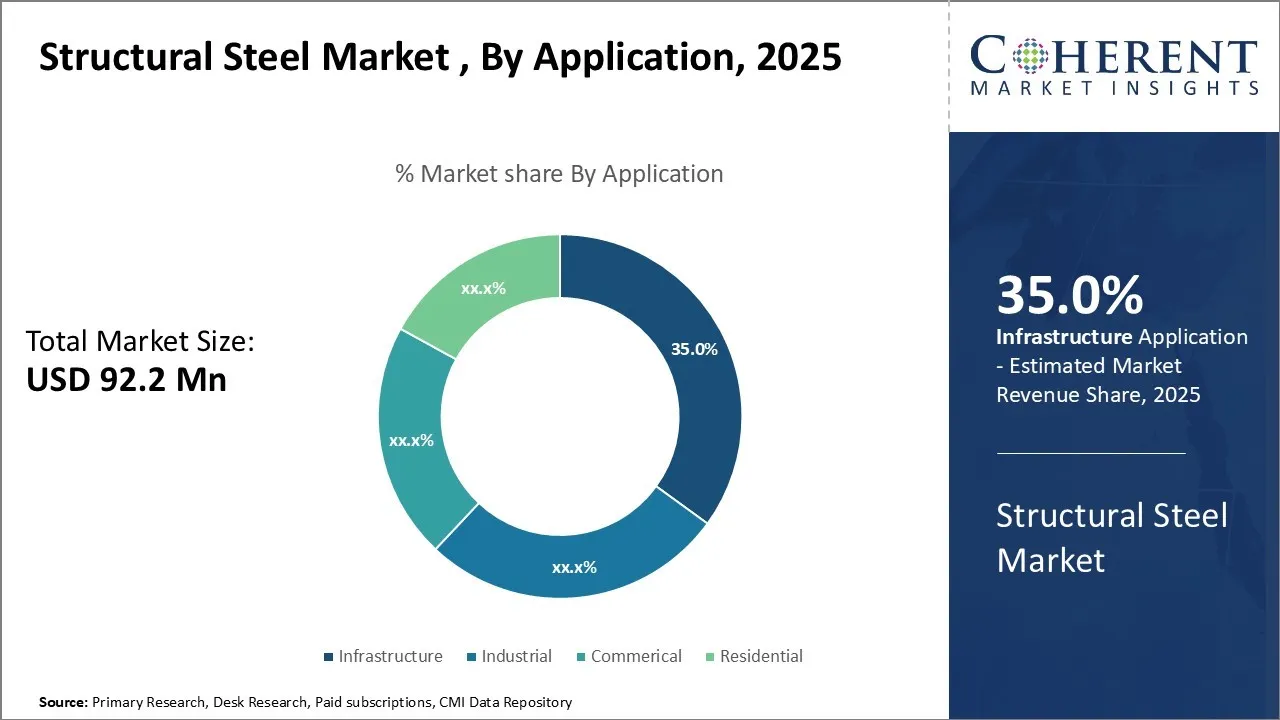
Global Structural Steel Market Insights, by Application
Based on Application, the Infrastructure is expected to dominate the global market with 36% share over the forecast period. Structural steel is a common building material that is used to create strong and durable structures. Structural steel can be made into many different shapes, and it is typically used in the construction of high-rise buildings as well as other structures such as bridges and towers. Residential segment is also expected to witness significant growth in the near future and this is owing to the growing demand for high-rise residential buildings
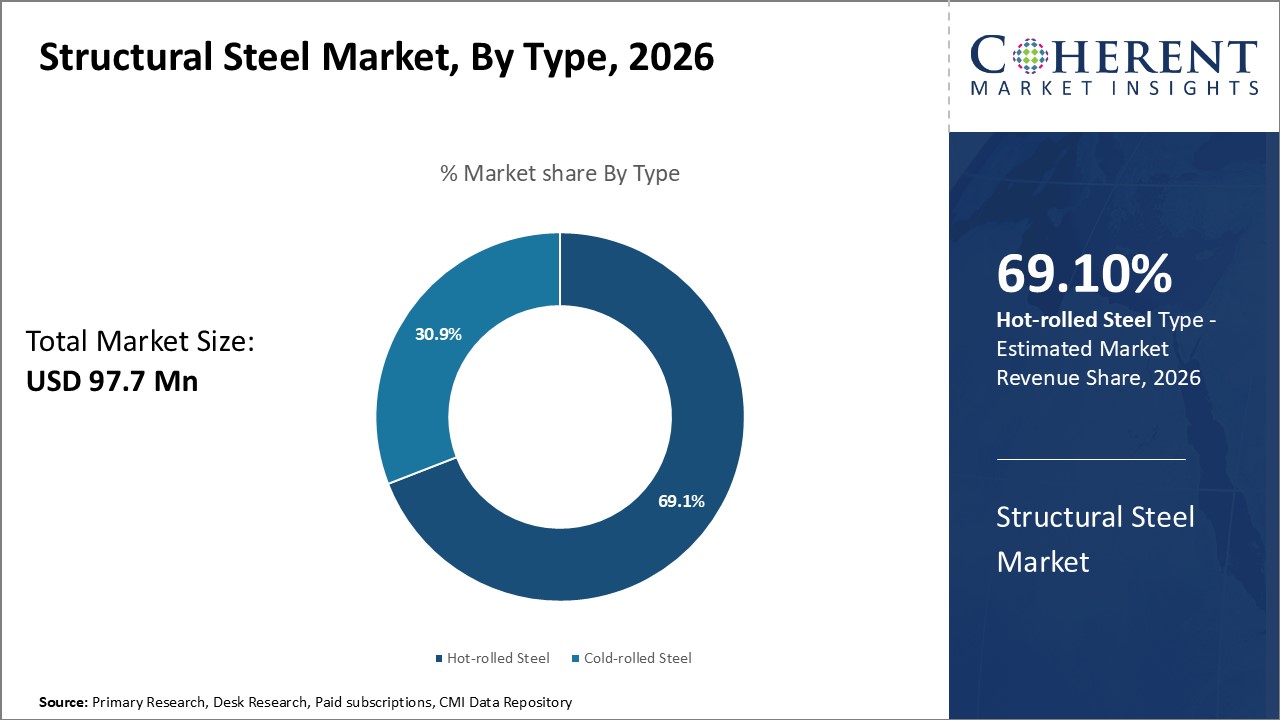
Global Structural Steel Market Insights, by Type
Based on Type, the Hot-rolled Steel is expected to dominate the global market over the forecast period. They require less processing which makes them less expensive. They are ideal for applications where dimensional tolerances are less critical than total material strength is not a big problem. Cold-rolled Steel segment is also expected to witness significant growth in the near future and this is owing to their better dimensional and mechanical properties.
Global Structural Steel Market: Regional Insights
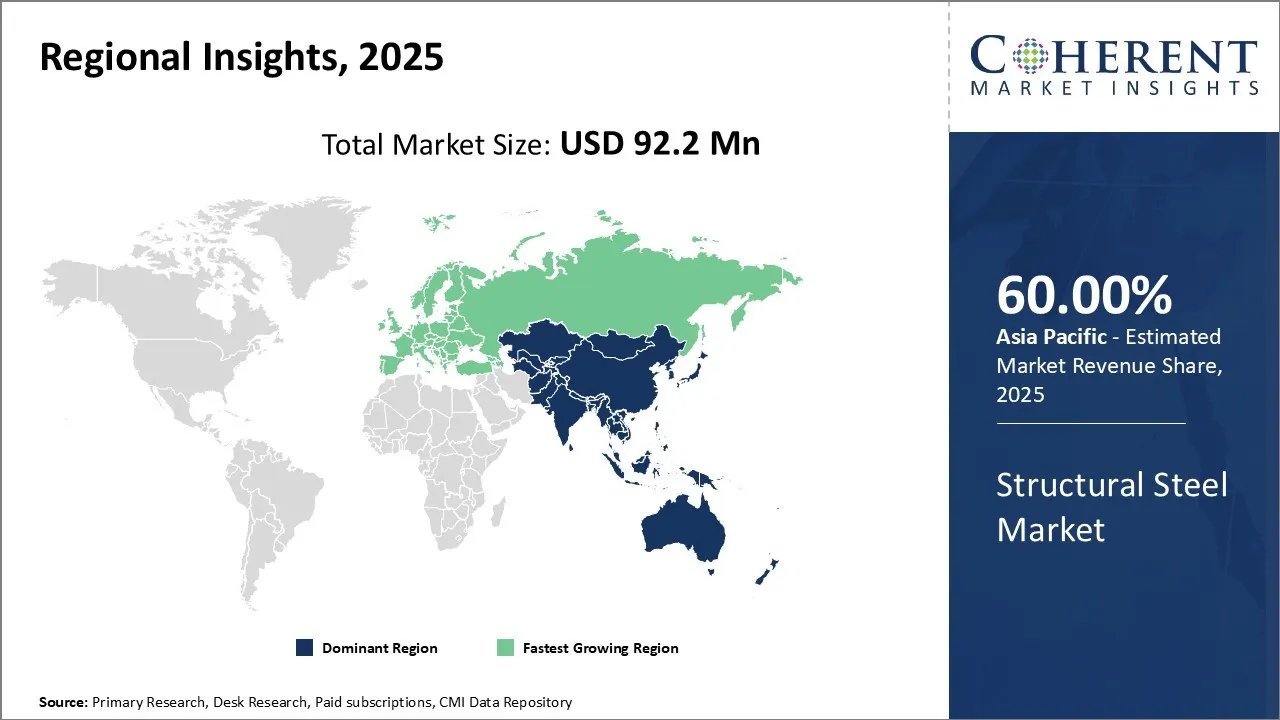
Asia Pacific Structural Steel Market Analysis and Trends
Asia Pacific is estimated to hold the largest share of the global structural steel market over the forecast period. The region is expected to witness robust growth due to the rising population and government initiatives for improving housing conditions. In addition, the increase in infrastructure development is likely to boost the structural steel market growth.
Global Structural Steel Market Dominating Countries
China Structural Steel Market Analysis and Trend
China is the world's biggest producer and consumer of structural steel, and it produces more than half of the world's steel. Its vast infrastructure projects, urbanization, and robust manufacturing sector propel its dominance. China maintains influence over global prices and supply chains despite moves to curb overcapacity and emissions.
India Structural Steel Market Analysis and Trend
India is becoming a significant player in the structural steel industry, supported by government policies such as "Make in India" and huge infrastructure, railway, and housing investments. With expanding domestic demand and rising exports, India's steel sector will be a major force in world supply in the next few years.
United States Structural Steel Market Analysis and Trend
The American structural steel industry is driven by investment in modernization of roads, bridges, and public buildings. In addition to emphasis on domestic production and environmentally friendly building practices, the American steel industry is turning towards Electric Arc Furnace (EAF) technology to cut emissions and enhance efficiency.
Market Report Scope
Structural Steel Market Report Coverage
| Report Coverage | Details | ||
|---|---|---|---|
| Base Year: | 2025 | Market Size in 2026: | USD 97.7 Mn |
| Historical Data for: | 2020 To 2024 | Forecast Period: | 2026 To 2033 |
| Forecast Period 2026 to 2033 CAGR: | 5.9% | 2033 Value Projection: | USD 146.3 Mn |
| Geographies covered: |
| ||
| Segments covered: |
| ||
| Companies covered: | Arcelormittal, Nippon Steel Corporation, Shougang, Tata Steel, Hyundai Steel, Anyang Iron & Steel Group Co., Ltd., British Steel, China Ansteel Group Corporation Limited, Emirates Steel, Evraz Plc, And Gerdau S/A | ||
| Growth Drivers: |
| ||
| Restraints & Challenges: |
| ||
Global Structural Steel Market: Key Developments
- In February 2024, POSCO effectively developed low-cost, high-performance gigasteel welding technology named PosZET®GIGA. The relevant study was released in Nature Communications. The welding technology has niobium (Nb) and chromium (Cr) elements added to the welding material (welding wire) and achieves a complex and dense mesh structure within the weld metal while enhancing strength and toughness.
Global Structural Steel Market: Key Companies Insights
The global structural steel market is highly competitive. This is attributed to continuous launch of new technologies due to ongoing R &D and efforts by value chain participants. Moreover, key players are adopting various business growth strategies in order to expand their presence on regional as well as global basis. Some of the key players in the global structural steel market are Arcelormittal, Nippon Steel Corporation, Shougang, Tata Steel, Hyundai Steel, Anyang Iron & Steel Group Co., Ltd., British Steel, China Ansteel Group Corporation Limited, Emirates Steel, Evraz Plc, And Gerdau S/A
Analyst View
- Structural steel continues to witness major momentum worldwide based primarily on the growing use of sustainable and environmentally-friendly building processes. Growing awareness of the advantages of structural steel in the form of high durability, strength, ease of construction, and recyclability continues to drive good market dynamics.
- Fast-paced urbanization coupled with growing investments in infrastructure development in the emerging economies highly propels the demand for structural steel, which creates positive market momentum.
- Yet unstable raw material prices, mostly because of fluctuating steel costs, are a significant hindrance to market stability. Uncertainty in such an environment burdens manufacturers and users alike with added difficulties in approximating long-term project costs, thus discouraging uninterrupted market growth.
- Regionally, Asia-Pacific stands out as the region with the highest level of production and consumption, fuelled by widespread industrialization and tremendous residential and commercial building development. Along with the emerging markets of India and China, territories like North America and Europe present significant opportunities in conjunction with infrastructure redevelopment projects and added emphasis on environmental-friendly construction practices.
- In the future, industry players strategically positioning themselves around technology breakthroughs and geographic expansion, especially into economies with lively construction activity, are well-positioned for long-term market momentum and competitive edge.
Market Segmentation
- Global Structural Steel Market , By Application (Revenue, USD Mn, 2021 - 2033)
- Infrastructure
- Industrial
- Commercial
- Residential
- Global Structural Steel Market , By Type (Revenue, USD Mn, 2021 - 2033)
- Hot-rolled Steel
- Cold-rolled Steel
- Global Structural Steel Market , By Geography (Revenue, USD Mn, 2021 - 2033)
- North America
- U.S.
- Canada
- Latin America
- Brazil
- Mexico
- Argentina
- Rest of Latin America
- Europe
- Germany
- U.K.
- France
- Italy
- Spain
- Russia
- Rest of Europe
- Asia Pacific
- China
- India
- Japan
- Australia
- South Korea
- ASEAN
- Rest of Asia Pacific
- Middle East
- GCC
- Israel
- Rest of Middle East
- Africa
- South Africa
- Central Africa
- North Africa
- Company Profiles
- Arcelormittal
- Nippon Steel Corporation
- Shougang
- Tata Steel
- Hyundai Steel
- Anyang Iron & Steel Group Co., Ltd.
- British Steel
- China Ansteel Group Corporation Limited
- Emirates Steel
- Evraz Plc
- Gerdau S/A
Sources
Primary Research Interviews
- Structural Steel Manufacturers
- Structural Steel Suppliers & Distributors
- Industry Consultants
- End-use Industry Experts
- Others
Databases
- Factiva
- MarketWatch
- Bloomberg
- Others
Magazines
- Modern Steel Construction
- Steel Times International
- Engineering News-Record (ENR)
- Others
Journals
- Journal of Constructional Steel Research
- Steel and Composite Structures
- International Journal of Steel Structures
- Others
Newspapers
- The Economic Times
- Business Standard
- Financial Times
- Others
Associations
- World Steel Association
- American Institute of Steel Construction (AISC)
- European Steel Association (EUROFER)
- Others
Public Domain Sources
- United States Geological Survey (USGS)
- International Trade Administration (ITA)
- Organization for Economic Cooperation and Development (OECD)
- Others
Proprietary Elements
- CMI Data Analytics Tool
- Proprietary CMI Existing Repository of information for last 8 years
*Definition: Structural steel is the most commonly used building material across all areas of construction. It has many advantages over other materials such as concrete, wood and masonry, and it can be fabricated into an endless variety of shapes and sizes.
Get access to 250+ pages report
Every segment, forecast, competitor profile and data table behind the analysis above — available for instant download.
- ESOMAR Member
- ISO 9001:2015 Certified
- D-U-N-S Registered
- GDPR & CCPA Compliant
Missing comfort of reading report in your local language? Find your preferred language:
Transform your Strategy with Exclusive Trending Reports
Frequently Asked Questions
The Structural Steel Market size is estimated to be valued at USD 97.7 Mn in 2026, and is expected to reach USD 146.3 Mn by 2033.
The CAGR of the global Market is projected to be 5.9% from 2026 to 2033.
Increasing industrialization across developing countries and eco-friendly nature of structural steel are fuelling the market.
The infrastructure segment is the leading in application segment in the market.
High costs of the material is the major factors restraining the market.
Arcelormittal, Nippon Steel Corporation, Shougang, Tata Steel, Hyundai Steel, Anyang Iron & Steel Group Co., Ltd., British Steel, China Ansteel Group Corporation Limited, Emirates Steel, Evraz Plc, And Gerdau S/A