

Smart Materials Market Size and Forecast — 2026 - 2033
The Global Smart Materials Market size is estimated to be valued at USD 45.20 billion in 2026 and is expected to reach USD 89.50 billion by 2033, exhibiting a compound annual growth rate (CAGR) of 10.2% from 2026 to 2033.
Overview
Smart materials products include materials that respond dynamically to external stimuli such as temperature, pressure, light, electric fields, or magnetic fields. Key product categories include piezoelectric materials, shape memory alloys, electrochromic materials, magnetostrictive materials, and self-healing materials. These products are widely used across industries such as aerospace, automotive, construction, healthcare, electronics, and energy. Applications range from sensors, actuators, and adaptive structures to smart coatings, medical implants, and wearable devices. Their ability to enhance performance, efficiency, durability, and functionality makes smart materials increasingly important in advanced and next-generation technologies.
Key Takeaways
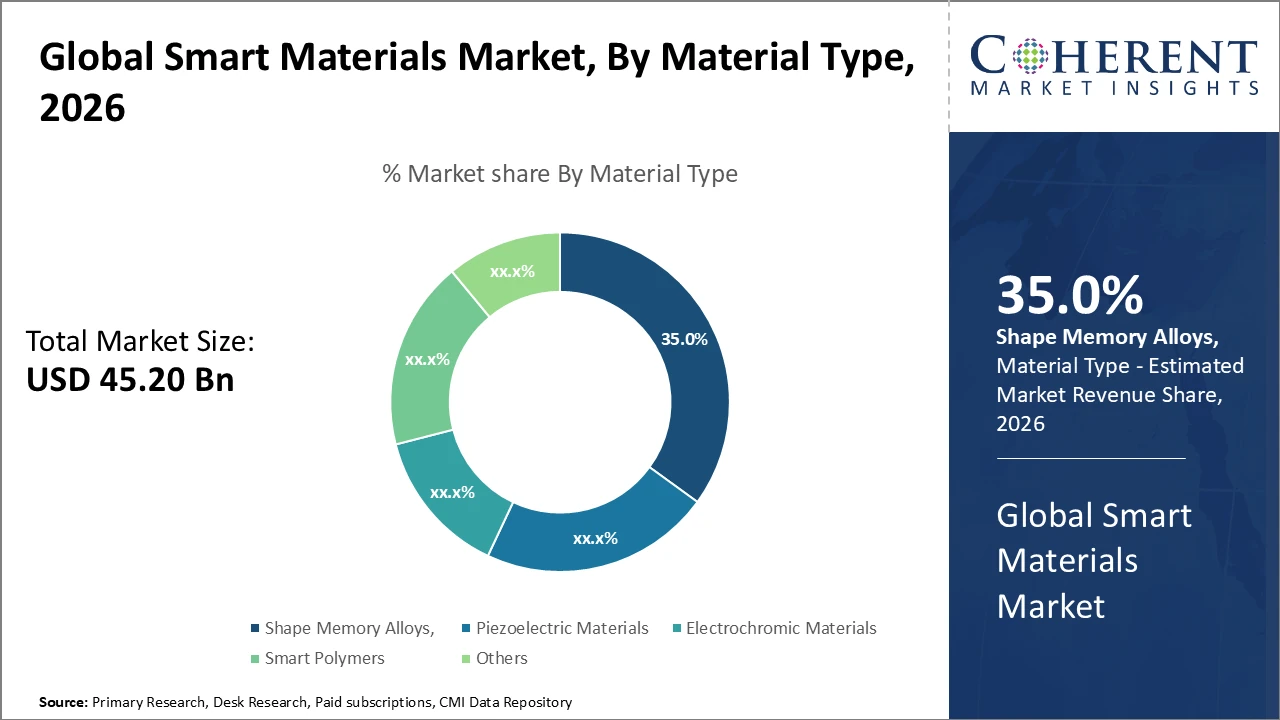
Shape memory alloys dominate the market with a 35% share, supported by strong demand in aerospace applications due to superior fatigue resistance, reliability, and adaptability in dynamic operating environments.
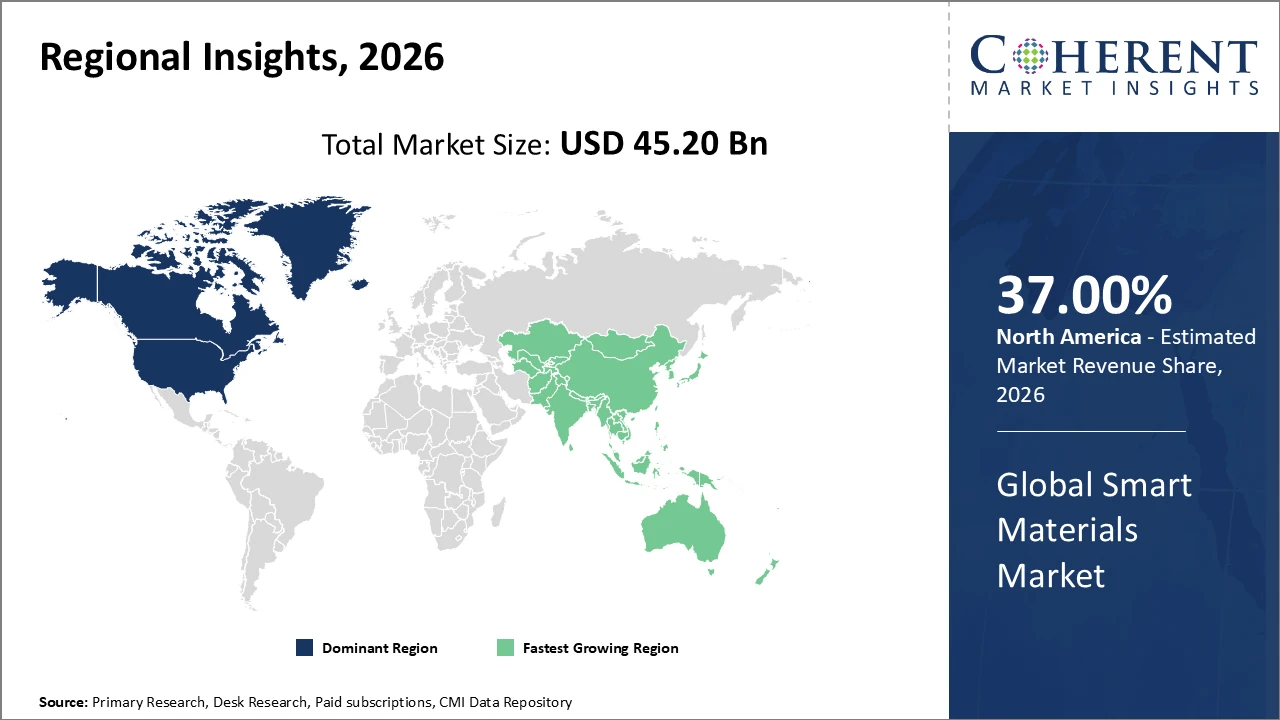
North America holds the largest regional market share, benefiting from technological leadership, supportive regulatory frameworks, and a high concentration of major smart material manufacturers.
Asia Pacific is the fastest-growing region, fueled by expanding manufacturing bases in China and India, increasing export activities, and government incentives promoting smart material research and innovation.
Smart Materials Market Segmentation Analysis
Smart Materials Market Insights, By Material Type
Shape Memory Alloys dominate the market due to their ability to retain and recover their original shape, making them essential in aerospace structural components where durability, flexibility, and fatigue resistance are critical. Sustained investment in this segment is driven by its contribution to fuel efficiency and structural reliability. Piezoelectric Materials are the fastest-growing subsegment, supported by rising adoption in medical devices and precision sensors, alongside rapid advancements in actuation performance. Electrochromic Materials are gaining traction for smart windows and displays that enhance energy efficiency. Smart Polymers show strong potential in flexible electronics, while other emerging materials focus on multi-responsive functionalities.
Smart Materials Market Insights, By Technology
Electroactive Polymers hold the dominant market share due to their multifunctional properties and proven use in soft robotics, medical devices, and adaptive consumer products. Their high flexibility, low weight, and energy efficiency make them a core revenue-generating technology. Magneto-Rheological Fluids are the fastest-growing segment, driven by rising adoption in automotive suspension systems and vibration damping applications that enhance vehicle performance and ride comfort. Thermochromic Materials are increasingly used in smart windows and temperature sensors, supporting sustainability initiatives. Photovoltaic Materials, while niche, are critical for self-powered smart devices. Other emerging nanomaterials continue to expand the functional capabilities of smart material systems.
Smart Materials Market Insights, By Application
Aerospace & Defense leads the market due to strong demand for lightweight, adaptive materials that meet strict safety and performance requirements, capturing the largest industry share. These materials are widely used in fuel-efficient aircraft structures and advanced defense wearables. Healthcare & Medical Devices is the fastest-growing application segment, driven by innovations in biomaterials for implantables, smart prosthetics, and diagnostic tools, supported by advances in electroactive polymers and piezoelectric sensors. Automotive applications benefit from smart composites that improve vehicle efficiency and safety. Consumer Electronics adopt smart polymers and coatings for wearables and flexible devices, while Construction is emerging with thermochromic and energy-efficient materials enhancing building sustainability.
Smart Materials Market Trends
The smart materials market is shifting toward multifunctional materials that combine sensing, actuation, and self-healing capabilities.
In 2025, electroactive polymers with integrated self-healing mechanisms advanced notably in consumer electronics, extending product lifespans by 35%.
Integration of AI with smart materials is accelerating, enabling adaptive systems capable of real-time environmental response.
This trend was demonstrated by AI-enabled smart coatings in aerospace in 2024, which reduced maintenance costs by 15%.
There is growing emphasis on eco-friendly and bio-based smart materials to support sustainability objectives.
Companies increased R&D investments by over 22% in 2025, reflecting alignment with global environmental and regulatory goals.
Smart Materials Market Insights, By Geography
North America Smart Materials Market Analysis and Trends
In North America, the Smart Materials market is led by technological expertise, robust industry infrastructure, and supportive government policies that promote innovation hubs. The United States, in particular, drives demand through its aerospace and healthcare sectors, extensively using shape memory alloys and piezoelectric materials. Strong R&D investment by major corporations further reinforces the region’s leadership, fostering the development of advanced multifunctional materials. This combination of industrial strength, government support, and sector-specific adoption positions North America as a dominant player in the global smart materials landscape.
Asia Pacific Smart Materials Market Analysis and Trends
The Asia Pacific region is the fastest-growing market for smart materials, achieving a CAGR exceeding 12% in recent years. Growth is driven by expanding manufacturing hubs in China and India, where government incentives promote smart materials development and innovation. Increasing exports from the region have further strengthened business expansion, while cost-effective production provides a competitive advantage. Additionally, a growing number of domestic and international market players are establishing a strong presence, accelerating technology adoption across sectors such as electronics, automotive, and healthcare. These factors collectively position Asia Pacific as a rapidly emerging leader in the global smart materials market.
Smart Materials Market Outlook for Key Countries
USA Smart Materials Market Analysis and Trends
The USA plays a pivotal role in the growth of the smart materials market, hosting leading companies specializing in shape memory alloys and electroactive polymers. In 2025, U.S.-based firms accounted for over 35% of total market revenue, driven by strong demand from the aerospace sector and rising adoption in healthcare applications. Government funding supporting defense and medical research has strengthened the industry’s position, while strategic collaborations among key players have accelerated innovation and commercialization of advanced smart materials. These factors collectively reinforce the United States as a central hub for technological advancement and market leadership in smart materials.
Germany Smart Materials Market Analysis and Trends
Germany is a key player in the European smart materials market, driven by its strong engineering base, advanced manufacturing capabilities, and focus on Industry 4.0 technologies. The country excels in the development and application of shape memory alloys, piezoelectric materials, and electroactive polymers, particularly in automotive, aerospace, and medical sectors. Government initiatives supporting research and sustainable technologies further bolster growth, while collaborations between universities and industry accelerate innovation. Germany also emphasizes eco-friendly and energy-efficient smart materials, aligning with European sustainability goals. These factors position the country as a leading hub for advanced smart materials research, production, and commercialization in Europe.
Analyst Opinion
The surge in aerospace demand has been a major market driver, with smart composites in 2025 improving fuel efficiency by 15% for several aircraft models. This performance-based adoption allows OEMs to reduce weight while enhancing durability, supporting supply-side growth strategies.
On the demand side, healthcare accelerated imports of smart biomaterials, with hospital procurement rising over 20% in 2024 compared to 2023. Increased use of piezoelectric sensors in wearable medical devices drives market revenue through diversified applications.
Pricing is affected by rare earth element availability for magneto-rheological materials, which saw a 12% price increase in early 2026, prompting innovation toward cost-effective alternatives.
Regionally, Asia Pacific saw a 14% year-on-year increase in smart materials exports in 2025, led by India and China, strengthening the region’s manufacturing ecosystem and rapidly growing market share.
- Current Industry Events of 2026
- Market Size Estimation
- Regional Breakdown
- Competitive Landscape
- Customer Intelligence
- Segmental Analysis
- Pricing Analysis
- Key Market Drivers, Challenges & Future Trends
- Customized Insights Section
Market Scope
| Report Coverage | Details | ||
|---|---|---|---|
| Base Year: | 2025 | Market Size in 2026: | USD 45.20 billion |
| Historical Data for: | 2020 To 2024 | Forecast Period: | 2026 To 2033 |
| Forecast Period 2026 to 2033 CAGR: | 10.2% | 2033 Value Projection: | USD 89.50 billion |
| Geographies covered: |
| ||
| Segments covered: |
| ||
| Companies covered: | Advanced Materials Inc., FlexTech Solutions, AeroSmart Composites, MedTech Biomaterials, ThermoTech Innovations, Magno Materials Ltd., NanoMat Systems, BioFlex Materials, SenoTech Electronics, FutureShape Polymers | ||
| Growth Drivers: |
| ||
Smart Materials Market Growth Factors
The growth of the Smart Materials market is driven by several key factors. Rising technological adoption in the automotive and consumer electronics sectors is a major driver, with smart polymers enabling lightweight, intelligent components that increased automotive sector revenue by around 18% in 2025. Increased government investment in aerospace innovation programs, particularly in North America and Europe, has further accelerated growth through long-term contracts and strategic collaborations. The healthcare industry’s development of smart biomaterials for minimally invasive procedures led to a 20% rise in demand in 2024, creating new market opportunities. Additionally, sustainability initiatives promoting smart construction materials, such as thermochromic windows, support energy-efficient building solutions and contribute to a growing revenue stream.
Smart Materials Market Development
In February 2026, Bar-Ilan University established Israel’s first Institute for the Synthesis of Smart Materials, advancing the nation’s scientific and technological capabilities.
Key Players
Leading Companies of the Market
Advanced Materials Inc.
FlexTech Solutions
AeroSmart Composites
MedTech Biomaterials
PolyShape Technologies
ElectroSmart Devices
Magno Materials Ltd.
NanoMat Systems
BioFlex Materials
FutureShape Polymers
Leading companies have strengthened their competitive advantage through strategic initiatives. Advanced Materials Inc., for example, expanded production capacity by 30% in 2025, enabling it to capture a larger market share in aerospace applications while improving supply chain efficiency and reinforcing its position in high-performance smart materials. Similarly, MedTech Biomaterials focused on aggressive R&D investment in hybrid smart polymers, resulting in a 25% increase in patent filings in 2024. This bolstered its innovation pipeline, enhanced product differentiation, and reinforced its presence in healthcare and medical device markets, demonstrating the significant impact of targeted research and development on market leadership.
Smart Materials Market Future Outlook
The Smart Materials market is poised for robust growth, driven by increasing demand across aerospace, healthcare, automotive, and consumer electronics. Future trends include the development of multifunctional materials combining sensing, actuation, and self-healing properties, as well as AI-enabled adaptive systems capable of real-time environmental response. Sustainability will play a key role, with eco-friendly and energy-efficient materials gaining prominence in construction and industrial applications. Advances in manufacturing technologies and rising R&D investments are expected to expand application possibilities and reduce costs. Overall, continued innovation, technological integration, and regulatory support will shape a dynamic and rapidly evolving global smart materials market.
Smart Materials Market Historical Analysis
The Smart Materials market has experienced steady growth over the past decade, driven by technological advancements and increasing adoption across key industries. Historically, aerospace and defense were primary growth drivers, with shape memory alloys and smart composites enhancing performance, fuel efficiency, and structural durability. The healthcare sector also contributed significantly, with early adoption of piezoelectric sensors and electroactive polymers in medical devices. Automotive and consumer electronics gradually embraced smart polymers and coatings for lightweight, flexible, and adaptive applications. Market expansion was supported by government R&D funding, strategic collaborations, and emerging manufacturing hubs in Asia Pacific, laying the foundation for the market’s current rapid growth trajectory.
Sources
Primary Research Interviews:
Materials Scientists and Engineers
R&D Heads of Smart Materials Companies
Product Designers in Aerospace, Automotive, and Healthcare
Manufacturers of Electroactive Polymers, Shape Memory Alloys, and Piezoelectric Devices
Databases:
World Intellectual Property Organization (WIPO) Patent Data
Magazines:
Materials Today
Smart Materials & Structures
Advanced Materials Today
CompositesWorld
Design News
Journals:
Smart Materials and Structures Journal
Advanced Functional Materials
Materials Science and Engineering: A
Journal of Intelligent Material Systems and Structures
Progress in Materials Science
Newspapers:
Financial Times (Technology & Materials)
The Economist (Science & Innovation)
The Wall Street Journal (Materials & Manufacturing)
TechCrunch (Materials Technology)
MIT Technology Review (Materials & Engineering)
Associations:
International Association of Smart Materials
European Materials Research Society
American Society for Materials (ASM International)
Society for Biomaterials
International Institute for Advanced Materials
Get access to 250+ pages report
Every segment, forecast, competitor profile and data table behind the analysis above — available for instant download.
- ESOMAR Member
- ISO 9001:2015 Certified
- D-U-N-S Registered
- GDPR & CCPA Compliant
Missing comfort of reading report in your local language? Find your preferred language:
Transform your Strategy with Exclusive Trending Reports
Frequently Asked Questions
Leading companies include Advanced Materials Inc., FlexTech Solutions, and MedTech Biomaterials, who collectively influence market dynamics through innovation and strategic expansion.
The market size is projected to grow from USD 45.2 billion in 2026 to approximately USD 89.5 billion by 2033, reflecting strong market growth supported by expanding applications.
The aerospace segment remains the largest growth driver, given the increasing use of smart composites and alloys to improve fuel efficiency and structural performance.
Emerging trends include multifunctional smart materials, AI integration, and bio-based alternatives, which will shape the market forecast and drive innovation.
The market is characterized by intense competition among established players focusing on R&D and vertical integration; challenges include raw material price volatility and technology adoption barriers.
Leading companies employ strategic partnerships, capacity expansions, and innovation-driven product launches to gain market share and penetrate various end-use industries.