

Hcl Leaching High Purity Alumina Market Size and Forecast — 2026 - 2033
The global HCl leaching high purity alumina market is projected to be valued at USD 1.35 billion in 2026 and is anticipated to reach USD 3.05 billion by 2033, growing at a compound annual growth rate (CAGR) of 11.8% during the forecast period from 2026 to 2033.
Overview
Products in the HCl leaching high purity alumina (HPA) market primarily include 4N (99.99%), 5N (99.999%), and 6N (99.9999%) purity grades, each tailored for advanced applications. These products are manufactured using hydrochloric acid leaching processes that ensure high purity and consistency. HPA is widely used in LED substrates, lithium-ion battery separators, semiconductor wafers, and sapphire glass production. The product portfolio also includes powders, granules, and customized forms designed for specific industrial requirements. Manufacturers focus on ultra-low impurity levels, uniform particle size distribution, and high thermal stability to meet stringent performance standards across electronics, energy storage, and optical industries.
Key Takeaways
In terms of purity grade, the 99.99% purity grade dominates the market, accounting for over 60% of the total share, driven by its extensive use in electronics and battery materials.
In terms of process type, the continuous leaching process leads with around 58% share due to its efficiency and scalability advantages.
In terms of applications, electronics and semiconductors contribute more than 40% of market revenue, whereas battery materials represent the fastest-growing segment, registering a CAGR above 12% due to increasing electric vehicle adoption.
Asia Pacific holds the largest market share at nearly 55%, supported by strong production capacity and favorable government policies in countries like China and Japan, while North America shows the fastest growth with a CAGR of about 13%, driven by increasing imports and efforts to strengthen local supply chains for battery and semiconductor industries.
HCL Leaching High Purity Alumina Market Segmentation Analysis
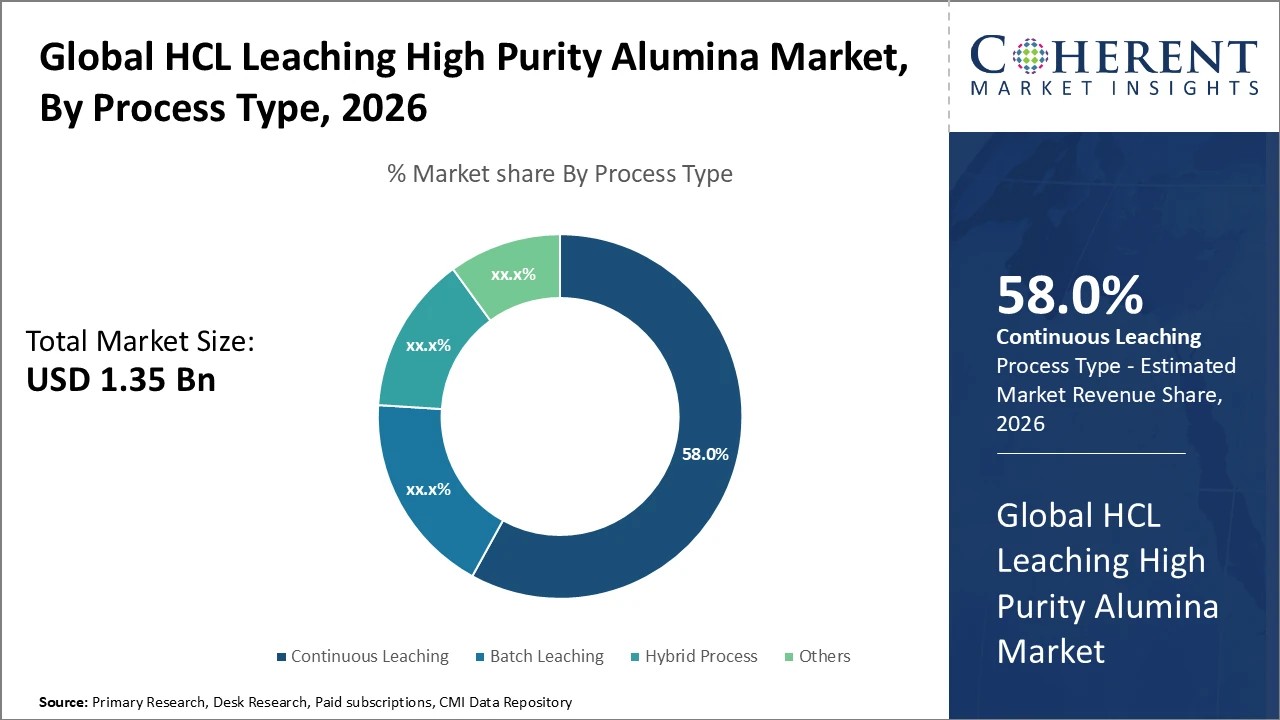
HCL Leaching High Purity Alumina Market Insights, By Process Type
Continuous leaching dominates the market with approximately 58% share, driven by efficient acid utilization, high throughput, and lower operational costs, making it ideal for large-scale production.
The hybrid process is the fastest-growing segment, as it combines the advantages of both batch and continuous methods, offering greater flexibility and improved control for producing specialty high purity alumina grades. Batch leaching remains relevant for smaller facilities and customized, low-volume production requirements.
The ‘others’ category includes emerging and proprietary techniques being developed to enhance process efficiency, reduce environmental impact, and meet stricter regulatory standards in high purity alumina manufacturing.
HCL Leaching High Purity Alumina Market Insights, By Purity Grade
The 99.99% purity grade dominates the market due to its wide applicability in electronics and battery materials, offering an optimal balance between cost and performance. Its strong demand is supported by consistent quality for semiconductor applications and scalability for battery-grade alumina production.
The fastest-growing segment is the 99.999% purity grade, driven by rising demand for ultra-high purity alumina in advanced LED technologies and optical devices requiring minimal impurities.
Other grades, including 99.995% and 99.9995%, serve niche uses in specialized ceramics and high-end optics, while remaining grades cater to cost-sensitive and emerging applications with moderate purity needs.
HCL Leaching High Purity Alumina Market Insights, By Application
Electronics and semiconductors dominate the market due to high demand for sapphire substrates and wafer production, contributing the largest revenue share. Growth is supported by continuous advancements in consumer electronics and semiconductor technologies.
Battery materials are the fastest-growing segment, driven by rapid electric vehicle adoption and increasing use in portable electronics requiring high purity alumina for separators and cathode coatings. Optical and LED devices maintain steady growth with rising global LED adoption. Ceramic coatings are emerging as a key application for surface enhancement in industrial equipment.
The ‘others’ segment includes specialized uses in aerospace and defense materials requiring high-performance properties.
HCL Leaching High Purity Alumina Market Trends
The market is witnessing a strong shift toward greener leaching technologies, particularly in countries like China and Japan, focusing on reducing environmental impact and improving sustainability.
Increasing adoption of advanced process automation is enhancing operational efficiency, consistency, and scalability in high purity alumina production facilities.
Closed-loop acid recovery systems are gaining traction, helping manufacturers lower both environmental footprint and operating costs through efficient acid reuse.
Technological advancements are delivering measurable results, such as a facility in Japan achieving around a 15% reduction in acid consumption in 2025.
Supply chain regionalization is accelerating in United States and broader North America, driven by geopolitical factors and increasing demand from battery manufacturing hubs.
HCL Leaching High Purity Alumina Market Insights, By Geography
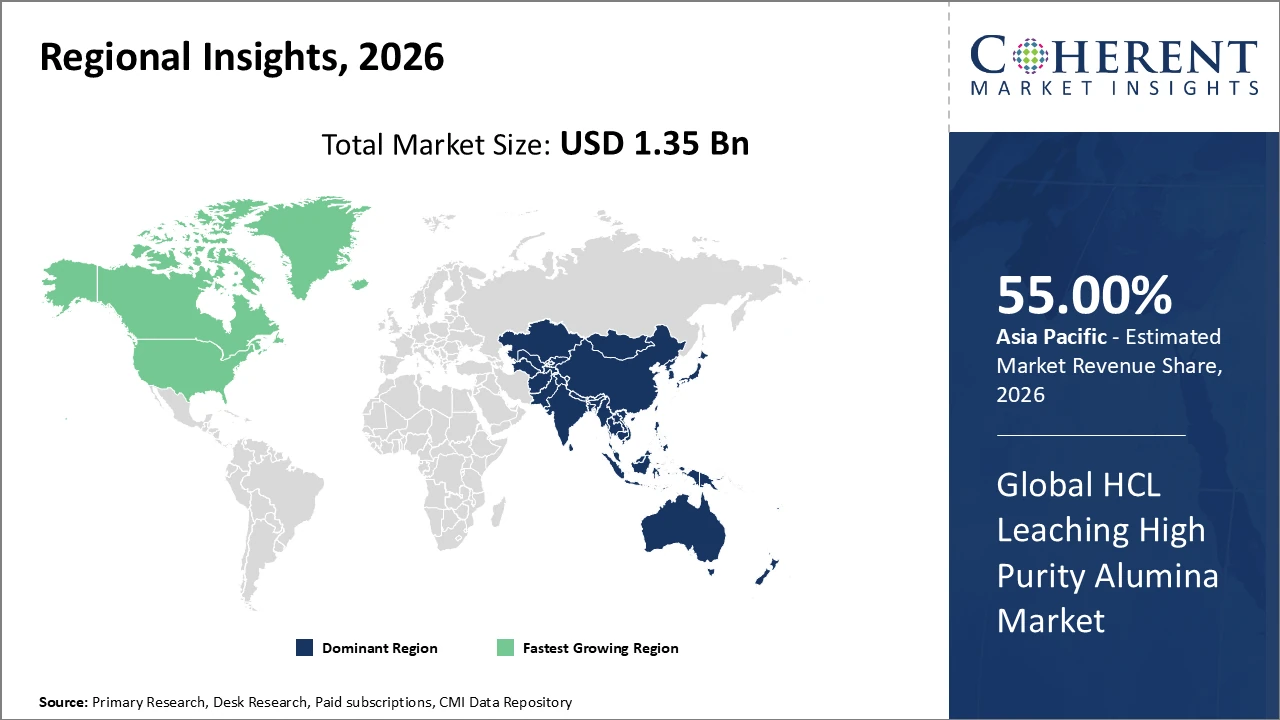
Asia Pacific HCL Leaching High Purity Alumina Market Analysis and Trends
Asia Pacific dominates the HCl leaching high purity alumina market, accounting for nearly 55% of the global share. This leadership is driven by strong industrial ecosystems in China and Japan, supported by extensive production infrastructure and favorable government policies promoting advanced materials manufacturing. The region benefits from close integration with electronics and electric vehicle battery supply chains, ensuring steady demand. Key companies such as Showa Denko K.K. and Tokuyama Corporation enhance market stability through localized production, reducing reliance on imports and minimizing supply chain disruptions.
North America HCL Leaching High Purity Alumina Market Analysis and Trends
North America is the fastest-growing region, with a CAGR of around 13%, driven by rising demand for battery-grade alumina linked to rapid electric vehicle adoption. Government incentives supporting clean technologies and domestic manufacturing are accelerating investments in local refining capacity, particularly in the United States. The presence of major industry players such as Alcoa Corporation strengthens regional capabilities, while increasing imports from Asian countries help meet growing demand. These factors collectively contribute to a dynamic and evolving market landscape, positioning North America as a key growth hub in the high purity alumina industry.
HCL Leaching High Purity Alumina Market Outlook for Key Countries
USA HCL Leaching High Purity Alumina Market Analysis and Trends
The HCl leaching high purity alumina market in the United States is expanding rapidly, driven by strong growth in the electric vehicle and semiconductor industries. In 2025, HPA imports increased by over 30%, reflecting rising demand for lithium-ion battery cathodes and sapphire substrates used in semiconductor wafers. Federal initiatives focused on strengthening domestic supply chains have encouraged investments in advanced production facilities utilizing continuous leaching and improved acid recovery systems. Major players such as Alcoa Corporation are collaborating with battery manufacturers to develop specialized HPA grades, enhancing performance and reinforcing the country’s competitive position.
Germany HCL Leaching High Purity Alumina Market Analysis and Trends
Germany’s HCl leaching high purity alumina market is evolving amid strong growth in electronics, LED lighting, and battery materials sectors. The broader high purity alumina market in the country is expanding rapidly, with projections showing significant revenue growth through the early 2030s, supported by increasing use of 4N-grade products in key industrial applications. Demand in Germany benefits from advanced manufacturing capabilities, rising EV adoption, and integration with European supply chains, while innovation in production technologies, including HCl leaching, seeks to improve cost efficiency and product quality. Challenges include high production costs and competition from hydrolysis-based processes, but strategic industry investments continue to shape the market.
Analyst Opinion
Strong demand-driven capacity expansion: Production of HCl leaching HPA grew over 20% in 2025, driven by rising lithium-ion battery demand. Key manufacturers in Asia Pacific increased capacity using green HCl recycling technologies, achieving a 15% reduction in production costs by early 2026, boosting regional market share.
Pricing dynamics and cost optimization: HCl leaching HPA prices remained stable in 2024–2025 despite raw material fluctuations, supported by optimized leaching processes and enhanced acid recovery. Closed-loop acid recovery in 2025 cut operational costs by ~12%, enabling competitive pricing while maintaining semiconductor-grade purity.
End-use diversification driving revenue: Electronics, especially sapphire substrates and LED wafers, contributed over 40% of 2025 revenue. Emerging battery applications in EVs led to a 30% rise in North American HPA imports in 2026, increasing demand for high-purity grades.
Regional import/export trends: Asia Pacific remained the largest exporter from 2024–2026, with ~55% of global shipments. North America and Europe saw rising imports due to supply chain localization and environmentally compliant production practices, reshaping global market dynamics.
- Current Industry Events of 2026
- Market Size Estimation
- Regional Breakdown
- Competitive Landscape
- Customer Intelligence
- Segmental Analysis
- Pricing Analysis
- Key Market Drivers, Challenges & Future Trends
- Customized Insights Section
Market Scope
| Report Coverage | Details | ||
|---|---|---|---|
| Base Year: | 2025 | Market Size in 2026: | USD 1.35 billion |
| Historical Data for: | 2020 To 2024 | Forecast Period: | 2026 To 2033 |
| Forecast Period 2026 to 2033 CAGR: | 11.8% | 2033 Value Projection: | USD 3.05 billion |
| Geographies covered: |
| ||
| Segments covered: |
| ||
| Companies covered: | Tokuyama Corporation, Sasol Limited, Alcoa Corporation, Sumitomo Chemical Co. Ltd., Nippon Light Metal Co. Ltd., Baosteel Group, Showa Denko K.K., U.S. Aluminum Company | ||
| Growth Drivers: |
| ||
HCL Leaching High Purity Alumina Market Growth Factors
Growth in electric vehicle and portable electronics manufacturing remains a key driver of the HCl leaching high purity alumina market, increasing demand for battery-grade HPA due to its high purity and processing efficiency. Rising consumption of sapphire substrates in smartphone and LED industries further supports growth, with Asia Pacific reporting a 25% volume increase in 2026. Strict environmental regulations are promoting eco-friendly production, accelerating adoption of HCl leaching with efficient acid recovery systems. Technological advancements in leaching processes improve yield, reduce processing time, and enhance product availability, enabling manufacturers to meet escalating global demand across electronics, energy storage, and optical applications.
HCL Leaching High Purity Alumina Market Development
In January 2025, an Australian critical minerals manufacturer secured a significant supply agreement with a major Japanese electronics company to support semiconductor cooling systems, alongside plans to construct a new USD 553 million high purity alumina refinery in Queensland aimed at commencing production by 2026, strengthening Australasia’s role in advanced materials supply.
Also in 2025, Alpha HPA Limited continued expansion of its HPA First Project in Gladstone, Queensland, advancing Stage 2 construction while maintaining continuous production at Stage 1, underscoring commercial scaling of proprietary HPA technologies for electronics and battery applications.
Key Players
Leading Companies of the Market
Tokuyama Corporation
Sasol Limited
Alcoa Corporation
Sumitomo Chemical Co. Ltd.
Nippon Light Metal Co. Ltd.
Baosteel Group
U.S. Aluminum Company
Showa Denko K.K.
Competitive strategies in the HCl leaching high purity alumina market commonly involve vertical integration to secure raw material supply and forward integration into downstream battery material production. In 2025, Tokuyama formed a strategic partnership with battery manufacturers, resulting in a 10% revenue increase through the supply of customized HPA grades. Similarly, Sasol Limited focused on research and development to enhance continuous leaching technology, achieving over an 18% improvement in operational efficiency by 2026. These approaches demonstrate how leading companies leverage collaboration and technological innovation to strengthen market position and meet growing demand in electronics and battery applications.
HCL Leaching High Purity Alumina Market Future Outlook
The future outlook for the HCl leaching high purity alumina market is highly positive, driven by sustained growth in electric vehicles, portable electronics, and advanced LED applications. Increasing adoption of 5N and 6N purity grades for next-generation semiconductors and optical devices will continue to expand market demand. Technological advancements in continuous and hybrid leaching processes, coupled with efficient acid recovery systems, are expected to improve production yields and reduce environmental impact. Regional markets in Asia Pacific will maintain dominance, while North America and Europe are projected to grow rapidly due to localized production initiatives, government incentives, and rising investment in high-performance battery supply chains.
HCL Leaching High Purity Alumina Market Historical Analysis
The historical analysis of the HCl leaching high purity alumina market shows steady growth over the past decade, driven primarily by expanding electronics, LED, and battery industries. From 2015 to 2025, demand for 4N-grade HPA dominated due to its cost-effectiveness and suitability for large-scale applications, while ultra-high purity grades gradually gained traction in specialized optical and semiconductor uses. Asia Pacific, led by China and Japan, historically accounted for the largest market share owing to extensive production capacity and strong government support. Continuous leaching technology emerged as the preferred method, offering higher efficiency and scalability compared with batch processes, shaping market development trends over the years.
Sources
Primary Research Interviews:
Executives and operations managers at high purity alumina manufacturing plants
Process engineers specializing in HCl leaching, acid recovery, and purification technologies
Technology providers for continuous leaching, hybrid purification, and process automation
Databases:
Bloomberg Terminal
Thomson Reuters Eikon
IHS Markit
Euromonitor International
Orbis
Factiva
Others
Magazines:
Ceramic Industry – High Purity Alumina Applications and Developments
Materials Today – Innovations in Electronic and Optical Materials
Chemical Engineering – HPA Production Processes and Industry News
Industrial Minerals – Specialty Alumina Market Updates
Journals:
Journal of Materials Science – High Purity Alumina and Advanced Ceramics
Journal of Cleaner Production – Sustainable HPA Manufacturing
Ceramics International – Applications of HPA in Electronics and LED Devices
Chemical Engineering Research and Design – Process Optimization in HPA Production
Newspapers:
The Wall Street Journal – Advanced Materials and Specialty Chemicals
Financial Times – HPA Market Trends and Global Trade
Industrial Minerals News – High Purity Alumina Production Updates
Chemical & Engineering News – Specialty Alumina Market Developments
Associations:
American Ceramic Society (ACerS) – High Purity Alumina and Advanced Ceramics
European Ceramic Society – HPA and Specialty Materials Committees
International Aluminium Institute – Alumina Production and Applications
International Council of Chemical Associations (ICCA) – Specialty Chemicals & High Purity Alumina
Get access to 250+ pages report
Every segment, forecast, competitor profile and data table behind the analysis above — available for instant download.
- ESOMAR Member
- ISO 9001:2015 Certified
- D-U-N-S Registered
- GDPR & CCPA Compliant
Missing comfort of reading report in your local language? Find your preferred language:
Transform your Strategy with Exclusive Trending Reports
Frequently Asked Questions
The market is dominated by leading entities such as Tokuyama Corporation, Sasol Limited, Alcoa Corporation, and Sumitomo Chemical Co., Ltd., which collectively drive innovation and production capacity globally.
The market size is projected to grow from USD 1.35 billion in 2026 to USD 3.05 billion by 2033, reflecting a CAGR of 11.8% during this period.
Electronics and Semiconductors, particularly for electric vehicles and portable electronics, exhibits the largest growth opportunity with a CAGR surpassing 12%, supported by expanding EV production.
We anticipate continued adoption of continuous leaching processes, advancements in acid recovery systems, and increased regional production localization to mitigate supply chain risks and adhere to environmental standards.
The market landscape is characterized by high technology adoption and strategic partnerships. Challenges include raw material price volatility and the capital-intensive nature of process improvements necessary to maintain ultrahigh purity levels.
Companies focus on vertical integration, R&D investment, and expansion of production capacities through joint ventures and collaborations with downstream industry players to customize product offerings and secure market share.