

High Purity Alumina Market Analysis & Forecast: 2026-2033
High Purity Alumina Market is estimated to be valued at USD 6,438.4 Mn in 2026 and is expected to reach USD 22,602.9 Mn in 2033, exhibiting a compound annual growth rate (CAGR) of 19.6% from 2026 to 2033.
Key Takeaways
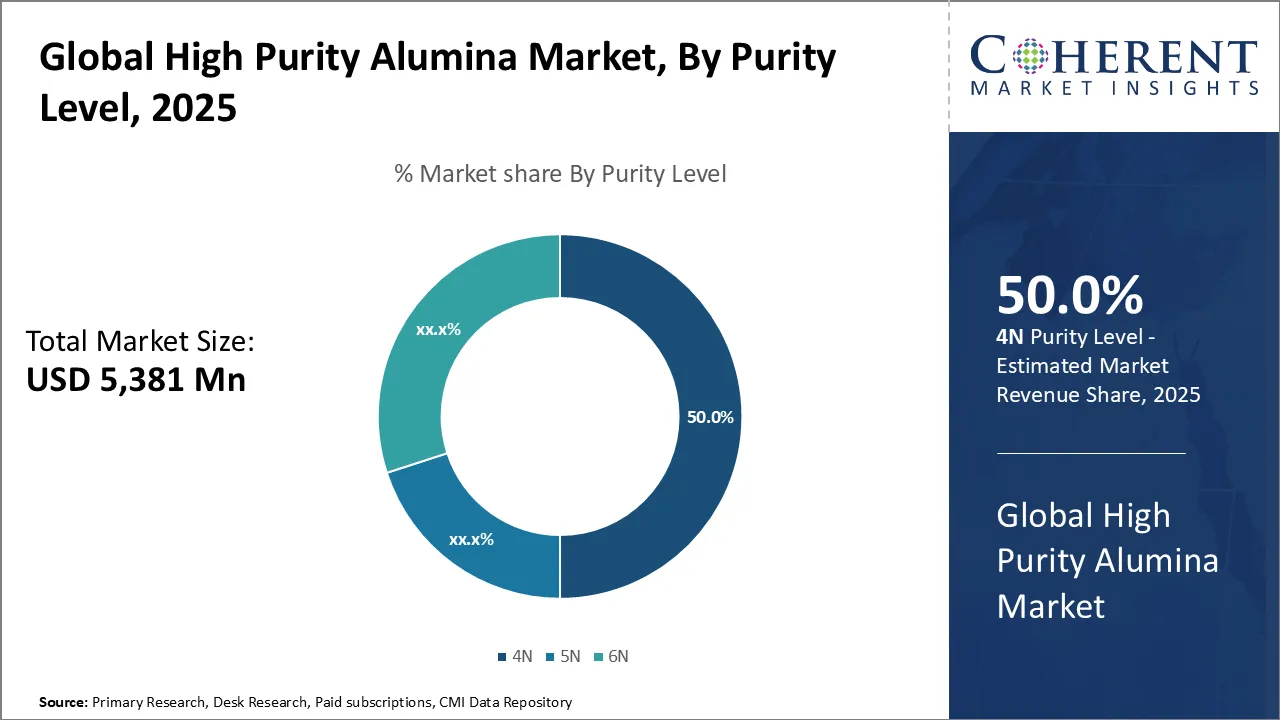
- Based on Purity Level, 4N segment leads the market holding an estimated share of 51% in 2026, as the most cost-effective and widely used grade across mainstream applications.
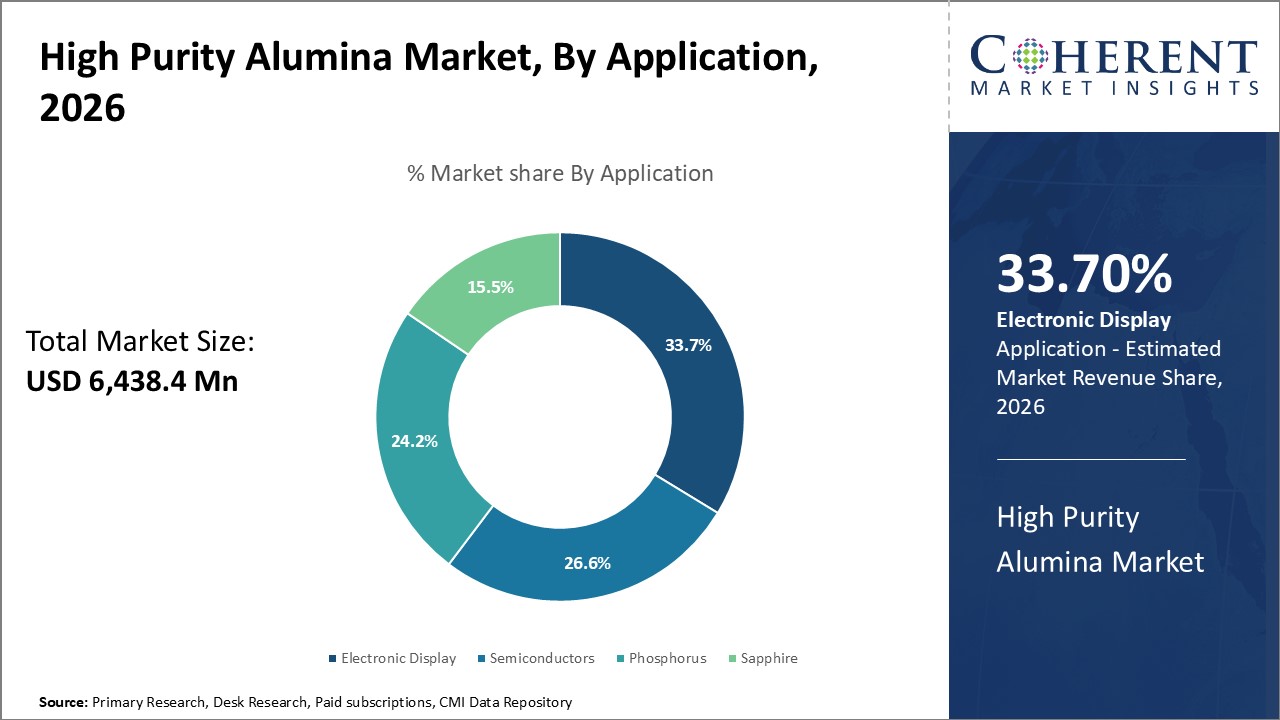
- Based on Application, the Electronic Display segment is projected to dominate with the largest share of the market in 2026, due to rising use of HPA in led and OLED screen manufacturing.
- Based on Technology, the Hydrolysis segment leads the market with its highest share in 2026, favored for its environmental efficiency, lower operational costs, and ability to produce consistent 4N-grade material.
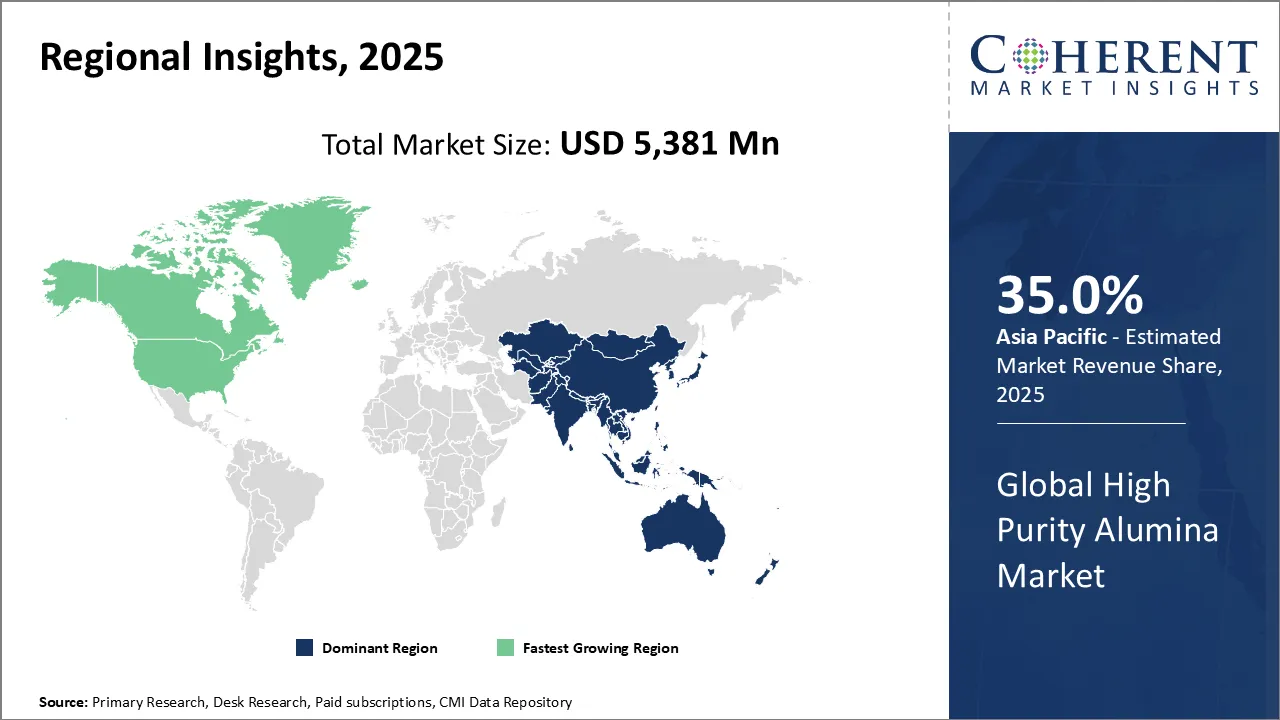
- Based on Region, Asia Pacific is estimated to lead the market with a share of 35% in 2026. While, North America is projected to be the fastest growing region.
Market Overview
The High Purity Alumina Market demand is rising due to its critical role in lithium-ion batteries, LED production, and semiconductor applications. With growing adoption of electric vehicles and energy-efficient lighting, manufacturers are investing in advanced refining technologies. Asia-Pacific remains a key region, driven by strong industrial growth and expanding electronics and energy storage sectors.
Current Events and their Impacts on the High Purity Alumina Market
Current Event | Description and its Impact |
Bauxite Supply Chain Restructuring and Resource Nationalism |
|
Semiconductor Industry Transformation and AI-Driven Demand Acceleration |
|
Segmental Insights
- Current Industry Events of 2026
- Market Size Estimation
- Regional Breakdown
- Competitive Landscape
- Customer Intelligence
- Segmental Analysis
- Pricing Analysis
- Key Market Drivers, Challenges & Future Trends
- Customized Insights Section
High Purity Alumina Market Insights, By Purity Level: 4N Purity Dominates as The Most Cost-Effective and Widely Used Grade
In terms of purity, the 4N segment is projected to capture 51% share of the market in 2026. It offers a balanced combination of performance and cost-effectiveness, making it ideal for mass-market applications such as LED lighting, lithium-ion battery separators, and electronic displays. While higher grades like 5N and 6N are used in specialized fields such as semiconductors and aerospace, their production costs and limited demand keep them niche. The 4N segment dominates due to its scalability and compatibility with mainstream manufacturing processes, especially in Asia-Pacific’s booming electronics and energy sectors.
For instance, in October 2025, Andromeda Metals launched a pilot-scale program for continuous production of 4N high purity alumina (HPA), a key material for LEDs, batteries, and electronics. The initiative aims to validate its proprietary processing technology and support growing demand for cost-effective, high-grade alumina in global advanced manufacturing sectors.
High Purity Alumina Market Insights, By Application: Electronic Displays Lead Market Demand Due to Rising Use of HPA In LED and OLED Screen Manufacturing
In terms of application, the electronic display segment is expected to contribute the highest share of the market in 2026, due to the widespread use of HPA in LED and OLED screens. High purity alumina is essential for manufacturing sapphire substrates, which serve as the base for LEDs used in smartphones, televisions, tablets, and other consumer electronics. As global demand for high-resolution, energy-efficient displays continues to surge, manufacturers are increasingly relying on HPA to ensure durability, brightness, and thermal stability. This segment’s dominance is further reinforced by the rapid expansion of smart devices and digital signage across both developed and emerging markets.
For instance, in March 2025, AEMHPA highlighted the role of High Purity Alumina (HPA) in enabling sustainable manufacturing for the LED and watch sectors. Used in sapphire substrates, 4N HPA enhances durability and energy efficiency in electronic displays and timepieces, supporting eco-friendly innovation across consumer electronics and luxury goods industries.
High Purity Alumina Market Insights, By Technology: Hydrolysis Remains the Preferred Production Method for Its Scalability, Efficiency, And Environmental Benefits
In terms of technology, the hydrolysis segment is expected to hold the largest share of the market in 2026, favored for its environmental efficiency, lower operational costs, and ability to produce consistent 4N-grade material. This method involves the controlled hydrolysis of aluminum alkoxide, yielding high-purity alumina with minimal impurities. Compared to HCL-based processes, hydrolysis is more sustainable and better suited for large-scale production, particularly in regions with stringent environmental regulations. Its widespread adoption by key manufacturers ensures that hydrolysis remains the leading technology, supporting the growing demand for HPA in LEDs, batteries, and display technologies.
Regional Insights
Asia Pacific High Purity Alumina Market Analysis & Trends
The Asia Pacific region, holing an estimated share of 35% in 2026, dominates the high purity alumina market due to the region’s dominance in electronics, LED lighting, and electric vehicle manufacturing. Countries like China, Japan, South Korea, and India are major producers of smartphones, tablets, and TVs, all of which rely on HPA for sapphire substrates in LED displays. Government initiatives promoting energy-efficient lighting and the rapid shift to LED bulbs further fuel HPA consumption. Additionally, the surge in electric vehicle adoption drives demand for HPA in lithium-ion battery separators. With robust industrial infrastructure and rising investments in advanced materials, Asia Pacific continues to expand its HPA footprint.
For instance, in September 2024, construction began on Australia’s first dedicated high purity alumina (HPA) plant in Gladstone, Queensland. Spearheaded by Alpha HPA, the facility will produce 4N-grade HPA for use in LEDs, batteries, and electronics. This milestone positions Australia as a key player in the global advanced materials supply chain.
North America High Purity Alumina Market Analysis & Trends
North America is expected to exhibit the fastest growth in the high purity alumina market due to the region’s strategic push toward advanced manufacturing, clean energy, and semiconductor independence. The United States is ramping up domestic chip production, where HPA plays a vital role in chemical mechanical planarization and thermal interface materials. Simultaneously, the rise of electric vehicles is driving the need for lithium-ion batteries, which use HPA-coated separators for enhanced safety and performance. LED lighting adoption in residential, commercial, and public infrastructure also contributes to growing consumption of 4N-grade HPA. With sustainability goals and technological innovation at the forefront, North America is expanding its HPA footprint.
High Purity Alumina Market Outlook Country-Wise
The U.S. High Purity Alumina Market Trends
The High Purity Alumina (HPA) market in the United States is experiencing strong demand due to its critical role in advanced technologies. HPA is essential for manufacturing lithium-ion battery separators, LED components, and sapphire substrates used in electronics and semiconductors. With the U.S. expanding domestic production of electric vehicles and investing in chip fabrication, the need for high-performance materials like HPA continues to grow. Additionally, efforts to strengthen supply chain resilience and reduce reliance on imports are driving interest in local HPA production. This aligns with broader goals in clean energy, national security, and technological innovation.
For instance, in March 2023, Southern Ionics launched pilot-scale production of high purity alumina (HPA) tailored for lithium-ion battery applications. The initiative aims to support growing demand for ceramic-coated battery separators, enhancing safety and performance in electric vehicles and energy storage systems. This marks a strategic step in advancing U.S.-based HPA capabilities.
Australia High Purity Alumina Market Trends
Australia’s High Purity Alumina (HPA) market is gaining momentum due to its abundant bauxite reserves, which provide a cost-effective and sustainable source for alumina production. The country is investing in advanced manufacturing facilities, such as the Alpha HPA plant in Gladstone, to meet rising global demand for 4N-grade HPA used in LEDs, lithium-ion batteries, and electronic displays. With the growth of electric vehicles and clean energy technologies, domestic consumption is increasing, while export opportunities to Asia-Pacific markets further boost the sector. Australia’s focus on low-carbon production and innovation positions it as a key player in the global HPA supply chain.
For instance, in April 2026, Impact Minerals announced a strategic joint venture to accelerate high purity alumina (HPA) production at its Western Australia project. The partnership aims to meet rising demand for HPA in lithium-ion batteries and LED technologies, positioning the company as a key player in the global advanced materials market.
Market Report Scope
High Purity Alumina Market Report Coverage
| Report Coverage | Details | ||
|---|---|---|---|
| Base Year: | 2025 | Market Size in 2026: | USD 6,438.4 Mn |
| Historical Data for: | 2020 To 2024 | Forecast Period: | 2026 To 2033 |
| Forecast Period 2026 to 2033 CAGR: | 19.6% | 2033 Value Projection: | USD 22,602.9 Mn |
| Geographies covered: |
| ||
| Segments covered: |
| ||
| Companies covered: | Altech Chemicals Limited, Baikowski Pure Solutions, Nippon Light Metal, Polar Sapphire Ltd., Sumitomo Chemical Co. Ltd., Orbite Technologies Inc., and Alcoa Inc. | ||
| Growth Drivers: |
| ||
| Restraints & Challenges: |
| ||
Global High-Purity Alumina Market Drivers
High adoption of LED bulbs over traditional bulbs
The rising adoption of LED bulbs over traditional lighting is significantly boosting the High-Purity Alumina Market size. LEDs require sapphire substrates, which are manufactured using 4N-grade high purity alumina due to its superior thermal conductivity and durability. As consumers and industries shift toward energy-efficient lighting, demand for HPA continues to surge. This trend is further amplified by government initiatives promoting sustainable technologies and the expansion of smart infrastructure. With LEDs dominating residential, commercial, and industrial lighting, manufacturers are scaling up HPA production to meet growing needs, positioning it as a critical material in the global lighting and electronics supply chain.
Global High Purity Alumina Market Trends
Product customization based on Grade and Specific applications to meet End-use industry Demands
High purity alumina is one of the chemical compounds and is used for several end-use applications, especially in the end- use industries. End users always demands for customized, low-Carbon emission, high purity level range of products. In order to meet this demand for customized and tailored products, key manufacturers are focusing on improving product quality as well as its purity level. This factor is also responsible for product innovation, which increases demand and sales in the high purity alumina market.
Analyst Opinion (Expert Opinion)
The high purity alumina market value is experiencing a transformative phase, driven by technological innovations and strategic investments. Production methods are evolving, with hydrolysis currently dominating 88% of the market, while hydrochloric acid leaching is emerging as a highly scalable alternative, projected to grow significantly in the coming years. These technological shifts are crucial to meet the increasing requirements of industries demanding ultra-high-purity materials, particularly semiconductors and LED manufacturing.
Strategic investments are reshaping the global HPA supply chain. Alpha HPA’s $553 million refinery in Queensland, Australia, is set to produce over 10,000 tonnes of HPA annually, supporting semiconductor cooling and other high-tech applications. Similarly, Indonesia’s $941 million smelter-grade alumina refinery in West Kalimantan underscores efforts to strengthen domestic production and downstream processing, reducing reliance on imports.
Geopolitical factors further influence market dynamics. Russia’s 26% stake in India’s Pioneer Aluminium Industries reflects a strategic approach to secure HPA supply amid export restrictions, highlighting the market’s sensitivity to global alliances and resource access.
Speak to the analyst
Want personalized insights?
Take the findings above to one of our principal consultants, or have the report rebuilt around the segments, geographies and competitors you actually track.
Recent Developments
- In June 2025, Alpha HPA signed a $20 million contract with McCosker Contracting to construct its high purity alumina (HPA) facility in Gladstone, Australia. The project supports growing demand for 4N HPA in electronics, batteries, and LED applications, marking a major step in expanding sustainable advanced material production.
- In October 2024, Impact Minerals received USD 2.87 million in federal funding to advance pilot plant work at its Lake Hope High Purity Alumina (HPA) Project in Western Australia. The funding supports development of HPA for use in lithium-ion batteries and electronics, reinforcing Australia’s role in the global clean energy and advanced materials supply chain.
Market Segmentation
- Global High purity alumina Market, By Application (Revenue, USD Mn, 2021 - 2033)
- Semiconductors
- Phosphorus
- Electronic Display
- Sapphire
- Global High purity alumina Market, By Purity Level (Revenue, USD Mn, 2021 - 2033)
- 4N
- 5N
- 6N
- Global High purity alumina Market, By Technology (Revenue, USD Mn, 2021 - 2033)
- Hydrolysis
- HCL Based
- Global High purity alumina Market, By Region (Revenue, USD Mn, 2021 - 2033)
- North America
- U.S.
- Canada
- Europe
- U.K.
- Germany
- Italy
- France
- Russia
- Rest of Europe
- Asia-Pacific
- China
- India
- Japan
- ASEAN
- Australia
- SouthKorea
- By Rest of Asia Pacific
- Latin America
- Brazil
- Mexico
- Rest of Latin America
- Middle East
- GCC
- Israel
- Africa
- North Africa
- Central Africa
- South Africa
- North America
- Company Profiles
- Altech Chemicals limited
- Company Overview
- Product Portfolio
- Financial Performance
- Key Strategies
- Recent Developments
- Future Plans
- Nippon Light Metal
- Baikowski Pure Solutions
- Polar Sapphire Ltd.
- Orbite Technologies Inc.
- Sumitomo Chemicals Co. Ltd.
- Alcoa Inc.
- Altech Chemicals limited
Sources
Primary Research Interviews from the following stakeholders
Stakeholders
- Interviews with alumina refinery, chemical engineers, sapphire substrate manufacturers, LED and semiconductor producers, lithium-ion battery material developers, and procurement heads across major global markets.
Specific stakeholders
- Materials R&D leads at LED and sapphire substrate manufacturers
- Procurement and production heads at lithium-ion battery and separator manufacturers
- Operations managers at aluminum refineries and high-purity processing facilities
- Quality assurance and process engineers in semiconductor wafer fabrication units
- Supply chain and sustainability managers in EV and electronics OEMs
- Chemical process design experts at alumina purification technology firms
- Product and innovation managers at advanced ceramics and optical component manufacturers
Databases
- UN Comtrade Database
- World Trade Organization (WTO) Trade Statistics
- United States Geological Survey (USGS) Minerals Yearbook
- World Bureau of Metal Statistics (WBMS)
- International Aluminium Institute (IAI)
- Eurostat
- China Customs Statistics
- Japan External Trade Organization (JETRO)
- Korea Customs Service Data Portal
- Directorate General of Commercial Intelligence and Statistics (DGCIS), India
- Department of Industry, Science and Resources (Australia)
Magazines
- Ceramic Industry Magazine
- Industrial Minerals (IM)
- Materials Today
- Chemical Engineering World
- Asian Ceramics
- Aluminium Insider
- LEDs Magazine
- Battery Industry News
- Advanced Materials & Processes (ASM International)
Journals
- Journal of the European Ceramic Society
- Journal of Materials Science
- Materials Chemistry and Physics (Elsevier)
- Journal of Crystal Growth
- Ceramics International
- Journal of Power Sources
- Advanced Energy Materials
- Journal of the American Ceramic Society
Newspapers
- The Wall Street Journal – Materials & Industrial Tech
- The Economic Times – Chemicals & Energy
- The Hindu Business Line – Metals & Manufacturing
- Financial Times – Industrial Materials and Energy Transition
- Nikkei Asia – Semiconductor and Raw Materials
- South China Morning Post – Manufacturing and Supply Chain
Associations
- International Aluminium Institute (IAI)
- European Ceramic Society (ECerS)
- American Ceramic Society (ACerS)
- International Energy Agency (IEA) – Battery Materials Division
- Institute of Materials, Minerals and Mining (IOM3)
- Battery Materials and Components Association (BMAC)
- Council of Scientific and Industrial Research (CSIR) – Materials Research Division, India
- Aluminium Association (U.S.)
Public Domain Sources
- Ministry of Mines (Government of India)
- Ministry of Industry and Information Technology (MIIT), China
- S. Geological Survey (USGS)
- Department of Industry, Science and Resources (Australia)
- Ministry of Economy, Trade and Industry (METI), Japan
- U.S. International Trade Commission (USITC)
- European Commission – Raw Materials Information System (RMIS)
- NITI Aayog – Advanced Materials Mission
- Reserve Bank of India (RBI) – Manufacturing and Export Reports
- Energy Efficiency Services Limited (EESL), India – Advanced Materials Program
Proprietary Elements
- CMI Data Analytics Tool
- Proprietary CMI Existing Repository of information for last 8 years.
Get access to 250+ pages report
Every segment, forecast, competitor profile and data table behind the analysis above — available for instant download.
- ESOMAR Member
- ISO 9001:2015 Certified
- D-U-N-S Registered
- GDPR & CCPA Compliant
Missing comfort of reading report in your local language? Find your preferred language:
Transform your Strategy with Exclusive Trending Reports
Frequently Asked Questions
The High Purity Alumina Market is estimated to be valued at USD 6,438.4. Mn in 2026, and is expected to reach USD 22,602.9 Mn by 2033.
Increasing application of high purity alumina across various end-use industries such as electronic display, synthetic sapphire, semiconductors, and phosphorus is one of the major factors that is expected to propel growth of the market over the forecast period.
Product customization based on grade and specific applications to meet end-use industry demands are the trends in the market
The market, where production costs are high, thereby increasing overall cost of the end products. It is the major factor that is expected to hamper growth of the market over the forecast period.
Major players in the market include Altech Chemicals Limited, Baikowski Pure Solutions, Nippon Light Metal, Polar Sapphire Ltd., Sumitomo Chemical Co. Ltd., Orbite Technologies Inc., and Alcoa Inc., among others.
The CAGR of the High Purity Alumina Market is projected to be 19.6% from 2026 to 2033.