

Electronic Display Market Size and Trends Forecast
The electronic display market is estimated to be valued at USD 174.80 Bn in 2026 and is expected to reach USD 226.90 Bn by 2033, exhibiting a compound annual growth rate (CAGR) of 3.8% from 2026 to 2033.
Key Takeaways of the Electronic Display Market
- By technology, LCD segment is estimated to contribute 49.5% share of the market in 2026.
- By application, consumer electronics segment is estimated to contribute the highest market share of 40.5% in 2026.
- In terms of end-use industry, entertainment segment is estimated to contribute the highest share of 37.2% in the market in 2026.
- Asia Pacific leads the market with an estimated share of 42.4% in 2026, while North America, holding an estimated share of 28.8% in the same year, is projected to display the fastest growth over the forecast period.
Market Overview
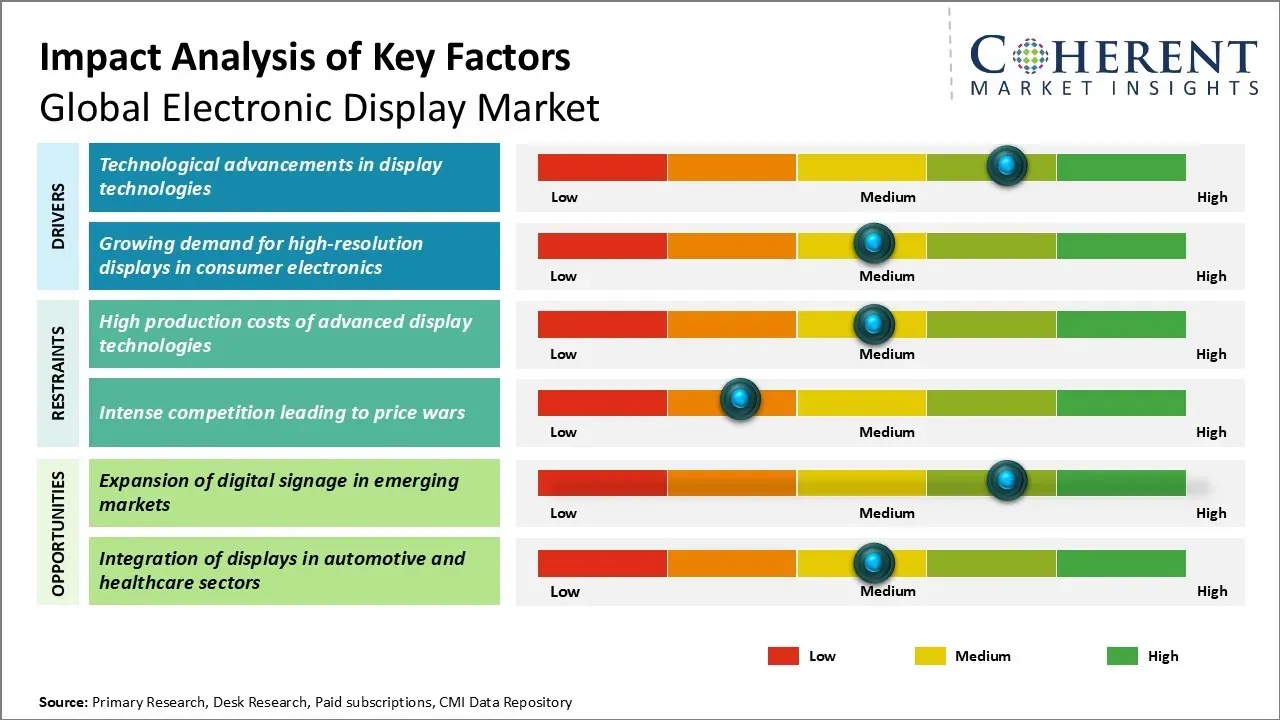
The electronic display market is witnessing positive trends across various industries like consumer electronics, retail, transportation, healthcare, and corporate. Mobility and digitization are driving the demand for advanced electronic displays with higher resolution, contrast, and brightness. Growing preference for large-screen and OLED displays in premium smartphones and TVs along with the increasing penetration of smart home appliances is boosting the market revenues.
However, the market faces challenges such as high production costs and intense competition, which may impact profit margins.
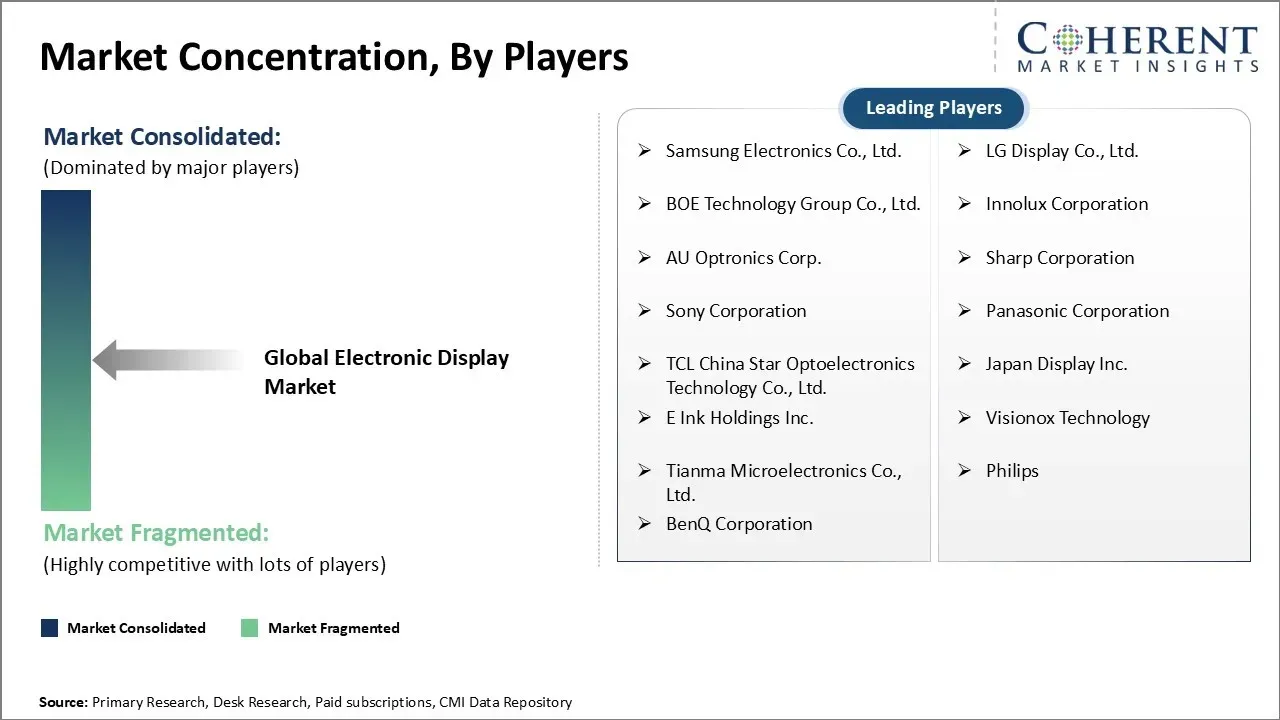
Market Concentration and Competitive Landscape
Current Events and their Impact on the Electronic Display Market
Current Events | Description and its impact |
Geopolitical Tensions in East Asia |
|
Macroeconomic Inflation and Raw Material Price Volatility |
|
- Current Industry Events of 2026
- Market Size Estimation
- Regional Breakdown
- Competitive Landscape
- Customer Intelligence
- Segmental Analysis
- Pricing Analysis
- Key Market Drivers, Challenges & Future Trends
- Customized Insights Section
Market Trends
Technological Advancements in Display Technologies
As the electronic industry continues to rapidly innovate and develop newer and improved display technologies, it has enabled new applications and use cases which has significantly driven the demand for advanced electronic displays globally. One of the major breakthroughs has been in the OLED display space which offers superior picture quality compared to traditional LCD displays with abilities like higher contrast, deeper blacks as well as thinner and more flexible form factors.
For instance, in January 2025, flexible OLED technology was a major highlight at CES 2025, with bendable and transparent display advancements. This is a type of OLED display that can be bent or curved. This display warped into a fisheye-like shape before returning to its original flat state.
Segmental Insights
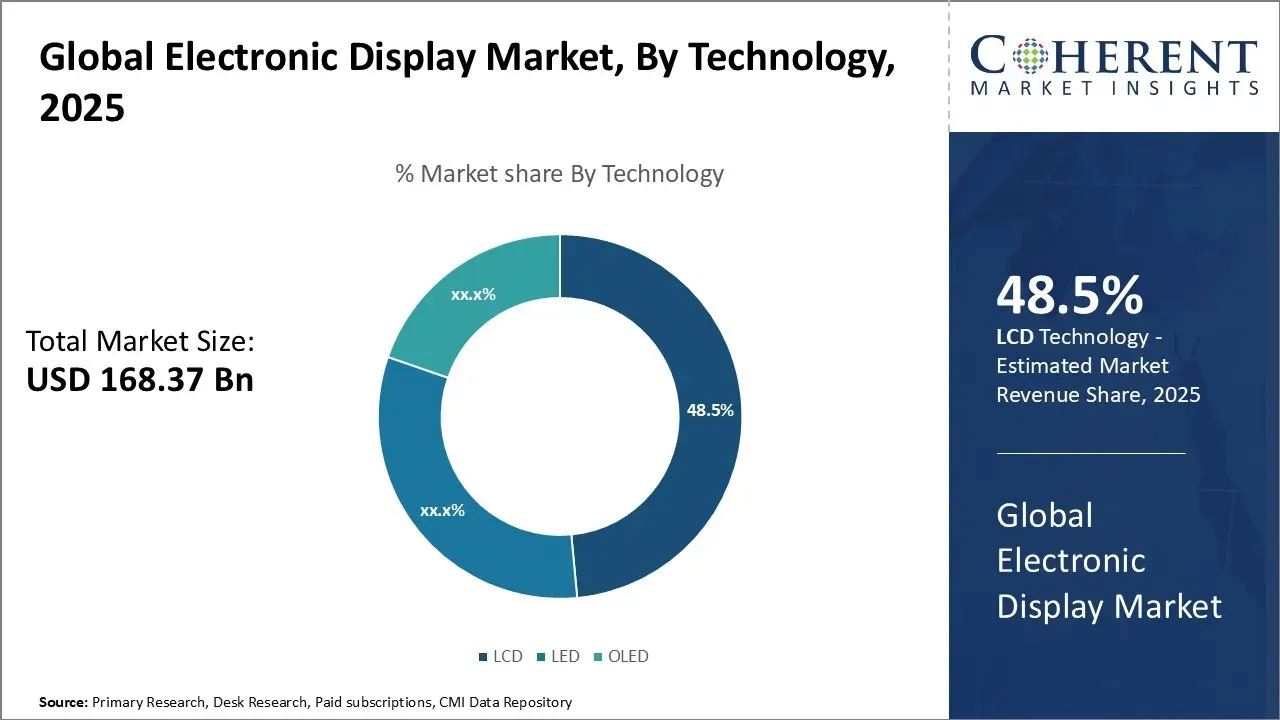
Electronic Display Market Insights, By Technology: LCD Dominates Due to Superior Picture Quality
In terms of technology, LCD segment is estimated to contribute the highest share of 49.5% in 2026 in the market, owing to its advantages over other display technologies.
LCD displays have become the predominant display type in most consumer electronics due to their better picture quality compared to LED displays. Though pricier than LED, LCD offers higher resolution, richer colors, and deeper blacks. The crisp images on LCD have made them irreplaceable for use cases requiring visual accuracy like professional artwork, photography editing, and medical imaging. Their widespread adoption in televisions further cemented LCD's position as the most popular display technology.
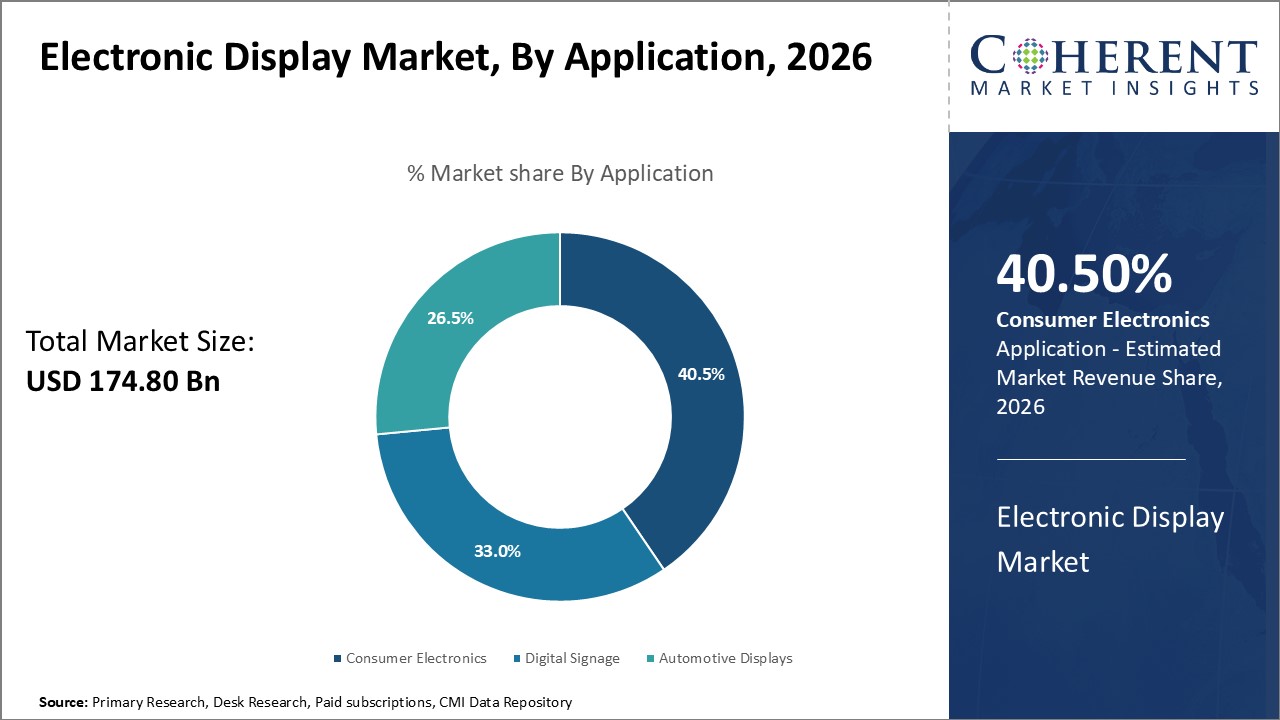
Electronic Display Market Insights, By Application: Consumer Electronics Segment Turns Out to be a Lucrative Application Avenue
In terms of application, consumer electronics segment is estimated to contribute the highest share of 40.5% in 2026 of the market owing to electronic displays being ubiquitous interfaces in various consumer devices.
Electronic displays have been integrated nearly into every digital product used in households, ranging from televisions to smartphones to smart home devices. This widespread proliferation of screens across consumer electronics has contributed exponentially to display panel demand. The growing popularity of streaming entertainment services has bolstered television sales and advanced the need for larger, higher resolution displays.
Electronic Display Market Insights, By End-Use Industry: Entertainment Segment Lead with Growing Demand from Video Gaming and AR/VR Platforms
In terms of end-use industry, entertainment segment is estimated to contribute the highest share of 37.2% in the market in 2026, owing to its extensive display needs across various verticals.
Within entertainment, the proliferation of streaming services, virtual/augmented reality platforms, and video gaming have hugely increased display usage. Televisions remain the predominant medium to enjoy movies, sports, and online content at home. Cinemas/movie theatres also leverage giant screens for immersive viewing experiences.
Emerging Innovations in the Electronic Display Market
- Transition from Conventional liquid crystal display (LCD) technology
- One of the most significant current trends in the electronic display market is the transition from conventional liquid crystal display (LCD) technology to more advanced display types such as organic light-emitting diode (OLED), MicroLED, and Quantum Dot displays. OLED displays have become increasingly prevalent due to their superior contrast ratios, deeper blacks, and better color accuracy compared to LCDs. Their ability to be fabricated on flexible substrates has opened doors for foldable smartphones, rollable TVs, and wearable devices, all of which are reshaping consumer expectations.
- Quantum Dot displays
- Quantum Dot displays represent another leap forward, primarily by enhancing LCD technology. Quantum dots are semiconductor nanocrystals that emit precise wavelengths of light when excited by a backlight. Incorporating Quantum Dot layers into displays enables much wider color gamuts, improved brightness, and energy efficiency. As a result, Quantum Dot-enhanced TVs and monitors are favored by consumers who prioritize image quality, particularly for HDR (high dynamic range) content.
Impacts of Artificial Intelligence (AI) on the Electronic Display Market
Artificial Intelligence (AI) is profoundly transforming the electronic display market, driving innovation from manufacturing processes to end-user experiences. By seamlessly integrating AI into industry operations, enhancing application functionalities, and revolutionizing product offerings, this technology is shaping the future of displays in both consumer and commercial sectors.
- For instance, BOE has launched AI-enhanced flexible OLED displays that utilize AI to monitor and adjust display parameters in real-time, catering especially to emerging augmented reality (AR) and wearable devices markets. This AI capability ensures consistent image quality despite the mechanical stress or varying ambient conditions typical of flexible devices. End users benefit from clearer visuals and increased device durability, setting new standards for smart display technologies that blend adaptability with superior performance.
- The adoption of AI in the electronic display industry primarily centers on optimizing production and design processes. AI algorithms analyze massive datasets to predict material usage, reduce defects, and enhance manufacturing precision. Samsung, a global leader in display technology, exemplifies this integration. The company employs AI-driven quality control systems in its OLED display production lines to detect microscopic imperfections in real-time. This application not only increases yield rates but also accelerates production speed, ensuring that high-quality screens reach the market faster and with greater reliability.
Regional Insights
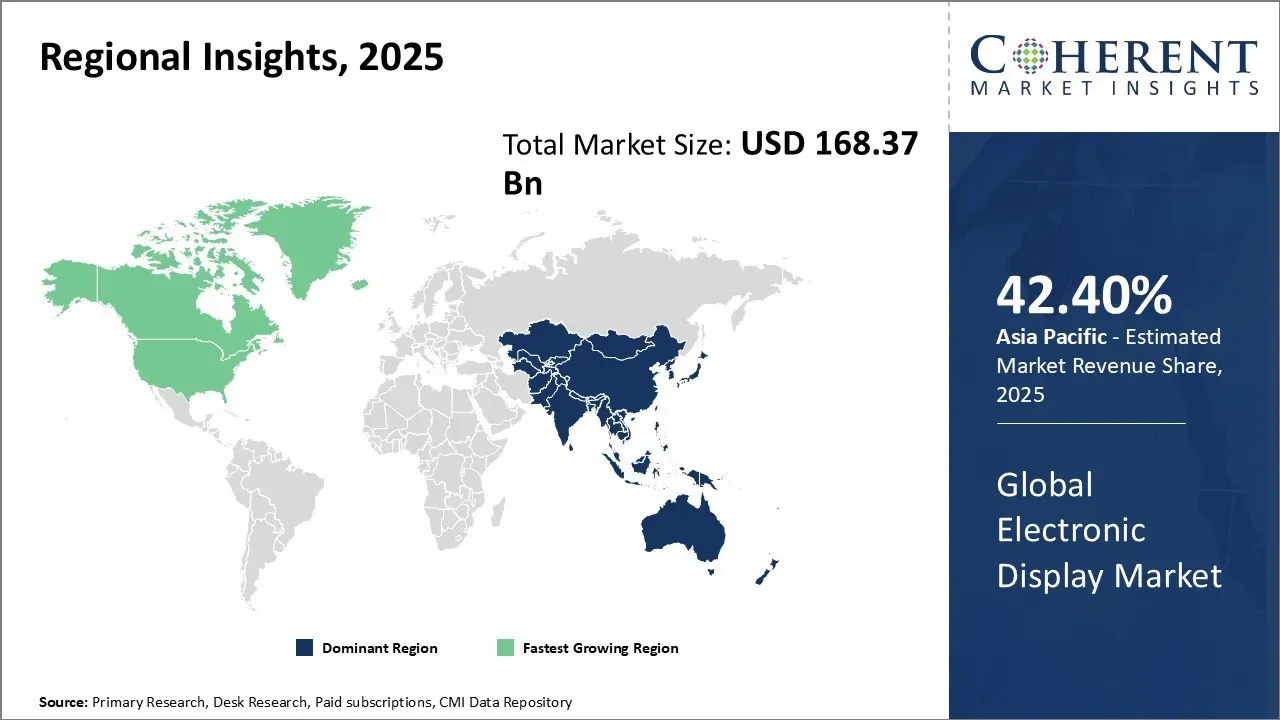
Asia Pacific Electronic Display Market Analysis and Trends
The Asia Pacific region dominates the market with an estimated share of 42.40% in 2026, driven by the expanding consumer electronics industry across developing countries. Factors such as a large consumer base, low production costs, and government initiatives to attract investments have established Asia Pacific as the manufacturing hub.
For instance, Dell and HP captured 10–15% of production share in South-Eastern Asia in 2024 and may increase this to 20–25% in 2026, owing to tariff changes. Other PC brands are likely to aim for 10–15% OEM production shares in the same region.
North America Electronic Display Market Analysis and Trends
North America holds an estimated share of 28.8% in 2026 and is projected to display the fastest growth over the forecast period. This growth can be attributed to the strong presence of manufacturing giants and industry leaders such as Apple, Samsung, and LG Electronics. Furthermore, rising demand for OLED and flexible display technologies from consumers is stimulating growth.
In May 2026, Universal Display announced that the company will exhibit and present at the Society for Information Display (SID) Display Week 2026, a globally recognized symposium and exhibition spotlighting the latest in electronic display and imaging technology.
U.S. Electronic Display Market Analysis and Trends
The U.S. market continues to expand owing to rising expenditure on mobile devices, computers, and automotive displays. Technology leaders like Apple, Microsoft, and Intel fuel this growth by driving innovation and investing in advanced display technologies such as MicroLED and OLED. The increasing adoption of smart home devices, gaming monitors, and augmented reality (AR) applications further boosts demand. Local players, including Corning Inc., play a crucial role by supplying cutting-edge glass substrates for high-performance displays, supporting the development of next-generation display solutions.
China Electronic Display Market Analysis and Trends
China remains at the forefront of display manufacturing due to the presence of major panel producers such as BOE Technology Group, TCL China Star Optoelectronics Technology, and HKC. The country has invested heavily in ramping up OLED and flexible display production to reduce dependence on foreign suppliers. Local players like Visionox and Tianma Microelectronics contribute significantly to China’s display ecosystem, focusing on innovations in foldable and curved screens.
Japan Electronic Display Market Analysis and Trends
Japanese brands like Sony, Panasonic, and Sharp maintain strong innovative prowess and contribute new technologies to the display industry, particularly in high-resolution and energy-efficient panels. Japan's display sector focuses on niche markets, including high-end professional monitors, medical imaging displays, and automotive screens. Local players such as Japan Display Inc. (JDI) specialize in advanced LCD and OLED panel manufacturing, while E Ink Holdings leads in electronic paper (ePaper) technology.
South Korea Electronic Display Market Analysis and Trends
South Korea continues to lead with advanced panel makers such as Samsung Display and LG Display, which regularly introduce cutting-edge products, such as next-generation OLED panels and rollable displays. These companies focus on expanding their OLED production capabilities to meet growing demand from smartphone and TV manufacturers worldwide. Local players like CSOT Korea and Duksan Neolux contribute to the industry by supplying essential display components, including organic materials for OLED screens.
Pricing Analysis of the Electronic Display Market
- North America & Western Europe: Highest retail prices due to strong purchasing power and premium product preference.
- Asia Pacific (China, India, Southeast Asia): Competitive pricing, strong domestic manufacturing hubs reducing costs. Brand penetration varies.
- Middle East & Africa: Prices vary widely based on import tariffs, logistics, and local demand.
- Latin America: Generally higher retail prices due to taxes and shipping but growing market demand.
Market Report Scope
Electronic Display Market Report Coverage
| Report Coverage | Details | ||
|---|---|---|---|
| Base Year: | 2025 | Market Size in 2026: | USD 174.80 Bn |
| Historical Data for: | 2020 To 2024 | Forecast Period: | 2026 To 2033 |
| Forecast Period 2026 to 2033 CAGR: | 3.8% | 2033 Value Projection: | USD 226.90 Bn |
| Geographies covered: |
| ||
| Segments covered: |
| ||
| Companies covered: | Samsung Electronics Co., Ltd., LG Display Co., Ltd., BOE Technology Group Co., Ltd., Innolux Corporation, AU Optronics Corp., Sharp Corporation, Sony Corporation, Panasonic Corporation, TCL China Star Optoelectronics Technology Co., Ltd., Japan Display Inc., E Ink Holdings Inc., Visionox Technology, Tianma Microelectronics Co., Ltd., Philips, and BenQ Corporation | ||
| Growth Drivers: |
| ||
| Restraints & Challenges: |
| ||
Electronic Display Industry News
- In May 2025, Samsung Display introduced various IT OLED solutions - slimmer, lighter, and clear OLED, low-power technologies empowering AI era, and various form factors – that can envision the future lifestyle.
- In February 2025, LG Display, the world’s leading innovator of display technologies, announced that it has officially begun mass production of the industry’s first 40-inch Pillar to Pillar (P2P) automotive display. The company is accelerating its push into the Software-Defined Vehicle (SDV) era by scaling up the production of premium automotive display solutions with the goal of revolutionizing the driving experience.
- In January 2025, AUO, one of the world's leading providers of display HMI solutions, teamed up with its subsidiary, BHTC, to debut the company’s Smart Cockpit at CES 2025, January 7-10 in Las Vegas, U.S.
- In May 2025, Sony Electronics Inc. expanded its lineup of LED walls with the debut of Crystal LED CAPRI. The new CAPRI series achieves a maximum brightness of 1,500 cd/m2 with a 2.50mm LED pitch size. Additional benefits include installation flexibility, familiar structure, streamlined maintenance, and compatibility with Sony’s ecosystem of virtual production technologies. The new models, ZRD-VS25FB and ZRD-VS25FM, are compatible with the Brompton controller and the Megapixel controller, respectively.
Analyst View
- The electronic display market is witnessing significant transformation driven by rapid technological advancements and increasing demand for enhanced visual experiences across various sectors. Key drivers include the widespread adoption of OLED and AMOLED technologies, which offer superior image quality and energy efficiency compared to traditional LCDs. Additionally, the growing penetration of smart devices, digital signage, and automotive displays contribute substantially to market momentum.
- However, the high production cost of advanced display panels and the volatility in raw material prices pose notable challenges to market expansion.
- From an opportunity standpoint, the integration of flexible and transparent displays is opening new avenues in wearable technology, augmented reality (AR), and foldable smartphones. Furthermore, increasing investments in smart city projects and healthcare infrastructure fuel demand for innovative display solutions that offer high resolution and durability.
- Regionally, the Asia Pacific market dominates due to the presence of major manufacturing hubs and accelerating consumer electronics consumption, with countries like China, Japan, and South Korea leading the innovation race. Meanwhile, North America emerges as one of the fastest-growing regions, driven by significant advancements in automotive displays and rising adoption of digital signage in commercial spaces.
Market Segmentation
- Technology Insights (Revenue, USD Bn, 2021 - 2033)
- LCD
- LED
- OLED
- Application Insights (Revenue, USD Bn, 2021 - 2033)
- Consumer Electronics
- Digital Signage
- Automotive Displays
- End-use Industry Insights (Revenue, USD Bn, 2021 - 2033)
- Entertainment
- Retail
- Corporate
- Healthcare
- Government
- Others
- Regional Insights (Revenue, USD Bn, 2021 - 2033)
- North America
- U.S.
- Canada
- Latin America
- Brazil
- Argentina
- Mexico
- Rest of Latin America
- Europe
- Germany
- U.K.
- Spain
- France
- Italy
- Russia
- Rest of Europe
- Asia Pacific
- China
- India
- Japan
- Australia
- South Korea
- ASEAN
- Rest of Asia Pacific
- Middle East
- GCC Countries
- Israel
- Rest of Middle East
- Africa
- South Africa
- North Africa
- Central Africa
- Key Players Insights
- Samsung Electronics Co., Ltd.
- LG Display Co., Ltd.
- BOE Technology Group Co., Ltd.
- Innolux Corporation
- AU Optronics Corp.
- Sharp Corporation
- Sony Corporation
- Panasonic Corporation
- TCL China Star Optoelectronics Technology Co., Ltd.
- Japan Display Inc.
- E Ink Holdings Inc.
- Visionox Technology
- Tianma Microelectronics Co., Ltd.
- Philips
- BenQ Corporation
Sources
Primary Research Interviews
- Manufacturer Executives (Display Panel Producers)
- Technology Providers (OLED, LCD, MicroLED specialists)
- End-User Industry Experts (Consumer Electronics, Automotive, Healthcare sectors)
- Distribution Channel Partners
- Others
Magazines
- Display Daily
- Display Weekly
- LEDs Magazine
- Sign Media Magazine
- Others
Journals
- Journal of Display Technology (IEEE)
- SID (Society for Information Display) Journal
- Journal of the Society for Information Display
- Others
Newspapers
- The Wall Street Journal (Technology Section)
- Financial Times (Tech & Telecom)
- Nikkei Asia (Tech & Electronics)
- The Economic Times (Technology)
- Others
Associations
- Society for Information Display (SID)
- Consumer Technology Association (CTA)
- Display Materials Industry Association (DMIA)
- International Electrotechnical Commission (IEC)
- Others
Public Domain Sources
- Company Annual Reports & Investor Presentations
- Government Trade and Industry Reports
- Press Releases from Key Market Players
- Research Articles and Whitepapers from Public Websites
- Others
Proprietary Elements
- CMI Data Analytics Tool – Electronic Display Market
- CMI Existing Repository of Information for the Last 8 Years
*Definition: The electronic display market encompasses all products and services related to the design, manufacture, and distribution of visual display devices that present images, video, or text electronically. This includes a range of technologies—such as LCD, LED, OLED, AMOLED, microLED, quantum-dot, and flexible/foldable screens—used across multiple applications like TVs, monitors, digital signage, smartphones, automotive displays, and specialized industrial or medical instruments.
Get access to 250+ pages report
Every segment, forecast, competitor profile and data table behind the analysis above — available for instant download.
- ESOMAR Member
- ISO 9001:2015 Certified
- D-U-N-S Registered
- GDPR & CCPA Compliant
Missing comfort of reading report in your local language? Find your preferred language:
Transform your Strategy with Exclusive Trending Reports
Frequently Asked Questions
The global electronic display market is estimated to be valued at USD 168.37 Bn in 2025 and is expected to reach USD 215.49 Bn by 2032.
The CAGR of the global electronic display market is projected to be 3.6% from 2025 to 2032.
Technological advancements in display technologies and growing demand for high-resolution displays in consumer electronics are the major factors driving the growth of global electronic display market.
High production costs of advanced display technologies and intense competition leading to price wars are the major factors hampering the growth of global electronic display market.
In terms of technology, the LCD segment is estimated to dominate the market revenue share in 2025.
Samsung Electronics Co., Ltd., LG Display Co., Ltd., BOE Technology Group Co., Ltd., Innolux Corporation, AU Optronics Corp., Sharp Corporation, Sony Corporation, Panasonic Corporation, TCL China Star Optoelectronics Technology Co., Ltd., Japan Display Inc., E Ink Holdings Inc., Visionox Technology, Tianma Microelectronics Co., Ltd., Philips, and BenQ Corporation are the major players in the electronic display market.
Asia Pacific is expected to lead the global electronic display market, holding a share of 42.4% in 2025.