

Metal Anodizing Market Size and Share Analysis: (2026 - 2033)
The global metal anodizing market size is expected to reach USD 1,010 Mn in 2026 and is projected to grow at a CAGR of 5.9% during the forecast period (2026-2033), totaling approximately USD 1,500 Mn by 2033.
Key Takeaways from the Metal Anodizing Market Report
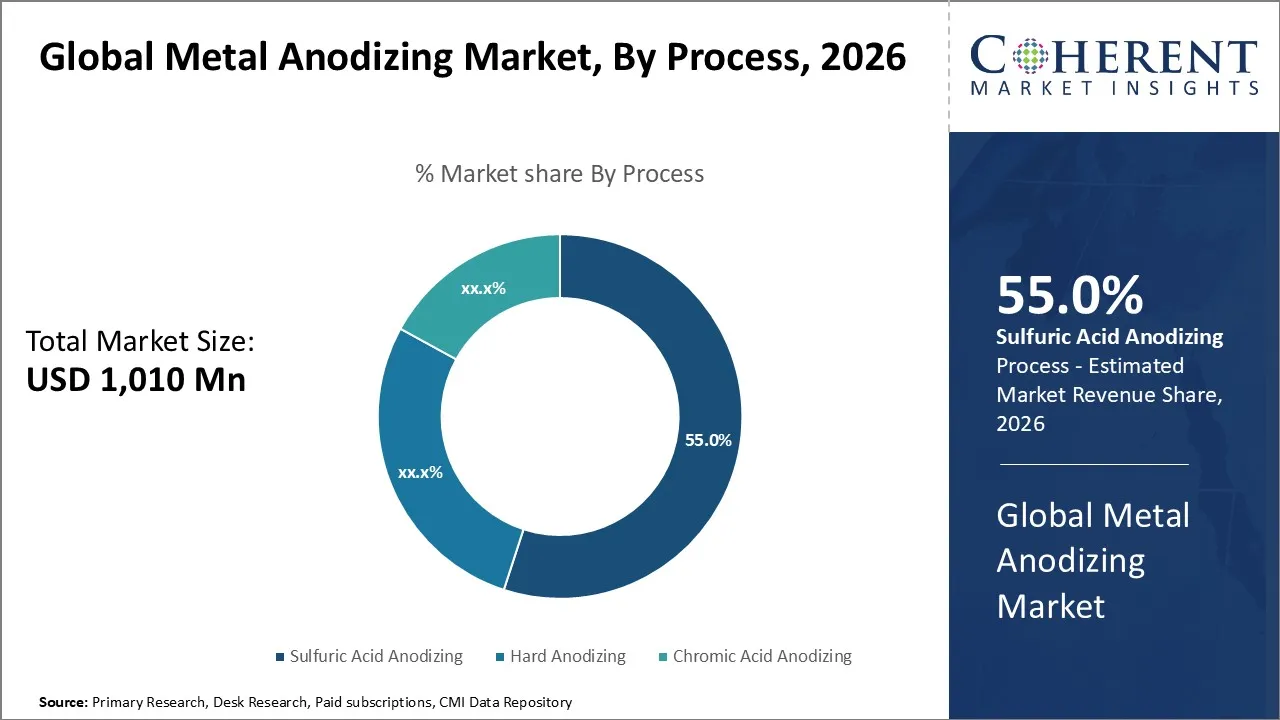
- Sulfuric acid anodizing segment is expected to dominate the market with a share of 55% in 2026, thanks to its cost-effectiveness and broad applicability.
- By product type, anodized aluminum is slated to account for 66% of the global metal anodizing market share in 2026. This is due to its extensive use in lightweight structural applications.
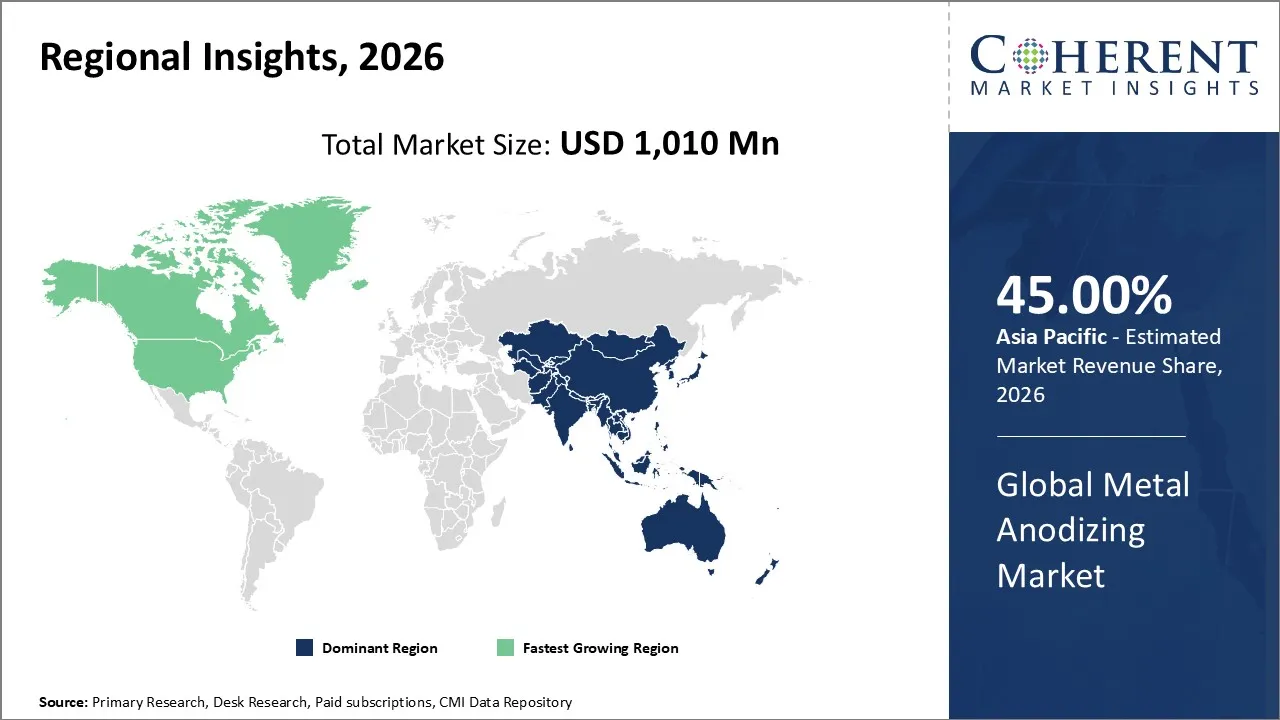
- Regionally, Asia Pacific is expected to lead the global metal anodizing industry, capturing a share of more than 45% in 2026.
- North America, with an estimated share of 30% in 2026, is anticipated create lucrative growth opportunities for metal anodizing companies during the forecast period.
Metal Anodizing Market Overview
The global metal anodizing market is expected to grow steadily during the forecast period. This is mostly due to the rising demand for corrosion-resistant and aesthetically appealing metal surfaces across industries like automotive, construction, aerospace, and electronics. Moreover, increasing adoption of aluminum and its alloys in lightweight applications is supporting market expansion.
Metal anodizing is an electrochemical process that converts the metal surface into a durable, decorative, corrosion-resistant, and anodic oxide finish. Anodizing is most commonly used for improved corrosion resistance on certain types of aluminum alloys. Types of anodizing processes include sulfuric acid anodizing, hard anodizing, and chromic acid anodizing.
The advantages of metal anodizing are boosting market growth. This electrochemical process turns metal surfaces into a strong, corrosion-resistant material and thickens the natural oxide layer. Anodized metals can also be dyed and have better adhesion, making them more popular than regular metals.
Emerging sectors like telecommunications, renewable energy, and medical devices are starting to use specialized anodized surfaces for better performance and to meet regulations. For example, they are used in 5G equipment, wind turbines, solar structures, and medical systems.
Advancements in metal anodizing technologies are making the process more efficient and environmentally friendly. For example, in August 2025, Henkel launched Bonderite M‑AD 2000A. It is an anodizing additive that reduces sulfuric acid use by 25 % as well as shortens process times by 15 %, making aluminum anodizing more efficient and sustainable.
Current Events and Their Impact on the Metal Anodizing Market
Current Event | Description and its Impact |
Global Electric Vehicle (EV) Market Expansion |
|
Advanced Nano-Level Anodizing Technologies |
|
Segmental Insights
- Current Industry Events of 2026
- Market Size Estimation
- Regional Breakdown
- Competitive Landscape
- Customer Intelligence
- Segmental Analysis
- Pricing Analysis
- Key Market Drivers, Challenges & Future Trends
- Customized Insights Section
Metal Anodizing Market Insights, By Process - Sulfuric Acid Anodizing Remains the Leading Process for Metal Surface Treatment
Based on process, sulfuric acid anodizing segment projected to lead the global market with a share of 55% in 2026. This is mostly due to its cost-effectiveness, versatility, and wide applicability across multiple industries. Sulfuric acid anodizing provides excellent corrosion protection and improves surface qualities. This makes it ideal for aluminum and its alloys, which are widely used in automotive, aerospace, consumer electronics, and building applications.
For instance, according to the Aluminum Anodizers Council (AAC), sulfuric acid anodizing is the predominant method in industry today because of its practicality and broad applicability. Academic studies also confirm it as one of the most common treatments to enhance corrosion resistance on aluminum alloys.
Sulfuric acid anodizing process also supports a range of thicknesses and finishes without requiring complex equipment. This is driving its adoption among manufacturers focused on performance, durability, and aesthetic quality. Its well‑established industry standards and compatibility with large‑scale production further reinforce its dominance over alternative anodizing techniques such as chromic acid, hardcoat, and organic acid anodizing.
Metal Anodizing Market Insights, By Product Type - Anodized Aluminum Dominates the Metal Anodizing Industry
By product type, anodized aluminum segment is expected to account for over 66% of the global metal anodizing industry share in 2026. This dominance is primarily due to aluminum's lightweight, corrosion-resistant properties, and widespread use across automotive, aerospace, and construction sectors. Moreover, anodized aluminum gives a smooth surface finish and strong durability, making it the preferred choice for architectural applications and consumer electronics. Major manufacturers are increasing anodized aluminum production capacity to meet the growing demand in construction, transportation, and infrastructure applications.
Regional Insights
Asia Pacific Remains at the Epicenter of Metal Anodizing Market Growth
Asia Pacific is expected to dominate the global metal anodizing market, capturing a share of more than 45% in 2026. This is mostly due to booming electronics manufacturing, industrial equipment production, and construction activities. Countries like China, Japan, and South Korea are increasingly using anodized aluminum in smartphones, laptops, and other consumer electronics to improve aesthetic appeal, durability, and corrosion resistance. For instance, Samsung and Xiaomi rely heavily on anodized metal casings for premium devices manufactured in the region.
Industrial growth is another major metal anodizing market factor in Asia Pacific. Anodized aluminum is being widely used in machinery, chemical plants, and solar panel frames. Rapid urbanization in India and Southeast Asia is boosting demand for anodized metals in construction and infrastructure projects. In addition, government initiatives promoting industrial expansion and incentives for advanced manufacturing processes are creating growth prospects for the target market.
Aerospace and EV Expansion Triggering Growth in North America
North America metal anodizing market is set to register steady growth during the forecast period. This can be attributed to rising adoption of anodized metals in aerospace and electric vehicle (EV) manufacturing. As per Coherent Market Insights, North America is forecast to account for a global market share of 30% in 2026.
Anodized aluminum is widely used in aircraft fuselage panels and engine components in North America’s aerospace industry. This is due to its superior corrosion resistance and lightweight properties. For example, Boeing 777X extensively incorporates anodized aluminum alloys to enhance durability while reducing maintenance needs. Because of this, demand for metal anodizing is expected to rise steadily in the region during the forecast period.
Rapid growth of EVs is driving higher demand for anodized components used in battery housings, heat exchangers, and lightweight chassis parts. Leading companies like Tesla and Rivian are significantly increasing their use of anodized aluminum in EV frames, which is raising consumption in the region.
Metal Anodizing Market Outlook – Country-wise
China Metal Anodizing Market Trends
The metal anodizing market in China is expected to grow rapidly during the forecast period, owing to increasing industrialization and automotive production. Rising demand for corrosion-resistant and aesthetically enhanced aluminum components in consumer electronics, construction, and transportation sectors is driving market expansion. Additionally, adoption of advanced anodizing technologies, such as hard and colored anodizing, is fueling growth as manufacturers seek durable and high-quality surface finishes.
United States Metal Anodizing Market Forecast
The U.S. metal anodizing market is expected to grow steadily due to strong demand from the aerospace, automotive, and architectural sectors. The need for lightweight and durable aluminum components, along with strict rules for corrosion resistance, is driving the use of anodizing processes. Advances in eco-friendly anodizing and precise surface finishing are also helping the market grow.
Metal Anodizing Industry News
- In August 2025, Henkel introduced its new additive, Bonderite M-AD 2000A, for aluminum anodizing. This innovation allows anodizing baths to operate at temperatures up to 24 °C, above the conventional 18–20 °C range. It reduces energy use, extends bath life, and maintains high-quality anodized surfaces.
- In March 2024, Lorin Industries opened a new batch anodizing line in Muskegon. This new facility allows customers in industries like military, automotive, toys, aerospace, and medical devices to access the Lorin’s premium anodizing process.
- In October 2024, KO‑AR introduced a new titanium anodizing service. The anodizing process adds a very wear‑resistant surface layer to titanium parts without changing their size.
Market Report Scope
Metal Anodizing Market Report Coverage
| Report Coverage | Details | ||
|---|---|---|---|
| Base Year: | 2025 | Market Size in 2026: | USD 1,010 Mn |
| Historical Data for: | 2020 To 2024 | Forecast Period: | 2026 To 2033 |
| Forecast Period 2026 to 2033 CAGR: | 5.9% | 2033 Value Projection: | USD 1,500 Mn |
| Geographies covered: |
| ||
| Segments covered: |
| ||
| Companies covered: | Alucol, HPL Stampings Inc., Kikukawa Kogyo Co., Ltd., Nihon Anodizing Co., Ltd, Pailian Aluminium, Prototech Asia, Saporito Finishing Co., Techmetals Inc., Tiodize, Inc., United Anodisers Limited, and Xometry Europe GmbH | ||
| Growth Drivers: |
| ||
| Restraints & Challenges: |
| ||
Metal Anodizing Market Drivers
Growing Demand for Corrosion Resistance and Durability
The metal anodizing process significantly enhances corrosion resistance and surface hardness. It makes metals such as aluminium and titanium well-suited for harsh environments, including marine, automotive, and aerospace sectors. This improved longevity reduces maintenance costs and supports long-term performance requirements across industries. Thus, rising demand for corrosion-resistant and durable metal products is expected to drive growth of metal anodizing market during the forecast period.
Escalating Need for Lightweight Materials from Advanced Industries
Industries like automotive and aerospace are increasingly adopting aluminum and other lightweight metals. The anodizing process strengthens these materials while keeping them lightweight, enabling improved fuel efficiency, extended range, and superior performance. Rising emphasis on lightweight yet durable components across these industries is slated to fuel metal anodizing demand in the coming years.
Rising Interest in Aesthetic and Functional Finishes
Rising interest in aesthetic and functional finishes is boosting metal anodizing market value. Anodizing not only protects metal but also allows for colorful, customizable, and high‑quality surface finishes. This is especially valuable in consumer electronics, architecture, and luxury goods, where both durability and visual appeal matter. For example, in October 2024, Viva launched Pure Aura, a new range of anodized aluminum panels for the architecture and building sectors.
Metal Anodizing Market Trends
Increasing Electric Vehicle Adoption
Increasing electric vehicle (EV) production is a key growth-shaping trend in the metal anodizing market. EVs use anodized aluminum for thermal management, battery housings, chassis parts, and lightweight construction. According to the International Energy Agency’s Global EV Outlook 2025, global electric car sales are expected to pass 20 million units in 2025. Rising EV production and sales are therefore expected to drive demand for anodized metals during the forecast period.
Sustainability and Environment Regulations
Stricter environmental standards are pushing manufacturers toward anodizing processes that are more eco‑friendly and compliant. Likewise, ongoing regulatory shifts support the development of greener surface treatment technologies. In response, many companies are exploring sustainable metal anodizing techniques. For instance, Dutch start-up Loop Loop recently developed colored anodizing using plant-based dyes, demonstrating how anodizing processes can evolve toward greater sustainability.
Metal Anodizing Market Opportunities
Expanding End-Use Applications
Anodized metals are gaining traction in electronics (heat sinks, enclosures), construction (window frames, curtain walls), consumer goods, and industrial machinery. This is because of their protective and functional advantages. Expansion of these end-use applications is expected to create growth opportunities in the metal anodizing market during the assessment period.
Technological Advancements and Metal Anodizing Process Innovation
Advances like hard anodizing, automated systems, digital monitoring, and eco‑efficient electrolytes are improving production efficiency as well as consistency and product quality. These trends support broader adoption of anodizing in advanced manufacturing contexts. As a result, the future metal anodizing market outlook appears promising.
Analyst Opinion (Expert Opinion)
- The metal anodizing sector is moving strongly toward functional coatings, with hard anodizing leading in aerospace and defense applications. These coatings, often over 50 µm thick, increase wear resistance and can extend component lifespan by up to 3× compared to traditional coatings. More high-performance aircraft parts and defense-grade aluminum components are being anodized to handle extreme thermal and mechanical stress, making anodizing a key factor in mission reliability, not just a surface finish.
- Corrosion resistance in tough environments is another key driver, especially for marine and offshore applications. Anodized aluminum with built-in sealing layers can last up to 75% longer against saltwater corrosion than standard zinc-phosphated treatments. This makes anodizing a smart choice for engineers designing offshore wind turbines, ship parts, and heavy-duty infrastructure where long-term durability is essential.
- Thermal management is becoming necessary in electronics and industrial equipment. Anodized surfaces on heat sinks and electrical enclosures can improve heat dissipation by about 20% compared to powder-coated alternatives. Companies like TE Connectivity and Schneider Electric are using hard anodized finishes in power modules to boost operational efficiency, showing that anodizing now affects product performance, not just appearance.
- The market is also changing due to environmental and compliance pressures. Trivalent chromium and sulfuric acid-based anodizing are replacing traditional hexavalent chromium processes. Over 60% of recent industrial contracts now require environmentally compliant anodized coatings. OEMs like Airbus and Siemens expect anodizing partners to deliver engineered, multi-stage finishes that meet both performance as well as sustainability goals, making anodizing a key part of strategic supply chain planning.
Speak to the analyst
Want personalized insights?
Take the findings above to one of our principal consultants, or have the report rebuilt around the segments, geographies and competitors you actually track.
Market Segmentation
- By Process Insights ( Revenue, USD Mn, 2020 - 2033)
- Sulfuric Acid Anodizing
- Hard Anodizing
- Chromic Acid Anodizing
- By Product Type Insights ( Revenue, USD Mn, 2020 - 2033)
- Anodized Aluminum
- Anodized Magnesium
- Anodized Titanium
- Anodized Zinc
- Others
- By Application Insights ( Revenue, USD Mn, 2020 - 2033)
- Building & Construction
- Aerospace & Defense
- Automotive
- Electronic Appliances
- Energy
- Biomedical
- Marine
- Jewelry
- Heavy Equipment
- Others
- By Region Insights ( Revenue, USD Mn, 2020 - 2033)
- North America
- U.S.
- Canada
- Latin America
- Brazil
- Argentina
- Mexico
- Rest of Latin America
- Europe
- Germany
- U.K.
- Spain
- France
- Italy
- Russia
- Rest of Europe
- Asia Pacific
- China
- India
- Japan
- Australia
- South Korea
- ASEAN
- Rest of Asia Pacific
- Middle East & Africa
- GCC Countries
- Israel
- Rest of Middle East & Africa
- North America
- Key Players
- Alucol
- HPL Stampings Inc.
- Kikukawa Kogyo Co., Ltd.
- Nihon Anodizing Co., Ltd
- Pailian Aluminium
- Prototech Asia
- Saporito Finishing Co.
- Techmetals Inc.
- Tiodize, Inc.
- United Anodisers Limited
- Xometry Europe GmbH
Sources
Primary Research interviews
- Interviews with plant managers and operations heads at metal finishing facilities
- Discussions with anodizing equipment manufacturers
- Conversations with procurement and quality heads in aerospace, automotive, and electronics OEMs
- Insights from industry technologists and R&D leads in surface treatment processes
Databases
- International Trade Centre (ITC) Trade Map
- United Nations Comtrade Database
- World Bank Open Data
- United States Geological Survey (USGS) Minerals Yearbook
- Eurostat
Magazines
- Surface World
- Products Finishing
- Finishing & Coating
- Industrial Heating
- Metal Finishing News
Journals
- Surface and Coatings Technology
- Journal of Materials Processing Technology
- Materials Science and Engineering
- Journal of Manufacturing Processes
- Corrosion Science
Newspapers
- The New York Times – Manufacturing/Technology sections
- The Financial Times – Industrial & Metals news
- The Times of India – Business and Industry coverage
- The Wall Street Journal – Industrials and Materials coverage
- Hindustan Times – Economy/Manufacturing news
Associations
- ASTM International (American Society for Testing and Materials)
- The Aluminum Association
- National Association for Surface Finishing (NASF)
- Society of Manufacturing Engineers (SME)
- Indian Stainless Steel Development Association (ISSDA)
Public Domain sources
- Government trade reports & tariff schedules
- Patent filings related to anodizing technologies
- Company annual reports & investor presentations
- Import/export statistics from national customs agencies
- Technical standards and specifications published by governments
Proprietary Elements
- CMI Data Analytics Tool
- Proprietary CMI Existing Repository of information for last 8 years
Get access to 250+ pages report
Every segment, forecast, competitor profile and data table behind the analysis above — available for instant download.
- ESOMAR Member
- ISO 9001:2015 Certified
- D-U-N-S Registered
- GDPR & CCPA Compliant
Missing comfort of reading report in your local language? Find your preferred language:
Transform your Strategy with Exclusive Trending Reports
Frequently Asked Questions
The global market is estimated to be valued at USD 1,010 Mn in 2026.
The global Metal Anodizing Market value is expected to surpass USD 1,500 Mn by 2033.
The global market is poised to exhibit a CAGR of 5.9% from 2026 to 2033.
Major growth factors include advantages of anodizing, rapid industrial growth, and rise in construction spending.
Unfavourable geographic and political conditions
Some major companies in the metal anodizing market include Alucol, HPL Stampings Inc., Kikukawa Kogyo Co., Ltd., Nihon Anodizing Co., Ltd, Pailian Aluminium, Prototech Asia, Saporito Finishing Co., Techmetals Inc., Tiodize, Inc., United Anodisers Limited, and Xometry Europe GmbH.
Asia Pacific, with 45% share in 2026, is expected to lead the market during the forecast period.