

Garbage Disposals Market Size and Trends: 2026-2033
The Garbage Disposals Market is estimated to be valued at USD 2.4 Bn in 2026 and is expected to reach USD 4.27 Bn by 2033, growing at a compound annual growth rate (CAGR) of 8.6% from 2026 to 2033.
Key Takeaways
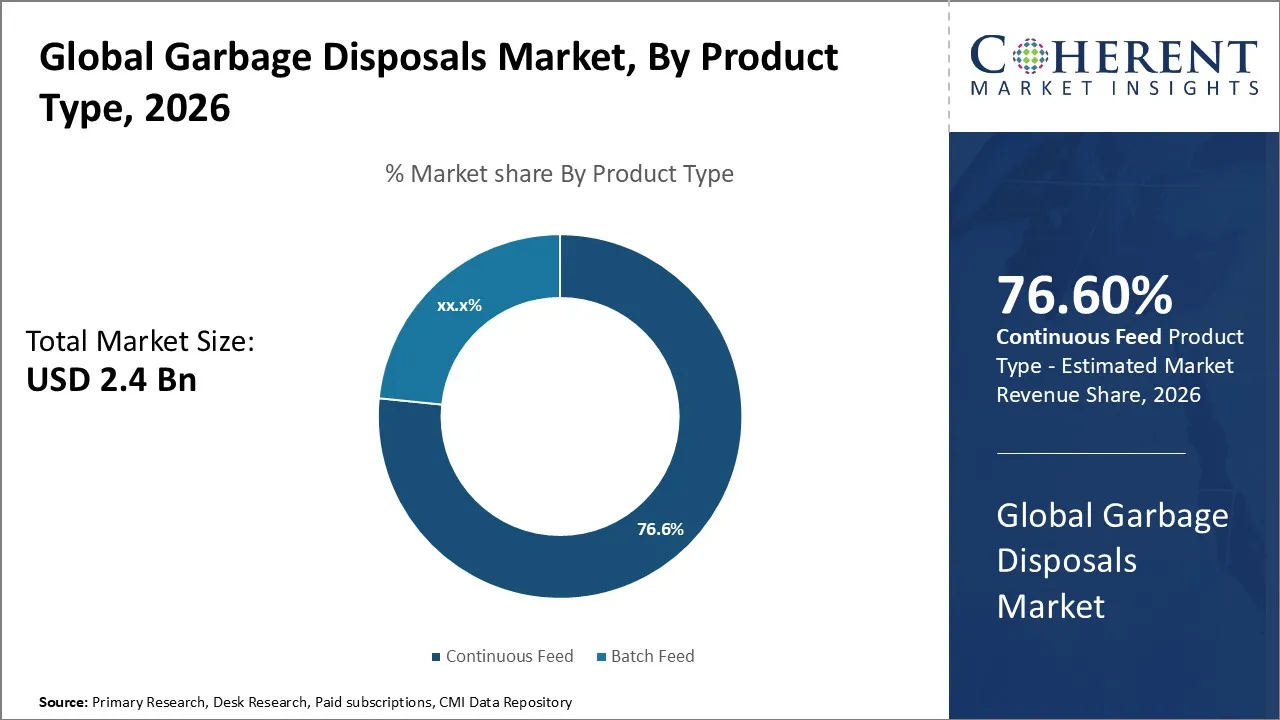
- Based on Product Type, the Continuous Feed segment is expected to lead the market with 76.60 % share in 2026, due to its ease of use and cost‑effectiveness.
- Based on Application, the Residential segment is expected to lead the market with 62.10 % share in 2026, driven by growing home installations and rising urban household demand.
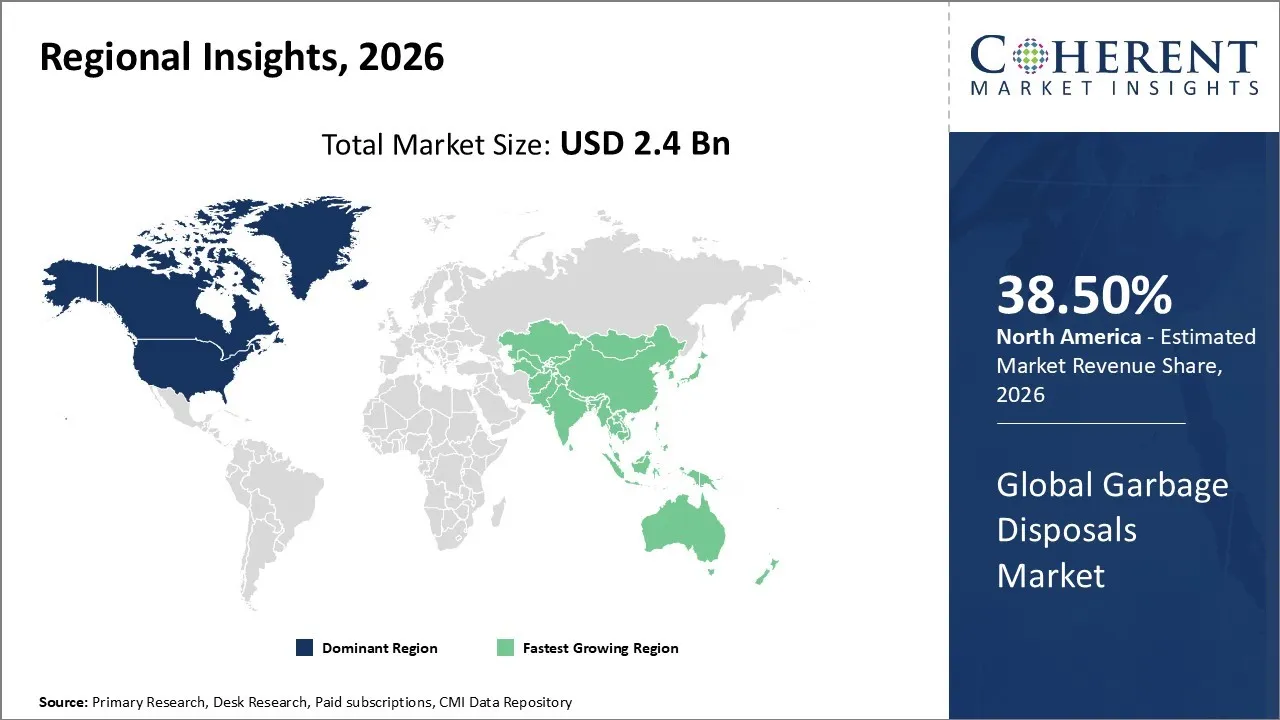
- Based on Region, North America is set to lead the market with 38.50 % share in 2026. While, Asia Pacific is anticipated to be the fastest growing region.
Market Overview
The garbage disposals market is advancing significantly with the rising applications in modern residential kitchens and the commercial hospitality sector. Moreover, the expanding urban construction, rising demand for smart home integration, and tightening municipal waste management standards are expected to drive market growth over the forecast period.
Garbage disposals are important appliances designed to break down food waste into small particles that can move easily via plumbing systems. This mechanical process aids in the efficient management of organic waste, thereby reducing the reliance on landfills and supporting more sustainable urban infrastructure.
The garbage disposals industry is going through a major period of change supported by several improving mechanical factors, the use of advanced high-torque motor systems, and growing demand for efficient waste solutions across sectors such as residential estates, food service, and hospitality. These developments have spread the capabilities of modern units and enhanced their efficiency, noise, and durability.
Current Events and Its Impacts on the Garbage Disposals Market
Current Event | Description and the Impact |
Technological Advancements in Garbage Disposal Systems
|
|
Global Sustainability Policies and Regulations |
|
Urbanization and Changing Consumer Lifestyles in Emerging Markets |
|
Segmental Insights
- Current Industry Events of 2026
- Market Size Estimation
- Regional Breakdown
- Competitive Landscape
- Customer Intelligence
- Segmental Analysis
- Pricing Analysis
- Key Market Drivers, Challenges & Future Trends
- Customized Insights Section
Garbage Disposals Market Insights, By Product Type – Continuous Feed Leads Due to Ease of Use and Cost ‑ Effectiveness
In terms of product type, the continuous feed segment contributes the highest share of 76.60% in 2026 of the garbage disposals market. The growth is due to its exceptional convenience and efficiency in high-volume kitchens. These units let users add food waste while the system is running, thereby making cleanup quicker and easier after meals. This makes it a preferred choice for busy households and professional culinary environments alike. In addition, these models are generally more affordable and offer a wide variety of power options, which appeals to a broad consumer base. Their ability to handle consistent waste streams without interruption ensures their continued dominance in the global marketplace.
Garbage Disposals Market Insights, By Application – Residential Leads Due to Growing Home Installations
In terms of application, the residential segment contributes the highest share of 62.10% in 2026 of the garbage disposals market. The growth is owing to urban population and modern kitchen renovations. The homeowners are focusing on integrated waste management solutions that improve kitchen hygiene by eliminating food odors and minimizing the need for traditional trash storage. The increasing use of smart home technology and high-end appliances has sped up this trend. The newer disposal models provide quieter operation and better energy efficiency. In addition, the growing environmental consciousness among individuals encourages the use of disposals to divert organic waste from landfills. The steady demand from the housing sector ensures that residential installations remain the primary driver of overall market growth.
Regional Insights
North America Garbage Disposals Market Analysis & Trends
North America has maintained its position as the dominant region in the global garbage disposals market and accounts for a share of 38.50% in 2026. This growth can be attributed to a strong residential construction sector and a home renovation culture that emphasizes modern kitchen convenience. The consumers in the region prefer high end models that offer quiet operation and powerful grinding capabilities. The result creates a need for high performance appliances that can handle a wide variety of food waste without frequent maintenance. Innovation and environmental policy are the two main forces driving the growth in the industry. Many municipalities are promoting the use of disposals as a strategic measure to divert organic waste from landfills to wastewater treatment facilities, where food solids can be repurposed into biogas or fertilizer.
This transition toward a circular economy has compelled manufacturers to integrate smart technology and antimicrobial features into their products. A few established brands with extensive retail and distribution networks lead the market. The region is home to major firms such as Whirlpool (InSinkErator), Moen (Waste King), and Franke. Other notable companies include Haier (GE Appliances) and Joneca Corporation. As a result, the regional market continues to evolve, with homeowners opting for sustainable, high-tech solutions for urban waste management.
Asia Pacific Garbage Disposals Market Analysis & Trends
The Asia Pacific region is currently the fastest-growing market for garbage disposals. The growth is attributable to increasing urbanization, a growing middle class, and an massive boom in residential construction. The region is a dynamic growth frontier where modern kitchen appliances are viewed as a premium standard in new high-rise apartments and gated communities.
China leads the regional landscape, while India is emerging as a high-potential market with the highest projected country-level growth rate. This expansion is heavily supported by government-led waste management initiatives, such as China's nationwide waste sorting campaign and India's Swachh Bharat Mission, which encourage the diversion of organic waste from landfills. Technological innovation is a major trend, with rising demand for quieter, more powerful models capable of handling diverse and fibrous diets. The global giants, such as Whirlpool (InSinkErator) and Moen, have a significant presence in the market. The local manufacturers in China and India are competing mainly on price and by coming up with specialized features.
Garbage Disposals Market Outlook Country-Wise
The US Garbage Disposals Market Trends
The US garbage disposal market represents the largest and most mature segment of the global industry. The market can be attributed to the robust residential housing sector which includes both new construction and a consistent demand for replacements in existing homes. The technological breakthroughs and the trend toward smart homes are redefining the industry. The consumers are opting for premium, high-horsepower units that feature cutting-edge noise insulation as well as multi-stage grinding capabilities to manage tougher food scraps. The incorporation with home automation systems for diagnostics and energy monitoring is becoming a notable differentiator for high-end brands. This shift toward premiumization allows manufacturers to maintain value growth even in a saturated market.
China Garbage Disposals Market Trends
The China garbage disposals market is currently the most dynamic growth engine in the global industry, evolving from a luxury niche to a key part of urban waste management. This transformation is mainly driven by strong government policy, specifically the implementation of mandatory waste sorting regulations in major metropolitan areas like Shanghai and Beijing. These policies have clearly influenced consumer habits, as families search for practical ways to separate wet waste at home to avoid penalties and improve daily disposal practices.
The market is characterized by a strong preference for high-tech, premium products. Chinese consumers prefer smart disposals equipped with intelligent sensors that detect grind consistency and automatically adjust motor speed to avoid jams. There is also a strong focus on compact designs that match the specific plumbing setups of high-density apartment living.
Market Report Scope
Garbage Disposals Market Report Coverage
| Report Coverage | Details | ||
|---|---|---|---|
| Base Year: | 2025 | Market Size in 2026: | USD 2.4 Bn |
| Historical Data for: | 2020 To 2024 | Forecast Period: | 2026 To 2033 |
| Forecast Period 2026 to 2033 CAGR: | 8.6% | 2033 Value Projection: | USD 4.27 Bn |
| Geographies covered: |
| ||
| Segments covered: |
| ||
| Companies covered: | Emerson Electric Co., Fortune Brands Home & Security Inc., Whirlpool Corporation, Illinois Tool Works Inc., Joneca Corporation, Salvajor, Electrolux AB, Western Industries Plastic Products LLC., Sears Brands, LLC, and Haier Inc., Waste King, and Frigidare. | ||
| Growth Drivers: |
| ||
| Restraints & Challenges: |
| ||
Garbage Disposals Market Drivers
Increasing need for environment friendly garbage disposals
The increasing demand for environmentally friendly garbage disposals compared to conventional disposal methods is a considerable factor expected to drive market growth during the forecast period. Waste generated from garbage disposals is processed in wastewater treatment plants and the remaining grit and solid materials are repurposed as fertilizers. This method is preferred over traditional methods of dumping or burning garbage as it allows for the utilization of residual waste. In-sink disposers convert food waste into fine particles in the form of slurry. This slurry flows through the plumbing system to reach the septic tank, where a process known as anaerobic digestion transforms the waste into end products such as biogas. This biogas can be utilized as fertilizer or biofuel for electricity generation.
Using garbage disposals effectively reduces carbon footprints compared to conventional landfill disposal methods, which produce methane gas. Methane traps heat from the environment and releases a liquid acidic residue that seeps into groundwater, polluting water reserves. Additionally, traditional garbage disposal methods, along with the unpleasant odors from trash bins and soot from burning waste, contribute to various health hazards, including dengue, malaria, asthma, and respiratory illnesses. Therefore, the factors mentioned above are anticipated to drive market growth for garbage disposals, leading to increased demand during the forecast period.
Analyst Opinion (Expert Opinion)
- The Garbage Disposals Market is witnessing steady growth, driven by increasing urbanization, rising household incomes, and heightened focus on efficient waste management solutions. With global urban populations projected to exceed 4.5 billion by 2030, demand for convenient, hygienic, and environmentally friendly kitchen waste systems is rising across residential, commercial, and institutional settings.
- Technological innovations such as multi-stage grinding, noise reduction mechanisms, and energy-efficient motors are enhancing product performance and user adoption. Data from leading manufacturers indicate that models featuring anti-jam technology and corrosion-resistant components account for over 60% of new installations in North America and Europe, reflecting consumer preference for durability and reliability.
- Regionally, North America remains a mature market with high consumer awareness and established plumbing infrastructure, while the Asia Pacific region is emerging rapidly, led by urban centers in India, China, and Southeast Asia, contributing roughly 35–40% of global sales volumes. Growth in these regions is supported by rising disposable incomes, real estate expansion, and government initiatives promoting sustainable waste management.
- Commercial and institutional adoption of high-capacity disposals is also increasing, with reported reductions in organic waste volume by up to 50%, lowering transportation and landfill pressures. Environmentally friendly designs, compliance with energy efficiency standards, and use of recyclable materials are shaping market trends, highlighting a focus on sustainability alongside operational efficiency.
Speak to the analyst
Want personalized insights?
Take the findings above to one of our principal consultants, or have the report rebuilt around the segments, geographies and competitors you actually track.
Garbage Disposals Industry News
- In February 2026, Composer Appliance, Inc. unveiled Composer One, a device designed to be quieter, safer, and easier to use. This innovative appliance can efficiently handle 100% of regular food waste without the risk of clogging.
- In February 2026, InSinkErator, the leading global provider of garbage disposals, introduced a new range of LEDefense products at the 2026 Kitchen and Bath Industry Show (KBIS). These innovative LEDefense offerings are launched in partnership with Vyv.
- In September 2023, InSinkErator unveiled its next generation of products designed for modern kitchens. The Power and Advance Series disposals feature redesigned MultiGrind® and SoundSeal® Technology. InSinkErator has introduced new EZ Connect technology to simplify the installation process for these units.
- In November 2022, Whirlpool Corporation has acquired InSinkErator, the leading manufacturer of food waste disposers and instant hot water dispensers for both home and commercial applications, from Emerson.
Market Segmentation
- Product Type Insights (Revenue, USD Bn, 2026 - 2033)
- Continuous Feed
- Batch Feed
- Application Insights (Revenue, USD Bn, 2026 - 2033)
- Residential
- Commercial
- Regional Insights (Revenue, USD Bn, 2026 - 2033)
- North America
- U.S.
- Canada
- Latin America
- Brazil
- Argentina
- Mexico
- Rest of Latin America
- Europe
- Germany
- U.K.
- France
- Italy
- Russia
- Rest of Europe
- Asia Pacific
- China
- India
- Japan
- Australia
- South Korea
- ASEAN
- Rest of Asia Pacific
- Middle East
- GCC Countries
- Israel
- Rest of Middle East
- Africa
- North Africa
- Central Africa
- South Africa
- Key Players Insights
- Emerson Electric Co.,
- Fortune Brands Home & Security Inc.
- Whirlpool Corporation
- Illinois Tool Works Inc.
- Joneca Corporation
- Salvajor
- Electrolux AB
- Western Industries Plastic Products LLC.
- Sears Brands, LLC
- Haier Inc.
- Waste King
- Frigidaire
Sources
Primary Research Interviews
- Garbage Disposal Manufacturers
- Waste Management Solution Providers
- Kitchen Appliance Integrators
- Environmental & Industrial Engineers
- Waste Processing Technology Consultants
- Others
Databases
- Bloomberg Terminal
- Thomson Reuters Eikon
- Others
Magazines
- Waste Management World
- Kitchen & Bath Design News
- Environmental Leader
- Chemical Engineering Magazine
- Others
Journals
- Journal of Environmental Management
- Waste Management & Research
- Resources, Conservation & Recycling
- Environmental Science & Technology
- Others
Newspapers
- Financial Times
- The Wall Street Journal
- Reuters
- Bloomberg News
- Others
Associations
- Solid Waste Association of North America (SWANA)
- International Solid Waste Association (ISWA)
- Kitchen & Bath Industry Association (KBIS)
- European Waste Management Association (FEAD)
- Others
Public Domain Sources
- U.S. Environmental Protection Agency (EPA)
- European Environment Agency (EEA)
- World Bank Open Data
- United Nations Environment Programme (UNEP)
- Others
Proprietary Elements
- CMI Data Analytics Tool
- Proprietary CMI Existing Repository of Information for the Last 8 Years
Definition: The Garbage Disposal Market refers to the global industry involved in the production and sale of kitchen appliances that grind food waste into tiny fragments. These devices are installed beneath sinks to facilitate the easy removal of organic scraps through the plumbing system. The market is influenced by rising urbanization and a growing consumer preference for convenient waste management solutions that improve kitchen hygiene. On a broader scale, the industry is supported by environmental initiatives seeking to divert food waste away from landfills to reduce methane emissions. As modern infrastructure evolves, the market is seeing a rise in high-performance models that offer quieter operation and increased energy efficiency. These systems are essential components of sustainable urban living by helping process organic matter into materials suitable for water treatment facilities.
Get access to 250+ pages report
Every segment, forecast, competitor profile and data table behind the analysis above — available for instant download.
- ESOMAR Member
- ISO 9001:2015 Certified
- D-U-N-S Registered
- GDPR & CCPA Compliant
Missing comfort of reading report in your local language? Find your preferred language:
Transform your Strategy with Exclusive Trending Reports
Frequently Asked Questions
The Garbage Disposals Market is estimated to be valued at USD 2.4 Bn in 2026, and is expected to reach USD 4.27 Bn by 2033.
The CAGR of the Garbage Disposals Market is projected to be 8.6% from 2026 to 2033.
Increasing demand for environment friendly garbage disposals over the conventional disposal methods is one of the major factors driving the growth of the Garbage Disposals Market.
Low adoption of garbage disposals due to restriction on disposing certain food items such as egg shells, bones, and others is one of the major factors hampering the growth of the Garbage Disposals Market.
In terms of product type, the continuous feed segment is estimated to dominate the market revenue share in 2026.
Emerson Electric Co., Fortune Brands Home & Security Inc., Whirlpool Corporation, Illinois Tool Works Inc., Joneca Corporation, Salvajor, Electrolux AB, Western Industries Plastic Products LLC., Sears Brands, LLC, and Haier Inc., Waste King, and Frigidare are the major players.
North America is expected to lead the Garbage Disposals Market in 2026.