

Global Smart Home Technologies Market Size and Forecast – 2026-2033
The Global Smart Home Technologies Market is estimated to be valued at USD 154.18 Bn in 2026 and is expected to reach USD 812.55 Bn by 2033, exhibiting a compound annual growth rate (CAGR) of 26.8% from 2026 to 2033.
Key Takeaways of the Global Smart Home Technologies Market
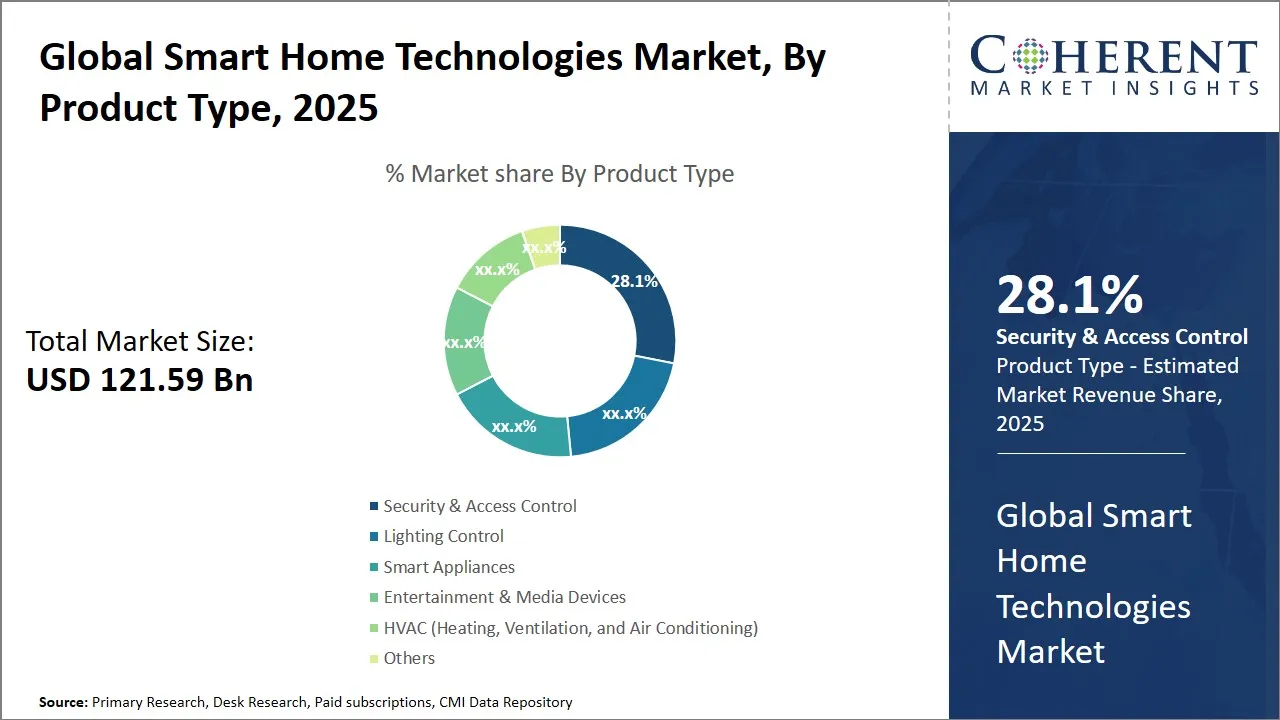
- The security & access control segment is expected to lead the market holding a share of 29.1 % in 2026.
- The residential segment is projected to dominate with a share of 65.8 % in 2026.
- The Wi-Fi segment leads the market holding an estimated share of 52.7 % in 2026.
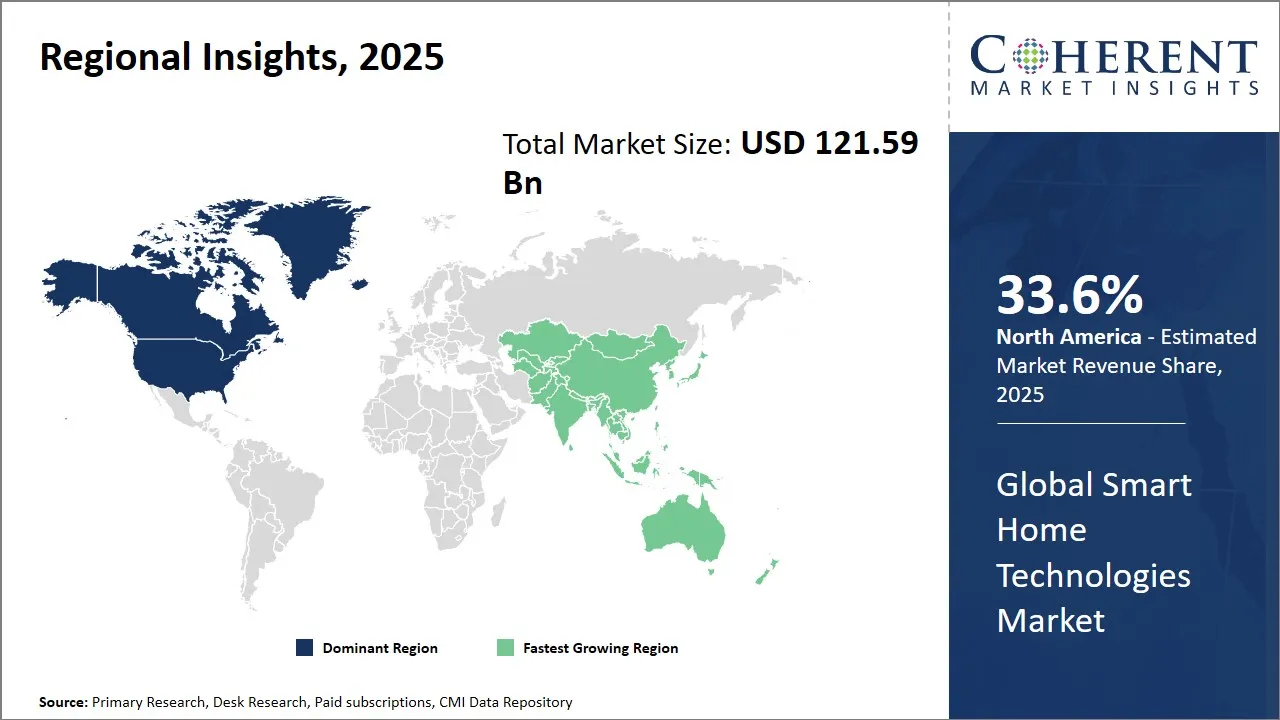
- North America, holding an estimated share of 33.6 % in 2026, is projected to dominate the market.
- Asia Pacific, holding a projected share of 22.5 % in 2026, shows the fastest growth in the market.
Market Overview
The market sees a fast shift towards AI-integrated smart home devices, making possible more personalized and efficient user experiences. Also, energy management systems are gaining traction due to growing environmental concerns and the need for sustainable living. The increasing connectivity in devices and greater focus on data privacy and cybersecurity add to innovation and consumer confidence in the smart home technologies space.
Current Events and Its Impact
Current Events | Description and its Impact |
Geopolitical and Trade Developments |
|
Economic and Industrial Trends |
|
Segmental Insights
- Current Industry Events of 2026
- Market Size Estimation
- Regional Breakdown
- Competitive Landscape
- Customer Intelligence
- Segmental Analysis
- Pricing Analysis
- Key Market Drivers, Challenges & Future Trends
- Customized Insights Section
Global Smart Home Technologies Market Insights, By Product Type – Security & Access Control Drives Smart Home Adoption Through Enhanced Safety and Convenience
The Security & Access Control segment leads the global smart home technologies market with an estimated 29.1% share in 2026 because of the rising awareness of safety and convenience. Devices like smart locks, video doorbells, and surveillance systems help homeowners to monitor and control access remotely, addressing growing concerns over property safety in both urban and suburban areas.
Innovations like AI-powered facial recognition and video analytics are adding to segment growth, making possible proactive threat detection and personalized access management. These technologies not only strengthen home security but also enhance user experience through real-time alerts and digital key sharing for guests or service providers.
Integration with broader home ecosystems like lighting or Heating, Ventilation, and Air Conditioning (HVAC) systems that respond to security status adds to its appeal. For instance, Ring by Amazon mixes motion detection, video analytics, and Alexa voice control.
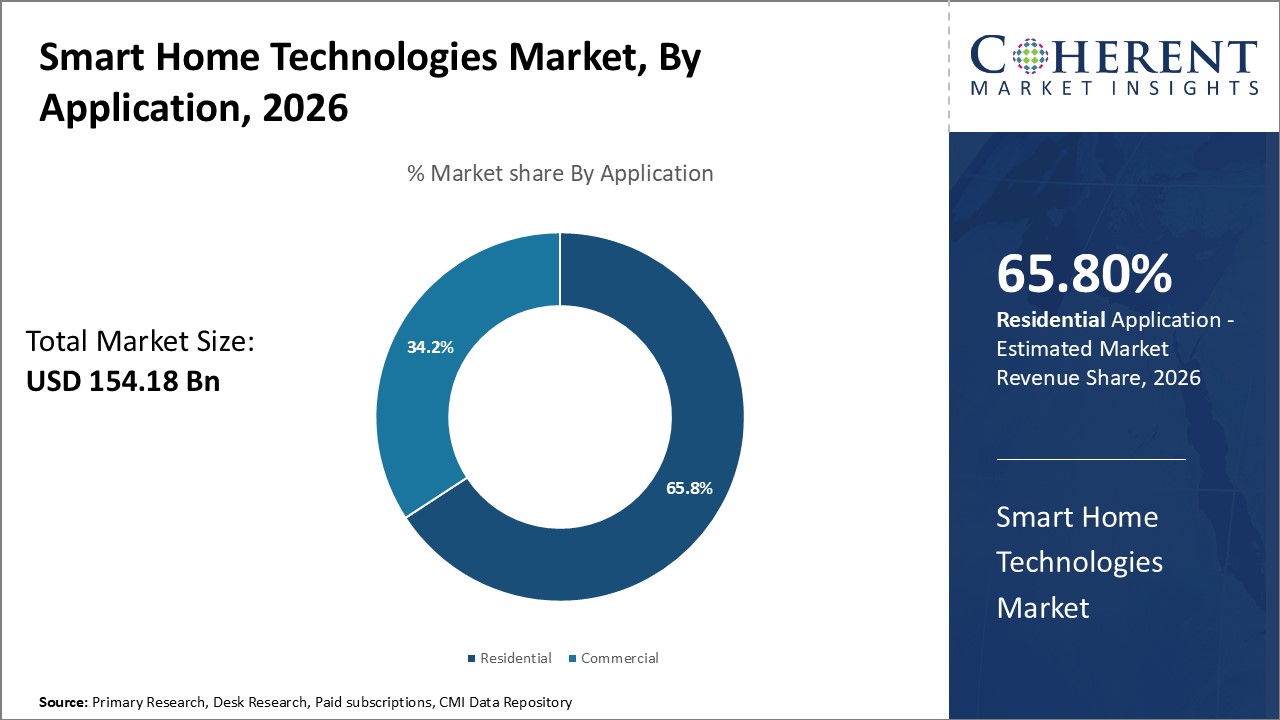
Global Smart Home Technologies Market Insights, by Application – Residential Applications Fueled by Growing Consumer Desire for Comfort and Energy Efficiency
The residential segment dominates with a projected 65.8% share in 2026 because of increasing consumer demand for comfort, automation, and energy efficiency. Homeowners are using smart solutions to optimize daily living, like automated lighting and temperature control.
Energy-conscious consumers invest in smart HVAC and lighting systems that respond to occupancy or external weather, reducing energy costs and increasing sustainability. The rise of smartphone uses and intuitive apps has made controlling these systems easier and more accessible.
Younger homeowners, especially tech-native generations, are adding to this adoption trend. For example, Google Nest Learning Thermostat uses adaptive algorithms to optimize heating and cooling based on user habits—demonstrating how residential smart systems blend sustainability with everyday comfort.
Global Smart Home Technologies Market Insights, By Communication Technology – Wi-Fi Communication Technology Powers Smart Home Connectivity with Ubiquity and Ease of Use
The Wi-Fi segment is expected to hold a dominant 52.7% share in 2026 because of its ubiquity, high bandwidth, and compatibility in different devices. Its existing infrastructure and familiarity make it the default choice for connecting smart products such as cameras, thermostats, and voice assistants in most homes.
The simplicity of Wi-Fi-based setup removes the need for separate hubs, making consumer appeal, especially for first-time smart home users. Continuous upgrades to Wi-Fi standards have improved reliability, speed, and power efficiency, supporting complex ecosystems of interconnected devices.
A notable example is TP-Link’s Tapo ecosystem, which leverages Wi-Fi for seamless control of smart plugs, bulbs, and cameras without requiring an additional hub—illustrating how convenience and interoperability sustain Wi-Fi’s dominance in smart home communication.
Pricing Analysis of the Smart Home Technologies Market
Product/Category | Typical Retail Price (USD) |
Smart speaker — mid tier (e.g., Sonos One/Era 100 class) | USD 199.00 |
Smart speaker — entry tier (Echo Dot/basic Alexa device) | USD 99.99 |
Smart display/hub (mid-sized smart display) | USD 220.00 (typical) |
Smart thermostat — Google Nest (retail) | USD 129.99 |
Smart thermostat — Ecobee (Enhanced/Premium) | USD 199.99 – USD 259.99 |
Video doorbell — Ring (battery/wireless models) | USD 149.99 |
Outdoor/indoor smart security camera (single) — Arlo Pro class | USD 99.99 |
Robot vacuum (iRobot Roomba j7 class) | USD 599.99 |
Smart lock (August/Yale branded Wi-Fi locks) | USD 229.99 – USD 249.99 |
Smart LED bulb — Philips Hue (single A19 color/broadly available model) | USD 24.99 |
Smart plug (TP-Link Kasa/Tapo class — per unit/small-pack implied) | USD 6.50 – USD 24.99 (per unit) — Representative: USD 12.99 (2-pack ≈ USD 12.99) |
Smart lighting starter kit/2-pack Hue (white ambiance 2-pack) | USD 54.99 (2-pack) |
Smart refrigerator (Samsung Family Hub — mid/high tier) | USD 1,699.00 – USD 3,299.00 — Representative: USD 2,699.00 (premium Family Hub model) |
Smart washing machine (LG smart front-load, mainstream smart model) | USD 899.00 |
Smart audio soundbar/premium AV (Sonos Arc class) | USD 1,099.00 (high-end) — Representative: USD 219.00 (compact sound/speaker Era 100) |
Regional Insights
North America Smart Home Technologies Market Analysis and Trends
North America, holding an estimated share of 33.6% in 2026, is set to dominate the global smart home technologies market stems from a highly developed technology ecosystem, widespread consumer adoption, and strong infrastructure that supports smart devices and IoT integration. The region sees a lot of investment in R&D, tech-savvy consumers, and early adoption of smart home solutions such as automated lighting, security systems, and voice-activated assistants.
Established tech hubs, particularly in the U.S. and Canada, house big industry players like Google (Nest), Amazon (Alexa), and Apple (HomeKit), which continue to drive innovation and consumer penetration. Also, North America's well-established distribution channels and extensive partnerships between technology providers and home builders streamline market expansion.
Asia Pacific Smart Home Technologies Market Analysis and Trends
The Asia Pacific region, holding a projected share of 22.5% in 2026, shows the fastest growth in smart home technologies because of fast urbanization, increasing disposable incomes, and rising awareness of home automation benefits. Countries like China, Japan, South Korea, and India show strong demand because of growing middle-class populations eager to adopt digital lifestyles. Proactive government policies for smart cities and IoT infrastructure add to market growth.
The presence of prolific manufacturing hubs in China and South Korea supports cost-effective production and rapid deployment of smart devices globally. Big regional players like Xiaomi, Huawei, Samsung, and Panasonic offer competitively priced and innovative products tailored to local consumer preferences. Trade dynamics also support Asia Pacific, with active exports and collaborations improving technology distribution worldwide.
Global Smart Home Technologies Market Outlook for Key Countries
U.S. Smart Home Technologies Market Analysis and Trends
The U.S. leads smart home technology innovation, seeing a lot of globally recognized tech giants like Google, Amazon, and Apple. Strong consumer demand for interoperability, security, and convenience drives frequent product launches and ecosystem advancements. Smart home adoption is supported by proactive regulatory environments pushing energy savings and smart infrastructure developments. The country’s strong venture capital environment also supports numerous startups specializing in niche smart home solutions, like advanced security systems and AI-powered home assistants.
China Smart Home Technologies Market Analysis and Trends
China smart home technologies market sees fast technological adaptation and a huge consumer base because of rising urbanization and digital transformation policies. Domestic companies like Xiaomi and Huawei are big contributors, offering affordable smart devices and ecosystem integration made for local needs. The government’s significant focus on smart city projects and IoT infrastructure provides fertile ground for both innovation and deployment. Also, China uses its manufacturing capabilities to serve as a major exporter of smart home technologies, influencing global supply chains.
Germany Smart Home Technologies Market Analysis and Trends
Germany continues to lead Europe smart home technologies market because of a mix of high consumer interest in energy-efficient solutions and stringent regulatory frameworks promoting sustainability. German companies like Bosch and Siemens are important in integrating smart home technologies with energy management and security systems targeted at Europe. The country’s strong industrial base and precision engineering expertise add to product reliability and adoption in both residential and commercial sectors. Trade policies supporting intra-European cooperation also add to technology standardization and market cohesion.
Japan Smart Home Technologies Market Analysis and Trends
Japan smart home technologies market sees innovation in robotics and consumer electronics, with big players like Panasonic, Sony, and Toshiba driving development of smart appliances and security solutions. High government support for IoT adoption and aging population-focused technologies makes demand for healthcare and assisted living smart home features. High consumer expectations for product quality and seamless integration challenge local companies to maintain leadership in sophisticated smart home ecosystems.
India Smart Home Technologies Market Analysis and Trends
India smart home technologies market shows dynamic growth potential because of increasing smartphone penetration and the digitalization wave in urban and semi-urban areas. Local and international companies are focusing on affordability and customization to meet different consumer needs. Key players like Godrej, Xiaomi India, and Samsung are actively releasing budget-conscious smart home solutions. Despite infrastructure challenges, rising awareness and internet accessibility makes continuous demand.
Market Players, Key Development, and Competitive Landscape
Key Developments
- On October 15, 2025, Synaptics Incorporated, announced the new Astra SL2600 Series of multimodal Edge AI processors designed to deliver exceptional power and performance. The Astra SL2600 series enables a new generation of cost-effective intelligent devices that make the cognitive Internet of Things (IoT) possible.
- On October 14, 2025, At Network X 2025, TCL, a global leader in display technology across feature-rich smartphones, tablets, and connected devices, announced a partnership with F-Secure, a pioneer in cybersecurity, aimed at integrating advanced security capabilities into TCL's Fixed Broadband (FBB), Fixed Wireless Access (FWA) and Mobile Broadband (MBB) products.
- In May 2025, Smart home controller maker, Brilliant NextGen, launched its second generation of touchscreen panels that replace traditional light switches. The new hardware, which looks like the previous model, has a 4x higher resolution screen and dual-band WiFi (2.4GHz and 5GHz) to help curb interference.
- In July 2024, LG Electronics acquired an 80% stake in Athom to strengthen LG’s position in the smart home industry. With this acquisition, the Homey operating system, connectivity and partnerships that Athom has developed over the past ten years became available to LG.
Top Strategies Followed by Smart Home Technologies Market Players
- Established industry giants dominate by investing a lot in research and development (R&D) to continuously innovate and introduce high-performance products that meet evolving consumer demands.
- Samsung Electronics has significantly expanded its R&D investment in AI-integrated smart home ecosystems. In 2024, it launched the SmartThings Home AI platform, which unifies appliances, lighting, and energy devices using advanced machine learning.
- Mid-level players in the smart home technologies market focus on delivering cost-effective solutions that offer a balance between quality and affordability.
- Xiaomi Corporation offers the Mi Smart Home ecosystem, adding affordable smart plugs, cameras, and sensors through its Mi Home app.
- Small-scale players in the smart home technologies market adopt highly specialized strategies to carve out distinctive niches amid intense competition.
- Aqara (a startup spun out of Lumi United Technology) has carved out a niche in smart home security and automation using Apple HomeKit and Matter support.
Market Report Scope
Smart Home Technologies Market Report Coverage
| Report Coverage | Details | ||
|---|---|---|---|
| Base Year: | 2025 | Market Size in 2026: | USD 154.18 Bn |
| Historical Data for: | 2020 To 2024 | Forecast Period: | 2026 To 2033 |
| Forecast Period 2026 to 2033 CAGR: | 26.8% | 2033 Value Projection: | USD 812.55 Bn |
| Geographies covered: |
| ||
| Segments covered: |
| ||
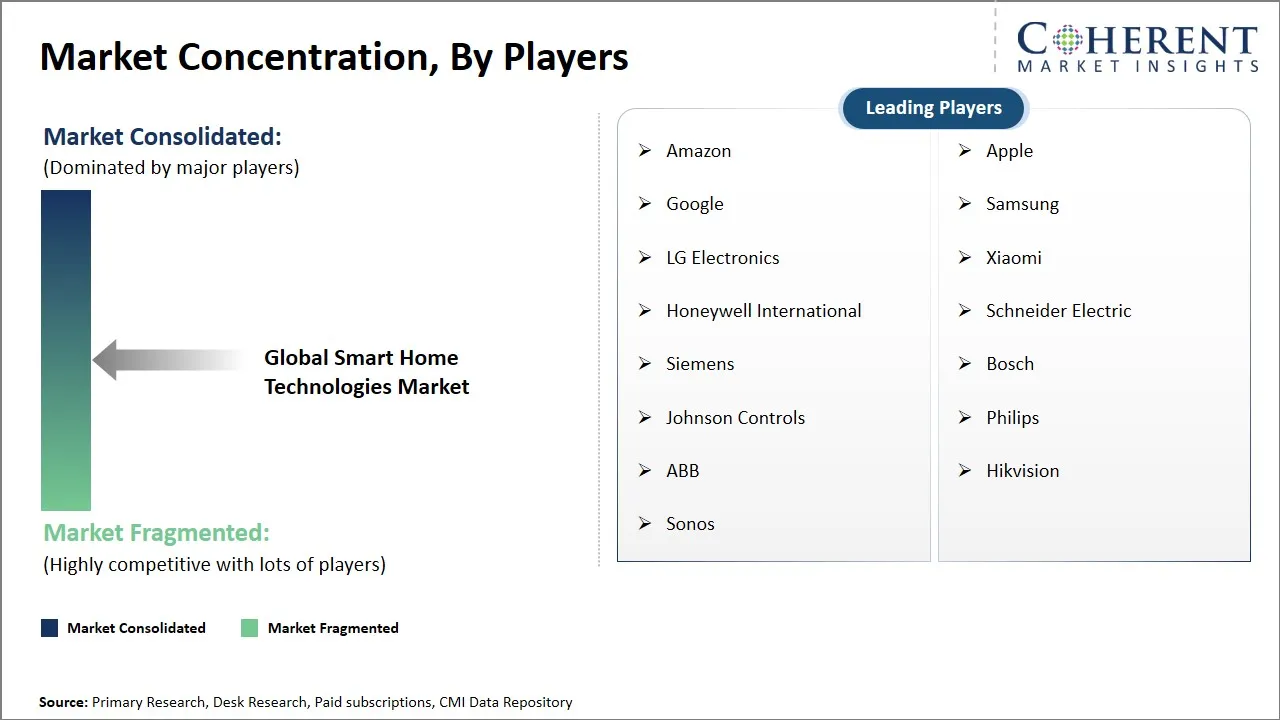
| Companies covered: | Amazon, Apple, Google, Samsung, LG Electronics, Xiaomi, Honeywell International, Schneider Electric, Siemens, Bosch, Johnson Controls, Philips, ABB, Hikvision, and Sonos | ||
| Growth Drivers: |
| ||
| Restraints & Challenges: |
| ||
Market Dynamics
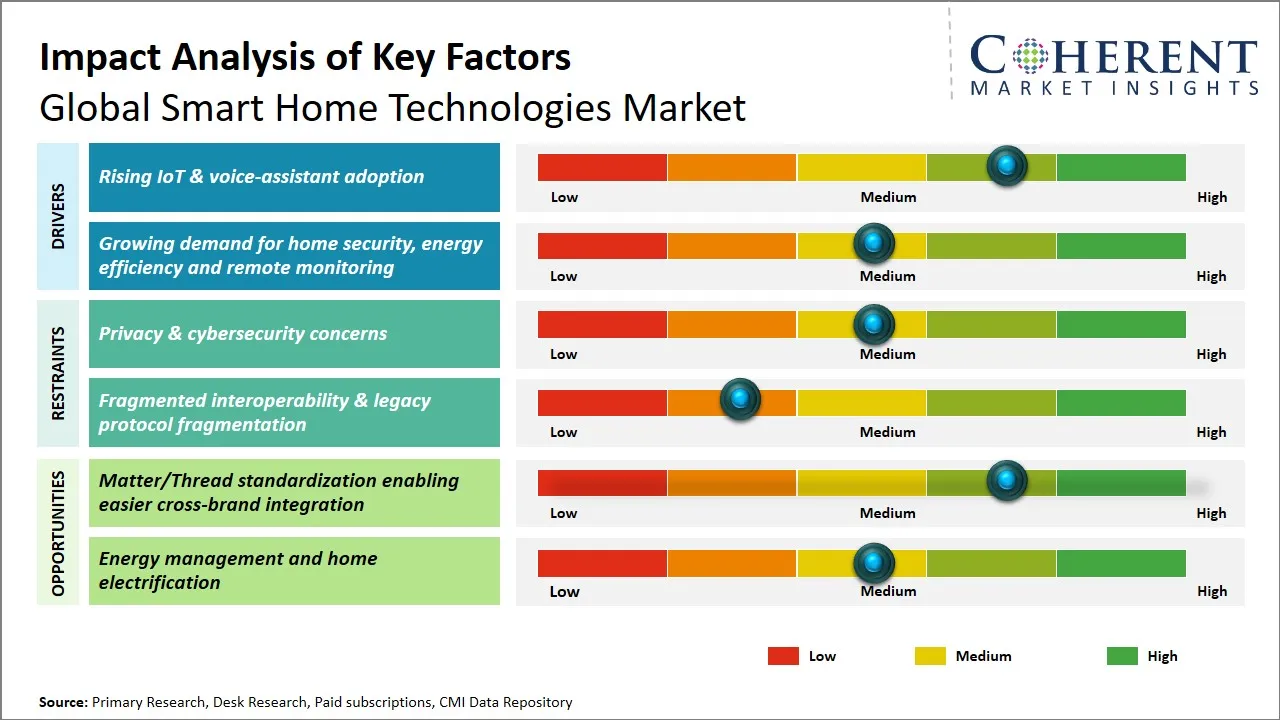
Global Smart Home Technologies Market Driver - Rising IoT & Voice-Assistant Adoption
The increasing integration of Internet of Things (IoT) devices and voice-assistant technologies is significantly propelling the demand for smart home solutions worldwide. Consumers are using connected devices that offer control over different household functions like lighting, security, temperature, and entertainment through intuitive and hands-free interfaces. Voice assistants like Amazon Alexa, Google Assistant, and Apple’s Siri have become very useful for simplifying user interaction with smart devices, enabling commands through natural language processing and fostering a more personalized home environment.
Additionally, advancements in IoT infrastructure have enhanced device interoperability, allowing multiple smart systems to communicate and operate cohesively. This interconnectedness improves user convenience, energy efficiency, and home security, contributing to a more intelligent living space. As consumers place a higher value on convenience, automation, and real-time responsiveness, the rising adoption of IoT and voice-assistant technology continues to act as a crucial catalyst driving the evolution and expansion of the smart home technologies market.
Global Smart Home Technologies Market Opportunity – Matter/Thread Standardization Enabling Easier Cross-Brand Integration
The rise of Matter and Thread as industry standards presents a big opportunity for the global smart home technologies market. It addresses one of the sector’s most persistent challenges: interoperability in different devices and brands. Matter, developed by the Connectivity Standards Alliance, is made to unify different communication protocols, making possible compatibility and simplifying the user experience across smart home ecosystems. Thread, a low-power, mesh networking protocol, complements Matter by providing reliable and scalable connectivity specifically made for smart home devices. This standardization lowers barriers for consumers hesitant to invest in smart home products because of fears of incompatibility or complex setup processes.
For manufacturers, adherence to Matter and Thread protocols reduces development costs and makes time-to-market faster by removing the need for proprietary solutions and fragmented ecosystems. Also, this unified approach fosters innovation and collaboration among leading technology companies, driving the creation of more diverse and advanced smart devices. The adoption of Matter and Thread will add to market expansion by improving device interoperability, boosting consumer confidence, and ultimately increasing the penetration of smart home technologies globally. This development serves as a catalyst for accelerated growth within the smart home technologies market landscape.
Analyst Opinion (Expert Opinion)
- As the number of interconnected devices multiplies, each additional endpoint becomes a potential vulnerability. The proliferation of low-cost IoT sensors and smart appliances—often released with minimal security oversight—creates an ecosystem where a single compromised device can expose entire home networks to breaches and data theft.
- The exponential growth of always-listening devices and cloud-synced platforms has outstripped the pace of global privacy legislation. Even with frameworks like the EU Cyber Resilience Act and U.S. IoT Cybersecurity Labeling Program, inconsistent enforcement and regional disparity leave consumers exposed to data misuse and unauthorized surveillance.
- Consumers are becoming more skeptical of connected ecosystems following repeated incidents of smart camera hacking and voice data leaks. Long-term adoption will increasingly depend on manufacturers embedding encryption, local data processing, and transparent privacy practices as standard features—transforming cybersecurity from a compliance checkbox into a competitive differentiator.
Speak to the analyst
Want personalized insights?
Take the findings above to one of our principal consultants, or have the report rebuilt around the segments, geographies and competitors you actually track.
Market Segmentation
- Product Type Insights (Revenue, USD Bn, 2021 - 2033)
- Security & Access Control
- Smart Appliances
- HVAC (Heating, Ventilation, and Air Conditioning)
- Entertainment & Media Devices
- Lighting Control
- Others
- Application Insights (Revenue, USD Bn, 2021 - 2033)
- Residential
- Commercial
- Communication Technology Insights (Revenue, USD Bn, 2021 - 2033)
- Wi-Fi
- Zigbee
- Z-Wave
- Bluetooth
- Others
- Component Insights (Revenue, USD Bn, 2021 - 2033)
- Software
- Hardware
- Services
- Regional Insights (Revenue, USD Bn, 2021 - 2033)
- North America
- U.S.
- Canada
- Latin America
- Brazil
- Argentina
- Mexico
- Rest of Latin America
- Europe
- Germany
- U.K.
- Spain
- France
- Italy
- Russia
- Rest of Europe
- Asia Pacific
- China
- India
- Japan
- Australia
- South Korea
- ASEAN
- Rest of Asia Pacific
- Middle East
- GCC Countries
- Israel
- Rest of Middle East
- Africa
- South Africa
- North Africa
- Central Africa
- North America
- Key Players Insights
- Amazon
- Apple
- Samsung
- LG Electronics
- Xiaomi
- Honeywell International
- Schneider Electric
- Siemens
- Bosch
- Johnson Controls
- Philips
- ABB
- Hikvision
- Sonos
Sources
Primary Research Interviews
Stakeholders
- Smart Device Manufacturers and OEMs
- IoT Platform Developers and Software Integrators
- Component Suppliers (chipmakers, sensor and connectivity module vendors)
- Home Automation Installers and Systems Integrators
- Retailers and E-commerce Channel Partners (consumer electronics distributors)
- Residential Property Developers and Smart Home Solution Providers
- Cybersecurity Experts specializing in IoT and connected home systems
- Utility Companies involved in energy management and smart metering projects
Databases
- U.S. Department of Energy (DOE) Smart Grid Database
- International Telecommunication Union (ITU) ICT Statistics
- World Internet of Things Observatory (WITO)
- Global Connected Living Index (GCLI)
- OECD Digital Economy Outlook
- Home Connectivity Standards Alliance (HCSA) Annual Database
Magazines
- Smart Home World
- IoT Innovator
- Connected Living Review
- Home Automation Today
- Consumer Electronics Digest
Journals
- Journal of Ambient Intelligence and Smart Environments
- IEEE Internet of Things Journal
- International Journal of Smart Grid and Clean Energy
- Sensors and Actuators Reports
- Energy Informatics Journal
Newspapers
- The Wall Street Journal – Tech Section
- Financial Times – Technology & Innovation
- The Guardian (UK) – Smart Living Series
- The Economic Times (India) – Gadgets & Tech
- Nikkei Asia – Technology Business Desk
Associations
- Consumer Technology Association (CTA)
- Zigbee Alliance / Connectivity Standards Alliance (CSA)
- International Electrotechnical Commission (IEC) Smart Home Division
- Home Connectivity Alliance (HCA)
- European Committee for Electrotechnical Standardization (CENELEC)
- Open Connectivity Foundation (OCF)
Public Domain Sources
- U.S. Energy Information Administration (EIA)
- EUROSTAT
- International Energy Agency (IEA)
- United Nations Economic and Social Council (ECOSOC)
- World Bank – Digital Development Indicators
- ResearchGate
Proprietary Elements
- CMI Data Analytics Tool, Proprietary CMI Existing Repository of Information for Last 8 Years
Get access to 250+ pages report
Every segment, forecast, competitor profile and data table behind the analysis above — available for instant download.
- ESOMAR Member
- ISO 9001:2015 Certified
- D-U-N-S Registered
- GDPR & CCPA Compliant
Missing comfort of reading report in your local language? Find your preferred language:
Transform your Strategy with Exclusive Trending Reports
Frequently Asked Questions
The global smart home technologies market is estimated to be valued at USD 154.18 billion in 2026 and is expected to reach USD 812.55 billion by 2033.
The CAGR of the global smart home technologies market is projected to be 26.8% from 2026 to 2033.
Rising IoT & voice-assistant adoption and growing demand for home security, energy efficiency and remote monitoring are the major factors driving the growth of the global smart home technologies market.
Privacy & cybersecurity concerns and fragmented interoperability & legacy protocol fragmentation are the major factors hampering the growth of the global smart home technologies market.
In terms of product type, the security & access control is estimated to dominate the market revenue share in 2026.
These standards promote interoperability between devices from different brands, simplifying integration and boosting consumer trust.
AI enables predictive automation and personalization—devices can learn user habits, optimize energy use, and enhance home safety autonomously.