

Smart Bridges Market Size and Share Analysis – Growth Trends and Forecasts (2026–2033)
The Smart Bridges Market size is anticipated to grow at a CAGR of 8.5%, reaching USD 9.44 Bn in 2026, and is expected to attain USD 16.77 Bn by 2033. The primary drivers are largely defined by increasing investments in bridge modernization, rising adoption of structural health monitoring systems, growing deployment of IoT-enabled sensors, and the increasing use of artificial intelligence for predictive maintenance and real-time infrastructure assessment. According to the U.S. Federal Highway Administration’s 2025 National Bridge Inventory, the U.S. had 624,193 bridges, of which 309,729 were classified in fair condition and 41,685 were in poor condition.
Key Takeaways
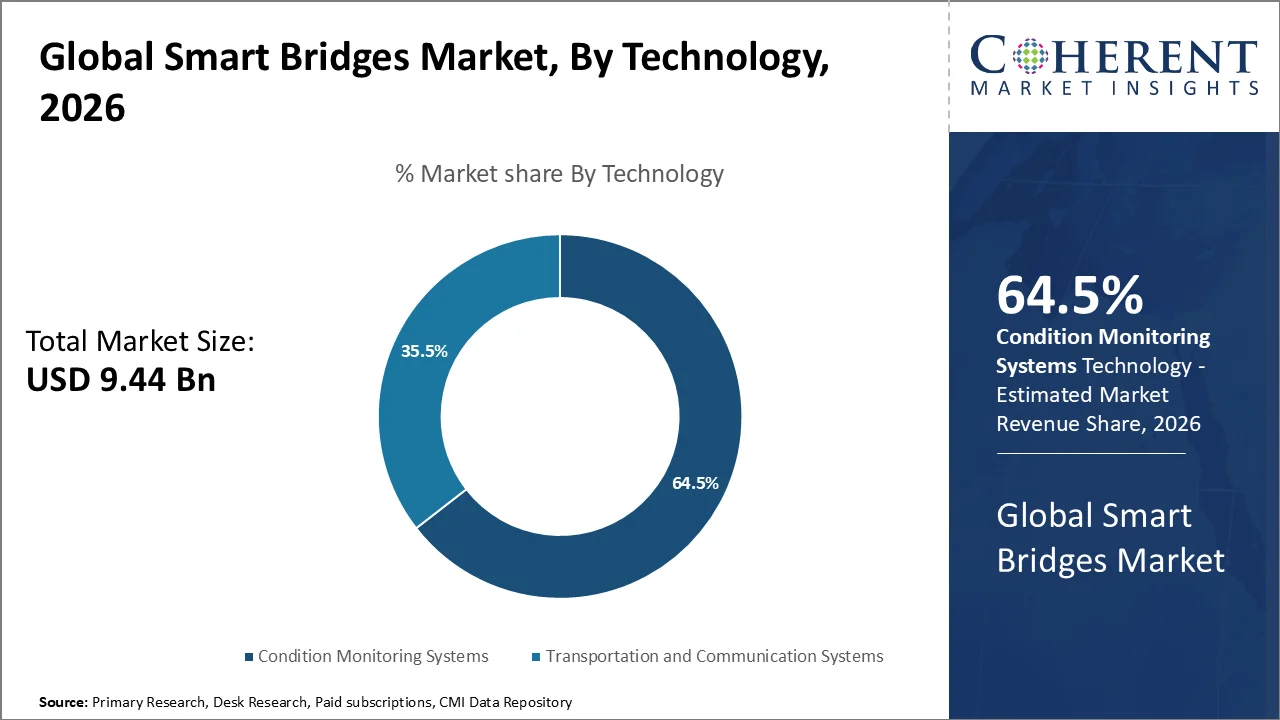
- The condition monitoring systems segment is likely to dominate the market with 64.5% in 2026. The segment’s growth is owing to the increasing deployment of IoT-based structural health monitoring, real-time vibration and strain assessment, AI-enabled anomaly detection, digital twins, and predictive maintenance platforms. In 2024, research carried out by scientists showed that the developed monitoring system based on artificial intelligence had a 99.9% rate of accuracy in detecting anomalies, while the traditional benchmarking technique used had only 95.03%.
- The temperature sensors segment is set to lead with 22.8% in 2026. The segment’s growth is owing to the widespread requirement to measure thermal expansion, temperature-induced strain, material deformation, bearing movement, and seasonal changes in concrete and steel structures. A 2024 peer-reviewed IoT bridge-monitoring study integrated five sensing parameters, deflection, vibration, temperature, humidity, and infrared measurements, into a real-time warning system, demonstrating the central role of temperature data in multi-sensor bridge-health assessment.
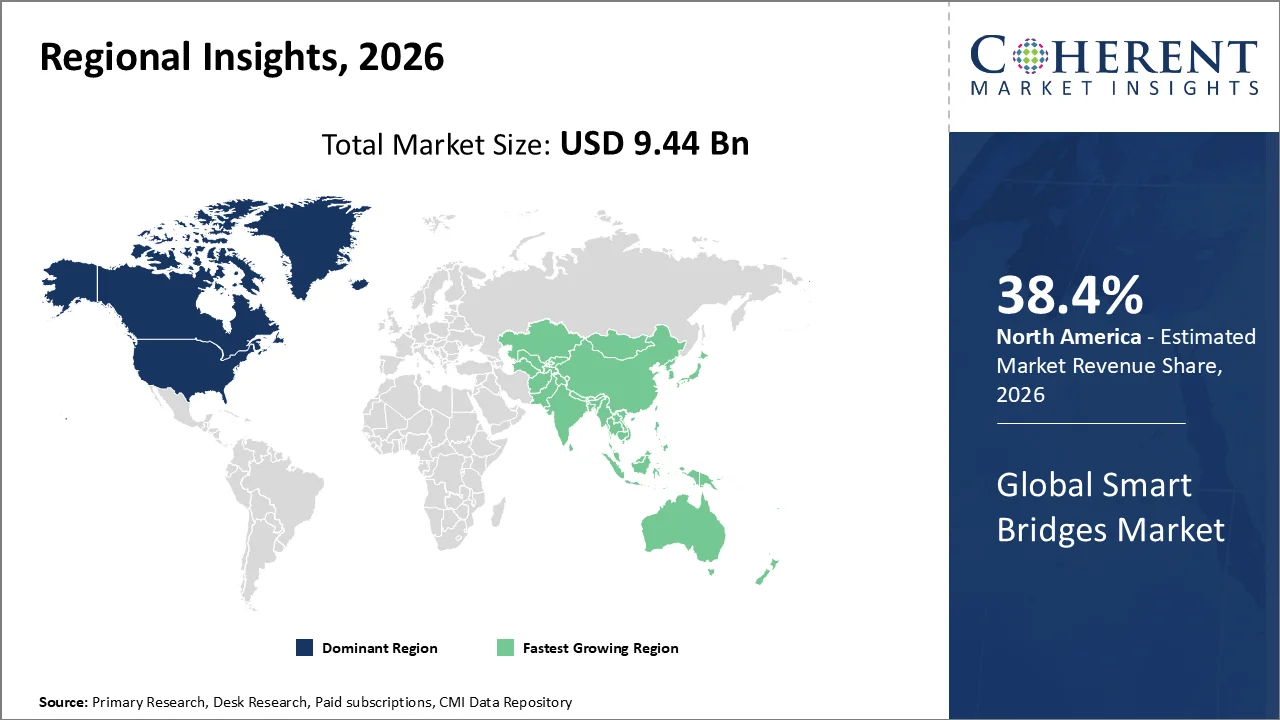
- North America is expected to dominate the smart bridges market with a 38.4% share in 2026. The region’s leadership is owing to the large-scale adoption of structural health monitoring systems, federal funding for smart transportation technologies, deployment of connected sensor networks, and increasing integration of digital twins and AI-based infrastructure analytics. The U.S. Federal Highway Administration’s FY 2026 budget provides USD 5.5 billion for the Bridge Formula Program and approximately USD 2.55 billion for the Bridge Investment Program.
Market Drivers
AI- and IoT-Based Condition Monitoring is Transforming Smart Bridge Maintenance
The smart bridges market is advancing as bridge owners shift from periodic visual inspection toward continuous, condition-based maintenance. Integrated accelerometers, strain gauges, temperature sensors, IoT gateways, cloud platforms, and digital twins enable authorities to identify structural anomalies and prioritize repairs before deterioration results in major disruption.
According to the report issued by the Enterprise Europe Network, which is supported by the European Commission, in November 2025, the WeStatiX structural health monitoring system was implemented in over 300 infrastructure systems in Italy and several other countries. The WeStatiX system is a combination of artificial intelligence, finite element analysis, Internet of Things, and digital twin technology.
Increasing Climate-Resilience Requirements are Accelerating Smart Bridge Deployment
Climate resilience has become one of the key factors driving the smart bridge market due to threats from floods, hot weather conditions, storms, strong winds, and rising water levels. Smart sensors make it possible for relevant authorities to monitor scouring, displacement, thermal expansion, wind effects, water levels, and structural movements in extreme conditions.
In April 2024, the U.S. Department of Transportation allocated almost USD 830 million to around 80 transportation-resilience projects through its PROTECT program. Out of these 80 projects, 36 projects were allocated around USD 621 million for making changes that improve their resilience through elevating bridges, improving drainage systems, rehabilitation of structures, and other resilience enhancements.
Current Events and Their Impact
Current Event | Description and its Impact |
FHWA Implements New Digital National Bridge Inventory Reporting Standard (2026) |
|
EU Cyber Resilience Act Introduces Mandatory Security-Incident Reporting for Connected Products (2026) |
|
- Current Industry Events of 2026
- Market Size Estimation
- Regional Breakdown
- Competitive Landscape
- Customer Intelligence
- Segmental Analysis
- Pricing Analysis
- Key Market Drivers, Challenges & Future Trends
- Customized Insights Section
Segmental Insights
Why are Condition Monitoring Systems Acquiring the Largest Share?
On the basis of technology, the condition monitoring systems segment is projected to account for the largest smart bridges market share of 64.5% in 2026. The segment’s growth is owing to the increasing need for continuous measurement of vibration, displacement, strain, cable behavior, structural movement, and extreme-event impacts. These systems enable bridge owners to shift from scheduled inspections toward condition-based maintenance, automated alerts, and risk-prioritized repair planning.
In May 2026, the West Virginia Department of Transportation reported the deployment of a structural health monitoring system comprising 57 sensors on the East Huntington–Gunner Gatski Bridge, which carries more than 14,000 vehicles per day. The system monitors vibrations, displacements, and other structural parameters, while the next deployment stage is planned to cover six additional bridges along the Ohio West Virginia border.
Temperature Sensors Hold the Largest Market Share
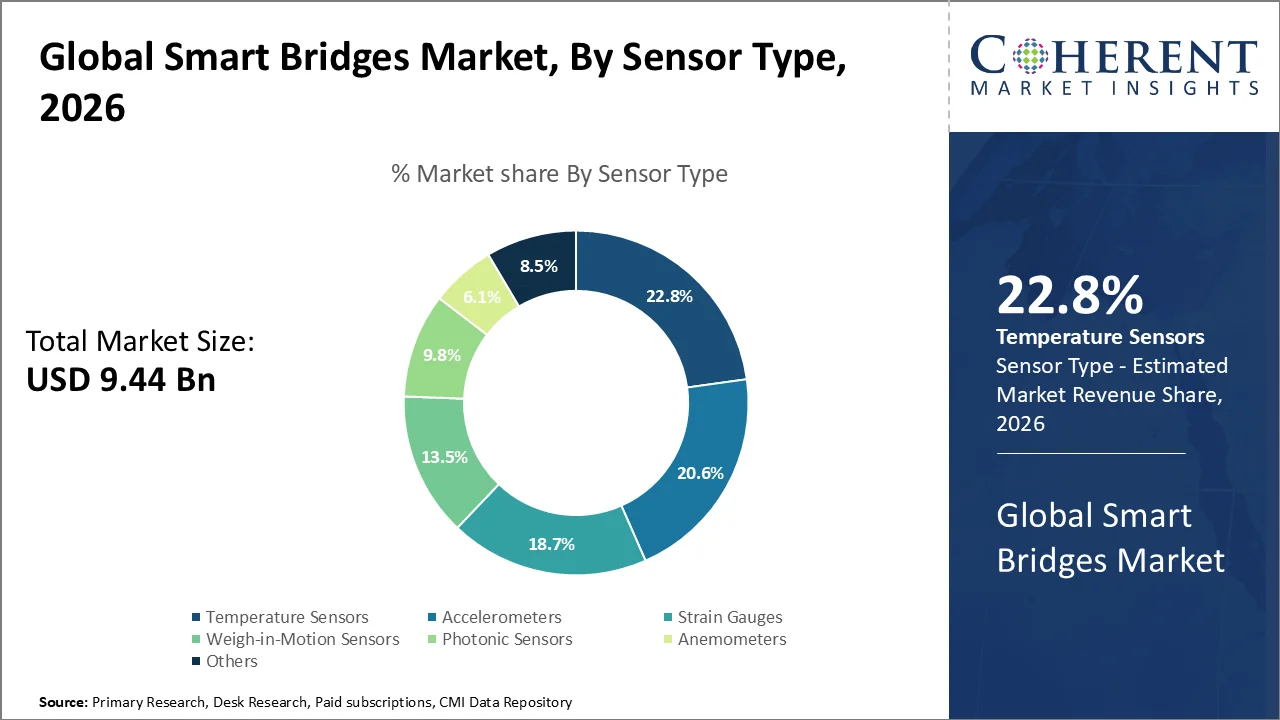
On the basis of sensor type, the temperature sensors segment is projected to lead the smart bridges market with a 22.8% share in 2026. The segment’s growth is owing to the significant influence of temperature on bridge expansion, contraction, strain, displacement, cable tension, bearing movement, and concrete deformation. Temperature readings are also required to distinguish environmentally induced structural changes from actual deterioration or sensor malfunction.
A 2025 study of a long-span cable-supported bridge installed nine structural temperature sensors across nine bridge cross-sections, including the north tower, south tower, mid-span, and steel-box-girder sections. The sensors operated at a 1 Hz sampling frequency, enabling continuous temperature compensation for cable-performance assessment and early-warning analysis.
In January 2026, Kistler announced its first fully digital structural health monitoring system designed specifically for bridges and subsequently showcased it at Intertraffic Amsterdam in March 2026.
Smart Bridges Market Trends
- The rising trend of digital twins being integrated with real-time data collected from sensors fitted on bridges allows visualization of stress, strain, and loading behaviors prior to the degradation of the bridge structure. In a 2025 study done on bridges that was peer-reviewed, a physics-based digital twin model capable of refreshing data in one second and tested loads between 0 N to 500 N was successfully created.
- Increased use of drones, computer vision, and machine learning technology is leading to a reduction in the need for bridge inspection by humans and dedicated bridge inspection equipment. As per the report released by the U.S. Department of Transportation in January 2025, the cost of regular bridge inspections ranges from USD 4,500 to USD 10,000, and there are over 600,000 U.S. bridges which require regular inspections.
- The trend of increased use of high density multi-parametric sensors is now replacing stand-alone sensor systems with sophisticated monitoring systems. Such systems measure acceleration, strain, displacement, temperature, humidity, and cable tension at the same time to enhance the accuracy of structural analysis. According to a study published in 2025, approximately 300 to 500 sensors can be mounted on an individual extra long span bridge.
Regional Insights
North America Dominates Owing to Advanced Bridge-Monitoring and Connected Transportation Infrastructure
North America is expected to account for the largest smart bridges market share of 38.4% in 2026. The region’s leadership is owing to the early adoption of structural health monitoring, connected-vehicle communication, satellite-based infrastructure assessment, digital twins, and AI-supported bridge inspection across the U.S. and Canada.
In December 2025, the U.S. Department of Transportation listed a USD 1,999,999 SMART grant for the Port Authority of New York and New Jersey to pilot cellular vehicle-to-everything technology on the approach corridors of the George Washington Bridge. The project is intended to address recurring vehicle collisions and traffic congestion along the Trans-Manhattan Expressway section of the bridge, demonstrating the growing integration of connected transportation systems with major bridge infrastructure.
Asia Pacific Smart Bridges Market Trends
Asia Pacific is expected to be the fastest-growing region in the smart bridges market, expanding at a modeled CAGR of approximately 10.7% from 2026 to 2033. The region’s growth is owing to extensive bridge construction, rapid urbanization, expansion of intelligent transportation networks, and the increasing integration of AI, digital twins, automated construction systems, and real-time structural monitoring into new infrastructure projects.
In June 2025, China Railway Engineering Corporation introduced a smart cantilever bridge-building system integrating five core systems: load-bearing components, formwork, platform protection, intelligent control, and digital monitoring. The development indicates that smart technologies are being incorporated not only into bridge operation and maintenance but also into the construction phase.
Digital-Twin Inspection and AI-Based Asset Management are Accelerating the Smart Bridges Market in the United States
The U.S. Smart Bridges Market is witnessing strong growth owing to the increasing adoption of digital twins, drone-based inspections, AI-supported defect detection, and sensor-enabled bridge asset management. Federal and state transportation agencies are increasingly evaluating these technologies to improve inspection accuracy, reduce field exposure, and support condition-based maintenance.
In addition, at the 2025 Infrastructure Data Workshop of the U.S. Federal Highway Administration, artificial intelligence (AI), machine learning, advanced bridge management data systems, building information modeling, digital twins, and advanced structural performance modeling have been pinpointed as critical technologies that will be used to increase the service lives of bridges. The efforts by the federal government are increasing the demand for these bridge management technologies.
In March 2026, Bentley Systems reported that Collins Engineers used drone imagery, an AI-enabled digital twin, and cloud-based inspection tools for Minnesota’s Robert Street Bridge. The system enabled engineers to collect approximately 70% of the total inspection information before entering the bridge site and reduced on-site inspection time by at least 20%.
China Smart Bridges Market Trends
China is expected to witness strong growth in the Smart Bridges Market over the forecast period. The country’s growth is owing to its extensive bridge infrastructure, rapid construction of complex long-span bridges, strong state-owned engineering ecosystem, and increasing adoption of satellite navigation, drones, intelligent monitoring systems, and digital construction technologies.
In May 2026, Fujian Province reported the adoption of intelligent monitoring, protective materials, insurance mechanisms, and regular inspection programs for its historic wooden-roofed arch bridges. The province has 547 such bridges and has invested RMB 61.03 million, equivalent to approximately USD 8.93 million, in their protection and maintenance.
Who are the Major Companies in Smart Bridges Industry
Some of the major key players in Smart Bridges Market are Siemens AG, International Business Machines Corporation, Honeywell International Inc., Cisco Systems, Inc., Kapsch TrafficCom AG, Huawei Technologies Co., Ltd, Alcatel Lucent S.A., Indra Sistemas, S.A, and LORD Corporation.
Key News
- In November 2025, Honeywell showcased its integrated smart-city technologies at the Smart City Expo World Congress. The portfolio included Honeywell City Suite, IoT-based automation, real-time analytics dashboards, connected asset monitoring, and integrated management across transportation, security, and public utilities.
Market Report Scope
Smart Bridges Market Report Coverage
| Report Coverage | Details | ||
|---|---|---|---|
| Base Year: | 2025 | Market Size in 2026: | USD 9.44 Bn |
| Historical Data for: | 2020 To 2024 | Forecast Period: | 2026 To 2033 |
| Forecast Period 2026 to 2033 CAGR: | 8.5% | 2033 Value Projection: | USD 16.77 Bn |
| Geographies covered: |
| ||
| Segments covered: |
| ||
| Companies covered: | Siemens AG, International Business Machines Corporation, Honeywell International Inc., Cisco Systems, Inc., Kapsch TrafficCom AG, Huawei Technologies Co., Ltd, Alcatel Lucent S.A., Indra Sistemas, S.A, and LORD Corporation. | ||
| Growth Drivers: |
| ||
| Restraints & Challenges: |
| ||
Analyst Opinion
- The Smart Bridges Market is moving from isolated pilot installations toward broader, government-supported transportation technology deployment. As of January 2025, the U.S. Department of Transportation had committed more than US$400 million across 150 project sites through the SMART and ATTAIN programs for technologies including digital infrastructure, drone-based asset inspection, and advanced traffic systems. This indicates a strengthening procurement pipeline for bridge sensors, inspection technologies, communication networks, and monitoring platforms.
- The market’s long-term value is expected to shift from standalone sensor hardware toward integrated digital twins, anomaly detection, and maintenance decision-support software. In March 2025, the European Commission reported that its bridge-focused DTADD project, supported by an EU contribution of approximately EUR 226,751, had developed real-time digital-twin models, evaluated multiple anomaly-detection algorithms, and delivered an open-source tool for prioritizing bridge interventions. This supports growing recurring demand for analytics, software integration, data management, and predictive-maintenance services.
- Smart bridges are increasingly becoming part of the connected-mobility ecosystem rather than functioning solely as monitored physical structures. The U.S. Department of Transportation had invested more than US$75 million in vehicle-to-everything technologies and supported transportation research across 140 universities in areas such as AI, automation, cybersecurity, and materials innovation. This is expected to accelerate the convergence of structural monitoring, intelligent traffic management, secure communications, and real-time incident response on bridge corridors.
Speak to the analyst
Want personalized insights?
Take the findings above to one of our principal consultants, or have the report rebuilt around the segments, geographies and competitors you actually track.
Market Segmentation
- By Technology (Revenue, USD Bn, 2026-2033)
- Transportation and Communication Systems
- Condition Monitoring Systems
- By Sensor Type (Revenue, USD Bn, 2026-2033)
- Accelerometers
- Anemometer
- Temperature Sensors
- Strain Gauges
- Weigh in Motion Sensors
- Photonic Sensors
- Others
- Global Smart Bridges Market , By Region (Revenue, USD Bn, 2026-2033)
- North America
- U.S.
- Canada
- Latin America
- Brazil
- Mexico
- Argentina
- Rest of Latin America
- Europe
- Germany
- U.K.
- France
- Italy
- Spain
- Russia
- Rest of Europe
- Asia Pacific
- China
- India
- Japan
- Australia
- South Korea
- ASEAN
- Rest of Asia Pacific
- Middle East
- GCC
- Israel
- Rest of Middle East
- Africa
- South Africa
- Central Africa
- North Africa
- North America
- Key Players
- Siemens AG
- International Business Machines Corporation
- Honeywell International Inc.
- Cisco Systems, Inc.
- Kapsch TrafficCom AG
- Huawei Technologies Co., Ltd
- Alcatel Lucent S.A.
- Indra Sistemas, S.A
- LORD Corporation
Sources
Primary Research Interviews
- Bridge design and structural engineering professionals
- Structural health monitoring system developers
- IoT sensor and data-acquisition system manufacturers
- Bridge owners, operators, and maintenance authorities
- Intelligent transportation system solution providers
- Toll-road and bridge traffic-management operators
- Civil infrastructure EPC and system-integration companies
- Government transportation and public-works officials
- Digital-twin, AI analytics, and predictive-maintenance experts
- Key opinion leaders in bridge engineering and infrastructure monitoring
Databases
- U.S. Federal Highway Administration National Bridge Inventory
- U.S. Department of Transportation
- Bureau of Transportation Statistics
- World Bank Infrastructure Database
- Organisation for Economic Co-operation and Development
- European Commission CORDIS Research Database
- Eurostat Transport and Infrastructure Database
- Transport Canada Infrastructure Publications
- China Ministry of Transport Statistics
- United Nations Economic Commission for Europe Transport Database
Magazines
- Bridge Design & Engineering
- Roads & Bridges
- ITS International
- Civil + Structural Engineer
- Smart Cities World
- Traffic Technology Today
- Engineering News-Record
- Infrastructure Intelligence
Journals
- Journal of Bridge Engineering
- Structural Control and Health Monitoring
- Engineering Structures
- Structure and Infrastructure Engineering
- Automation in Construction
- Sensors
- Smart Structures and Systems
- Journal of Civil Structural Health Monitoring
- Transportation Research Record
- Computer-Aided Civil and Infrastructure Engineering
Newspapers
- The Wall Street Journal
- Financial Times
- The New York Times
- The Guardian
- Reuters
- South China Morning Post
- China Daily
- The Economic Times
Associations
- International Association for Bridge and Structural Engineering
- American Society of Civil Engineers
- American Association of State Highway and Transportation Officials
- World Road Association
- Intelligent Transportation Society of America
- International Road Federation
- Transportation Research Board
- International Society for Structural Health Monitoring of Intelligent Infrastructure
- European Association of Toll Road Infrastructure Operators
- International Bridge, Tunnel and Turnpike Association
Public Domain Sources
- Government bridge inventory and inspection reports
- Bridge modernization and infrastructure funding documents
- Transportation authority project announcements
- Company annual reports and investor presentations
- Smart bridge technology product announcements
- University bridge-monitoring research publications
- Structural health monitoring pilot-project reports
- Public procurement and tender databases
- Patent databases such as WIPO, USPTO, and Google Patents
- Technical standards for bridge inspection, IoT security, and structural monitoring
- Environmental and climate-resilience infrastructure reports
- Publicly available smart-city and intelligent transportation project documents
Proprietary Elements
- CMI Data Analytics Tool, Proprietary CMI Existing Repository of Information for the Last 10 Years
Get access to 250+ pages report
Every segment, forecast, competitor profile and data table behind the analysis above — available for instant download.
- ESOMAR Member
- ISO 9001:2015 Certified
- D-U-N-S Registered
- GDPR & CCPA Compliant
Missing comfort of reading report in your local language? Find your preferred language:
Transform your Strategy with Exclusive Trending Reports
Frequently Asked Questions
The Smart Bridges Market is expected to reach USD 16.77 Billion by 2033, increasing from USD 9.44 Billion in 2026.
A smart bridge is a bridge equipped with sensors, communication networks, data-processing systems, and intelligent software that continuously monitor structural condition, environmental exposure, traffic movement, and operational safety.
The condition monitoring systems segment is projected to account for the largest market share of 64.5% in 2026, owing to the increasing need for continuous vibration, strain, displacement, cable-force, and structural-movement assessment.
The temperature sensors segment is projected to lead with a 22.8% share in 2026, owing to its widespread use in measuring thermal expansion, contraction, temperature-induced stress, bearing movement, and deformation in concrete and steel bridge components.
Common sensors include accelerometers, anemometers, temperature sensors, strain gauges, weigh-in-motion sensors, photonic sensors, displacement sensors, corrosion sensors, humidity sensors, and water-level sensors.
AI and digital twins analyze real-time and historical sensor data to identify structural anomalies, simulate bridge performance, predict maintenance requirements, prioritize repairs, and support faster decision-making during extreme weather or structural incidents.
Governments are investing in smart bridge technologies to improve public safety, extend bridge service life, reduce inspection costs, strengthen climate resilience, digitize infrastructure records, and prioritize limited maintenance funding based on real-time asset condition.