

Global Temperature Sensors Market Size and Forecast: 2026-2033
The Global Temperature Sensors Market is estimated to be valued at USD 10.03 Bn in 2026 and is expected to reach USD 14.50 Bn by 2033, exhibiting a compound annual growth rate (CAGR) of 5.4% from 2026 to 2033.
Key Takeaways of the Temperature Sensors Market
- The thermocouples segment leads the market holding an estimated share of 41.3% in 2026.
- North America is estimated to lead the market with a share of 40. 3% in 2026.
- Asia Pacific, holding a share of 36.8 % in 2026, is projected to be the fastest growing region.
Market Overview
A key trend in the temperature sensors market is the shift towards smart and connected sensor systems that enable real-time monitoring and analytics. Integration with wireless technologies and energy-efficient designs is enhancing sensor performance and reducing operational costs. Additionally, increasing emphasis on sustainability and energy management across industries is fueling the demand for precise temperature monitoring solutions, further propelling innovation and market expansion over the coming years.
Current Events and their Impact
Current Events | Description and its impact |
Smart Home & IoT Expansion |
|
Acquisitions & Mergers |
|
Segmental Insights
- Current Industry Events of 2026
- Market Size Estimation
- Regional Breakdown
- Competitive Landscape
- Customer Intelligence
- Segmental Analysis
- Pricing Analysis
- Key Market Drivers, Challenges & Future Trends
- Customized Insights Section
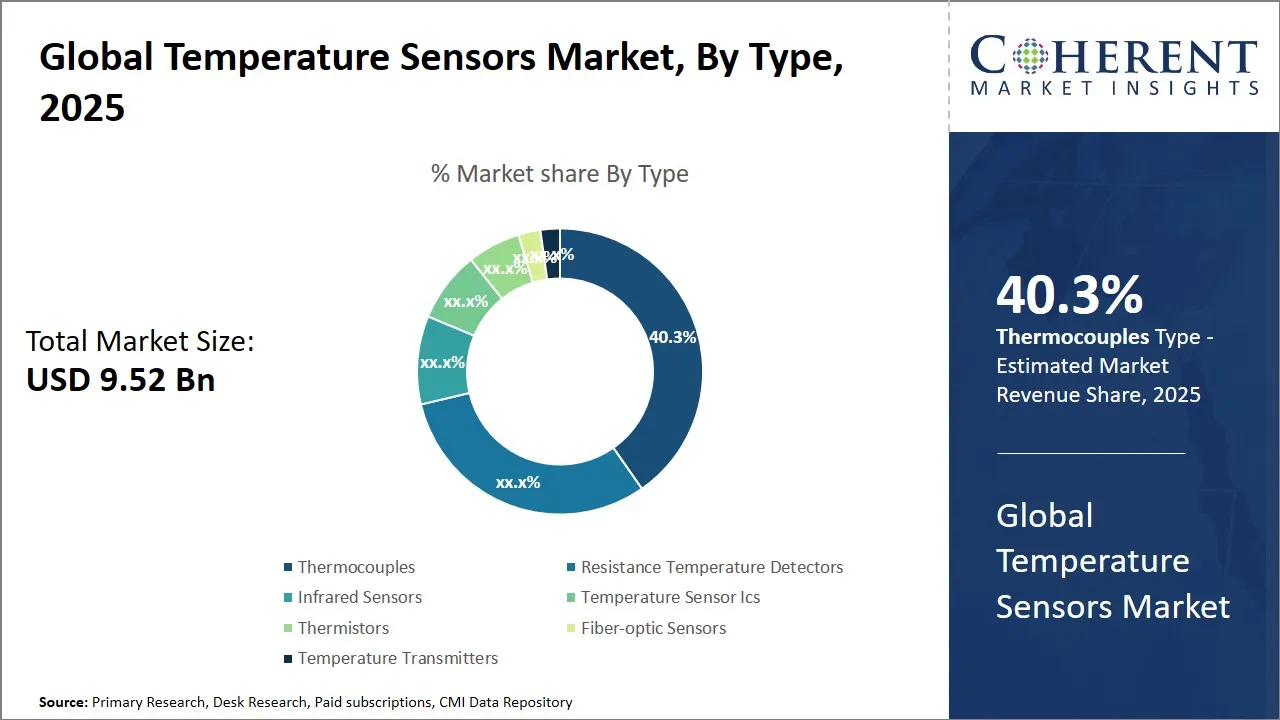
Global Temperature Sensors Market Insights, By Type – Thermocouples Leads Owing to its Robustness And Versatility
Thermocouples are expected to contribute the highest share of 41.3% in the global temperature sensors market in 2026. One of the foremost reasons for thermocouples’ dominance is their exceptional ability to operate effectively across a broad temperature range, from cryogenic temperatures up to extremely high temperatures exceeding 1800°C. This wide operating range makes thermocouples highly versatile and suitable for challenging industrial environments such as steel manufacturing, power generation, and chemical processing, where temperature monitoring under extreme conditions is essential.
Additionally, thermocouples offer quick response times and high durability, even in harsh environments involving vibration, pressure, and corrosive substances. Their rugged construction ensures reliable performance and longevity, which significantly reduces maintenance requirements and operational downtime. This durability also translates into cost-efficiency for industries that seek reliable temperature measurement solutions with minimal calibration needs.
Another factor propelling the growth of the thermocouples segment is their intrinsic simplicity and ease of installation. Thermocouples do not require external excitation power, which simplifies wiring and integration into existing control systems. This aspect makes them highly attractive for applications in automotive industries, aerospace, and Heating, Ventilation, and Air Conditioning (HVAC) systems where space and power constraints exist.
The variety of thermocouple types (such as Type K, J, T, and E) tailored for specific temperature ranges and environmental conditions also contributes to their extensive use. This diversity allows manufacturers and end-users to select sensors precisely matching their application requirements, further solidifying thermocouples’ leading position.
Impact of Artificial Intelligence ( AI) on the Temperature Sensors Market
Artificial Intelligence (AI) is significantly transforming the temperature sensors market by enabling smarter, faster, and more predictive sensing applications. Through the integration of AI with temperature sensors and IoT platforms, industries can now move from reactive to predictive maintenance—anticipating equipment failure based on real-time thermal data analysis. In manufacturing, for instance, AI-powered systems can analyze trends from thousands of temperature data points to optimize thermal management in high-precision environments such as semiconductor fabrication or automotive assembly lines. AI also helps in calibrating sensors more accurately and automating anomaly detection, reducing the need for manual intervention and improving operational efficiency.
Honeywell’s AI-driven HVAC optimization system utilizes a network of temperature sensors across commercial buildings.
Regional Insights
North America Temperature Sensors Market Analysis and Trends
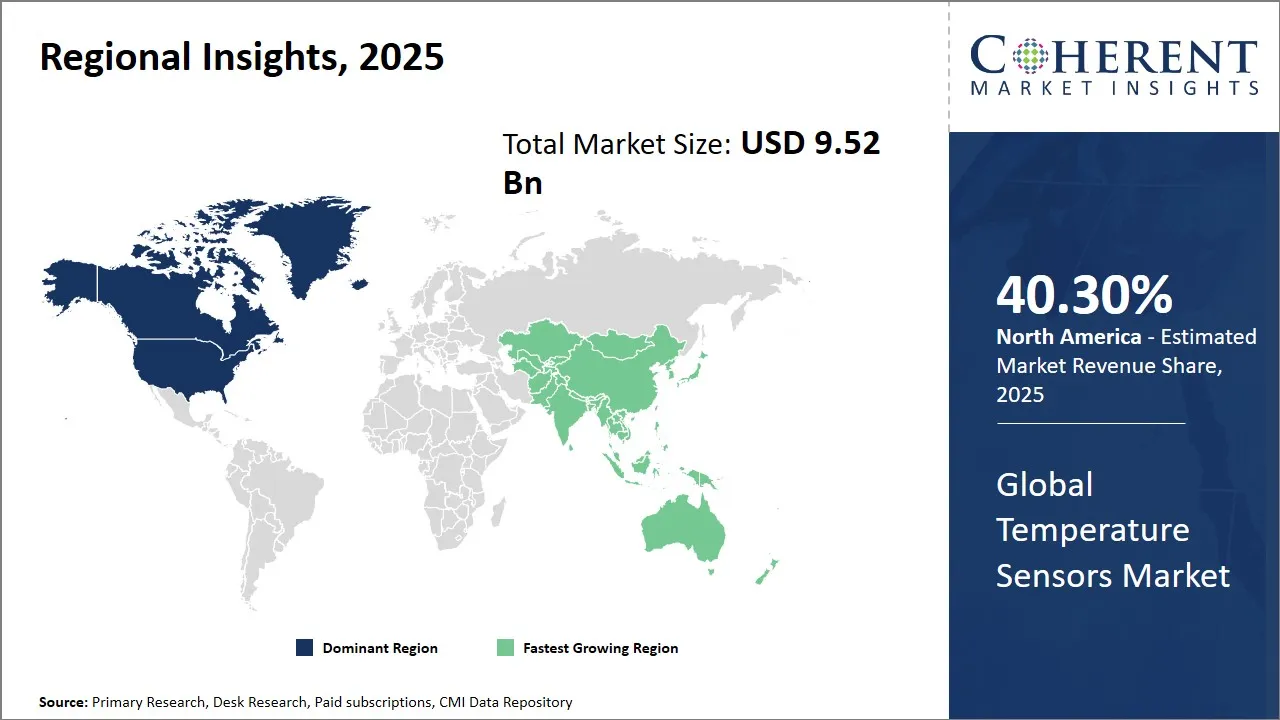
North America, holding a share of 40.30% in 2026, dominates the global temperature sensors market, driven by the region’s well-established industrial ecosystem and advanced technological infrastructure. The presence of numerous manufacturing hubs, automotive industries, and healthcare sectors fuels the demand for high-precision temperature sensors. Furthermore, supportive government policies promoting innovation and stringent regulatory standards for safety and quality enhance adoption across various end-use industries.
Trade dynamics also favor North America due to robust import-export frameworks and strategic partnerships with technology providers. Key companies like Texas Instruments, Honeywell International, and Amphenol Advanced Sensors have solidified their market position through continuous R&D investments and tailored product offerings, ensuring a comprehensive portfolio meeting diverse application needs.
Asia Pacific Temperature Sensors Market Analysis and Trends
The Asia Pacific region, holding a share of 36.8% in 2026, is expected to exhibit the fastest growth in the global temperature sensors market, propelled by rapid industrialization, urbanization, and expanding automotive and electronics manufacturing sectors. Emerging economies such as China, India, and South Korea are aggressively investing in smart manufacturing and automation technologies, which heavily rely on accurate temperature sensing solutions.
Government initiatives focused on infrastructure development, renewable energy, and smart cities contribute to boosting market expansion. The regional trade environment benefits from a well-integrated supply chain network and favorable policies encouraging foreign direct investment. Key players such as Panasonic Corporation, Samsung Electronics, and Omron Corporation actively participate in regional growth by localizing production and developing cost-effective sensors suited for dynamic market demands.
Temperature Sensors Market Outlook for Key Countries
U.S. Temperature Sensors Market Analysis and Trends
The U.S. is highly advanced, characterized by strong demand from sectors including healthcare, aerospace, and automotive. Leading companies such as Honeywell International and Texas Instruments offer sophisticated temperature sensors that support precision and reliability standards essential for critical applications. Innovation in IoT and connected devices further stimulates sensor integration across multiple platforms. Government emphasis on improving safety regulations and environmental monitoring continues to boost demand.
China Temperature Sensors Market Analysis and Trends
China demonstrates rapid expansion, underpinned by extensive manufacturing activities and rising adoption of automation in industries. Domestic companies like Hangzhou Newrun Optoelectronics and multinational corporations such as Panasonic have established significant manufacturing bases here, facilitating quick innovation cycles and competitive pricing. Policy support for smart manufacturing and environmental sustainability is pivotal in enhancing the deployment of temperature sensors across sectors like electronics, energy, and construction.
Germany Temperature Sensors Market Analysis and Trends
Germany continues to lead Europe’s temperature sensors market with a strong focus on automotive engineering, industrial automation, and renewable energy sectors. Robust industrial infrastructure and government initiatives aimed at Industry 4.0 adoption drive sensor application growth. Companies like Siemens and Bosch consistently contribute to technological advancements, offering reliable and highly integrated temperature sensing solutions aligned with evolving industry requirements.
India Temperature Sensors Market Analysis and Trends
India is on an ascending trajectory, supported by rapid industrial growth, government programs to boost manufacturing under initiatives like "Make in India," and increasing investments in smart infrastructure. Indian manufacturers and global players, including Omron Corporation and Honeywell, focus on localized sensor solutions tailored to the country’s diverse industrial needs. Expanding end-use industries such as pharmaceuticals, automotive, and electronics provide a broad base of demand.
Japan Temperature Sensors Market Analysis and Trends
Japan is marked by technological sophistication, with a strong presence of companies like Omron Corporation and Panasonic Corporation who emphasize precision and miniaturization of temperature sensors. The country’s advanced robotics, automotive, and electronics sectors heavily utilize temperature sensors for efficiency and safety improvements. Government policies promoting innovation and collaboration between industries and research institutions contribute to the steady evolution of the market landscape.
Market Players, Key Development, and Competitive Intelligence
Key Developments
- In June 2025, Sensirion launched the SHT40-AD1P-R2 and SHT41-AD1P-R2 digital humidity and temperature sensors, now available through its global distribution network. Designed for demanding environments, these sensors deliver high accuracy and reliability and are equipped with a removable protective cover to ensure durability during handling and deployment.
- In June 2025, Sensirion Connected Solutions, a subsidiary of Sensirion Holding AG specializing in sensor-based IoT solutions and services for emissions monitoring, announced the acquisition of Kuva Systems, a U.S.-based innovator in image-based methane emissions monitoring. The company will be integrated into Sensirion Connected Solutions, strengthening its position as a full-spectrum provider for continuous methane emissions monitoring in oil and gas applications.
- In February 2025, ifm, a leader in sensor technology and automation solutions, introduced two innovative products: the TP2 Temperature Plug and the TSM clamp on Temperature Sensor Module. These advancements are specifically designed to meet the stringent hygiene standards of various industries, offering exceptional reliability and performance.
- In January 2025, Emerson introduced AVENTICS DS1, a dew point sensor that enhances air quality monitoring in pneumatic systems, protecting equipment and reducing costs and downtime.
Top Strategies Followed by Temperature Sensors Market Players
- Established market leaders invest heavily in research and development (R&D) to consistently innovate and bring high-performance, reliable temperature sensing products to market.
- Texas Instruments launched the TMP117 precision digital temperature sensor, featuring ±0.1°C accuracy and ultra-low power operation. This innovation was the result of the company’s R&D focus on high-performance analog and embedded processing solutions to support wearables, medical, and industrial automation markets.
- Mid-level players in the temperature sensors market tend to adopt a more cost-conscious approach, aiming to provide solutions that offer a balance between quality and affordability.
- SEMITEC Corporation (Japan) expanded its range of cost-efficient thermistors for automotive and white goods applications.
- Small-scale market players differentiate themselves by focusing on niche applications or incorporating specialized features into their temperature sensors, carving out distinct segments within the broader market.
- Exergen Corporation (USA), a small yet specialized player, focuses on non-contact infrared temperature sensors used in medical devices and industrial processes.
Market Report Scope
Temperature Sensors Market Report Coverage
| Report Coverage | Details | ||
|---|---|---|---|
| Base Year: | 2025 | Market Size in 2026: | USD 10.03 Bn |
| Historical Data for: | 2020 To 2024 | Forecast Period: | 2026 To 2033 |
| Forecast Period 2026 to 2033 CAGR: | 5.4% | 2033 Value Projection: | USD 14.50 Bn |
| Geographies covered: |
| ||
| Segments covered: |
| ||
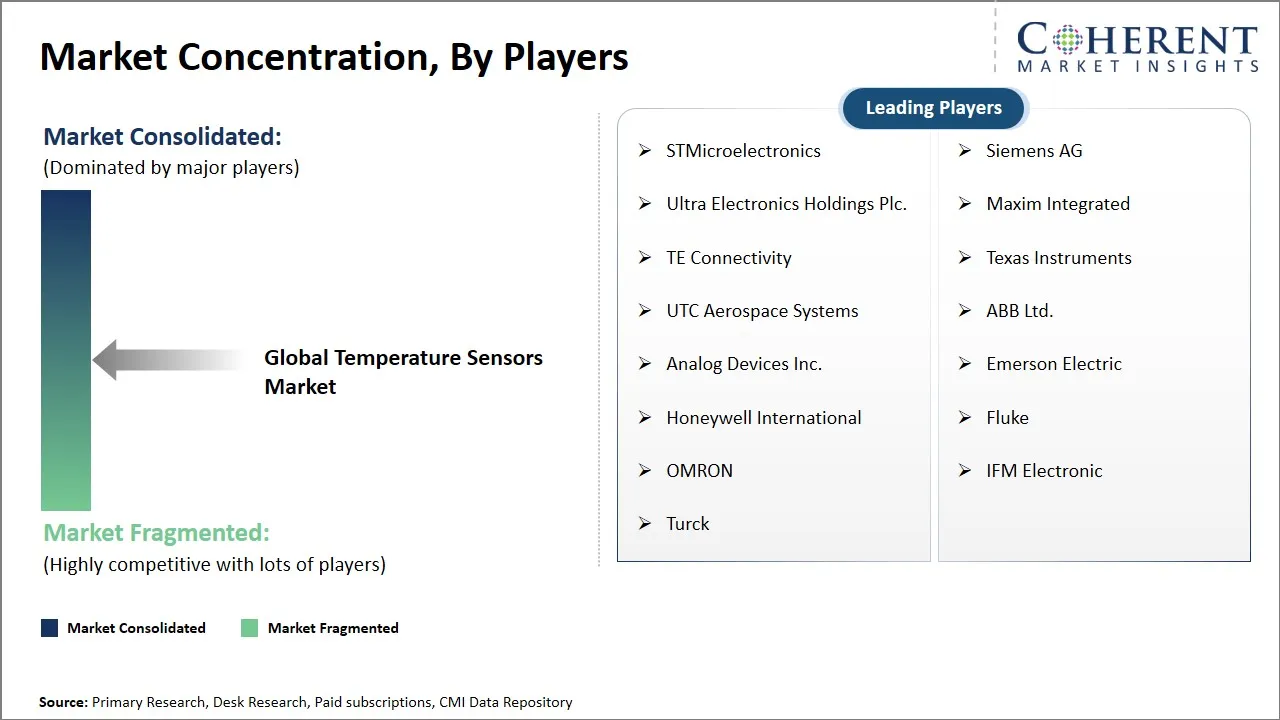
| Companies covered: | STMicroelectronics, Siemens AG, Ultra Electronics Holdings Plc., Maxim Integrated, TE Connectivity, Texas Instruments, UTC Aerospace Systems, ABB Ltd., Analog Devices Inc., Emerson Electric, Honeywell International, Fluke, OMRON, IFM Electronic, and Turck | ||
| Growth Drivers: |
| ||
| Restraints & Challenges: |
| ||
Market Dynamics
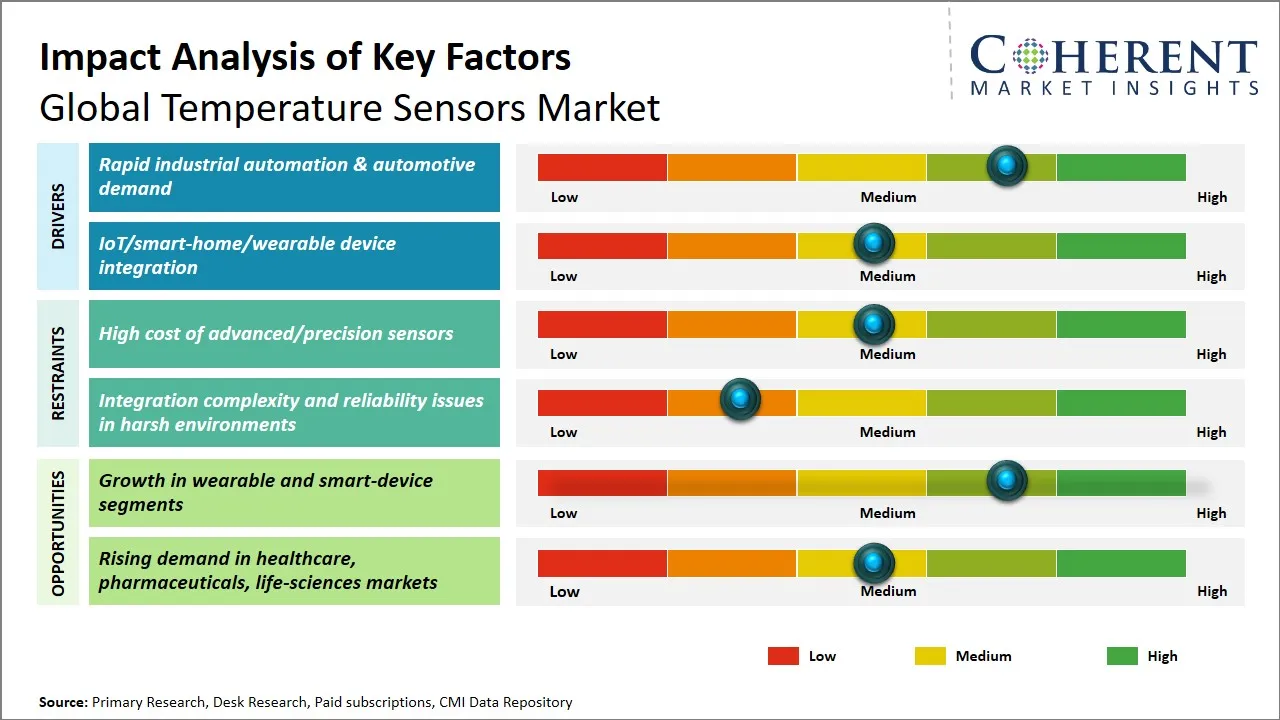
Global Temperature Sensors Market Driver – Rapid Industrial Automation & Automotive Demand
The accelerating pace of industrial automation has become a key catalyst driving the demand for advanced temperature sensors worldwide. As manufacturing processes increasingly rely on automated control systems, precise and real-time temperature monitoring has become indispensable to ensure product quality, operational efficiency, and equipment safety. Temperature sensors play a critical role in maintaining optimal conditions within automated machinery, enabling predictive maintenance and reducing downtime. Simultaneously, the automotive sector’s push towards electric vehicles (EVs), enhanced safety systems, and advanced driver-assistance technologies has significantly boosted the need for accurate temperature measurement solutions.
Siemens has integrated advanced temperature sensors into its SIMATIC automation systems, enabling real-time thermal monitoring in smart factories. These sensors are part of predictive maintenance modules that detect overheating in motors or drives before failure occurs—crucial for Industry 4.0 environments.
Thermal management is crucial in EV battery systems, engine components, and cabin climate controls, making temperature sensors vital for vehicle performance and passenger safety. The convergence of these factors—heightened automation across industries and evolving automotive technologies—has created a robust environment that accelerates the integration of sophisticated temperature sensing devices, thereby propelling the market's momentum on a global scale.
Global Temperature Sensors Market Opportunity – Expansion in Wearable and Smart Device Segments
The escalating adoption of wearable technology and smart devices presents a significant growth opportunity for the global temperature sensors market. Wearables such as fitness trackers, smartwatches, and health monitoring devices increasingly rely on precise temperature sensing to provide critical health metrics and enhance user experience. This demand is driven by rising consumer awareness regarding personal health, alongside the growing emphasis on remote health monitoring and preventive care solutions.
Furthermore, advancements in IoT-enabled smart devices for home automation, including smart thermostats and environmental monitoring systems, require integrated temperature sensors to optimize energy efficiency and ensure comfort. The miniaturization of sensors and improvements in power efficiency further enable their seamless integration into compact wearable and smart device designs. Apple has incorporated temperature sensing in its Apple Watch Series 8, allowing users to track body temperature trends for health insights like ovulation cycles.
Analyst Opinion (Expert Opinion)
- Regulatory agencies like the U.S. FDA and EMA are tightening compliance around temperature-sensitive pharmaceutical and biotech products, especially under Good Manufacturing Practices (GMP). This is pushing manufacturers to adopt high-accuracy temperature sensors for continuous cold chain monitoring and lab environments. Regulatory scrutiny is driving demand for validated, traceable sensor systems with audit trails.
- As ADAS and EV platforms expand, temperature sensors are becoming critical for battery safety and thermal load management. Regulatory frameworks such as ISO 26262 mandate precise sensor feedback for functional safety in automotive electronics. This is increasing adoption of robust, AI-integrated temperature sensors in automotive ECUs, especially for real-time thermal diagnostics and predictive maintenance.
- The growing use of temperature sensors in consumer IoT and wearables (e.g., smartwatches, fitness bands, home automation) brings them under GDPR and similar data protection laws. Regulators now require companies to ensure secure transmission and storage of biometric temperature data. This is encouraging sensor developers to integrate secure firmware and edge processing to comply with privacy-by-design principles.
Speak to the analyst
Want personalized insights?
Take the findings above to one of our principal consultants, or have the report rebuilt around the segments, geographies and competitors you actually track.
Market Segmentation
- Type Insights (Revenue, USD Bn, 2021 - 2033)
- Thermocouples
- Resistance Temperature Detectors
- Infrared Sensors
- Temperature Sensor ICs
- Thermistors
- Fiber-optic Sensors
- Temperature Transmitters
- Regional Insights (Revenue, USD Bn, 2021 - 2033)
- North America
- U.S.
- Canada
- Latin America
- Brazil
- Argentina
- Mexico
- Rest of Latin America
- Europe
- Germany
- U.K.
- Spain
- France
- Italy
- Russia
- Rest of Europe
- Asia Pacific
- China
- India
- Japan
- Australia
- South Korea
- ASEAN
- Rest of Asia Pacific
- Middle East
- GCC Countries
- Israel
- Rest of Middle East
- Africa
- South Africa
- North Africa
- Central Africa
- North America
- Key Players Insights
- STMicroelectronics
- Siemens AG
- Ultra Electronics Holdings Plc.
- Maxim Integrated
- TE Connectivity
- Texas Instruments
- UTC Aerospace Systems
- ABB Ltd.
- Analog Devices Inc.
- Emerson Electric
- Honeywell International
- Fluke
- OMRON
- IFM Electronic
- Turck
Sources
Primary Research Interviews
Stakeholders
- Sensor Manufacturers (e.g., Process Engineers, Product Managers)
- Electronics Component Distributors and Integrators
- Automotive OEMs and Tier 1 Suppliers
- Healthcare Device Manufacturers
- Industrial Automation Solution Providers
- Smart Wearable Device Companies
- AI & IoT Product Developers (focused on thermal monitoring)
Databases
- ElectroTech Global Database
- AutoSensors Data Consortium
- SmartDevice Industry Index
- OECD
- U.S. Census
Magazines
- Electronics World Today
- Sensor Trends Monthly
- TechTemperature Digest
- Smart Manufacturing Review
Journals
- Journal of Intelligent Sensor Networks
- IEEE Sensors Journal
- Journal of Applied Thermal Engineering
- Advanced Electronics Materials Journal
Newspapers
- TechTimes Global
- Electronic Manufacturing Daily
- The Economic Times (India)
- The Wall Street Tech Tribune
Associations
- International Society of Automation (ISA)
- Sensor Industry Association (SIA)
- American Electronics Manufacturers Association (AEMA)
- Asia-Pacific Smart Sensors Consortium
- European Embedded Systems Council (EESC)
Public Domain Sources
- U.S. Census Bureau
- EUROSTAT
- World Bank
- United Nations Industrial Development Organization (UNIDO)
- ResearchGate
Proprietary Elements
- CMI Data Analytics Tool, Proprietary CMI Existing Repository of information for last 8 years
Get access to 250+ pages report
Every segment, forecast, competitor profile and data table behind the analysis above — available for instant download.
- ESOMAR Member
- ISO 9001:2015 Certified
- D-U-N-S Registered
- GDPR & CCPA Compliant
Missing comfort of reading report in your local language? Find your preferred language:
Transform your Strategy with Exclusive Trending Reports
Frequently Asked Questions
The global temperature sensors market is estimated to be valued at USD 10.03 Bn in 2026 and is expected to reach USD 14.50 Bn by 2033.
The CAGR of global temperature sensors market is projected to be 5.4% from 2026 to 2033.
Rapid industrial automation & automotive demand and IoT/smart‑home/wearable device integration are the major factors driving the growth of the global temperature sensors market.
High cost of advanced/precision sensors and integration complexity and reliability issues in harsh environments are the major factors hampering the growth of the global temperature sensors market.
In terms of type, thermocouples is estimated to dominate the market revenue share in 2026.
STMicroelectronics, Siemens AG, Ultra Electronics Holdings Plc., Maxim Integrated, TE Connectivity, Texas Instruments, UTC Aerospace Systems, ABB Ltd., Analog Devices Inc., Emerson Electric, Honeywell International, Fluke, OMRON, IFM Electronic, and Turck are the major players.
North America is expected to lead the global temperature sensors market in 2026.