

Grow Lights Market Analysis & Forecast - 2026 To 2033
The global grow lights market size was valued at USD 8,120.7 Mn in 2026 and is anticipated to witness USD 30,890.2 Mn in 2033 with a compound annual growth rate (CAGR) of 21% from 2026 to 2033, due to the rapid expansion of indoor farming and vertical agriculture driven by urbanization and the need for sustainable food production. A Bayer indoor farming report polled 150+ growers in 8 countries, and 84% plan to expand, adding 22 Mn square feet, with hydroponic leafy greens seeing 46% profit margins.
Key Takeaways in the Grow Lights Market
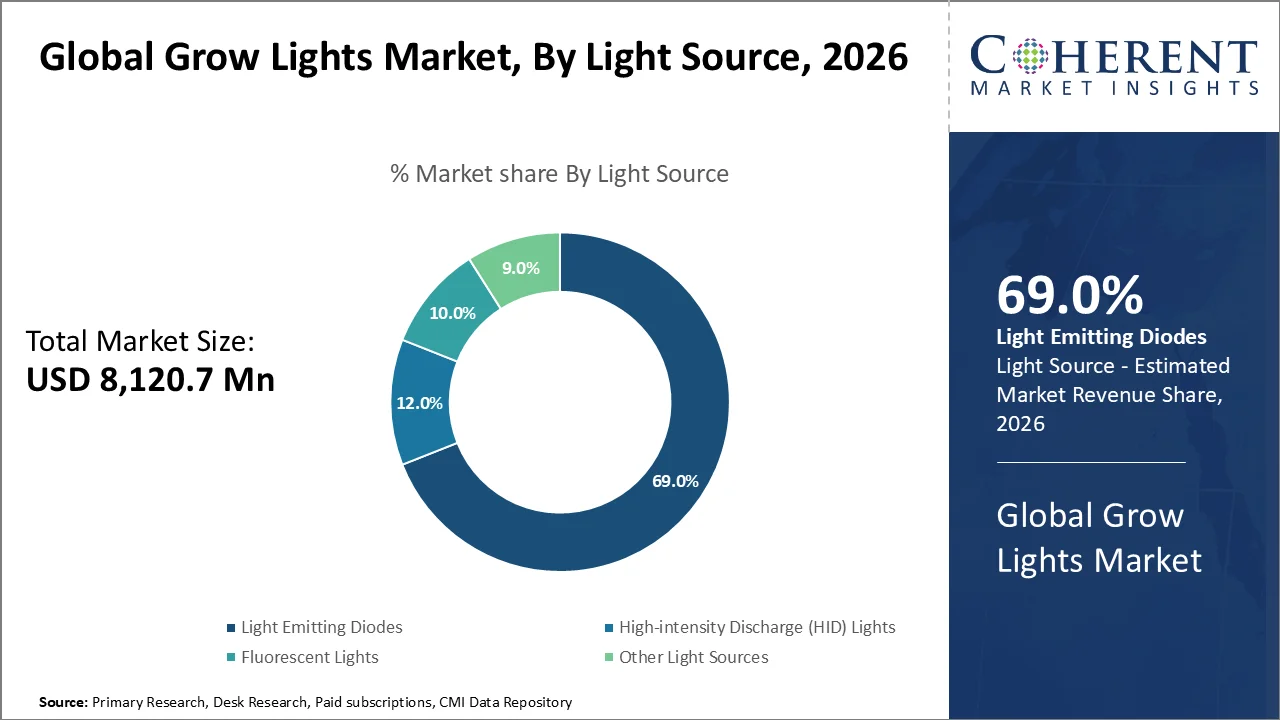
- The LED grow light segment is expected to lead the market with 69% share of the market in 2026 based on the light source owing to energy savings, spectrum control, and durability.
- The new installation segment is expected to account for 60% of the market in 2026, as vertical farms and greenhouses are adopting advanced IoT-enabled lighting systems.
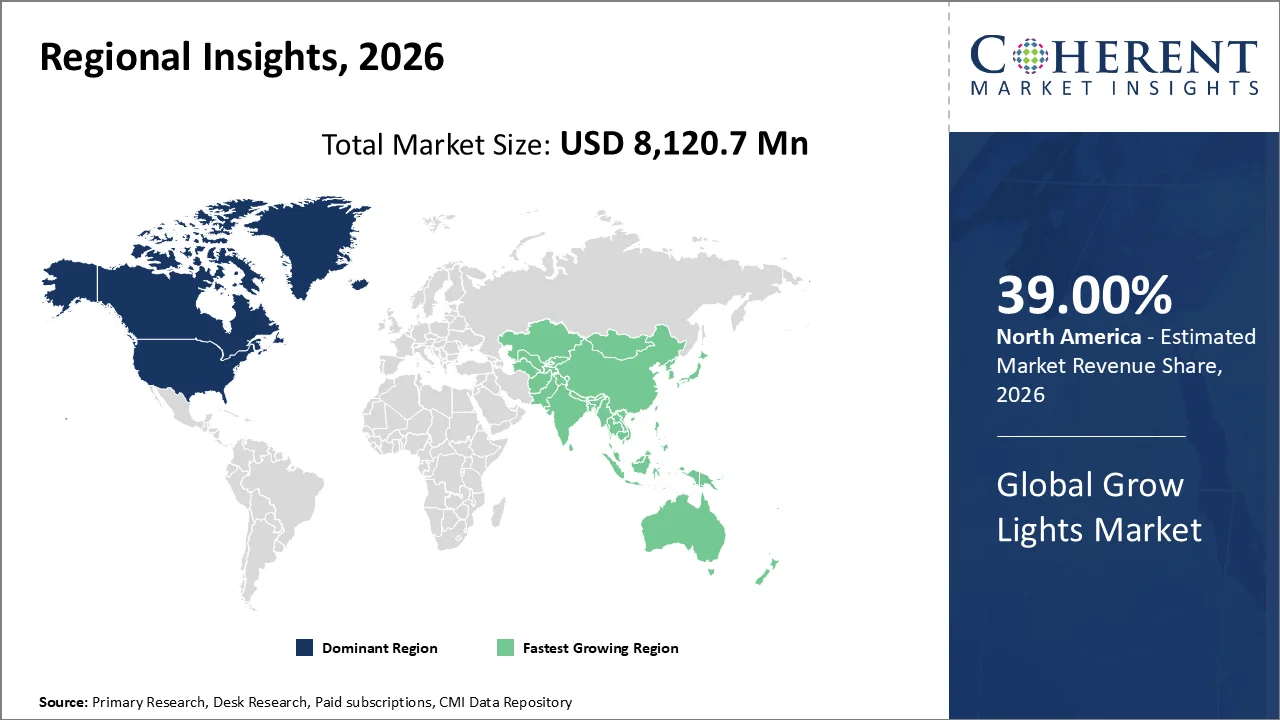
- North America is projected to dominate the grow lights market with a share of 39% in 2026 on account of greenhouse adoption, legalization of cannabis, and strong penetration of LEDs. U.S. and Canada are the hubs of sustainable innovation. The biggest farm in the US by acreage is Texas’s legendary King Ranch, at approximately 825,000 acres. The Wonderful Company is one of the largest farm operations in the country for commercial crop production, with more than 190,000 acres of nuts and citrus, while Bill Gates is the largest private farmland owner in the nation overall, with 242,000 acres.
- The Asia Pacific region is predicted to grow the fastest, driven by urbanization, vertical farming and government subsidies, with China, Japan and India leading the adoption of energy efficient LED grow lights for sustainable agriculture. China built a 1000-acre vertical farming city and grows 9× more food with 90% less water – one of the world’s most advanced agricultural megaprojects for sustainable food security.
Segmental Insights
Will LEDs Surge Efficiency?
By light source, LED grow lights will dominate with nearly 69% share in 2026, due to energy efficiency, spectrum customization, and long lifespan. Their penetration is accelerating in vertical farms and greenhouses that are replacing HID and fluorescent systems with lower operating costs and government incentives supporting sustainable agricultural technologies worldwide. IUP Energy Management verifies that LEDs are energy efficient. 80-90% of electricity is converted to light; 100,000 hours lifespan; cut carbon footprint; outperform inefficient incandescent bulbs burning 80% as heat.
For example, Pib press release, January 2025: Energy efficient LEDs. Distributed 36.87 crore LED bulbs under UJALA scheme saving ₹19,153 crore per annum, reducing 6.2 million tonnes CO₂ and reducing 1,500 MW peak demand through affordable and efficient lighting adoption across the country.
- Current Industry Events of 2026
- Market Size Estimation
- Regional Breakdown
- Competitive Landscape
- Customer Intelligence
- Segmental Analysis
- Pricing Analysis
- Key Market Drivers, Challenges & Future Trends
- Customized Insights Section
Will new installations be the growth driver?
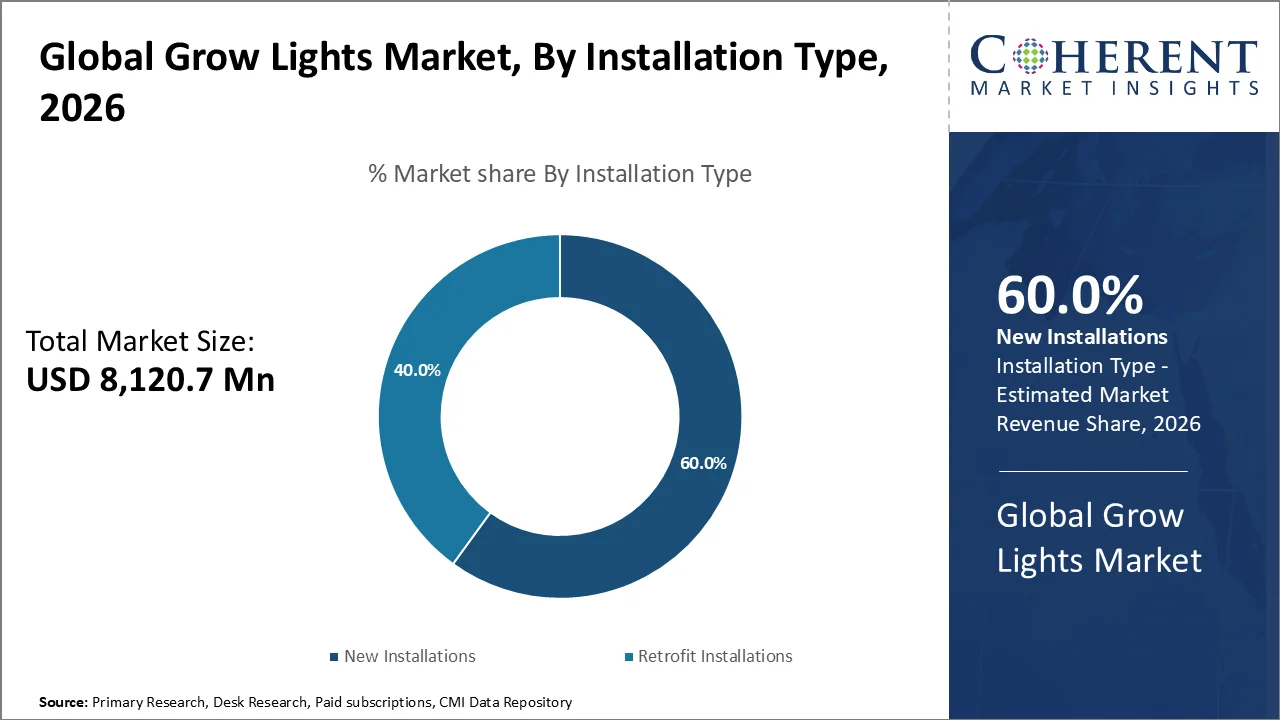
By type of installation, new installations will account for more than 60% share in 2026, driven by the rapid growth of vertical farms and commercial greenhouses that integrate IoT-enabled lighting systems, automation, and climate control for scalable, sustainable food production. Premium LEDs consume 50–80 % less electricity, achieve an efficacy of 2.7–3.0 µmol/J, have a lifetime of over 50 000 h and cut annual costs in typical setups by $100–150.
For example, Jumplights released its Vert Series LED grow lights for multi-tier and vegetative cultivation in March 2026. The fixtures provide high efficiency, balanced spectrum and optimized vertical racking performance. The new grow light installations underscore the rapid adoption of energy-efficient LEDs revolutionizing controlled-environment agriculture globally.
Smart LED Grow Lights Power Precision Farming with Automation
Smart LED grow lights, combined with automation systems, are transforming the face of agriculture. They are controlled by smartphone apps or linked to smart farming technologies so that light intensity, duration and spectrum can be precisely adjusted to real-time conditions. This automation enables better crop management, precision agriculture and valuable data collection. Farmers optimize growing environments, yielding healthier plants, higher crop yields, and lower resource consumption. As integration becomes more profound, smart LED grow lights are increasingly becoming the foundation of sustainable farming, combining efficiency, adaptability and innovation to meet the growing needs for food security with lowered energy costs.
Current Events and their Impacts on the Grow Lights Market
Current Event | Description and its Impact |
Technological Breakthroughs in LED Efficiency and Smart Agriculture |
|
North American Cannabis Legalization Expansion |
|
Regional Insights
Cannabis Legalization: North America Leading the Way
North America is the largest grow lights market in 2026 with almost 39% share owing to advanced adoption of greenhouses, legalization of cannabis and strong penetration of LEDs. Technological leadership, extensive commercial farming, and sustainability efforts ensure ongoing preeminence, with the U.S. and Canada continuing as centers of innovation and agricultural advancement. USDA ERS (EIB 248) outlines the growth in adoption of precision agriculture. Auto steer jumped from 5.3% in 2001 to 58% in 2016. GPS takes 40% of farmland. Yield maps are still 5 – 25%, but with large farms over 50% adoption.
For example, in February 2026, Nature’s Miracle Holding Inc. announced an exclusive U.S. supply agreement with Megaphoton USA LLC. The partnership, based in Florida and California, supplies grow lights – including 1000W and 600W LED fixtures and HPS systems – for domestic manufacturing and to help drive the adoption of controlled environment agriculture across the United States.
Asia-Pacific Vertical Farming Expansion Spurs Growth
The Asia-Pacific is the fastest growing region in 2026. Demand is driven by urbanization, vertical farming projects and government subsidies, while China, Japan and India are investing heavily in sustainable agriculture. The region’s rising concerns about food security are driving the increased use of energy-efficient LED grow lights. Bharatia IMPACT: Advanced farming adoption remains poor. The yield potential is 30–70%, but the current practices produce less than 30%. India's annual loss of 20-30% of its produce worth ₹92,000 crore (~$11 billion) underscores the urgent need for increased adoption of high-tech greenhouses and infrastructure upgrades.
For instance, Singapore inaugurated the world’s tallest indoor vertical farm, constructed by Archisen, in January 2026. This supports the nation’s food security goal of producing 30% locally by 2030 through LED grow lights and controlled environment agriculture. The farm is space efficient and advocates sustainable urban farming in land scarce Singapore.
Country Growth Lights Market
Urban Farming and Food Security Policies Boost Demand for Grow Lights in China
Rapid urbanization, limited arable land and government backed vertical farming initiatives will drive demand for China grow lights in 2026. Mega cities like Shanghai and Beijing are pouring a lot of money into controlled-environment agriculture to secure food supplies. The increased adoption of LED grow lights aids in year-round crop production and sustainability goals.
For instance, China imported USD 207.4 billion agricultural goods in 2025 (January 2026), held 41% of global vertical farming patents and contributed 38% of LED spectral technology patents (government backed initiatives driving food security and agritech innovation).
Cannabis Legalization and Indoor Farming Boom in United States Drives Grow Light Demand
Cannabis cultivation, which has been legalized in many states, and booming indoor farming are fueling the U.S. grow lights market. Demand is driven by warehouse conversions and vertical farms in cities such as New York and Los Angeles. Advanced LED technologies reduce energy costs. Consumer preference for locally grown produce accelerates the adoption of horticultural lighting systems across the country.
For instance, in May 2026, IST America’s LEDcure NX launch in the USA showcases advanced LED UV curing technology that reduces energy costs, improves heat management, and enhances sustainability, offering converters efficient, mercury‑free, ozone‑free production with reliable performance.
Who are some major players in the Global Grow Lights Market
Some of the key players in the global grow lights market are Epistar Corporation, Signify, Hydro Grow, Savant Systems Inc., Iwasaki Electric Co. Ltd., Heliospectra AB, Everlight Electronics Co. Ltd., OSRAM Licht AG, LumiGrow Inc., and Illumitex Inc.
Market Report Scope
Grow Lights Market Report Coverage
| Report Coverage | Details | ||
|---|---|---|---|
| Base Year: | 2025 | Market Size in 2026: | USD 8,120.7 Mn |
| Historical Data for: | 2020 To 2024 | Forecast Period: | 2026 To 2033 |
| Forecast Period 2026 to 2033 CAGR: | 21% | 2033 Value Projection: | USD 30,890.2 Mn |
| Geographies covered: |
| ||
| Segments covered: |
| ||
| Companies covered: | Epistar Corporation, Signify, Hydro Grow, Savant Systems Inc., Iwasaki Electric Co. Ltd., Heliospectra AB, Everlight Electronics Co. Ltd., OSRAM Licht AG, LumiGrow Inc., and Illumitex Inc., Others | ||
| Growth Drivers: |
| ||
| Restraints & Challenges: |
| ||
Grow Lights Market Trends
- LED Adoption: Energy efficiency, tunable spectrum and long lifespan have resulted in LEDs maintaining their dominance with a nearly 69% share. HID and fluorescent lights are moving quickly. The uptake of LED lighting has rapidly increased globally, with an estimated 65% of installed lighting expected to be LED-based by 2025 and an estimated saturation level of 90–100% by the early 2030s. LEDs are 80% more efficient than incandescent bulbs, reducing energy demand and dramatically lowering costs.
- Smart Controls: IoT-enabled systems with dimming, zoning and automation are becoming the norm, allowing growers to optimize energy consumption and crop yield. Smart controls, sensors and analytics optimize usage, reducing lighting energy by 40–60%, maintenance by 20–30%, and integrating with HVAC for 50% efficiency gains.
- Tunable Spectrum: Growers demand the ability to customize the spectrum to the specific stage of the crop, which increases productivity and reduces energy waste. NIST Spectrally Tunable Lighting Facility is about tunable spectrum. It uses 3,600 LEDs across 22 color channels, producing ~50,000 lumens and adjustable white light from 2,500K to 10,000K.
- ROI-Focused Buying: Buyers see past fixture wattage to the total cost of ownership, warranties and payback periods. 77% of buyers do ROI analysis 63% want financial outcomes 57% are value focused 70% want measurable cost savings in one year.
- Growth of Vertical Farming: In Asia-Pacific, warehouses are being turned into vertical farms in cities, with the growth supported by food security projects and subsidies. The UNICEF SOFI 2025 report is about food security initiatives, shows 673 million people faced hunger, 2.6 billion couldn’t afford healthy diets, and highlights subsidies, social protection, and food system investments.
Analyst Opinion
- The grow lights market is developing rapidly from 2024 to 2026 with agriculture adopting controlled-environment farming and smart horticultural systems. The industry is transitioning from conventional lighting to smart, spectrum-optimized solutions, increasing yield and sustainability.
- Spectrum optimization and crop yield LED grow lights with tunable spectra will boost crop yields by 25% compared to fixed-spectrum systems by 2025, according to controlled-environment agriculture trials. Research in advanced photobiology has shown that the use of dynamic red-blue-green balancing can accelerate growth cycles by 10-15%, and that the supplementation of far-red light can encourage flowering in high-value crops. By 2026, smart grow lights will feature AI-powered spectral tuning, enabling real-time optimization based on plant growth stage and environmental feedback.
- Integration of smart agriculture ecosystem: IoT-enabled vertical farms and greenhouse automation systems are projected to adopt grow lights from 2024 to 2026, enabling precise energy management and predictive crop modeling. Take urban farming for example. Large scale vertical farms can reduce energy consumption by up to 40% per kilogram of produce by using adaptive lighting schedules. “We expect grow lights to be integrated with humidity, nutrient delivery and CO₂ enrichment sensors as part of closed loop agricultural ecosystems to create fully autonomous food production hubs in smart cities by 2026.”
Speak to the analyst
Want personalized insights?
Take the findings above to one of our principal consultants, or have the report rebuilt around the segments, geographies and competitors you actually track.
Market Segmentation
- By Light Source (Revenue, USD Mn, 2021-2033)
- High-intensity Discharge (HID) Lights
- Light Emitting Diodes
- Fluorescent Lights
- Other Light Sources
- By Installation Type (Revenue, USD Mn, 2021-2033)
- New Installations
- Retrofit Installations
- By Application (Revenue, USD Mn, 2021-2033)
- Indoor Farming
- Vertical Farming
- Commercial Greenhouse
- Other Applications
- By Region (Revenue, USD Mn, 2021-2033)
- North America
- U.S.
- Canada
- Latin America
- Brazil
- Mexico
- Argentina
- Rest of Latin America
- Europe
- Germany
- U.K.
- France
- Italy
- Spain
- Russia
- Rest of Europe
- Asia Pacific
- China
- India
- Japan
- Australia
- South Korea
- ASEAN
- Rest of Asia Pacific
- Middle East
- GCC
- Israel
- Rest of Middle East
- Africa
- South Africa
- Central Africa
- North Africa
- North America
Sources
Primary Research Interviews
- Commercial Greenhouse Operators
- Indoor Farming Specialists
- Hydroponics and Vertical Farming Managers
- Horticultural Lighting Manufacturers
- Agricultural Extension Officers
- Urban Farming Entrepreneurs
- Botanical Research Scientists
- Retail Garden Center Owners
- Controlled Environment Agriculture (CEA) Technologists
- Others
Databases
- Bloomberg Terminal
- Thomson Reuters Eikon
- S&P Global Market Intelligence
- FAO Agricultural Statistics
- USDA Agricultural Research Database
- European Commission Agriculture Data
- NCBI Plant Science Resources
- Patent Databases (USPTO/EPO)
- Others
Magazines
- Horticulture Week
- Greenhouse Grower
- Urban Ag News
- LEDs Magazine
- Hydroponics World
- Commercial Grower
- AgriTech Tomorrow
- Others
Journals
- Journal of Horticultural Science & Biotechnology
- Acta Horticulturae
- Agricultural and Forest Meteorology
- Plant Physiology
- Journal of Plant Growth Regulation
- Frontiers in Plant Science
- Biosystems Engineering
- Nature Plants
- Others
Newspapers
- Reuters
- Bloomberg News
- The Wall Street Journal – Agriculture Section
- Financial Times – Agribusiness
- The New York Times – Environment Section
- The Guardian – Environment Section
- AgriBusiness Global
- HortiDaily
- Others
Associations
- International Society for Horticultural Science (ISHS)
- American Society for Horticultural Science (ASHS)
- Controlled Environment Agriculture Alliance (CEA)
- Hydroponic Society of America
- European Plant Science Organisation (EPSO)
- International Association for Vertical Farming (AVF)
- National Gardening Association (NGA)
- Lighting Europe
- Others
Public Domain Sources
- U.S. Department of Agriculture (USDA)
- Food and Agriculture Organization (FAO)
- European Commission – Agriculture and Rural Development
- National Institute of Food and Agriculture (NIFA)
- NCBI Plant Science Database
- World Health Organization (WHO) – Food Security Reports
- International Energy Agency (IEA) – Lighting Efficiency
- United Nations Environment Programme (UNEP)
- Others
Proprietary Elements
- CMI Data Analytics Tool
- Proprietary CMI Existing Repository of information for last 10 years
Definition: Grow lights are used to provide indoor plants with the light they need to thrive. They can also help speed flowering and keep plants healthy. There are many varieties of these lights, from LED bulbs to incandescent.
Get access to 250+ pages report
Every segment, forecast, competitor profile and data table behind the analysis above — available for instant download.
- ESOMAR Member
- ISO 9001:2015 Certified
- D-U-N-S Registered
- GDPR & CCPA Compliant
Missing comfort of reading report in your local language? Find your preferred language:
Transform your Strategy with Exclusive Trending Reports
Frequently Asked Questions
The global Grow Lights Market size was valued at USD 8,120.7 Mn in 2026 and is expected to reach USD 30,890.2 Mn in 2033.
The global grow lights market size is estimated to be valued at USD 8,120.7 Mn in 2026 and is expected to exhibit a CAGR of 21% between 2026 and 2033.
Growing adoption of indoor farming practices and surge in the number of startups innovating novel technologies are fueling the market.
The Light Emitting Diodes segment is the leading component segment in the market.
Changing lighting needs for different crops and high cost of setup and maintenance are the major factors restraining growth of the market.
Epistar Corporation, Signify, Hydro Grow, Savant Systems Inc., Iwasaki Electric Co. Ltd., Heliospectra AB, Everlight Electronics Co. Ltd., OSRAM Licht AG, LumiGrow Inc., and Illumitex Inc.