

Industrial and Commercial LED Lighting Market Size and Trends
Industrial and commercial led lighting market is estimated to be valued at USD 89.78 Bn in 2026 and is expected to reach USD 331.22 Bn in 2033, exhibiting a compound annual growth rate (CAGR) of 20.5% from 2026 to 2033.
Key Takeaways
- Based on End User, the Commercial segment is expected to lead with the largest share of 41.0% of the market in 2026, due to energy-efficiency goals and operational cost savings.
- Based on Region, North America is expected to lead the market with the highest share in 2026.While, Asia Pacific is anticipated to be the fastest growing region, with a market share of 32.2% in 2026.
Market Overview
The global industrial and commercial led lighting market is experiencing strong growth due to the rising energy efficiency regulations, increasing sustainability initiatives, and declining LED costs. Businesses across sectors, factories, offices, retail, and logistics are transitioning from traditional lighting to smart LED systems to reduce energy consumption and enhance operational efficiency. Government mandates and green building certifications are accelerating retrofitting and new installations. Technological innovations, such as IoT-enabled lighting and motion sensors, are further driving adoption. The surge in infrastructure development and modernization of commercial spaces is expected to boost industrial and commercial led lighting market demand globally in the coming years.
Current Events and their Impact on the Industrial and Commercial LED Lighting Market
Current Event | Description and Its Impact |
US-China Trade Tariffs and Global Trade Policies |
|
Technological Advancements |
|
Role of Artificial Intelligence (AI) into Industrial and Commercial LED Lighting Market
The integration of artificial intelligence into industrial and commercial LED lighting market is enhancing the functionality and efficient of the LED lighting products. By streamlining processes and optimizing resource allocation, AI solutions can lead to significant cost reductions for businesses and organizations. AI algorithms analyze vast data to adjust lighting based on occupancy, natural light levels, and user preference, resulting in a significant energy saving. In factories or offices, AI can automatically adjust LED brightness or switch lights off in unoccupied zones, drastically reducing energy waste. This aligns with global sustainability goals and helps organizations cut operating costs.
In January 2025, Signify introduced a series of AI-powered enhancements to Philips Hue, debuting its first generative AI assistant in the Hue app. Users can now generate personalized lighting scenes via voice or text based on mood, occasion, or style.
- Current Industry Events of 2026
- Market Size Estimation
- Regional Breakdown
- Competitive Landscape
- Customer Intelligence
- Segmental Analysis
- Pricing Analysis
- Key Market Drivers, Challenges & Future Trends
- Customized Insights Section
Export Analysis of LED Lighting
From November 2023 to October 2024, India exported 13,318 LED light shipments, involving 1,568 Indian exporters and 2,899 international buyers. In October 2024 alone, India recorded 1,194 LED light export shipments—reflecting a 4% year-over-year increase from October 2023 and a 9% rise compared to September 2024. Globally, China, Vietnam, and Mexico are the top LED light exporters, with China leading at 2,136,092 shipments, followed by Vietnam with 355,522, and Mexico with 116,400 shipments.
Segmental Insights
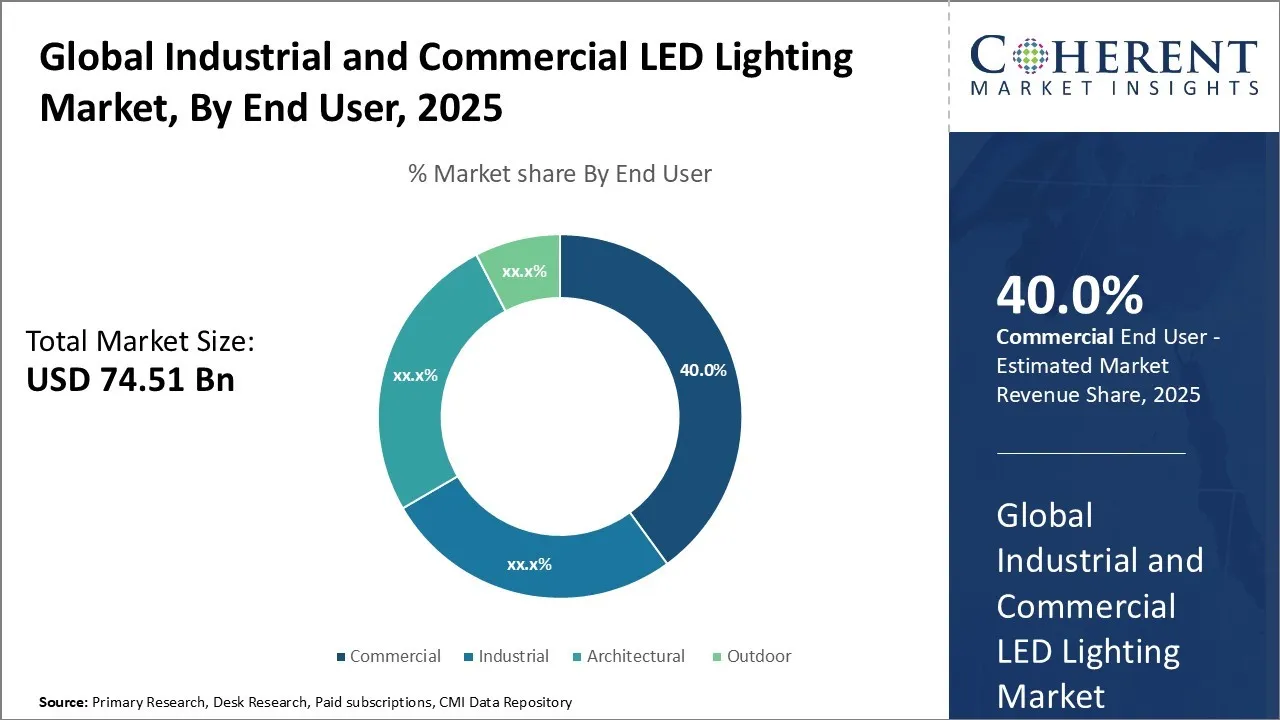
Industrial and Commercial LED Lighting Market Insights, By End User: Commercial Segment is Driven by Energy-Efficiency and Operation Cost Saving
In terms of end user, the commercial segment is expected to command the largest share with 41.0% in 2026, primarily due to a combination of energy-efficiency goals, operational cost savings, and the need for smart, adaptive lighting environments across modern business spaces. Commercial spaces such as retail stores, offices, malls, and hotels operate for long hours and consume substantial electricity. LED lighting significantly reduces energy costs, often by 50–70% compared to conventional lighting. This makes it a preferred choice for businesses aiming to lower operating expenses. Modern commercial buildings increasingly deploy smart LED systems integrated with motion sensors, timers, daylight harvesting, and IoT platforms. These systems support automation, real-time energy monitoring, and compliance with green building standards. Corporates are prioritizing environmental sustainability and ESG (Environmental, Social, Governance) goals. LEDs reduce carbon footprint and are mercury-free, supporting green certifications like LEED and BREEAM. This pressure to decarbonize commercial properties boosts LED adoption.
In July 2025, Rishang Malaysia, the exclusive local distributor of leading lighting brand Rishang LED, unveiled a range of commercial LED lighting solutions across Malaysia. The new lineup includes LED modules, power supplies, components, bulbs, strips, and tube lights tailored for offices, retail, signage, and outdoor applications.
Regional Insights
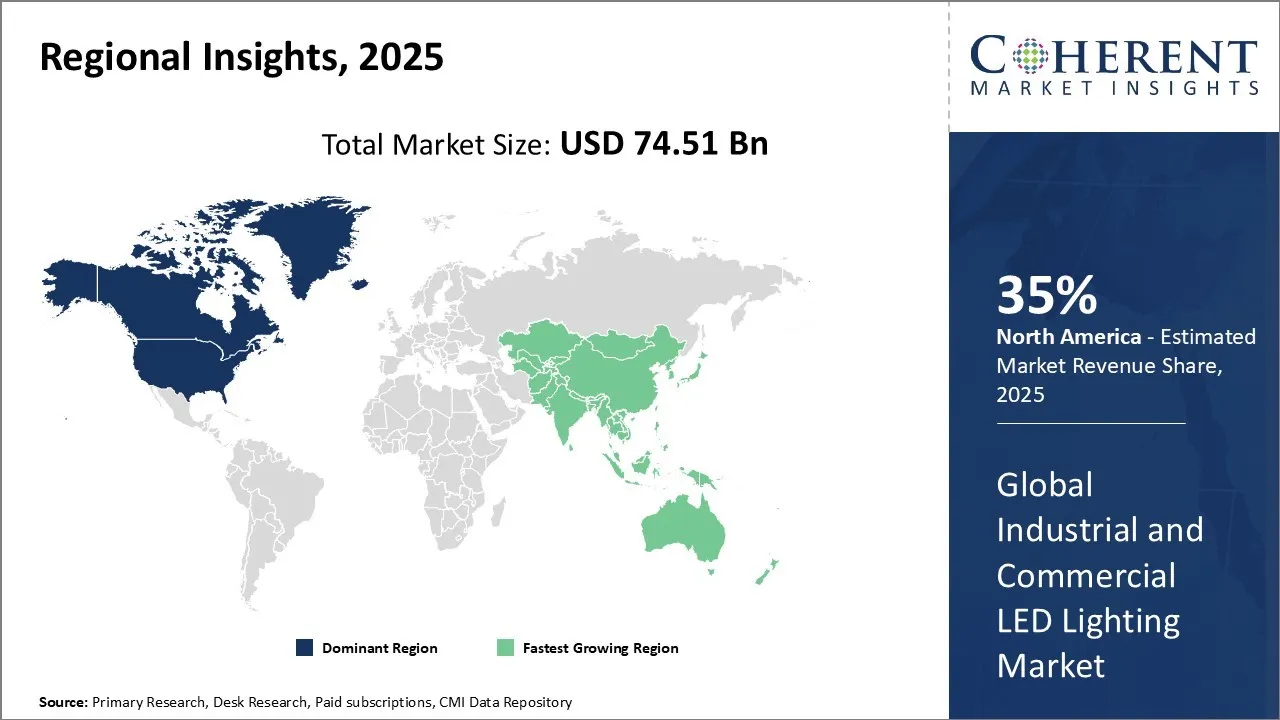
North America Industrial and Commercial LED Lighting Market Analysis & Trends
North America leads the global industrial and commercial LED lighting market with a share of 35% primarily due to the regulatory, economic, technological, and environmental factors that are reshaping how businesses and facilities manage energy consumption and lighting infrastructure. The North America region has a strong energy efficiency regulation. For instance, SloanLED, a pioneer in lighting technology, has unveiled the Symphony Area Light—an innovative extension of its Symphony Series of architectural lighting solutions for the U.S. and Canadian markets. Featuring three different housing sizes and four interchangeable, field-configurable mounting options, the Symphony Area Light integrates effortlessly into architectural environments while delivering superior performance, improved uniformity, wider pole spacing, and reduced power density.
Governments in both the United States and Canada have implemented stringent lighting standards under programs such as ENERGY STAR, DesignLights Consortium (DLC), and state-level building codes (e.g., California Title 24). These mandates push industries, offices, and commercial establishments to phase out older technologies like incandescent and fluorescent lights in favor of high-efficiency LED systems. This is further adding to the industrial and commercial LED lightning market demand.
Asia Pacific Industrial and Commercial LED Lighting Market Analysis & Trends
Asia Pacific region is expected to exhibit the fastest growth in the industrial and commercial LED lighting market with a share of 32.2% in 2026, owing to its economic, environmental, and regulatory factors. Asia Pacific region is experiencing rapid pace of urbanization and industrial development in countries like China, India, Vietnam, Indonesia, and Thailand, where the expansion of manufacturing hubs, logistics centers, retail complexes, and smart cities is creating a surge in demand for reliable, energy-efficient lighting solutions. Governments across the region are also actively promoting energy efficiency policies to reduce carbon emissions and dependence on fossil fuels.
For example, China’s national green building standards are mandating energy-saving measures, including LED adoption in public and commercial infrastructure. Such initiatives make LED lighting not only a cost-effective choice but also a regulatory necessity in many commercial and industrial developments. Asia Pacific is expanding towards cost efficiency, and the broader push toward smart and sustainable infrastructure.
Industrial and Commercial LED Lighting Market Outlook Country-Wise
The U.S. Industrial and Commercial LED Lighting Market Trends
In the United States, the demand for industrial and commercial LED lighting market continues to grow rapidly due to strict energy regulations and increased focus on sustainable development. One of the key drivers is the enforcement of Title 24 energy efficiency standards in states like California, which mandate the use of energy-saving lighting systems in commercial and industrial buildings. Additionally, organizations across the country are investing heavily in ESG (Environmental, Social, and Governance) initiatives, leading to widespread retrofitting of outdated lighting infrastructure with advanced LED systems. This is especially evident in office complexes, smart warehouses, logistics centers, and nationwide retail chains, where LEDs offer substantial energy savings, longer lifespan, and intelligent control capabilities.
The industrial and commercial led lighting market size in the United States is also expanding due to the shift toward smart building technologies, where lighting plays a critical role in overall energy management and automation. According to recent updates from the U.S. Department of Energy and utility reports, commercial lighting accounts for nearly 20% of total energy consumption in buildings, prompting large-scale adoption of LED systems to lower operational costs and meet energy compliance requirements. Furthermore, government-led rebate programs and tax incentives for energy-efficient upgrades are accelerating market penetration. This combination of regulatory pressure, cost efficiency, and sustainability goals continues to fuel robust growth in the U.S. industrial and commercial LED lighting sector.
Germany Industrial and Commercial LED Lighting Market Trends
Germany is witnessing significant momentum in the Industrial and Commercial LED Lighting Market Growth, driven by its national energy transition strategy, known as Energiewende, which emphasizes a shift toward sustainable and low-carbon energy systems. This policy push is closely aligned with the implementation of stringent building efficiency standards that require commercial and industrial facilities to reduce energy consumption and carbon emissions. As a result, there is a growing trend of LED lighting adoption across factories, smart warehouses, green office buildings, and logistics hubs. These settings benefit from LED lighting’s lower energy usage, long operational life, and compatibility with automated and sensor-based energy management systems.
In January 2026, LEDVANCE, a global leader in lighting, acquired German design lighting specialist loblicht. This strategic move enhances LEDVANCE’s project capabilities and expands its premium brand portfolio.
Market Report Scope
Industrial and Commercial LED Lighting Market Report Coverage
| Report Coverage | Details | ||
|---|---|---|---|
| Base Year: | 2025 | Market Size in 2026: | USD 89.78 Bn |
| Historical Data for: | 2020 To 2024 | Forecast Period: | 2026 To 2033 |
| Forecast Period 2026 to 2033 CAGR: | 20.5% | 2033 Value Projection: | USD 331.22 Bn |
| Geographies covered: |
| ||
| Segments covered: |
| ||
| Companies covered: | Toshiba Corporation, Digital Lumens, Inc., GE Lighting Solutions, Koninklijke Philips Electronics N.V.3, Osram Licht AG, Cooper Industries plc, Cree, Inc., and Dialight plc. | ||
| Growth Drivers: |
| ||
| Restraints & Challenges: |
| ||
Global Industrial and Commercial LED Lighting Market Drivers
High efficiency and durability of LED light are expected to drive growth
High efficiency and durability of LED lights are expected to drive growth of the global industrial and commercial LED lighting market during the forecast period. LED is considered as a feasible alternative to conventional lighting due to its longer life span and higher energy-saving potential. LED lighting products are increasingly replacing conventional lighting products, owing to various benefits such as greater energy efficiency, high eco-friendly properties, small size, and lower heat output.
LED lighting is an advanced and futuristic source of lighting as it reduces power consumption by up to 80% and generates about 90% less heat than incandescent bulbs. The life span of LED bulbs is about 10 times higher than that of compact fluorescent lamps and much higher than incandescent lamps. According to DOE, the widespread use of LEDs could save 348 TWh (compared to no LED use) of electricity which is equivalent to annual electricity output of 44 large electric power plants generating 1,000 MW each and result in a total saving of US$ 30 billion at today’s electricity prices.
Government regulations are expected to boost the market
Government regulations are playing a critical role in boosting the growth of the industrial and commercial led lighting market, particularly through energy efficiency mandates, environmental sustainability goals, and building code updates. Across major economies, regulatory frameworks are pushing industries and commercial establishments to replace conventional lighting systems with energy-efficient alternatives like LEDs.
For instance, the European Union’s Ecodesign Directive and the Restriction of Hazardous Substances (RoHS) ban inefficient incandescent and halogen lamps, accelerating the shift to LED technologies in industrial and commercial spaces. Similarly, in the United States, the Department of Energy (DOE) has implemented new minimum efficacy standards for general service lamps, which directly impacts commercial buildings, warehouses, and factories, many of which are now required to install LED lighting to meet compliance.
As more countries adopt net-zero emission targets and green building codes, demand for smart, sensor-enabled, and low-energy lighting solutions will further surge, propelling the industrial and commercial LED lighting market revenue.
Global Industrial and Commercial LED Lighting Market Opportunities
High efficiency and durability are to drive demand for LED
There is huge scope for LED lighting in the global lighting market. High efficiency and durability are driving demand for LED lighting across the globe. Currently, the penetration of LED lighting in the global lighting market is about 7% with incandescent and fluorescent lighting accounting for the majority of the market share. However, the market is witnessing higher adoption of LED lighting due to various benefits. Hence, the LED lighting market is expected to grow at a faster rate in the next few years. Design flexibility, controllability, and the ability to change the color temperature of LED lights enables intelligent lighting systems.
Global Industrial and Commercial LED Lighting Market Trends
Companies are focused on research and development
In the Industrial and Commercial LED Lighting Market, companies are intensifying their focus on research and development (R&D) to stay competitive and meet evolving demands for energy efficiency, smart functionality, and sustainability. As global businesses aim to reduce operational costs and carbon footprints, lighting manufacturers are developing intelligent LED systems that incorporate motion sensors, daylight harvesting, and IoT connectivity for real-time control and monitoring.
For instance, companies like Signify (formerly Philips Lighting) and Acuity Brands have invested heavily in R&D to offer human-centric lighting solutions that enhance workplace productivity and comfort. In industrial settings such as warehouses and factories, R&D efforts have led to innovations in high-bay LED fixtures with advanced thermal management and rugged designs to withstand harsh conditions.
Furthermore, the push for sustainability and circular economy models has led companies to develop LED luminaires that are easier to upgrade or recycle, extending their lifecycle and reducing electronic waste. The integration of LEDs with building management systems and smart city infrastructure, especially in commercial complexes and urban developments is also a direct outcome of focused R&D initiatives.
Government authorities are using LED lights for public infrastructure
Government authorities across the globe are increasingly turning to LED lighting solutions for public infrastructure, significantly contributing to the growth of the Industrial and Commercial LED Lighting Market. Municipal bodies are replacing conventional street lights with LED alternatives to reduce energy consumption, lower maintenance costs, and meet environmental sustainability targets. These initiatives are not limited to street lighting but extend to public buildings, airports, railway stations, and government facilities.
For example, in India, the government-led UJALA and SLNP programs have replaced over 13 million streetlights with LEDs, generating massive energy savings. Similarly, cities like New York and Los Angeles have undertaken large-scale LED retrofitting of public lighting infrastructure. In Europe, smart city initiatives are driving the adoption of sensor-integrated LED streetlights to optimize lighting and reduce emissions.
Such government-led transitions not only create direct demand for LED products but also push commercial contractors, facility managers, and industrial operators to adopt similar energy-efficient systems. This continues to expand the Industrial and Commercial LED Lighting Market, as LED technology becomes the standard across both public and private sectors.
Key Developments
- In April 2025, Edison Opto launched its new “Smart RGB LED Series,” designed to revolutionize automotive lighting with twice the brightness of standard LEDs. Featuring a 3‑chip design driven at up to 60 mA per channel, the series achieves 4000 mcd at 6500 K—53% brighter than competitors.
- In March 2025, Crompton Greaves Consumer Electricals Ltd. launched two premium LED batten lights aimed at modern home and office interiors. The Infinia 24 W, featuring PRISTECH tech and chrome endcaps, delivers soft, indirect lighting with 20 % more brightness and glare-free comfort.
- In March 2025, Super Bright LEDs, a leading U.S. online LED lighting retailer, unveiled Industrial Commercial Lighting (ICL), a dedicated e‑commerce portal targeting businesses, facility managers, contractors, and electricians. All products undergo rigorous in‑house testing—including a two‑week burn‑in and extreme thermal trials to ensure durability and energy efficiency.
- In October 2024, Nessa Illumination Technologies Pvt Ltd, a leading industrial LED and solar-tech firm based in Gujarat, unveiled two flagship products at the Renewable Energy India Expo: a NB‑IoT‑enabled Smart Light and a Hybrid Solar High‑Mast. The Smart Light targets smart city initiatives, industries, and rural applications, offering remote monitoring for enhanced Accountability, Transparency, and Impact.
Analyst Opinion (Expert Opinion)
The industrial and commercial LED lighting market is undergoing a profound transformation not just merely technological, but structural. The convergence of sustainability mandates, evolving workspace design, and intelligent infrastructure demands is rewriting the role of lighting from a utility to a strategic enabler.
As of 2024, over 35% of new commercial lighting installations in developed economies include IoT-enabled components—a figure expected to reach parity with non-connected systems by 2027. This has ushered in a silent shift: lighting manufacturers are now competing not just with each other, but with building automation firms, software integrators, and sensor platform providers. The market has bifurcated between commoditized luminaires and intelligent lighting nodes that double as data capture tools.
A compelling example is Signify’s Interact Pro platform, which allows facility managers to monitor occupancy, light, and energy usage across zones. In industrial settings, such as logistics centers or large-scale manufacturing units, this intelligence has proven pivotal. A 2023 study by the Lighting Research Center found that predictive maintenance and dynamic dimming strategies enabled by connected LEDs reduced operational energy use by up to 49% compared to static LED deployments. The margin here is not trivial; it marks the difference between mere compliance and performance-led sustainability.
Furthermore, it is critical to recognize the widening disparity between retrofitting and new construction demand. While retrofits still represent the lion’s share in mature markets, the efficacy ceiling of plug-and-play LED tubes has largely plateaued. The market is decisively shifting toward integrated troffer replacements and modular fixtures that support tunable white, circadian rhythm alignment, and DALI-2 interoperability, particularly in commercial office and healthcare environments. This evolution, however, is underleveraged in markets such as India and Southeast Asia, where retrofit fatigue has set in due to inconsistent product lifespans and unregulated imports.
Speak to the analyst
Want personalized insights?
Take the findings above to one of our principal consultants, or have the report rebuilt around the segments, geographies and competitors you actually track.
Market Segmentation
- Global Industrial and Commercial LED Lighting Market, By End User (Revenue, USD Bn, 2021 - 2033)
- Industrial
- Commercial
- Outdoor
- Architectural
- Global Industrial and Commercial LED Lighting Market, By Region (Revenue, USD Bn, 2021 - 2033)
- North America
- U.S.
- Canada
- Latin America
- Brazil
- Argentina
- Mexico
- Rest of Latin America
- Europe
- Germany
- U.K.
- Spain
- France
- Italy
- Russia
- Rest of Europe
- Asia Pacific
- China
- India
- Japan
- Australia
- South Korea
- ASEAN
- Rest of Asia Pacific
- Middle East
- GCC Countries
- Israel
- Rest of Middle East
- Africa
- South Africa
- North Africa
- Central Africa
- North America
- Key Companies Insights (Revenue, USD Bn, 2021 - 2033)
- Toshiba Corporation
- Digital Lumens, Inc.
- GE Lighting Solutions
- Koninklijke Philips Electronics N.V.3
- Osram Licht AG
- Cooper Industries plc
- Cree, Inc.
- Dialight plc.
Sources
Primary Research Interviews from the following stakeholders
Stakeholders
- Interviews with lighting manufacturers, electrical contractors, facility managers, urban planners, ESG compliance heads, sustainability consultants, and procurement heads across major economies.
Databases
- World Bank Open Data
- UN Comtrade Database
- Ministry of Power (India)
- Eurostat
- US Department of Energy
- China National Bureau of Statistics
- Korea Energy Agency Statistics
- Japan External Trade Organization (JETRO)
- Directorate General of Commercial Intelligence and Statistics (DGCIS), India
Magazines
- LEDs Magazine
- Architectural SSL
- Electrical Contractor Magazine
- EC&M (Electrical Construction & Maintenance)
- Smart Buildings Magazine
- LightNOW
- Lux Review
- Modern Building Services
Journals
- Energy and Buildings (Elsevier)
- Journal of Solid-State Lighting
- Journal of Building Engineering
- Lighting Research & Technology
- IEEE Transactions on Industry Applications
- Journal of Cleaner Production
Newspapers
- The Economic Times – Energy & Infrastructure
- Financial Times – Clean Tech and Urban Development
- Business Standard – Manufacturing & Energy Innovation
- Nikkei Asia – LED Technology and Smart Factories
- The Hindu Business Line – Urban Affairs & Lighting Policy
- South China Morning Post – Urban Tech and Manufacturing
Associations
- Lighting India and Indian Society of Lighting Engineers (ISLE)
- Illuminating Engineering Society (IES)
- DesignLights Consortium (DLC)
- National Electrical Contractors Association (NECA)
- International Association of Lighting Designers (IALD)
- Confederation of Indian Industry (CII) – Energy & Smart Infrastructure Panel
- European Lighting Experts Association (ELEA)
Public Domain Sources
- Bureau of Energy Efficiency (India)
- Ministry of Housing and Urban Affairs – Smart Cities Dashboard
- Ministry of Economy, Trade and Industry (METI), Japan
- US Department of Energy – Building Technologies Office
- India Smart Grid Forum Reports
- NITI Aayog – Infrastructure and Energy Insights
- EU Energy Efficiency Reports
- Reserve Bank of India (RBI) – Infrastructure and Corporate Investment Trends
Proprietary Elements
- CMI Data Analytics Tool, and Proprietary CMI Existing Repository of information for last 8 years
Get access to 250+ pages report
Every segment, forecast, competitor profile and data table behind the analysis above — available for instant download.
- ESOMAR Member
- ISO 9001:2015 Certified
- D-U-N-S Registered
- GDPR & CCPA Compliant
Missing comfort of reading report in your local language? Find your preferred language:
Transform your Strategy with Exclusive Trending Reports
Frequently Asked Questions
The Industrial and Commercial Led Lighting Market is estimated to be valued at USD 89.78 Bn in 2026, and is expected to reach USD 331.22 Bn by 2033.
The CAGR of the Industrial and Commercial Led Lighting Market is projected to be 20.5% from 2026 to 2033.
Significant dominance of fluorescent lamps is expected to restrain growth of the market during the forecast period.
Increasing patent filling trends can present lucrative growth opportunities in the market.
North America region is expected to hold a dominant position in the market over the forecast period (2026-2033), accounting for 44% share.
Major companies operating in the market are Toshiba Corporation, Digital Lumens, Inc., GE Lighting Solutions, Koninklijke Philips Electronics N.V.3, Osram Licht AG, Cooper Industries plc, Cree, Inc., and Dialight plc.
Industrial LED lights typically last 50,000 to 100,000 hours, depending on usage, environment, and build quality.