

Computer Numerical Control (CNC) Machines Market Size and Trends
Computer Numerical Control Machine Market is estimated to be valued at USD 96.85 Bn in 2026 and is expected to reach USD 187.54 Bn in 2033, exhibiting a compound annual growth rate (CAGR) of 9.9% from 2026 to 2033.
Key Takeaways
- Based on Type, the Lathe Machines segment leads the market with the largest share of the market in 2026, due to their essential role in precision machining across a wide range of industries.
- Based on End Use, the Automotive segment leads the market holding an estimated share of 38.5% in 2026, due to their ability to deliver precision, speed, and consistency which is essential qualities for mass-producing complex vehicle components.
- Based on Region, Asia Pacific is estimated to lead the market with a share of 38.7% in 2026. While, North America is anticipated to be the fastest growing region during the forecast period.
Market Overview
The CNC (Computer Numerical Control) machines market demand continues to grow and advance significantly due to various factors. Rising demand for manufacturing process automation and precision in industries such as automotive, aerospace, electronics, and healthcare is a major driver of the market. In addition, technological advances in (CNC) machines, such as the integration of artificial intelligence, machine learning, and Internet of Things (IoT) capabilities, have further increased their efficiency, productivity, and versatility. In addition, the increasing adoption of CNC machines in emerging markets and the growing trend toward smart factories are expected to drive market expansion. Overall, the CNC market is poised for continued growth as manufacturers strive to streamline production processes and improve operational efficiency.
Current Events and Its Impact on the Computer Numerical Control (CNC) Machines Market
Current Event | Description and its Impact |
Industry 4.0 Technological Acceleration |
|
Corporate Consolidation and Sectoral Demand Shifts |
|
Role of Artificial Intelligence (AI) in Computer Numerical Control (CNC) Machines
Artificial Intelligence (AI) is transforming the capabilities of Computer Numerical Control (CNC) machines by enabling smarter, faster, and more efficient manufacturing. AI enhances CNC operations through predictive maintenance, real-time quality control, tool path optimization, and adaptive machining, leading to improved precision, reduced downtime, and lower production costs.
Building on these advancements, Prototek is enhancing its Instant Quoting platform with a new CNC project feature. Developed by Prototek’s in-house technology team, this AI-powered platform streamlines the quoting and purchasing process by leveraging advanced machine learning algorithms. It delivers instant, accurate quotes and seamless order placement for designers, engineers, and buyers. By combining AI with Prototek’s proven manufacturing quality and direct-to-manufacturer efficiency, the platform sets a new standard for speed, accuracy, and convenience in CNC project workflows.
- Current Industry Events of 2026
- Market Size Estimation
- Regional Breakdown
- Competitive Landscape
- Customer Intelligence
- Segmental Analysis
- Pricing Analysis
- Key Market Drivers, Challenges & Future Trends
- Customized Insights Section
End-User Feedback and Unmet Needs in Computer Numerical Control (CNC) Machines
Efficiency and Productivity
- End-users seek faster setup and cycle times to meet growing production demands.
- There is a strong desire for machines that support continuous, unattended operation with minimal downtime.
- Requests for greater automation capabilities to reduce reliance on manual intervention are common.
Usability and Interface Design
- Operators often report that CNC machine interfaces are complex and not intuitive.
- There is a need for simplified, user-friendly controls and programming environments.
- Enhanced training resources and support documentation are frequently requested.
Customization and Flexibility
- CNC users often require machines tailored to specific applications or materials, yet customization options remain limited.
- Flexibility to switch between prototypes and production runs is a key unmet need, especially for small and mid-sized manufacturers.
Cost and Accessibility
- High upfront investment and maintenance costs remain barriers, particularly for small businesses.
- There is a demand for more affordable, scalable CNC solutions with modular features.
- Users also express interest in subscription-based or usage-based pricing models.
Segmental Insights
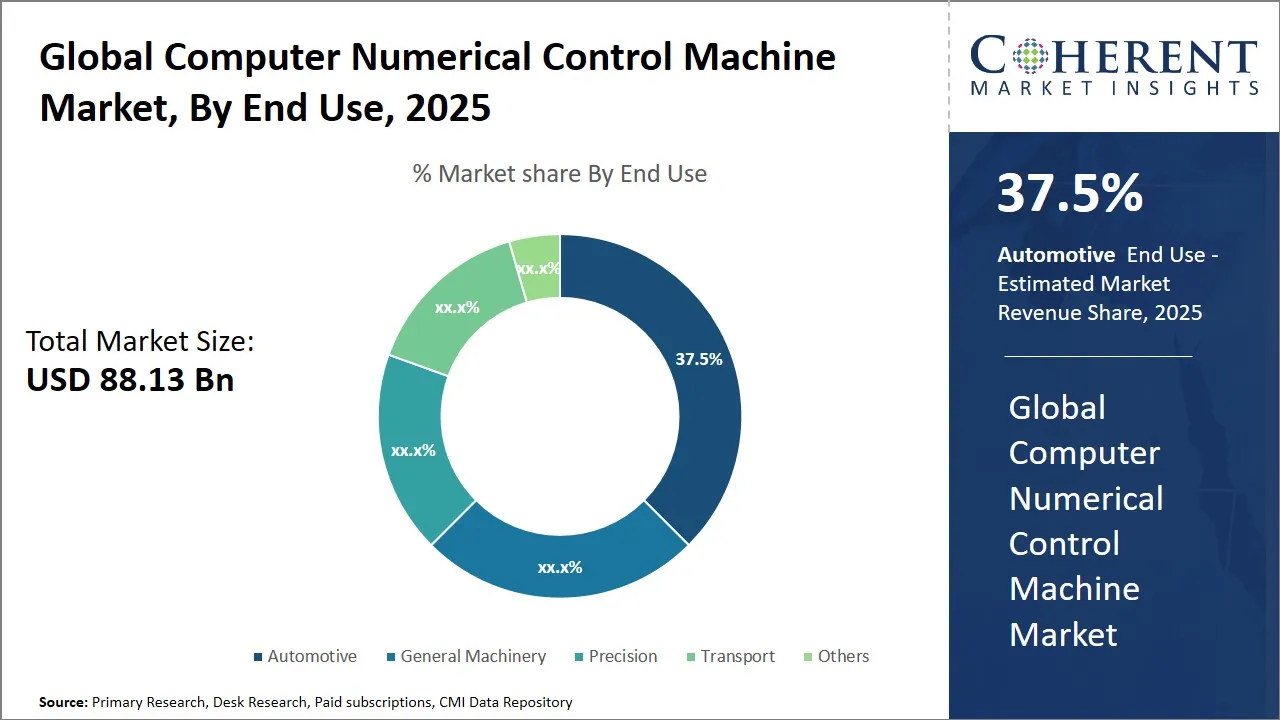
Computer Numerical Control (CNC) Machines Market Insights, By End Use
Automotive Segment Acquires the Largest Share owing to its High Precision and Consistency
In terms of end use, the automotive segment dominates the global computer numerical control (CNC) machines market, holding, an estimated share of 38.5% in 2026, due to their ability to deliver precision, speed, and consistency which is essential qualities for mass-producing complex vehicle components. CNC machines are used to produce engine blocks, transmission parts, brake components, drive shafts, and custom gears parts that must meet tight tolerances for safety and performance.
Moreover, Automotive manufacturing involves large-scale, high-volume production, and CNC machines can repeat the same operation thousands of times with minimal deviation, reducing defects. As automakers move toward electric vehicles (EVs), CNC machines provide the flexibility to reprogram and adapt to new parts such as battery housings, motor cases, and lightweight aluminum frames. Many automotive manufacturers integrate CNC machines into robotic cells and smart factories, enabling automated workflows, remote monitoring, and predictive maintenance.
In July 2025, Shakti Hi‑Tech enhanced its automotive CNC machining capacity with advanced, multi‑axis machining centers aimed at micron‑level precision, targeting growing demand from Tier‑1 and Tier‑2 suppliers. The new lineup includes high‑speed spindles, automated tool changers and integrated quality‑control systems, enabling the production of complex components such as engine brackets, gearbox housings, suspension arms and control rods. Equipped with Industry 4.0 features—real‑time monitoring, predictive maintenance and in‑house metrology, the upgraded facility ensures tighter tolerances, faster cycles and consistent output. The expansion further supports the computer numerical control machines market share.
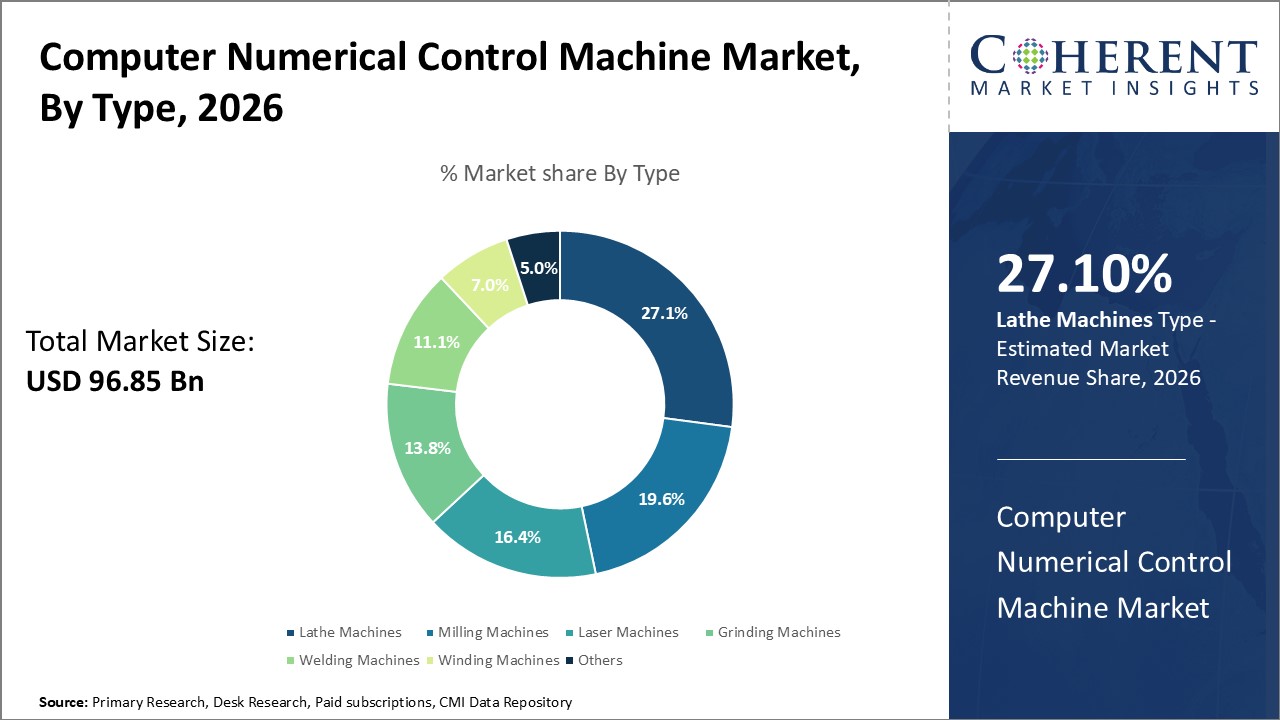
Computer Numerical Control (CNC) Machines Market Insights, By Type
Lathe Machines Dominates the Overall Market owing to its Versatility Across Industries
In terms of type, the lathe machines segment dominates the global computer numerical control (CNC) machines market in 2026 due to their essential role in precision machining across a wide range of industries. These machines are specifically designed for shaping metal or other rigid materials by rotating the workpiece against various cutting tools, making them vital for manufacturing high-precision cylindrical components. CNC lathe machines are indispensable in sectors like automotive, aerospace, electronics, medical devices, and general engineering. Their ability to perform turning, threading, drilling, and facing operations makes them a foundational tool in many production environments.
Moreover, with increasing demand for tight tolerance parts, CNC lathes provide the accuracy and consistency required in modern manufacturing, especially in defense and aerospace applications. Their ability to rapidly produce uniform parts makes them ideal for batch production in industries that require high-volume, repeatable components such as bushings, shafts, and fasteners.
In September 2024, Okuma America Corporation launched its latest horizontal lathe, the LB2000 EX III, featuring a 140 Flat spindle engineered for precision machining. Designed to excel in producing finely tuned small parts and complex components, the machine integrates seamlessly with the optional MYW gauging system to enhance accuracy and efficiency. The LB2000 EX III builds on Okuma’s reputation for innovation in CNC solutions, offering manufacturers improved performance and flexibility on the shop floor. This is further proliferating the computer numerical control machines market revenue.
Regional Insights
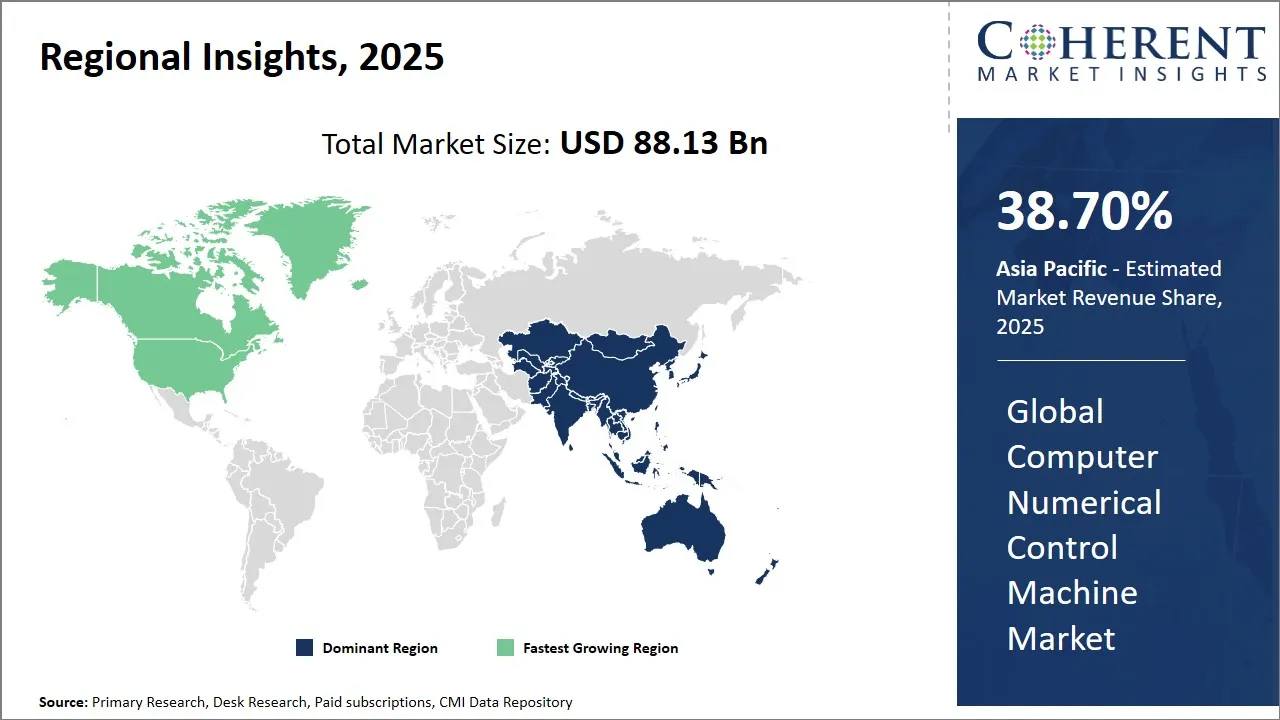
Asia Pacific Computer Numerical Control (CNC) Machines Market Analysis & Trends
Asia Pacific, holding a share of 38.7% in 2026, is expected to dominate the global computer numerical control (CNC) machines market. Countries such as China, Japan, and South Korea are at the forefront of technological progress in manufacturing. The automotive, electronics, and heavy equipment industries are the main buyers of CNC systems in this region.
In China, precision engineering is scaling up: Dongguan Evml CNC Equipment Technology recently launched a 20,000 m² facility producing five-axis CNC machines, and demand is so high that its order book is already filled through mid-2026. Meanwhile, Chinese high-end CNC tool orders continue to surge, driven by booming sectors like new energy vehicles, robotics, and semiconductors, prompting manufacturers to operate production lines at full capacity.
Japan and South Korea further strengthen the region’s dominance through consistent technological leadership and global partnerships. For example, Japanese engineers are showcasing ultra-precision machining centers at major trade shows like CIMT 2026, aiming to support China’s expanding semiconductor and aerospace industries. This technology-sharing synergy, along with infrastructure investments and growing disposable incomes in the Asia Pacific, underscores why the region continues to lead computer numerical control machines market forecast.
North America Computer Numerical Control (CNC) Machines Market Analysis & Trends
North America region is expected to exhibit the fastest growth in the global computer numerical control (CNC) machines market due to the strong presence of major industries. The region has made significant investments in advanced manufacturing technology, leading to increased adoption of CNC systems. The demand for high precision and efficiency in the machining process is driving the growth of the CNC market in North America.
Recently, AI-driven software innovations are enhancing CNC productivity. For example, in June 2026, British company CloudNC launched its CAM Assist software in the U.S., automating 80% of complex CNC programming.
Meanwhile, major companies are ramping up factory investments to support precision machining. Notably, GE Aerospace pledged nearly USD 1 billion in 2026 to expand U.S. factories and supplier networks, including engine parts manufacturing that relies heavily on CNC systems. These examples illustrate how North America’s emphasis on reshoring, automation, and high-precision manufacturing is rapidly increasing the demand for CNC machines, making the region a key growth engine in the global computer numerical control machines market share.
Computer Numerical Control (CNC) Machines Market Outlook Country-Wise
China Computer Numerical Control (CNC) Machines Market Trends
China is a key driver of CNC machine demand, fueled by its dominance in automotive, electronics, and heavy manufacturing. The government’s “Made in China 2026” strategy accelerates industrial automation, prompting widespread CNC adoption. Major firms like BYD and Xiaomi invest in 5-axis and high-speed machines for precision components. Domestic manufacturers such as DMTG and Shenyang Machine Tool are also scaling up, backed by state support and exports. China's push for smart factories and self-reliant manufacturing is cementing its position as a global leader in the CNC machines market demand.
The U.S. Computer Numerical Control (CNC) Machines Market Trends
The United States is a major market for CNC machines due to its strong aerospace, defense, and automotive sectors. Companies like Boeing, Lockheed Martin, and Ford use CNC machines for high-precision parts made from metals and composites. The rise of electric vehicles is also boosting demand for CNC in battery and motor component production. Government initiatives such as the CHIPS Act and reshoring incentives are driving investments in smart manufacturing and automation. These factors, combined with training programs to address the skilled labor gap, continue to strengthen CNC machine industry in the U.S. industrial landscape.
Germany Computer Numerical Control (CNC) Machines Market Trends
Germany is a major driver of CNC machine demand, fueled by its leadership in automotive, engineering, and precision manufacturing. Companies like BMW and Siemens rely on CNC systems for high-precision parts and automated production. The country shows strong demand for multi-axis and hybrid CNC machines, essential in sectors like aerospace and toolmaking. Manufacturers such as DMG Mori support this with advanced 5-axis systems. Integration with Industry 4.0 and smart factory technologies further accelerates adoption, keeping Germany at the forefront of CNC innovation.
Market Report Scope
Computer Numerical Control Report Coverage
| Report Coverage | Details | ||
|---|---|---|---|
| Base Year: | 2025 | Market Size in 2026: | USD 96.85 Bn |
| Historical Data for: | 2020 To 2024 | Forecast Period: | 2026 To 2033 |
| Forecast Period 2026 to 2033 CAGR: | 9.9% | 2033 Value Projection: | USD 187.54 Bn |
| Geographies covered: |
| ||
| Segments covered: |
| ||
| Companies covered: | Hurco Companies Inc., Protomatic Inc., Metal Craft, AMS Micromedical LLC, JTEKT Corporation, Haas Automation, Fanuc Corporation, Siemens AG, DMG Mori Seiki Co. | ||
| Growth Drivers: |
| ||
| Restraints & Challenges: |
| ||
Global Computer Numerical Control (CNC) Machines Market Drivers
Growing demand for automated manufacturing in the industrial sector
The growing need for automated manufacturing in the industrial sector is a major driver of the CNC market. Industries as diverse as automotive, aerospace, electronics, and consumer goods are increasingly interested in automation to improve the productivity, efficiency, and quality control of their manufacturing processes. This shift towards automation has created a strong demand for CNC (Computer Numerical Control) systems. CNC machines play an important role in automated manufacturing as they enable accurate, repeatable, and complex machining operations. CNC technology allows manufacturers to program machines to perform a wide range of tasks with high precision, consistency, and speed. This eliminates the need for manual intervention, reduces human error, and increases the efficiency of the entire process.
Rising need for medical devices, electric vehicles (EV), and telecommunications equipment
Growing demand for medical equipment, electric vehicles (EVs), and telecommunications equipment are strongly driving the growth of the CNC market. These industries require highly precise and complex manufacturing processes, for which CNC machines can be used. In the medical device industry, CNC machines play an important role in manufacturing various components and devices. From surgical instruments and implants to diagnostic equipment, CNC machines enable the production of complex, precision parts for medical applications. Increased demand for innovative medical equipment, advances in healthcare technology, and an aging population have increased the need for CNC machines in this field. The electric vehicle industry is growing rapidly around the world due to the push for sustainable transportation and the shift to clean energy sources.
CNC machines play a key role in manufacturing critical EV components such as battery cells, electric motors, power electronics, and charging infrastructure. The ability of CNC machines to produce lightweight, high-strength components to tight tolerances supports the development of efficient and reliable electric vehicles. As the demand for electric vehicles grows, so does the need for CNC machines in this sector. For instance, in August 2022, Wipro GE Healthcare, a leading global provider of advanced medical technologies announced that it had partnered with medical device maker Boston Scientific to offer comprehensive, cutting-edge cardiac interventional care solutions in India. These events indicate a growth in the medical sector thereby also increasing the CNC market growth.
Global Computer Numerical Control (CNC) Machines Market Opportunity
Integration of additive manufacturing
The combination of CNC machining and additive manufacturing technology opens up new possibilities in terms of design freedom, material utilization, and production efficiency. CNC machining has traditionally been used for subtractive manufacturing processes, but 3D printing can create complex and intricate shapes by adding material layer by layer. By integrating additive manufacturing capabilities into CNC machines, manufacturers can take advantage of the strengths of both technologies. CNC machining excels at producing high-precision parts with excellent surface finishes, while 3D printing allows for complex geometries and custom components.
The integration of these technologies enables a hybrid manufacturing process that uses CNC machining to refine and finish 3D printed parts, resulting in a high-quality, functional end product. For instance, GE has been a leader in additive manufacturing, particularly with its subsidiary GE Additive. They offer a range of CNC additive manufacturing solutions, including their Concept Laser and Arcam brands. GE utilizes CNC additive manufacturing to produce complex components for industries such as aerospace, healthcare, and automotive.
Analyst Opinion (Expert Opinion)
The Computer Numerical Control (CNC) machine market value is undergoing a nuanced transformation, less a matter of expansion and more of strategic recalibration. The sector is no longer driven by simple automation imperatives; it is increasingly governed by the demand for precision engineering, digital interoperability, and end-use customization.
In my assessment, the most consequential shift is the integration of CNC systems with real-time analytics and Industrial Internet of Things (IIoT) architectures. This isn’t mere digitization, it’s a functional redefinition. Manufacturers are now leveraging CNC platforms that can predict tool wear using AI-driven algorithms, automatically recalibrate based on sensor feedback, and even self-optimize for material waste reduction. According to a 2024 survey by Make UK, nearly 68% of precision engineering firms in Europe have integrated smart CNC tools with MES and ERP systems, a clear indication that CNC is no longer viewed as a standalone automation asset, but rather as a node within a broader data and process ecosystem.
Moreover, Japanese manufacturers such as FANUC and Okuma are investing heavily in hybrid CNC machines capable of both subtractive and additive processes. FANUC’s latest “Robodrill α-DiB Plus Series” offers AI-powered spindle management, and is a clear illustration of the industry’s move toward hybrid, software-defined machining. Meanwhile, in the United States, the defense and aerospace sectors are dictating demand, particularly for 5-axis CNC machines capable of complex, multi-material processing for lightweight components. This is no longer a race for capacity, but for machining intelligence.
The skill barrier remains an underappreciated structural concern. High-spec CNC machines increasingly require operators who are not only technically proficient but also capable of interpreting machine data, adjusting digital twin models, and engaging with real-time decision interfaces. The talent gap is not closing fast enough. Data from Germany’s VDMA indicates that over 45% of advanced CNC machining firms in the DACH region face production delays due to operator shortages, suggesting that machine capabilities are outpacing human readiness.
Sustainability is emerging as both a compliance driver and a differentiator. CNC machines with dry-cutting capabilities and minimum quantity lubrication (MQL) are seeing accelerated adoption, especially in Europe, where environmental compliance is tightening. A compelling example is DMG Mori’s “ecoMill V Series,” which has achieved a 25% reduction in power consumption through regenerative braking and thermally stable machine beds.
Speak to the analyst
Want personalized insights?
Take the findings above to one of our principal consultants, or have the report rebuilt around the segments, geographies and competitors you actually track.
Recent Developments
- In April 2025, Makera, a leader in desktop CNC innovation, launched its next‑generation Makera CAM software, aiming to make digital fabrication more accessible to makers worldwide. The free‑for‑Carvera‑users platform supports 2D, 3D, 4th‑axis machining, laser engraving, PCBs, and image-based projects, all within an intuitive, easy-to-learn interface backed by tutorials and community support.
- In March 2025, Queen Elizabeth’s Hospital (QEH) in Bristol unveiled a state‑of‑the‑art CNC (Computer Numerical Control) machine for its Design & Technology department. The initiative aims to enrich GCSE and Sixth Form students’ educational experience by providing hands‑on exposure to digital manufacturing and precision engineering.
- In January 2025, WIDMA® Machining Solutions, part of Kennametal India, unveiled its latest CNC offerings at IMTEX 2025, including the advanced MacHX800 horizontal machining centre, engineered for large-part applications in commercial vehicles, aerospace and construction, with full Industry 4.0 IoT integration.
- In May 2024, Mitsubishi Electric India introduced its advanced M80LA CNC controller, tailored specifically for turning operations. Launched at the CNC eXPerience Park, the system supports multi-axis and multi-system controls to enhance productivity in complex machining workflows.
Market Segmentation
- Global Computer Numerical Control (CNC) Machines Market, By Type (Revenue, USD Bn, 2021 - 2033)
- Lathe Machines
- Milling Machines
- Laser Machines
- Grinding Machines
- Welding Machines
- Winding Machines
- Others
- Global Computer Numerical Control (CNC) Machines Market, By End-use (Revenue, USD Bn, 2021 - 2033)
- Automotive
- Aerospace & Defense
- Construction Equipment
- Power & Energy
- Industrial
- Others
- Global Computer Numerical Control (CNC) Machines Market, By Region (Revenue, USD Bn, 2021 - 2033)
- North America
- U.S.
- Canada
- Europe
- Germany
- Italy
- U.K.
- France
- Spain
- Russia
- Rest of Europe
- Asia Pacific
- China
- Japan
- Australia
- India
- ASEAN
- South Korea
- Rest of Asia Pacific
- Latin America
- Brazil
- Mexico
- Argentina
- Rest of Latin America
- Middle East & Africa
- GCC Countries
- Israel
- South Africa
- Rest of Middle East & Africa
- North America
- Company Profiles
- Hurco Companies Inc.
- Protomatic Inc.
- Metal Craft
- AMS Micromedical LLC
- JTEKT Corporation
- Haas Automation
- Fanuc Corporation
- Siemens AG
- DMG Mori Seiki Co.
Sources
Primary Research Interviews from the following stakeholders
Stakeholders
- Interviews with CNC machine manufacturers, automation integrators, precision engineering firms, industrial equipment dealers, maintenance contractors, plant heads, and procurement leads across major manufacturing economies.
Databases
- United Nations Industrial Development Organization (UNIDO)
- World Trade Organization (WTO) Trade Statistics
- UN Comtrade Database
- Ministry of Heavy Industries (India)
- U.S. Bureau of Economic Analysis (BEA)
- Eurostat – Machinery & Equipment Section
- China Customs Statistics
- Korea Trade Statistics Promotion Institute (KOTIS)
- Japan External Trade Organization (JETRO)
- Directorate General of Commercial Intelligence and Statistics (DGCIS), India
Magazines
- Modern Machine Shop
- Cutting Tool Engineering
- Production Machining
- Manufacturing Today
- Industrial Machinery Digest
- The Machinist India
- Metalworking World Magazine
- Control Engineering
Journals
- Journal of Manufacturing Processes
- International Journal of Machine Tools and Manufacture
- CIRP Annals – Manufacturing Technology
- Precision Engineering (Elsevier)
- Robotics and Computer-Integrated Manufacturing
- Journal of Materials Processing Technology
Newspapers
- The Wall Street Journal – Manufacturing & Technology
- The Economic Times – Manufacturing & Auto
- The Hindu Business Line – Engineering & Industrial Goods
- Financial Times – Automation & Industrial Technology
- Nikkei Asia – Machinery and Export Markets
- South China Morning Post – Industrial Innovation
Associations
- Indian Machine Tool Manufacturers’ Association (IMTMA)
- VDW – German Machine Tool Builders’ Association
- Japan Machine Tool Builders' Association (JMTBA)
- Association for Manufacturing Technology (AMT), U.S.
- European Association of the Machine Tool Industries (CECIMO)
- Confederation of Indian Industry (CII) – Manufacturing & Automation Council
- International Federation of Robotics (IFR)
Public Domain Sources
- Ministry of Heavy Industries (India)
- Ministry of Economy, Trade and Industry (METI), Japan
- National Institute of Standards and Technology (NIST), U.S.
- U.S. International Trade Commission (USITC)
- NITI Aayog – Manufacturing Sector Reports
- Reserve Bank of India (RBI) Reports – Industrial Investment Trends
- India Investment Grid – Advanced Manufacturing
- EU Single Market Observatory – Engineering Goods
Proprietary Elements
- CMI Data Analytics Tool, and Proprietary CMI Existing Repository of information for last 8 years
*Definition: Computer Numerical Control (CNC) machines have revolutionized the manufacturing industry by offering unparalleled precision, efficiency, and versatility in automated machining processes. These sophisticated machines utilize computerized controls to precisely guide the movement of cutting tools, resulting in highly accurate and repeatable operations.
Get access to 250+ pages report
Every segment, forecast, competitor profile and data table behind the analysis above — available for instant download.
- ESOMAR Member
- ISO 9001:2015 Certified
- D-U-N-S Registered
- GDPR & CCPA Compliant
Missing comfort of reading report in your local language? Find your preferred language:
Transform your Strategy with Exclusive Trending Reports
Frequently Asked Questions
The Computer Numerical Control Machine Market is estimated to be valued at USD 96.85 Bn in 2026, and is expected to reach USD 187.54 Bn by 2033.
The CAGR of the Computer Numerical Control Machine Market is projected to be 9.9% from 2026 to 2033.
Major players operating in the Market include Hurco Companies Inc., Protomatic Inc., Metal Craft, AMS Micromedical LLC, JTEKT Corporation, Haas Automation, Fanuc Corporation, Siemens AG, DMG Mori Seiki Co., and others.
High initial investment, coupled with a lack of skilled labor to operate and maintain CNC machines are some of the major factors that are expected to hamper the growth of the market over the forecast period.
Growing demand for automated manufacturing in the industrial sectors and the increasing need for medical devices, electric vehicles (EV), and telecommunications equipment are the major factors that is expected to propel the growth of the market.
Among region, Asia Pacific held a dominant position in the Global Computer Numerical Control CNC Machines Market in 2026.
AI enhances CNC precision, automates programming, predicts maintenance, and improves production efficiency, driving innovation and competitiveness in the market.