

Traffic Sensor Market Size and Forecast — 2026-2033
The Global Traffic Sensor Market size is estimated to be valued at USD 5.03 billion in 2026 and is expected to reach USD 10.06 billion by 2033, exhibiting a compound annual growth rate (CAGR) of 10.4% from 2026 to 2033.
Overview
Traffic sensors encompass a wide range of technologies designed to detect, measure, and analyze vehicle and pedestrian movement. Traditional solutions, such as inductive loops and magnetic sensors, provide presence and vehicle count data, while modern radar, infrared, and LiDAR sensors offer more accurate detection under diverse conditions. Video and image sensors are widely used for real-time monitoring and incident detection, and acoustic or piezoelectric sensors support niche applications such as weight or noise monitoring. Together, these products form the backbone of traffic management systems, enabling functions like automated tolling, traffic signal control, incident management, and smart mobility planning.
Key Takeaways
The inductive loop sensor segment dominates the market share due to its established reliability and infrastructure compatibility, accounting for 44% of total sensor installations.
In the sensor application category, traffic flow management holds the highest market traction owing to its direct influence on congestion mitigation and emission reduction.
From a regional perspective, North America leads the market, driven by substantial investments in smart city projects and regulatory mandates, whereas Asia Pacific is the fastest-growing region propelled by rapid urbanization and government initiatives in India and China.
Traffic Sensor Market Segmentation Analysis
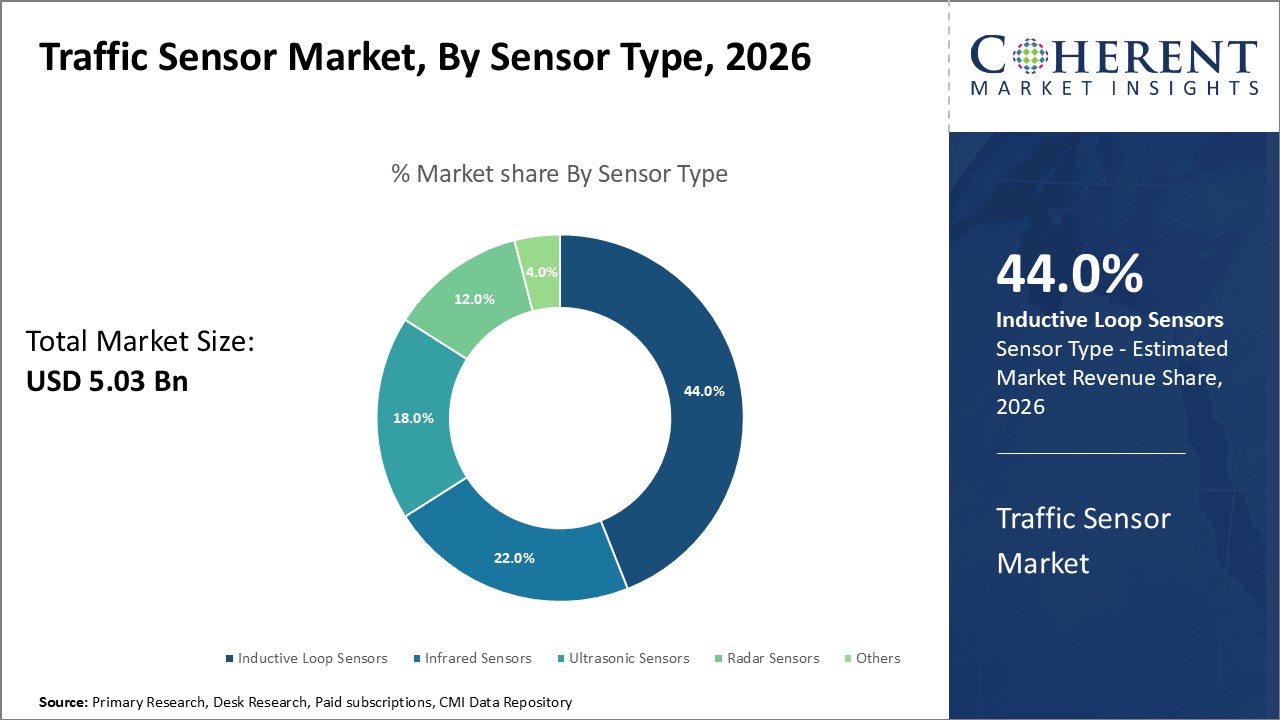
Traffic Sensor Market Insights, By sensor type
In terms of sensor type, the market is segmented into Inductive Loop Sensors, Infrared Sensors, Ultrasonic Sensors, Radar Sensors, and Others, among which Inductive Loop Sensors dominate the market share at 44%. Inductive loop sensors retain primacy due to their proven accuracy in vehicle detection and extensive compatibility with existing infrastructure, making them indispensable in mature markets like North America and Europe. The fastest growing subsegment is Radar Sensors, driven by increasing demand for non-intrusive and weather-resilient detection methods, especially in regions with harsh environmental conditions.
Traffic Sensor Market Insights, By Application
Traffic Flow Management holds the largest share due to its vital role in optimizing urban mobility and is extensively adopted in metropolitan traffic control centers. The sector benefits from enhanced sensor data integration with AI-powered traffic control systems, improving congestion mitigation. Incident Detection is the fastest-growing application, buoyed by the rising necessity for real-time accident detection and rapid emergency response in densely populated regions. Vehicle Counting is widely used for statistical traffic analysis, while Speed Detection is critical for regulatory enforcement and safety controls.
Traffic Sensor Market Insights, By End-User
Government Transportation Authorities dominate market share due to their mandate over urban traffic control and infrastructure development, facilitating extensive deployments of traffic sensors to comply with evolving regulatory requirements. The fastest-growing segment comprises Private Traffic Management Companies that are increasingly providing outsourced smart traffic solutions, especially in North America and Asia Pacific, creating innovative service models and expanding market scope.
Traffic Sensor Market Trends
Recent developments indicate a robust transition from conventional traffic sensing mechanisms to AI-enhanced systems offering predictive traffic analytics.
Notably, the deployment of 5G-connected radar and video sensors in major urban centers has facilitated significant reductions in congestion duration, as observed in cities like Seoul and Los Angeles.
Furthermore, the trend toward wireless sensor networks aids rapid system expansions while curbing operational expenses, demonstrated by Latin America’s extensive smart city projects in Mexico City.
Apart from this, integration of multi-sensor fusion technologies increases detection reliability under adverse weather conditions and heavy traffic volumes, thus improving overall transportation safety and efficiency.
Traffic Sensor Market Insights, By Geography
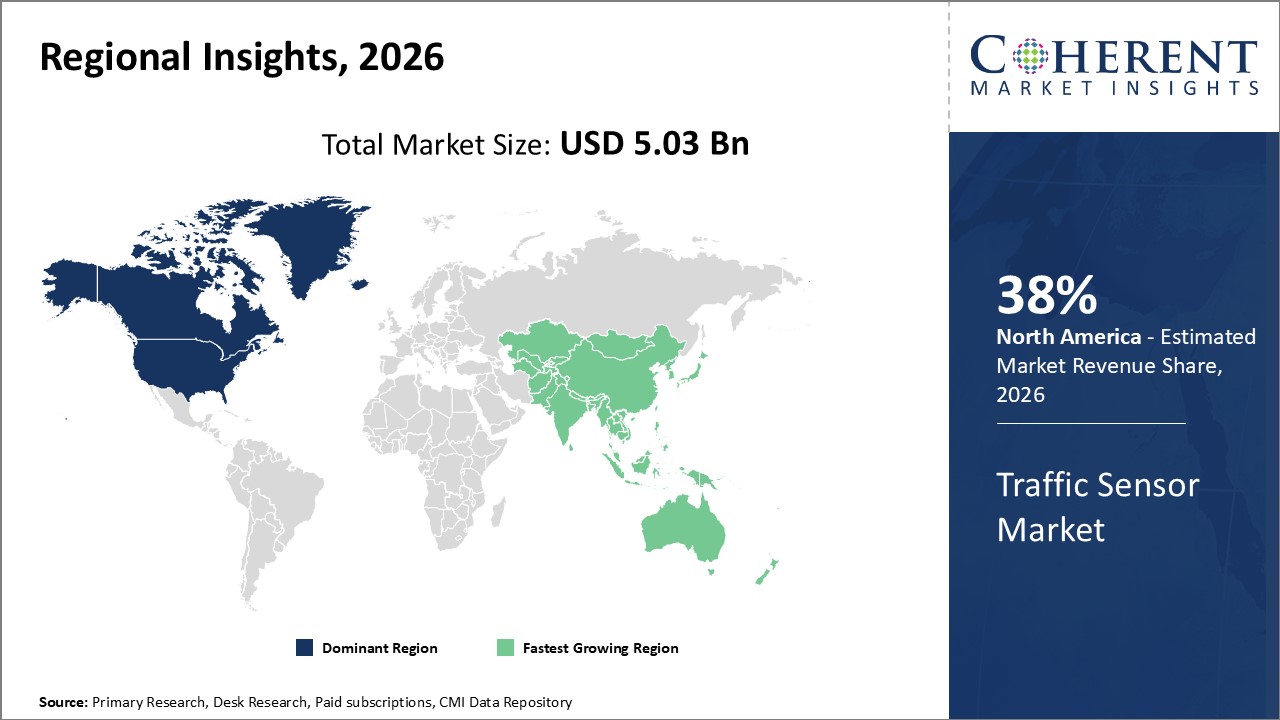
North America Traffic Sensor Market Analysis and Trends
In North America, the dominance in the Traffic Sensor market is fueled by extensive smart city initiatives, strong governmental support, and a mature technological ecosystem. The U.S. leads with significant investments in intelligent transportation systems and regulatory frameworks promoting sensor-based traffic management. The region commands approximately 38% of the market share, supported by notable companies such as Siemens AG and FLIR Systems enhancing infrastructural capabilities and smart monitoring.
Asia Pacific Traffic Sensor Market Analysis and Trends
Meanwhile, the Asia Pacific exhibits the fastest growth, driven by rapid urbanization, government incentives, and infrastructure modernization, particularly in China and India. This region’s CAGR outpaces others at an estimated 12.5%, with expanding installation of wireless sensors and IoT-enabled systems across metropolitan areas. Leading firms such as Vaisala Oyj and Mobisys Technology are capitalizing on this growth by tailoring products to local infrastructure demands and funding opportunities.
Traffic Sensor Market Outlook for Key Countries
USA Traffic Sensor Market Analysis and Trends
The USA's market is advanced due to high urban traffic density and proactive infrastructure modernization. Federal funding initiatives such as the Infrastructure Investment and Jobs Act have allocated billions toward intelligent transportation projects integrating traffic sensors in 2025 and 2026. Market leaders like Bosch Mobility Solutions and Zebra Technologies have expanded their North American footprints by supplying next-generation sensor arrays compatible with connected vehicle platforms. This growing ecosystem promotes enhanced traffic flow analytics and safer road conditions, driving significant market revenue.
China Traffic Sensor Market Analysis and Trends
China’s traffic sensor market is rapidly evolving alongside its urban expansion and smart city projects. The government’s commitment to digital infrastructure has resulted in large-scale deployments of radar and camera-based sensors across major cities such as Shanghai and Beijing. Companies including Siemens AG and Mobisys Technology have been pivotal in introducing innovative traffic management solutions, supporting China’s goal to reduce traffic congestion and pollution. The aggressive urban public transport expansions and smart roadways are strong growth catalysts in this region.
Analyst Opinion
Enhanced sensor accuracy and integration capabilities have significantly contributed to the expansion of the traffic sensor market share. Recent advancements in radar and LiDAR technologies enabled a 16% increase in detection accuracy in 2025, enhancing real-time traffic monitoring applications across meteorologically diverse regions. For example, deployments in Tokyo and Berlin showcased improved traffic data precision, leading to optimized traffic light management systems.
Demand-side momentum is evident through increased adoption of traffic sensors in emerging economies, where urbanization requires scalable monitoring solutions. Countries like India and Brazil witnessed a 21% uplift in traffic sensor installations in 2026 due to government-backed smart city initiatives, reflecting a robust market forecast. Intermodal transportation hubs in Mumbai have particularly benefited from these installations, reducing vehicular idling times.
Market drivers include the rising need for emission reduction and safety enhancement, bolstered by stricter regulations globally. The European Union’s directive in 2025 mandating real-time emission monitoring accelerated the integration of advanced sensors, increasing market revenue by over 12% in targeted countries. Furthermore, public safety campaigns in the U.S. led to a 10% acceleration in demand for dynamic traffic sensors in metropolitan areas during the same year.
Micro-level indicators reveal a shift toward wireless and low-power sensor modules, which accounted for 36% of new devices shipped in 2025. Innovations in energy harvesting technologies have extended sensor lifespan by an average of 18 months, significantly reducing maintenance costs. This trend was notably observed in South Korea’s urban highways where sensor uptime improved notably.
- Current Industry Events of 2026
- Market Size Estimation
- Regional Breakdown
- Competitive Landscape
- Customer Intelligence
- Segmental Analysis
- Pricing Analysis
- Key Market Drivers, Challenges & Future Trends
- Customized Insights Section
Market Scope
| Report Coverage | Details | ||
|---|---|---|---|
| Base Year: | 2025 | Market Size in 2026: | USD 5.03 billion |
| Historical Data for: | 2020 To 2024 | Forecast Period: | 2026 To 2033 |
| Forecast Period 2026 to 2033 CAGR: | 10.4% | 2033 Value Projection: | USD 10.06 billion |
| Geographies covered: |
| ||
| Segments covered: |
| ||
| Companies covered: | Sensys Networks Inc., FLIR Systems, Siemens AG, Kapsch TrafficCom AG, Mobisys Technology, Vaisala Oyj, Bosch Mobility Solutions, Iteris Inc., Denso Corporation, Zebra Technologies, Hikvision, ST Electronics, Albis Technologies, Acusensus | ||
| Growth Drivers: |
| ||
Traffic Sensor Market Growth Factors
The acceleration in smart city infrastructure developments is a primary catalyst driving market growth as governments prioritize sustainable urban mobility frameworks. For instance, China’s 2026 smart transportation blueprint has intensified demand for traffic sensor deployments by integrating multi-modal transport data. Growing legislative focus on vehicular safety standards also propels the adoption of precise incident detection sensors, evidenced by a 22% increase in installation projects across European urban centers in 2025.
Additionally, advancements in sensor technologies that allow seamless integration with AI-driven traffic management platforms are expanding the market scope by improving system responsiveness and predictive capabilities. The proliferation of automotive OEM collaborations for traffic data utilization further supports business growth, as recently demonstrated by cooperative projects between major automakers and sensor providers in North America. confidence in WebRTC solutions, driving higher adoption.
Traffic Sensor Market Development
In August 2026, Sensys Networks launched MultiSens Intersection, touted as the industry’s first unified traffic detection platform that fuses video AI + wireless sensor technologies, eliminating traditional trade-offs between intersection analysis and advance detection.
In August 2026, Sumitomo Electric introduced the “NEXUSEYE™” millimeter-wave pedestrian detection sensor (commercialized in Oct 2025). It can detect pedestrians up to ~55 m away, even in poor weather or nighttime, and has already been deployed in the U.S.
Key Players
Key market players include:
Sensys Networks Inc.
FLIR Systems
Siemens AG
Kapsch TrafficCom AG
Mobisys Technology
Bosch Mobility Solutions
Iteris Inc.
Denso Corporation
Zebra Technologies
Hikvision
ST Electronics
Albis Technologies
Acusensus
Competitive strategies observed include Siemens AG’s expansion via partnerships with urban municipalities to pilot AI-powered sensor grids, resulting in a 26% improvement in traffic throughput in select German cities by 2026. Meanwhile, FLIR Systems increased its product portfolio through acquisitions specializing in thermal sensing, enhancing its footprint in North America’s market landscape. Vaisala Oyj leveraged cloud-based analytics to serve emerging Asian markets, boosting regional market share by 19% in 2025.
Traffic Sensor Market Future Outlook
In the future, the market is expected to expand significantly with the rising adoption of advanced sensing technologies. The shift toward wireless, AI-enabled, and edge-based traffic sensors will become more pronounced as authorities demand faster, more accurate data for real-time decision making. Regions with strong smart city development will see the fastest adoption, while mature markets will focus on upgrading outdated infrastructure. Traffic sensors will increasingly integrate with connected vehicles, autonomous systems, and IoT platforms, making them a critical enabler of future mobility ecosystems.
Traffic Sensor Market Historical Analysis
The traffic sensor industry has evolved steadily over the past few years as cities and transport authorities focused on reducing congestion and improving road safety. Initially, intrusive sensors such as inductive loops were dominant, but over time there has been a clear shift toward non-intrusive options like radar, video, and image-based technologies. This transformation has been supported by growing urbanization, government initiatives for smart city projects, and the integration of intelligent transportation systems into existing infrastructure.
Sources
Primary Research interviews:
Traffic Engineers
Smart City Project Managers
Transport Department Officials
Databases:
International Transport Forum (ITF)
World Bank Transport Database
National Highway Traffic Safety Administration (NHTSA)
Magazines:
ITS International
Traffic Technology International
Smart Highways Magazine
Intelligent Transport
Journals:
Journal of Intelligent Transportation Systems
Transportation Research Part C: Emerging Technologies
IEEE Transactions on Intelligent Transportation Systems
IET Intelligent Transport Systems
Newspapers:
The Economic Times (Infrastructure)
- The Guardian (Transport)
The New York Times (Mobility
Associations:
Institute of Transportation Engineers (ITE)
Intelligent Transportation Society of America (ITS America)
European ITS Association (ERTICO)
Get access to 250+ pages report
Every segment, forecast, competitor profile and data table behind the analysis above — available for instant download.
- ESOMAR Member
- ISO 9001:2015 Certified
- D-U-N-S Registered
- GDPR & CCPA Compliant
Missing comfort of reading report in your local language? Find your preferred language:
Transform your Strategy with Exclusive Trending Reports
Frequently Asked Questions
The traffic sensor market is led by companies such as Sensys Networks Inc., Siemens AG, FLIR Systems, and Kapsch TrafficCom AG, which have demonstrated strong technological offerings
What will be the size of the Traffic Sensor market in the coming years?
Which end user’ industry has the largest growth opportunity?
How will market development trends evolve over the next five years?
What is the nature of the competitive landscape and challenges in the Traffic Sensor market?
What go-to-market strategies are commonly adopted in the Traffic Sensor market?