

VRF Systems Market Size and Forecast – 2026 to 2033
The global VRF systems market is estimated to be valued at USD 17.50 Bn in 2026. The market is expected to reach USD 36.61 Bn by 2033, exhibiting a compound annual growth rate (CAGR) of 11.1% from 2026 to 2033.
Key Takeaways
- By Type, Heat Pump System hold the largest market share of 41.6% in 2026 owing to its energy efficiency and operational cost savings.
- By Component, Outdoor Units expected to hold largest market share of 47.1% in 2026 owing to the urbanization and infrastructure development.
- By End User, Residential acquired the prominent market share of 48.2% in 2026 owing to the energy efficiency and cost savings.
- By Region, Europe dominates the overall market with an estimated share of 40.0% in 2026 owing to the stringent energy efficiency regulations.
Market Overview
VRF or variable refrigerant flow systems are witnessing wider adoption from the commercial sector owing to their energy efficiency and flexibility over traditional heating, ventilation, and air conditioning (HVAC) systems. VRF allows independent zoned temperature control without the need for separate air conditioning (AC) units in each zone thereby helping in reducing capital and operating costs significantly. The VRF systems market is expected to witness strong growth over the forecast period driven by factors such as rapid urbanization leading to infrastructural growth of commercial sector including offices, hotels, and retail buildings. VRF systems offer an optimal solution for various heating and cooling needs of large multi-zone commercial infrastructures. Strong focus on energy-efficiency and cost optimization in the commercial sector across regions will further drive preference of VRF over conventional HVAC systems.
Current Events and their Impact
Current Events | Description and its impact |
Geopolitical and Regulatory Developments |
|
Economic and Supply Chain Dynamics |
|
Regional Market Expansion and Urbanization |
|
Role of AI (Artificial Intelligence) in VRF Systems
Artificial intelligence enhances Variable Refrigerant Flow (VRF) systems by enabling smart, energy-efficient climate control in commercial spaces. AI analyzes real-time data such as occupancy, weather conditions, and usage patterns to automatically adjust heating and cooling for optimal performance. This reduces energy consumption, lowers operating costs, and improves overall system efficiency. AI also supports predictive maintenance by identifying potential issues before they cause failures, minimizing downtime and extending equipment lifespan.
In July 2025, G Electronics ANZ launched the Multi V i HVAC system, a commercial climate control solution that uses AI to enhance energy efficiency and support decarbonisation. Designed for commercial buildings, the Multi V i VRF system targets HVAC energy use—which can account for up to 40% of a site's total consumption—to reduce emissions and operational costs.
- Current Industry Events of 2026
- Market Size Estimation
- Regional Breakdown
- Competitive Landscape
- Customer Intelligence
- Segmental Analysis
- Pricing Analysis
- Key Market Drivers, Challenges & Future Trends
- Customized Insights Section
Segmental Insights
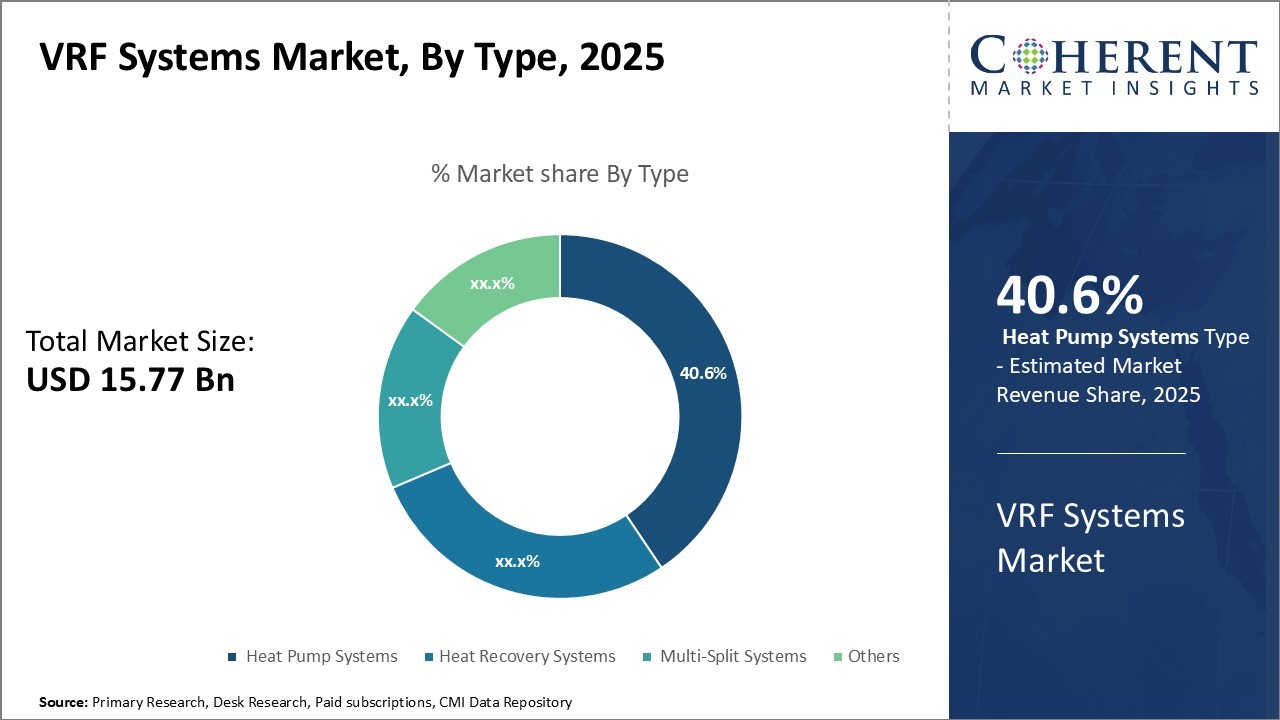
VRF Systems Market Insights, by Type - Heat Pump System contribute the highest share of the market owing to its urbanization and infrastructure development
Heat Pump System hold the largest market share of 41.6% in 2026. As more people want HVAC systems that are better for the environment and use less energy, the market for heat pump systems in VRF technology is growing. People are becoming more aware of how important it is to lower their carbon footprints, therefore they are actively looking for systems that use less energy to heat and cool their homes. Improvements in technology make systems work better and allow for smart control integration, which makes them more pleasant and useful for users. In addition, people all over the world are using heat pump-based VRF systems because of government rules and the growth of cities' infrastructure.
For instance, in April 2025, Mitsubishi Electric Trane HVAC US LLC (METUS), a leading supplier of all-electric, all-climate ductless and ducted mini-split and Variable Refrigerant Flow (VRF) heat pump and air-conditioning systems, introduced a new, innovative product line featuring a low global warming potential (GWP) refrigerant.
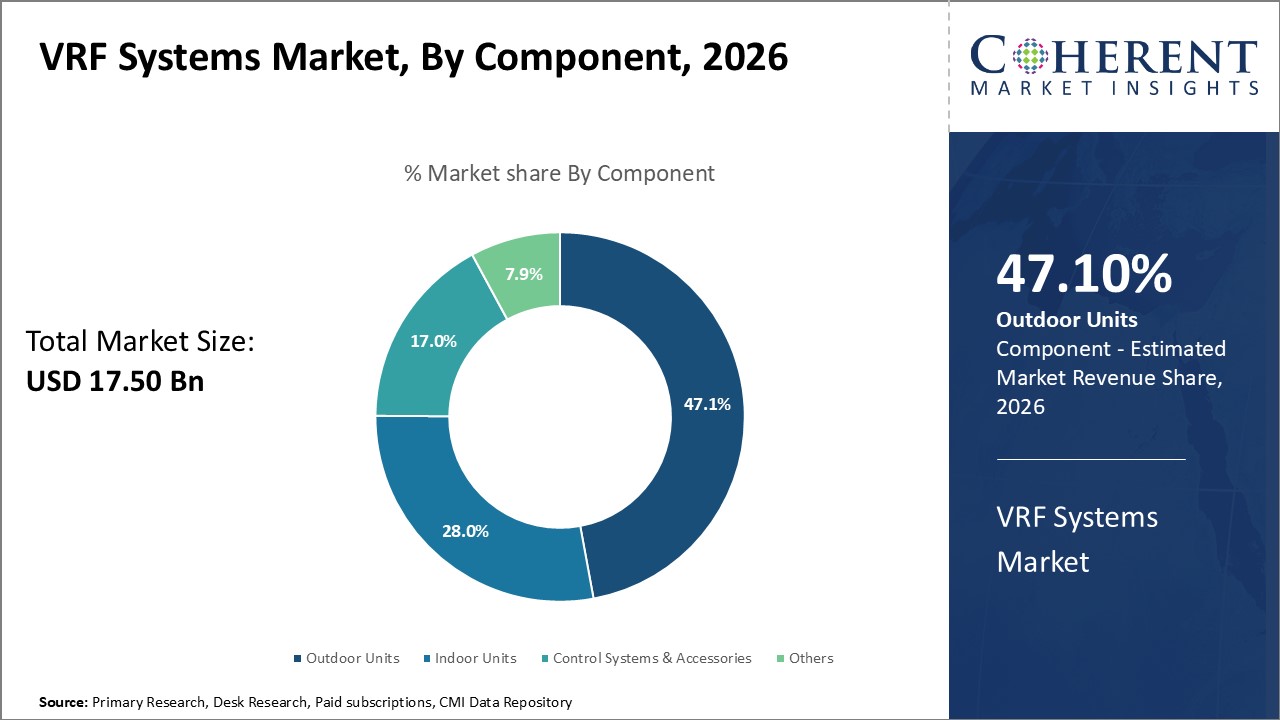
VRF Systems Market Insights, by Component - Outdoor contribute the highest share of the market owing to its customization and scalability
Outdoor Units expected to hold largest market share of 47.1% in 2026. Outside units are required in the VRF systems sector since both households and businesses require reliable and efficient HVAC systems. Compressor technological advancements and sophisticated controls extend system life and reduce energy use. More modular outdoor units are being erected as a result of urban expansion and expanding infrastructure initiatives. These units are suitable for a wide range of architectural styles. Governments also set stricter environmental regulations and provide incentives to encourage consumers to choose eco-friendly, scalable outdoor units as their preferred HVAC solution.
For instance, Samsung has introduced its large-capacity DVM S Eco VRF air conditioning system in India, offering energy-efficient, eco-friendly, and quiet multi-room cooling with a single outdoor unit.
VRF Systems Market Insights, by End User - Residential contribute the highest share of the market owing to its quiet operation and aesthetic flexibility
Residential acquired the prominent market share of 48.2% in 2026. The residential VRF systems market is being driven by homeowners, who desire heating and cooling systems that are energy-efficient, adaptable, and provide them with increased comfort. These systems enable you to regulate the temperature in various areas of your residence in accordance with your preferences. By incorporating smart home technology, consumers can remotely monitor and manage their HVAC systems, thereby simplifying the process. As an increasing number of individuals relocate to urban areas, there is an increasing demand for units that are both space-saving and silent, and that are compatible with contemporary living environments. This transition is facilitated by government policies, and an increasing number of individuals are transitioning to VRF systems due to their increased environmental awareness.
For instance, in April 2025, Marvel Realtors has launched Basilo, an ultra-luxury high-rise project in Lane 5, Koregaon Park, featuring premium interiors and VRV/VRF air-conditioning in every residence.
Regional Insights
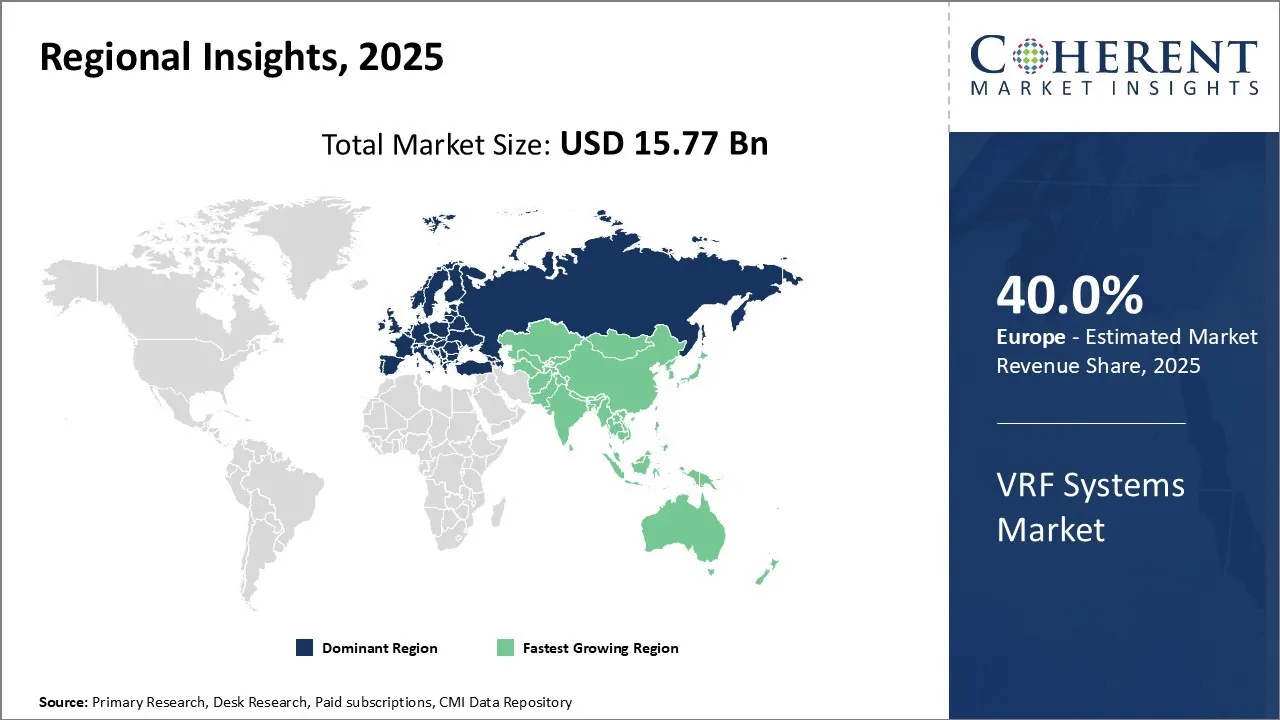
Europe VRF Systems Market Trends
Europe dominates the overall market with an estimated share of 40.0% in 2026. The VRF systems market revenue in Europe is changing quickly because there is a strong focus on energy efficiency and sustainability. Regulators encourage the use of HVAC technologies that consume less energy, which pushes producers to come up with new ideas. Companies combine smart building technologies with renewable energy sources to improve system performance and provide users more control. As cities grow and older buildings are renovated, the need for adaptable, space-saving VRF solutions rises. Also, more people are becoming concerned of the environment, and the government is giving incentives to encourage wider use of VRF technology, making it a major force in Europe's HVAC industry.
For instance, in November 2024, Daikin unveiled a new CO2 VRF system in Europe, alongside the existing R32-based VRV5 range, which it continues to promote as the top choice for most commercial and industrial uses.
Asia Pacific VRF Systems Market Trends
The Asia Pacific VRF systems market is growing quickly because more people are moving to cities and there is a growing need for energy-efficient HVAC systems. As developers create more homes and businesses, the need for climate control systems that can be changed and expanded grows. To make systems work better and make users happier, manufacturers include new technologies like smart controls and IoT integration. Governments are actively encouraging people to save energy and protect the environment, which is speeding up the use of VRF. The region's changing weather and ongoing infrastructure improvements make it a great place for flexible, high-performance VRF systems.
For instance, in August 2024, Trane®, a global climate innovator under Trane Technologies, launched its new GEN Elite C Series — a Cooling Only VRF system — for India, Thailand, Vietnam, and other emerging Asia Pacific markets.
United Kingdom VRF Systems Market Trends
In the UK, building owners drive the VRF systems industry by putting energy-efficient and long-lasting HVAC systems first. They are more likely to use modern, low-energy systems because of stricter government rules and goals to cut carbon emissions. As cities rebuild and modernize, the need for HVAC systems that are flexible and small grows. Manufacturers add smart technologies to their products to make them easier to regulate and use less energy. This appeals to both businesses and homeowners. Also, more people in the UK are accepting VRF devices since they are more aware of the environment.
For instance, Bosch, the renowned German engineering and electronics company, introduced a new range of VRF air conditioning units in the UK.
India VRF Systems Market Trends
India's VRF systems market is growing because of the need for better HVAC systems as cities grow and businesses build more commercial buildings. People are becoming more aware of how important it is to save energy, therefore they are choosing systems that let them adjust the temperature exactly and use less electricity. Manufacturers make their systems more appealing by adding new technologies like smart controls and the use of renewable energy. This expansion is actively supported by government regulations that encourage sustainable development and give incentives for energy-efficient technologies. The growing need for sophisticated, space-saving HVAC systems also affects India's changing VRF market.
For instance, Samsung, India’s leading consumer electronics brand, has launched the DVM S2 VRF outdoor unit, which delivers windfree, gentle, and efficient cooling in coordination with indoor AC units.
End-user Feedback and Unmet Needs in the VRF Systems Market
- Demand for Enhanced Energy Efficiency: End-users often seek VRF systems that deliver superior energy savings without compromising comfort. While current models perform well, customers expect continuous improvements to reduce operating costs and environmental impact, highlighting a need for more advanced, energy-optimized solutions.
- Simplified Installation and Maintenance: Users report that installation complexity and maintenance requirements can be challenging, especially in retrofit projects. There is a clear demand for systems designed to streamline setup and reduce ongoing servicing efforts to minimize downtime and overall operational expenses.
- Improved Integration with Smart Technologies: Many customers desire better integration of VRF systems with smart home or building automation platforms. Enhanced connectivity, user-friendly interfaces, and predictive maintenance capabilities are increasingly important to improve system control and efficiency.
VRF Systems Market Trend
Growing Focus on Energy Efficiency and Sustainability
The VRF market is increasingly driven by the demand for energy-efficient HVAC solutions that minimize environmental impact. Manufacturers are developing systems with advanced inverter technology and eco-friendly refrigerants to meet stringent regulations. This trend aligns with global efforts to reduce carbon emissions and energy consumption, encouraging widespread adoption in residential, commercial, and industrial sectors. Sustainability remains a central theme as building owners prioritize long-term operational savings and green certifications.
Integration with Smart and IoT Technologies
Smart technology integration is transforming VRF systems by enhancing user control, efficiency, and maintenance. IoT-enabled VRF units offer real-time monitoring, remote access, and predictive diagnostics, allowing proactive system management. Building automation systems increasingly incorporate VRF controls to optimize performance based on occupancy and weather conditions. This trend improves energy management and user convenience, making VRF solutions more appealing for modern residential and commercial developments.
VRF Systems Market Opportunity
Expansion into Residential Retrofit Projects
There’s significant opportunity in retrofitting older residential buildings with VRF systems, especially in regions where energy efficiency regulations are tightening. Many existing homes have outdated HVAC setups that can benefit from VRF’s zoning and energy-saving features. Targeting this market can drive growth by offering cost-effective upgrades that improve comfort and reduce energy bills, while also addressing space constraints common in older constructions.
Market Report Scope
VRF Systems Market Report Coverage
| Report Coverage | Details | ||
|---|---|---|---|
| Base Year: | 2025 | Market Size in 2026: | USD 17.50 Bn |
| Historical Data for: | 2020 To 2024 | Forecast Period: | 2026 To 2033 |
| Forecast Period 2026 to 2033 CAGR: | 11.1% | 2033 Value Projection: | USD 36.61 Bn |
| Geographies covered: |
| ||
| Segments covered: |
| ||
| Companies covered: | Daikin Industries, Ltd., Mitsubishi Electric Corporation, LG Electronics, Panasonic Corporation, Toshiba Carrier Corporation, Fujitsu General Limited, Hitachi, Ltd., Samsung Electronics, Trane Technologies, Johnson Controls International plc, Rheem Manufacturing Company, Carrier Global Corporation, Lennox International Inc., Midea Group, and Gree Electric Appliances, Inc. | ||
| Growth Drivers: |
| ||
| Restraints & Challenges: |
| ||
VRF Systems Market News
- In September 2025, Mitsubishi Heavy Industries Air-Conditioners Australia (MHIAA) has introduced the KXZ3 Series, Australia's first large-capacity commercial VRF system to use R32 refrigerant.
- In February 2025, the Samsung Lennox North America joint venture has launched its first ductless heat pump products—the Samsung mini-split system and Varix VRF—featuring R32 refrigerant and SmartThings app compatibility.
- In September 2024, Fujitsu has introduced the updated J-Series heat pump mini VRF system, now using lower-GWP R32 refrigerant and offering enhanced efficiency.
Analyst Opinion (Expert Opinion)
- The VRF systems market is undergoing a transformative shift, driven less by conventional demand and more by a convergence of technological innovation and regulatory pressure. From my perspective, the critical pivot in VRF adoption is its unparalleled ability to marry energy efficiency with user-centric comfort control, a feature increasingly non-negotiable in both commercial and high-end residential sectors.
- For instance, the integration of inverter-driven compressors in VRF units has pushed seasonal energy efficiency ratios (SEER) well beyond 20 in some models, which significantly outperforms traditional HVAC solutions that typically hover around 14-16 SEER. This leap is not merely incremental—it redefines HVAC benchmarks, enabling building managers to slash electricity consumption by nearly 30% during peak seasons, as demonstrated in recent case studies from commercial complexes in Singapore and Japan.
- Moreover, the growing implementation of VRF systems in retrofit projects highlights their adaptability. Unlike conventional HVAC systems, VRFs can be deployed without extensive ductwork, minimizing downtime and lowering installation costs by up to 40%, a fact underscored by recent projects in Europe’s urban regeneration initiatives in London and Berlin. This flexibility answers a long-standing industry pain point: how to upgrade aging infrastructure without disruptive overhauls.
- However, the market still faces hurdles, primarily related to upfront costs and technical expertise required for optimal installation and maintenance. From what I’ve observed, this gap is narrowing as manufacturers increasingly bundle advanced diagnostics and predictive maintenance tools powered by AI and IoT, which reduce operational uncertainties and lifecycle costs. Mitsubishi Electric’s collaboration with smart building platforms is a case in point, where predictive analytics have decreased system failures by 25%, thereby boosting client confidence and adoption rates.
Speak to the analyst
Want personalized insights?
Take the findings above to one of our principal consultants, or have the report rebuilt around the segments, geographies and competitors you actually track.
Market Segmentation
- Type Insights (Revenue, USD Bn, 2021 - 2033)
- Heat Pump Systems
- Heat Recovery Systems
- Multi-Split Systems
- Others
- Component Insights (Revenue, USD Bn, 2021 - 2033)
- Outdoor Units
- Indoor Units
- Control Systems and Accessories
- Others
- End User Insights (Revenue, USD Bn, 2021 - 2033)
- Residential
- Commercial
- Industrial
- Regional Insights (Revenue, USD Bn, 2021 - 2033)
- North America
- U.S.
- Canada
- Latin America
- Brazil
- Argentina
- Mexico
- Rest of Latin America
- Europe
- Germany
- U.K.
- Spain
- France
- Italy
- Russia
- Rest of Europe
- Asia Pacific
- China
- India
- Japan
- Australia
- South Korea
- ASEAN
- Rest of Asia Pacific
- Middle East
- GCC Countries
- Israel
- Rest of Middle East
- Africa
- South Africa
- North Africa
- Central Africa
- Key Players Insights
- Daikin Industries, Ltd.
- Mitsubishi Electric Corporation
- LG Electronics
- Panasonic Corporation
- Toshiba Carrier Corporation
- Fujitsu General Limited
- Hitachi, Ltd.
- Samsung Electronics
- Trane Technologies
- Johnson Controls International plc
- Rheem Manufacturing Company
- Carrier Global Corporation
- Lennox International Inc.
- Midea Group
- Gree Electric Appliances, Inc.
Sources
Primary Research interviews
- HVAC industry experts
- VRF system manufacturers’ R&D teams
- Installation and maintenance professionals
- Facility managers and end-users in commercial and residential sectors
Databases
- Government trade and industry databases
- Customs and import/export databases
- Patent and trademark databases
- Energy consumption and efficiency databases
Magazines
- HVAC&R Magazine
- Engineered Systems Magazine
- Green Building & Design Magazine
- Climate Control News
Journals
- ASHRAE Journal
- Energy and Buildings Journal
- Journal of Building Engineering
- International Journal of Refrigeration
Newspapers
- The Wall Street Journal (Energy & Tech sections)
- Financial Times (Industrial and Technology sections)
- The New York Times (Environment and Technology sections)
Associations
- American Society of Heating, Refrigerating and Air-Conditioning Engineers (ASHRAE)
- Air-Conditioning, Heating, and Refrigeration Institute (AHRI)
- International Energy Agency (IEA)
- European Partnership for Energy and the Environment (EPEE)
Public Domain sources
- Government publications and reports on energy efficiency
- Patent filings related to VRF technology
- Industry white papers and standards documentation
- Regulatory frameworks and policies on HVAC systems
Proprietary Elements
- CMI Data Analytics Tool, and Proprietary CMI Existing Repository of information for last 8 years
Get access to 250+ pages report
Every segment, forecast, competitor profile and data table behind the analysis above — available for instant download.
- ESOMAR Member
- ISO 9001:2015 Certified
- D-U-N-S Registered
- GDPR & CCPA Compliant
Missing comfort of reading report in your local language? Find your preferred language:
Transform your Strategy with Exclusive Trending Reports
Frequently Asked Questions
The VRF Systems Market is estimated to be valued at US$ 17.50 Bn in 2026, and is expected to reach US$ 36.61 Bn by 2033.
The CAGR of the VRF Systems Market is projected to be 11.1% from 2026 to 2033.
Increasing demand for energy-efficient HVAC solutions and growing construction and infrastructure development globally are the major factors driving the market growth for VRF systems.
High initial installation costs of VRF systems and limited awareness and understanding of VRF technology among consumers are the major factors hampering the market growth for VRF systems.
In terms of type, the heat pump systems segment is estimated to dominate the market revenue share in 2026.
Daikin Industries, Ltd., Mitsubishi Electric Corporation, LG Electronics, Panasonic Corporation, Toshiba Carrier Corporation, Fujitsu General Limited, Hitachi, Ltd., Samsung Electronics, Trane Technologies, Johnson Controls International plc, Rheem Manufacturing Company, Carrier Global Corporation, Lennox International Inc., Midea Group, and Gree Electric Appliances, Inc. are the major players.
Europe is expected to lead the global VRF systems market in 2026.